QUICK ANSWER
Pass Florida's question bank contains 1,142 original Florida real estate exam practice questions mapped to all 19 content areas in the Department of Business and Professional Regulation (DBPR) blueprint. They are not copied Pearson VUE questions. Each item is written for study, tagged by topic, and paired with an explanation so you can understand the rule and the distractors. Start with the free topic sets or the 25-question timed practice exam, then use the full bank when you need more fresh questions and weak-area tracking.
If you searched for Florida real estate exam questions and answers, you probably want two things: realistic questions you can take now and explanations you can trust. You can start with the free practice-questions hub for all 19 topics or take the free 25-question timed exam for a scored checkpoint.
A question bank helps you only if its questions match the Florida exam, explain why each answer is right, and are sorted by topic so you can drill the areas you keep missing. A 1,200-question file of generic national real estate questions with no explanations is worse practice than 200 Florida-specific questions that teach you something. Raw count is the easiest number to advertise and the weakest one to study by.
This page explains how the Pass Florida question bank is built, maps its 1,142 questions to the official 19-area blueprint, gives you sample questions with full answers, and shows how to use a bank by topic instead of grinding it front to back.
This page explains the full bank behind those free experiences: how questions map to the official outline, how originality is protected, what a useful explanation should teach, and how to turn missed answers into a study plan.
What this guide covers
- What a question bank is, and why topic weighting matters
- The 1,142 questions mapped to the 19 DBPR areas
- Why raw question count is a weak way to choose
- Sample questions with answers
- More sample questions with answers
- How to practice a question bank by topic
- How many questions do you actually need?
- Frequently Asked Questions
What a question bank is, and why topic weighting matters
A question bank is a large set of practice questions organized by content area, and the useful ones are weighted to the exam blueprint so you practice heavy topics more than light ones.
The Florida sales associate exam has 100 multiple-choice questions, runs 3.5 hours, and requires a score of 75 out of 100 (75%) to pass. DBPR publishes the exam as one 100-question exam built from 19 weighted content areas, with no separate state and national sections. Some areas, like brokerage activities and contracts, carry far more weight than others, like planning and zoning.
A good question bank mirrors that weighting. If brokerage activities is 12% of the exam and planning and zoning is 1%, your practice should reflect that ratio. The Pass Florida bank of 1,142 questions is built around the same 19 areas in the same proportions, so the time you spend practicing matches where the points actually are.
That is the real value of a bank over a flat list: it lets you practice in the exam's proportions and target one area at a time, instead of guessing how much each topic matters.
The 1,142 questions mapped to the 19 DBPR areas
The bank covers all 19 DBPR content areas in their blueprint proportions, so brokerage activities and contracts get the most questions and the 1%-weight areas get the fewest.
The table below lists all 19 content areas with their official exam weight. On a 100-question exam, the weight is roughly the number of questions you can expect from that area. The bank is weighted the same way, and each area links to a free set of practice questions you can drill now.
| DBPR content area | Exam weight | Practice the area |
|---|---|---|
| Real estate brokerage activities and procedures | 12% | Brokerage practice |
| Real estate contracts | 12% | Contracts practice |
| Residential mortgages | 9% | Mortgages practice |
| Property rights: estates, tenancies, condos and HOAs | 8% | Property rights practice |
| Real estate appraisal | 8% | Appraisal practice |
| Authorized relationships, duties and disclosures | 7% | Relationships practice |
| Titles, deeds and ownership restrictions | 7% | Titles and deeds practice |
| License law and qualifications for licensure | 6% | License law practice |
| Real estate computations and closing | 6% | Computations practice |
| Legal descriptions | 5% | Legal descriptions practice |
| Types of mortgages and sources of financing | 4% | Financing practice |
| Violations of license law, penalties and procedures | 3% | Violations practice |
| Federal and state laws | 3% | Federal and state law practice |
| Taxes affecting real estate | 3% | Taxes practice |
| License law and commission rules (FREC) | 2% | FREC rules practice |
| Real estate investments and business brokerage | 2% | Investments practice |
| The real estate business | 1% | Real estate business practice |
| Real estate markets and analysis | 1% | Markets practice |
| Planning and zoning | 1% | Planning and zoning practice |
The weights add up to 100%. Notice the top five areas (brokerage, contracts, mortgages, property rights, and appraisal) make up 49% of the exam by themselves. If your study time is limited, those five are where a question bank earns its keep.
DRILL BY TOPIC
Practice the bank the way the exam is built.
Use fresh Florida questions to test recall, review every miss, and track whether the same weak topics keep returning.
Why raw question count is a weak way to choose
A larger question count means nothing if the questions are generic, unexplained, or not sorted by topic. Florida specificity, explanations, and topic targeting matter more.
Question count is the headline number in most exam-prep marketing because it is easy to compare. It is also the least reliable signal of whether you will pass. Here is what actually separates a useful bank from a big one.
Florida specificity. A large share of the exam tests Florida law: Chapter 475, FREC rules, escrow timelines, doc stamp rates, and homestead. A national question bank that does not mention Florida statutes leaves you exposed on exactly the questions that decide pass or fail. Count the Florida-specific questions, not the total.
Explanations. A question you get wrong teaches you nothing unless you learn why. A bank that only marks right or wrong trains you to memorize answers, not reasoning. The questions that move your score explain why the right choice wins and why each wrong one fails.
Topic sorting and diagnostics. A flat list of 1,200 questions cannot tell you that you are weak in appraisal and strong in contracts. A bank sorted by the 19 areas, paired with a diagnostic, can send you straight to your weak areas. That targeting is worth more than hundreds of extra random questions.
Freshness. Florida tax figures, homestead numbers, and rules change. A static PDF dump from three years ago can teach you outdated facts with full confidence. A maintained bank updates when the law does. For more on this format gap, see practice test PDF vs timed practice.
Originality and traceability. Legitimate exam prep should not claim to reproduce secure Pearson VUE questions. Pass Florida questions are original constructions based on the public DBPR blueprint, Florida statutes, FREC rules, and standard real estate principles. An explanation should let you trace the tested rule to a public source without pretending to reveal a live exam item.
So when a search suggests "1,000 questions" or "1,200 questions" is the thing to optimize for, reframe it. The right question is how many Florida-specific, explained, topic-sorted questions you have, and whether they point you at your weak areas.
Sample questions with answers
These eight original sample questions span the highest-weighted Florida content areas, each with the answer, a short explanation, and the area to drill next.
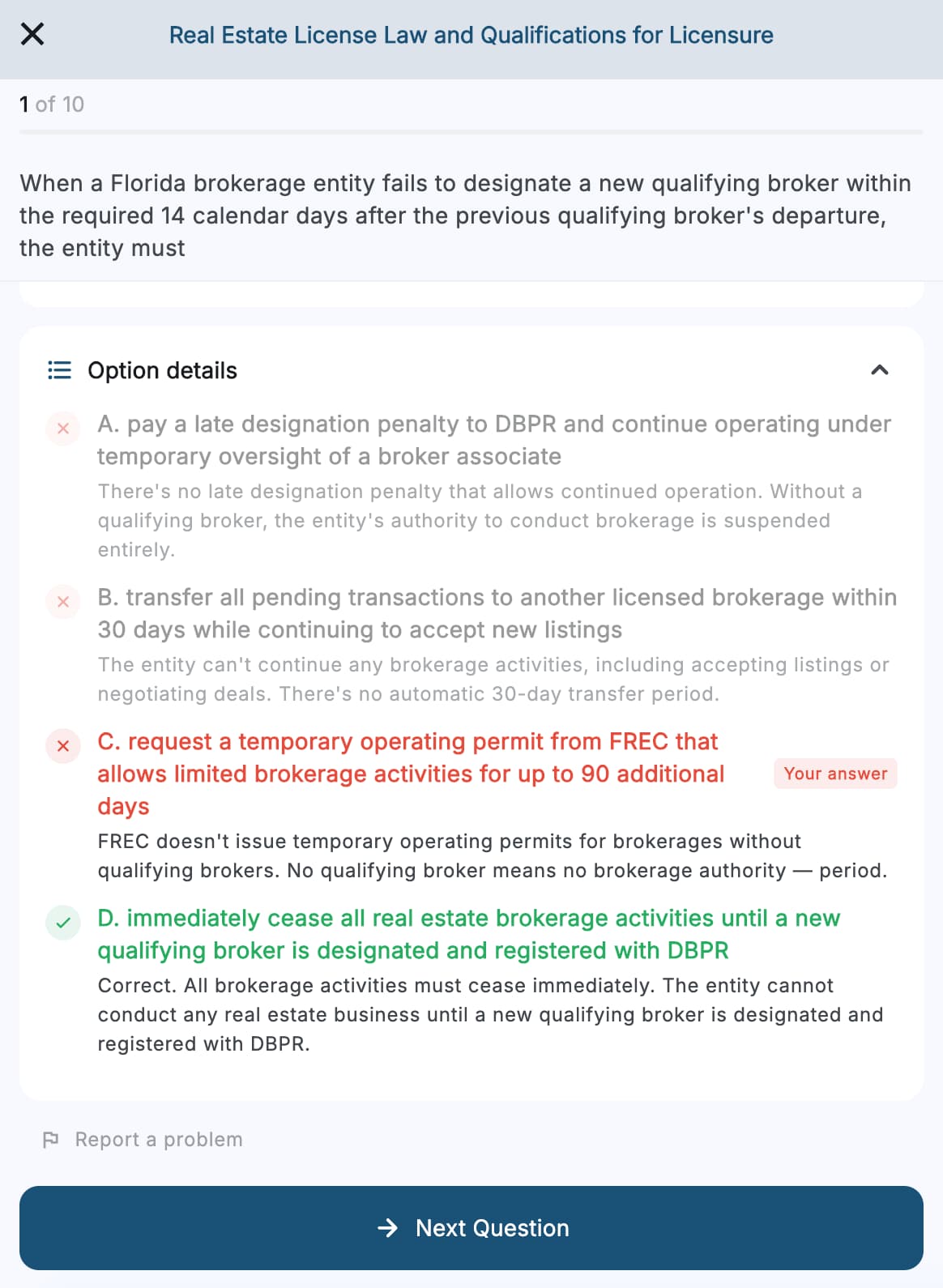
Below are eight original Florida-style questions, one from each of several high-weight areas, with answers and explanations. They are written to match exam patterns, not copied from any exam. Cover the answer, choose, then check.
1. Brokerage activities (12%)
A sales associate receives a $5,000 earnest money deposit on a Tuesday. By when must the broker deposit it into the brokerage escrow account?
- A. Immediately, the same day
- B. By the end of the next business day
- C. By the end of the third business day
- D. Within seven calendar days
Answer: C. Under FREC rules, a broker must deposit escrow funds no later than the end of the third business day after the associate receives them. The associate must deliver the funds to the broker by the end of the next business day, which is the trap behind option B.
Drill more in brokerage activities practice.
2. Real estate contracts (12%)
A 17-year-old signs a contract to buy a condominium. What is the status of the contract?
- A. Void
- B. Voidable by the minor
- C. Voidable by the seller
- D. Fully enforceable
Answer: B. A contract with a minor is voidable at the minor's option. The minor can enforce it or disaffirm it, but the adult party cannot escape on the basis of the minor's age. "Void" (option A) means no contract ever existed, which is not the case here.
Drill more in contracts practice.
3. Authorized relationships (7%)
Which duty does a single agent owe that a transaction broker does not?
- A. Dealing honestly and fairly
- B. Accounting for all funds
- C. Loyalty
- D. Using skill, care, and diligence
Answer: C. Loyalty is one of the nine single-agent duties and is not owed by a transaction broker. Dealing honestly and fairly, accounting for funds, and using skill, care, and diligence are owed under both relationships, which is what makes them the distractors.
Drill more in relationships practice.
4. Residential mortgages (9%)
A loan that is guaranteed by the federal government and available to eligible veterans is best described as a:
- A. FHA loan
- B. VA loan
- C. Conventional loan
- D. Conforming loan
Answer: B. A VA loan is guaranteed by the Department of Veterans Affairs for eligible veterans. The trap is option A: FHA loans are insured, not guaranteed, and are not limited to veterans. The words "guaranteed" and "veterans" point to VA.
Drill more in mortgages practice.
More sample questions with answers
These four cover property rights, appraisal, titles and deeds, and license law, again with the answer, a short explanation, and the area to drill next.
5. Property rights (8%)
Which form of ownership gives the most complete bundle of rights and lasts for an indefinite duration?
- A. Life estate
- B. Estate for years
- C. Fee simple absolute
- D. Leasehold estate
Answer: C. Fee simple absolute is the highest and most complete form of ownership. It is of indefinite duration and is inheritable. A life estate (option A) ends at someone's death, and an estate for years (option B) has a fixed end date.
Drill more in property rights practice.
6. Real estate appraisal (8%)
An appraiser is valuing a church, a special-purpose property with no comparable sales and no rental income. Which approach is most appropriate?
- A. Sales comparison approach
- B. Income approach
- C. Cost approach
- D. Gross rent multiplier
Answer: C. The cost approach is used for special-purpose properties like churches, schools, and libraries, where comparable sales and income data are scarce. It values the land plus the depreciated cost to rebuild the improvements.
Drill more in appraisal practice.
7. Titles and deeds (7%)
Which deed offers the grantee the greatest protection?
- A. Quitclaim deed
- B. Special warranty deed
- C. General warranty deed
- D. Bargain and sale deed
Answer: C. A general warranty deed provides the full set of covenants and warrants the title against all defects, including those that arose before the grantor owned the property. A quitclaim deed (option A) offers the least protection because it conveys only whatever interest the grantor may have, with no warranties.
Drill more in titles and deeds practice.
8. License law and FREC (6% and 2%)
How many members serve on the Florida Real Estate Commission (FREC)?
- A. Five
- B. Seven
- C. Nine
- D. Eleven
Answer: B. FREC has seven members appointed by the Governor and confirmed by the Senate: four licensed brokers, one broker or sales associate, and two consumer members who are not licensees. At least one member must be 60 or older.
Drill more in license law practice and FREC rules practice.
For Florida math questions with worked solutions, use the dedicated set of 21 math practice questions and answers.
How to practice a question bank by topic
Diagnose your weak areas first, drill those topics one at a time, then move to mixed and timed practice, rather than grinding the bank front to back.
A bank of 1,142 questions is not meant to be worked straight through once. The order matters more than the volume. Use it like this:
- Diagnose first. Take a short diagnostic or the free timed practice exam to see which of the 19 areas cost you the most points. Start the free diagnostic question if you want a single sample first.
- Drill weak areas one at a time. Use Topic Practice to work a single content area until the explanations stop surprising you. The practice-questions hub has a free set for every area.
- Mix it back together. Once individual areas feel solid, switch to Mixed Practice so you have to recognize the topic without a label, the way the real exam presents it.
- Finish under time. Use Exam Style mode to rehearse the 100-question, 3.5-hour format. Pacing is its own skill.
- Re-test the weak areas. Weak Area Blitz resurfaces your missed questions so you confirm the gaps are actually closed, not just reviewed once.
This loop, diagnose, drill, mix, time, and re-test, is why a topic-sorted bank beats a flat list. The structure does the triage for you. To turn the loop into a daily habit, including how many questions to do a day, see how to practice Florida exam questions daily.
How many questions do you actually need?
Most candidates need a few hundred well-explained, Florida-specific questions across all 19 areas, not the largest possible count.
There is no magic number. A candidate who works 400 explained, Florida-specific questions, understands every miss, and re-tests weak areas is better prepared than one who clicks through 1,200 generic questions once.
The reason the Pass Florida bank holds 1,142 is coverage and variety: enough questions in every one of the 19 areas to drill a weak topic repeatedly without seeing the same item over and over, and enough range to keep Mixed and Exam Style practice fresh. The count serves the structure. It is not the point by itself.
Aim to cover all 19 areas, weight your time toward the heavy ones, understand every explanation, and confirm your weak areas with a second pass. Do that, and the exact size of the bank stops mattering.
Ready to drill the full Florida question bank?
Start with a free question, take the free timed practice exam, then drill the full 1,142-question bank by topic in the app.
You now know how a question bank should be built and how to study one. The next step is reps, sorted by topic, with explanations on every miss.
THE FULL BANK
1,142 Florida questions, sorted by topic.
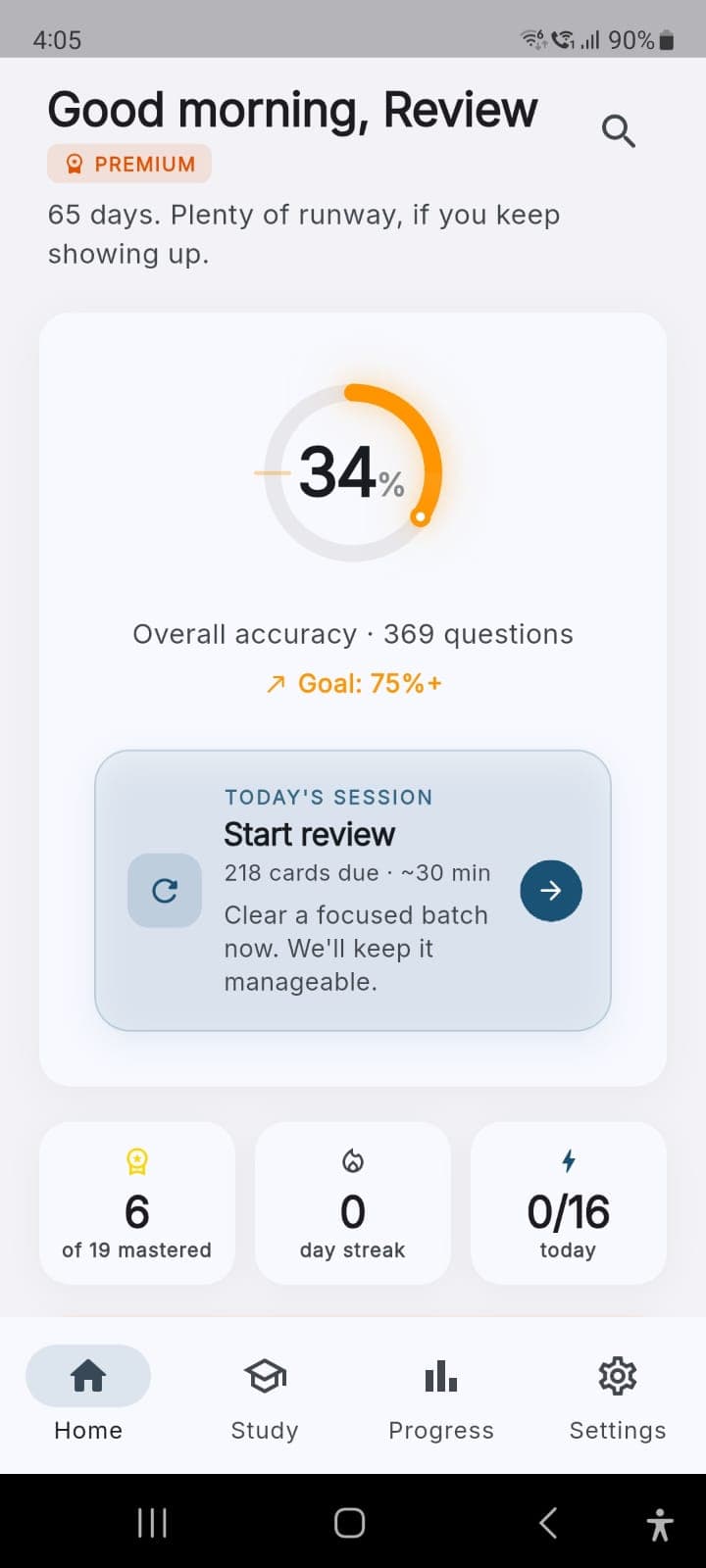
Try a free question, test yourself on the free timed practice exam, then download Pass Florida for the full 1,142-question bank, a 19-topic diagnostic, Topic Practice, Weak Area Blitz, Math Coach, and offline access for one $39.99 purchase.
Frequently Asked Questions
How many questions are in the Florida real estate exam question bank?
The Pass Florida bank holds 1,142 Florida-specific practice questions across all 19 DBPR content areas. The real sales associate exam itself is 100 questions, so the bank gives you roughly ten times the exam length to drill, weighted to the same blueprint.
Are these the actual Florida exam questions?
No. Reusing real Pearson VUE exam questions is prohibited, and no legitimate prep tool provides them. A good bank uses original questions written to match the exam's patterns, difficulty, and Florida-specific content, with explanations that teach the reasoning.
Is 1,000 questions enough, or do I need 1,200 or more?
Raw count is the wrong target. A few hundred Florida-specific, explained, topic-sorted questions that you actually understand beat a larger pile of generic, unexplained ones. Prioritize Florida specificity, explanations, and weak-area targeting over the headline number.
Can I practice the question bank by topic?
Yes. The bank is organized by the 19 DBPR content areas, so you can drill a single weak area at a time with Topic Practice. The free practice-questions hub has a set for every area, and the app holds the full bank.
Are the questions free?
You can practice a free set for every content area on the practice-questions hub and take a free 25-question timed practice exam. The full 1,142-question bank, diagnostic, and adaptive modes are in the Pass Florida app for one $39.99 purchase.
How should I split my study time across the 19 topics?
Weight your time to the blueprint. The top five areas (brokerage, contracts, mortgages, property rights, and appraisal) are 49% of the exam, so they deserve the most reps. Use a diagnostic to find your weak areas, then drill those first within the heavy topics.
Methodology
The DBPR-hosted Florida Real Estate Sales Associate Candidate Information Booklet provides the 19-area exam blueprint, the 100-question exam length, the 3.5-hour limit, and the 75-out-of-100 passing score. The exam weights are the official content-area percentages from that booklet and sum to 100%. The question count (1,142), topic count (19), study modes (6), and math calculation types (14) are counted from the Pass Florida app's bundled content. The eight sample questions are original constructions written to match Florida exam patterns and are not copied exam questions; their answers reflect current Florida law and standard exam conventions, including the FREC escrow deposit timeline, the nine single-agent duties, and the seven-member composition of the Florida Real Estate Commission. This is study guidance, not licensing advice.
Product note
Pass Florida publishes this guide and offers the exam-prep app linked on this page. Pass Florida is independent exam preparation, not a DBPR-approved 63-hour pre-license course, post-license course, continuing education course, or Pearson VUE scheduling service. It does not provide licensing credit and does not guarantee passage.
Sources
- DBPR Florida Real Estate Sales Associate Candidate Information Booklet
- Pearson VUE Florida Real Estate testing page
- Florida Statutes: Chapter 475, real estate brokers and sales associates
- Florida Statutes: F.S. 475.278, authorized brokerage relationships and duties
- Florida Statutes: F.S. 475.02, Florida Real Estate Commission membership
This post is exam preparation content for the Florida Real Estate Sales Associate exam. It is not legal, tax, financial, lending, appraisal, brokerage, insurance, title, closing, or professional advice. For real-world decisions, verify current requirements with the official source or consult a qualified licensed Florida professional.