Math PDF
Florida Real Estate Math Cheat Sheet
Stop guessing which formula fits. Review commission, proration, doc stamps, millage, LTV, PITI, GRM, IRV, acreage, and the traps that mix them together.
Drill mixed math with Math CoachStart with readiness, then drill the calculations Florida candidates actually miss: documentary stamps, prorations, millage, commission, LTV, mortgage ratios, seller net, cap rate, GRM, appraisal adjustments, and closing math.
Single-topic calculators are great for learning. The next step is mixed drill, because the real Florida exam will not tell you which formula it is testing.
Get the printable Florida exam math sheet plus a clean study order for the calculator library.
Start with the math cheat sheet, then use the wallchart, recall cards, and trap-word list when you need the full library.
Stop guessing which formula fits. Review commission, proration, doc stamps, millage, LTV, PITI, GRM, IRV, acreage, and the traps that mix them together.
Drill mixed math with Math CoachTurn fuzzy vocabulary into active recall. Each card gives you the clue, the answer check, and the trap that makes the term easy to confuse.
Test terms in Florida-specific questionsCatch the Florida-only details national prep can blur. Use this sheet before mixed practice so state-specific rules do not leak points.
Practice Florida-specific questionsPDFs plus practice
The study PDFs help you organize topic weights, formulas, and trap patterns. Pass Florida turns the same skills into Florida-specific reps with Math Coach, Trap Library, and Confidence Calibration.
Exam prep only. Not a substitute for the 63-hour course, DBPR steps, or Pearson VUE scheduling.
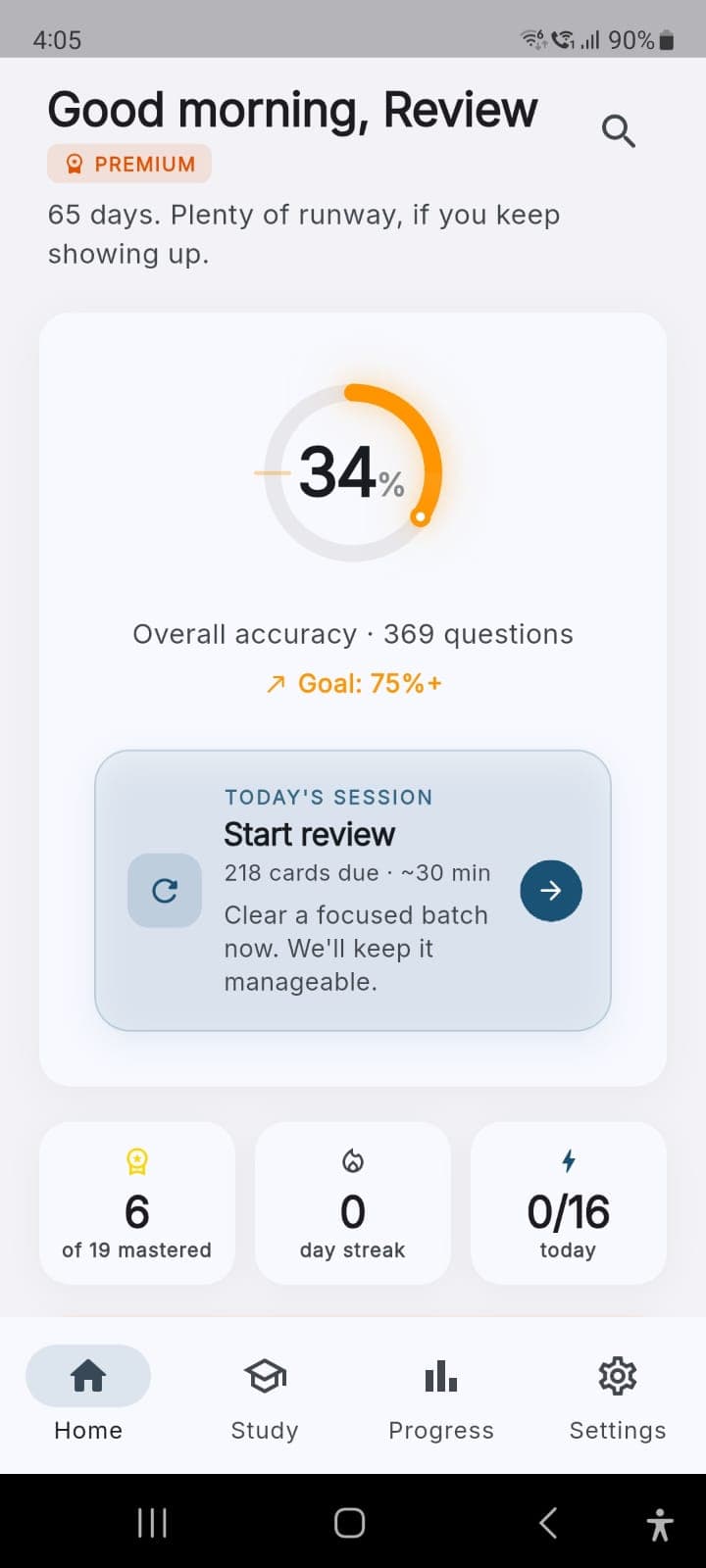
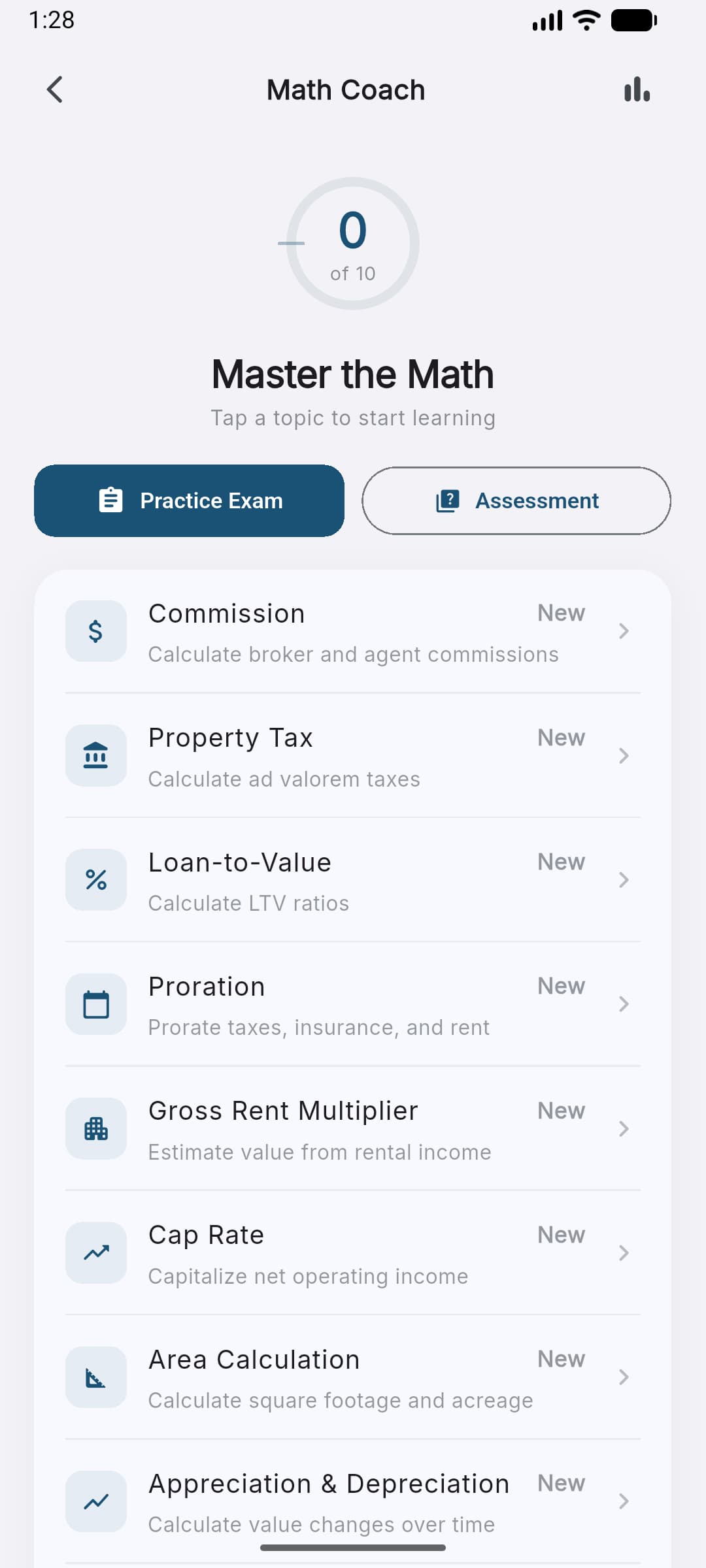
Pick the line that sounds most like your last practice miss. The goal is not to use every calculator today. It is to start with the one that fixes the next weak setup.
Start with documentary stamps, then proration, then mixed closing math.
Use LTV, mortgage ratios, seller net, and mixed closing math in that order.
Take the readiness calculator before choosing a math topic.
These are the current calculator entry points. The hub gives candidates an immediate action before they drill the individual exam-math topics below.
Five questions that estimate whether you are early, close, or ready to sit for the Florida sales associate exam.
Formula reference with worked examples, plus current calculator pages for the high-value math topics.
Ten mixed Florida math questions that force you to recognize the formula before solving.
Each calculator has its own focused page: tool first, formula second, Florida exam trap third, and app practice as the next step.
Question counts map to the current DBPR Candidate Information Booklet, effective January 2025. Difficulty is Pass Florida study guidance, not an official DBPR label.
Florida deed doc stamps (the state transfer tax), mortgage and note stamps, intangible tax, the Miami-Dade rate and surtax, and the round-up trap.
Open calculator →Taxes, rent, HOA dues, buyer credit, seller credit, 365-day method, and closing-day ownership.
Open calculator →A Florida homestead exemption calculator and property tax tool: assessed value, the $25,000 base and additional non-school exemptions, taxable value, millage, and school versus non-school tax.
Open calculator →Florida homestead savings for 2026: the $25,000 first exemption, the inflation-adjusted $26,411 additional exemption, the Save Our Homes cap, and school versus non-school.
Open calculator →Florida nonrecurring intangible tax: 2 mills (0.002) on the mortgage amount, not the sale price, with no rounding and the loan-versus-price trap.
Open calculator →Sale price, commission rate, cooperating broker split, agent split, fees, and realistic take-home.
Open calculator →Loan-to-value, loan amount, purchase price, down payment, and missing-variable practice.
Open calculator →Investment math for income properties, including solve-for-value and solve-for-income modes.
Open calculator →Square feet, acres, lots, legal description math, and irregular-shape breakdowns.
Open calculator →One exam-style worksheet that combines doc stamps, prorations, commission, tax, and loan math.
Open calculator →Seller proceeds, payoff, commission, deed stamps, fixed costs, percent costs, and reverse target-net problems.
Open calculator →Itemized Florida seller closing costs to net proceeds: commission, deed stamps, owner's title by county custom, and property tax proration.
Open calculator →Loan amount, PITI, front-end ratio, back-end ratio, monthly debt, and qualifying income.
Open calculator →Equity, cash after sale, appreciation percent, market depreciation, profit after costs, and annualized value change.
Open calculator →Sales comparison approach practice: adjust the comparable, add for inferior, subtract for superior, and reconcile value.
Open calculator →Start with documentary stamps, prorations, millage, and commission. These topics punish memorized formulas because Florida-specific setup details change the answer.
Move into LTV, qualifying ratios, cap rate, NOI, and GRM once the Florida closing math feels stable. These are quick wins when you can name the formula before using it.
Finish with mixed closing, seller net, appraisal adjustments, and profit/equity questions. The exam will not label the topic for you, so mixed practice builds the reflex.
The Florida sales associate exam tests commission and broker splits, documentary stamp tax on deeds and notes, intangible tax on mortgages, proration of taxes and rent, property tax and millage, homestead exemption, loan-to-value and qualifying ratios, seller net and required sale price, cap rate, net operating income, gross rent multiplier, area and acreage, and comparable sales adjustments. Every version of the exam includes math.
The Florida exam is built for basic arithmetic, and you bring your own calculator. Under the DBPR Candidate Information Booklet, calculators are only permitted at the test center and must be silent, handheld, battery-operated, nonprinting, and without an alphabetic keypad. Confirm the current testing-room rules before exam day, and practice with simple calculator-style arithmetic, not spreadsheet shortcuts, so your method matches the exam.
Deed documentary stamps are $0.70 per $100 of the sale price statewide, except Miami-Dade County, which charges $0.60 per $100, plus a $0.45 surtax per $100 on any transfer that is not a single-family residence. Note and mortgage stamps are $0.35 per $100 of the obligation. Always round the taxable amount up to the next $100 before applying the rate. The documentary stamp tax calculator handles each case.
Florida nonrecurring intangible tax is 2 mills, or 0.002, charged on the mortgage amount, not the sale price. There is no rounding. The most common exam trap is applying the rate to the purchase price instead of the loan. The intangible tax calculator isolates the loan amount so you practice the correct base.
Florida closings typically prorate using a 365-day year, with the seller responsible through the day before closing unless the contract states otherwise. Count the seller's days of ownership, multiply by the daily tax amount, and credit the buyer. The proration calculator covers taxes, rent, and HOA dues using the day-count method the exam expects.
Yes. All 15 calculators are free to use, with worked formulas, the Florida exam trap for each topic, and a printable formula sheet. The Pass Florida app extends the same math into 1,142 exam-style questions with explanations and repetition across the 19-topic outline.