Exam Data22 min read2026-03-22

    We Analyzed Every Question on the Florida Real Estate Exam. Here's What You Should Actually Study.

    The three-hour mistake

    The night before her Florida sales associate exam, a candidate opens a 500-page textbook and decides to review one chapter per hour. She works through The Real Estate Business. Then Real Estate Markets and Analysis. Then Planning and Zoning. She feels productive. By midnight she's tired and stops.

    What she doesn't know: she's just spent three hours on topics that account for exactly three questions on tomorrow's exam.

    This is the preventable mistake the Florida sales associate exam is designed to surface. Its 100 questions cover 19 content areas, weighted from 1% to 12% of the exam. The heaviest topic carries 12 times the weight of the lightest. Every hour you spend on a 1% topic is an hour you're not spending on a 12% topic. Do that math wrong across months of preparation, and you're the 48% who walks out of Pearson VUE without a license.

    We analyzed all 100 questions. The official content specifications published by the Florida Department of Business and Professional Regulation, cross-referenced with the 855-question Pass Florida question bank and its cognitive-level tagging. Here's what the numbers show you should actually study, and where most candidates are losing points they didn't have to.

    How we analyzed this. Topic weights throughout this piece come from the Florida DBPR's Candidate Information Booklet, Sales Associate Examination Specifications (effective January 2025). Question-format and cognitive-level analysis draws on the 855-question Pass Florida question bank, each tagged by content area per the DBPR's 19-topic specification and by Bloom's Taxonomy level (recall, application, analysis). Historical pass-rate behavior references the DBPR's quarterly Exam Performance Summary.


    What this guide covers


    Which topics are most tested on the Florida real estate exam?

    Two topics account for nearly a quarter of the exam: Real Estate Brokerage Activities & Procedures (12%) and Real Estate Contracts (12%). Combined, they generate 24 of the 100 questions. A candidate who walks into the testing center fluent in these two has already banked nearly a quarter of the exam before reading question 25.

    Here's the top tier:

    Rank Topic Weight Questions
    1 Brokerage Activities & Procedures 12% 12
    2 Real Estate Contracts 12% 12
    3 Residential Mortgages 9% 9
    4 Property Rights 8% 8
    5 Real Estate Appraisal 8% 8

    These five topics alone generate 49 questions, nearly half the exam. A candidate who masters these five walks in with 49 scored opportunities before ever reading about any of the other 14 content areas.

    Bar chart of the 19 Florida real estate sales associate exam content areas by weight, from 12% at the top (Brokerage Activities; Real Estate Contracts) down to 1% at the bottom (The Real Estate Business; Markets and Analysis; Planning and Zoning). The top 11 topics account for 84% of the exam.

    Source: Florida DBPR Candidate Information Booklet · Sales Associate Examination Specifications, effective January 2025. The chart above lives at a shareable URL: passfloridarealestate.com/charts/florida-exam-topic-weights.svg.

    Contrast the heavy tier with the bottom:

    Rank Topic Weight Questions
    17 The Real Estate Business 1% 1
    18 Real Estate Markets & Analysis 1% 1
    19 Planning & Zoning 1% 1

    Three topics, three questions total. Each one is a dense chapter in any pre-license textbook, roughly the same page count as Real Estate Contracts. But reading the 1% chapter earns you one-twelfth the exam cushion that reading the 12% chapter earns.

    The fuller topic-by-topic reference, including what each content area specifically tests, lives in our deep-dive on the 19 Florida real estate exam topics.


    What's the 84/16 rule?

    The single most useful heuristic to memorize about the Florida real estate exam is this: the top 11 topics account for 84% of the exam. The bottom 8 combined account for just 16%.

    The chart above marks the break visually. The dashed line between Mortgage Types & Sources (ranked 11th at 4%) and License Violations & Penalties (ranked 12th at 3%) is the cliff. Above it, every topic earns you at least four questions. Below it, no topic earns you more than three.

    The implication for study time is direct:

    • Top 11 topics: 80 to 85% of your study time. Not because they're more interesting or harder, but because they're weighted that way by the state.
    • Bottom 8 topics: 15 to 20% of your study time. Enough to be familiar. Not enough to be fluent. They're not where the exam is rewarding mastery.

    Most candidates end up closer to 1/19, about 5.3% of study time per topic, because that's the structure of the pre-license course they just finished. A 63-hour course with 19 content areas gives each area roughly 3.3 hours. Fair. Even. And completely mismatched to how the exam actually scores.

    A candidate who spends 3.3 hours on Planning & Zoning (1% of the exam, 1 question) and 3.3 hours on Real Estate Contracts (12% of the exam, 12 questions) has invested equal effort in 1 point of cushion versus 12 points. On a 100-question exam where the difference between pass and fail is a single question, that miscalibration is how a well-intentioned, hard-working candidate ends up at 72 instead of 78.


    How much math is on the Florida real estate exam?

    Roughly 10 of the 100 questions involve math. That's 10% of the exam, proportionally small. Math is also the single highest-leverage study investment a candidate can make.

    Here's why. The math types are predictable. Every single math question on a recent Florida exam falls into one of these ten archetypes:

    1. Proration. Property tax, rent, or interest, using the 360-day banker's year.
    2. Commission. Full, split percentages, 60/40 scenarios, commission-to-agent math.
    3. Capitalization rate. Investment valuation (NOI ÷ value).
    4. Loan-to-value ratio. Loan amount ÷ property value.
    5. Documentary stamps. $0.70 per $100 on deed; $0.35 per $100 on note.
    6. Intangible tax. $0.002 per $1 on new Florida mortgages.
    7. Area calculation. Square feet, acreage, government rectangular survey sections.
    8. Depreciation. Straight-line method for investment property.
    9. Closing cost / seller's net. Back-into-price problems.
    10. Mill rate. Annual property tax calculation.

    A candidate who drills these ten types for 15 to 20 total study hours across a prep cycle will answer 8 or 9 of the 10 math questions on exam day. A candidate who skipped the math chapter will answer 2 or 3.

    The difference: 5 to 6 points. On a 100-question exam with a 75% passing line, five avoidable points is the difference between a comfortable 80% pass and a 73% fail. Most failing candidates we've spoken to lost 4 to 7 points on math they could have earned with a weekend of dedicated practice.

    The math isn't hard in an algebraic sense. It's two-step multiplication, proportional reasoning, and careful unit tracking. What trips candidates up is setting up the correct equation under time pressure, especially when the question is wrapped in a scenario ("a home sells for $425,000 at 6% commission with a 60/40 split…"). That's a practice problem, not a math problem.

    We break down every formula with worked examples in Florida real estate exam math: the only 10 formulas you actually need.


    What's the difference between the state and national portions?

    The Florida exam has 45 Florida-specific questions and 55 national-principle questions. They're shuffled together. You won't see a label marking them. But the construction is deliberate, and understanding it changes how you should prioritize your final weeks of prep.

    The state portion covers content unique to Florida:

    • Florida Statute 475 (the real estate license law)
    • FREC's administrative rules (Florida Administrative Code 61J2)
    • Florida's three authorized brokerage relationships: transaction broker, single agent, no brokerage relationship
    • Florida-specific disclosures (lead paint, property condition, energy efficiency, coastal/flood zones)
    • Florida documentary stamps and intangible tax rates (uniquely set by F.S. 201)
    • Florida homestead constitutional protection
    • Tenancy by the entireties (a marital form of ownership most states don't recognize)

    The national portion covers general real estate and federal law:

    • General real estate principles (agency, contracts, property rights in theory)
    • Federal law (Fair Housing Act, ADA, RESPA, TRID, Sherman Act antitrust)
    • General finance (mortgage structure, underwriting, discount points)
    • Math, applied to both state and national problems
    • Appraisal and valuation (three approaches, USPAP principles)
    • Environmental law (CERCLA, federal flood insurance)

    Here's the critical insight most candidates miss: a candidate with perfect national preparation but weak Florida knowledge will still fail. The arithmetic is simple. 55 national questions at 100% correct equals 55 points. The 75% passing threshold requires 75 points. Even a flawless national portion leaves a candidate 20 points below passing.

    This is why most out-of-state study materials (national real estate textbooks, Kaplan's general prep courses, generic YouTube channels) are insufficient for the Florida exam on their own. They cover the 55 national questions well. They don't cover F.S. 475.25(1)(k) escrow timing, Florida-specific disclosure requirements, or the three Florida brokerage relationships at exam depth. Candidates who study only a general text meet the 45 Florida-specific questions on test day and freeze.

    Florida-specific depth is not optional. Plan for it explicitly.


    What makes a Florida real estate exam question "application-level"?

    Here's where our question-bank data gets interesting. The DBPR's Sales Associate Examination Specifications state that questions are written at application level and above, meaning they require you to apply Florida law to a scenario, not just recall the definition of a term.

    Compare two questions on the same content area:

    Recall-level (what most free materials test):

    What is a transaction broker?

    A. A broker representing only the seller B. A broker providing limited representation to either party C. A broker with no client relationship D. A broker who executes contracts

    Answer: B. This is a definition question. If you've read the chapter, you get it right.

    Application-level (what the DBPR actually tests):

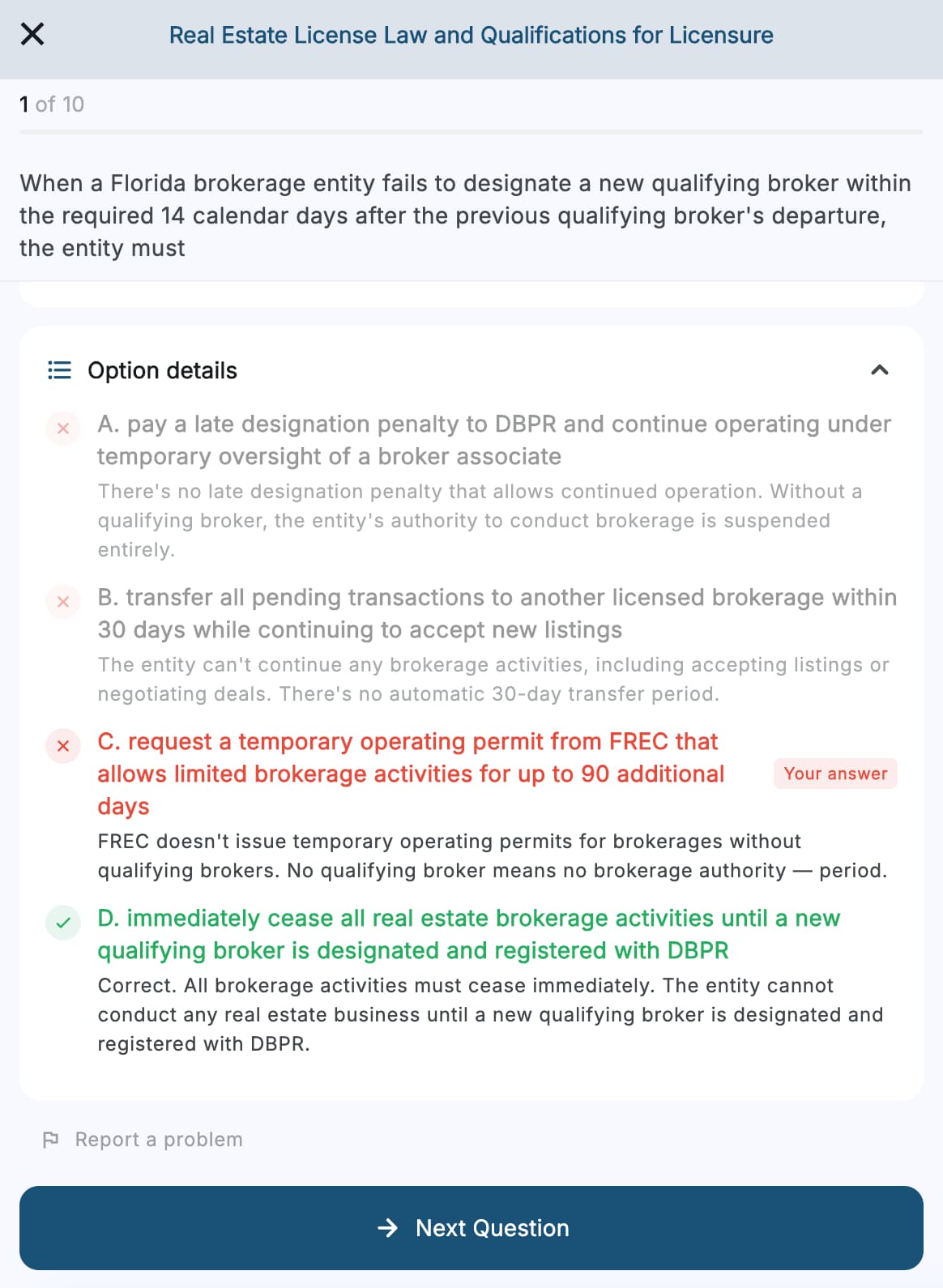
    A listing broker acting as a transaction broker receives a full-price offer on the seller's home. The seller, in the middle of a marital dispute, asks the broker not to show the offer to the husband, who is a joint owner on the deed. What must the broker do?

    A. Honor the seller's request; the broker's client is the seller who signed the listing B. Present the offer to both joint owners; the duty to present runs to all principals C. Withdraw from the transaction immediately D. Present only to the husband as the titleholder

    Answer: B. This is a scenario question. It tests whether you understand that the statutory duty to present offers runs to every principal, not only the one who signed the listing agreement. It requires application of F.S. 475.278(3)(a).

    Same topic. Wildly different cognitive demands. A candidate who studied by memorizing definitions gets the first question right. The same candidate fails the second, not because they don't know what a transaction broker is, but because they've never practiced applying the definition under pressure, with a plausible distractor (Option A) designed to trip up candidates who haven't thought carefully about who the statute's duty runs to.

    The Pass Florida question bank's 855 questions are tagged by cognitive level. Our distribution is weighted toward application and analysis to match the exam's cognitive demand. Candidates whose practice material is predominantly recall arrive at Pearson VUE with the wrong skill. Technically informed but operationally untrained. That gap is the single biggest preventable cause of Florida exam failure.

    The fastest way to find out whether your current practice material is calibrated: take the 5-question Florida real estate diagnostic. Five scenario-based questions, each with the Florida statute it tests. Ten minutes. If your answers come easily, your practice has been calibrated. If they're harder than what you've been training on, you have your answer.


    Why do most candidates fail despite long hours of study?

    Florida's first-time pass rate has held between 52% and 56% across recent DBPR reporting cycles. That stability isn't randomness. It's the commission doing its job as a competence filter. And looking at how the failing half typically prepared, the pattern resolves into four recurring mistakes.

    1. They study in chapter order, not in weight order. The pre-license course presents topics in the order the state booklet lists them (alphabetical in parts, chronological in others). Candidates open chapter one (The Real Estate Business, 1% of the exam) and build their study plan from there. By the time exam day arrives, they've invested disproportionate time in the first few topics and rushed through the last ten. The mid- and late-booklet topics (Residential Mortgages at 9%, License Violations at 3%) are where the cumulative weight lives. Running out of study time on page 300 means running out of study time on the test.

    2. They practice at recall level. We covered this above. The specific failure pattern: candidate scores 85% or higher on free practice quizzes, concludes they're ready, books the exam, walks in, scores 68%, walks out stunned. The free quizzes weren't wrong in their content. They were wrong in their cognitive level. Preparing on recall questions and meeting application questions is like training for a 5K by walking to the mailbox. Technically training, practically useless.

    3. They avoid math. Math-avoidant candidates don't fail at math. They fail because 10 points of avoidable cushion went uncollected. A candidate who answers 2 of 10 math questions correctly needs to score 73 of 90 on the remaining questions, about 81%, to reach a 75 total. That's an achievable but tight margin. A candidate who answers 9 of 10 math correctly needs only 66 of 90 on the rest, 73%. The second candidate has 15 points of margin the first candidate surrendered before walking in. More in our math formulas reference.

    4. They under-study Florida-specific law. The 45 Florida questions include ones that look similar to national principles questions but test Florida-specific rules. F.S. 475.25(1)(k) gives a cooperating broker three business days to deposit a binder, but a general textbook will tell you "next business day" is the standard. Transaction broker, single agent, and no brokerage relationship are Florida terms; other states have different nomenclature. A candidate studying a national textbook assumes the rules match. They don't. Fifteen to twenty Florida-specific questions get missed this way.

    Every one of these mistakes is preventable. They share a common root: a study plan that wasn't built from the exam specifications. The DBPR has told candidates, publicly and for decades, exactly what the test looks like. Most candidates never read it. We explore the full failure profile in why 50% of Florida candidates fail and why did I fail the Florida real estate exam.


    How should I allocate my study time?

    Based on the 19-topic weight distribution and the pattern of passers versus failers, here's the study-hour allocation we'd recommend. Assume a 60-hour total study budget spread across 6 to 8 weeks after the pre-license course:

    Tier Topics (by rank) Share of exam Study hours Share of time
    Heavy #1 to 5 (12%, 12%, 9%, 8%, 8%) 49% 25 to 28 hrs ~45%
    Medium #6 to 11 (7%, 7%, 6%, 6%, 5%, 4%) 35% 22 to 26 hrs ~40%
    Light #12 to 19 (3%, 3%, 3%, 2%, 2%, 1%, 1%, 1%) 16% 6 to 10 hrs ~15%

    Plus 10 to 15 dedicated math hours layered across the six to eight weeks, because math is integrated with several topics but benefits from its own block of concentrated drill.

    Compare that to the default "I'll study each chapter equally" approach:

    • 19 topics times ~3 hours each equals 57 hours
    • Every topic gets the same time whether it's worth 1 question or 12

    The default approach gives The Real Estate Business the same study time as Real Estate Contracts. You end up over-prepared for a topic generating one question and under-prepared for a topic generating twelve. The exam rewards the opposite calibration.

    If you already have a study plan in place, the single most valuable thing you can do this week is rebuild it by weight. For every remaining hour, ask: is this the best use of time, or is there a higher-weight topic I haven't mastered yet? If you're a month out, 75% of your remaining hours should be on the top 11 topics. If you're a week out, 90%. The only time to drill a 1% topic is when the top 11 are locked in cold.

    Ready-made schedules are available at the 30-day study plan and the full Florida real estate exam pillar guide.


    Your next 30 minutes

    Reading data isn't studying. If you close this tab and go back to what you were doing yesterday, nothing changes. Here's what to do in the next thirty minutes to turn this analysis into a calibrated study plan.

    Minutes 1 to 10. Take the 5-question Florida real estate diagnostic. Five scenario-based questions drawn from the heaviest-weight exam topics, each with the Florida statute it tests. Ten minutes will tell you whether your practice material has been calibrated at application level or whether you've been building confidence on recall-level material that doesn't match test day.

    Minutes 11 to 20. Open the DBPR Candidate Information Booklet. Compare your current study time allocation to the topic weights in the chart above. If you've been going chapter by chapter, you're almost certainly over-studying the bottom eight topics by 50 to 100% and under-studying the top three.

    Minutes 21 to 30. Rebuild your remaining study time by weight. Use the table in the section above. For every study hour left on your calendar, allocate it to a topic proportional to its exam weight, unless you're already fluent there, in which case move to the next one.

    When you sit down at Pearson VUE and question one loads, you won't remember whether you understood Planning & Zoning at 95% or 85%. You'll remember whether you knew the escrow timing rule, the three brokerage relationships, the doc stamp rate, and the proration formula. Study in proportion to what the exam tests.


    Frequently Asked Questions

    Which topic is most tested on the Florida real estate exam?

    Real Estate Brokerage Activities & Procedures and Real Estate Contracts are tied at 12% each, the heaviest-weight topics on the Florida sales associate exam. Together they generate 24 of the 100 questions.

    What percentage of the Florida real estate exam is math?

    About 10% of the 100 questions involve math, spread across proration, commission splits, documentary stamps, capitalization rate, loan-to-value, area calculation, and a handful of other predictable types. Math is integrated with other topics, not a separate section.

    How many questions on the Florida real estate exam are Florida-specific?

    45 of the 100 questions cover Florida-specific law: F.S. 475, FREC administrative rules, Florida brokerage relationships, Florida tax rates, and Florida-specific disclosures. The remaining 55 cover national real estate principles, federal law, and general finance.

    What happens if I'm strong on real estate principles but weak on Florida law?

    You fail. A perfect score on the 55 national questions plus zero on Florida-specific questions equals 55% total, 20 points below the 75% passing score. The state portion cannot be made up by excellence on the national portion.

    Should I study every chapter of my pre-license course equally?

    No. Topics are weighted from 1% to 12%, a 12x difference. Allocating equal time to a 1% topic and a 12% topic is the most common study-plan mistake. The correct allocation is proportional to the DBPR's published weights, with roughly 45% of study time on the top five topics, 40% on topics 6 to 11, and 15% on the bottom eight.

    What does "application-level" mean for Florida real estate exam questions?

    Application-level, per Bloom's Taxonomy, means the question requires you to apply a concept to a scenario rather than simply recall its definition. The Florida DBPR specifies that sales associate exam questions are predominantly application-level and analysis-level. Practice material written at recall level ("what does FREC stand for?") does not prepare candidates for the real exam's cognitive demand.

    Are Pass Florida's questions at the same difficulty as the real exam?

    Pass Florida's 855 questions are tagged by cognitive level (recall, application, analysis) according to Bloom's Taxonomy. The bank is weighted toward application-level questions to match the DBPR's specification. Every question cites the Florida statute or FREC rule it tests.

    How long does it take to master the top 11 topics?

    Candidates we've observed typically reach consistent 80%+ accuracy on the top 11 topics after about 40 to 50 hours of focused, application-level practice, roughly four to six weeks at 8 to 10 hours per week. Candidates using recall-level practice material generally take significantly longer, because the practice doesn't build the right skill.


    Sources & Methodology

    Primary sources. Florida Department of Business and Professional Regulation, Division of Real Estate: Candidate Information Booklet, Sales Associate Examination Specifications (effective January 2025), topic weight percentages and cognitive-level specifications. Florida Statute 475 (full chapter). Florida Administrative Code Chapter 61J2 (FREC administrative rules). DBPR Exam Performance Summary data for first-time and retake pass-rate references.

    Pass Florida data. Topic assignment and cognitive-level tagging across the 855-question Pass Florida bank. Questions are classified by content area per the DBPR's 19-topic specification and by Bloom's Taxonomy level (recall, application, analysis) following the Anderson and Krathwohl 2001 revision.

    Note on recency. Topic weights in this analysis have been stable through the 2023 to 2025 reporting cycles. The DBPR periodically revises exam specifications. If you are reading this article more than 12 months after publication, verify current weights against the live DBPR booklet before finalizing a study plan. All statute and administrative code references are as of publication.

    $39.99 · one-time · lifetime updates

    Ready to pass the Florida real estate exam?

    Download Pass Florida and start studying with questions that actually match the exam.