QUICK ANSWER
The Florida sales associate exam has 100 multiple-choice questions across 19 DBPR content areas. The top 7 topics make up 63% of the official blueprint, the next 4 make up 21%, and the bottom 8 make up 16%. Brokerage Activities and Contracts are the two heaviest topics at 12% each. Use those percentages as study weights, not a promise that every form contains an identical item count.
The Florida sales associate exam is not a 19-way tie. The official outline weights some topics at 12% and others at 1%. That matters because a candidate with limited study time can lose points by treating every chapter as equally urgent.
The better move is to use the outline as a score map. Start with the high-weight topics, convert the middle topics into cushion, then review the low-weight topics without letting them steal your best study hours.
WHERE THIS PAGE FITS
Use this page as the official 19-area reference and route into every topic practice page. Use the topics breakdown for study-time strategy and the Practice Questions hub to drill all 19 areas. Return to the Florida real estate exam Study Guide for the complete learn, review, practice, and test sequence.
Start with the right 19-topic practice route
Start with a broad practice exam to find your weak topics, then drill the top-weighted practice areas before spending time on 1% topics.
| If you need this | Practice next | Why it helps |
|---|---|---|
| A broad diagnostic across the exam | Take the free practice exam | Shows whether your weak area is a top-weight topic or a low-weight detail |
| The two heaviest DBPR topics | Practice brokerage activities and practice contracts | These two areas are 24% of the official outline |
| Math setup, formulas, and closing calculations | Start Math Drill | Math appears in computations, appraisal, taxes, legal descriptions, and investments |
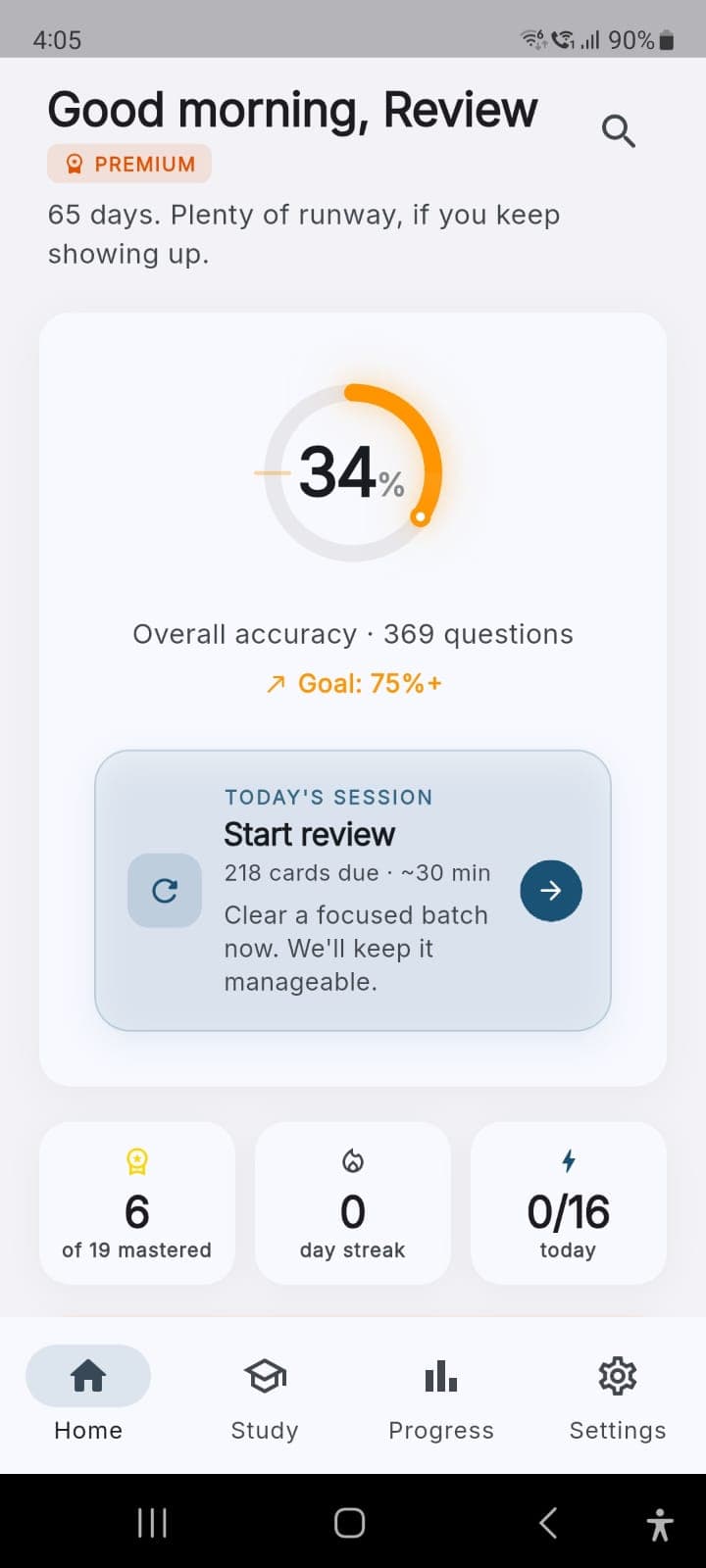
| Full app repetition after the free routes | Download Pass Florida | Use the full 19-topic diagnostic and Florida-specific question bank when you need more reps |
19-TOPIC DIAGNOSTIC
Find the weak area before you reread everything.
Use the official DBPR weights as the map: diagnose broadly, drill the heaviest misses first, then clean up low-weight topics near the end.
The 63/21/16 Study Map
The 63/21/16 Study Map means the top 7 topics are 63%, the next 4 are 21%, and the bottom 8 are 16%.
The 63/21/16 Study Map is the simplest way to turn the official outline into a study decision:
- Top 7 topics: 63% of the exam
- Next 4 topics: 21% of the exam
- Bottom 8 topics: 16% of the exam
That does not mean you ignore the bottom eight. It means you stop giving a 1% topic the same study energy as a 12% topic.
| Study band | Official weight | How to use it |
|---|---|---|
| Build first | 63% | Top 7 topics, deepest practice reps |
| Convert next | 21% | Next 4 topics, cushion points |
| Review last | 16% | Bottom 8 topics, short final review |
If you have a full month, this map tells you where to spend the most reps. If you have one week, it tells you where not to waste the week.
Official Florida real estate exam topics and weights
The official Florida sales associate exam outline has 19 content areas. Because the exam has 100 questions, each percentage point is a useful one-question planning equivalent, but the published percentages should not be read as a guarantee for every exam form.
DBPR's Candidate Information Booklet, effective January 2025 and checked again on August 31, 2026, lists nineteen content areas. The table below preserves DBPR's official names and weights but sorts them by study priority, not booklet order.
| Rank | Official content area | Weight | Approx. equivalent | Best study move |
|---|---|---|---|---|
| 1 | Real Estate Brokerage Activities and Procedures | 12% | About 12 of 100 | Build early |
| 2 | Real Estate Contracts | 12% | About 12 of 100 | Build early |
| 3 | Residential Mortgages | 9% | About 9 of 100 | Drill scenarios |
| 4 | Property Rights: Estates, Tenancies; Condominiums, Homeowner Associations, and Time-Sharing | 8% | About 8 of 100 | Sort ownership facts |
| 5 | Real Estate Appraisal | 8% | About 8 of 100 | Tie approach to facts |
| 6 | Authorized Relationships, Duties and Disclosures | 7% | About 7 of 100 | Memorize duties by role |
| 7 | Titles, Deeds, and Ownership Restrictions | 7% | About 7 of 100 | Compare deed and title facts |
| 8 | License Law and Qualifications for Licensure | 6% | About 6 of 100 | Know eligibility and status rules |
| 9 | Real Estate Related Computations and Closing of Transactions | 6% | About 6 of 100 | Drill math families |
| 10 | Legal Descriptions | 5% | About 5 of 100 | Practice section and description labels |
| 11 | Types of Mortgages and Sources of Financing | 4% | About 4 of 100 | Separate loan types and markets |
| 12 | Violations of License Law, Penalties and Procedures | 3% | About 3 of 100 | Learn the discipline sequence |
| 13 | Federal and State Laws Pertaining to Real Estate | 3% | About 3 of 100 | Focus on fair housing and lending laws |
| 14 | Taxes Affecting Real Estate | 3% | About 3 of 100 | Drill homestead, millage, and doc stamps |
| 15 | Real Estate License Law and Commission Rules | 2% | About 2 of 100 | Know FREC and DBPR roles |
| 16 | Real Estate Investments and Business Opportunity Brokerage | 2% | About 2 of 100 | Separate cap rate, GRM, and business opportunity |
| 17 | The Real Estate Business | 1% | About 1 of 100 | Review definitions |
| 18 | Real Estate Markets and Analysis | 1% | About 1 of 100 | Review supply, demand, and CMA basics |
| 19 | Planning and Zoning | 1% | About 1 of 100 | Review police power and zoning terms |
The percentages are study weights, not a guarantee that every form will feel identical. Still, they are the best official guide you have. A 12% topic deserves a different plan from a 1% topic.
Appraisal is one of the two 8% content areas. Use the Florida real estate exam appraisal guide to review approach selection, comparable adjustments, NOI, depreciation, CMA, BPO, and USPAP before practicing Topic 5.
Build First: The Top Seven Topics
Build first around the top seven topics because they make up 63% of the official blueprint.
The top seven topics are 63% of the exam. These are not optional. They are where most candidates either build a passing score or spend the retake wondering why their low-weight memorization did not save them.
| Topic | What the exam tends to test | Common miss | Drill it with |
|---|---|---|---|
| Brokerage activities | Escrow, advertising, offices, broker supervision, business entities | Mixing sales associate duties with broker duties | Escrow and trust account rules |
| Contracts | Validity, counteroffers, Statute of Frauds, contingencies, remedies | Treating a counteroffer as an acceptance | Contracts guide |
| Residential mortgages | Note vs mortgage, clauses, PITI, LTV, qualifying | Confusing acceleration with alienation | Mortgages and lending guide |
| Property rights | Estates, tenancies, condos, co-ops, HOAs, CDDs, time-sharing | Mixing joint tenancy with tenancy by the entireties | Property rights and ownership |
| Appraisal | Sales comparison, cost, income, depreciation, value principles | Choosing income approach for ordinary owner-occupied residential property | GRM vs cap rate |
| Brokerage relationships | Single agent, transaction broker, no brokerage relationship, disclosures | Calling a transaction broker a fiduciary | Brokerage relationships |
| Titles and deeds | Deed types, title, notice, liens, easements, restrictions | Thinking a quitclaim deed guarantees title | Deeds exam guide |
Your job here is not to read once and hope. Your job is to answer scenario questions until the stem facts trigger the right rule before the answer choices distract you.
Convert Next: The 21% Middle Band
The next four topics add 21%, so mastering them after the top seven gives you coverage of 84% of the official outline.
The next four topics add another 21%. When you combine them with the top seven, you have covered 84% of the official outline.
License law and qualifications is mostly rule recognition: who qualifies, what education is required, when post-license education matters, and what different license statuses mean. Do not turn this into moral-character prediction. For exam purposes, focus on what the rule says and what DBPR or FREC decides.
Computations and closing is the math center. It includes commission, proration, seller net, buyer funds, doc stamps, and closing-statement logic. The Florida real estate exam math formulas post is the better drill hub if this is your weak band.
Legal descriptions reward repetition. You need to know metes and bounds, lot and block, and government survey math. If the words "section," "township," or "range" make you slow down, use the legal descriptions guide before you take another full practice exam.
Types of mortgages and sources of financing is a label-sorting topic. Separate FHA, VA, conventional, primary market, secondary market, Fannie Mae, Freddie Mac, and Ginnie Mae. The primary and secondary mortgage market guide is built for that distinction.
Review Last: The Bottom Eight Topics
The bottom eight topics total 16%, so review them last, but do not ignore them.
The bottom eight topics are 16% together, roughly 16 questions by weight on a 100-question form. That is still real score value, but it should not eat the time you need for contracts, brokerage, mortgages, property rights, appraisal, relationships, and deeds.
Use a fast review pattern:
- Read the topic summary once.
- Make a short list of exact terms, numbers, or sequences.
- Answer enough practice questions to expose the trap.
- Move on before you start polishing a 1% topic.
The biggest mistake is not "I ignored planning and zoning." The bigger mistake is "I spent three nights on planning and zoning while contracts stayed at 58%."
To practice in these proportions, see how the Florida exam question bank maps 1,142 questions across all 19 areas by exam weight.
Read the weight traps
The biggest weight trap is studying every topic equally even though DBPR assigns 12% to some topics and 1% to others.
The official outline helps only if you use it correctly. These are the traps that make candidates study hard and still feel surprised on exam day.
| Trap | What it sounds like | Why it costs points | Better move |
|---|---|---|---|
| Equal-time studying | "I will give every topic one evening." | A 1% topic gets the same attention as a 12% topic. | Spend the most reps on the 63% band. |
| Bottom-topic avoidance | "Planning and zoning is only one question, so skip it." | The bottom eight still add up to 16% of the blueprint. | Review them last, not never. |
| Math isolation | "Math is only Topic 9." | Math also appears in appraisal, taxes, legal descriptions, and investments. | Drill math families across topics. |
| Textbook-order studying | "My course chapter order must be the exam order." | Course order may not match DBPR weights. | Use the official outline as the map. |
| Memorizing without scenarios | "I know the definition." | Many questions test application, not vocabulary alone. | Practice stems that force a decision. |
When you get a practice question wrong, do not only mark the topic. Mark the type of miss: rule gap, trap word, math setup, or pacing. That tells you whether to reread, drill, slow down, or move on.
TOPIC WEIGHTS INTO PRACTICE
Practice in the proportions Florida actually tests.
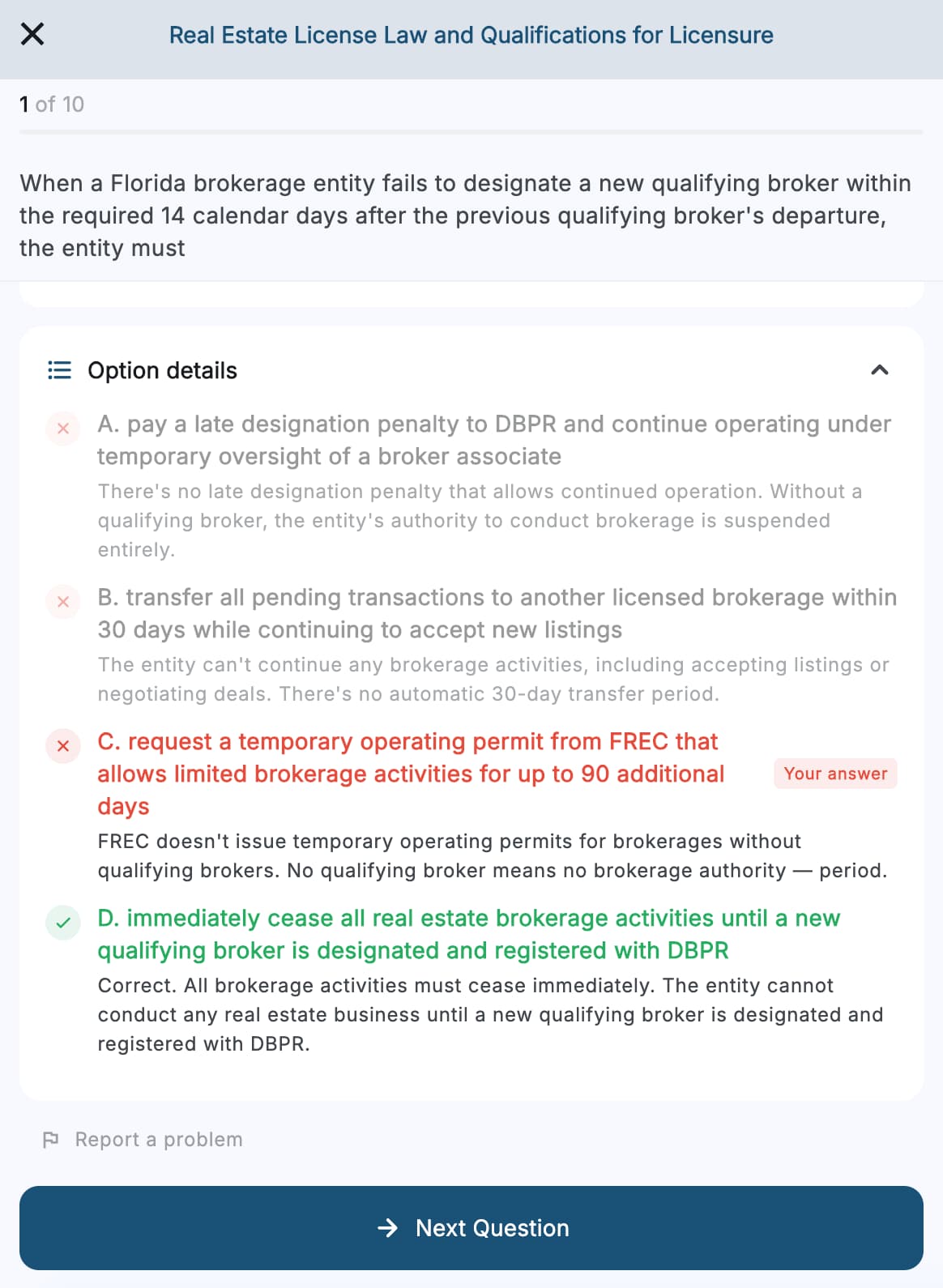
The free practice exam shows where you stand; the app keeps you drilling in the right proportions. Turn the rule in this guide into Florida-specific scenario practice, then explain why each plausible distractor is wrong.
Exam-Style Study Decision
When time is short, the best study decision is the one that gives more time to the higher-weight weak topic.
A candidate has six hours left before a retake. Their weakest areas are Contracts, Planning and Zoning, Real Estate Markets and Analysis, and The Real Estate Business. Which study choice best follows the official topic weights?
A. Spend most of the time on Planning and Zoning because zoning terms are easy to memorize B. Spend most of the time on Contracts, then do a short review of the 1% topics C. Split the six hours evenly across all four weak areas D. Skip Contracts because the candidate already took the pre-license course
Show answer
Correct answer: B. Contracts is a 12% content area, while Planning and Zoning, Real Estate Markets and Analysis, and The Real Estate Business are 1% each. The 1% topics still deserve review, but equal time would overinvest in low-weight areas and underinvest in a high-weight area.
A is tempting because zoning vocabulary feels manageable, but it carries only 1% of the official blueprint. C sounds fair, but the official weights are not equal across those topics. D is the classic retake mistake: having seen a topic before is not the same as being ready for a scenario question.
Frequently Asked Questions
What are the 19 topics on the Florida real estate exam?
The official 19 topics are listed in DBPR's Candidate Information Booklet. They include brokerage activities, contracts, residential mortgages, property rights, appraisal, brokerage relationships, titles and deeds, licensing, computations, legal descriptions, financing sources, violations, federal and state laws, taxes, FREC rules, investments, the real estate business, markets, and planning and zoning.
Which Florida real estate exam topics are most important?
The highest-weight topics are Real Estate Brokerage Activities and Procedures at 12%, Real Estate Contracts at 12%, Residential Mortgages at 9%, Property Rights at 8%, Real Estate Appraisal at 8%, Authorized Relationships at 7%, and Titles and Deeds at 7%. Together, those seven topics make up 63% of the official outline.
How many questions are on the Florida real estate sales associate exam?
The DBPR Candidate Information Booklet states that the Florida sales associate exam has 100 multiple-choice questions and a three-and-a-half-hour time limit. The passing score is 75 points.
Should I study all 19 topics equally?
No. Study all 19 topics, but do not study them equally. A 12% topic deserves deeper practice than a 1% topic because it carries much more score weight on the exam.
Which Florida real estate exam topics include math?
The main math topic is Real Estate Related Computations and Closing of Transactions, but math also appears in appraisal, legal descriptions, taxes, and investments. That is why a candidate should drill math families, not only one outline topic.
Are DBPR topic percentages exact question counts?
Treat them as official study weights. A 12% topic generally means about 12 questions on a 100-question exam, but individual forms can vary. The point is not to predict every item; it is to keep your study time aligned with the official map.
Did the Florida real estate exam topics change in 2026?
As of August 31, 2026, DBPR's live Candidate Information Booklet for the sales associate examination remains the edition effective January 2025 and lists the same 19 content areas and weights shown here. Always verify the live booklet at myfloridalicense.com before testing day because DBPR can replace the specifications.
Does Pass Florida replace the 63-hour course or DBPR process?
No. Pass Florida is exam preparation content, not the required FREC-approved 63-hour pre-license course, not DBPR application processing, and not Pearson VUE scheduling. It is a Florida-specific practice app with 1,142 original exam-prep questions.
Ready to practice in the proportions Florida actually tests?
The 19-topic outline is a study map. The candidates who consistently pass use it as one. They spend the most reps on the 63% band, convert the 21% middle band into cushion, and review the 16% bottom band without letting it steal the time the high-weight topics deserve.
Before you leave, test the rule in a fresh Florida scenario and explain why the distractors fail.
Take the free practice exam | Start Math Drill | Download Pass Florida
Methodology
This guide focuses on how the official 19-topic outline affects study decisions, practice priorities, and common exam-prep traps. Its factual anchors come from the live DBPR Real Estate Sales Associate Candidate Information Booklet, effective January 2025 and rechecked August 31, 2026: 100 multiple-choice questions, 75 points to pass, 3.5 hours, and 19 content areas with published weights. Those weights are Real Estate Brokerage Activities and Procedures 12%, Real Estate Contracts 12%, Residential Mortgages 9%, Property Rights 8%, Real Estate Appraisal 8%, Authorized Relationships 7%, Titles and Deeds 7%, License Law 6%, Real Estate Related Computations and Closing 6%, Legal Descriptions 5%, Types of Mortgages 4%, Violations 3%, Federal and State Laws 3%, Taxes 3%, FREC Rules 2%, Investments and Business Opportunity 2%, The Real Estate Business 1%, Real Estate Markets and Analysis 1%, and Planning and Zoning 1%.
The 63/21/16 Study Map, the Build First / Convert Next / Review Last priority framework, the top-seven deep-dive table, the weight-traps anti-pattern table, and the exam-style study decision question are practical study patterns derived from common candidate mistakes, not DBPR, FREC, or Pearson VUE rules.
This article does not promise a passing result on the Florida sales associate examination, does not promise admission at Pearson VUE, and does not replace DBPR, FREC, Pearson VUE, your course provider, a tutor, or qualified licensed Florida professional guidance. Outcomes depend on candidate preparation, current statutory and rule updates, and test-day execution. Topic weights and percentages reflect the DBPR Candidate Information Booklet effective January 2025 and used for current 2026 prep; verify against the current booklet before relying on any specific number.
Product note. Pass Florida publishes this guide and offers the exam-prep app linked on this page. We do not claim to use copied exam questions, promise passage, replace the 63-hour FREC-approved pre-license course, or replace DBPR processes, FREC rule interpretation, Pearson VUE scheduling, course-provider records, a tutor, or qualified licensed Florida professional guidance.
Sources
- DBPR Real Estate Sales Associate Candidate Information Booklet
- DBPR Candidate Information Booklets index
- Pearson VUE Florida Real Estate and Appraisers Licensing Exams
- Florida Statutes Chapter 475
- F.A.C. 61J2-2.029, Examination Areas of Competency
This post is exam-prep planning content for Florida real estate sales associate candidates. It summarizes the DBPR Candidate Information Booklet 19-topic outline with published topic weights, the 63/21/16 Study Map (top 7 = 63%, next 4 = 21%, bottom 8 = 16%), the Build First / Convert Next / Review Last priority framework, the top-seven deep-dive cross-link table, and the weight-traps anti-pattern framing. It is not a guarantee of passing the exam, not legal advice, not licensing advice, and not a substitute for DBPR, FREC, Pearson VUE, the course provider, a tutor, or a qualified licensed Florida professional. Verify any topic weight, question count, or content area against the current DBPR Candidate Information Booklet before relying on this article for a real licensing decision. Pass Florida is an educational study tool sold for one $39.99 purchase with no subscription.