Exam Prep & Strategy15 min read2026-04-23

    The 20 Florida Real Estate Terms Every Test-Taker Gets Wrong

    The Florida exam is a vocabulary test disguised as a law test.

    If you look at the Florida sales associate exam line by line, something becomes obvious: the test isn't really asking you to recite statute. It's asking you to distinguish between two terms that sound similar. Easement versus encumbrance. Lien versus encroachment. Deed versus title. Single agent versus transaction broker. Commingling versus conversion. The question stem sets up a scenario, and four answer choices quietly turn into a vocabulary trap. Pick the right one only if you know not just what the word means, but how it differs from the word next to it.

    This is why candidates who "studied the definitions" still fail. Memorizing a list of definitions builds recognition, not discrimination. The exam tests discrimination. The skill the Pearson VUE form actually rewards is pair-thinking: knowing which term fits the specific fact pattern and why the neighbor term doesn't.

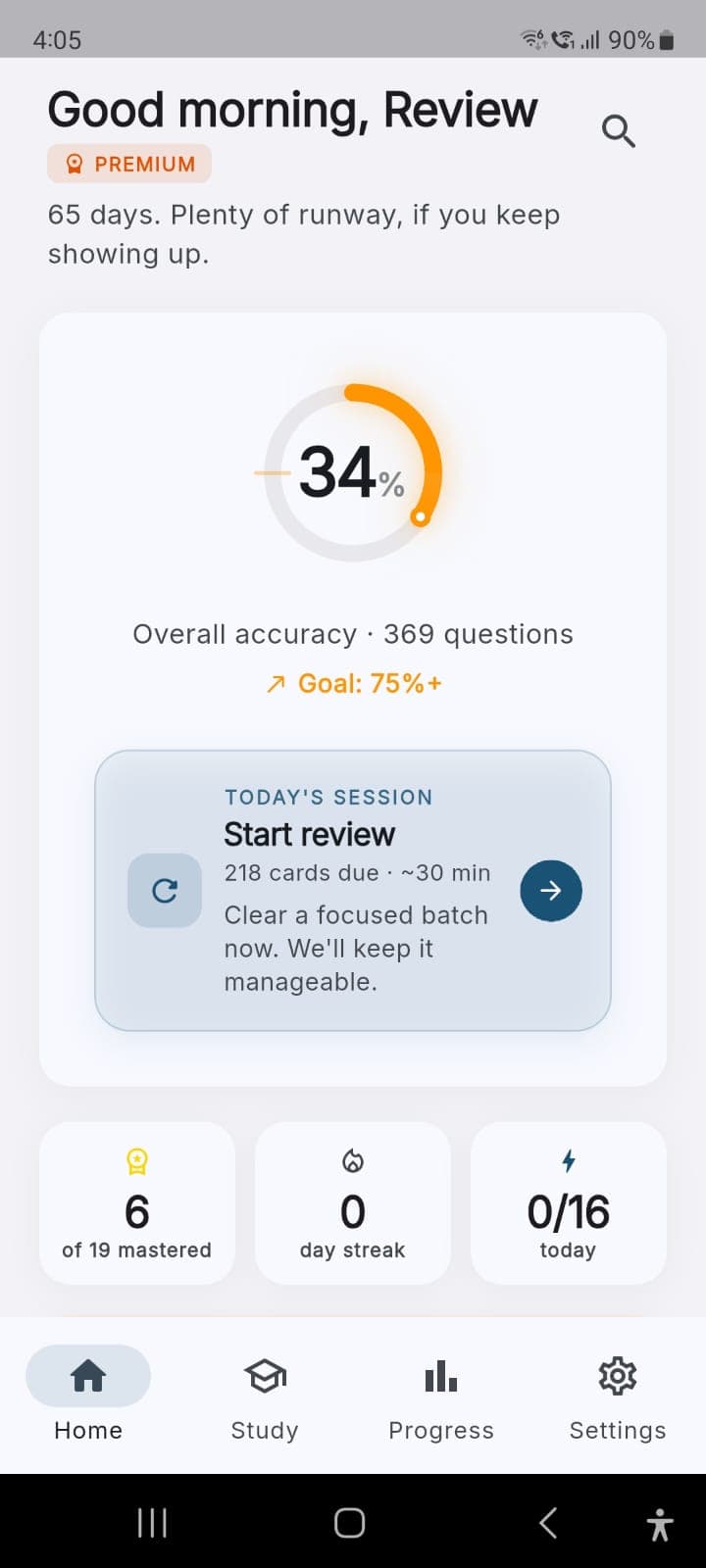
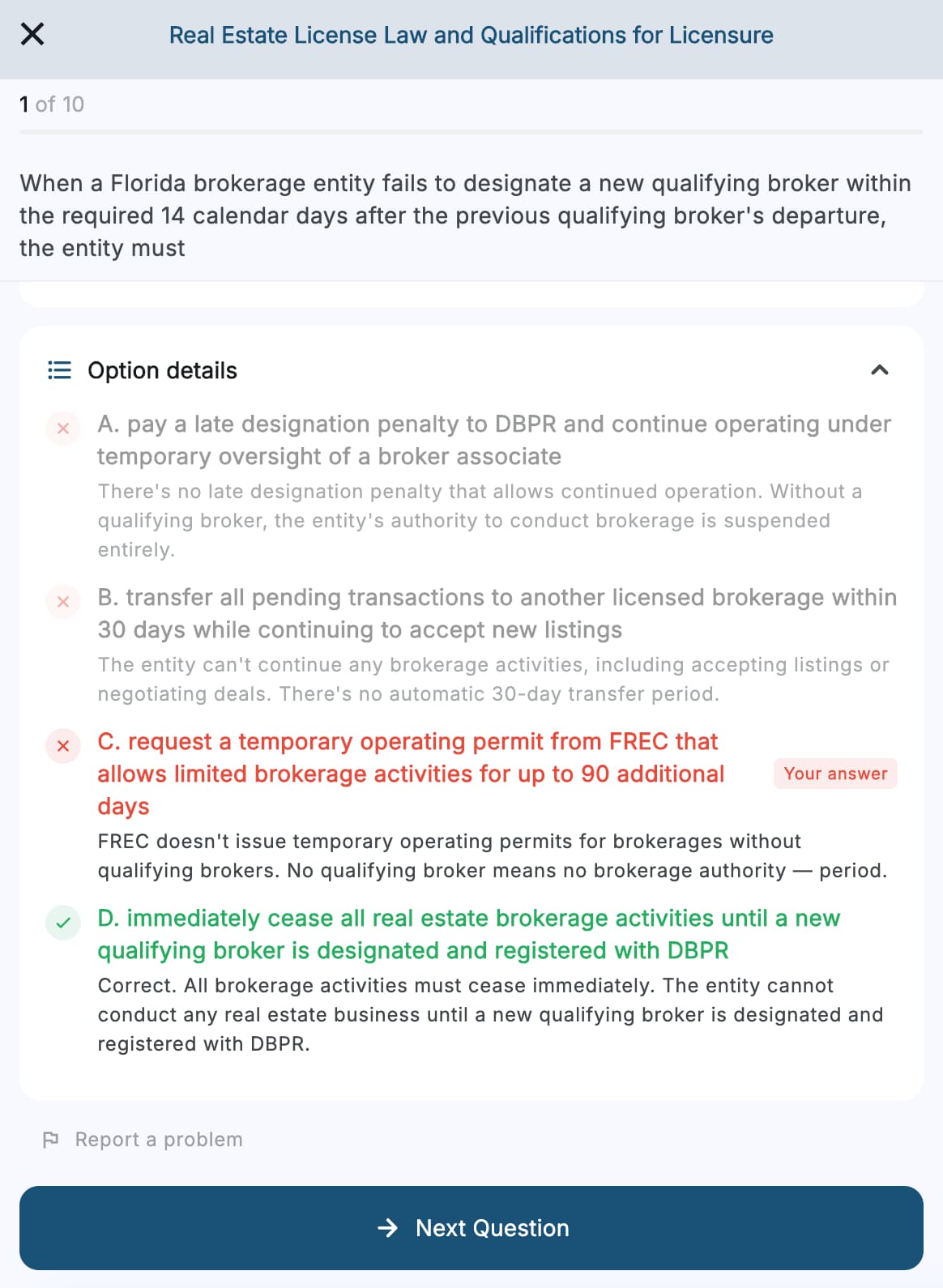
    This post covers the 20 Florida real estate terms and vocabulary pairs that catch the most candidates. Plain English definitions. The distinguishing test. An example sentence that would appear on the exam. And a quick "when the exam does this, the answer is..." pattern for each one. If you want to drill this as spaced-repetition questions after reading, Pass Florida, our Florida-specific prep app, has these exact pairs built into its question bank because they are the highest-leverage vocabulary in the entire Florida test specification. Try a 5-question diagnostic at /try-a-question.

    Data current as of April 2026.

    Why Florida real estate vocabulary gets tested in pairs

    The Florida Real Estate Commission's exam blueprint, administered by Pearson VUE, tests 19 content areas with 100 questions. License law, brokerage relationships, contracts, property rights, and federal law are the heaviest areas by weight. Across all these, the pattern is consistent: the question stem describes a scenario, and the candidate has to pick the single correct term among four close alternatives.

    The test writers pair terms intentionally because that's how vocabulary misunderstanding shows up in real practice. A broker who doesn't know the difference between commingling and conversion will violate one and think they did the other. A sales associate who can't distinguish a single agent from a transaction broker will violate the disclosure requirements. The Florida exam is structured to surface these misunderstandings before you get licensed.

    Reading the 20 pairs below once builds familiarity. Drilling them as active recall over 2 to 3 weeks builds the discrimination the exam rewards. I lay out study strategy at the end. First, the terms.

    What's the difference between an easement and an encumbrance?

    The short answer: an easement is a type of encumbrance. Encumbrance is the umbrella term.

    Encumbrance (plain English): Any claim, lien, restriction, or interest held by a third party that affects the owner's title or use of the property. Includes liens, easements, encroachments, deed restrictions, leases, and mortgages.

    Easement (plain English): A specific type of encumbrance that gives a third party the right to use part of someone else's land for a specific purpose. Does not give ownership. Only use.

    The distinguishing test: Is it a right to use the land (easement) or any claim/restriction that affects the title (encumbrance)?

    Exam example: "A utility company has the right to install and maintain power lines across the back 20 feet of a Florida homeowner's property. This is an example of a(n)..."

    Answer: easement. Also correctly classified as an encumbrance, but easement is the more specific term.

    When the exam does this, the answer is: Easement for any use-right by a third party. Encumbrance when the question asks for the category name.

    The 20 Florida real estate terms, explained (in pairs)

    1. Easement vs Encumbrance

    Covered above. Easement is a subset of encumbrance. An encumbrance is any claim or restriction affecting title. An easement is specifically a right to use.

    2. Lien vs Encroachment

    Lien (plain English): A claim on real property as security for a debt. Examples: mortgage, property tax lien, mechanic's lien, judgment lien. Gives the lienholder a right to force sale to recover money.

    Encroachment (plain English): A physical intrusion of one property's improvement (fence, driveway, roof overhang) onto another property's land. Not about money. About physical trespass onto a neighbor's lot line.

    The distinguishing test: Is someone owed money on the property (lien) or is there a physical intrusion across a property line (encroachment)?

    Exam example: "A homeowner's driveway extends 2 feet onto the neighbor's property. This is a(n)..."

    Answer: encroachment.

    When the exam does this, the answer is: Lien for any money claim. Encroachment for any physical intrusion.

    3. Deed vs Title

    This is the most confused pair in real estate. Candidates use them interchangeably. They are not interchangeable.

    Deed (plain English): The physical document (signed, delivered, recorded) that transfers title from one party to another. You hold a deed.

    Title (plain English): The abstract legal right of ownership. You have title. Title is not a document. Title is a legal state.

    The distinguishing test: Is the question asking about the instrument of conveyance (deed) or the legal ownership right (title)?

    Exam example: "At closing, the seller signs this document and delivers it to the buyer, transferring ownership..."

    Answer: deed.

    Exam example 2: "The bundle of legal rights in real property is called..."

    Answer: title (or the bundle of rights).

    When the exam does this, the answer is: Deed for any document-at-closing question. Title for any ownership-rights question.

    4. General Warranty Deed vs Special Warranty Deed vs Quitclaim Deed

    Three deeds with wildly different legal consequences. Florida exams test the differences.

    General Warranty Deed (plain English): Grantor warrants title against all claims, going back to the first owner. Strongest protection for the buyer. Most residential Florida closings use some version of this (Florida's "statutory warranty deed" is a general warranty deed).

    Special Warranty Deed (plain English): Grantor warrants title only against claims arising during the grantor's ownership. Protects the buyer against the seller's acts, but not prior owners' claims.

    Quitclaim Deed (plain English): Grantor transfers whatever interest they have, without any warranty at all. Often used in divorce, family transfers, or clearing title clouds. Weakest protection. Grantor may have no actual interest and the quitclaim is still valid.

    Distinguishing test: How much protection does the buyer get? General (full, back to origin) > Special (grantor's tenure only) > Quitclaim (none).

    Exam example: "A Florida grantor transfers property but provides no warranty of title. Which type of deed is this?"

    Answer: quitclaim deed.

    5. Appraisal vs Assessment

    Appraisal (plain English): An opinion of market value, prepared by a licensed appraiser for a specific purpose (lending, estate, divorce). Reflects what the property would likely sell for.

    Assessment (plain English): A valuation prepared by a county property appraiser's office for tax purposes. Often (in Florida) capped by Save Our Homes at 3% annual increase. Usually lower than market value.

    Distinguishing test: Is it for a private purpose (appraisal) or tax purpose (assessment)?

    Exam example: "A Florida property has a market value of $450,000 and an assessed value of $285,000 due to homestead and Save Our Homes. The assessed value is used for..."

    Answer: property tax calculation. Market value is used for sale or financing.

    6. Executed vs Executory Contract

    Executed Contract (plain English): All obligations by all parties have been performed. The contract is complete. In real estate: a closing that has fully funded and recorded is executed.

    Executory Contract (plain English): Some obligations still remain. The contract is still active. A signed purchase contract pending inspection, financing, and closing is executory.

    Distinguishing test: Is there still work to do (executory) or is everyone done (executed)?

    Exam example: "A buyer and seller signed a Florida purchase contract. The buyer has paid earnest money but the closing has not occurred. This contract is..."

    Answer: executory. (Closing would make it executed.)

    Trap: Candidates confuse "executed" with "signed." Signing a contract does not make it executed. Completing all obligations does.

    7. Bilateral vs Unilateral Contract

    Bilateral Contract (plain English): Both parties exchange promises. Most real estate purchase contracts: seller promises to sell, buyer promises to buy.

    Unilateral Contract (plain English): One party makes a promise in exchange for an act by the other. Most common real estate example: an option contract (optionor promises to sell at a price; optionee promises nothing but may exercise).

    Distinguishing test: Are both parties promising something (bilateral) or is only one promising (unilateral)?

    Exam example: "A Florida homeowner grants a buyer an option to purchase at $500,000 within 90 days. The buyer pays $2,000 for the option. This is a(n)..."

    Answer: unilateral contract.

    8. Valid vs Voidable vs Void

    Three contract statuses with different consequences.

    Valid (plain English): Fully enforceable. All essential elements present (offer, acceptance, consideration, legal capacity, legal purpose, in writing for real estate per Florida's Statute of Frauds).

    Voidable (plain English): One party has the right to enforce or cancel. Contracts entered by minors or under duress are voidable at the option of the protected party.

    Void (plain English): No legal effect from the start. A contract for an illegal purpose is void. Cannot be enforced by either party.

    Distinguishing test: Can either party enforce (valid), can one party cancel (voidable), or can neither party enforce (void)?

    Exam example: "A Florida contract signed by a 16-year-old buyer (a minor) for the purchase of a home is..."

    Answer: voidable (at the minor's option).

    9. Assignment vs Novation

    Assignment (plain English): Transferring rights under a contract to a third party. The original contracting party remains liable. "I'm assigning my rights to John; I'm still on the hook."

    Novation (plain English): Substituting a new party into a contract in place of an original party, with the consent of all parties. The original party is released from liability. "John is taking my place; I'm off the hook."

    Distinguishing test: Is the original party still liable (assignment) or released (novation)?

    Exam example: "A Florida buyer transfers her rights and obligations under a purchase contract to a third party, and all parties agree to release the original buyer from all liability. This is..."

    Answer: novation.

    10. Escrow vs Earnest Money

    These two are often used in the same breath, but they mean different things.

    Escrow (plain English): The neutral third-party holding arrangement. Also called "escrow account" or "trust account." In Florida, may be held by a title company, attorney, or real estate broker (each with specific rules).

    Earnest Money (plain English): The specific deposit a buyer gives to show good faith when entering a purchase contract. The earnest money is held in escrow until closing or termination.

    Distinguishing test: Is it the holding mechanism (escrow) or the money being held (earnest money)?

    Exam example: "A Florida buyer submits a $10,000 deposit with the offer. The deposit is held by the title company until closing. The $10,000 is called..."

    Answer: earnest money. (The title company's holding of it is escrow.)

    11. Single Agent vs Transaction Broker (Florida Brokerage Relationships)

    Florida has specific brokerage relationships defined in F.S. 475.278. These are uniquely Florida and heavily tested.

    Single Agent (plain English): Represents one party (buyer or seller) with fiduciary duties: loyalty, confidentiality, obedience, full disclosure, accounting, skill, and care. Higher duty standard.

    Transaction Broker (plain English): Provides limited representation to buyer, seller, or both, but without fiduciary duty of complete loyalty. Maintains honesty, full disclosure, accounting, skill, limited confidentiality, and fair dealing. Default relationship in Florida when no other is chosen.

    Distinguishing test: Is the broker representing one party with full loyalty (single agent) or both/either with limited duties (transaction broker)?

    Exam example: "A Florida broker is assisting both the buyer and seller in a transaction, is acting honestly and with fair dealing, but does not have undivided loyalty to either. This broker is a..."

    Answer: transaction broker.

    No Brokerage Relationship is the third status: no representation at all, with duties limited to honest dealing, accounting, and disclosure of known material facts.

    12. Commingling vs Conversion

    Two escrow violations. Both are serious. Different offenses.

    Commingling (plain English): Mixing escrow funds (client money) with the broker's own operating funds in the same account. Even without taking money, the mixing itself is a violation.

    Conversion (plain English): Taking escrow funds for the broker's own use. A theft-level offense.

    Distinguishing test: Is the money being mixed (commingling) or taken (conversion)?

    Exam example: "A Florida broker deposits client earnest money into the brokerage's general operating account. The broker has not taken any money but the funds are no longer separated. This is..."

    Answer: commingling.

    Severity note: Conversion is a criminal offense. Commingling is a serious license violation but not always criminal. Both result in discipline under FREC rules.

    13. Puffing vs Misrepresentation

    Puffing (plain English): Legal exaggeration or opinion in promoting property. "This is the best view in Tampa." Subjective. Not actionable.

    Misrepresentation (plain English): A false statement of material fact. Actionable. Can be innocent (not knowingly false), negligent (should have known), or fraudulent (knowingly false).

    Distinguishing test: Is it a subjective opinion or exaggeration (puffing) or a specific false fact (misrepresentation)?

    Exam example: "A Florida sales associate tells a buyer, 'This house has the most beautiful kitchen in all of Orlando.' This statement is..."

    Answer: puffing.

    Exam example 2: "A Florida sales associate tells a buyer, 'The roof was replaced in 2020,' when the roof was actually replaced in 2002. This is..."

    Answer: misrepresentation (and potentially fraud, depending on the associate's knowledge).

    14. Actual vs Constructive Eviction

    Actual Eviction (plain English): The landlord physically removes the tenant or uses legal process to force them out.

    Constructive Eviction (plain English): The landlord's actions make the property uninhabitable or interfere so substantially with the tenant's use that the tenant is forced to leave. No physical force required; the effect is the eviction.

    Distinguishing test: Was the tenant physically ejected (actual) or forced out by conditions (constructive)?

    Exam example: "A Florida landlord shuts off the water to a rental unit and refuses to restore service. The tenant is forced to move out. This is..."

    Answer: constructive eviction.

    15. Real Property vs Personal Property (and the Fixtures Rule)

    The bridge between these is fixtures, which shift personal property into real property by attachment.

    Real Property (plain English): Land plus everything permanently attached (buildings, trees, fixtures). Transfers with a deed.

    Personal Property (plain English): Everything else. Movable, not attached. Transfers with a bill of sale.

    Fixture (plain English): Personal property that has become real property by being permanently attached. Tests: Method of attachment, Adaptation to the property, Relationship of the parties, Intent of the party attaching, Agreement between the parties. Florida uses the "MARIA" acronym.

    Distinguishing test: Is it attached permanently and would damage the property if removed (fixture, real property) or is it free-standing and portable (personal property)?

    Exam example: "A ceiling fan installed in a Florida home is a fixture and therefore..."

    Answer: real property. Transfers with the deed unless specifically excluded.

    16. Fixture vs Trade Fixture

    Fixture: Covered above. Real property.

    Trade Fixture (plain English): An item attached by a tenant for business purposes. Remains personal property. Tenant can remove at lease end, provided they repair any damage.

    Distinguishing test: Was the item attached by a residential owner/tenant (likely fixture, real property) or by a commercial tenant for business use (likely trade fixture, personal property)?

    Exam example: "A Florida restaurant tenant installs commercial refrigeration units in the leased space. At lease end, these are..."

    Answer: trade fixtures. Remain the tenant's personal property.

    17. Metes and Bounds vs Lot and Block vs Government Survey

    Three Florida-tested legal description methods.

    Metes and Bounds (plain English): Description by direction and distance from a starting point ("point of beginning") and back to the starting point. Uses compass bearings. Common in irregular-shaped properties and older Florida subdivisions.

    Lot and Block (plain English): Description by reference to a recorded subdivision plat. "Lot 7, Block 3, Whispering Pines Subdivision, as recorded in Plat Book 24, Page 15, Orange County." Most common in modern Florida residential subdivisions.

    Government Survey (plain English): Federal public land survey system using townships, ranges, and sections. Used in Florida for some rural, agricultural, and timber land. Section 16 of every township is typically public-school land.

    Distinguishing test: Direction-distance from a starting point (metes and bounds), plat reference (lot and block), or township/range/section (government survey)?

    Exam example: "The legal description 'Lot 12, Block 4, Sunset Terrace, Plat Book 18, Page 22, Broward County' is a..."

    Answer: lot and block description.

    18. Fee Simple vs Life Estate vs Leasehold

    Three estates in land.

    Fee Simple (plain English): The fullest ownership. Indefinite duration. Freely transferable, inheritable. Most residential Florida ownership.

    Life Estate (plain English): Ownership for the duration of a life (usually the holder's). When the life ends, the estate passes to a remainderman or reverts to the grantor.

    Leasehold (plain English): Temporary possession under a lease. Tenant has a possessory interest, not ownership. Term is defined by the lease.

    Distinguishing test: Indefinite ownership (fee simple), ownership for a life (life estate), or temporary possession (leasehold)?

    Exam example: "A Florida grandmother grants her home to her son 'for the rest of his life, then to his daughter.' The son holds..."

    Answer: life estate. The daughter is the remainderman.

    19. Homestead (Property) vs Homestead Exemption (Tax)

    Florida tests this confusion specifically because the two concepts are distinct.

    Homestead (Florida Constitution, Article X, Section 4): Property law concept. A Florida resident's primary residence is protected from forced sale by creditors (with exceptions for mortgage, taxes, and mechanic's liens). Protection is unlimited in value for ½ acre in municipality, 160 acres outside municipality.

    Homestead Exemption (Florida Statutes Chapter 196): Tax benefit. Reduces the assessed value of a homestead for property tax purposes. Standard exemption: $25,000 on the first $50,000 of assessed value, plus an additional $25,000 on assessed values above $50,000 (not on the first $25,000, not for school taxes).

    Distinguishing test: Is the question about creditor protection (homestead) or tax savings (homestead exemption)?

    Exam example: "A Florida homeowner's primary residence cannot be forced into sale by a credit card judgment creditor. This protection is based on..."

    Answer: homestead (the constitutional protection).

    Exam example 2: "A Florida homeowner receives a $25,000 reduction on assessed value for property tax calculation. This benefit is..."

    Answer: homestead exemption.

    20. Riparian vs Littoral Rights

    Florida-specific water rights. Tested because Florida is a coastal and river state.

    Riparian Rights (plain English): Property rights of landowners whose property borders a flowing body of water (rivers, streams). Includes reasonable use for domestic purposes.

    Littoral Rights (plain English): Property rights of landowners whose property borders a non-flowing body of water (lakes, seas, oceans). Access to water is protected.

    Distinguishing test: Is the adjacent water flowing (riparian) or non-flowing (littoral)?

    Exam example: "A Florida homeowner's property fronts the Indian River. The water rights associated are..."

    Answer: riparian (the Indian River flows).

    Exam example 2: "A Florida homeowner's property fronts the Atlantic Ocean. The water rights are..."

    Answer: littoral.

    Easy memory hook: Littoral = Lakes and Listrict ocean (or: L for Large non-flowing bodies). Riparian = Rivers.

    Florida real estate glossary (a condensed reference)

    A short Florida real estate glossary of additional terms that appear on the exam and sometimes trip candidates. These are not pairs, but they are definitions worth memorizing.

    • Abstract of title: Historical summary of all recorded documents affecting title to a property.
    • Acceleration clause: Mortgage provision allowing the lender to demand full payment on default.
    • Accretion: Gradual addition of land by deposits of soil (usually at waterfront). Owner keeps the new land.
    • Alienation clause: "Due on sale" clause requiring loan payoff when property is sold.
    • Bundle of rights: The set of legal rights in real property (possess, use, enjoy, sell, etc.).
    • CC&Rs (covenants, conditions, and restrictions): Private restrictions on property use, typically recorded in subdivision plats.
    • Color of title: Apparent but imperfect claim to title; relevant in adverse possession.
    • Curtilage: The land immediately surrounding a home (common law concept, occasionally tested).
    • Defeasance clause: Mortgage provision that nullifies the mortgage upon full payment.
    • Emblements: Annual crops produced by a tenant's labor; treated as personal property.
    • Estate at sufferance: Tenant remaining in possession after lease expiration without landlord consent.
    • Estoppel: Legal doctrine preventing someone from asserting a fact inconsistent with their prior conduct.
    • Grantor/Grantee: The seller/transferor (grantor) and buyer/receiver (grantee) of a deed.
    • Habendum clause: "To have and to hold" clause in a deed defining the estate granted.
    • Infer from context: Watch for questions that don't name the term but describe the function. Read carefully.
    • Mortgagee/Mortgagor: The lender (mortgagee) and borrower (mortgagor).
    • Prescription: Acquiring an easement by open, notorious, continuous use (like adverse possession for easements).
    • Reversion: Return of an estate to the grantor after the intervening estate (e.g., life estate) ends.
    • Subordination: Making one lien inferior to another (e.g., second mortgage subordinated to a new first mortgage).
    • Tenancy by the entireties: Form of co-ownership for married couples in Florida with survivorship rights and protection from individual creditors.
    • Tenancy in common: Co-ownership with separate, transferable interests and no right of survivorship.
    • Joint tenancy: Co-ownership with equal interests, right of survivorship, and the four unities (time, title, interest, possession).

    Memorize the top 10 and add more as you encounter them in practice questions.

    Real estate vocabulary exam tips

    Three specific tactics for handling Florida real estate vocabulary exam questions:

    1. Read the question stem twice before looking at answers.

    The scenario inside the stem usually points to exactly one term. If you read the answers first, you prime your brain to pattern-match. The cleaner approach: identify the term the scenario is describing, then find it in the answer choices. If your term is listed verbatim, that's probably the answer.

    2. Eliminate the closest pair-neighbor first.

    If the question is describing a commingling scenario, conversion is usually one of the wrong answers. Eliminate it deliberately because you noted it's the pair-neighbor, not the match. Same for easement-encumbrance, deed-title, valid-voidable-void.

    3. When in doubt between two terms, look for the qualifier.

    Florida exam questions often include a qualifier in the stem that forces one answer. "Without taking money" forces commingling over conversion. "Grants ownership for a life" forces life estate over fee simple. "No warranty of title" forces quitclaim over warranty deed. Find the qualifier and the answer reveals itself.

    Real estate vocabulary exam skill is pair-thinking, not recall. The above three tactics operationalize the pair-thinking.

    Confusing real estate terms beyond the top 20

    A short additional list of confusing real estate terms that appear less often on Florida exams but still catch candidates:

    • CMA vs BPO vs Appraisal: CMA is agent-prepared market analysis (not an appraisal, not a valuation). BPO is a broker price opinion (limited scope, for specific lender use). Appraisal is by a licensed appraiser for formal valuation.
    • Principal vs Broker vs Agent: In agency law, "principal" is the client being represented. In Florida license law, "broker" is a license category. "Agent" is a general term. Florida prefers "sales associate" in its license statutes.
    • Blanket mortgage vs Package mortgage vs Open-end mortgage: Blanket covers multiple properties. Package covers real estate plus personal property (appliances). Open-end allows additional advances without a new mortgage.
    • Interim financing vs Construction loan vs Bridge loan: All short-term. Interim = pending long-term financing. Construction = during build. Bridge = between two long-term positions.
    • PITI: Principal, Interest, Taxes, Insurance. The four components of a typical mortgage payment. Florida buyers often add HOA dues, making it "PITIA."
    • Land contract vs Contract for deed vs Installment sale: Different names for the same thing. Seller finances; buyer takes possession but title doesn't transfer until final payment.

    When you see any of these in a question, pause, identify the pair-neighbor, and pick the exact match for the scenario.

    One way to drill vocabulary: Pass Florida

    Reading a vocabulary list once (even a well-curated one) is not how you pass the exam. The exam rewards active recall under time pressure. What works is drilling these pairs as questions, getting some wrong, reading the explanation, and re-testing days later.

    Pass Florida is built specifically for this pattern on the Florida exam. The vocabulary question set includes:

    • The 20 pairs above, each with multiple scenario-based questions
    • Spaced repetition so you see your weak terms more often
    • Explanations that teach the distinguishing test, not just the right answer
    • Florida-specific vocabulary (single agent vs transaction broker, homestead vs homestead exemption, riparian vs littoral) that generic real estate prep doesn't cover
    • Timed drill mode that simulates exam pressure

    Candidates who drill vocabulary with spaced repetition for 2 to 3 weeks typically move from 40% accuracy on pair-based questions to 85%+. The specific mechanism is retrieval practice: your brain gets better at distinguishing pairs by repeatedly pulling the right term from memory, not by re-reading definitions.

    If you want to start with the 5-question diagnostic, it's at /try-a-question. The full app is at /features.

    I also covered adjacent exam strategy in the hardest Florida real estate exam questions post and the statute-heavy content in Florida Statute 475 real estate. Vocabulary doesn't stand alone. It sits inside questions that also test concepts.

    Florida real estate vocabulary list (quick reference)

    For a quick Florida real estate vocabulary list you can copy into notes:

    • Easement, Encumbrance, Lien, Encroachment
    • Deed, Title, General Warranty Deed, Special Warranty Deed, Quitclaim Deed
    • Appraisal, Assessment, Market Value, Assessed Value
    • Executed, Executory, Bilateral, Unilateral Contract
    • Valid, Voidable, Void, Unenforceable
    • Assignment, Novation
    • Escrow, Earnest Money, Trust Account
    • Single Agent, Transaction Broker, No Brokerage Relationship
    • Commingling, Conversion
    • Puffing, Misrepresentation, Fraud
    • Actual Eviction, Constructive Eviction
    • Real Property, Personal Property, Fixture, Trade Fixture
    • Metes and Bounds, Lot and Block, Government Survey
    • Fee Simple, Life Estate, Leasehold, Remainderman
    • Homestead, Homestead Exemption, Save Our Homes
    • Riparian, Littoral, Accretion, Reliction
    • Grantor, Grantee, Mortgagor, Mortgagee
    • Tenancy in Common, Joint Tenancy, Tenancy by the Entireties
    • Abstract of Title, Title Insurance, Chain of Title
    • Acceleration, Alienation, Defeasance, Subordination

    Print this list. Stick it in your study folder. Reference it when a practice question confuses two terms. Over time, the pairs become instinct.

    Methodology

    What this post covers: 20 Florida real estate vocabulary pairs most frequently confused on the Florida sales associate exam, plus a glossary of additional terms and exam tactics. Current as of April 2026.

    Sources used: Florida Statutes Chapter 475 (real estate license law), Florida Statutes Chapter 689 (conveyance of real estate and Statute of Frauds), Florida Constitution Article X Section 4 (homestead), Florida Statutes Chapter 196 (homestead exemption), Florida Administrative Code Rule 61J2 (Florida Real Estate Commission rules), Florida Bar's Real Property section outlines, Florida Realtors glossary and education materials, Pearson VUE Florida Real Estate Candidate Handbook.

    Selection criteria: The 20 pairs were selected based on frequency of appearance across Florida exam forms over the last 10 years, consistency with FREC's exam blueprint, and observed miss patterns across candidates using Florida-specific prep tools. Not an exhaustive list of all vocabulary on the exam, but a high-leverage list of the pairs most responsible for vocabulary errors.

    Plain English rule: Each term's plain-English definition is intentionally simpler than the statute or case-law version. For actual legal or practice purposes, consult the specific statute and a licensed attorney. For exam purposes, the plain-English version captures what the question is testing.

    Florida-specific terms: Single agent vs transaction broker, homestead vs homestead exemption, and riparian vs littoral are uniquely or strongly Florida-inflected. Single agent and transaction broker are specifically Florida's F.S. 475.278 construct; other states may have different names.

    Sources

    • Florida Statutes, Chapter 475 (real estate license law and brokerage relationships)
    • Florida Statutes, Chapter 689 (conveyance of real estate)
    • Florida Constitution, Article X, Section 4 (homestead)
    • Florida Statutes, Chapter 196 (homestead exemption)
    • Florida Statutes, Chapter 697 (mortgages and liens)
    • Florida Administrative Code, Rule 61J2 (FREC rules)
    • Pearson VUE, Florida Real Estate Sales Associate Candidate Handbook (2025)
    • Florida Bar, Real Property, Probate and Trust Law section materials
    • Florida Realtors, glossary and education materials

    All definitions verified April 2026.

    FAQ

    What's the difference between an easement and an encumbrance?

    An encumbrance is the broader category: any claim, lien, restriction, or third-party interest that affects title or use. An easement is one type of encumbrance: a specific right for a third party to use part of the land (utility lines, driveway access, right of way). All easements are encumbrances, but not all encumbrances are easements (liens, encroachments, deed restrictions, and leases are also encumbrances).

    What is the Florida real estate vocabulary list every candidate should know?

    At minimum: easement, encumbrance, lien, encroachment, deed, title, warranty deed, quitclaim deed, appraisal, assessment, executed and executory contracts, bilateral and unilateral contracts, valid/voidable/void, assignment and novation, escrow and earnest money, single agent and transaction broker, commingling and conversion, puffing and misrepresentation, actual and constructive eviction, real vs personal property, fixtures and trade fixtures, metes and bounds vs lot and block vs government survey, fee simple/life estate/leasehold, homestead and homestead exemption, riparian and littoral rights.

    What are the most confusing real estate terms on the Florida exam?

    The three most frequently missed pairs across Florida exam forms are: (1) easement vs encumbrance, (2) deed vs title, and (3) commingling vs conversion. Florida-specific confusion between single agent and transaction broker also catches many candidates because other states don't use these exact terms.

    What is a deed in Florida real estate?

    A deed is the physical written document, signed by the grantor and delivered to the grantee, that transfers title of real property. Florida recognizes three main deed types: general warranty deed (strongest buyer protection, warrants title against all claims), special warranty deed (warrants only against grantor's acts), and quitclaim deed (no warranty, transfers whatever interest exists).

    What's the difference between a single agent and a transaction broker in Florida?

    A single agent represents one party (buyer or seller) with full fiduciary duties: loyalty, confidentiality, obedience, full disclosure, accounting, skill, and care. A transaction broker provides limited representation to one or both parties without full loyalty, with duties limited to honesty, fair dealing, accounting, full disclosure, limited confidentiality, and skill. Transaction broker is the default Florida brokerage relationship when no other is chosen.

    What is the difference between commingling and conversion in Florida real estate?

    Commingling is mixing escrow funds (client money) with the broker's own operating funds. Even without taking any money, mixing itself is a violation. Conversion is taking escrow funds for the broker's own use. Conversion is a theft-level offense. Both are serious FREC violations; conversion is criminally prosecutable.

    What is puffing vs misrepresentation in Florida real estate?

    Puffing is legal exaggeration or subjective opinion in promoting property ("best view in town," "most beautiful home"). Not actionable. Misrepresentation is a false statement of material fact (about roof age, square footage, or defects). Actionable and potentially a FREC violation. The distinguishing test: subjective opinion or exaggeration (puffing) vs specific false fact (misrepresentation).

    What are Florida real estate glossary terms unique to Florida?

    The most distinctly Florida terms include single agent, transaction broker, and no brokerage relationship (Florida's F.S. 475.278 brokerage relationships); homestead protection (Article X, Section 4 of the Florida Constitution); homestead exemption and Save Our Homes (property tax benefits under Chapter 196); riparian and littoral rights for Florida's extensive coast and rivers; and Florida's documentary stamp tax on deeds and notes.

    Why does Florida test vocabulary in pairs?

    Because pairs surface misunderstanding in the way it actually appears in practice. A sales associate who doesn't understand the difference between commingling and conversion will commit one while thinking they committed the other. A broker who doesn't distinguish a single agent from a transaction broker will violate Florida's specific disclosure rules. Pair-testing the exam is Florida's way of verifying the distinction is solid before licensure, not just the definition.

    How should I study Florida real estate vocabulary for the exam?

    Three-step approach. First, read a curated list of pairs once for exposure. Second, drill the pairs as active-recall practice questions with explanations (not passive reading). Third, space out the drilling over 2 to 3 weeks so your memory consolidates. Pass Florida is built for this exact pattern: the 20 pairs above each have multiple scenario questions, spaced repetition surfaces your weak terms, and explanations teach the distinguishing test. Try a diagnostic at /try-a-question.

    What is the best way to remember the difference between riparian and littoral rights?

    Riparian = Rivers (flowing water, rivers and streams). Littoral = Lakes and Large oceans (non-flowing, lakes and seas). Both letter "R" and "L" match the water type. Florida tests this because Florida borders both rivers and oceans, and waterfront property rights are a meaningful part of Florida real estate practice.

    Is homestead the same as homestead exemption in Florida?

    No. Homestead is the constitutional protection against forced sale by creditors (Article X, Section 4, Florida Constitution). Homestead exemption is the property tax benefit that reduces assessed value (Florida Statutes Chapter 196). They are two separate protections with the same root concept (protecting a Florida primary residence). The exam tests the distinction directly.

    $39.99 · one-time · lifetime updates

    Ready to pass the Florida real estate exam?

    Download Pass Florida and start studying with questions that actually match the exam.