QUICK ANSWER
Chapter 475, Part I is Florida's real estate brokerage license law. It defines licensed activity and exemptions, creates FREC, establishes qualifications and brokerage duties, and provides discipline and Recovery Fund rules. Chapter 61J2 supplies implementing rules. Study who acts, for whom, for what compensation, and under which license status before choosing a consequence.
Someone calls a payment a “consulting fee” after negotiating a property sale for another person. The label does not decide whether a license was required. The activity and compensation arrangement do.
This guide is the map of Chapter 475. The linked lessons handle detailed escrow, advertising, compensation and complaint questions without making you reread the whole statute for each one.
Chapter 475, Chapter 455 and Chapter 61J2
| Source | Function |
|---|---|
| Chapter 475, Part I | Brokerage licenses, qualifications, relationships, conduct and enforcement |
| Chapter 475, Part II | Appraisers and appraisal regulation, a distinct professional framework |
| Chapter 455 | General DBPR regulation and procedures that also affect licensees |
| Chapter 61J2, Florida Administrative Code | FREC's implementing rules |
| DBPR candidate booklet | Published exam scope and content weights |
The DBPR outline spreads these rules across several content areas. License Law and Qualifications is 6%, Commission Rules is 2%, Authorized Relationships is 7%, Brokerage Activities is 12%, and Violations and Penalties is 3%. Do not assign the whole of Chapter 475 a made-up separate exam percentage.
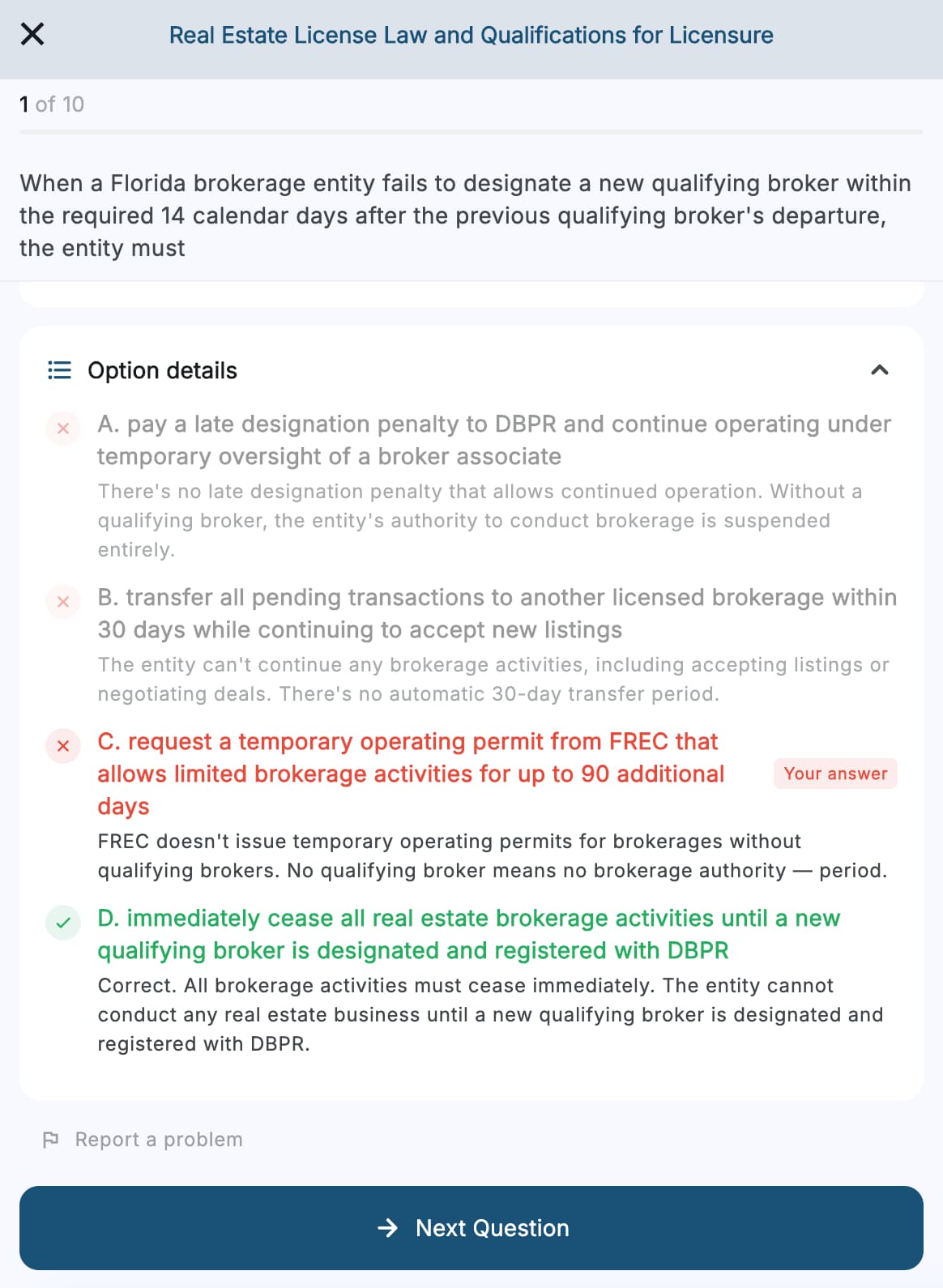
Start with License Law and Qualifications practice. Then choose a narrower topic when your mistakes show where the rule is breaking down.
Which activities require a real estate license?
F.S. 475.01 defines brokerage activity broadly. It includes specified selling, buying, leasing, renting, procuring prospects and negotiating activity for another for compensation or the expectation of compensation. Business enterprises and opportunities are also within the statutory definition in the circumstances described there.
Ask four questions:
- What did the person actually do?
- Was it for another person or entity?
- Was compensation paid, promised or expected?
- Does a specific exemption fit?
Scenario: An unlicensed person negotiates a sale for two unrelated owners, expecting $2,000 at closing. Calling the payment a gift or consulting fee does not change the licensed activity. A one-time transaction is not automatically exempt.
Exemptions are specific, not job-title privileges
F.S. 475.011 lists exemptions. Examples include qualifying owners dealing with their own property, specified salaried employees, attorneys acting within ordinary professional duties, and certain court-appointed or fiduciary roles.
Read the conditions. An owner's exemption does not automatically cover an independent salesperson negotiating for a commission. An attorney's professional-duty exemption does not turn every separate brokerage business into exempt law practice. Limited tenant-referral exceptions also do not create a general right to pay unlicensed negotiation commissions.
The unlicensed-assistant guide applies this activity test to daily office work.
FREC vs DBPR: who does what?
DBPR is the department. The Division of Real Estate performs administrative functions within that structure. FREC is the commission administering and enforcing the brokerage licensing law, including rulemaking and disciplinary decisions within its authority.
Under F.S. 475.02, FREC has seven members:
- Four brokers active for the five years before appointment.
- One broker or sales associate active for the two years before appointment.
- Two consumer members who are not and have never been brokers or sales associates.
The Governor appoints members, subject to Senate confirmation, for four-year terms. At least one member must be 60 or older. “Five brokers and two consumers” loses the distinct fifth licensee-seat qualification.
FREC does not set a standard commission rate, award ordinary contract damages as a civil court, or prosecute a criminal case. Those boundaries matter as much as the member count.
Sales associate, broker associate and broker
A sales associate performs brokerage activity under a registered employing broker. A broker associate has broker qualifications but works in the associate capacity under another broker. A broker can operate the brokerage subject to individual and entity requirements.
For the ordinary sales associate route, F.S. 475.17 and applicable rules address age 18, high-school education or equivalent, character, approved education, examination and application requirements. Exemptions can change the education route; completing a prep app is not approved pre-license education.
Course completion, application processing, examination eligibility and license activation have separate requirements and clocks. Use the application guide for that sequence rather than assuming one date controls everything.
First-renewal post-license education is different from later continuing education. Failure to complete required post-license education can make the license null and void under the applicable provisions. That is different from voluntary inactivity, ordinary renewal delinquency, suspension or revocation. See the renewal guide.
Brokerage relationships under section 475.278
Florida permits transaction brokerage and single agency, and a licensee may deal with a person without representing them. Disclosed or undisclosed dual agency is prohibited.
| Capacity | Core distinction |
|---|---|
| Transaction broker | Limited representation; presumed unless single agency or no brokerage relationship is established in writing |
| Single agent | Fiduciary representation of the buyer or seller |
| No brokerage relationship | No representation, but statutory duties still apply |
F.S. 475.278 lists seven transaction-broker duties, nine single-agent duties and three no-brokerage duties. Transaction brokerage includes additional mutually agreed duties; do not omit that seventh statutory item.
Known residential facts materially affecting value that are not readily observable must be disclosed under the applicable duties. No representation is not permission to hide a known material defect or mishandle entrusted money.
For residential disclosure situations covered by the statute, single-agent disclosure is due before or at the representation agreement, or before showing property, whichever occurs first. No-brokerage disclosure is due before showing. Transition from single agent to transaction broker requires prior written consent. Learn the scope and exceptions in the brokerage relationships guide.
Escrow: distinguish receipt, handoff, deposit and dispute
The ordinary broker-held sale-deposit sequence comes from Chapter 475 and Rules 61J2-14.008 through 14.010:
| Event | Ordinary rule |
|---|---|
| Associate receives a deposit | Deliver to the broker or employer by the end of the next business day |
| Broker's receipt for timing | Includes receipt by the associate or other brokerage representative |
| Broker deposits entrusted funds | No later than the end of the third business day after receipt under the rule's “immediately” definition |
| Broker has conflicting demands or good-faith doubt | Apply the separate notice and settlement clocks |
Under Rule 61J2-10.032, the ordinary conflicting-demand pattern is 15 business days to notify FREC and 30 business days to institute a permitted settlement procedure, measured from the applicable trigger. They are not consecutive periods totaling 45 business days.
EDO, arbitration, litigation and mediation have different consent and procedural requirements. An attorney or title company holding the money is not automatically subject to the same FREC broker-held-dispute process. Residential rental deposits also have Chapter 83 rules. Use the escrow guide for these distinctions.
Compensation follows the licensed brokerage structure
Sections 475.25 and 475.42 govern compensation and unlicensed fee-sharing issues. Section 475.455 is about disciplinary-information exchange, not the commission-sharing rule.
An associate cannot bypass the employing broker and independently collect brokerage compensation as though operating a separate brokerage. Section 475.42 also restricts collecting money connected with a brokerage transaction except in the employer's name and with express consent.
A fee between properly licensed brokers is different from paying an unlicensed person for licensed services. A disclosed customer rebate is also different from a prohibited kickback. Federal settlement-service law can impose additional limits. Continue with the associate compensation guide.
Advertising, office registration and business names
False, deceptive or misleading advertising can trigger discipline. Rules 61J2-10.025 and 10.026 separately address general and team advertising. Brokerage identification, internet contact information, relative prominence and prohibited team terms are details to learn from the advertising guide.
An active broker's office and sign requirements come from F.S. 475.22. Forming an LLC, registering a trade name or creating a team does not by itself authorize brokerage practice. Entity registration and the responsible broker's license are separate issues. See the business-entity guide.
Administrative, civil and criminal consequences
F.S. 475.25 authorizes specified licensing action, including denial, reprimand, probation, suspension, revocation and an administrative fine up to $5,000 per count or separate offense. Statutory suspension authority extends up to ten years; that is not the automatic penalty for every violation.
Misrepresentation, dishonest dealing, failure to account, improper escrow handling, unlawful fee sharing and supervision failures can raise disciplinary issues. Exact sanctions depend on the charge, facts, guidelines and process.
F.S. 475.42 separately defines violations. Operating as a broker or sales associate without a valid current active license under its core prohibition is a third-degree felony. Do not classify every subsection or every paperwork error as the same offense.
A civil court can address damages, while criminal authorities address criminal charges. One set of facts may involve more than one system. FREC's administrative fine is not money awarded to an injured buyer as compensation.
Recovery Fund is a separate statutory remedy
The fund can reimburse qualifying actual monetary loss under sections 475.482–475.484. Ordinary claim eligibility involves more than showing that a person had a real estate license.
The familiar caps are $50,000 per transaction and $150,000 across claims against one licensee, subject to the statute's conditions and allocation rules. A fund payment does not automatically mean the claimant receives the full judgment. Payment can also affect the licensee's status. Use the Recovery Fund guide for eligibility, exclusions and the distinct EDO-payment route.
What to memorize, and what to apply
The published outline gives content weights. It does not publish a verified “very high / medium / low” frequency table for individual Chapter 475 scenarios. Use the weights and your errors to allocate study time.
Learn these anchors: 475.01 definitions; 475.011 exemptions; 475.02 FREC; 475.17 qualifications; 475.25 discipline; 475.278 relationships; 475.42 violations; 475.482–475.484 fund. Then connect each to an action and consequence.
Three self-checks
- Associate receives a deposit on Monday: absent a holiday, hand it to the employer by the end of Tuesday. Do not open a personal escrow account or wait for acceptance.
- Transaction broker presents an offer: distinguish limited representation from single-agent loyalty. No brokerage relationship also has required duties.
- Unlicensed negotiator expects a closing fee: apply the licensed-activity and exemption test. A new payment label does not remove the underlying conduct.
Turn statute reading into a practice routine
Read one rule, answer five new scenarios, then write the fact that changed the result. Rotate license qualifications, brokerage activities, authorized relationships and violations.
Get Pass Florida for original Florida questions, explanations and topic review. It is independent exam preparation, not a licensing authority or approved pre-license course.
FAQ
What does Chapter 475 regulate?
Part I governs real estate brokerage licensure and practice. Part II addresses appraisers. General DBPR law and FREC rules also matter; Chapter 475 is not the only source for every exam topic.
Does selling my own property require a license?
A qualifying owner may have an exemption under section 475.011. That does not automatically exempt an independent person paid to negotiate for the owner. Identify the actor and the exemption's conditions.
Can a broker associate operate independently of the employing broker?
Broker qualifications do not erase the chosen associate role. A broker associate working under another broker follows the applicable employing-broker structure.
Does FREC award damages to customers?
FREC disciplines licensees within its statutory authority. Ordinary civil damages are a court matter. The Recovery Fund is a separate statutory reimbursement process with conditions and limits.
Which deadlines should I memorize first?
Separate the associate's next-business-day escrow handoff, the broker's third-business-day deposit rule and the ordinary 15/30-business-day dispute process. Course, application, renewal and complaint deadlines have different triggers and should be studied separately.
Is Chapter 475 enough to pass the whole exam?
No. The 19-topic outline also includes contracts, property, mortgages, appraisal, taxes, math and other federal and state laws. Use this chapter as the brokerage-law map within that larger syllabus.
Sources and method
Reviewed October 20, 2026 against the linked 2026 Chapter 475, the FREC law booklet, current rule gateways and DBPR exam outline. The live statute and rule texts control if a compiled booklet differs. Teaching scenarios and study priorities are original coaching guidance, not disclosed live exam questions or official frequency data.