QUICK ANSWER
Your first Florida real estate sale will probably come from your personal network, not a paid lead source. Expect the process to be supervised by your broker or mentor. A 45 to 90 day path from first serious client conversation to commission deposit is a practical planning example, not a promise. The goal is not to look experienced. The goal is to protect the client, track every deadline, avoid unsupported claims, and close cleanly.
STILL PREPARING FOR THE EXAM?
Keep Florida rules fresh before and after licensure.
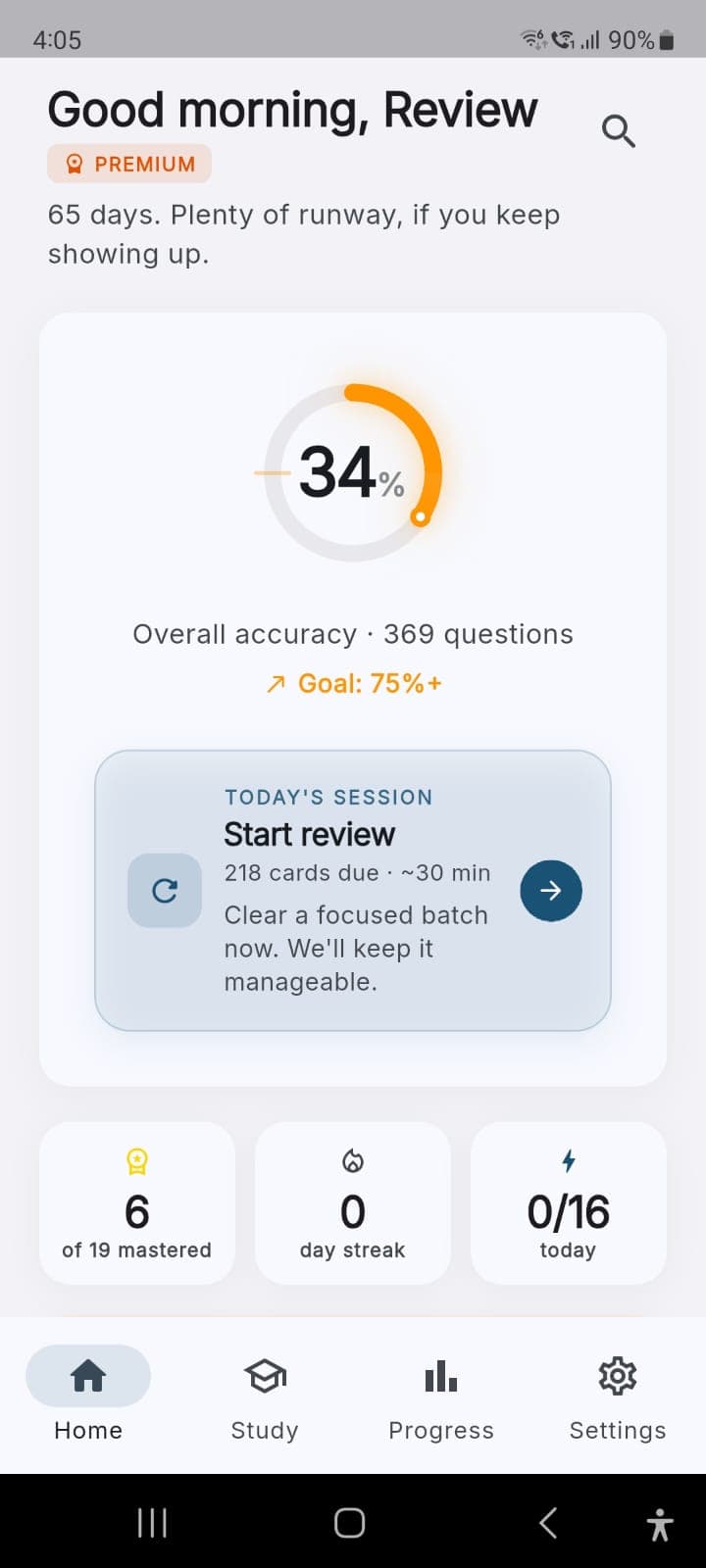
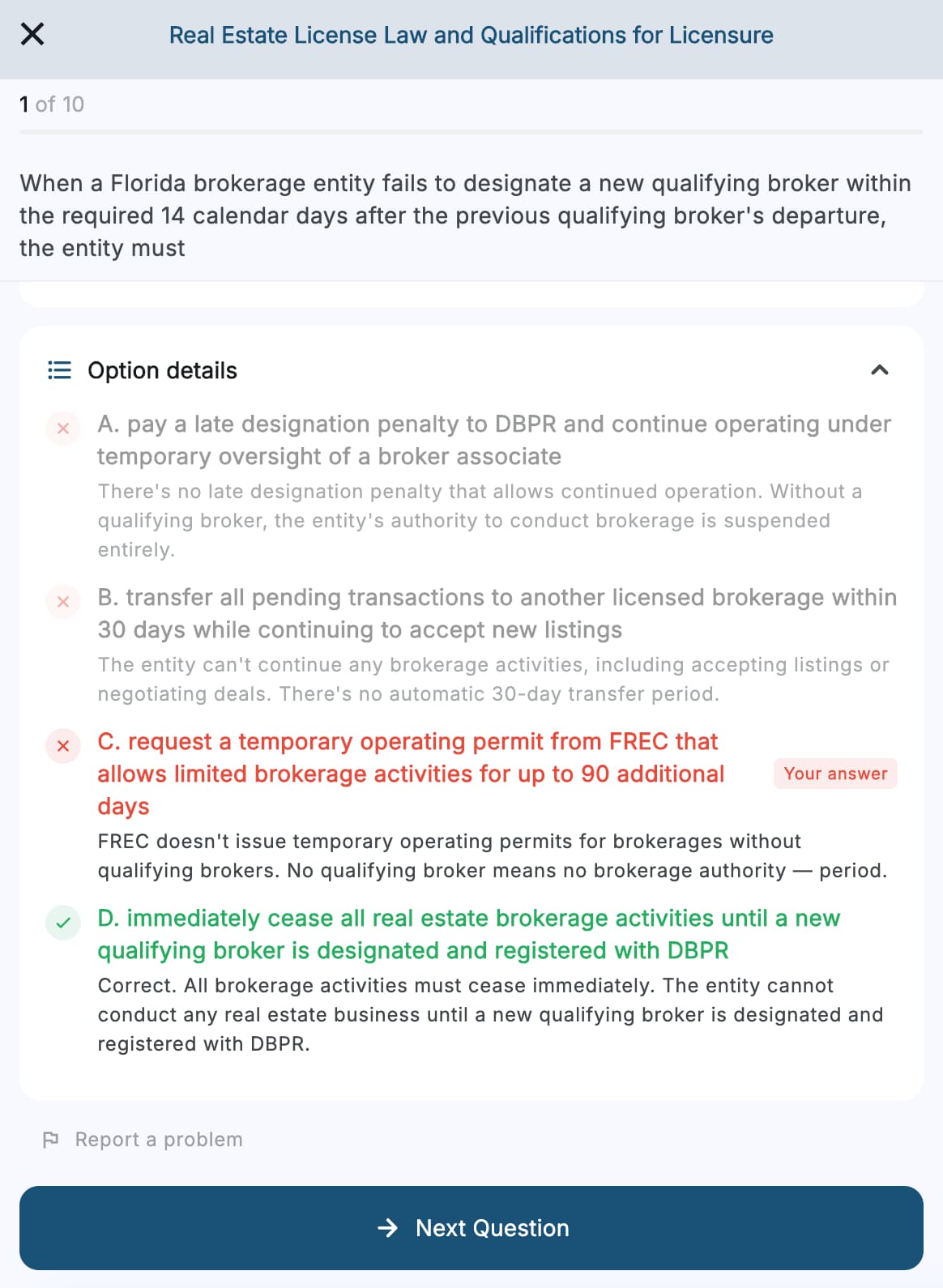
Pass Florida is an educational exam-prep app with 1,142 Florida-specific questions, Math Coach, timed practice, offline access, and a one-time $39.99 paid upgrade after the free download. It is not transaction supervision or brokerage advice.
The first deal isn't about finding a buyer. It's about not breaking one.
Your first Florida sale is usually a supervised transaction from your network, and the job is to protect deadlines, disclosures, communication, and broker review.
Almost every new Florida agent's first sale starts the same way. A sibling, a college roommate, a former coworker, or a neighbor who watched you get licensed sends a text. "We heard you got licensed. We're thinking about selling the condo. Want to help?" Your heart drops. You say yes. You drive home wondering what a listing appointment even looks like.
This is the realistic version. Not the HGTV version where a 24-year-old in a blazer closes a million-dollar waterfront in week six. For the vast majority of new Florida agents in 2026, the first real estate sale is a 1,400-square-foot house in Apopka that a family friend owns, and the challenge is not finding the client. It's handling the transaction without breaking it. Contracts, disclosures, inspection deadlines, title coordination, and communication windows are what matter on deal one. Not prospecting. Not branding. Not TikTok.
This post is the realistic playbook for your first sale: how the deal actually shows up, what to do on day one, the 7-stage Florida transaction process, the paperwork sequence, the specific moments where new agents blow up the deal, and what actually hits your bank account at closing. It assumes you've activated your license and signed with a broker. If you haven't, go read how to find a sponsoring broker in Florida first. If you are still deciding whether the career math works, start with the Florida real estate agent salary guide, the license cost breakdown, and the first-time pass rate reality check. This post picks up from there.
How do I sell my first house as a new Florida real estate agent?
Start with your network, tell your broker immediately, get the right agreement signed, track the transaction sequence, and escalate dollar or legal decisions before you answer.
The short answer, for a new agent who has activated a license in Florida in 2026:
- Accept that your first deal will come from your personal network. Not from the brokerage's pipeline. Not from a lead source. Send a "I got licensed" update to 50 to 100 personal contacts and wait. The deal will appear, usually within 3 to 9 months.
- Tell your broker or mentor the moment a deal shows up. Before you promise anything to the client. Before you quote a number. Before you walk the property. Treat deal-one mentorship as the operating system, not a backup plan.
- Sign the listing agreement or buyer agreement first. Not after you've shown houses. Not after you've negotiated. Before any material work. Unsigned work is unpaid work.
- Run the transaction through a clean Florida residential process. Listing or offer, contract, escrow, inspection, appraisal, title, closing. If your deal uses the Florida AS IS Contract, each deadline has real consequences.
- Lean on your broker for every decision that has dollar or legal consequences. Counter-offer wording. Repair negotiation. Escalation clauses. Inspection response. Your broker carries the errors and omissions insurance. Use that protection.
The honest answer is that deal one is a supervised apprenticeship. You do the work. Your mentor reviews it before it goes out. The commission comes at closing, typically 30 to 60 days after the contract is signed. Your first closing check is usually far lower than the headline gross commission after the brokerage split, transaction fees, and tax set-aside.
The slow, supervised version is the right version. Breaking your first deal because you tried to do it solo is worse than taking an extra week on documents that are correct the first time.
The first real estate sale Florida new agent timeline
A practical first-deal timeline runs from a personal-network lead to broker-reviewed consultation, signed agreement, contract, inspection, financing, title, closing, and commission processing.
Here is what the first real estate sale Florida new agent timeline typically looks like, in calendar weeks, from the moment the client texts to the moment the wire hits your account. Based on common patterns observed across new Florida agents in 2024 to 2026.
Week 0: The text lands.
Friend, family member, or past coworker reaches out. "We're thinking of selling." You schedule a conversation. You also immediately call your broker or assigned mentor to say "I have a potential first deal, can you help me prep?"
Week 1: The listing appointment (or buyer consultation).
For a listing: you walk the property, take notes, and come back with a comparative market analysis (CMA), a listing presentation, and a recommended list price. For a buyer: you sit down, sign the appropriate buyer agreement before touring homes if your brokerage and MLS participation require it under the post-2024 NAR practice changes, then discuss price range, neighborhoods, and timeline. If you are working in a market like Melbourne, where aerospace relocations and barrier-island insurance questions show up quickly, or Ocala, where acreage and farm-property conversations are common, your mentor should help you tailor the first consultation to that local market.
Your mentor shadows or reviews everything you prepare.
Week 2: Signed agreement and MLS entry (for sellers).
The listing agreement gets signed. You coordinate photos, draft the MLS listing, review it with your broker for accuracy, and push it live. For a buyer, week 2 might be the first showings.
Weeks 2 to 6: Active market time.
For a listing, this is showings, feedback, possibly price adjustments, and eventually an offer. For a buyer, this is showings, offers, and getting under contract.
Day 0 of escrow: Contract signed.
The deal is under contract. If the parties use the Florida AS IS Contract (FAR/BAR form), that contract controls the deadlines from here. The 7-stage process starts.
Days 1 to 15: Inspection period.
Buyer inspects during the negotiated inspection period. Buyer may request repairs or credit. Seller counters. Deal either continues or terminates based on the contract terms.
Days 1 to 30: Financing and appraisal (if financed).
Lender orders appraisal. Appraisal returns. If value is at or above contract price, continue. If below, re-negotiate or terminate.
Days 10 to 30: Title work.
Title company (or closing attorney) orders title search, clears liens, prepares closing documents. In Florida, title companies can perform closings; attorneys are not required but may be used.
Day 30 to 45: Closing.
Buyer and seller sign closing documents. Funds wire. Deed records. You walk out of the title company having closed your first Florida home sale. Your commission check from the broker usually arrives 1 to 14 days after closing.
Total calendar time from "hi, we're thinking of selling" to "commission deposited" for a first deal: typically 45 to 90 days. Longer if the property sits on market, shorter if it's a cash deal.
New realtor first listing: what to actually do day one
On day one, gather property facts, pull comps, prepare a broker-reviewed listing package, and avoid unsupported pricing or disclosure statements.
The new realtor first listing moment is where most first-deal mistakes originate. Not because the work is hard, but because new agents feel pressure to sound expert in a conversation where they should be sounding methodical. Six things to do on day one of your first listing:
1. Walk the property without the client present (or with, if that's what they want).
Take photos on your phone. Note condition. Measure rooms if you need to. Note any obvious issues (roof age, water stains, HVAC age). This is the raw data you'll use to build a CMA.
2. Pull 3 to 5 comparable sales (CMA).
The Florida MLS systems (Stellar, MIAMI, Matrix NEF, regional) let you pull solds in the same neighborhood or comparable sub-market over the last 6 months. Focus on homes with similar square footage, beds, baths, age, and condition. If you've never pulled a CMA, your mentor should walk you through this. Don't guess.
3. Build a listing presentation.
Most brokerages provide a template. Fill it out with the specific property's CMA, your marketing plan, and the compensation structure your broker authorizes. Do not improvise disclosure or compensation language from memory. Read every line, then have your broker review the package before it goes to the client.
Florida brokerage relationships matter here. Under F.S. 475.278, transaction broker is presumed unless another relationship is established, and single-agent relationships carry fiduciary duties. FREC disclosure rules in F.A.C. 61J2 control the disclosure forms and timing. On deal one, do not improvise this language. Use your brokerage's form package and ask your broker which relationship applies before the appointment.
4. Set a price range, not a single number.
New agents often feel pressured to say "I think it's worth $425,000." The honest answer is "based on comps, this property should list in the $410,000 to $435,000 range. I'll recommend a specific list price when we meet and we can discuss what aggressive vs. conservative pricing means for your timeline." A range is harder to argue with than a single number.
5. Show up to the listing appointment with your mentor, if possible.
Especially on deal one. Having a more experienced agent in the room for the first listing presentation raises your confidence, saves you from common errors, and makes the seller more comfortable. Split the commission if that's what it takes. Your learning cost is real.
6. Don't sign anything at the first meeting unless you're sure.
A reasonable seller will give you time to finalize the listing agreement. Use that time to review it with your broker. First-deal anxiety makes people sign fast. Slow the paperwork down until it is right.
Florida first home sale: the 7-stage process
A typical Florida resale moves through contract, escrow, inspection, financing or appraisal, title, walkthrough, and closing, with deadlines controlled by the signed contract.
The Florida first home sale process, from signed contract to closing, runs through 7 stages. Each stage has deadlines that are written into the Florida AS IS Residential Contract (FAR/BAR) or the Florida Realtors/Florida Bar contract, depending on which form is used. Missing a deadline can terminate the deal or expose you to a claim.
Stage 1: Contract execution.
Both parties sign. Buyer sends earnest money deposit (typically 1% to 3% of purchase price) to the escrow agent within 3 business days. The escrow holder is usually the title company or a designated escrow agent. In Florida, real estate brokers can also hold escrow, but most brokerages prefer the title company to hold it.
Stage 2: Inspection period (typically 10 to 15 days).
The AS IS Contract gives the buyer a specific inspection period (negotiable, usually 10 to 15 days). Buyer orders inspections (general, WDO/termite, roof if needed). If the buyer wants to cancel for any reason during this window, they can. If they want repairs or credits, they submit them in writing before the inspection period ends.
Stage 3: Inspection response and negotiation.
Seller reviews repair requests. Seller can accept, counter, or refuse. Buyer can accept, counter, or terminate. This negotiation has to conclude inside the inspection period or the buyer loses the right to cancel for inspection reasons.
Stage 4: Financing (if applicable, typically 21 to 30 days).
Buyer's lender orders the appraisal, processes the loan application, and issues the loan commitment. Appraisal returns with a value. If appraisal is at or above contract price, the loan can proceed. If below, the buyer and seller renegotiate or the buyer can terminate under the appraisal contingency.
Stage 5: Title work (parallel to financing).
Title company runs title search, confirms chain of title, identifies any liens or clouds, and prepares the title commitment. The buyer reviews the title commitment. Any title issues get resolved before closing.
Stage 6: Final walkthrough.
24 to 48 hours before closing, the buyer walks the property to confirm it's in the condition the contract specified. Repairs (if negotiated) should be complete. If not, last-minute negotiations can happen.
Stage 7: Closing.
Both parties meet at the title company (or sign remotely) and execute closing documents. Funds wire. Deed records with the county. The buyer gets keys. The seller gets the net proceeds. Your brokerage receives the commission from the title company, and your broker pays you your share shortly after.
Every stage has dates tied to the contract. Your job on deal one is to know every date and track every deadline. Most new agents miss this and the deal goes sideways. Florida AS IS Contracts are strict on time. "Time is of the essence" is not a cliche in Florida real estate. It's a contract term.
New agent closing process Florida (step by step)
The closing phase is coordination, not improvisation: confirm loan, title, disclosure, walkthrough, signing, funding, recording, and brokerage commission processing.
The new agent closing process Florida candidates need to understand breaks into three phases: pre-closing coordination, closing day, and post-closing. Here's what actually happens in each.
Pre-closing coordination (days 25 to 45 of escrow):
- Confirm loan commitment has been issued (if financed)
- Confirm title company has the clear-to-close from the lender
- Review the Closing Disclosure (CD) when it's issued (at least 3 business days before closing for federally regulated loans)
- Communicate the final cash-to-close number to the buyer
- Coordinate the final walkthrough
- Confirm utilities transfer, HOA estoppel letter (if applicable), and home warranty (if offered)
Closing day:
- Both parties arrive at the title company (or the title company sends documents for remote notary execution). Florida allows remote online notarization (RON), which became common post-2020.
- Parties sign: deed, mortgage documents (if applicable), closing disclosure, bill of sale, tax proration forms, and Florida-specific forms (homestead if applicable, Form DR-15HS if senior exemption claimed, etc.)
- Funds wire from lender and buyer. Buyer typically wires cash-to-close the day before or morning of closing.
- Title company disburses: seller receives net proceeds, liens and mortgages get paid off, commission checks are issued to the brokerage.
- Keys are handed to the buyer.
Post-closing (days 1 to 14 after closing):
- Deed records with the county clerk (usually within 3 to 7 business days in Florida)
- Your brokerage receives the commission from the title company
- Your broker processes your commission share, usually via direct deposit within 1 to 14 days
- You send a thank-you note to the client (this is where first-deal agents often forget and miss out on referrals)
- You request a review from the client (Google, Zillow agent profile, Facebook)
The money flow on your first deal: title company pays commissions according to the contract, closing statement, and brokerage instructions. In many transactions the listing brokerage receives the listing-side commission, and any buyer-broker compensation is handled under the negotiated agreement rather than through an MLS compensation field. Each brokerage then pays its agent based on the agent's independent contractor agreement. Your split after your broker's cut is what lands in your account.
Florida real estate agent first deal: the paperwork sequence
Your first deal paperwork should follow the brokerage package and transaction timeline, with broker review before client-facing promises or forms go out.
For a Florida real estate agent first deal, the paperwork runs in a specific sequence. Missing documents or misfiling can delay closing or expose the brokerage to a complaint. Here is the document sequence for a typical Florida residential transaction in 2026.
Before any work begins:
- Listing agreement (if you represent the seller) or buyer agreement (if you represent the buyer). After the 2024 NAR settlement implementation, MLS participants generally need a written buyer agreement before touring homes with a buyer. Florida Realtors publishes buyer agreement forms, and your broker will tell you which form and compensation language to use.
- Brokerage relationship disclosure: Florida presumes transaction brokerage unless a single-agent or no-brokerage relationship is established in writing. Single-agent and no-brokerage relationships carry written disclosure requirements under F.S. 475.278. Use your brokerage package and ask your broker which relationship applies before you present forms.
- Property disclosure: If you represent the seller, Florida common law and case law (Johnson v. Davis) require seller disclosure of known material defects. The Florida Realtors Seller's Property Disclosure form covers this.
At contract:
- Florida AS IS Residential Contract (FAR/BAR) or Florida Realtors/Florida Bar Residential Contract. The AS IS version is more common for most residential resales.
- Lead-based paint disclosure (for homes built before 1978, federally required).
- HOA/Condo disclosure (if applicable; Florida Condo Act and HOA Act have specific disclosure requirements).
- Financing and appraisal addenda as applicable.
- Earnest money deposit instructions to the escrow holder.
For first deals, disclosures are the danger zone. Flood disclosure, condo documents, HOA timing, estoppel issues, insurance questions, and short-term-rental facts can all require broker, title, legal, or lender review. You do not need to memorize every statute on deal one. You do need to know when a topic requires a broker or title-company check before you answer.
During inspection period:
- Inspection reports
- Request for repairs or credits (if any)
- Amendment to contract (if terms change)
Before closing:
- Closing Disclosure (CD) for financed transactions, issued by the lender at least 3 business days before closing (TRID rule)
- Title commitment from the title company
- Estoppel letter from HOA (if applicable)
- Survey (optional, sometimes required by lender)
- Homeowner's insurance evidence (for financed transactions)
Title work is where old facts surface. Boundary questions, unrecorded interests, and adverse-possession concerns are not common on first deals, but F.S. 95.16 is the statute behind the topic. If the title company flags something you only half remember from the exam, pause and escalate it. The 19-topic exam guide and the legal descriptions guide are useful refreshers when a title issue stops being theoretical.
At closing:
- Deed (warranty, special warranty, or quitclaim depending on situation)
- Seller's closing statement
- Buyer's closing statement
- Mortgage documents (if financed)
- Bill of sale for any personal property included
- Form 1099-S (IRS reporting for seller proceeds)
- Florida documentary stamp tax filing (paid by seller, calculated at $0.70 per $100 of sale price for most Florida counties, $0.60 in Miami-Dade)
If doc stamps or prorations come up and you feel rusty, review the documentary stamps walkthrough and the Florida proration guide. Those are exam math topics, but they are also real closing-table conversations.
After closing:
- Recorded deed (returned from county, usually to title company then to buyer)
- Commission disbursement statement (from brokerage to agent)
Your broker and title company handle most of this mechanically. Your job is to understand what each document is, why it's required, and when it's due. You don't need to draft them. You do need to know when they should be signed and what they're for.
Client conversations that make or break new agents
First deals usually survive or fail through conversations: strategy, offer structure, inspection response, appraisal issues, and final closing logistics.
Beyond the paperwork, the work of deal one is really conversations. Five specific conversations matter more than any others.
1. The "what's our strategy" conversation.
Before the property goes on market, or before you start showing buyer houses, sit down with the client and talk strategy. For sellers: aggressive price vs. conservative price, marketing channels, when to adjust, what we do if there's no offer in 21 days. For buyers: range, must-haves vs. nice-to-haves, how quickly we move when we find a fit, how we handle multiple offers. This conversation sets expectations. Skipping it means every subsequent decision is a surprise.
2. The "here's the offer" conversation (or "here's what we got").
When an offer comes in, or when you find a house to offer on, the conversation is about structure, not just price. Contingencies, earnest money, closing timeline, concessions, contingencies. A client who understands the whole structure negotiates better than a client who only hears the price.
3. The "inspection came back" conversation.
Inspections often find something. The question is what matters (structural, safety, major systems) and what doesn't (cosmetic, minor, end-of-life but functional). A new agent who panics at the inspection report panics the client. A new agent who walks through the report methodically, categorizes issues, and recommends a specific response (which repairs to request, which to accept, which to ignore) keeps the deal on track.
4. The "the appraisal came in low" conversation.
This is the conversation that kills the most first deals. Options: (a) buyer brings more cash, (b) seller reduces price, (c) parties split the difference, (d) terminate. Most clients don't know these options exist. Walking them through the four calmly, with a recommended path, is the mentor-supervised skill every new agent needs to build.
5. The "we need to close and here's what's next" conversation.
In the final 2 weeks, the client gets anxious. Money is at stake. Logistics are messy. A weekly check-in (sometimes daily in the last 3 days) from the agent is what separates a smooth close from a chaotic one. The conversation is not about progress reports. It's about reassurance. "Here's what's happening today, here's what's due tomorrow, here's what you need to have ready."
The common thread: deal one is taught by the conversations, not the contract. Contracts are the output of conversations handled well. New agents who rush conversations to get to the paperwork end up with deals that break in the last week.
The three things that derail first deals
First deals most often derail from missed contract deadlines, unsupported statements, or trying to handle dollar and legal decisions without the broker.
In first-deal coaching, three patterns show up again and again.
1. Missing a contract deadline.
Florida AS IS Contracts are time-strict. The inspection period, financing contingency, and title response dates matter. New agents who are not tracking contract dates day by day can lose leverage, lose a contingency, or create an earnest-money dispute. Use a transaction management platform such as Dotloop, DocuSign Rooms, or SkySlope that tracks dates automatically. Do not rely on paper alone.
2. Saying something you can't say.
New agents sometimes speak beyond their role. "The seller will definitely accept $400,000" when the seller hasn't agreed. "This house will appraise no problem" when you don't know. "The inspection is just a formality" when you should be reading the report. Every unguarded statement is exposure. The safe pattern: "let me check with the listing agent" or "let me confirm with my broker" or "let's wait for the inspection report." Your job is to coordinate. It's not to guarantee outcomes.
This is also why the no-fake-reviews stance matters. If you cannot prove it, do not say it. Pass Florida does not publish fake student reviews, and a new agent should use the same discipline with clients: no invented buyer interest, no unsupported repair promises, no "this will definitely pass appraisal," no fake certainty.
3. Trying to handle the deal without your broker.
The third and most common first-deal failure is pride. A new agent doesn't want to bother the broker, doesn't want to look inexperienced, doesn't want to slow down. So they send the counter-offer themselves, respond to the inspection request themselves, and then hit a moment where the deal is structurally broken and the broker has to rescue it. The rescue usually works. The rescue also burns goodwill. Use the broker from the start. The supervised version of deal one is the only version that consistently closes.
These three derailers are avoidable. All three come from inexperience, which is the normal first-deal condition. The fix is not trying to be experienced. The fix is being coachable.
Commission math: what actually hits your bank account
Your first commission check is not the sale price times the headline commission rate; brokerage split, transaction fees, E&O, and tax set-aside reduce the spendable amount.
New agents budget their first commission check based on the sale price times the commission rate, which overshoots by a lot. Here's what actually hits your account on a typical Florida first deal in 2026.
Assume a $375,000 sale price. This is a clean training number for a normal first-deal commission example. Your actual market may be lower or higher, and your actual check depends on the negotiated commission, brokerage split, transaction fees, and tax set-aside.
- Gross commission to the listing side in this example: 3% of sale price. Commissions are negotiable, and buyer-broker compensation is no longer handled through MLS compensation fields after the NAR settlement practice changes.
- Listing side gross commission (at 3%): $11,250.
- Listing brokerage keeps part of the split. If you are the listing agent at 70/30 split with your broker: $11,250 x 0.70 = $7,875.
- Minus transaction fees. Many brokerages charge a $199 to $395 transaction fee per closed deal. Say $295.
- Minus E&O contribution (if your brokerage takes per-transaction): $50.
- Your gross take-home: around $7,530.
Minus self-employment tax set-aside. Real estate agents are independent contractors. You owe self-employment tax (15.3%) plus federal income tax on the $7,530. A smart first-deal move is to set aside 25% to 30% for taxes. That's $1,880 to $2,260 into a tax savings account.
Net to you after tax set-aside: about $5,270 to $5,650 in spendable cash.
On a buyer-side deal at similar numbers, your take-home is similar or slightly lower after the buyer-agent negotiation terms. This is why the Florida real estate agent salary guide and the license cost breakdown are better planning tools than social-media commission screenshots.
For a new agent expecting $11,250 based on "the commission is 3%," the actual spendable amount of roughly $5,000 to $6,000 is a meaningful downward adjustment. That does not mean the deal was bad. It means you planned like an independent contractor instead of like an employee with a paycheck. I covered the year-one income reality in more detail in the new Florida real estate agent first-year post.
One tool that builds confidence on your first showing
A short daily exam-content refresh can help new agents recognize familiar rules, but live transaction answers still belong with your broker and current professional sources.
The biggest first-deal confidence gap is not contract knowledge. It's content mastery. When a client asks you about homestead exemption rules, documentary stamp taxes, the difference between a special warranty and a general warranty deed, or how proration works on property taxes, your ability to answer calmly (or say "let me confirm, I want to get this right") is what signals competence.
Most of what you'll be asked in your first deal overlaps heavily with what the exam tested. The exam was six weeks ago and you've forgotten half of it. The fastest way to rebuild that content is a short daily refresh, not a textbook reread.
I built a short diagnostic at /try-a-question that samples questions from the weighted Florida content areas with explanations. For new agents in their first 90 days, it's a 5-minute daily refresh that keeps the exam material live while you continue to rely on broker supervision and current transaction sources for live-deal answers.
You won't always know the answer. What you want is the ability to recognize familiar exam concepts when they show up in practice, and the confidence to say "let me confirm" when a live deal needs broker, legal, title, lending, or tax review. The diagnostic supports that habit.
Pass Florida publishes this guide and offers the exam-prep app linked on this page. This article is for study purposes only and does not replace DBPR, FREC, Pearson VUE, a pre-license provider, or qualified professional guidance.
Methodology
What this post covers: The realistic playbook for a new Florida real estate agent's first closed sale, including how the deal typically originates, the 7-stage Florida transaction process, the document sequence, client conversations, common derailers, and illustrative first-commission math..
Sources used: Florida Realtors contract forms (AS IS Residential Contract, Buyer Broker Agreement); Florida Bar/Florida Realtors Residential Contract; Florida Statutes Chapter 475 and Chapter 475.278 (single agency and brokerage relationships); Florida Administrative Code Rule 61J2; Florida case law on seller disclosure (Johnson v. Davis); 2024 NAR settlement implementation guidance; Florida documentary stamp tax rates (Chapter 201, F.S.); Florida Real Estate Commission guidance documents.
Current-practice caution: This post flags common first-deal risk areas for new agents: flood disclosure, condo and HOA document issues, estoppel timing, insurance-market questions, title issues, and closing-cost math. These are not substitutes for broker supervision or current legal guidance. They are prompts to slow down and verify before answering clients.
What this post does not cover: Commercial transactions (different forms, different timelines), new construction (different contract forms), for-sale-by-owner deals (different dynamics), foreclosure or short sale (specialty tracks), and deals in Florida counties with unique local requirements (the Keys condo overlay, for instance, or agricultural land tracts).
Commission math: The $375,000 example is illustrative, not a market-price claim. Actual commissions vary by brokerage split, fee structure, and the specific negotiation of buyer broker compensation post-NAR settlement. Your first check will be determined by your specific brokerage agreement and the specific deal terms.
NAR settlement impact: The August 2024 NAR settlement implementation changed how buyer broker compensation is disclosed and negotiated. This post reflects 2026 practice. Specifics continue to evolve and some details vary across Florida brokerages.
Educational scope: This article is career and exam-prep education for new Florida licensees. It is not legal, tax, lending, brokerage, title, insurance, or closing advice. For a real transaction, follow your broker's supervision, the signed contract, current forms, title-company instructions, lender requirements, and licensed professional advice where appropriate.
Sources
- Florida Realtors, standard contract forms (AS IS Residential Contract, Buyer Broker Agreement, Seller's Property Disclosure)
- Florida Bar and Florida Realtors, joint residential contract form
- Florida Statutes, Chapter 475 (real estate brokers, sales associates, and schools)
- Florida Statutes, Section 475.278 (authorized brokerage relationships)
- Florida Statutes, Section 689.302 (residential flood disclosure)
- Florida Statutes, Chapter 201 (documentary stamp taxes)
- Florida Statutes, Chapter 718 (condominiums)
- Florida Statutes, Chapter 720 (homeowners' associations)
- Florida Administrative Code, Rule 61J2 (Florida Real Estate Commission rules)
- Florida case law, Johnson v. Davis (seller disclosure duty)
- HB 913, Florida condominium and association updates
- SB 2-A, Florida property insurance reform context
- National Association of Realtors, 2024 settlement and implementation guidance
- Consumer Financial Protection Bureau, TRID rule guidance (Closing Disclosure timing)
FAQ
How do I sell my first house as a new Florida real estate agent?
Start with your personal network: send a "I got licensed" update to 50 to 100 contacts. When a lead appears, loop in your broker or mentor before you quote a price or promise anything. Sign the listing agreement or buyer agreement before doing substantial work. Run the deal through Florida's residential transaction sequence: contract, escrow, inspection, appraisal when applicable, title, walkthrough, and closing. Lean on your broker at every decision with dollar or legal consequences.
What does the first real estate sale Florida new agent process look like?
A typical first deal for a Florida new agent originates from personal network, runs through a 45 to 90 day process from first serious conversation to commission deposit, involves the Florida AS IS Residential Contract with a negotiated inspection period, financing period, title work, and closing, and may produce a spendable commission check of roughly $4,000 to $6,000 after split, fees, and tax set-aside on a mid-priced residential example.
How long does it take to close your first sale as a new Florida real estate agent?
From the first client conversation to the commission check usually takes 2 to 4 months. About 2 to 6 weeks for the listing or buyer consultation through contract, 30 to 45 days from contract to closing, and 1 to 14 days after closing for the commission to process and deposit.
What's the new realtor first listing checklist?
Walk the property and take photos, pull 3 to 5 comparable sales for a CMA, build a listing presentation with a price range not a single number, discuss marketing plan and strategy with the seller, sign the listing agreement after your broker reviews it, coordinate photos, draft the MLS listing, have your broker review before going live.
What is the Florida first home sale process?
Florida's standard residential sale process runs 7 stages: contract execution with earnest money deposit, inspection period, inspection response negotiation, financing and appraisal if applicable, title work in parallel, final walkthrough, and closing. Each stage can carry contract deadlines with deal consequences.
What is the new agent closing process Florida agents need to know?
The closing process has three phases. Pre-closing coordination (days 25 to 45 of escrow): confirm loan commitment, review Closing Disclosure (at least 3 business days before closing), coordinate final walkthrough. Closing day: parties sign documents, funds wire, deed records, commission is paid to brokerage. Post-closing (days 1 to 14): deed records with county, brokerage processes your commission share, you request a client review.
What paperwork does a Florida real estate agent first deal require?
Before work: listing agreement or buyer agreement, brokerage relationship disclosure when applicable, and property disclosure. At contract: Florida AS IS Residential Contract or another broker-approved contract form, lead-based paint disclosure for pre-1978 homes, HOA or condo disclosure when applicable, and financing addenda. Before closing: Closing Disclosure if financed, title commitment, estoppel letter if HOA or condo, and evidence of homeowner's insurance. At closing: deed, seller and buyer closing statements, mortgage documents if financed, and Form 1099-S when applicable.
How much will I make on my first real estate sale in Florida?
On a $375,000 example sale with a 3% listing commission at a 70/30 brokerage split, gross commission to you is around $7,875. After brokerage transaction fees ($200 to $400) and E&O contribution, your gross is around $7,530. After setting aside 25% to 30% for self-employment and income tax, net spendable cash is typically $5,000 to $6,000 on a first deal.
How do I handle the inspection period on my first Florida deal?
Track the negotiated inspection deadline strictly. Buyer orders inspections within the first few days. Review the report with the buyer methodically: separate structural, safety, and major systems issues from cosmetic or minor issues. Submit repair requests in writing before the inspection period ends if that is the buyer's strategy. Under common AS IS contract wording, the buyer's inspection-based cancellation right is tied to that deadline, so ask your broker before the window gets close.
What happens if my first deal's appraisal comes in low?
Four options: (1) buyer brings additional cash to the closing to cover the gap, (2) seller reduces the price to the appraised value, (3) parties split the difference with buyer cash and seller reduction, or (4) buyer terminates under the appraisal contingency and recovers the earnest money deposit. New agents should walk the client through all four options calmly with a recommended path rather than panicking.
How do I avoid blowing up my first deal as a new Florida agent?
Three rules. One: track every contract deadline in a transaction management platform such as Dotloop, DocuSign Rooms, or SkySlope, not on paper alone. Two: do not make statements you cannot back up, including guaranteeing offers will be accepted, guaranteeing appraisals, or dismissing inspection findings. Three: use your broker at every decision with dollar or legal consequences. Coachability is the fix.
What is the commission structure in Florida real estate after the NAR settlement?
After the August 2024 NAR settlement practice changes, MLS participants generally use written buyer agreements before touring homes with buyers, and offers of buyer-broker compensation are no longer communicated through MLS compensation fields. Common structures range from seller concessions or negotiated seller-paid compensation to buyer-funded models where the buyer pays their own broker. Specific structures vary by brokerage, MLS participation, and deal negotiation. Ask your broker for the exact compensation process your brokerage uses.
Ready to pass Florida on the first try?
The first deal is easier when the exam content is still alive in your head. Brokerage relationships, doc stamps, prorations, disclosure duties, homestead, title issues, and closing math all return after licensure. Pass Florida gives you 1,142 Florida-specific questions, lifetime access on iPhone, iPad, and Android phone or tablet, and a one-time $39.99 paid upgrade after the free download. No subscription. No copied exam questions.