QUICK ANSWER
A new Florida real estate agent's first year is usually not a straight line from passing the exam to steady commission checks. The first year is about activating under a broker, learning contracts, completing the 45-hour post-license requirement before first renewal, building a contact list, hosting open houses, following up every week, and turning trust into first clients. Income is possible, but it usually lags activity by months. The agents who survive year one treat it like building a small business, not like starting a normal job.
CAREER PLANNING ONLY
This guide is educational career-planning and exam-prep transition content. It is not legal, tax, brokerage, employment, licensing, or compensation advice. Your broker's policies and written agreements control client work. The commission examples and income ranges in this guide are illustrative planning scenarios, not Pass Florida earnings claims or predictions of what any individual will earn. Real results vary widely and are never guaranteed.
Official Source Map
A new Florida sales associate's first year starts with a clean license transition: activate under a broker, work through that broker, protect the 45-hour post-license deadline, and build a tracked pipeline before income feels stable.
| Claim this guide relies on | Primary source |
|---|---|
| Florida sales associate candidates need the 63-hour pre-license course, application, fingerprints, exam pass, and license activation | DBPR Real Estate Associate Requirements |
| The Florida sales associate exam pass mark is at least 75 | DBPR Real Estate Associate Requirements |
| New sales associates need 45 hours of post-license education before the initial license expires | DBPR Real Estate Associate Requirements |
| A sales associate may not operate without a valid current active license or work for someone not registered as the employer | Florida Statutes section 475.42 |
| Sales associate compensation must flow through the registered employer broker | Florida Statutes section 475.42 |
| MLS participants working with buyers need written buyer agreements before touring homes, and broker compensation is negotiable | NAR settlement consumer guidance |
| Referrals, prior relationships, and repeat trust remain central to how buyers and sellers find agents | NAR 2025 Home Buyers and Sellers Generational Trends |
| Wage tables are labor-market context, not a first-year income promise | BLS OEWS May 2025 tables |
Your First Year Is Not a Sales Job Yet
A new Florida real estate agent's first year is a business-building year: license activation, broker onboarding, forms practice, sphere outreach, follow-up, open houses, and post-license deadline control.
Most people imagine the first year like this:
Get licensed. Join a brokerage. Meet clients. Show homes. Write offers. Get paid.
That can happen.
But it is not the normal rhythm at the beginning.
The first year is usually slower, messier, and more operational than the highlight reels make it look. You are learning your brokerage systems, contracts, MLS searches, buyer conversations, compensation conversations, inspection timelines, appraisal problems, lender delays, association rules, and local market patterns while also trying to find people who trust you enough to hire you.
That is a lot.
So the goal of year one should not be "look successful."
The goal should be:
Build a business that can produce clients without you starting over every Monday.
That means:
- Activate your license correctly.
- Pick a broker who will teach you.
- Learn the forms before a client is waiting.
- Build your sphere list in week one.
- Follow up without disappearing.
- Host open houses even before you have listings.
- Track every lead in a CRM.
- Practice buyer and seller conversations.
- Protect your post-license deadline.
- Keep studying Florida law because now mistakes affect real people.
That is the work.
BEFORE YEAR ONE STARTS
Passing the exam is the first business decision.
Exam preparation helps you reach the licensing gate. Broker supervision, local training, prospecting, and transaction experience determine what happens after it.
First, Finish the Licensing Transition
After passing, confirm DBPR status, activate under a broker, complete onboarding, learn office forms, and track the 45-hour post-license deadline before acting like the business is fully open.
The exam is not the finish line.
It is the door.
Before you can build a real first-year plan, make sure the license side is clean.
| Step | What it means |
|---|---|
| Save exam proof | Keep your Pearson VUE result and DBPR records |
| Confirm DBPR status | Make sure your license status is issued correctly |
| Activate under a broker | A Florida sales associate must work under a broker to perform licensed services |
| Complete brokerage onboarding | E&O, office policies, forms, MLS access, CRM, transaction system |
| Track post-license deadline | New sales associates must complete 45 hours before first renewal |
| Learn local board and MLS rules | Realtor board and MLS membership are business decisions, not license requirements by themselves |
If you just passed, start with passed the Florida real estate exam, now what?. If you are still choosing a broker, read find a sponsoring broker in Florida.
Do not skip the administrative pieces because they feel boring.
Year one gets much harder when your first buyer is ready to tour and you still do not know which forms, disclosures, buyer agreement, MLS rules, or broker approval process applies.
The First-Year Reality: Income Lags Activity
First-year real estate income often lags activity because trust, signed agreements, inspections, financing, title, and closing must happen before commission is paid.
Real estate is not paid like a normal job.
You can work hard for 90 days and earn nothing.
Then one closing can pay more than a month of wages.
That delay is why new agents quit even when they are doing some of the right things. They expect effort to pay weekly. Real estate often pays after a long chain:
- Contact someone.
- Build trust.
- Learn their timing.
- Follow up.
- Get hired.
- Show homes or prepare a listing.
- Negotiate.
- Survive inspection, appraisal, financing, title, HOA, and closing.
- Get paid after closing.
That can take 30 days.
It can take 9 months.
For a new agent, the first year is a pipeline year. The people you call in month one may become clients in month five. The open house visitor in March may write an offer in July. The friend who says "not yet" may send you their cousin before they buy anything themselves.
If you need stable monthly income immediately, start part-time or keep a separate income source while you build.
For more income context, read Florida real estate agent salary.
What to Do in Your First 30 Days
The first 30 days should produce an active broker relationship, working systems, a 100 to 200 person sphere list, first outreach, form practice, and an open-house routine.
The first month should be simple.
Not easy.
Simple.
You need structure, visibility, and reps.
| Week | Focus | Output |
|---|---|---|
| Week 1 | Broker onboarding | Active license, office systems, mentor contact, form access |
| Week 1 | Sphere list | 100 to 200 names in a spreadsheet or CRM |
| Week 2 | Personal announcement | Direct texts, calls, emails, and notes to people who already know you |
| Week 2 | Contract basics | Buyer agreement, listing agreement, purchase contract, disclosures |
| Week 3 | Open house routine | Ask listing agents if you can host, prepare sign-in and follow-up |
| Week 4 | Follow-up rhythm | Every contact gets a next step and date |
The biggest mistake in month one is waiting until you "feel ready" before telling people.
You do not need to pretend you are a 20-year expert.
You can say:
"I just activated my Florida real estate license and joined a brokerage where I have broker support. I am building my business and would be grateful if you kept me in mind for anyone buying, selling, or asking real estate questions."
That is honest.
It also lets people help you.
Your Sphere Is Not a Spam List
Your sphere is not a blast list. It is the group of people who already know you, trust you, and may remember or refer you if you stay useful without being pushy.
Your sphere is the group of people who already know your name.
Friends. Family. Former coworkers. Neighbors. Parents from school. Gym contacts. People from church, community groups, sports, college, volunteering, and past jobs.
NAR's buyer and seller research continues to show how much agent choice depends on referrals, previous relationships, and trust. That does not mean your friends owe you business. It means people often choose an agent through relationship and recommendation, not random search.
The right sphere strategy is personal:
| Contact type | Best first touch |
|---|---|
| Close friend or family | Call or text personally |
| Former coworker | Personal email or LinkedIn message |
| Neighbor | Conversation or handwritten note |
| Local business contact | Quick visit or short message |
| Distant acquaintance | Simple announcement email |
Do not send one generic blast and call it done.
Your goal is not to ask everyone for a deal.
Your goal is to let people know what you do, make it easy to remember you, and stay useful without being strange about it.
Useful follow-up includes:
- "Here is what changed in our local market this month."
- "Here are the three steps before touring homes."
- "Here is how Florida homestead can affect taxes."
- "Here is a checklist for selling before hurricane season."
- "Here is what an inspection period actually means."
The tone matters.
You are becoming the real estate person in your network, not the person who only appears when they want a referral.
Open Houses Still Matter for New Agents
Open houses still matter for new Florida agents because they create conversation reps, buyer questions, follow-up practice, and local-market familiarity.
Open houses are not magic.
They are reps.
For a new agent, open houses help with:
- Talking to buyers without the pressure of a signed client relationship
- Learning how people describe needs and objections
- Practicing property features, neighborhood facts, and financing questions
- Meeting unrepresented buyers
- Building follow-up discipline
- Learning what serious vs casual traffic sounds like
- Getting visible in a local area
After the NAR settlement practice changes, buyer representation and compensation conversations need to be cleaner. NAR's consumer guidance says MLS participants working with buyers need written buyer agreements before touring homes. New agents should not wing that conversation.
Ask your broker:
- Which buyer agreement does our office use?
- When exactly must it be signed?
- How do we explain compensation?
- What can and cannot be said at an open house?
- What follow-up language is approved?
- How does our MLS handle compensation information after the settlement changes?
Open houses are a great lead source only if your broker teaches you the rules.
Commission Math Without the Old Assumptions
First-year commission math should use examples, not promises, because compensation is negotiable and actual take-home depends on agreements, splits, fees, taxes, expenses, and closing facts.
Be careful with first-year income articles that still assume a fixed 6% commission and automatic 50/50 split.
Compensation has always been negotiable, and the post-settlement environment made that conversation more visible to consumers. Your actual income depends on the written agreement, the side you represent, seller concessions or compensation arrangements, brokerage split, fees, transaction costs, taxes, and whether the deal closes.
Use examples, not promises.
Example buyer-side gross math:
| Item | Example |
|---|---|
| Sale price | $400,000 |
| Agreed buyer-broker compensation example | 2.5% |
| Brokerage gross | $10,000 |
| Agent split example | 70% |
| Agent gross before fees and tax | $7,000 |
Example listing-side gross math:
| Item | Example |
|---|---|
| Sale price | $400,000 |
| Agreed listing compensation example | 2.5% |
| Brokerage gross | $10,000 |
| Agent split example | 70% |
| Agent gross before fees and tax | $7,000 |
Those are simple examples. They are not market guarantees.
From that gross amount, you may still have:
- Brokerage transaction fee
- E&O pass-through
- Team split, if applicable
- Marketing reimbursement
- Referral fee, if applicable
- Self-employment tax
- Federal income tax
- Business expenses
This is why the better year-one question is not "How do I make $50K?"
It is:
"How many real conversations, appointments, signed clients, and closings do I need to build a stable pipeline?"
Money follows the pipeline. Not the other way around.
YEAR ONE STARTS AT THE EXAM
No pipeline pays until you pass and activate.
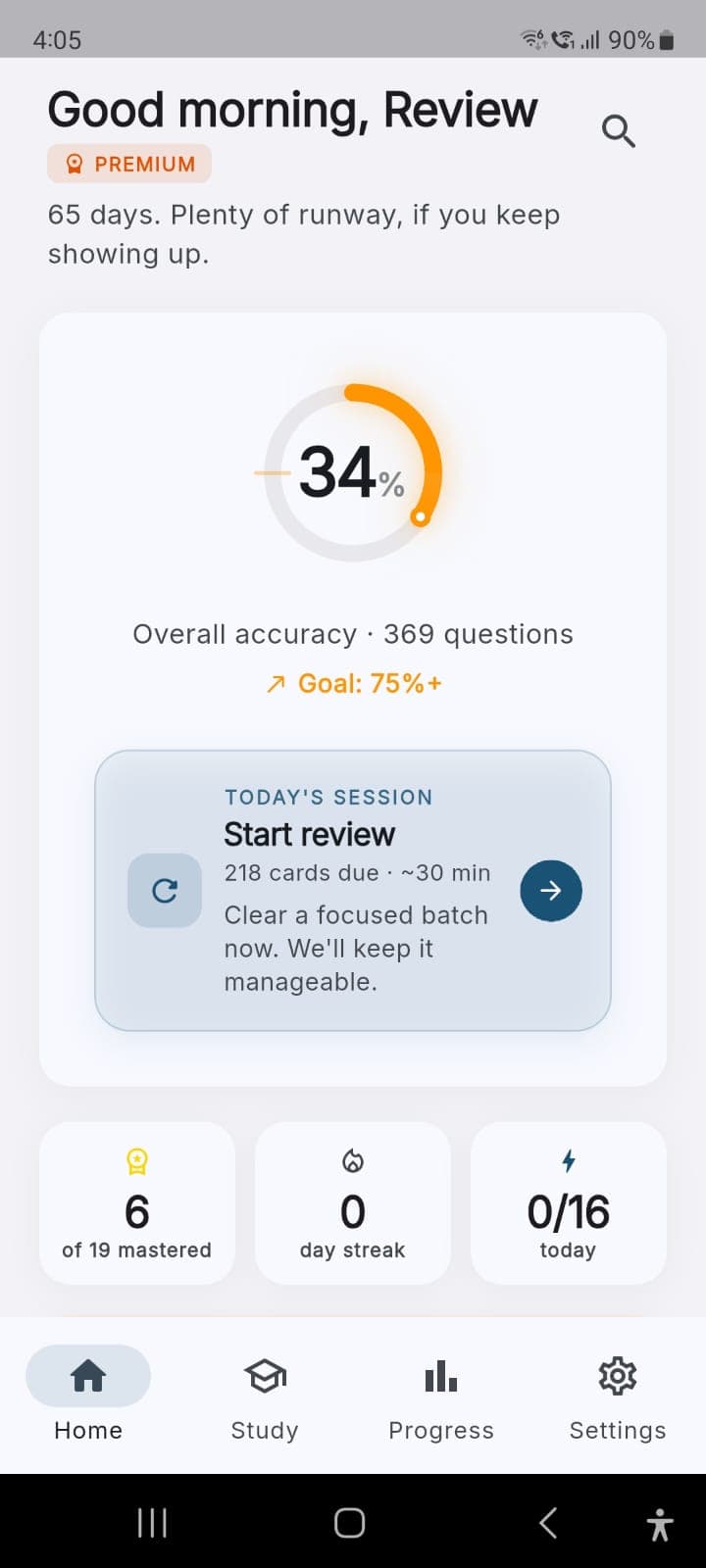
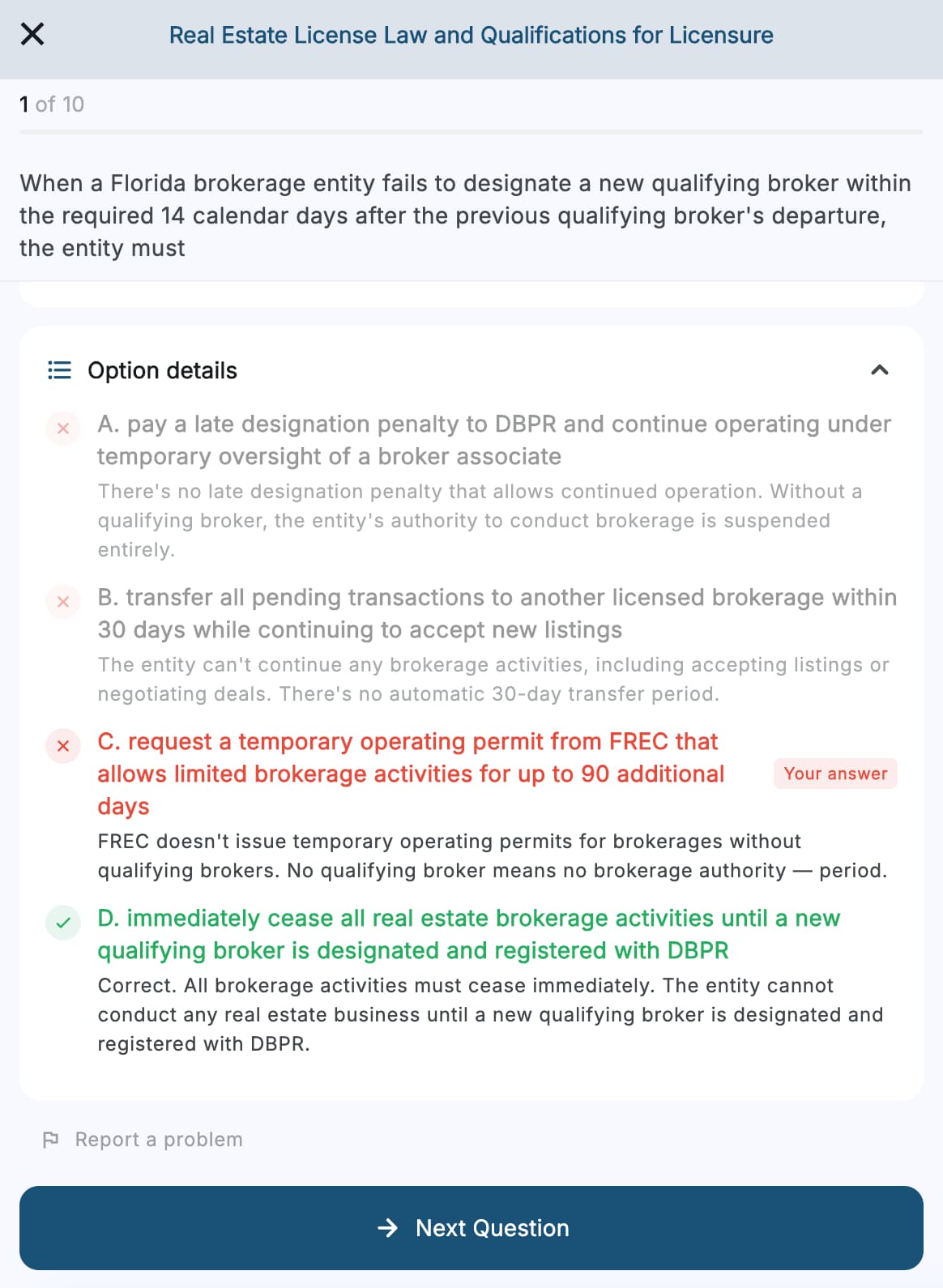
If you are still before the state exam, the fastest first-year move is clearing the gate. Pass Florida is exam prep only: 1,142 Florida-specific practice questions, a 19-topic diagnostic, Math Coach across the 14 Florida math calculation types, Trap Library, and one $39.99 purchase. No subscription. No copied exam questions.
Months 2 to 3: Build the Reps
Months 2 to 3 should be a repeatable activity block: sphere conversations, open houses, follow-up, form practice, broker check-ins, market review, and CRM tracking.
Once the basic setup is done, your job becomes consistent activity.
A reasonable weekly rhythm:
| Activity | Weekly target |
|---|---|
| Sphere conversations | 10 to 20 |
| Open houses | 1 to 2 |
| Follow-up messages | 20 to 40 |
| Contract or form practice | 2 hours |
| Broker or mentor meeting | 1 touchpoint |
| Local market review | 1 hour |
| Social or email market update | 1 useful post or note |
The early goal is not to look busy.
The goal is to create evidence:
- Which contacts respond?
- Who is thinking about buying?
- Who owns property?
- Who has a parent moving?
- Who has a lease ending?
- Who can refer you?
- Which neighborhoods do you want to understand?
- Which questions do buyers keep asking?
Every answer goes into the CRM.
If it is not tracked, it is probably lost.
Months 4 to 6: Turn Conversations Into Clients
Months 4 to 6 are about turning tracked conversations into signed clients while asking your broker before you advise on forms, deadlines, compensation, escrow, inspections, or financing.
By months 4 to 6, the agents who started early often have a few serious conversations.
Some may become signed buyer clients.
Some may become listing appointments.
Some may be months away.
This is the stage where new agents need broker support most.
Before you advise a client, make sure you can answer:
- Which brokerage relationship applies?
- Which disclosure is required?
- Which buyer agreement or listing agreement is needed?
- What compensation has been agreed to in writing?
- What deadlines matter?
- What happens if inspection fails?
- What happens if financing fails?
- What does the escrow timeline require?
- When do I call my broker?
Your first few transactions should be slow in the right way.
Do not rush what you do not understand.
Use your broker. Use your mentor. Ask before guessing.
The goal is not only to close.
The goal is to close without creating a compliance problem.
Months 7 to 12: Build the Repeatable System
Months 7 to 12 should turn one-off effort into a system for past-client follow-up, open-house follow-up, sphere updates, neighborhood knowledge, CRM review, and broker training.
By the back half of year one, the question changes.
Not "How do I get one client?"
"How do I keep a pipeline alive?"
That means:
| System | What it does |
|---|---|
| Past-client follow-up | Turns a closing into reviews, referrals, and repeat trust |
| Open-house follow-up | Turns visitors into future buyer conversations |
| Sphere newsletter | Keeps you remembered without asking every time |
| Neighborhood focus | Helps you build local credibility |
| Weekly CRM review | Prevents warm leads from going cold |
| Broker training | Helps you avoid repeating the same mistakes |
Most new agents lose business because they disappear.
They meet someone, have one good conversation, forget to follow up, then wonder why the person hired someone else 5 months later.
The agent who wins is often not the most polished.
It is the agent who stays useful and present.
First-Year Expenses to Expect
New Florida agents should budget beyond the license: broker onboarding, MLS access, association choices, E&O, tech, marketing, post-license education, taxes, and business basics.
Your license is not the only cost.
The first year can include:
| Cost | Notes |
|---|---|
| Broker activation and onboarding | Some brokerages cover pieces, some pass them through |
| Local board, Florida Realtors, and NAR dues | Optional legally, often required for MLS access through a brokerage path |
| MLS access | Depends on market and brokerage |
| Lockbox or showing tools | Varies by board and MLS |
| E&O insurance | Brokerage dependent |
| CRM or tech stack | May be included or paid by agent |
| Headshot, cards, signs, website | Keep it simple at first |
| Marketing | Start lean, then spend only where follow-up exists |
| Post-license course | Required before first renewal |
| Taxes | Commission income is not take-home pay |
Read Florida real estate license cost before you assume the license fee is the budget.
The practical founder-style advice:
Do not buy a shiny brand before you have a follow-up system.
Spend first on:
- Passing the exam
- Broker fit
- MLS and forms access
- Basic credibility assets
- CRM and follow-up
- Post-license education
Luxury branding can wait.
Mistakes New Florida Agents Make
The biggest first-year mistakes are waiting too long, relying only on brokerage leads, avoiding buyer-agreement conversations, overspending, skipping reps, and forgetting the 45-hour deadline.
They wait to tell people. Your network cannot refer you if they do not know you are active.
They rely on brokerage leads. Brokerage leads can help, but they should not be your whole business plan.
They avoid buyer agreement conversations. In the post-settlement environment, clarity builds trust. Avoidance creates awkwardness.
They spend too much before they have a pipeline. A logo will not rescue weak follow-up.
They skip open houses because they feel awkward. Awkward reps are still reps.
They do not study contracts until they have a client. That is too late.
They forget the 45-hour post-license deadline. Missing the first renewal requirement can damage momentum.
They stop learning after the exam. The exam tested concepts. Clients test judgment.
Related Exam and Career Concepts
Use this first-year guide with the passed-exam, sponsoring-broker, salary, cost, first-sale, and exam-readiness pages so readers can move from license gate to career plan.
| If you need this | Read this next |
|---|---|
| You just passed | Passed Florida real estate exam next steps |
| You still need the license path | How to get a Florida real estate license |
| You are choosing a broker | Find a sponsoring broker in Florida |
| You want realistic income context | Florida real estate agent salary |
| You need startup costs | Florida real estate license cost |
| You are comparing license levels | Florida broker vs sales associate |
| You need the first transaction picture | First real estate sale in Florida as a new agent |
| You still need to pass | How to pass the Florida real estate exam |
| You want a study plan | 30-day Florida real estate exam study plan |
| You need readiness check | Florida real estate exam readiness calculator |
Frequently Asked Questions
What should a new Florida real estate agent do first?
Confirm the license status with DBPR, activate under a broker, complete brokerage onboarding, learn the forms and buyer agreement process, build a 100-person sphere list, and start personal outreach. Do not wait until you feel like an expert to tell people you are licensed.
How long does it take a new Florida real estate agent to get a first client?
Many new agents need 3 to 6 months to create a serious client pipeline, and longer if they start with no sphere outreach. A first closing can take even longer because a client may need weeks or months before writing an offer or listing a property.
How much can a new Florida real estate agent make in the first year?
It varies widely. Some new agents earn little or nothing, some earn part-time income, and a smaller group builds enough pipeline to close several transactions. The safest expectation is that year one is unstable and requires financial runway.
Is $50,000 realistic in the first year?
It is possible, but it should not be treated as the default. It usually requires full-time effort, a strong sphere, disciplined follow-up, broker support, enough financial runway, and several closings. Use it as a stretch scenario, not a promise.
How do new agents get their first real estate clients?
Most first clients come from people who already know the agent or from referrals connected to that network. Open houses can also create early buyer conversations. Paid online leads can work, but they usually require strong follow-up and are not a substitute for sphere outreach.
Should a new Florida agent start part-time or full-time?
Part-time is safer if you need income stability. Full-time can grow faster if you have enough savings, a strong network, and a clear daily schedule. The wrong choice is going full-time with no runway and no lead plan.
Do I need to join a Realtor association in Florida?
Not by license law alone, but many brokerages and MLS access paths require local board membership, Florida Realtors, and NAR membership. Ask your broker what is required in your local market before budgeting.
What changed after the NAR settlement?
Buyer representation and compensation conversations became more visible and more formal. NAR guidance says MLS participants working with buyers need written agreements before touring homes. New agents should learn their brokerage's approved buyer agreement and compensation explanation before working with buyers.
What is the 45-hour post-license requirement?
Florida sales associates must complete 45 hours of post-license education before the first renewal. This is separate from the 63-hour pre-license course and should not be left until the final week.
What is the biggest mistake new Florida agents make?
Waiting. Waiting to tell their network, waiting to practice conversations, waiting to learn forms, waiting to host open houses, and waiting to follow up. The first year rewards useful, consistent action before confidence feels perfect.
Ready to Start the Career the Right Way?
The first year starts before your first client.
It starts when you decide to pass the exam, pick the right broker, protect your post-license deadline, and build real follow-up habits.
Pass Florida helps with the first gate:
- 1,142 Florida-specific questions
- 19 content-area diagnostics
- Timed practice exams
- Math Coach for Florida calculation patterns
- Trap Library for EXCEPT, NOT, and close-answer wording
- Offline access
- Lifetime updates
- $39.99 once
- No subscription
- No copied exam questions
Take the free Florida practice exam | Download Pass Florida | Read passed-exam next steps
Sources & Methodology
Commission examples are illustrative only. They do not represent fixed, standard, or required commission rates. Compensation is negotiable and depends on the written agreement, brokerage policies, local market norms, client choices, and closing facts.
This guide is educational career guidance, not legal, tax, brokerage, or financial advice. New agents should follow their broker's policies and consult qualified professionals for tax, legal, and business planning questions.
Primary sources reviewed:
- Florida DBPR Real Estate Associate Requirements
- Florida Statutes section 475.42
- NAR: What the settlement means for home buyers and sellers
- NAR 2025 Home Buyers and Sellers Generational Trends report
- BLS OEWS Tables, May 2025
Pass Florida publishes this guide and offers the exam-prep app linked on this page. It does not replace DBPR, FREC, Pearson VUE, a broker, a pre-license provider, or qualified legal, tax, lending, appraisal, title, brokerage, licensing, or financial guidance.