QUICK ANSWER
The cost of a Florida real estate license in 2026 has two layers. The license-only path usually runs about $260 to $1,200 if you include the 63-hour course, DBPR application, Livescan fingerprinting, Pearson VUE exam, and exam prep. The fixed DBPR/Pearson fees are $99.50: $62.75 for the DBPR sales associate application and $36.75 for the Pearson VUE salesperson exam. Fingerprinting usually adds about $50 to $80. Broker activation is still required before you can practice, but DBPR's RE 11 change-of-status form says no fee is assessed for that transaction. The realistic first-year cost of working as an agent can add another $1,500 to $3,500 once you include Realtor association dues, MLS subscription, lockbox access, E&O insurance, and basic marketing setup. Most "Florida real estate license cost" articles cover only the first layer. This one covers both.
The "how much does a Florida real estate license cost" search hides a structural problem. The license itself is cheap. The year-one runway to actually work as a Florida agent is not. Articles that answer the keyword only tell you the first number, which is usually the right answer to the wrong question.
The right question is: "How much will I have spent twelve months after I make the decision to pursue this?" For many working agents, the answer lands in the $2,000 to $5,000 range before personal living expenses. The gap between the keyword answer and the real answer is where new agents get into financial trouble. Many do not budget for Realtor association dues, MLS subscription, lockbox access, or the months of low income that can come before the first closing.
This post covers both numbers transparently: state fees, course costs, optional exam prep, and the year-one association and operating costs that many candidates do not see until the bills start arriving. Three budget scenarios show the trade space across rock-bottom, standard, and premium paths.
What this guide covers
- Mandatory licensing fees
- Exam prep costs
- Year-one agent costs
- Three realistic budget scenarios
- Where candidates overspend and underspend
- What this means for cost planning
- FAQ
KEEP EXAM PREP SIMPLE
Do not let one of the smallest line items become the costly delay.
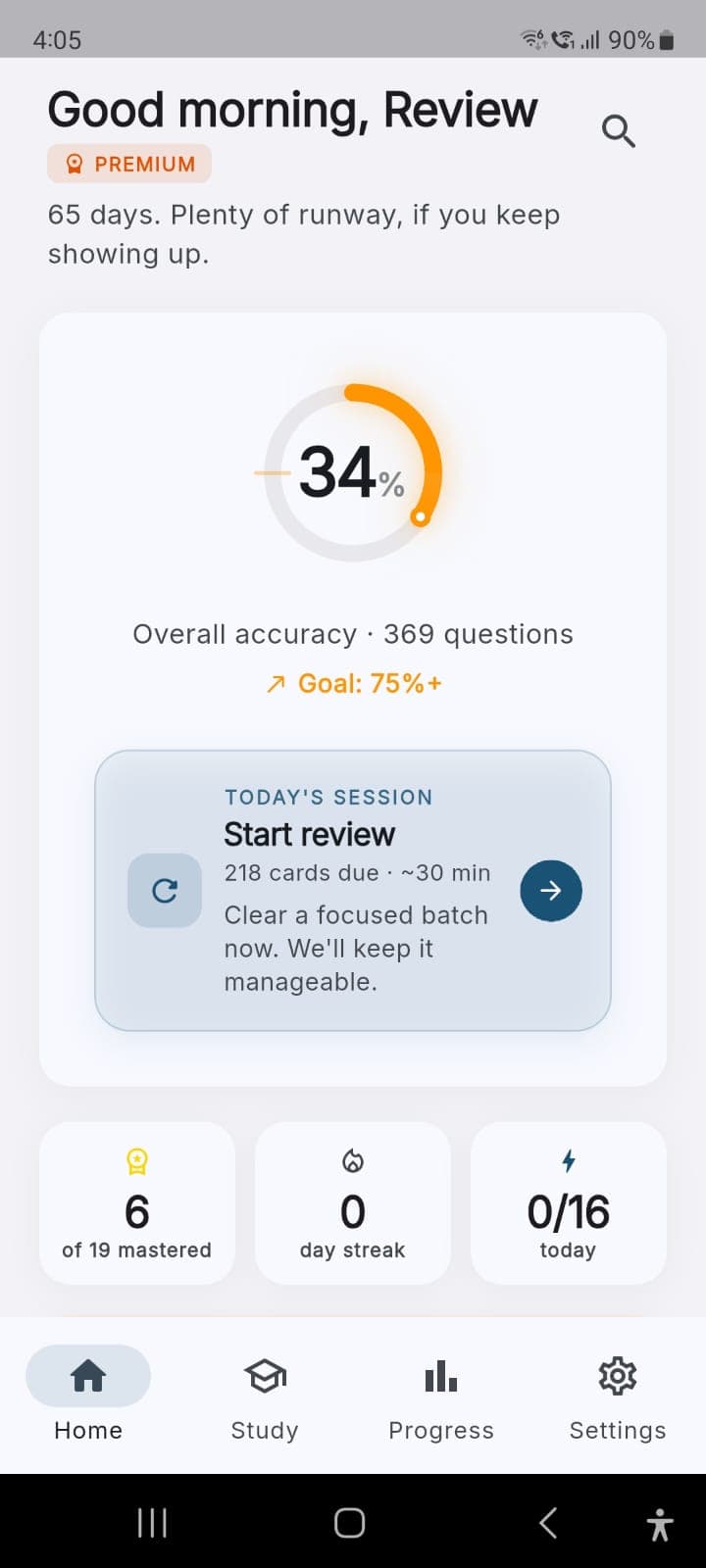
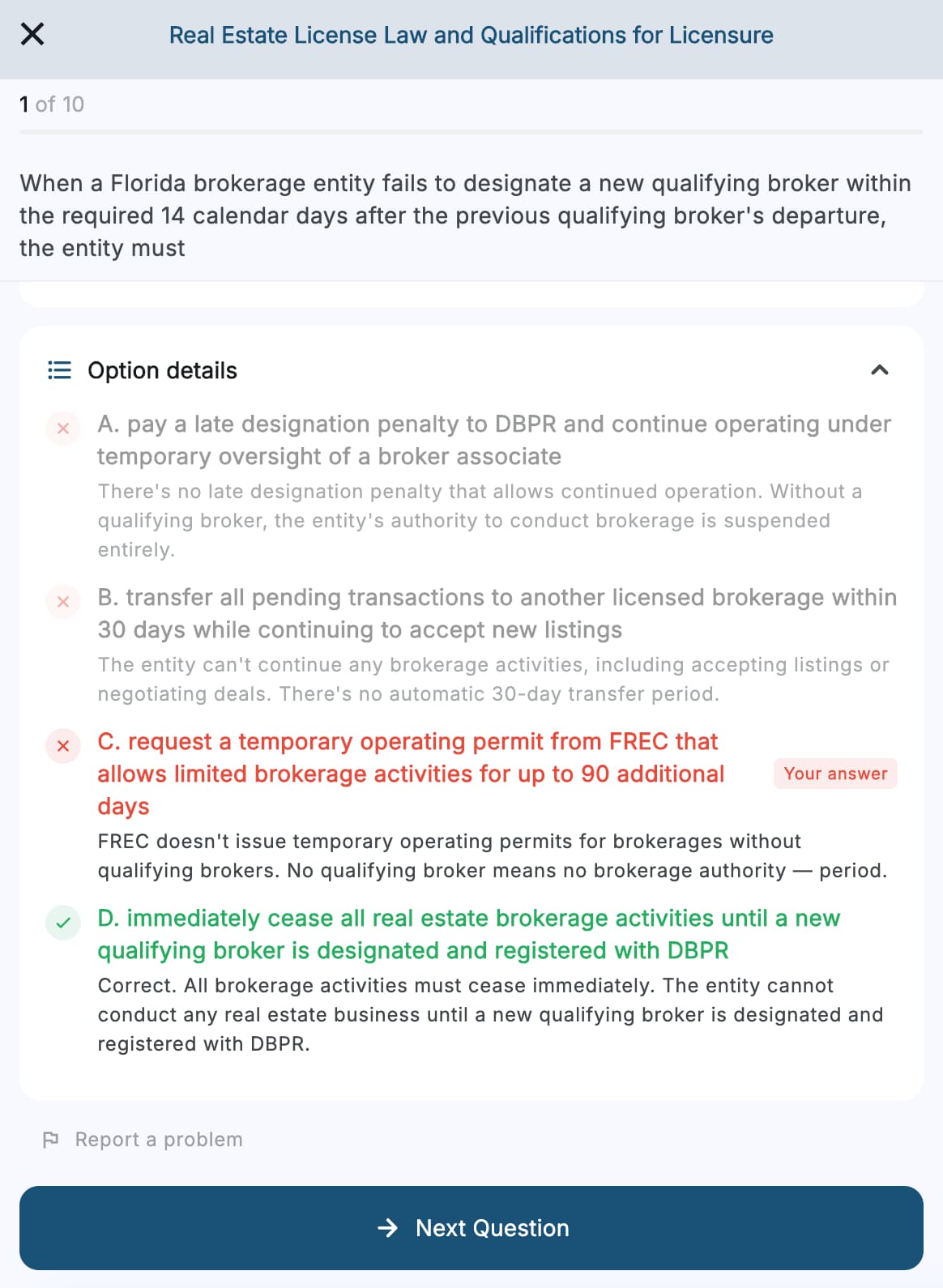
Pass Florida is an educational exam-prep tool for Florida sales associate candidates: 1,002 Florida-specific questions, a 19-topic diagnostic, six modes, Math Coach across the 10 Florida math archetypes, Trap Library, Confidence Calibration, offline access, optional sync, lifetime updates, and one $39.99 purchase. No subscription. No copied exam questions.
Mandatory licensing fees
These are the fees Florida statute and DBPR rules require to issue a sales associate license. They are non-negotiable and apply to every candidate regardless of background or path.
Florida DBPR RE 1 sales associate application: $62.75. Paid directly to the Department of Business and Professional Regulation through the MyFloridaLicense portal or with the paper application. This fee covers the sales associate application and initial license processing. Processing time varies by volume and application completeness. F.S. 475.17 sets the eligibility requirements; DBPR sets the fee. Always confirm the live fee in your DBPR account before paying because fee reductions and form updates can change the number candidates see at checkout.
Livescan Fingerprinting: $50 to $80. Done through an FDLE-approved Livescan provider. DBPR's fingerprinting guidance says Real Estate Sales and Brokers use ORI FL920010Z, and DBPR retains fingerprint results for 12 months from the date the digital fingerprints are electronically received by FDLE. Schedule fingerprinting right after you submit the application so the prints can match your file. If they do not show up, use the fingerprints delay checklist.
Pearson VUE State Exam Fee: $36.75 per attempt. Paid to Pearson VUE when you schedule the exam. If you retake the exam, you pay the exam fee again. Always confirm current scheduling and retake rules in the Pearson VUE candidate materials before you book.
Broker activation through RE 11: $0 DBPR transaction fee. Your sponsoring broker still has to add you through DBPR before you can practice. Until that activation processes, you may have passed the exam but you cannot list, show, write offers, or earn commission as a Florida sales associate. DBPR's RE 11 Change of Status form says no fee is assessed for this transaction. Some brokerages may charge their own onboarding, desk, technology, or association-related fees, but that is a brokerage cost, not a DBPR activation fee.
The 63-hour pre-license course: $70 to $800. This is the single widest cost range in the entire path, and the choice here matters more than the dollar amount suggests. Online-only providers like MLS Campus start around $70 to $150. Mid-tier online providers like Kaplan Real Estate Education (formerly Bob Hogue) or The CE Shop run $249 to $459. In-person classroom programs like Gold Coast Schools or Larson Educational Services range $399 to $799 depending on package. We compared the seven major Florida providers in detail in the best Florida pre-license course post. The course choice is a fit question (format, region, learning style), not a price question.
College students should also factor in semester timing, broker-fit questions, and whether an education exemption is actually available. The Florida real estate exam college student plan covers those decisions before you spend the course money.
Subtotal for the mandatory licensing path: about $220 to $980, depending mostly on which 63-hour course you pick and what your Livescan provider charges.
KEY INSIGHT: THE $99.50 FIXED FEE FLOOR
DBPR and Pearson VUE together account for $99.50 before fingerprinting and course tuition: $62.75 for the DBPR sales associate application and $36.75 for the Pearson VUE salesperson exam. Livescan usually adds about $50 to $80. For a typical candidate who also needs the 63-hour course, the practical hard floor is about $220 before optional exam prep.
Exam prep: optional in theory, standard in practice
Florida does not require exam prep beyond the 63-hour course. The course meets the eligibility requirement.
The course does not automatically meet the readiness requirement. Many candidates supplement the course with structured exam prep because the state exam tests application, trap wording, Florida-specific rules, and math setup in a way a pre-license course may not drill deeply.
Exam prep budget range: $40 to $200. Pass Florida is $39.99 one-time for 1,002 Florida-specific questions with lifetime access. Lexawise sells subscription access. The CE Shop's Exam Prep Edge is bundled into higher-tier 63-hour course packages. PrepAgent sells exam prep separately. We compared two of the most-searched exam prep options in the Pass Florida vs Lexawise post.
The honest framing on exam prep: it is one of the smallest line items in the licensing budget, but it can protect you from delay, retake fees, and lost momentum. Candidates whose budget is tight should consider a moderate course plus a real exam-prep tool rather than the most expensive course with no dedicated practice questions.
Subtotal with exam prep included: about $260 to $1,180 for the full pre-license-to-exam path.
The year-one costs most articles don't disclose
The license is the door. Working as an agent is the room. Most articles that answer "Florida real estate license cost" stop at the door and never describe the room.
Here are the standard year-one costs most working Florida agents incur in their first 12 months after activation:
45-hour Florida post-license course: $99 to $249. Required before your first license renewal. The first renewal period is not always a full 24 months, so use the expiration date in your DBPR account instead of guessing. New agents often forget this and rush it before the renewal deadline. Cost ranges from $99 for online discount providers to $249 for in-person or higher-support Florida-focused schools.
Realtor association dues (optional but standard): $677 to $907 first year, $600 to $700 recurring. Realtor membership is not required by law. In practice, most working agents join because Realtor membership is bundled with MLS access at many brokerages and gives access to standard contract forms. The breakdown:
- National Association of Realtors (NAR): $156 dues + $45 Consumer Advertising Campaign assessment = $201 in 2026
- Florida Realtors (state): $146 dues + $30 advocacy fund + $30 processing fee for new members = $206 first year, $176 recurring
- Local Realtor Association (varies widely by city): $200 application fee (new members) + $300 to $400 annual dues. Examples: Orlando Regional Realtor Association (ORRA) = $200 application + $300 annual. Miami Realtors and other large local boards run in the same range.
First-year Realtor total: $677 to $907. Recurring annual after year one: $600 to $700.
MLS subscription: $400 to $800 per year. Most Florida MLSs are organized by region. Stellar MLS covers Central Florida (Orlando), Tampa Bay, and much of the Gulf Coast, with annual subscriber fees in the $400 to $600 range. South East Florida MLS, Miami Realtors MLS, and Northeast Florida MLS cover their respective regions at similar rates. Your brokerage will tell you which MLS you need to subscribe to. Some brokerages bundle MLS into their monthly fees; some pass the cost through to the agent.
Lockbox / Supra key: $150 to $300 per year. Required for showing listed properties with electronic lockboxes. The Supra eKey runs roughly $20 per month after activation. Some local boards bundle this into Realtor membership; many do not.
E&O insurance: $200 to $500 per year. Errors and Omissions insurance. Many brokerages provide group E&O as part of the agent's monthly desk fee or split structure; some require the agent to carry their own policy. Confirm at the brokerage interview.
Brokerage desk fees and transaction fees (highly variable). A flat-fee brokerage like Charles Rutenberg Realty or LPT Realty charges $50 to $200 per month or per-transaction. A traditional split brokerage takes its cut from commission and may charge $0 in monthly fees. eXp Realty has a $149/month base. Compass and Keller Williams structures vary. This is the most variable line item in the year-one budget; it can be $0 monthly with a higher split, or $200/month with a 100% split.
Marketing setup (one-time, year-one only): $200 to $1,000. Professional headshot ($150 to $400), business cards ($50 to $200), basic signage and template materials ($100 to $400), CRM subscription if not brokerage-provided ($0 to $300/year). Optional but standard for agents who plan to actually generate business.
Continuing education (after first renewal): $30 to $100 every 2 years. Florida requires 14 hours of continuing education each renewal cycle after the first post-license course (3 hours core law, 3 ethics, 8 specialty). Modest cost, easy to overlook.
Expired pre-license course certificate: $70 to $800 if you have to redo it. DBPR says the Florida sales associate pre-license course is good for two years from completion. If you waited too long and your course certificate expired before the state exam, use the course certificate expired guide before paying Pearson VUE.
Year-one realistic total above the licensing path: $1,500 to $3,500, depending mostly on Realtor association choices and how much marketing infrastructure the agent builds in month one.
Three realistic budget scenarios
The honest cost ranges fall into three patterns most candidates can match themselves against.
Scenario 1: Rock-bottom budget ($260 to $500 license path, under $1,500 bare-bones year one)
For candidates who want to spend the minimum required to legally hold an active license and start generating commission.
| Line item | Cost |
|---|---|
| 63-hour course (MLS Campus tier) | $70 to $150 |
| Pass Florida exam prep | $39.99 |
| DBPR application | $62.75 |
| Livescan fingerprinting | $50 to $75 |
| Pearson VUE exam (first attempt) | $36.75 |
| Broker activation through RE 11 | $0 DBPR fee |
| License path subtotal | $259 to $364 |
| Realtor association (skip year 1) | $0 |
| MLS (brokerage-provided) | $0 to $400 |
| Lockbox (local board provided) | $0 to $250 |
| E&O (brokerage-provided) | $0 |
| Post-license course (within 24 mo) | $99 to $149 |
| Minimal marketing | $100 to $200 |
| Year-one total | $458 to $1,363 |
Trade-off: budget brokerage with high split but no leads, no infrastructure, no mentorship. Realistic for candidates with an existing book of referrals.
Scenario 2: Standard budget ($460 to $900 license path, $2,100 to $3,900 year one)
The middle path most working Florida agents land on.
| Line item | Cost |
|---|---|
| 63-hour course (mid-tier online) | $249 to $499 |
| Pass Florida exam prep | $39.99 |
| DBPR application | $62.75 |
| Livescan fingerprinting | $50 to $75 |
| Pearson VUE exam (first attempt) | $36.75 |
| Broker activation through RE 11 | $0 DBPR fee |
| License path subtotal | $438 to $713 |
| Realtor association (first year) | $677 to $907 |
| MLS subscription | $400 to $600 |
| Lockbox / Supra key | $150 to $300 |
| E&O insurance | $0 to $500 |
| Post-license course | $129 to $229 |
| Marketing setup (headshot, cards) | $300 to $600 |
| Year-one total | $2,094 to $3,849 |
Trade-off: middle-of-road brokerage with structured training, real MLS, full Realtor membership, professional marketing setup.
Scenario 3: Premium budget ($1,000+ license path, $4,500+ year one)
In-person classroom learner, full first-year infrastructure.
| Line item | Cost |
|---|---|
| Gold Coast in-person Ultimate | $799 |
| Premium exam prep | $39.99 to $200 |
| DBPR application | $62.75 |
| Livescan fingerprinting | $75 |
| Pearson VUE exam | $36.75 |
| Broker activation through RE 11 | $0 DBPR fee |
| License path subtotal | $1,013 to $1,174 |
| Realtor association (first year) | $907 |
| MLS subscription | $600 |
| Lockbox / Supra key | $300 |
| E&O insurance (self-carried) | $400 |
| Post-license course | $249 |
| Premium marketing (headshot, brand) | $800 to $1,500 |
| CRM subscription | $300 |
| Year-one total | $4,569 to $5,430 |
Trade-off: structured in-person training, full infrastructure, faster ramp for candidates with a clear specialization thesis (luxury, STR, international buyers).
Where candidates over-spend and where they under-spend
Three patterns hold across most first-year Florida agents.
Where candidates over-spend: the 63-hour course. The hour count is set by statute. The curriculum is set by FREC. A higher-priced course may be worth it if you need classroom structure, instructor access, or a familiar local school, but the extra cost does not automatically translate into better exam readiness. Spending an extra $200 on the course rather than on exam prep can be a poor allocation if you still lack application-level practice.
Where candidates under-spend: exam prep. Exam prep is small compared with course, MLS, association, and marketing costs. Skipping it can be expensive if it leads to a retake, delayed activation, or another month before you can start building business.
Where candidates under-budget: year-one Realtor and MLS costs. The license path itself is usually a few hundred dollars to a little over $1,000. The first 12 months of being a working agent adds another $1,500 to $3,500 most candidates do not see until the bills arrive. New agents often quit not because the work is hard but because the cash position got worse before commissions came in. Plan 6 to 12 months of living expenses on top of the license budget before counting on real estate income.
What this means if you're cost-planning right now
The honest cost of being a Florida real estate agent in your first year is meaningfully higher than what the keyword "Florida real estate license cost" implies. Plan for the fixed DBPR/Pearson fees ($99.50). Plan for Livescan fingerprinting ($50 to $80). Plan for the course ($70 to $800). Plan for exam prep ($40 to $200). Plan for the year-one Realtor/MLS/infrastructure layer ($1,500 to $3,500). And plan for 6 to 12 months of personal-living-expense runway during the ramp before commissions can be relied upon.
Total realistic year-one outlay including personal runway: $5,000 to $15,000 above the cost of the license itself, depending on cost of living, brokerage structure, and how aggressively you build the business.
The exam itself is one cost in a much larger budget. Pass Florida is $39.99 once, which makes the exam-prep portion of the budget one of the smaller line items. The bigger structural decisions are the course choice, the brokerage choice, and whether to take on Realtor membership in year one. We covered the brokerage decision in the sponsoring broker guide.
FAQ
What's the absolute minimum I have to pay to get a Florida real estate license?
Roughly $150 to $180 before the required course: $62.75 DBPR application + $36.75 Pearson VUE exam + about $50 to $80 for Livescan fingerprinting. You still need to complete a 63-hour FREC-approved pre-license course unless you qualify for an exemption. The cheapest online-only options can start around $70 to $150. For a typical candidate who needs the course, skips exam prep, and passes on the first attempt, the practical floor is about $220 to $330. Broker activation is required before you can work, but DBPR's RE 11 form says no fee is assessed for that transaction.
What's a realistic total budget if I want to pass on the first attempt?
$500 to $1,200 is a realistic license-path budget if you want a mid-tier course plus dedicated exam prep. A more expensive course may help if it matches your learning style, but it should not replace application-level practice questions, timed review, and Florida-specific math drills.
Do I have to be a Realtor to work as a Florida real estate agent?
No. The Realtor designation is membership in the National Association of Realtors (NAR) and its state and local affiliates. You can hold an active Florida real estate license without being a Realtor. In practice, many working agents join because Realtor membership is bundled with MLS access at many brokerages and provides access to widely used Florida transaction forms. If your brokerage requires Realtor membership, plan for $677 to $907 in first-year dues.
Is the cost different in Miami vs Tampa vs Orlando?
The DBPR application fee, Pearson VUE exam fee, and broker activation process are statewide. The 63-hour course varies by provider, not by city. The year-one Realtor and MLS costs vary by metro because each metro has its own local Realtor association with its own dues structure. Orlando ORRA, Miami Realtors, Tampa Realtor Group, and others run roughly $200 to $400 application plus $300 to $500 annual dues. We covered the per-metro path in the Miami, Tampa, Orlando, Jacksonville, and Fort Lauderdale posts.
What happens if I fail the exam? How does that change the cost?
Each retake requires another Pearson VUE exam fee, currently listed at $36.75. Confirm current waiting-period and scheduling rules in the Pearson VUE candidate materials. Budgeting for one possible retake is prudent, but the larger cost is usually the delay. If you fail, review your score report, fix the weak areas, and retake after your prep method changes.
Can I deduct any of this from my taxes?
Some line items may be deductible as business expenses once you have an active license and are generating real estate income. The 63-hour pre-license course itself is typically not deductible because it qualifies you for a new profession (IRS rules disallow education that qualifies a taxpayer for a new trade or business). Post-license, continuing education, Realtor dues, MLS, lockbox, E&O, and marketing costs are typically deductible. Confirm with a tax professional; this is not tax advice.
What's the cheapest way to get licensed in Florida if budget is the only constraint?
The cheapest legitimate path with exam prep is roughly $260 to $365: MLS Campus or a similar online 63-hour course ($70 to $150), Pass Florida exam prep ($39.99), DBPR application ($62.75), Livescan ($50 to $75), and Pearson VUE exam ($36.75). Broker activation through RE 11 has no DBPR transaction fee, but your broker still has to add you before you can practice. Find a brokerage that provides MLS access without requiring Realtor membership, and your bare-bones first-year total can stay under $1,500. The trade-off is often less formal mentorship, fewer premium leads, and less professional marketing setup.
What's the most expensive part of becoming a Florida agent?
Not the license. The most expensive part is the 6 to 12 months of zero real estate income while your pipeline builds. Most new agents close their first transaction in months 4 to 8. Most need a second source of income (savings, part-time work, spouse income) during that ramp. The dollars spent on the license path itself are usually the smaller cost; the dollars not earned during the ramp are the bigger risk.
Make exam prep the cheapest controllable line item
The biggest swings in the year-one budget are course choice, brokerage structure, and Realtor/MLS decisions. The smallest controllable line item is exam prep, and skipping it can be the most expensive shortcut on this list because a retake plus the delay before commission income usually costs more than a prep tool ever would.
Pass Florida is an educational exam-prep tool for Florida sales associate candidates: 1,002 Florida-specific questions, a 19-topic diagnostic, six modes, Math Coach across the 10 Florida math archetypes, Trap Library, Confidence Calibration, offline access, optional sync, lifetime updates, and one $39.99 purchase. No subscription. No copied exam questions. It is exam prep, not CE, not post-license credit, and not a substitute for the 63-hour pre-license course.
This post is educational planning content, not legal, tax, brokerage, MLS, association, insurance, or financial advice. Fees and dues change. Verify current amounts with DBPR, Pearson VUE, your course provider, Livescan provider, local association, MLS, insurer, and sponsoring broker before paying.
Methodology
What this post covers. The 2026 cost structure for becoming a licensed Florida real estate sales associate, including state licensing fees, the 63-hour course range, exam prep, the 45-hour post-license course, year-one Realtor association and MLS costs, and three budget scenarios across rock-bottom, standard, and premium paths.
Why this post addresses year-one costs, not just the licensing path. Most "Florida real estate license cost" articles answer the keyword by listing the state fees and course range and stopping there. That answer is incomplete. New Florida agents incur an additional $1,500 to $3,500 in year-one association, MLS, infrastructure, and marketing costs that the keyword-narrow answer doesn't mention. Disclosing both layers is the honest version.
Why the Realtor membership cost is presented as optional. Realtor membership through NAR, Florida Realtors, and a local association is not required by Florida statute. Many working agents join because MLS access at their brokerage requires it. Some do not join in year one. The post presents both paths.
Pricing currency. State and exam fees can change, so candidates should verify current amounts through DBPR and Pearson VUE before paying. The 63-hour course range ($70 to $800) reflects provider pricing observed in May 2026 across the major Florida-approved providers compared in the best pre-license course post. Realtor, MLS, and local association costs vary by market and billing month.
What this post does not cover. Income expectations and the year-one revenue side of the business. We covered Florida real estate agent income in the salary post, which is the right companion to the cost side covered here. Specific brokerage fee structures (Compass, Keller Williams, eXp, etc.) vary widely and change frequently; the ranges in this post reflect rough industry norms.
Tax treatment. Comments about deductibility are general orientation, not tax advice. Florida has no state income tax; federal deductibility of business expenses depends on the agent's specific situation and tax filing structure. Consult a tax professional.
Product note. Pass Florida is our Florida-specific exam prep app. This page references our own product, so the relationship is direct and disclosed. We do not claim to use copied exam questions, guarantee passage, or provide legal, tax, brokerage, insurance, MLS, association, or financial advice.
Sources
- DBPR RE 1 Sales Associate Application
- DBPR RE 11 Change of Status for Sales Associates and Broker Sales Associates
- DBPR fingerprinting guidance
- Florida Statutes Chapter 475, real estate license law
- Florida Administrative Code Chapter 61J2, FREC rules
- Pearson VUE Florida Real Estate testing page
- Pearson VUE Florida real estate candidate fact sheet
- National Association of Realtors dues information
- Orlando Regional REALTOR Association membership dues
- Northeast Florida Association of REALTORS dues and fees
- Local Realtor association and MLS fee schedules
- Provider course catalogs reviewed May 2026: Gold Coast Schools, Kaplan Real Estate Education, Climer School, Larson Educational Services, The CE Shop, Aceable Agent, MLS Campus
All information verified May 27, 2026.