The standard Florida sales associate license path has five steps. Course study and application processing can overlap. The schedules below are planning examples; your course pace, application review, exam availability, retakes, and broker onboarding determine the actual time.
QUICK ANSWER
To become a real estate agent or REALTOR in Florida, get the Florida sales associate license first, then join a REALTOR association after activating with a broker. The license itself requires that you be at least 18, have a high school diploma or GED, have a U.S. Social Security number, complete a 63-hour FREC-approved pre-license course (active Florida Bar members and holders of a four-year or higher real estate degree are exempt from the course but still take the exam), submit the DBPR application and electronic fingerprints, pass the Pearson VUE sales associate exam, and activate your license under a sponsoring broker. REALTOR is a membership term for licensees who join the National Association of REALTORS through a local or state board, not a separate license. Budget about $260 to $1,200 for the license path, including exam prep and before first-year business costs, and plan 10 to 20 weeks from course enrollment to active license.
The Florida real estate licensing process is not complicated, but the order matters. Many candidates finish the 63-hour course, then start the DBPR application, then wait for fingerprints, then schedule the exam, then begin looking for a broker. That stacks waiting time on top of waiting time.
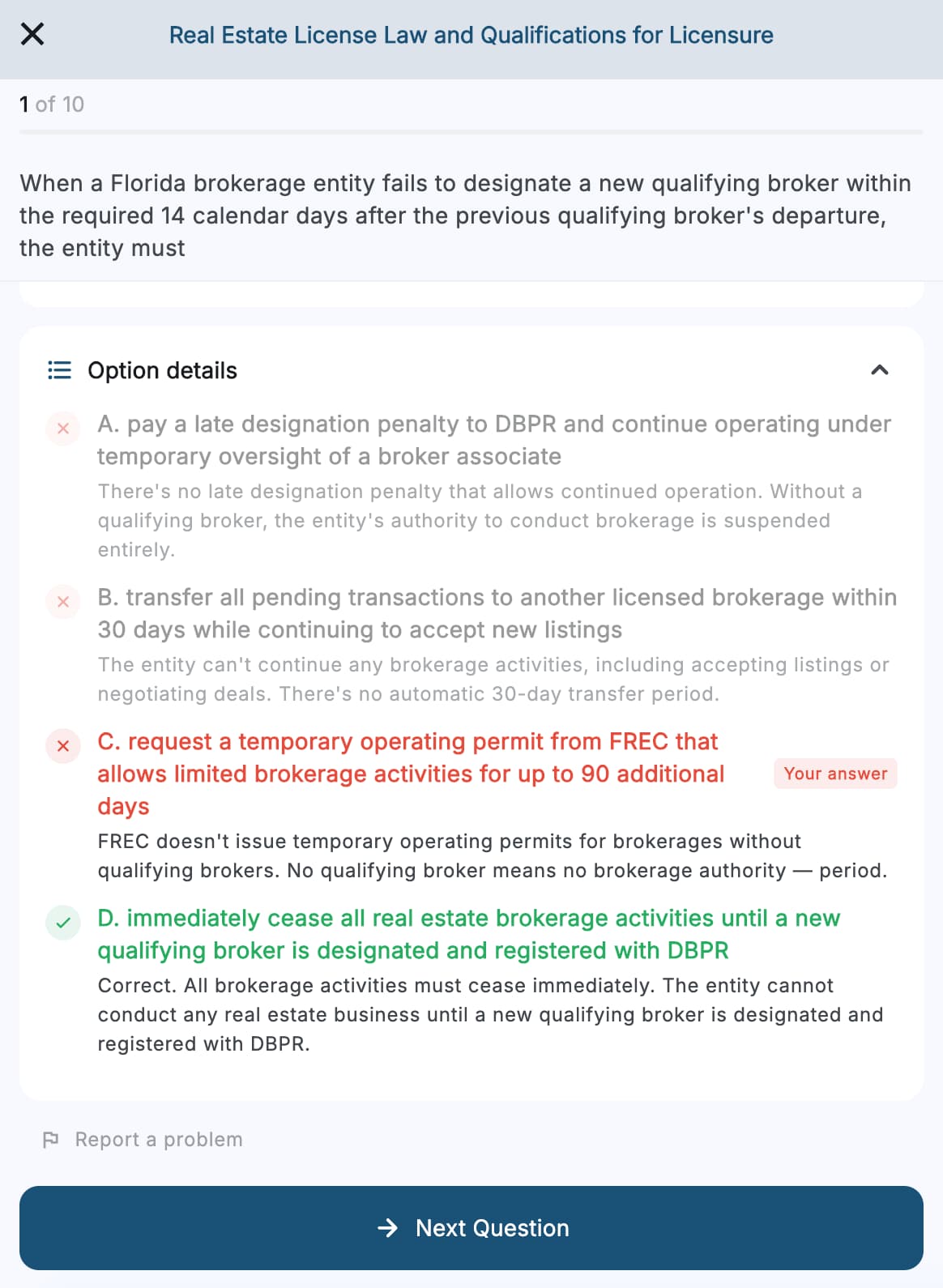
The faster path runs independent steps in parallel. Submit your DBPR application during the pre-license course. Schedule fingerprints early. Start researching brokers before exam day. Prepare for the state exam while the course material is still fresh. Same requirements. Less dead time. When you reach exam prep, drill the license law and qualifications practice questions.
Do you need a college degree? No. Do you need to live in Florida? No. Can you do this while working full-time? Yes, especially with a self-paced course. What is the step most likely to slow you down? The state exam, because it tests application under timed conditions. If you have already passed the exam and need the post-exam roadmap, the complete post-exam guide picks up where Step 4 of this guide ends.
If you are trying to start while still in school, use the Florida real estate exam college student plan. It explains course timing, degree-exemption misconceptions, semester study schedules, and first-broker questions for students.
Start with the right license route
If you are just starting, use the requirements checklist first; if you are already in the course or approved to test, move straight to exam practice and app download.
| If this is your situation | Go here next | Why it helps |
|---|---|---|
| You are checking whether you qualify | License requirements at a glance | Confirms age, education, SSN, course, application, exam, broker, and post-license requirements |
| You are comparing total cost | See the full cost breakdown and Pass Florida pricing | Separates licensing fees, optional prep, and first-year career startup costs |
| You are in the 63-hour course now | Take the free practice exam | Shows whether course recall is turning into exam-ready application |
| You have DBPR approval and an exam date | Download Pass Florida | Moves you into mobile Florida-specific practice, Math Coach, and weak-area drilling |
| You already passed the state exam | Use the post-exam guide | Covers broker choice, activation, association/MLS, and first-week setup |
Florida Real Estate License Requirements at a Glance
To meet the Florida real estate license requirements, you must be at least 18, hold a high school diploma or GED, have a United States Social Security number, complete a 63-hour FREC-approved pre-license course, submit the DBPR application with electronic fingerprints, pass the Pearson VUE state exam with a 75 out of 100, and activate your license under a sponsoring broker. Florida has no residency requirement and no college-degree requirement.
Here is every requirement in the order the Department of Business and Professional Regulation (DBPR) and the Florida Real Estate Commission (FREC) apply it:
- Be 18 or older. No upper age limit (F.S. 475.17).
- Hold a high school diploma or GED. No college degree and no specific coursework are required.
- Have a United States Social Security number. Citizenship is not required, but a valid SSN is.
- Pass DBPR's character and background review. Electronic Live Scan fingerprints feed a background check under F.S. 475.17 and F.S. 475.25.
- Complete the 63-hour pre-license course (Course I) from a FREC-approved provider and pass the school's end-of-course exam. Active Florida Bar members and holders of a four-year or higher real estate degree are exempt from the course but still take the state exam.
- Submit the DBPR RE 1 application, currently $62.75. Verify the fee in the live application before you pay.
- Pass the Pearson VUE Sales Associate exam: 100 questions, 75 to pass, 210 minutes.
- Activate under a licensed Florida broker with the RE 11 form. A sales associate cannot practice independently.
- Complete 45 hours of post-license education before your first renewal (18 to 24 months after activation), or the license becomes null and void.
| Requirement | Standard | Source |
|---|---|---|
| Age | 18 or older | F.S. 475.17 |
| Education | High school diploma or GED | F.S. 475.17 |
| Social Security number | Required (citizenship not required) | DBPR RE 1 application |
| Residency | Not required | DBPR |
| Pre-license course | 63 hours, FREC-approved | F.S. 475.17 |
| Application fee | $62.75 (verify current amount) | DBPR RE 1 |
| Fingerprints | Electronic Live Scan, $50 to $80 | DBPR |
| State exam | 100 questions, 75 to pass, 210 minutes | Pearson VUE |
| Broker activation | Required before practicing | F.S. 475.42 |
| Post-license education | 45 hours before first renewal | F.S. Chapter 475 |
Two requirements people most often get wrong. The 75% passing score is on the state exam, not the easier end-of-course school exam that many schools set at 70%. And the 45-hour post-license course is mandatory before your first renewal, even though it comes after you are already licensed. The rest of this guide turns each requirement into an action plan with timelines and costs.
Want this on one page? Download the free Florida real estate license requirements checklist (PDF), or view it online. No email required.
PREPARE FOR THE EXAM STEP
The license process is procedural. The exam is the filter.
Verify the official licensing requirement first, then use Florida-specific practice only for the sales associate knowledge exam.
Timeline: 10 to 20 weeks from course enrollment to active license | License path cost: about $260 to $1,200 before first-year business costs | Exam: 100 questions, 75 to pass, 210 minutes
How to Become a REALTOR in Florida vs Getting Licensed
In Florida, get the DBPR sales associate license first; REALTOR membership comes later through a local association if your brokerage path requires it.
Most people searching "how to become a realtor" really mean "how do I become a licensed real estate agent in Florida?" In Florida, the license is a real estate sales associate license issued through DBPR. REALTOR is a membership term for a real estate professional who belongs to the National Association of REALTORS through a local or state association.
The order is:
- Get the Florida sales associate license.
- Activate the license under a Florida broker.
- Join a local REALTOR association and MLS if your broker and market require it.
- Use REALTOR only if you are a member and follow the association's rules.
So this guide covers the license path first. The REALTOR and MLS step usually happens after broker affiliation, not before the state exam.
Step 1: Meet the Eligibility Requirements
Florida's threshold eligibility rules are age 18 or older, high school diploma or GED, U.S. Social Security number, and character/background review.
Under F.S. 475.17, you need three things:
- Age 18 or older. There is no upper age limit.
- High school diploma or GED equivalent. No college degree required. No specific coursework required.
- United States Social Security Number. You do not need to be a US citizen. Permanent residents, visa holders with work authorization, and anyone with a valid SSN can apply.
Those are the three basic threshold requirements. DBPR and FREC still review your character and background under F.S. 475.17, which the next section covers.
What You Do NOT Need
Students frequently delay because they believe requirements exist that do not:
- No Florida residency required. You can live in any state and hold a Florida real estate license. Many agents licensed in Florida live in other states and practice remotely or seasonally.
- No prior real estate experience required. The pre-licensing course teaches you from zero.
- No college degree required. A high school diploma or its equivalent is sufficient.
- No sponsoring broker required at this stage. You need a broker to activate your license after you pass the exam, not before you start the process.
Criminal Background
Eligibility also requires that DBPR and FREC be satisfied with your character and background after review. This does not mean every applicant must have a clean record. DBPR evaluates background issues under Florida's licensing statutes, the exact application questions, the nature of the conduct, time elapsed, documentation, and evidence of rehabilitation. The full framework is in the criminal background section below.
Where people lose weeks: Researching eligibility requirements that do not exist. If you are 18, have a high school diploma, and have a Social Security Number, you are eligible. The next step is enrolling in the pre-licensing course, not spending another week reading articles about whether you qualify.
Step 2: Complete the 63-Hour Pre-Licensing Course
Most candidates must complete a 63-hour FREC-approved sales associate pre-license course and pass the school's end-of-course exam before sitting for the state exam.
The course is officially called "Course I" or the "Sales Associate Pre-Licensing Course." FREC publishes a list of approved providers on the DBPR website.
Two narrow exemptions exist under F.S. 475.17: active members in good standing of the Florida Bar, and applicants who hold a four-year or higher degree in real estate from an accredited institution, do not have to take the 63-hour course. Both still submit the DBPR application and pass the state exam, and Florida Bar members must still complete the 45-hour post-license course in the first renewal cycle.
What the Course Covers
The 63 hours cover the same 19 content areas tested on the state exam:
- Real property concepts and characteristics
- Forms of property ownership
- Legal descriptions
- Real estate contracts
- Brokerage relationships and duties
- Florida license law
- Real estate finance and mortgages
- Appraisal and property valuation
- Fair housing and civil rights law
- Closing procedures and documentary stamp taxes
- Real estate math
The course teaches the material. It does not, by itself, prepare most students to pass the state exam. That distinction matters. Students who finish the course scoring 85% on the school's end-of-course exam frequently fail the state exam because the state exam tests application, not recall. Supplementing the course with practice exams and a structured study plan is how you bridge that gap.
Online vs Classroom
| Factor | Online Self-Paced | Classroom |
|---|---|---|
| Timeline | 3 to 6 weeks (depends on your pace) | 4 to 8 weeks (fixed schedule) |
| Cost | $200 to $400 | $300 to $500 |
| Schedule | Study any time, any day | Fixed days and hours |
| Interaction | Limited (email support, forums) | Live instructor, peer discussion |
| Best for | Working adults, self-motivated learners | Students who need structure and accountability |
| Accountability | Self-driven (you set the pace) | External structure (scheduled sessions) |
Online courses are faster and cheaper for students who are disciplined enough to complete them. Classroom courses are slower but provide structure that prevents procrastination. The content is identical. The FREC requirement is the same. The difference is entirely about how you learn best and how your schedule works.
How to Choose a Provider
All FREC-approved providers teach the same required curriculum. The differences are in delivery quality, support access, and whether the course includes supplemental exam prep materials.
Check for FREC approval first. This is non-negotiable. If the provider is not on the FREC-approved list, the course will not count toward your license requirements. Verify approval on the DBPR website before paying.
Ask whether exam prep is included. Some providers bundle practice exams, flashcards, and study guides with the course. Others sell the 63-hour course alone and charge separately for exam prep. If the course costs $199 but exam prep costs an additional $150, your total is $349, which may be more than a $299 course that includes both.
Read outcomes, not just course reviews. Course completion is not the goal. Passing the state exam is the goal. Reviews that say "great course, easy to follow" are less useful than reviews that explain whether the practice questions, explanations, and topic drills prepared the student for the state exam format.
The End-of-Course Exam
Every FREC-approved course includes a final exam that you must pass to receive your course completion certificate. This is not the state exam. It is the school's own exam, and it is typically easier than the state exam. Passing the end-of-course exam means you completed the education requirement. It does not mean you are ready for the state exam.
Your course provider transmits your completion electronically to the state. You do not need to mail a certificate to DBPR. The transmission is automatic.
Where people lose weeks: Treating the pre-licensing course as the hard part and coasting into the state exam. The course is a requirement. The exam is the filter. Students who spend 6 weeks on the course and 0 weeks on exam prep frequently fail the state exam and then spend another 2 to 4 weeks restudying and retaking. Allocate at least 2 to 4 weeks of dedicated exam prep after finishing the course, or overlap exam prep with the final weeks of coursework. The how to pass guide covers exactly how to structure that preparation.
Step 3: Submit Your DBPR Application and Fingerprints
Submit the DBPR application and electronic fingerprints during the 63-hour course so application review runs while you finish education.
Most guides present this step as happening after course completion. That is not a requirement. It is a habit that adds unnecessary weeks.
The Application
The DBPR Sales Associate application is submitted online at MyFloridaLicense.com. The current DBPR RE 1 application lists the fee as $62.75, but always verify the amount in the live DBPR application before you submit. For the click-by-click paperwork and scheduling walkthrough, see how to apply for and schedule the exam.
A note on fee waivers: temporary waiver programs can expire or change. Do not rely on an older article or school page for the final number. Check the DBPR application screen before you pay.
The application asks for personal information, education history, employment history, and criminal history disclosure. Answer every question completely and honestly. Incomplete applications are returned, and dishonest answers are grounds for denial regardless of what the underlying facts are.
Fingerprints
Florida requires electronic fingerprints (Live Scan) for a background check. You submit your fingerprints at an approved Live Scan vendor location near you. The cost is $50 to $80, depending on the vendor. DBPR does not accept ink-and-roll fingerprints or fingerprints submitted for other purposes. You must use a vendor in the DBPR-approved network and the correct real estate ORI. If this step stalls, use the Florida real estate fingerprints delay guide.
Schedule your fingerprints the same week you submit your application. The fingerprint results are transmitted electronically to DBPR and matched to your application. If you submit your application without fingerprints, DBPR cannot begin the background check, and your processing stalls.
Processing Timeline
| Component | Timeline | Notes |
|---|---|---|
| Application submission | Same day (online) | Submit at MyFloridaLicense.com |
| Fingerprint submission | Same week as application | Schedule Live Scan appointment |
| Background check | 3 to 7 business days | Runs automatically after fingerprints received |
| Application review | Often 5 to 10 business days for complete applications | DBPR reviews all materials |
| Status update | After review complete | Check MyFloridaLicense.com |
Processing time is commonly 5 to 10 business days from the date both your application and fingerprints are received, but background issues, missing documents, or agency volume can extend that window.
The Parallel Processing Strategy
Here is the insight that saves you 2 to 3 weeks: submit your DBPR application and fingerprints during your pre-licensing course, not after it. DBPR does not require course completion before accepting your application. The processing runs in the background while you finish your coursework. By the time you complete the course and pass the end-of-course exam, your DBPR application may already be approved, and you can schedule the state exam immediately.
Students who wait until after course completion to apply add the full processing window (5 to 10 business days) on top of their timeline as dead time. Students who apply during the course eliminate that waiting period entirely.
Tracking Your Application
Monitor your application status at MyFloridaLicense.com. The portal updates when your status changes. You do not need to call DBPR unless your application has been pending for more than 15 business days, which is uncommon for straightforward applications.
If DBPR requests additional documentation, respond promptly and keep copies. Missing records can delay review; the time needed depends on your application and the documents requested.
Where people lose weeks: Waiting until after course completion to submit the application. This is the most common sequencing mistake in the licensing process. The application and the course are independent of each other. Run them in parallel. The day you enroll in your pre-licensing course, create your DBPR account and submit your application. The day after that, schedule your Live Scan fingerprints.
Step 4: Schedule and Pass the State Exam
The Florida sales associate exam has 100 multiple-choice questions, a 3.5-hour time limit, and a 75-point passing score.
Steps 1, 2, 3, and 5 are procedural. Complete the requirements and you advance. Step 4 is different. It tests whether you can apply Florida real estate concepts under timed conditions.
Exam Details
| Detail | Specification |
|---|---|
| Questions | 100 multiple-choice (A/B/C/D) |
| Time limit | 210 minutes |
| Passing score | 75 out of 100 |
| Cost | $36.75 per attempt, verify current fee with Pearson VUE |
| Testing provider | Pearson VUE |
| Format | Computer-based, in-person only |
| Results | Immediate (score report prints at the center) |
| Retake booking | Check Pearson VUE account eligibility and available appointments |
| Application window | 2 years from the date DBPR receives your application to pass the exam |
Which exam? Most initial candidates take the 100-question Sales Associate Exam and need 75 to pass. Eligible mutual-recognition candidates take the shorter Florida Real Estate Law Exam, which requires a grade of 30. An education exemption, including Florida Bar membership, does not by itself establish eligibility for that exam. Follow the exam named in your DBPR and Pearson VUE authorization.
Scheduling the Exam
You can schedule your exam at Pearson VUE once your DBPR application is approved and your course completion is on file. Pearson VUE testing centers are located throughout Florida, and appointment availability varies by location. Major metro areas such as Miami, Orlando, Tampa, and Jacksonville usually have more options. Smaller markets may have limited dates.
Schedule your exam 2 to 4 weeks after completing your pre-licensing course. This gives you time for dedicated exam preparation without letting the material go stale. Students who schedule immediately after the course finish without adequate prep time. Students who wait too long forget what they learned in the first weeks of the course.
How to Prepare for the Florida Real Estate Exam
Use a diagnostic, study by DBPR topic weight, drill active practice questions, practice math, and take two timed 100-question exams before test day.
What the Pass Rate Tells You
Pass-rate data changes by reporting period, school mix, and retake volume. The useful lesson is stable: many candidates underestimate the exam because they treat the pre-license course as full exam prep. The course teaches the material. The state exam asks you to apply it under time pressure, often with answer choices that sound close.
Use the Florida exam pass-rate guide as a calibration tool, not a prediction about your own result. Your score depends less on statewide averages and more on whether you can handle contracts, brokerage relationships, license law, property rights, math, and Florida-specific traps without guessing.
How to Prepare
The how to pass guide covers exam preparation in detail. The short version:
- Take a diagnostic practice exam cold before you start studying. Identify which of the 19 content areas need work.
- Study by topic weight, not chapter order. Brokerage Activities and Real Estate Contracts (12% each) carry the most questions, followed by Residential Mortgages (9%), then Property Rights and Appraisal (8% each). Start there.
- Practice actively. Do 20 to 30 practice questions per study session. Passive reading does not prepare you for a timed multiple-choice exam.
- Do not skip the math. The official Computations and Closing area is 6%, but math also appears inside finance, taxes, appraisal, legal descriptions, and brokerage commission questions, so its real footprint on the exam is larger. The math formulas guide covers every formula you need.
- Take two full timed practice exams (100 questions, 210 minutes). If you score above 80% on both with no single topic below 65%, you are ready.
The 30-day study plan structures this preparation day by day if you want a complete schedule.
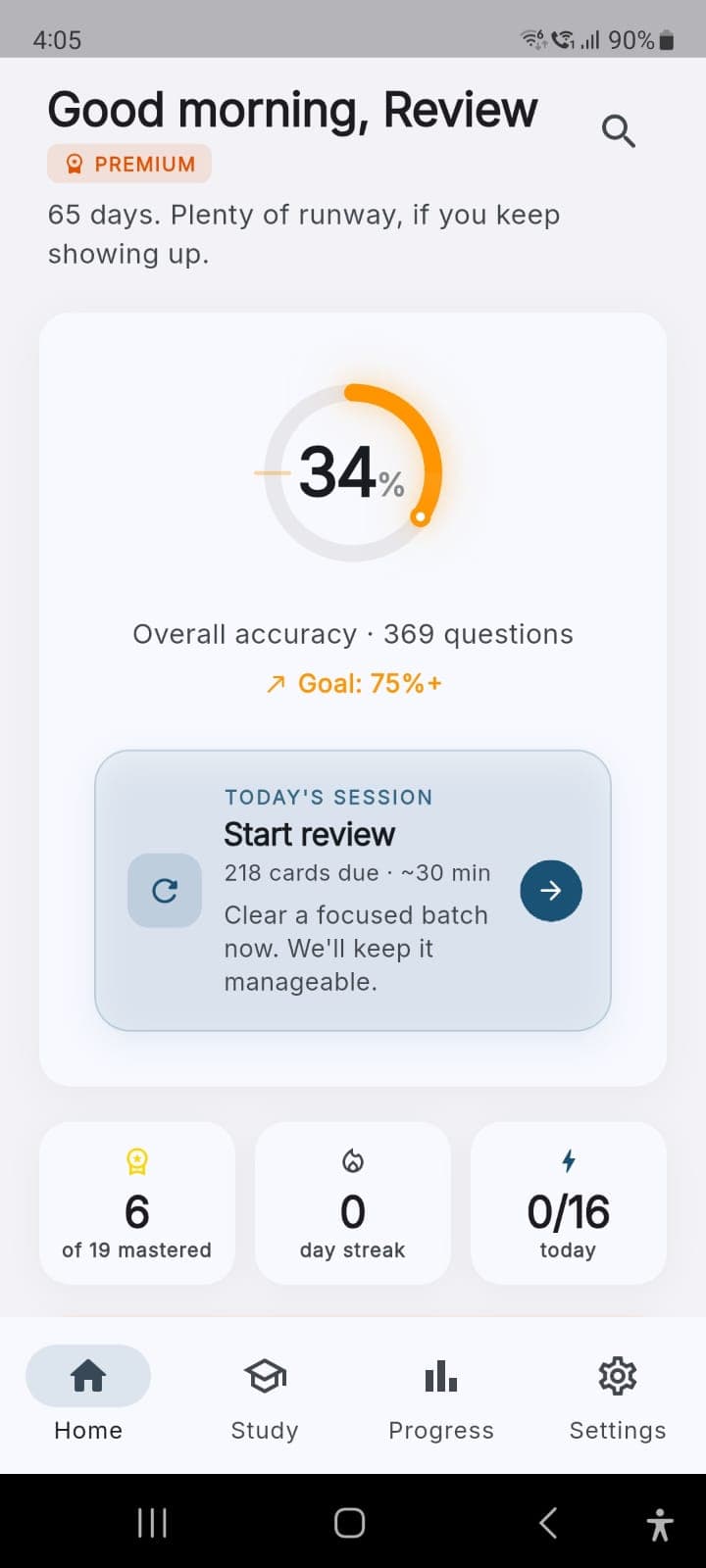
Take the free practice exam, or download the full 1,142-question bank to drill Step 4 before test day.
What to Bring on Exam Day
- Two forms of ID: one government-issued with photo and signature, one with signature
- Your course completion certificate. Pearson VUE lists Certification of Pre-licensing Education Completion for sales and broker candidates. Bring the required certificate or accepted exemption documentation and follow your authorization instructions; do not assume an electronic record replaces admission documents.
- A basic handheld calculator (silent, non-printing, no alphabetic keypad)
- Your Pearson VUE confirmation email or number
Leave your phone in your car. The exam day guide covers the full check-in process, testing room procedures, time management strategy, and what to do if you fail.
If You Fail
Check your Pearson VUE account for retake eligibility and the next available appointment. Each new attempt requires another exam fee, and your DBPR application window is limited. If you do not pass within the application window, you may need to reapply and pay DBPR again.
Do not retake just because the system lets you schedule. Review your score report, identify the content areas that cost you the most points, study those topics for 1 to 3 weeks, and retake when your practice exam scores show real improvement.
Where people lose weeks: Failing the exam and retaking it within days without changing their study approach. Each failed attempt costs another exam fee (see the exam cost and retake-fee breakdown) and, more importantly, adds delay. A focused prep tool that fixes weak areas is usually a better investment than repeating the same study routine and hoping for easier questions.
Step 5: Find a Broker and Activate Your License
A Florida sales associate cannot practice independently; your license must be active under a registered broker before you perform real estate services.
This is not a suggestion. It is Florida law. Practicing real estate without an active license under a broker is a third-degree felony.
Why You Need a Broker
A sales associate in Florida cannot operate independently. Every transaction you conduct, every listing you take, every buyer you represent, everything happens under your broker's supervision and authority. Your broker provides:
- Legal authorization to practice real estate
- Errors and omissions insurance coverage
- MLS access (through board membership, which requires a broker affiliation)
- Training and mentorship (varies by brokerage)
- Transaction management tools and systems
The RE 11 Form
The RE 11 Become Active form ties your license to a specific broker. In practice, the broker usually handles the activation through DBPR's online system, although DBPR's own instructions also allow activation once employment is secured. After DBPR processes the activation, your license status changes to "Active" on MyFloridaLicense.com, and you can begin practicing.
Processing time varies by submission method and DBPR workload. Most brokerages submit electronically, and you should wait until your status shows "Active" before doing anything that requires an active license.
When to Start Looking for a Broker
Start researching brokers during your pre-licensing course and interview while your application is being processed. DBPR approval comes before exam booking. After you pass, agree on the brokerage terms and have your broker complete activation before you practice.
The complete post-exam guide covers broker selection in depth: what to evaluate, what commission splits mean in practice, red flags to watch for, and the three broker models (national franchise, independent brokerage, team). That guide picks up exactly where this one ends and walks you through every step from score report to first listing.
What Happens After Activation
After initial licensure, track your renewal deadline separately from brokerage onboarding:
-
Post-licensing education: Complete the required 45-hour post-license course before the first expiration date shown in your DBPR account, generally 18 to 24 months after initial licensure, even if the license remains inactive. Broker activation does not restart that clock. A qualifying four-year or higher real estate degree provides an education exemption. Missing required post-license education can make the license null and void; check DBPR for any applicable exemption or hardship relief.
-
Board, association, and MLS enrollment: If your broker's model requires REALTOR association membership and MLS access, handle those steps soon after activation. REALTOR membership is separate from the Florida license, but many brokerages require association and MLS participation for practical day-to-day work.
Where people lose weeks: Waiting until after they pass the exam to start thinking about brokers. The broker decision is on your critical path. DBPR processing and broker activation time happen whether you have chosen a broker or not. If you wait to start your broker search until after you pass, you add research and interview time on top of the processing time. If you research and interview during the process, the steps overlap and your activation timeline compresses.
What It Costs to Get Licensed
These are planning ranges for a standard applicant who needs the course and passes on the first attempt. Course and fingerprint prices are vendor estimates; prep is optional, and exemptions or retakes change the total.
Budget about $260 to $1,200 for the license path, including exam prep and before first-year career costs. The required fees and course alone run about $220 to $980. The published application and testing fees are $62.75 to DBPR and $36.75 to Pearson VUE for one standard sales associate exam attempt. Fingerprints add $50 to $80. The pre-licensing course creates most of the range, from about $70 to $800 depending on format and whether exam prep is bundled.
Board and MLS dues, E&O insurance, lockbox access, and marketing arrive after activation. They are career startup costs, not licensing requirements. The full line-by-line budget, including three sample first-year scenarios, lives in the Florida real estate license cost guide. For the exam fee alone, including retake, cancellation, and no-show rules, use the Florida real estate exam cost guide.
Where people lose weeks: Shopping for the cheapest pre-licensing course without considering exam prep. A cheap course with no practice questions can become expensive if it leads to retakes, extra study time, and delayed activation. The cheapest course is not always the cheapest path.
THE COST YOU CONTROL
Choose prep around the topics you need to improve.
Each additional attempt costs $36.75, plus any extra preparation time. Pass Florida drills the one step the license process cannot guarantee: 1,142 Florida-specific practice questions, a 19-topic diagnostic, Math Coach, and a Trap Library, for one $39.99 purchase. No subscription. No copied exam questions.
The Real Timeline: 10 to 20 Weeks
Use 10 to 20 weeks as a planning allowance, not an official average or minimum. The examples below show how overlapping course study and application processing can reduce waiting. Some candidates finish sooner; application issues, limited appointments, or retakes can extend the schedule.
The work itself is the same. The sequencing determines the calendar time.
The Sequential Timeline (16 to 20 Weeks)
This is how most people do it. Each step waits for the previous one:
| Step | Duration | Running Total |
|---|---|---|
| Pre-licensing course | 4 to 8 weeks | 4 to 8 weeks |
| Submit DBPR application + fingerprints | 1 week to prepare, 5 to 10 business days to process | 7 to 11 weeks |
| Exam preparation | 2 to 4 weeks | 9 to 15 weeks |
| Schedule and take exam | 1 to 2 weeks | 10 to 17 weeks |
| Find broker and activate | 1 to 3 weeks | 11 to 20 weeks |
The Parallel Timeline (10 to 14 Weeks)
This is how you compress the process:
| Weeks 1-2 | Enroll in pre-licensing course. Submit DBPR application and fingerprints the same week. |
|---|---|
| Weeks 3-6 | Complete pre-licensing course. DBPR processes your application in the background. Begin reviewing exam prep materials during final course weeks. |
| Weeks 7-8 | Course complete. DBPR already approved. Begin dedicated exam preparation. Start researching brokers. |
| Weeks 9-10 | Take and pass the state exam. Interview brokers. |
| Weeks 11-12 | Select broker. Broker submits RE 11. License activates. |
The parallel timeline saves 4 to 8 weeks by overlapping independent steps. The DBPR application does not depend on course completion. Broker research does not depend on exam results. Exam prep can overlap with the final weeks of the pre-licensing course. Every step that does not depend on a previous step should run concurrently.
The Two Bottlenecks
Bottleneck 1: The pre-licensing course. Online self-paced students who study 10 to 15 hours per week can complete the 63-hour course in 4 to 6 weeks. Classroom students follow a fixed schedule, typically 6 to 8 weeks. This is the step that determines the minimum timeline. You cannot go faster than your course allows.
Bottleneck 2: The state exam. If you fail, add time for score review, weak-area study, and another appointment. Each failure extends your timeline and costs another exam fee. This is the only bottleneck you can control through preparation. Students who invest in exam prep before taking the exam avoid the most common delay in the entire process.
Where people lose weeks: Running every step sequentially when three of the five steps can overlap with others. The application, the course, and broker research are independent activities. Running them in parallel is the single most effective way to compress your timeline without rushing your preparation.
Criminal Background: How DBPR Reviews It
DBPR reviews criminal history case by case under the application questions, F.S. 475.17, and F.S. 475.25; there is no public one-line pass/fail list.
Criminal-background decisions are fact-specific. Use this as an orientation to the DBPR application and Florida statutes, not as a guarantee that a specific record will or will not be approved.
The Statutory Standard
F.S. 475.17 requires an applicant to be honest, truthful, trustworthy, of good character, and competent to deal safely with the public. F.S. 475.25(1)(f) authorizes discipline or denial when a person has been convicted or found guilty of, or entered a plea of nolo contendere to, a crime that directly relates to real estate brokerage activity, involves moral turpitude, or involves fraudulent or dishonest dealing.
The key point: DBPR does not publish a simple public list that says "this offense always passes" and "this offense always fails." The question is how the facts fit the statute, the application, and FREC's public-protection role.
What "Moral Turpitude" Means in Practice
The term is deliberately broad. It is applied case by case, not by category. However, certain offenses commonly create more scrutiny because they can relate to honesty, public safety, trust, or handling other people's money:
- Fraud and financial crimes: Forgery, embezzlement, identity theft, mortgage fraud
- Theft: Grand theft, robbery, burglary
- Violent offenses: Assault, battery, domestic violence
- Drug trafficking or distribution
- Perjury
- Sex offenses
Offenses That Often Require Context
The following examples are not safe-harbor categories. They are situations where the outcome may depend heavily on age of the offense, final disposition, whether all sanctions were satisfied, whether there were repeat offenses, and how clearly the applicant documents rehabilitation:
- A first-offense DUI with completed probation and no aggravating factors may be reviewed differently from multiple DUIs, a DUI involving serious injury, or a DUI paired with other recent conduct.
- Older minor misdemeanors may be reviewed differently from recent conduct, repeat conduct, or conduct involving dishonesty, theft, violence, or public safety.
- Juvenile matters may require a different analysis depending on the record, disposition, age of the applicant, and whether the conduct involved serious felonies.
For the full statutory picture, including why real estate applicants should not rely on the widely cited 5-year lookback in F.S. 455.213, see applying for a Florida real estate license with a criminal record.
Criminal Background Documents and Disclosure Rules
If the live DBPR application requires a "yes" answer, gather the arrest report, disposition or final order, proof that sanctions were satisfied, and any probation-status documentation before submitting.
Sealed and Expunged Records
Do not guess here. The DBPR RE 1 application says that if you intend to answer "No" because you believe records have been expunged or sealed under F.S. 943.0585, F.S. 943.059, or another state's law, you are responsible for verifying the expungement or sealing before answering. The same application warns that your answer may be checked against local, state, and federal records, and that an inaccurate answer may result in denial or revocation.
Practical rule: read the live application question exactly, verify the court order and legal status of the record, and consult a Florida licensing attorney or DBPR if you do not fully understand how to answer. Do not rely on memory, a school employee, or a generic internet answer for sealed or expunged records.
If You Answer Yes
DBPR's knowledge base says it is imperative to read the criminal-history question carefully and fully disclose all incidents that apply. If you answer "yes" to one of the background questions, the application requires review and approval by the Florida Real Estate Commission. DBPR says the commission meets once a month and has up to 90 days from the date a complete application is received to make a decision.
DBPR also lists the documentation normally required for a criminal-history disclosure: a written explanation, arrest report, disposition or final order, proof that all sanctions have been served and satisfied, and, if you are still on probation, a letter from your probation officer on official letterhead. If you want guidance before spending money, contact DBPR or qualified counsel directly. Do not assume a non-binding pre-application review is available unless DBPR confirms that path for your situation.
Three Rules for Applicants With Criminal Backgrounds
Rule 1: Answer the live application accurately. DBPR may check your answers against local, state, and federal records. Failure to answer accurately can become its own reason for denial or revocation, even when the underlying issue might have been manageable.
Rule 2: Time matters. An offense from 15 years ago with no subsequent issues is treated differently from the same offense 2 years ago. DBPR considers the totality of circumstances: the nature of the offense, the time elapsed, evidence of rehabilitation, completion of all court requirements, and any subsequent criminal activity.
Rule 3: Documentation helps. Letters of completion from probation, certificates from rehabilitation programs, character reference letters, and evidence of community involvement all support your application. DBPR does not just look at the conviction. It looks at what happened after.
Where people lose weeks: Assuming a past record automatically disqualifies them and never starting the process. Or worse, answering quickly without reading the exact application wording, then creating a disclosure problem that is harder to fix than the underlying record. If you have a criminal background, gather the records first, read the current DBPR application carefully, and get qualified help before guessing.
2026 Career Context: What Changed After the NAR Settlement
The Florida license steps are the same, but new agents now need stronger buyer-agreement and compensation conversations after activation.
New agents now need to be more comfortable explaining buyer representation, broker fees, compensation, and written agreements before they ever open a door for a client.
NAR Settlement: Buyer Broker Agreements Required
The National Association of REALTORS settlement, effective August 17, 2024, changed common industry practices around buyer representation and MLS compensation displays:
Written buyer agreements matter earlier. Many REALTOR-affiliated and MLS-based practices now require a written buyer agreement before a property tour. Your exact form set and workflow depend on your brokerage, association, and client situation. The brokerage relationships guide explains the Florida representation concepts you need before those conversations.
Buyer agent compensation is discussed more directly. Compensation is no longer something a new agent can treat as background MLS plumbing. You need to understand how your broker explains fees, seller concessions, buyer-paid compensation, and written agreements.
What this means for you: the career you are entering requires you to articulate your value to buyers before you show them a single home. Agents who cannot explain what they do, what it costs, and why it is worth paying for will struggle to sign buyer agreements. This is a skill your brokerage training should cover. Ask about it during your broker interviews.
Do Not Plan Around Proposed Law Changes
Florida legislation can change licensing, education, and renewal rules. That does not mean a proposed bill changes your current requirements. Plan from current DBPR requirements, not social media posts or school marketing pages.
For now, the practical rule is simple: complete your 45-hour sales associate post-license education before your first renewal unless DBPR says otherwise. Florida statute treats a missed post-license deadline seriously. Under F.S. 475.17, a sales associate who misses the required post-license education before first renewal can become null and void, which may require requalifying.
Where people lose weeks: Reading about proposed changes and assuming they do not need to complete post-licensing education. Plan around the rule that exists on DBPR, then adjust only if the state changes the requirement.
The 4 Decisions That Determine How Fast You Get Licensed
The four timeline decisions are course format, when you submit the DBPR application, how you prepare for the exam, and when you start broker interviews.
Every step in this guide matters, but four decisions carry disproportionate weight in determining whether you get licensed in 10 weeks or 20.
1. Online or classroom. This is not a quality decision. It is a pace decision. Online self-paced courses let you move as fast as you can study. Classroom courses move at the instructor's pace. If you are working full-time and studying evenings, online gives you more hours per week. If you struggle with self-discipline, classroom provides the structure. The pre-licensing section covers both formats in detail. Pick the one that matches how you actually behave, not how you wish you behaved.
2. When to submit your DBPR application. Submitting during your course instead of after saves 1 to 3 weeks. The application and the course are independent. There is no reason to wait. The application section explains the parallel processing strategy.
3. How much you invest in exam preparation. The state exam is where many otherwise qualified candidates lose time. Students who supplement the pre-licensing course with structured practice questions, math drills, and timed review usually make better decisions than students who rely on course notes alone. Two to four weeks of focused exam prep can be the difference between staying on schedule and adding a retake cycle. The how to pass guide covers the preparation in full.
4. When you start looking for a broker. The broker search does not depend on your exam result. Start during the pre-licensing course, interview during DBPR processing, and make your decision before exam day. Students who wait until after passing to start the broker search add 2 to 4 weeks of research and interviews on top of the RE 11 processing time.
These four decisions are all timing decisions. The work is the same regardless of when you do it. The timeline changes based on whether you stack the work or overlap it.
Licensing Process and Common-Mistake Reference
The most common licensing delays come from weak sequencing, late application submission, poor exam prep, and waiting too long to choose a broker.
For the eligibility rules themselves, use the requirements checklist near the top of this guide. This table is the companion: the process steps, cost cadence, and deadlines that sit between the requirements, plus the most common mistake at each one.
| Item | Detail | Common Mistake |
|---|---|---|
| Pre-licensing cost | $70 to $800 | Cheapest course is not always cheapest path (exam prep matters) |
| Pre-licensing timeline | 3 to 8 weeks | Online self-paced is faster |
| End-of-course exam | Required for course certificate | Not the state exam; passing it does not mean you are exam-ready |
| DBPR processing | 5 to 10 business days | Submit during the course, not after |
| State exam fee | $36.75 per attempt | Each retake costs $36.75 |
| Pass-rate data | Changes by reporting period | Use it to calibrate prep, not predict your result |
| Retake wait time | Pearson VUE currently lists 24 hours | Do not retake without additional study |
| Application window | 2 years from the date DBPR receives your application | Must pass exam within 2 years or reapply |
| RE 11 form | Usually handled by the broker online | Your license must be active under a broker before you practice |
| License activation | Varies after broker submission | Do not practice before status shows "Active" |
| First renewal | DBPR expiration date, generally 18 to 24 months after initial licensure | Complete required post-license education before that date, even if inactive |
| Planning timeline | Allow 10 to 20 weeks; individual timing varies | Overlap coursework and application processing where possible |
| Criminal background | DBPR reviews individually | Always disclose; concealment is grounds for denial |
Screenshot this table. Every row is a process step, cost, or deadline that sits between the core requirements.
5 Licensing Decision Scenarios
These five scenarios test the decisions most likely to cost Florida candidates time, money, or a failed exam attempt.
These are not exam questions. They are decisions that people actually face during the licensing process. Work through each one before checking the answer.
Scenario 1: The Course Decision
You find a FREC-approved online pre-licensing course for $149. Another FREC-approved course costs $349 and includes a practice exam bank, flashcards, and a study guide for the state exam. You are on a tight budget. Which course should you choose?
Show answer & reasoning
The answer depends on whether you plan to buy exam prep separately.
Both courses satisfy the same FREC requirement. The $149 course produces the same course completion certificate as the $349 course. The difference is what comes after. The state exam rewards applied practice, not just course completion, so you need a separate plan for practice questions, topic review, and math.
If you choose the $149 course and separately purchase an exam prep tool for $50 to $100, your total is $199 to $249 with targeted exam preparation. If you choose the $349 course with built-in exam prep, your total is $349 but you have everything in one package.
The mistake: choosing the $149 course, skipping exam prep entirely, failing the state exam, and then spending $36.75 per retake plus additional weeks of delay. The $149 "savings" costs you more in retake fees and lost time than the $200 price difference.
Budget for exam prep. Whether you bundle it with your course or buy it separately, do not skip it.
Scenario 2: The Application Timing
You enrolled in an online pre-licensing course last week. You have 55 hours of coursework remaining. Should you submit your DBPR application and schedule your fingerprints now, or wait until you finish the course?
Show answer & reasoning
Submit now. Do not wait.
Your DBPR application and your pre-licensing course are independent requirements. DBPR does not require course completion before accepting your application. If you submit now, DBPR processes your application (5 to 10 business days) while you complete your remaining coursework. By the time you finish the course, your application may already be approved.
If you wait until course completion to submit, you add the full processing window on top of your timeline as dead time. That is 1 to 2 weeks of waiting that serves no purpose.
Schedule your Live Scan fingerprints this week as well. The fingerprint results are transmitted electronically to DBPR and matched to your application. If DBPR has your application but not your fingerprints, the background check stalls.
The parallel processing strategy described in the application section is the single easiest way to compress your licensing timeline. It costs nothing. It requires no extra effort. It simply means doing two independent things at the same time instead of one after the other.
Scenario 3: The Background Question
You have a DUI conviction from 6 years ago. You completed all court requirements, paid all fines, and have had no subsequent offenses. Your record was not expunged or sealed. Should you disclose the DUI on your DBPR application?
Show answer & reasoning
Yes, if the live DBPR application question applies to that conviction. Do not treat it as optional.
DBPR runs a fingerprint-based background check on every applicant. The DUI may appear in the results. If you disclose it when the application requires disclosure, DBPR reviews the conviction on its merits: the nature of the offense, the time elapsed, completion of court requirements, and any subsequent activity. A first-offense DUI from 6 years ago with full compliance and no subsequent issues is a different fact pattern from multiple recent DUIs or a DUI involving serious injury, but DBPR still reviews the actual record.
If the application requires disclosure and you do not disclose it, DBPR may discover both the conviction and the inaccurate answer. That creates a character issue separate from the DUI itself. DBPR may deny or later discipline a license based on inaccurate application answers, even when the underlying event might have been reviewed more favorably if disclosed correctly.
The criminal background section covers the full framework. The rule is simple: read the live question, answer accurately, and do not make the decision for DBPR by hiding information.
Retake and Broker Decision Scenarios
Retake timing and broker choice are the two post-exam decisions most likely to extend your timeline after you become eligible to test.
Scenario 4: The Retake Decision
You scored 72 on the state exam. Three points short of passing. Pearson VUE currently allows candidates to schedule after a 24-hour wait. Should you schedule a retake for tomorrow?
Show answer & reasoning
No. Study for 2 to 3 more weeks, then retake.
A score of 72 means you missed 28 questions. Three points short feels close, but it represents knowledge gaps in multiple content areas. Your score report shows performance by topic. The topics where you scored lowest are the topics where you need additional study. Retaking tomorrow without addressing those gaps is likely to produce a similar result.
The retakers who improve are usually the ones who change their approach. The retakers who struggle again are the ones who assume they were "almost there" and just need different questions.
Review your score report by content area. Identify the 2 to 3 topics where you lost the most points. Spend 2 to 3 weeks working through practice questions in those specific areas. If a topic like contracts or brokerage relationships was a weak spot, read the dedicated guide for that topic. Retake when you are scoring above 80% on practice exams.
A 72 is not a reason to panic. It is a reason to study differently, not harder.
Scenario 5: The Broker Rush
You passed the exam yesterday. A recruiter from a national franchise brokerage calls you today and offers a position with a 50/50 commission split. The recruiter says the offer is available this week only. Should you accept?
Show answer & reasoning
Do not accept a same-day offer from any brokerage.
A broker who pressures you to sign immediately is prioritizing their recruitment numbers over your career decision. The brokerage will still have openings next week. And the week after that. Every brokerage in Florida is recruiting new agents continuously. The "limited time" framing is an urgency tactic.
Interview at least three brokerages before committing. The post-exam guide covers the full evaluation framework: training programs, lead generation, commission splits, fee structures, mentorship access, and red flags. A 50/50 split with strong training and mentorship often produces more first-year income than a 70/30 split with no support, because the training generates closings that the split applies to.
Use the time around exam results and broker activation to interview brokers, compare offers, and make an informed decision. The broker you choose determines your training, your daily support system, and your probability of surviving the first year. That decision deserves more than a 30-minute phone call with a recruiter.
What to Do Next
If you qualify, enroll in the course, submit the DBPR application during the course, schedule fingerprints, and begin exam prep before the course certificate goes stale.
If you got all five right: You understand the licensing process and the decisions within it. Enroll in a pre-licensing course this week and submit your DBPR application the same week. Your licensing clock starts when you start.
If you got three or four right: Review the scenario you missed. The decision you got wrong is the one most likely to cost you time or money during the process. Reread the relevant section, especially the "where people lose weeks" callout at the end. The knowledge is close. The practical application needs one more pass.
If you got two or fewer right: Read each section of this guide carefully before spending any money. The licensing process is simple, but the decisions within it have real consequences for your timeline and budget. Understand the full picture before enrolling in a course, and bookmark this guide so you can reference it at each step.
Get licensed in your Florida city
The state licensing steps are identical statewide, but course providers, Pearson VUE test centers, and local brokerage markets vary by metro. These city guides cover the local details on top of the statewide process above.
The 63-hour course, DBPR application, and state exam work the same in every county. What changes locally is where you test, which schools operate nearby, and what the brokerage market looks like when you activate. Pick your city:
- Boca Raton
- Bradenton
- Brandon
- Cape Coral
- Clearwater
- Coral Springs
- Davie
- Daytona Beach
- Doral
- Fort Lauderdale
- Fort Myers
- Fort Pierce
- Fort Walton Beach
- Gainesville
- Hialeah
- Hollywood
- Homestead
- Jacksonville
- Key West
- Kissimmee
- Lakeland
- Lehigh Acres
- Melbourne
- Miami
- Miami Gardens
- Miramar
- Naples
- Ocala
- Orlando
- Palm Bay
- Palm Coast
- Pembroke Pines
- Pensacola
- Plantation
- Pompano Beach
- Port St. Lucie
- Sarasota
- Spring Hill
- St. Augustine
- St. Petersburg
- Tallahassee
- Tampa
- The Villages
- Wesley Chapel
- West Palm Beach
Ready to clear the one step the license process cannot procedurally guarantee?
The state exam is the step where a focused Florida question bank can shorten the timeline by reducing retake risk.
Four of the five licensing steps are procedural. Meet the eligibility requirements. Complete the course. Submit the application. Find a broker. Those steps require time and money, not exam skill. Step 4 is different. You need to answer 75 out of 100 questions correctly under timed conditions, and you need to recognize Florida-specific wording traps quickly.
Verify the official licensing step first, then use exam practice only for the knowledge test.
Take the free practice exam | See what the one-time purchase includes | Download Pass Florida
Related Licensing and Exam Resources
The best related guides are the app page, Statute 475, exam-failure prevention, second-career planning, and the retake checklist.
| If you are deciding... | Read this next |
|---|---|
| Which Florida-specific prep tool fits the exam step | Florida real estate exam prep app |
| What legal backbone the license path tests | Florida Statute 475 real estate guide |
| How to avoid the common study mistakes before booking | How to fail the Florida real estate exam |
| Whether a second career in Florida real estate is realistic | Florida real estate as a second career |
| What to do if the first exam attempt goes badly | Retake action plan checklist |
Frequently Asked Questions
What are the requirements to get a Florida real estate license?
You must be at least 18, have a high school diploma or GED, have a U.S. Social Security number, complete the 63-hour FREC-approved course unless exempt, submit the DBPR application and fingerprints, pass the 100-question state exam with 75, and activate under a broker.
How much does a Florida real estate license cost?
Budget about $260 to $1,200 including exam prep, before first-year career startup costs. The fixed DBPR plus Pearson fee floor is $99.50, while course tuition, fingerprints, optional prep, and retakes create most of the range. See the Florida real estate license cost guide for the full breakdown.
How long does it take to get a Florida real estate license?
Plan for 10 to 20 weeks from course enrollment to active license. The faster path submits the DBPR application and fingerprints during the course, starts broker research early, and passes the state exam on the first attempt.
Do I need a college degree to get a Florida real estate license?
No. A high school diploma or GED is enough. A four-year or higher real estate degree can create a course exemption, but a regular college degree is not required.
Do I need to be a Florida resident to get a Florida real estate license?
No. Florida does not require state residency for sales associate licensure. You still need to satisfy DBPR requirements and work under a Florida broker before practicing.
Can I take the pre-licensing course online?
Yes. FREC-approved providers may offer classroom or online pre-license courses. Online is usually faster for disciplined students; classroom works better if you need scheduled structure.
What is the Florida real estate exam pass rate?
Pass-rate data changes by reporting period, school mix, and retake volume. Use the pass-rate guide for calibration, then build your own plan around practice questions and weak-area review.
How many questions are on the Florida real estate exam?
The sales associate exam has 100 multiple-choice questions covering 19 DBPR content areas. You get 210 minutes, and the questions test application, not just definitions.
What score do I need to pass the Florida real estate exam?
You need 75 out of 100 to pass the sales associate exam. Eligible mutual-recognition candidates take the shorter Florida Real Estate Law Exam and need 30 points. A course exemption alone does not establish eligibility for that exam; follow your DBPR authorization.
What happens if I fail the Florida real estate exam?
Each retake requires another exam fee. Check your Pearson VUE account for retake eligibility and available appointments. Review the score report, drill weak topics for 1 to 3 weeks, then retake when practice scores improve.
Can I get a real estate license with a felony in Florida?
Possibly. DBPR reviews criminal history individually under F.S. 475.17, F.S. 475.25, and the live application questions, so read the question carefully and get qualified guidance before guessing.
Can I get a real estate license with a DUI in Florida?
Possibly. A DUI is reviewed in context, including age of the offense, final disposition, completed sanctions, aggravating facts, and later conduct. Do not conceal a record the DBPR application requires you to disclose.
What is the DBPR application fee for a Florida real estate license?
The current DBPR RE 1 sales associate application lists $62.75. Because fees can change, verify the amount inside MyFloridaLicense.com before paying.
How do I become a REALTOR in Florida?
First get licensed and activate under a broker. Then join a local REALTOR association if your brokerage path requires it. REALTOR is a NAR membership term, not a separate Florida license.
Do I need a broker before I take the exam?
No. You need a broker to activate after you pass, not to apply, take the course, or sit for the exam. Start broker research early anyway so activation does not become a delay.
What is the RE 11 form?
The RE 11 is the Become Active form that ties your license to a sponsoring broker. Many brokers handle activation online, but you should wait until DBPR shows your status as Active before practicing.
What is post-licensing education and when is it due?
Florida requires new sales associates to complete 45 hours of post-license education before the first renewal. Missing the deadline can make the license null and void, so do it early after activation.
Methodology
Fees, processing windows, exam rules, association requirements, and legislation can change, so verify fee-sensitive details with DBPR, Pearson VUE, your course provider, and your broker before you apply.
Product Note
Pass Florida is our Florida-specific exam prep app. This page references our own product, so the relationship is direct and disclosed. We do not claim to use copied exam questions, guarantee passage, or replace official DBPR, Florida Real Estate Commission (FREC), Pearson VUE, course provider, broker, legal, tax, or professional guidance.
Sources
- DBPR real estate sales associate requirements PDF
- DBPR RE 1 sales associate application PDF
- Pearson VUE Florida Real Estate & Appraisers licensing exams
- Florida real estate candidate fact sheet, Pearson VUE PDF
- Florida Statutes Chapter 475, Florida Senate
- Florida Statute 943.0585, court-ordered expunction
- DBPR background-question documentation guidance
- NAR: How to become a REALTOR
- NAR consumer guide to written buyer agreements
- NAR definition of REALTOR
This post is educational content about Florida real estate licensing. It is not legal, tax, brokerage, licensing, immigration, employment, or professional advice. DBPR application fees, Pearson VUE exam fees, course tuition, fingerprint vendor pricing, REALTOR association dues, MLS dues, post-license education rules, and criminal-background analysis can change. Always verify your specific path with DBPR, Pearson VUE, your course provider, your broker, and qualified counsel before paying fees, scheduling an exam, or making a career decision based on this article.