QUICK ANSWER
Start a 30-day Florida real estate exam plan with a cold diagnostic. Use Days 1 to 3 to diagnose, Days 4 to 10 to repair weak rules, Days 11 to 17 for math and traps, Days 18 to 24 for mixed practice, and Days 25 to 30 for timed proof. The exam is administered by Pearson VUE on behalf of the Florida Department of Business and Professional Regulation (DBPR) and the Florida Real Estate Commission (FREC): 100 multiple-choice questions, 3.5 hours, 75 points to pass.
WHO THIS PLAN IS FOR
Use this plan if your 63-hour course is complete or nearly complete, your exam is about 3 to 5 weeks away, and you can study 60 to 90 minutes on most days. If you have exactly three weeks, use the 21-day study plan. If your test is closer, use the 14-day plan, 7-day reality check, or 48-hour score-protection plan. If you already failed once, use the score-report study plan before restarting a generic calendar. If you are still choosing a timeline, compare every option in the Florida real estate exam study-plan hub. Use the Florida real estate exam Study Guide as the topic map behind each repair block.
WHAT TO KNOW IN 2026
The primary sources confirm the exam facts used here: the Florida sales associate exam is 100 multiple-choice questions, 3.5 hours, and 75 points to pass. The DBPR candidate booklet organizes the exam into 19 content areas, which you can study in the 19-topic breakdown. This page is the structure for your month. Companion guides handle current dollar amounts, statute citations, and rule-specific details that can change faster than the study calendar itself.
Thirty days can be enough time to prepare for the Florida real estate exam if you stop treating the month like a reading assignment.
The candidates who waste a 30-day window usually do the same thing: they reread course chapters in order, feel productive for two weeks, then discover too late that the exam is not asking chapter-summary questions. It is asking scenario questions, wording traps, math setups, Florida license-law details, and "best answer" judgments under a timer.
This plan uses a different spine: The 30-Day Score Ladder.
- Days 1 to 3: Diagnose. Find the weak areas before your study calendar fills up.
- Days 4 to 10: Repair. Fix the highest-value rule families before they become repeated misses.
- Days 11 to 17: Math and traps. Build the setup habits that protect easy points.
- Days 18 to 24: Mixed practice. Turn chapter knowledge into question recognition.
- Days 25 to 30: Prove. Use timed exams and score-report-style review to decide whether you are ready.
Reading is allowed. Guessing your way through the month is not.
What this guide covers
- The 30-Day Score Ladder framework
- Before Day 1: making the exam date real
- The daily 60-90 minute study-session template
- Days 1 to 3: cold diagnostic, adaptive score path, and miss-log setup
- Days 4 to 10: repair the big rule families (license law, brokerage relationships, property rights, contracts, escrow, disclosures, appraisal)
- Days 11 to 17: math, the label-before-calculate routine, and wording traps
- Days 18 to 24: convert knowledge into question recognition
- Days 25 to 30: prove readiness under a timer (the 80/65/2 check)
- What to do if you fall behind
- Mistakes that break a 30-day plan
- FAQ, methodology, and sources
The 30-Day Score Ladder
The 30-Day Score Ladder moves from diagnosis to repair, math, mixed practice, and timed proof so the month produces evidence instead of just study hours.
The plan works because each week has a different job.
| Window | Job | What success looks like |
|---|---|---|
| Days 1 to 3 | Diagnose | You know your three weakest topic families. |
| Days 4 to 10 | Repair | You can explain rules without looking at notes. |
| Days 11 to 17 | Math and traps | You can set up calculations and spot EXCEPT/NOT wording. |
| Days 18 to 24 | Mixed practice | You can answer without being told the topic. |
| Days 25 to 30 | Timed proof | You can pass under exam-like conditions. |
This is the difference between a calendar and a strategy. A calendar says "study contracts on Tuesday." A strategy says "contracts are costing me points because I miss offer, acceptance, counteroffer, and time-of-essence questions, so Tuesday is for those patterns."
That is what the month should do: turn vague effort into visible score movement.
Before Day 1: Make the Clock Real
Before Day 1, confirm your target exam window, course status, course-completion validity, and available study blocks.
If your application is approved and you are eligible to schedule, pick a target exam window before you start the plan. You can still move the date if the data says you should, but a real date changes the quality of your study sessions.
Use these three checks before starting:
- You have completed or are near the end of the required 63-hour pre-license course.
- You know whether your course completion is still valid for licensure purposes.
- You can study 60 to 90 minutes on most days, with two longer timed-exam sessions in the final week.
If you are still early in the course, use the how-to-get-licensed guide first. This 30-day plan is exam prep, not a replacement for the required course.
The daily 60-90 minute study-session template
A good 30-day session starts with yesterday's miss log, repairs one weak topic, drills traps or math, and ends with tomorrow's next action.
Most candidates do not fail a 30-day plan because the plan is too short. They fail because each study session feels different. Use the same session shape most days so you are not deciding from scratch every night.
| Time block | What to do | Why it matters |
|---|---|---|
| 5 minutes | Review yesterday's miss log. | Start with evidence, not mood. |
| 25 to 35 minutes | Do targeted questions from the weakest topic. | Repair the point leak first. |
| 15 to 20 minutes | Read or rewrite the rule behind the misses. | Convert guessing into rule memory. |
| 15 to 20 minutes | Do math, EXCEPT/NOT stems, or trap review. | Protect easy points under pressure. |
| 5 minutes | Record score, miss type, and next drill. | Make tomorrow obvious. |
On mixed-practice days, swap the targeted block for a 25- to 40-question mixed set. On full-exam days, the timed test replaces the normal session, but the debrief still matters.
Days 1 to 3: Diagnose Before You Study
The first three days should find your weak areas, classify misses by type, and pick the first three repair targets.
The first three days should feel a little uncomfortable. That is the point.
Day 1: Take a cold diagnostic. Do not review first. Do not warm up with easy flashcards. Take a mixed diagnostic and record your score by topic. The number is not a judgment. It is the map.
Use the first diagnostic to choose the version of the plan you need.
| Cold diagnostic score | What it means | How to adjust the month |
|---|---|---|
| Under 50% | Too many core rules are missing. | Delay full mixed exams. Spend the first week repairing license law, brokerage relationships, property rights, contracts, and escrow before heavy mixed practice. |
| 50% to 64% | The plan fits, but rule repair must be heavier. | Follow the 30-day structure, but double the rule-repair block before each mixed set. |
| 65% to 74% | You have enough base knowledge to start transfer work. | Keep mixed practice early, but target the three weakest topic families every week. |
| 75% or higher | You are close enough that traps, math, pacing, and stamina matter most. | Do more mixed sets, more timed work, and two proof exams. Do not drift into passive rereading. |
Day 2: Build your miss log. Sort every missed question into one of four buckets:
| Miss type | What it means | Fix |
|---|---|---|
| Rule gap | You did not know the rule. | Read the rule, then answer five targeted questions. |
| Trap gap | You knew the rule but missed the wording. | Rewrite the question stem in plain English. |
| Math setup gap | You used the wrong formula or base. | Label every number before calculating. |
| Pacing gap | You rushed or overworked the question. | Practice timed sets of 10. |
Your miss log should be specific enough that tomorrow's drill is obvious.
| Topic | Miss type | Rule missed | Why the wrong answer was tempting | Next drill |
|---|---|---|---|---|
| Brokerage relationships | Rule gap | Transaction broker is presumed unless single agent or no brokerage relationship is established in writing. | The answer choice used "agent" casually, so it sounded familiar. | 10 brokerage relationship questions plus one duty list rewrite. |
| Proration | Math setup gap | Annual taxes must be converted to the correct daily amount before splitting buyer / seller days. | I divided by the wrong day count and ignored who owned the closing day. | 8 tax proration problems with labels before calculator. |
| Contracts | Trap gap | Counteroffer rejects the original offer. | The stem said "changed one term," and I treated it like acceptance. | 10 offer / acceptance / counteroffer stems. |
Day 3: Pick your first three targets. Your first targets should combine score impact and weakness. If property rights is weak and heavily represented in your prep results, it comes before a tiny topic you already understand.
This is where many candidates lose the month. They study what feels orderly. You should study what is costing you points.
DIAGNOSE, THEN DRILL
Turn the 30-day plan into Florida-specific reps.
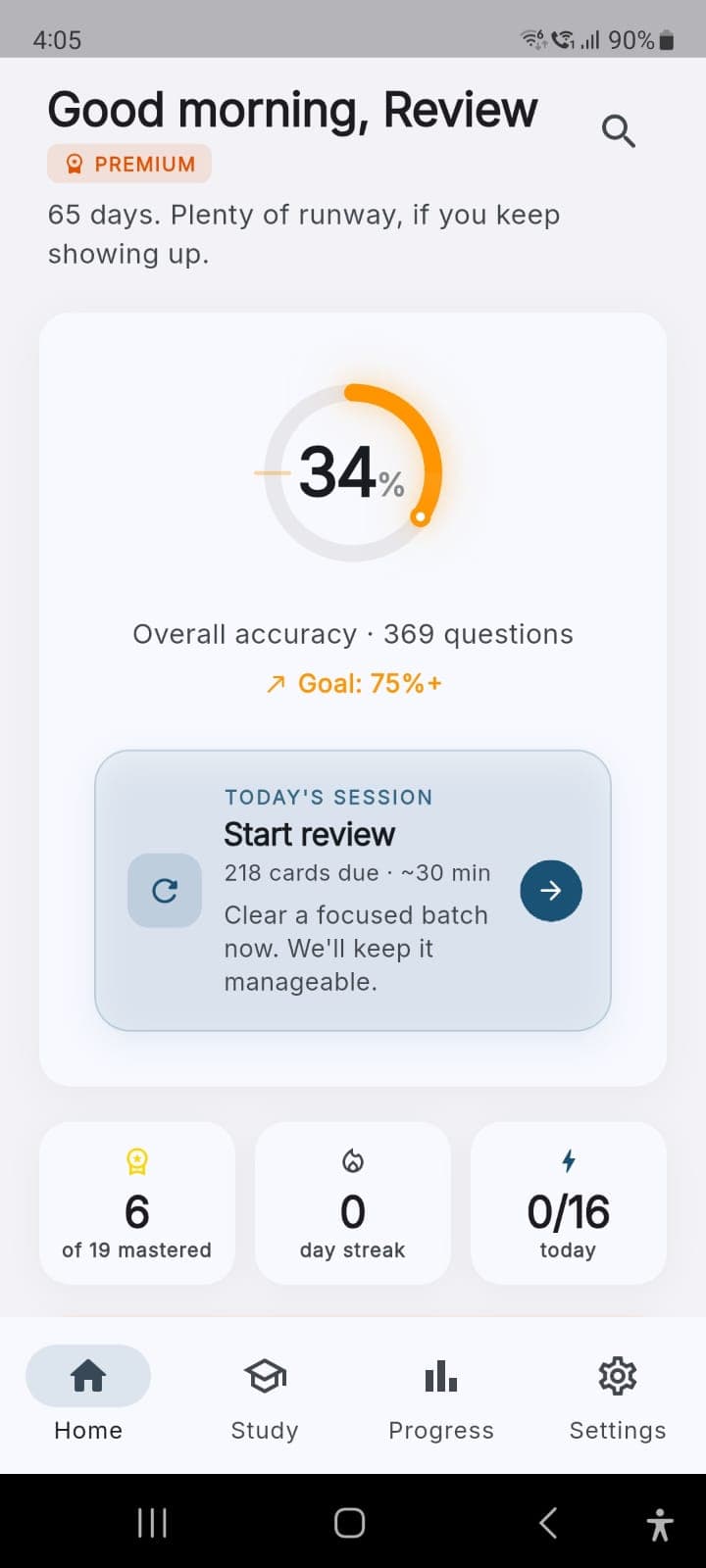
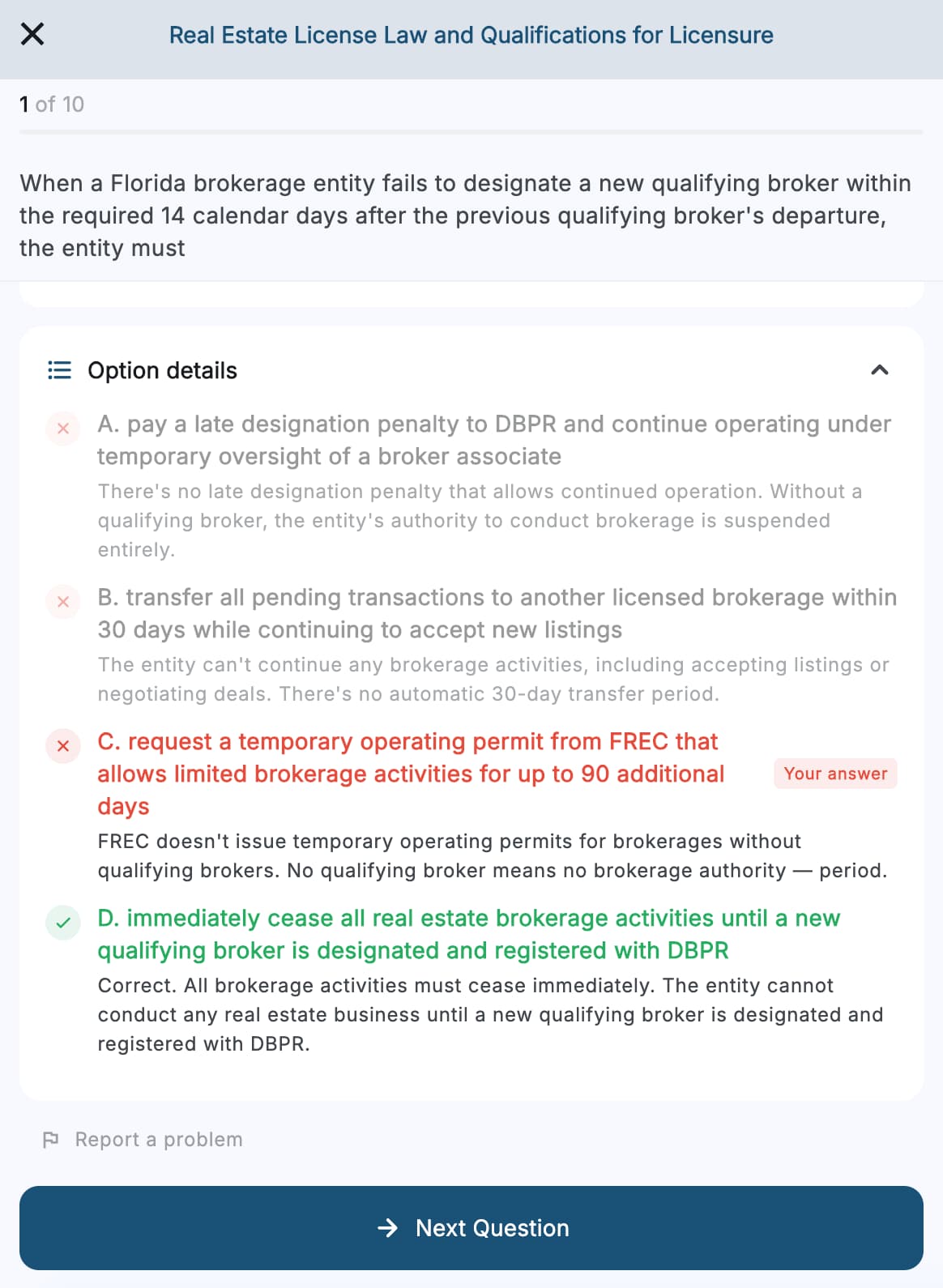
Pass Florida runs diagnostics, sorts your misses, and gives you 1,142 Florida-specific questions for the weak patterns this plan uncovers. It is exam prep only: one $39.99 purchase, no subscription, no copied exam questions, and not a replacement for the 63-hour course, DBPR, Pearson VUE, or licensed advice.
Try a Florida question Check readiness Download Pass Florida
Days 4 to 10: Repair the Big Rule Families
Days 4 to 10 should repair the biggest rule families first: brokerage, relationships, property rights, contracts, escrow, disclosures, and appraisal.
The first full week is not for memorizing everything. It is for making sure the highest-value rule families stop leaking points.
Day 4: Brokerage, license law, and FREC
Focus on who may do what, what requires an active license, how sales associates work under brokers, and what FREC can discipline. Pair this with Florida Statute 475 and FREC rules and violations.
Your test: Can you explain why a sales associate cannot collect compensation directly from a buyer or seller?
Day 5: Brokerage relationships and disclosures
Review transaction broker, single agent, no brokerage relationship, transition to transaction broker, and disclosure timing. This topic looks simple until answer choices differ by one duty. Use the brokerage relationships guide for the Florida-specific distinctions.
Your test: Can you identify the relationship from the facts without relying on one familiar phrase?
Day 6: Property rights, estates, and legal descriptions
Study estates, ownership forms, easements, encroachments, and legal descriptions. If you struggle with sections, townships, or acreage, read the legal descriptions guide and section-township-acreage guide.
Your test: Can you classify the property concept before choosing the answer?
Day 7: Contracts
Spend the day on offer, acceptance, counteroffer, consideration, breach, remedies, contingencies, assignments, and contract status. The trap is usually timing or legal effect. The contracts guide is the right companion.
Your test: Can you explain whether the contract is valid, void, voidable, or unenforceable from the fact pattern?
Day 8: Escrow, trust accounts, and deposits
Escrow questions punish vague memory. Review who holds deposits, what happens when there is a dispute, required notices, and the broker's options. Pair this with escrow trust account rules.
Your test: Can you separate "broker must act" from "broker may choose an option"?
Day 9: Disclosures and environmental topics
Review radon, lead-based paint, CDD, HOA/condo context, flood awareness, and material facts. Use Florida disclosures, radon disclosure, and CDD disclosure.
Your test: Can you identify who must disclose, when, and in what kind of transaction?
Day 10: Appraisal and market analysis
Review the three approaches, CMA vs appraisal vs BPO, depreciation, highest and best use, and investment-value vocabulary. Pair this with the appraisal guide.
Your test: Can you tell whether the question is asking for value method, professional role, or math?
Days 11 to 17: Math and Wording Traps
Days 11 to 17 should build label-before-calculate math habits and wording-trap discipline before mixed practice begins.
Math gets a full week because it improves through repetition. It also exposes whether you read carefully.
Use this label-before-calculate routine:
- Write what the question wants.
- Label each number in the stem.
- Cross out irrelevant numbers.
- Choose the formula.
- Calculate once.
- Check whether the answer makes sense.
Do not start with the calculator. Start with labels.
The reason the routine works is that most Florida math misses are not arithmetic misses. They are setup misses: the candidate grabbed a number, ran it through a formula, and produced a clean number that happens to answer a different question. Label the numbers first ("$240,000 = sale price; 6% = total commission rate; 50/50 split between listing and selling office; 60/40 broker/agent at the selling office") and the formula choice tends to write itself. Skip the labels and you can spend forty seconds producing a correct answer to the wrong question.
If you only have time to drill one habit this week, drill the habit of writing labels before touching the calculator. Calculators do not make Florida math hard; setup does.
| Day | Math focus | Companion guide |
|---|---|---|
| Day 11 | Commission, split, and sale price | Commission math |
| Day 12 | LTV, down payment, discount points | LTV guide |
| Day 13 | Documentary stamps and buyer costs | Documentary stamps |
| Day 14 | Proration | Proration guide |
| Day 15 | Millage and property tax | Millage guide |
| Day 16 | Cap rate, NOI, GRM | Cap rate guide |
| Day 17 | Mixed math set | Math formulas |
If math is your weak spot, read bad at math on the Florida exam before Day 11. The fix is not "become a math person." The fix is to become a setup person.
DAYS 11 TO 17: MATH WEEK
Setup is the skill. Reps are how it sticks.
Math Coach drills all 14 Florida calculation types with the label-before-calculate routine built in, so commission, proration, doc stamps, millage, LTV, and cap rate stop producing clean answers to the wrong question. Pass Florida pairs it with 1,142 Florida-specific questions and timed practice for one $39.99 purchase. No subscription. No copied exam questions.
Open Math Coach Use the calculator library Download Pass Florida
Days 18 to 24: Convert Knowledge Into Recognition
Days 18 to 24 should shift from labeled topic practice to mixed practice so you can recognize the tested rule from the facts.
This is the week where you stop studying topics in isolation.
The Florida exam does not place a sign above each question that says "this is a contracts question." It gives you facts. Your job is to recognize the topic from those facts.
Use this daily rhythm:
- Take a mixed set of 25 to 40 questions.
- Mark every miss by type: rule, trap, math, pacing.
- Rewrite three missed stems in plain English.
- Drill only the weakest topic for 20 minutes.
- End with 10 mixed questions so the repair has to transfer.
Use the free Florida real estate practice questions by topic for the labeled weak-area block. When the topic label comes off, use mixed questions to confirm that you can still recognize the rule from the facts.
For the daily habit that powers this plan, including how many questions to do a day and how spaced repetition resurfaces your misses, see Florida exam daily practice.
This is also when you should work on EXCEPT and NOT questions, question wording, and tricky question strategy.
Knowledge that only works when the chapter title is visible is not exam-ready knowledge.
Days 25 to 30: Prove Readiness Under A Timer
The final week should use timed practice and the 80/65/2 readiness check to decide whether to sit or reschedule.
The final week should answer one question: should you sit or reschedule?
Use this readiness check:
- 80: Score at least 80% on a full timed practice exam. Warm up on the free timed practice exam.
- 65: No major topic area should sit below 65%.
- 2: Do it twice, or do it once plus a strong targeted retest if you are short on time.
This does not promise a pass. It gives you a cleaner signal than "I studied a lot." The 80/65/2 numbers are not Pearson VUE rules and they are not DBPR rules. They are Pass Florida coaching thresholds designed to require score stability, topic balance, and timed stamina before you rely on one passing practice result.
Use the table below to make the sit-or-reschedule decision more honest.
| Final-week evidence | Best decision if you can choose | Why |
|---|---|---|
| 80% or higher twice, no major topic below 65% | Sit | You have score buffer, topic balance, and stamina evidence. |
| 80% once, then strong targeted retest | Usually sit | Good signal if the misses are narrow and math setup is stable. |
| 70% to 79% with no major topic below 65% | Maybe sit | You need confidence in pacing, math labels, and trap control. |
| 70% to 79% with one major topic below 65% | Usually reschedule if possible | One weak floor can turn into a near miss. |
| Below 70% on a timed full-length exam | Reschedule if possible | Hope is not a study strategy. Repair before paying for another attempt. |
Day 25: Full timed exam
Take 100 questions under a timer. Do not pause for notes. Do not check answers halfway through.
Day 26: Full debrief
Do not take another full exam immediately. Review every missed question and classify the reason. If the same rule appears three times, that rule gets repaired first.
Day 27: Weak-area repair
Target your two weakest areas. If you failed by math, do math. If you failed by wording, do wording. If you failed by license law, do license law.
Day 28: Second timed exam or heavy mixed set
If you have the stamina, take the second full timed exam. If not, take a 50-question mixed set and a 30-minute math set.
Day 29: Light review
Use the night-before checklist. Review rules, formula cues, and logistics. Do not try to learn an entire new topic.
Day 30: Exam day
Use the exam-day checklist. Arrive early, manage the timer, mark uncertain questions, and protect easy points first.
What to Do If You Fall Behind
If you fall behind, keep diagnostics, math, mixed practice, and at least one timed exam, then cut passive review first.
Do not restart the plan. Compress it.
If you miss one day, move on and add 20 minutes to the next two days. If you miss three days, cut passive review and keep diagnostics, math, mixed practice, and timed exams. If you miss a full week, switch to the 14-day study plan or 7-day plan.
The order of sacrifice is simple:
- Cut rereading first.
- Cut long videos second.
- Keep mixed questions.
- Keep math.
- Keep at least one timed exam.
Mistakes that break a 30-day plan
The biggest 30-day mistakes are equal-time studying, skipping the diagnostic, saving math for the end, and taking practice exams without debriefing.
Studying all topics equally. Equal time feels fair. It is not strategic. Your weak and high-value areas deserve more attention.
Avoiding the diagnostic. A cold score can bruise your ego for a day. Skipping it can waste two weeks.
Saving math for the end. Math needs reps. Put it in the middle so it appears again in mixed practice.
Counting notes as evidence. Notes show exposure. Timed questions show readiness.
Taking practice exams without debriefing. A practice exam without review is just a score report you paid for with time.
FAQ
Can I pass the Florida real estate exam in 30 days?
It can be enough if the 63-hour course is complete, the plan targets actual weak areas, and practice is Florida-specific. Use the Day 1 diagnostic and final-week timed results to decide whether 30 days is enough for you.
How many hours per day should I study?
Plan for 60 to 90 minutes on most days. The timed practice-exam days will take longer because the Florida sales associate exam is a 100-question, 3.5-hour test.
What should I study first?
Start with a diagnostic, then repair high-value weak areas. Do not start with whichever chapter appears first in your course binder.
Should I study math every day?
Not every day, but math should appear several times each week. If math scares you, use shorter sessions more often.
How do I know if I should reschedule?
If you are at 80% or higher on timed full-length practice, you have a cleaner signal to sit. If you are between 70% and 79%, look at the pattern: sit only if the misses are narrow, pacing is stable, and no major topic is below 65%. Below 70%, or below 65% in a major topic, rescheduling may be smarter than hoping exam-day adrenaline fixes the gap.
Is Pass Florida a course?
No. Pass Florida is exam prep, not a substitute for the required pre-license course, DBPR application steps, Pearson VUE scheduling, or licensed professional advice. It helps after or near the end of the course with Florida-specific questions, diagnostics, math explanations, and trap practice.
Ready to run the 30-day plan with Florida-specific reps?
Use a free diagnostic first, check readiness before scheduling, and download Pass Florida when you want the full Florida-specific repair loop.
The plan above is the structure. The reps are what move scores.
Print the 30-day study plan calendar to track the four weeks on paper, or browse the free study PDF library for the sprint calendars if you have less runway.
30-DAY STUDY LOOP
Diagnose, repair, mix, and prove readiness.
Start with a free Florida question, use the readiness calculator before the final-week decision, and download Pass Florida when you want topic diagnostics, Math Coach, Trap Library, timed practice, and the full Florida-specific question bank.
Try a free Florida question Run the readiness calculator Download Pass Florida
Methodology
The official exam facts and licensing anchors in this guide come from the primary sources listed below. The study structure uses the Pass Florida pattern: diagnose first, repair high-value misses, drill math setup, then prove readiness under time.
This plan does not promise a passing result on the Florida real estate exam, does not guarantee passage, and is not a substitute for the required 63-hour pre-license course, the DBPR application process, Pearson VUE scheduling, or official rules and statutes. The 80/65/2 readiness check is a practical buffer derived from common candidate patterns, not a Pearson VUE or DBPR rule.
Product note
Pass Florida publishes this guide and offers the exam-prep app linked on this page. Pass Florida is independent exam preparation, not a DBPR-approved 63-hour pre-license course, a tutoring service, a Pearson VUE scheduling tool, a licensing-activation service, legal advice, tax advice, or financial advice. Pass Florida does not guarantee passage.
Sources
- Pearson VUE Florida Real Estate & Appraisers licensing exams
- Pearson VUE Florida Real Estate and Appraiser Fact Sheet (PDF)
- DBPR Sales Associate Initial Application checklist
- DBPR Real Estate Sales Associate Requirements (PDF)
- DBPR Real Estate Sales Associate Candidate Information Booklet
- F.S. 475.17: Qualifications for practice
- Florida Statutes Chapter 475 (real estate brokers, sales associates, schools)
- Florida Administrative Code Chapter 61J2
- Florida Administrative Code Rule 61J2-3.008
This post is educational content about Florida real estate exam study strategy. It is not legal, tax, brokerage, licensing, or professional advice and it is not a guarantee of passing the Florida sales associate exam. The Florida real estate exam, DBPR application process, Pearson VUE scheduling, and the 63-hour course requirements are governed by DBPR, FREC, and Pearson VUE; verify current fees, content outline, scheduling rules, course requirements, and policies directly with DBPR, FREC, your course provider, Pearson VUE, your broker, and qualified counsel before making study, scheduling, or career decisions based on this article.