QUICK ANSWER
You can study for the Florida real estate exam while working full time if you use short, focused sessions. Plan on 30 to 45 minutes per day, 5 to 6 days per week, for 4 to 6 weeks after your 63-hour course. Start with the highest-weighted topics, do practice questions instead of re-reading, drill math in small daily reps, and reserve one weekend block for a full timed exam. Context: the May 2026 FREC Division Report shows April 2026 Florida sales associate pass rates of 48% for first-time takers and 32% for repeaters, so a working candidate's steady routine is doing more work than a one-week cram.
WHO THIS GUIDE IS FOR
Florida sales associate exam candidates working a full-time job and trying to fit exam preparation into 30 to 60 minutes of available time per day. Useful whether you are a career-switcher studying after work, a working parent with limited weekend study windows, a commuter looking to use train or bus time productively, or anyone whose study guide assumptions ("3-hour blocks, weekend boot camps") do not match their actual schedule. Pair with the should I take the exam before ready guide for the pre-scheduling readiness decision once your 4-to-6-week study window completes, the should I reschedule guide for the post-scheduling decision sibling if work demands shift your appointment, the 30-day study plan for a more granular day-by-day version, the week-before plan for the final-week structure, the Florida exam tips guide for the broader study-strategy overview, and the Florida exam app guide for the mobile-friendly study-tool selection. Not legal, tax, brokerage, lending, licensing, testing-accommodations, or DBPR-application advice.
EXAM PREP ONLY
The Florida sales associate exam is a closed-book, computer-based licensing exam. DBPR's current Sales Associate CIB states 100 multiple-choice questions, three and a half hours, 19 content areas, and a passing grade of at least 75. The exam covers Florida real estate principles and practices, real estate law, real estate mathematics, F.S. Chapter 475 Part I, and F.A.C. Chapter 61J2. This guide does not replace the required 63-hour FREC-approved pre-license course, DBPR application steps, Pearson VUE scheduling rules, fingerprinting, post-licensing, continuing education, legal advice, or official sources. The 30-to-45-minute daily target and the 4-to-6-week timeline are planning benchmarks, not DBPR-published readiness rules and not a guarantee of any specific Pearson VUE outcome.
Thirty to 45 focused minutes plus one weekend timed exam is enough structure for most working candidates after the course.
Anchor two reliable sessions, then use lunch, commute, and weekend blocks to protect 5 total study touches.
If you cannot reserve one 210-minute practice block, your readiness signal is incomplete. Build that block before scheduling.
You Do Not Need to Quit Your Job to Pass This Exam
A full-time worker can prepare by spreading focused practice across 4 to 6 weeks instead of trying to create long study blocks every day.
Most study guides for the Florida real estate exam are written for people with unlimited time. They suggest 3-hour study blocks, weekend boot camps, and daily schedules that assume your only obligation is exam prep.
That is not your life. You have a job. You might have a family. You have a commute, responsibilities, and maybe 30 to 60 minutes on a good day where you can sit down and study without someone needing something from you.
Here is the truth that those guides do not tell you: the Florida real estate exam does not require more total hours from a full-time worker than from someone studying full time. It requires the same knowledge. The difference is that you need to distribute those hours across more calendar days in smaller sessions, and you need every session to count because you do not have the luxury of wasted time.
This post is for people who are studying for the Florida exam while holding down a full-time job. It covers realistic schedules, the minimum viable study plan, what to prioritize when time is short, and how to use the dead time in your day, including commutes, lunch breaks, and waiting rooms, for effective exam prep without needing a desk or a textbook.
If your schedule is shaped more by childcare, school pickups, nap windows, and interrupted evenings than by a job calendar, use the Florida real estate exam study plan for parents. It adapts the short-session strategy to parenting realities.
BUILT FOR SHORT SESSIONS
Try 5 Florida questions during your next break.
Use short, repeatable sessions and let the diagnostic choose the next weak area. Finish with a small timed set so progress transfers under pressure.
What this guide covers
- Official source map
- Working-student schedule selector
- The math: how many hours you actually need
- Three realistic schedules (morning, lunch, evening)
- The minimum viable study plan
- How to use dead time effectively
- What to prioritize when time is short
- The weekend strategy
- Readiness checkpoint before scheduling
- Common mistakes working students make
- Related exam concepts
- Frequently asked questions
Official Source Map
Use DBPR for exam structure and course requirements, FREC reports for pass-rate context, Pearson VUE for scheduling rules, and this guide only for study coaching.
Use the DBPR Sales Associate CIB for exam structure and content areas. Use the current FREC monthly Division Report for pass-rate context. Use the Pearson VUE Florida Real Estate page for scheduling, cancellation, and physical test-center rules. Use the schedules, plans, and frameworks in this guide as study coaching.
| Claim in this guide | Primary source | Why it matters |
|---|---|---|
| The Florida sales associate exam is closed book, 100 multiple-choice questions, three and a half hours (210 minutes), 19 content areas, with a passing grade of at least 75 | DBPR Sales Associate Candidate Information Booklet PDF and DBPR Real Estate Sales Associate Requirements PDF | The structural framing that the working-candidate plans target |
| The required pre-license course is 63 hours and FREC-approved | DBPR Sales Associate Requirements | The baseline education requirement separate from this exam-prep guide |
| The May 2026 FREC Division Report shows April 2026 sales associate exam performance of 48% first-time pass rate and 32% repeater pass rate | May 2026 FREC Division Report PDF and Florida Real Estate Commission monthly Division Reports | The pass-rate spread that frames why a working candidate's disciplined 4-to-6-week routine matters more than a one-week cram |
| The DBPR Sales Associate CIB weights the largest content areas at 12% Brokerage Activities and Procedures, 12% Contracts, 9% Residential Mortgages, 8% Property Rights, and 8% Appraisal | DBPR Sales Associate CIB | Supports the priority order in the 4-week plan |
| Pearson VUE administers scheduling, physical test-center delivery, calculator allowances, cancellation/rescheduling, and exam fee collection | Pearson VUE Florida Real Estate and Appraisers licensing exams and Pearson VUE Florida real estate candidate fact sheet PDF | Scheduling logistics that follow the working-candidate study plan |
| Real estate brokerage law that frames the exam content is in F.S. Chapter 475, Part I, and F.A.C. Chapter 61J2 | F.S. Chapter 475, Florida Senate and F.A.C. Chapter 61J2 | The statutory and rule backbone for the Florida-law content this working-candidate plan prioritizes |
| The Three Realistic Schedules (Morning / Lunch / Evening / Hybrid), Working-Student Schedule Selector, Minimum Viable Study Plan, Dead-Time Framework, 7-Priority Allocation, Weekend Strategy, readiness checkpoint, and 5-mistake honest-failure diagnostic are study heuristics | Pass Florida coaching methodology | These are not DBPR, FREC, or Pearson VUE rules |
Working-Student Schedule Selector
Choose the plan by how many real study touches you can protect each week, not by the schedule you wish you had.
Pick the plan that matches the calendar you actually have, not the calendar you wish you had.
| Your real availability | Best plan | What to protect |
|---|---|---|
| 30 minutes, 5 days/week | 6-week plan | Consistency, one weekend timed exam, and daily math reps |
| 30 minutes, 6 days/week | 5-week plan | One focused topic per day plus Saturday review |
| 45 minutes, 5 to 6 days/week | 4-week plan | High-weight topics first, then mixed practice and weak-area repair |
| 60 minutes, 4 days/week | Hybrid plan | Two deep sessions, two short sessions, and dead-time flashcards |
| Less than 3 study touches/week | Delay the exam date | You need enough repetition to identify weak topics before Pearson VUE |
The best working-student plan is not the most ambitious plan. It is the plan you can repeat when work is busy, your commute is bad, and your evening is not your own.
The Math: How Many Hours You Actually Need
After the 63-hour course, many working candidates need about 20 to 30 hours of focused exam practice, usually spread across 4 to 6 weeks.
After completing the 63-hour pre-licensing course, many students need roughly 20 to 30 additional hours of exam-specific preparation. That estimate comes from a practical study reality: the course introduces the material, but the state exam tests whether you can apply it across 100 timed questions. The pass rate data is the warning sign. Unstructured review is risky. Focused practice gives you a better read on readiness.
Here is what 25 hours looks like for a full-time worker:
| Schedule | Daily Study Time | Days Per Week | Weeks Needed | Total Hours |
|---|---|---|---|---|
| Compact | 45 minutes | 6 days | 4 weeks | 18 hours + 2 weekend sessions |
| Standard | 30 minutes | 6 days | 5 weeks | 15 hours + 2 weekend sessions |
| Relaxed | 30 minutes | 5 days | 6 weeks | 15 hours + 3 weekend sessions |
The weekend sessions are for full timed practice exams. Current Florida sales associate candidate materials list a 210-minute testing window. You need at least one full simulation, ideally two, before the real exam. Those are the only study sessions that require a large time block. Every weekday session fits into 30 to 45 minutes.
Thirty minutes a day is not a lot. It is also not nothing. The key is that every one of those minutes is spent on the right activity at the right level. Re-reading a textbook for 30 minutes is not the same as answering 15 application-level practice questions with full explanations for 30 minutes. The second activity moves your score. The first feels productive but does not.
Three Realistic Schedules
Morning, lunch, evening, and hybrid schedules can all work if they produce 5 to 6 focused study sessions per week.
Not everyone has the same window. Pick the one that matches your life, or combine elements from multiple schedules.
The Early Morning Schedule (Before Work)
Best for: People who are sharpest in the morning, have a predictable start time, and can wake up 45 minutes earlier without it wrecking their day.
| Time | Activity | Duration |
|---|---|---|
| 5:45 AM | Wake up, coffee | 15 min |
| 6:00 AM | Practice questions (focused topic) | 30 min |
| 6:30 AM | Quick math drill (1 formula, 2 problems) | 10 min |
| 6:40 AM | Done. Get ready for work. |
Advantages: Studying is done before the day starts. No competing obligations. Your brain is fresh. If your evening gets hijacked by life, your study session already happened.
Disadvantages: Requires discipline to wake up early consistently. Not sustainable if you are already sleep-deprived.
The Lunch Break Schedule
Best for: People with a predictable 30 to 60 minute lunch break, a quiet place to sit (car, break room, park bench), and a phone.
| Time | Activity | Duration |
|---|---|---|
| 12:00 PM | Eat (10 min), then practice questions on phone | 20 min |
| 12:20 PM | Quick math drill or flashcard review | 10 min |
| 12:30 PM | Done. Back to work. |
Advantages: No early alarm. No late-night fatigue. Uses time that would otherwise be spent scrolling. A phone-based study app that works offline is essential for this schedule because not every break room has reliable wifi.
Disadvantages: Requires a study tool that works on a phone (not a textbook or laptop). May feel rushed if lunch breaks are unpredictable or interrupted by coworkers.
The Evening Schedule (After Work)
Best for: People who are not morning people, have a consistent evening window after work and dinner, and can avoid the couch-and-TV trap.
| Time | Activity | Duration |
|---|---|---|
| 8:00 PM | Practice questions (focused topic) | 25 min |
| 8:25 PM | Math drill or EXCEPT/NOT practice | 10 min |
| 8:35 PM | Review 2 to 3 missed questions from the session | 10 min |
| 8:45 PM | Done. Rest of the evening is yours. |
Advantages: No early alarm. Fits after dinner and family time. Can be done at a desk, at the kitchen table, or in bed with a phone.
Disadvantages: Willpower is lowest at the end of the day. Easy to skip "just this once," which becomes three days in a row. If you choose this schedule, set a daily alarm or reminder at your study time so the decision is made for you.
The Hybrid (Most Realistic for Most People)
Most working students end up combining approaches based on what each day allows:
- Monday, Wednesday, Friday: 30 minutes before work (6:00 AM)
- Tuesday, Thursday: 30 minutes at lunch
- Saturday morning: 2 to 3 hours for a longer study session or timed practice exam
- Sunday: Off. Rest.
The hybrid works because it does not require the same routine every day. Bad morning? Study at lunch. Busy lunch? Study in the evening. The key is getting in 5 to 6 sessions per week, not getting in the same session at the same time every day.
The Minimum Viable Study Plan (4 Weeks, 30 Min/Day)
A 4-week working-student plan should start with the heaviest topics, add Florida-specific rules and math, shift to mixed practice, then repair weak areas before exam day.
If you are working full time and have 4 weeks before your exam, here is the plan that fits into 30 minutes a day with one weekend session.
Week 1: The Highest-Weight Topics
Start with the highest-weighted content areas: Brokerage Activities and Procedures (12%), Contracts (12%), Residential Mortgages (9%), Property Rights (8%), and Appraisal (8%). Together, those five areas account for about 49 of the 100 exam questions.
- Daily (30 min): 15 practice questions from one high-weight topic, rotating daily. Read full explanations for every question, right or wrong.
- Daily (5 min of the 30): 2 math problems from the core formula patterns. Rotate formulas daily.
Week 2: Florida-Specific Rules + Math
Keep rotating the high-weight topics, then add Florida-specific rules that generic national prep often underplays: escrow deadlines, brokerage disclosures, FREC discipline, homestead exemption, documentary stamps, and Florida relationship duties.
- Daily (30 min): 15 mixed practice questions from the five heaviest areas. Track accuracy by topic.
- Daily (5 min): Continue math rotation. Add documentary stamp calculations and proration to the rotation.
- One session this week (15 min): Review the Florida-specific rules that national prep misses: escrow deadline, brokerage disclosure types, homestead exemption split.
Week 3: Mixed Practice + EXCEPT/NOT
Switch to mixed practice across all 19 content areas to simulate the randomized exam format.
- Daily (30 min): 15 mixed practice questions. Note which topics are still below 70%.
- One session this week (15 min): Do 15 EXCEPT/NOT questions in a row using the True/False Labeling technique.
- Weekend: Take a full timed practice exam (100 questions, 210 minutes). This is the one session that requires a large time block. Schedule it for Saturday or Sunday morning.
Week 4: Sharpen and Execute
- Daily (20 to 30 min): Target the 2 to 3 areas where your Week 3 practice exam showed the lowest scores. Do 10 to 15 questions per session in those areas only.
- Day 5 of this week: Light review, math formulas one last time, Florida-specific rules one last time. Stop by 6 PM.
- Day 6: Exam day. No studying. Execute the plan.
This plan totals approximately 20 to 25 hours across 4 weeks, depending on how many of the targeted review and format drilling sessions you fit in. That is achievable for anyone working full time.
How to Use Dead Time Effectively
Use 5 to 15 minute gaps for flashcards, single-topic questions, and one-formula math reps, not textbook reading or full exams.
Dead time is the 5 to 15 minute windows scattered throughout your day that are currently spent scrolling your phone, waiting, or staring into space. For a full-time worker, dead time is often the largest untapped study resource.
Where Dead Time Hides
- Commute (if not driving): Train, bus, or passenger seat. 15 to 30 minutes per direction.
- Lunch break: 10 to 20 minutes after eating.
- Waiting rooms: Doctor, dentist, DMV, car service. 10 to 30 minutes.
- Before meetings start: The 5 to 10 minutes everyone spends on their phone.
- Kids' activities: Waiting during sports practice, dance class, tutoring. 30 to 60 minutes.
- Grocery pickup/laundry wait: 10 to 15 minutes.
What Works in Dead Time
Flashcard review: Swipe-based flashcards on your phone are the best dead-time activity. Quick, self-contained, no context needed. Review 10 cards in 5 minutes.
Math formula practice: One formula, two problems. Commission split in 3 minutes. Proration in 4 minutes. You do not need a desk.
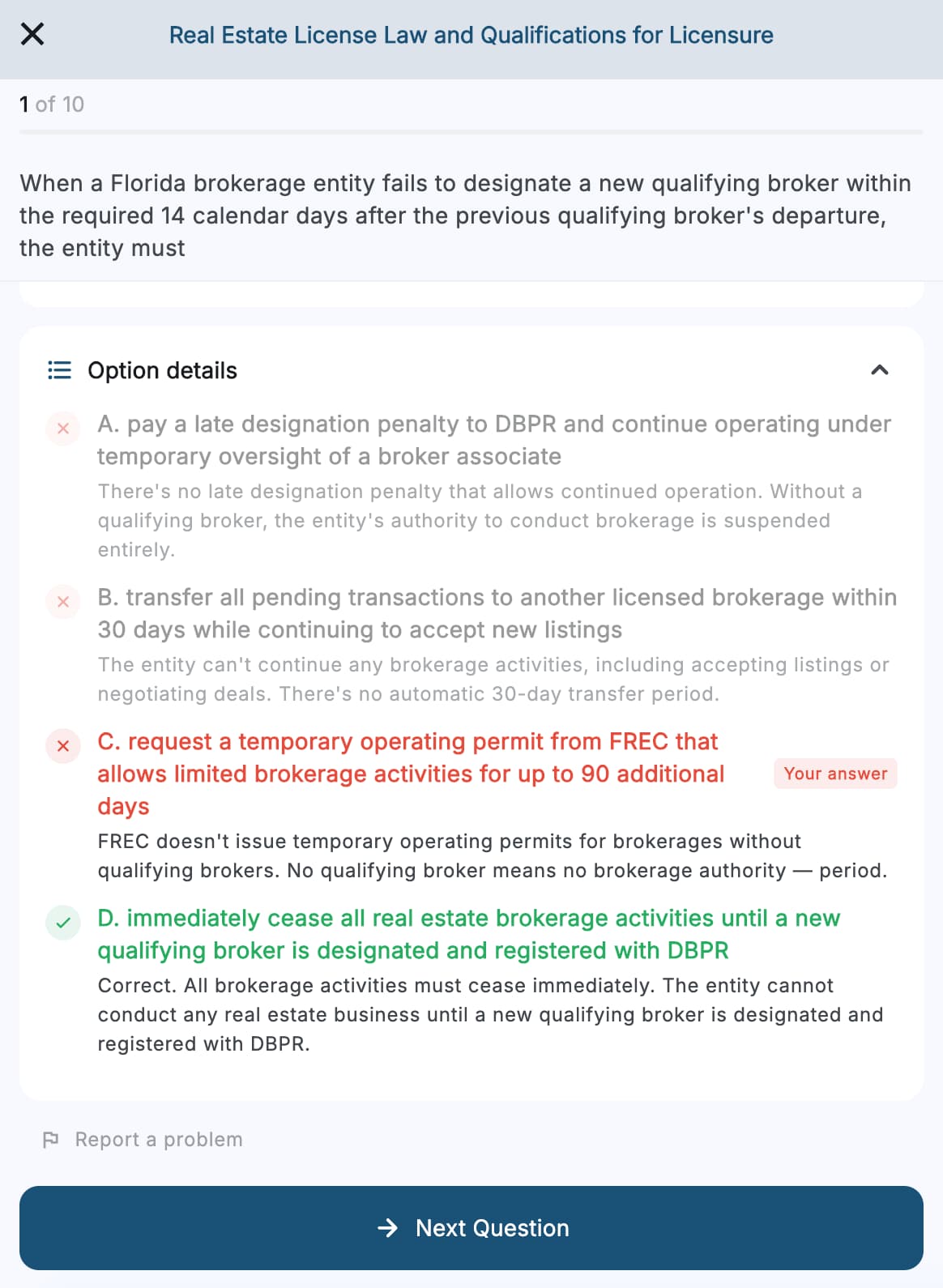
Single-topic practice questions: 5 questions on one content area take 5 to 8 minutes with explanations. Small enough to fit any gap.
What Does NOT Work in Dead Time
Reading the textbook: Requires sustained attention and a physical book or large screen. Not suited for 5-minute windows.
Timed practice exams: Require 210 uninterrupted minutes. Save these for weekends.
Learning new complex topics for the first time: Dead time is for reinforcing what you have already learned, not for initial learning. First exposure to a new topic needs a focused session, not a fragmented one.
The Tool That Makes Dead Time Work
Dead-time study only works if your study tool is on your phone and available without internet. If you need to boot a laptop, connect to wifi, and open a browser, you will not study during a 10-minute wait at the dentist. You will scroll Instagram instead.
A mobile app that works offline, tracks your progress, and lets you pick up where you left off in 30 seconds is the difference between dead time being wasted and dead time being study time. That is not a small difference when your total daily study window is 30 minutes.
What to Prioritize When Time Is Short
If time is tight, protect high-weight-topic practice, daily math, one timed exam, and EXCEPT/NOT practice before lower-value review.
If you only have 20 hours instead of 30, cut from the bottom of this list, not the top.
Priority 1 (never skip): Practice questions on the 5 heaviest topics at the application level. This is the core of your preparation. If you only do this well, you have covered a large share of the exam at the right cognitive level.
Priority 2 (never skip): Math formulas. 10 minutes a day. Math is one of the easiest areas to improve because the patterns repeat.
Priority 3 (strongly recommended): One full timed practice exam. This is the only way to know if your knowledge holds up under time pressure.
Priority 4 (recommended): EXCEPT/NOT question drilling. One focused session of 20 to 30 questions. Biggest format-specific score gain for the time invested.
Priority 5 (if time allows): Florida-specific rule review. Escrow deadline, brokerage types, documentary stamps, homestead exemption. One focused session.
Priority 6 (if time allows): Practice questions on the remaining 14 content areas beyond the Big Five.
Priority 7 (cut if needed): Second timed practice exam. Nice to have, not essential if your first practice score was above 80%.
A student who does Priorities 1 through 4 and skips 5 through 7 is better prepared than a student who does a little bit of everything without going deep on anything. Depth on the heavy topics beats breadth across all 19.
The Weekend Strategy
Weekdays handle short practice sessions. Weekends should protect the one thing that cannot be done in fragments: a 210-minute timed practice exam.
Your weekday sessions handle the daily practice. Your weekends handle the things that need longer blocks.
Saturday Morning (The One Big Session)
Reserve one Saturday morning during your study period for a full timed practice exam. This is the single session that cannot be broken into smaller pieces. Block 4 hours: 210 minutes for the exam, then 30 minutes to review results by content area.
Wake up, eat breakfast, sit at a desk, set a timer for 210 minutes, and take the exam with no interruptions. Tell your family or housemates in advance. Treat it like the real thing.
Other Weekends
On weekends when you are not taking a practice exam, you have two options:
Option A (60 to 90 minutes): Extended study session on your weakest content area. This is where you go deeper than 30 minutes allows. Work through 30 to 40 questions with full explanations. Review patterns in what you are missing.
Option B (30 minutes): Same as a weekday session. Sometimes a weekend is busy and 30 minutes is all you have. That is fine. Consistency across the 4 to 6 week period matters more than any individual session.
Readiness Checkpoint Before Scheduling
Before scheduling, use timed practice scores and weak-topic data instead of anxiety, confidence, or wishful thinking.
A full-time worker needs a readiness checkpoint because anxiety and exhaustion both distort judgment. Use evidence, not vibes.
| Signal | What it means | Best move |
|---|---|---|
| Timed practice exam at 80% or higher and no major topic below 65% | Your knowledge is likely holding under test conditions | Schedule or keep the Pearson VUE date |
| Timed practice exam 75% to 79% with one weak topic | You are close, but the weak topic can decide the exam | Keep studying; schedule only if you have 7 to 10 focused repair days |
| Timed practice exam below 75% | The score is not yet stable enough | Use the before-ready guide before scheduling |
| No timed practice exam yet | You do not have a real readiness signal | Reserve one 210-minute weekend block before choosing the test date |
| Work schedule changed after you scheduled | Your plan may no longer match reality | Use the reschedule guide and check Pearson VUE's current deadline |
For working candidates, the goal is not to feel perfectly calm. The goal is to have enough evidence that your score survives fatigue, interruptions, and timed pressure.
Common Mistakes Working Students Make
Working candidates usually lose time by cramming, re-reading, skipping math, failing to track weak topics, or scheduling from emotion instead of readiness data.
Mistake 1: Studying Every Day for 2 Weeks Instead of Consistently for 4 to 6 Weeks
Cramming does not work for a 19-topic exam that tests application, not recall. Two intense weeks produce shallow, fragile knowledge that decays under exam pressure. Four to six weeks of 30 minutes daily produces deeper knowledge that survives 210 minutes at Pearson VUE. If you have to choose between intensity and consistency, choose consistency every time.
Mistake 2: Re-Reading the Textbook Instead of Doing Practice Questions
Re-reading feels productive because it is easy. Practice questions feel harder because they expose what you do not know. That discomfort is the learning. A 30-minute session of 15 practice questions with full explanations moves your score more than 30 minutes of textbook review. The textbook is for initial learning (which your course already did). Exam prep is for practice.
Mistake 3: Skipping Math Because "I Am Not a Math Person"
Florida real estate exam math uses repeatable patterns that require multiplication, division, percentages, and careful setup. Skipping them means giving away points you could have trained with short daily reps. Ten minutes a day for two weeks can turn math from a panic topic into a manageable routine.
Mistake 4: Studying Without Tracking What You Have Studied
If you do not know which of the 19 content areas you have covered and which you have not, you will over-study comfortable topics and under-study the ones that need work. Use a prep tool that tracks accuracy by topic, or at minimum keep a simple spreadsheet: topic, date last studied, accuracy. That data prevents you from spending 3 of your 4 weeks on Property Rights when Brokerage is the topic costing you points.
Mistake 5: Waiting Until You "Feel Ready" to Schedule the Exam
Scheduling the exam creates accountability. Without a date on the calendar, study sessions are easy to skip ("I will study tomorrow instead") and preparation stretches indefinitely. Schedule the exam when you start your study plan, not when you finish it. A date 4 to 6 weeks out gives you a deadline, and deadlines prevent drift. If your practice scores say you are not ready as the date approaches, check Pearson VUE's current rescheduling rules before making a change. If you score 80% on timed practice, treat that as a stronger readiness signal than anxiety alone.
Related Exam Concepts
Use the connected guides when your working-student plan turns into a scheduling, rescheduling, final-week, math, or EXCEPT/NOT problem.
Working full time changes your calendar, not the exam. These companion guides cover the decisions that usually come before or after this plan.
| If this is your situation | Read this next | Why it connects |
|---|---|---|
| You want a day-by-day version of this plan | 30-day Florida real estate exam study plan | Turns the 4-week framework into daily tasks |
| You are not sure whether to schedule yet | Should I take the exam before I am ready? | Converts readiness into objective score and topic signals |
| You already scheduled and work got chaotic | Should I reschedule the Florida real estate exam? | Helps decide whether to keep or move the Pearson VUE date |
| You are inside the final week | Florida real estate exam week-before plan | Protects your last 7 days from over-cramming |
| Your misses are format-related | EXCEPT/NOT questions guide | Builds the label-and-eliminate method for negative stems |
| Your misses are math-related | Florida real estate exam math formulas | Gives short daily formula drills that fit working-student schedules |
Frequently Asked Questions
Can I pass the Florida real estate exam while working full time?
Yes. Many working students can prepare with roughly 20 to 30 hours of focused review after completing the pre-licensing course. At 30 minutes per day, 5 to 6 days per week, that is 4 to 6 weeks. Many students work full time throughout the licensing process, including the pre-licensing course, which most take online at their own pace, and exam preparation.
How many hours a day should I study for the Florida real estate exam?
Thirty to 45 minutes per day can be enough if the time is used on the right activities: application-level practice questions focused on the 5 heaviest content areas, daily math formula practice, and weekly EXCEPT/NOT drilling. Quality and focus matter more than volume.
How long does it take to study for the Florida real estate exam while working?
Four to six weeks after completing the pre-licensing course, studying 30 to 45 minutes per day. Some students compress this to 3 weeks with 45 to 60 minute daily sessions. The timeline depends on how many hours per day you can consistently dedicate. The 30-day study plan provides a full day-by-day structure.
Can I study on my phone?
Yes, and for working students it is often the most practical option. Phone-based study works during commutes, lunch breaks, and waiting time. The key requirement is that the app works offline, so you can study in places without wifi (subway, break room, car). Flashcard review, single-topic practice questions, and math formula drills all work well on a phone in 5 to 15 minute sessions.
What is the best way to study during a lunch break?
Eat in the first 10 minutes, then do 10 to 15 practice questions on your phone for 15 to 20 minutes. Focus on one content area per lunch session rather than mixed practice. Read the full explanation for every question. This is enough to cover 50 to 75 practice questions per week during lunch alone, which is a meaningful portion of your total preparation.
Should I take the pre-licensing course online or in a classroom if I work full time?
Online self-paced is usually the easier fit for working students because you control the schedule and can complete lessons during open windows. Classroom courses can work if you need external structure, but fixed days and hours may conflict with your job. Both produce the same FREC-approved certificate when the provider is approved. The pre-licensing course guide covers both options in detail.
Is it better to study in the morning or evening?
Whichever time you will actually do consistently. Research shows marginal advantages for morning study (better retention, fewer competing demands), but an evening session that happens every day beats a morning session you skip three times a week. Pick the time that fits your life and protect it. The three schedule options in this post cover morning, lunch, and evening with specific activities for each.
How do I stay motivated to study after a long day at work?
Set a daily alarm or reminder at your study time. Make the decision automatic rather than willpower-dependent. Reduce friction: have your study app open and ready on your phone so you can start within 30 seconds. Keep sessions short (30 minutes). And remember that every session you complete is one fewer session between you and a real estate license. Motivation fades. Systems persist.
How Pass Florida Fits a Working Student's Schedule
Pass Florida fits working-student prep by supporting short phone sessions, offline access, topic tracking, math drills, and weak-area review.
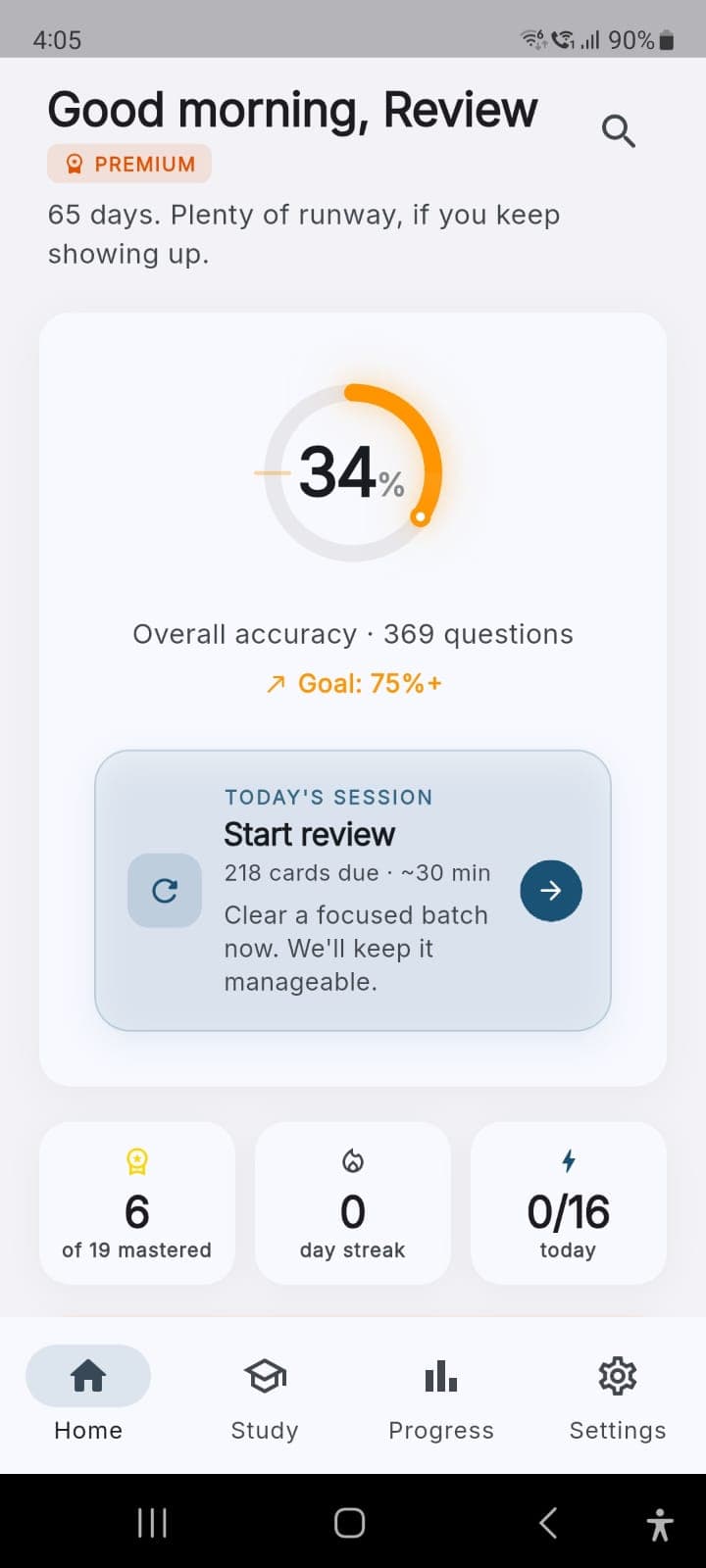
Pass Florida was designed for the way working students actually study: in short sessions, on a phone or tablet, during the cracks in the day.
Offline access means you can study on the subway, in the car as a passenger, at the gym, or in a break room with no wifi. No buffering. Open the app and start.
A 30-question diagnostic covers all 19 official content areas, so you know where your limited study time should go before you start guessing.
Six study modes fit different parts of a working schedule: Topic Practice for focused sessions, Weak Area Blitz for lunch breaks, Mixed Practice for review, Exam Style for weekends, Quick Review for tired nights, and Flashcard mode for dead time.
Math Coach across the 14 Florida math calculation types breaks down each archetype step by step, including proration, documentary stamps, property tax, loan-to-value (LTV), cap rate, GRM, NOI, commission, area, and appreciation/depreciation.
Trap Library and Confidence Calibration show you which questions you got right for the wrong reason and which trap patterns repeat across the 19 content areas. For a student who studies in fragments across the week, this tracking prevents the most common mistake: over-studying comfortable topics while neglecting the ones that are actually costing points.
A clean pricing model matters when you are already paying for the course, application, and exam. Pass Florida is $39.99 once, with lifetime access and Florida updates. No subscription. No copied exam questions.
Ready to start a working-student study routine?
Start with a short daily routine now, then use the readiness, reschedule, 30-day plan, and free-question links based on your current stage.
The 4-to-6-week disciplined daily routine is the single discipline that prevents most working-candidate exam failures. The next step usually depends on where you are in the working-candidate pathway: actively studying (this guide), about to schedule (should-i-take-before-ready), or already scheduled and uncertain (should-i-reschedule).
- Decide whether to schedule: Should I take the exam before I am ready?
- Decide whether to reschedule an existing date: Should I reschedule the Florida real estate exam?
- Use a granular day-by-day plan: 30-day Florida real estate exam study plan
- Try Florida-specific practice questions during your next break: Try 5 questions
Methodology
This method combines official DBPR, FREC, and Pearson VUE rules with Pass Florida coaching for short study sessions.
This guide was built for Florida sales associate exam candidates working full-time jobs and trying to fit exam preparation into 30 to 60 minutes of available time per day. It favors short daily sessions, topic rotation, spaced review, and mobile practice over marathon reading sessions. The structure assumes work fatigue is real and designs around it. It anchors the working-candidate study plan to the current DBPR Sales Associate Candidate Information Booklet (CIB) (100-question / 3.5-hour / 19-content-area / 75-passing structure), the DBPR-required 63-hour FREC-approved pre-license course as the baseline education, Pearson VUE scheduling and cancellation rules as the test-date logistics layer, and the pass-rate context from the May 2026 Florida Real Estate Commission (FREC) Division Report (48% first-time pass rate and 32% repeater pass rate for April 2026 sales associate exam performance).
The Three Realistic Schedules (Morning / Lunch / Evening / Hybrid), Working-Student Schedule Selector, Minimum Viable Study Plan, Dead-Time Framework, 7-Priority Allocation, Weekend Strategy, readiness checkpoint, and 5-mistake honest-failure diagnostic are Pass Florida observational coaching pedagogy and are not DBPR, FREC, or Pearson VUE process documents.
Pass Florida is not affiliated with the Department of Business and Professional Regulation (DBPR), the Florida Real Estate Commission (FREC), Pearson VUE, or any pre-license course provider, and Pass Florida does not guarantee passage of any state exam. Pass Florida does not replace the FREC-approved 63-hour pre-license course, DBPR application steps, Pearson VUE scheduling rules, fingerprinting, post-licensing, continuing education, or consultation with a qualified licensed professional. Its role is targeted practice with Florida-specific exam-style questions, not legal, tax, brokerage, lending, licensing, testing-accommodations, or DBPR-application guidance.
The 30-to-45-minute daily target, the 4-to-6-week timeline, and the 80%-with-no-major-topic-below-65% readiness threshold are practical planning benchmarks, not DBPR-published readiness rules and not a guarantee of any specific Pearson VUE outcome. Working candidates needing testing accommodations (extra time, separate room, reader) should follow DBPR's special-testing-accommodations process and Pearson VUE's accommodations workflow, not the standard timeline covered in this guide.
Official sources are listed below. Requirements, policies, exam outlines, application timing rules, and pass-rate distributions can change, so verify current details with the official source before making a real-world decision.
Product Note
Pass Florida is independent Florida sales associate exam prep, not a DBPR course, Pearson VUE scheduler, or guarantee of passing.
Pass Florida publishes this guide and offers the exam-prep app linked on this page. Pass Florida is not affiliated with DBPR, FREC, Pearson VUE, or any pre-license course provider, and Pass Florida does not guarantee passage of any state exam.
Sources
- DBPR Sales Associate Candidate Information Booklet PDF
- DBPR Real Estate Sales Associate Requirements PDF
- DBPR RE 1 Sales Associate Application PDF
- DBPR Candidate Information Booklets index
- May 2026 FREC Division Report PDF
- Florida Real Estate Commission monthly Division Reports
- Pearson VUE Florida Real Estate and Appraisers Licensing Exams
- Pearson VUE Florida real estate candidate fact sheet PDF
- F.A.C. Chapter 61J2, Florida Real Estate Commission
- F.S. Chapter 475, Real Estate Brokers, Sales Associates, Schools, and Appraisers, Florida Senate
This post is exam preparation content for the Florida Real Estate Sales Associate exam. It is not legal, tax, financial, lending, appraisal, brokerage, insurance, title, closing, career, testing-accommodations, DBPR-application, or professional advice. Pass Florida is not affiliated with the Department of Business and Professional Regulation (DBPR), the Florida Real Estate Commission (FREC), Pearson VUE, or any pre-license course provider, and Pass Florida does not guarantee passage of any state exam. The 30-to-45-minute daily target, the 4-to-6-week timeline, and the 80%-with-no-major-topic-below-65% readiness threshold are planning benchmarks, not DBPR rules and not a guarantee of any specific Pearson VUE outcome. Readiness decisions for testing-accommodation candidates are governed by DBPR's special-testing-accommodations process and Pearson VUE's accommodations workflow. For real-world decisions, verify current requirements with the official source or consult a qualified licensed Florida professional.