VERIFY BEFORE RELYING
This guide ranks 15 high-impact Florida sales associate real estate exam tips by score impact. It is exam-prep strategy only. The Department of Business and Professional Regulation (DBPR) Sales Associate Candidate Information Booklet controls the official rules around the 19 content areas, topic weights, 75-points passing grade, and the 100-question / 3.5-hour exam format. F.S. Chapter 475, F.A.C. Chapter 61J2, F.S. 201.02, F.S. 201.08, and F.S. 196.031 control the brokerage relationship duties, escrow rules, documentary stamp tax rates, and homestead-exemption references discussed in this guide. Pearson VUE's current Florida Real Estate page controls scheduling logistics. The 15-tip ranking, the situation-to-tip priority table, the 7-day final-week plan, the readiness gate, the confidence-versus-accuracy tracker, the two-pass timing method, and the EXCEPT/NOT drill protocol are Pass Florida coaching pedagogy, not DBPR or Pearson VUE process documents. Verify exam facts against the current DBPR Sales Associate Candidate Information Booklet and the current Pearson VUE Florida Real Estate page.
QUICK ANSWER
The best Florida real estate exam tips are not generic test-day reminders. The biggest score moves are: study the official topic weights, practice at the application level, drill Florida-specific law, do math every day, isolate EXCEPT and NOT questions, take full 100-question timed exams, and use your missed questions as a study map. If you only have one week left, focus on contracts, brokerage activities, mortgages, property rights, appraisal, Florida license law, escrow, documentary stamps, proration, and timed practice.
WHO THIS GUIDE IS FOR
Florida sales associate candidates who are past the 63-hour pre-license course and want a ranked list of what actually moves the score before the Pearson VUE attempt. Useful whether you are 2 to 4 weeks out and building a study plan, 7 days out and triaging final-week effort, or coming off a failed attempt and looking for what to do differently. Pair with the how-to-pass pillar for the full strategy, the 19 topics pillar for the official content map, the math formulas guide for the daily math habit, the EXCEPT and NOT questions guide for the negative-stem drill, the brokerage relationships guide for the transaction broker vs single agent comparison, the escrow guide for the deposit-timing rules, the retake plan if you are recovering from a fail, and the free practice questions for the scenario-based drills. Not a substitute for individual practice or for the official DBPR Candidate Information Booklet.
What this guide covers
- Official source map (DBPR, F.S. Chapter 475, F.A.C. 61J2, F.S. 201.02, F.S. 201.08, Pearson VUE)
- Why most Florida real estate exam tips are too generic
- The 15 tips, ranked by score impact
- Which tips to use first based on your situation
- Tip 1: study the official weights first
- Tip 2: practice at the application level
- Tip 3: fix Florida-specific gaps before adding more questions
- Tip 4: do real estate math every day
- Tip 5: take full timed practice exams
- Tip 6: drill EXCEPT and NOT questions separately
- Tip 7: study brokerage relationships as separate lists
- Tip 8: know escrow timing cold
- Tip 9: use your score report if retaking
- Tip 10: track confidence against accuracy
- Tip 11: master documentary stamps and proration
- Tip 12: use a two-pass timing strategy
- Tip 13: rotate question sources without chasing random volume
- Tip 14: separate the course final from state exam readiness
- Tip 15: schedule when the data says ready
- The readiness gate before scheduling
- What to do if your exam is in 7 days
- Frequently asked questions about Florida exam tips
Official Source Map
Use the official sources for exam facts, statutes, and rules. Use the 15 tips in this guide as exam-prep strategy.
The best Florida exam tips should track DBPR's 19-topic outline, Florida statutes, F.A.C. 61J2 rules, Pearson VUE timing, and Florida-specific math. Generic national test tips are not enough.
| Tip claim | Primary source | Why it matters |
|---|---|---|
| 100 multiple-choice questions in 3.5 hours, 19 content areas with published weights | DBPR Sales Associate Candidate Information Booklet | Tips 1, 5, and 12 all assume the official format and weighting |
| Passing requires 75 points or higher | DBPR CIB | Tips 5 and 15 set readiness targets above the minimum, not at it |
| The computer system allows mark-for-review and return-later behavior, and DBPR advises answering every question | DBPR CIB | Tip 12 converts the official testing tools into a practical two-pass strategy |
| Brokerage relationship duties for transaction broker, single agent, and no brokerage relationship | F.S. 475.278 and DBPR CIB | Tip 7 (study brokerage relationships separately) draws directly from statutory duty lists |
| Sales associate must deliver a deposit no later than the end of the next business day | F.A.C. 61J2-14.009 | Tip 8 (know escrow timing cold) depends on the exact business-day rule |
| "Immediately" for placing a deposit in escrow means no later than the end of the third business day after receipt | F.A.C. 61J2-14.008 | Tip 8 grounds the "3 business days" rule in administrative code, not folk advice |
| Discipline framework and escrow-related violations | F.S. 475.25 | Tips 7 and 8 frame escrow and relationship questions as license-discipline-relevant |
| Documentary stamp tax on deeds (most counties $0.70 per $100 of consideration) | F.S. 201.02 | Tip 11 cites the exact deed rate; Miami-Dade exception flagged in the body |
| Documentary stamp tax on promissory notes ($0.35 per $100 of indebtedness) | F.S. 201.08 | Tip 11 cites the exact note rate as a separate calculation from deeds |
| Homestead exemption references | F.S. 196.031 and DBPR CIB | Tip 3 treats homestead as Florida-specific content, not generic national prep |
| Pearson VUE controls scheduling, legal-name, and rescheduling logistics | Pearson VUE Florida Real Estate page | Tip 15 (schedule when data says ready) depends on current Pearson VUE rules |
| Exam content is grounded in Chapter 475 and F.A.C. 61J2 | DBPR CIB, F.S. Chapter 475, and F.A.C. Division 61J2 | Tip 3 (fix Florida-specific gaps) defines "Florida-specific" against these primary sources |
Most Exam Tips Are Too Generic
Most Florida real estate exam tips sound nice and change almost nothing.
Generic tips like sleep well and read carefully are not enough. Florida candidates need weighted topic study, Florida-specific law, daily math setup, EXCEPT and NOT drills, and timed mixed practice.
Sleep well. Eat breakfast. Read carefully. Eliminate wrong answers.
That advice is not wrong. It is just too broad. It could apply to a nursing exam, a driving test, or a college midterm. It does not explain why Florida candidates miss transaction broker duties, escrow deadlines, documentary stamp math, contract scenarios, appraisal questions, or negative-stem wording after they already passed a 63-hour course.
The Florida sales associate exam is a 100-question, closed-book exam built around knowledge, understanding, and application of real estate principles, real estate practice, Florida law, and real estate math. DBPR's candidate booklet gives candidates 3.5 hours and lists 19 content areas. That official structure should control how you study.
This guide gives you the 15 tips that actually move your score. They are ranked by impact, not by how common they are on generic study blogs.
If you only have time for five, do the first five.
If your practice scores are already stuck in the 65 to 74 range, use the last 10 points plan alongside this page. It shows how to turn these tips into a specific score-repair sequence.
START WITH A READINESS SIGNAL
Do not guess whether you are close.
Start with the diagnostic, practice the weakest Florida topics, and use timed mixed sets to prove the improvement before test day.
The 15 Florida Real Estate Exam Tips, Ranked
The highest-impact Florida real estate exam tips are: study by official weight, practice application questions, fix Florida-specific gaps, do math daily, take timed exams, drill EXCEPT and NOT, and schedule only when data says ready.
| Rank | Tip | Why it matters |
|---|---|---|
| 1 | Study by official weight | Prevents wasting equal time on unequal topics |
| 2 | Practice application questions | Matches how the real exam asks scenarios |
| 3 | Fix Florida-specific gaps | National prep misses too much Florida law |
| 4 | Do math daily | Protects 10 to 15 points many students give away |
| 5 | Take full timed exams | Tests pacing, stamina, and decision quality |
| 6 | Drill EXCEPT and NOT questions | Fixes one of the highest-miss question formats |
| 7 | Separate brokerage relationships | Stops category confusion on a major Florida topic |
| 8 | Know escrow timelines cold | Turns a common trap into an easy point |
| 9 | Use score reports correctly | Gives retakers a real study map |
| 10 | Track confidence vs accuracy | Finds hidden weak areas |
| 11 | Master doc stamps and proration | Builds Florida closing-math confidence |
| 12 | Use two-pass timing | Keeps hard questions from stealing easy points |
| 13 | Rotate question sources | Prevents memorized practice scores |
| 14 | Treat course final and state exam separately | Avoids false readiness |
| 15 | Schedule when the data says ready | Stops over-studying from turning into delay |
Which Tips to Use First
A ranked list is useful only if it changes what you do today. Use this table to turn the tips into a plan.
If you are 30 days out, build the map and close Florida gaps. If you are 14 days out, protect math, escrow, brokerage, and timing. If you are 7 days out, confirm readiness and stop wasting final-week energy.
| Your situation | Start with these tips | Your goal |
|---|---|---|
| 30 or more days out | Tips 1, 2, 3, 4, 10, and 13 | Build the map, close Florida-specific gaps, and avoid memorized practice scores |
| 14 days out | Tips 1, 4, 5, 6, 7, 8, 11, and 12 | Protect the heaviest topics, math, wording traps, escrow, and timing |
| 7 days out | Tips 5, 6, 8, 11, 12, and 15 | Confirm readiness, stop blanks, and avoid wasting final-week energy |
| Retaking after a fail | Tips 9, 10, 3, 5, and 12 | Use the score report, identify false confidence, and prove improvement under time |
| Stuck at 70% to 76% | Tips 1, 2, 4, 6, 10, and 11 | Build a cushion above the passing line instead of hoping for a friendly exam |
| Strong but anxious | Tips 5, 12, and 15 | Let timed data decide, then use the final week to maintain control |
If two rows describe you, choose the row with the shorter deadline. Time pressure changes the job from "learn everything" to "protect the points most likely to move."
Tip 1: Study the Official Weights First
The Florida exam does not treat all topics equally.
Start with DBPR's topic weights. Contracts and brokerage activities are each 12%, residential mortgages are 9%, and several Florida-specific areas are worth far more than the smallest topics.
According to the DBPR sales associate candidate outline, the exam has 19 content areas. Some are worth one question. Others are worth 8, 9, or 12 questions.
The highest-value areas include:
| Content area | Official weight | Approximate questions |
|---|---|---|
| Real Estate Brokerage Activities and Procedures | 12% | 12 |
| Real Estate Contracts | 12% | 12 |
| Residential Mortgages | 9% | 9 |
| Property Rights | 8% | 8 |
| Real Estate Appraisal | 8% | 8 |
| Authorized Relationships, Duties, and Disclosures | 7% | 7 |
| Titles, Deeds, and Ownership Restrictions | 7% | 7 |
| License Law and Qualifications | 6% | 6 |
| Computations and Closing of Transactions | 6% | 6 |
That is where the exam is trying to measure you.
If your study plan gives the same time to a 1% topic and a 12% topic, your plan is upside down. You can still review the smaller topics, but they should not control your week.
Use the 19-topic breakdown as your map. Start with the heaviest areas, then fill in the smaller ones after the big sections are stable.
Exam trap alert: Students often study the chapters they like first. That feels productive, but it usually avoids the places where the score is actually decided.
Tip 2: Practice at the Application Level
The course teaches definitions. The state exam often asks what should happen next.
That difference matters.
Recall question:
What is a transaction broker?
Application question:
A seller asks a transaction broker whether the buyer will pay more than the written offer. What should the broker do?
The second question requires you to know the duty, the relationship type, and the confidentiality rule. A flashcard alone will not train that.
For every major topic, ask:
- What happens next?
- Who has the duty?
- What must be disclosed?
- What is the deadline?
- What is prohibited?
- What changes if the fact pattern changes?
That is why scenario-based practice matters. It forces you to use the rule instead of just recognizing the phrase.
Tip 3: Fix Florida-Specific Gaps Before You Add More Questions
Florida does not use a national real estate exam. A lot of generic real estate prep teaches concepts that are useful in real estate generally but not enough for Florida's state test.
You need Florida-specific confidence on:
- Chapter 475, Florida Statutes
- Chapter 61J2, Florida Administrative Code
- FREC powers and discipline
- DBPR complaint process
- Transaction broker as the presumed brokerage relationship
- Single agent and no brokerage disclosure rules
- Escrow delivery and deposit timing
- Florida documentary stamp taxes
- Florida property tax and homestead structure
- Florida landlord-tenant rules
- Florida brokerage advertising and team name rules
If you cannot explain those out loud, more generic practice questions will not solve the problem. You need Florida-specific review first.
Start with Florida Statute 475 for the real estate exam, FREC rules and violations, and Florida-specific real estate exam content.
Tip 4: Do Real Estate Math Every Day
Math is not hard because of the arithmetic. It is hard because students wait too long between reps.
You do not need to love math. You need the setup to feel familiar.
The Florida exam can test:
- Commission and commission split
- Proration
- Documentary stamps on deeds and notes
- Property tax and millage
- Loan-to-value and down payment
- Mortgage qualifying ratios
- Cap rate, NOI, and GRM
- Area, acreage, and legal description math
- Profit, loss, equity, appreciation, and depreciation
- Seller net and required sale price
- Comparable sales adjustments
Do 10 minutes a day. Keep the sessions short enough that you will actually do them.
Use the Florida real estate exam math formulas guide, the math formulas page, and the math drill when you need repetition by topic.
Mistake students make: They reread the formula and think they know it. The exam does not ask you to admire the formula. It asks you to set it up under pressure.
Tip 5: Take Full Timed Practice Exams
The Florida sales associate exam gives you 210 minutes for 100 questions.
Before Pearson VUE, take full timed practice exams with 100 questions, 210 minutes, no phone, no notes, no timer pauses, and the same calculator setup you plan to use on test day.
Untimed practice is useful early. It is not enough near test day.
Before you sit for Pearson VUE, take at least two full timed practice exams:
- 100 questions
- 210 minutes
- No phone
- No notes
- No pausing the clock
- Same calculator rules you plan to use on test day
Your goal is not just a passing score. Your goal is a passing score with control.
For the full timing and review workflow, use the Florida real estate full length practice exam strategy.
If you finish with 80% or higher, no major weak area, and enough time left to review flagged questions, that is a readiness signal. If you score 70 to 76%, you are still too close to the line. The practice-test gap guide explains why practice scores often drop under real exam pressure.
Tip 6: Drill EXCEPT and NOT Questions Separately
EXCEPT and NOT questions are not harder because the law is harder. They are harder because the question reverses your habit.
Most multiple-choice practice trains you to find the true statement. A negative-stem question asks you to find the false one.
The method is simple:
- Catch the trigger word: EXCEPT, NOT, FALSE, INCORRECT, or LEAST.
- Label each answer choice true or false.
- Choose the false statement.
- Insert it back into the stem before submitting.
Do not wait for these questions to appear randomly. Drill 20 to 30 in a row. One focused session can change how your brain reads the stem.
The full process is explained in EXCEPT and NOT questions on the Florida real estate exam.
Tip 7: Study Brokerage Relationships as Separate Lists
Brokerage relationships are a Florida exam favorite because the categories look similar until they do not.
Do not study transaction broker, single agent, no brokerage relationship, and designated sales associate as one big blended topic.
Study them separately:
- Transaction broker: limited representation, no fiduciary capacity, limited confidentiality, presumed unless another relationship is established.
- Single agent: fiduciary duties such as loyalty, obedience, confidentiality, full disclosure, and skill, care, and diligence.
- No brokerage relationship: no representation, but still duties such as dealing honestly and fairly and disclosing known material facts affecting residential property value that are not readily observable.
- Designated sales associate: used in a narrow nonresidential setting when statutory conditions are met.
Then practice the comparison.
The exam likes questions that sound like this:
Which duty belongs to a single agent but not a transaction broker?
That question is not asking whether both relationships have duties. It is asking whether you can keep the lists separate.
Use the brokerage relationships guide if this topic feels blurry.
Tip 8: Know Escrow Timing Cold
Escrow timing is one of the cleanest places to gain points because the rules are specific.
Know these pieces:
- A sales associate who receives a deposit must deliver it to the broker or employer no later than the end of the next business day.
- "Immediately" for placing a deposit in escrow means no later than the end of the third business day after receipt of the item to be deposited.
- Saturdays, Sundays, and legal holidays are not business days.
- If a title company or attorney is holding the deposit, the contract should identify that holder, and the broker has verification duties under the rule.
Do not reduce this topic to "three days." That is how students miss it.
Ask: who received the money, where is it going, what counts as a business day, and what exactly did the question ask?
Read the escrow and trust account rules guide for the full timeline.
Tip 9: Use Your Score Report if You Are Retaking
If you failed the Florida real estate exam, do not start over from page one.
Start with the score report.
Your report is not a character judgment. It is a study map. It tells you where the exam found the weakness.
For the next attempt:
- Photograph or save the score report before you lose access to it.
- List your lowest content areas.
- Separate weak content from weak timing.
- Build the next seven days around the lowest two or three areas.
- Do not spend most of the week rereading topics you already passed.
Use failed the Florida real estate exam retake plan if you need a clean restart plan.
Tip 10: Track Confidence Against Accuracy
The most dangerous weak area is the one you think is strong.
During practice, mark each question before you check the answer:
- Confident
- Unsure
- Guessing
Then compare confidence to accuracy.
If you are confident and wrong, that topic needs attention immediately. It means you are not just missing facts. You are trusting a wrong pattern.
This often shows up in:
- Brokerage relationships
- Escrow
- Contract validity versus enforceability
- Doc stamps on deeds versus notes
- Homestead school versus non-school taxes
- Appraisal approaches
- Mortgage clauses
- License law discipline
Confidence tracking is not fancy. It works because it shows you where your gut is lying to you.
Tip 11: Master Documentary Stamps and Proration
Florida closing math shows up often enough that skipping it is a bad trade.
Two topics deserve special attention:
Documentary stamps
For most Florida counties, deeds are taxed at $0.70 per $100 or fraction of $100 of consideration. Miami-Dade has a different deed rate and a surtax issue. Promissory notes are taxed at $0.35 per $100 or fraction of $100 of indebtedness, subject to statutory details.
The exam trap is usually not multiplication. It is:
- Sale price versus loan amount
- Deed versus note
- Round up to the next taxable $100
- Most counties versus Miami-Dade
- Customary payer versus contract-specified payer
Use the documentary stamps guide and the doc stamp calculator to practice.
Proration
Florida property taxes are paid in arrears. That means the seller often owes the buyer credit for the part of the tax year the seller owned the property.
The trap is direction. Students calculate the right number and put it on the wrong side.
Use the proration guide and the proration calculator until the flow feels automatic.
Tip 12: Use a Two-Pass Timing Strategy
Do not let one ugly question steal five clean points later.
Use two passes:
First pass: Answer everything you can solve cleanly. Flag anything that feels long, unclear, or math-heavy.
Second pass: Return to flagged questions after you have banked the easier points.
This works because your job is not to prove toughness on question 17. Your job is to collect 75 or more correct answers across the full exam.
DBPR's candidate booklet describes a computer system that lets candidates mark questions for review and return later. DBPR's test-taking advice also tells candidates to record an answer for each question, even when they are not completely sure.
Translate that into one rule: if a question is taking too long, choose your best temporary answer, mark it for review, and move. Come back when the clock is less threatening.
Tip 13: Rotate Question Sources Without Chasing Random Volume
More questions only help if they are good questions.
If you repeat the same practice pool too often, your score can rise because you remember the question, not because you understand the rule. That is dangerous.
A better pattern:
- Learn a topic.
- Do targeted practice.
- Review missed questions.
- Wait a day.
- Do a mixed set from a different angle.
- Take a timed set later.
That gives you transfer. Transfer is what matters on exam day because the real question will not look exactly like your practice question.
The best Florida real estate exam prep app comparison explains what to look for in a question bank.
Tip 14: Do Not Treat the Course Final as State Exam Readiness
The 63-hour course final is an important milestone. It is not the same as being ready for Pearson VUE.
The course final proves you completed the required education and can pass that school's exam. The state exam asks Florida-specific application questions under a separate testing environment.
Do not make this mistake:
I passed the course final, so I should schedule immediately.
A better sequence:
- Finish the pre-license course.
- Pass the course final.
- Take a diagnostic.
- Fix weak areas.
- Take timed practice.
- Schedule when your data says you are ready.
That sequence protects you from false confidence.
Tip 15: Schedule When the Data Says Ready
Some students schedule too early. Others wait too long.
Use data, not feelings.
If your scores are ready and you keep delaying, material starts to fade. Schedule, then use the final week to maintain sharpness.
You may still feel nervous. That is normal. Nervous is not the same as unprepared.
The Readiness Gate
Before scheduling, run this 6-check gate. It separates real readiness from "I feel ready."
Schedule when two full timed practice exams are near 80% or higher, Florida math is stable, EXCEPT and NOT questions no longer cause rereading loops, and pacing leaves review time.
| Readiness check | Green light | Yellow light | Red light |
|---|---|---|---|
| Full timed practice | 80% or higher on two full 100-question timed exams | 75% to 79% with clear weak areas | Below 75% |
| Weakest content area | No major topic below 65% | One Tier 1 area still shaky | Multiple Tier 1 areas remain weak |
| Florida math | Solve doc stamps, proration, commission, LTV, and tax without looking up formulas | Accuracy improving but slow | Same setup mistakes repeat |
| EXCEPT and NOT | Negative-stem questions no longer cause panic | One trap type still costs time | Wording repeatedly causes rereading loops |
| Missed-question explanation | You can explain why each miss was wrong in plain English | You can explain most misses | You cannot articulate why answers were wrong |
| Pacing | You finish timed sets with review time for flagged questions | You finish but feel rushed | You run out of time or guess late |
If two or more checks are red, do another timed practice cycle before scheduling. If most checks are green and one yellow remains, schedule and use the final week to repair the yellow item.
What to Do If Your Exam Is in 7 Days
Do not relearn everything.
Seven days out, take a timed diagnostic, repair the two weakest areas, drill math, drill EXCEPT and NOT, take a 50-question timed set, review misses, and use the final day for light review and logistics.
Use this plan:
| Day | Focus |
|---|---|
| 7 days out | Take a timed diagnostic or full practice exam |
| 6 days out | Review the two weakest topics from the diagnostic |
| 5 days out | Drill math: doc stamps, proration, commission, LTV, tax |
| 4 days out | Drill EXCEPT and NOT questions plus brokerage relationships |
| 3 days out | Take a 50-question timed mixed set |
| 2 days out | Review missed questions and rule summaries |
| 1 day out | Light review only, confirm IDs, calculator, appointment details |
If your practice scores are still far below passing, use the last week to protect the highest-value topics instead of skimming everything equally.
Related Exam Concepts
| Related concept | Why it helps |
|---|---|
| How to pass the Florida real estate exam | Turns these tips into a full study strategy |
| Florida real estate exam 19 topics | Shows the official content-area weighting |
| Florida real estate exam pass rate | Explains why readiness margin matters |
| 30-day study plan | Gives a day-by-day path |
| Florida real estate exam week before | Helps with final-week triage |
| EXCEPT and NOT questions | Fixes negative-stem errors |
| Tricky questions strategy | Helps with close answer choices |
| Florida real estate exam math formulas | Organizes the formulas you need |
| FREC rules and violations | Strengthens license law and discipline |
| Florida brokerage relationships | Clarifies transaction broker and single agent duties |
Frequently Asked Questions
What is the best tip for passing the Florida real estate exam?
Study by official exam weight and practice at the application level. Contracts, brokerage activities, mortgages, property rights, appraisal, authorized relationships, title, license law, and computations deserve more time than low-weight topics. Then use scenario-based questions to test whether you can apply the rule.
How many weeks should I study after the 63-hour course?
Most students should plan for 2 to 4 weeks of focused exam prep after the course. Some need less if they already score high on timed practice. Some need more if math, Florida law, or reading stamina is weak.
What score should I get on practice exams before scheduling?
Aim for 80% or higher on two full timed exams, with no major topic below 65%. A 75% practice score is too close to the real passing line because test-day nerves, unfamiliar wording, and fatigue can pull the score down.
Should I study all 19 Florida real estate exam topics equally?
No. Review all 19, but do not study them equally. DBPR's outline weights the topics differently. A 12% topic deserves more time than a 1% topic.
Are EXCEPT and NOT questions really that important?
Yes, because they reverse the normal reading habit. Even strong students miss them when they pick a true statement by reflex. Drill them separately until True/False Labeling feels automatic.
What math should I know for the Florida real estate exam?
Know commission, proration, documentary stamps, property tax and millage, LTV, mortgage qualifying ratios, cap rate, area and acreage, seller net, and comparable sales adjustments. You do not need advanced math, but you do need repeated setup practice.
Is Florida-specific prep better than national exam prep?
For the Florida sales associate exam, yes. Florida has its own exam, statutes, administrative rules, brokerage relationship structure, escrow rules, tax details, and licensing procedures. National concepts help, but Florida-specific preparation is essential.
What should I do if I failed once already?
Use your score report as the starting point. Identify the weakest content areas, drill those first, then take timed mixed sets to confirm improvement. Do not simply reread the whole textbook.
Should I take the exam before I feel fully ready?
You may never feel fully calm. Use data instead. If timed scores are consistently above 80%, math is stable, and no major topic is below 65%, you are likely ready even if you still feel nervous.
Can I pass with free resources only?
Some students can, especially if they are disciplined and already strong test takers. The risk is uneven coverage, weak diagnostics, and too much recall-level practice. At minimum, make sure your free resources cover Florida law, Florida math, timed practice, and the official 19-topic outline.
What should I avoid during the final week?
Avoid learning brand-new topics from scratch unless they are high-weight gaps. Avoid full cramming days that leave you tired. Avoid repeating the same memorized practice questions and mistaking familiarity for readiness.
What should I bring on exam day?
Follow the current DBPR and Pearson VUE instructions for identification, appointment rules, and calculator restrictions. Confirm your appointment, IDs, and calculator the day before. Do not rely on old forum advice for test-center rules.
Ready to Study With a Real Plan?
The Florida exam is beatable when you stop treating every topic and every question type the same.
Study by weight. Practice at the application level. Drill the traps. Do math daily. Take timed exams before you book.
That is the difference between "I read the book" and "I am ready for Pearson VUE."
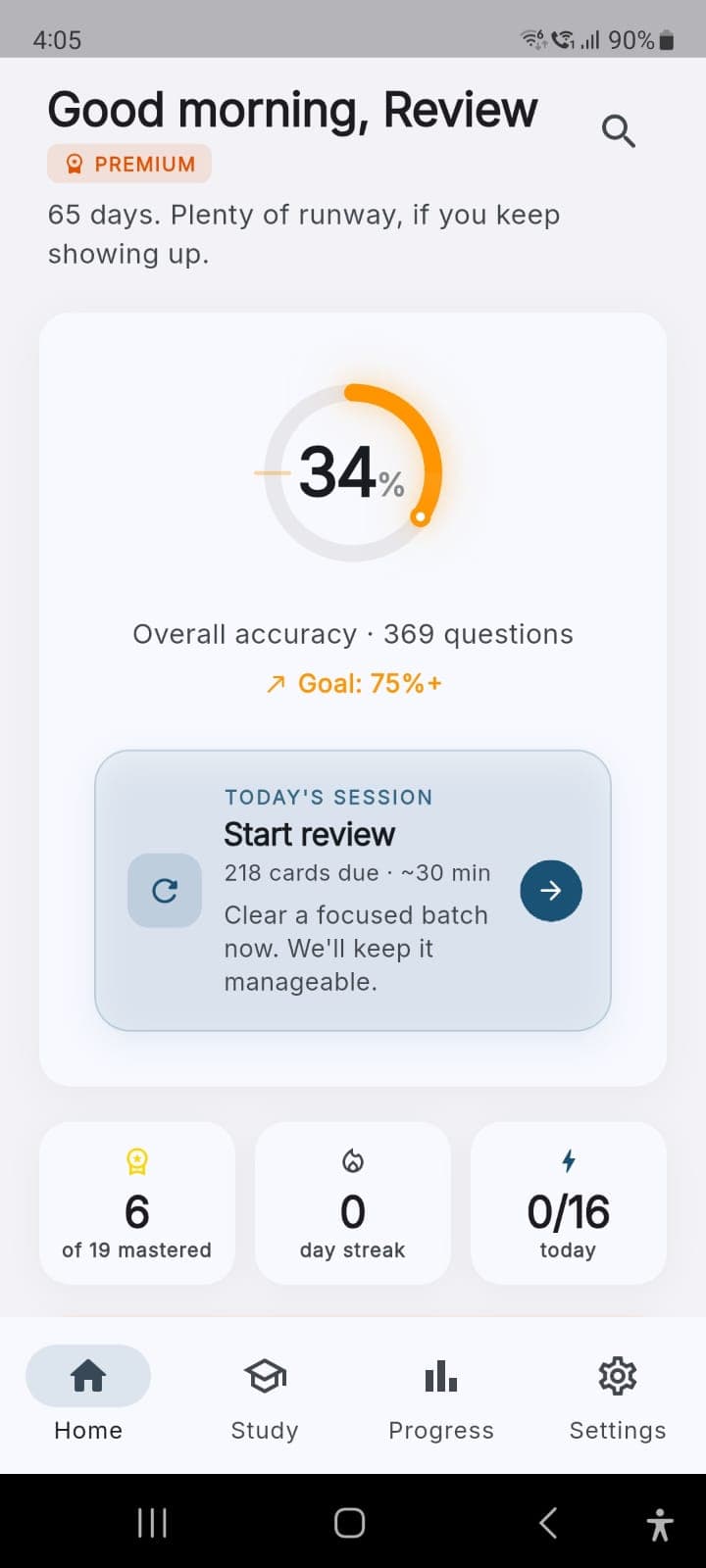
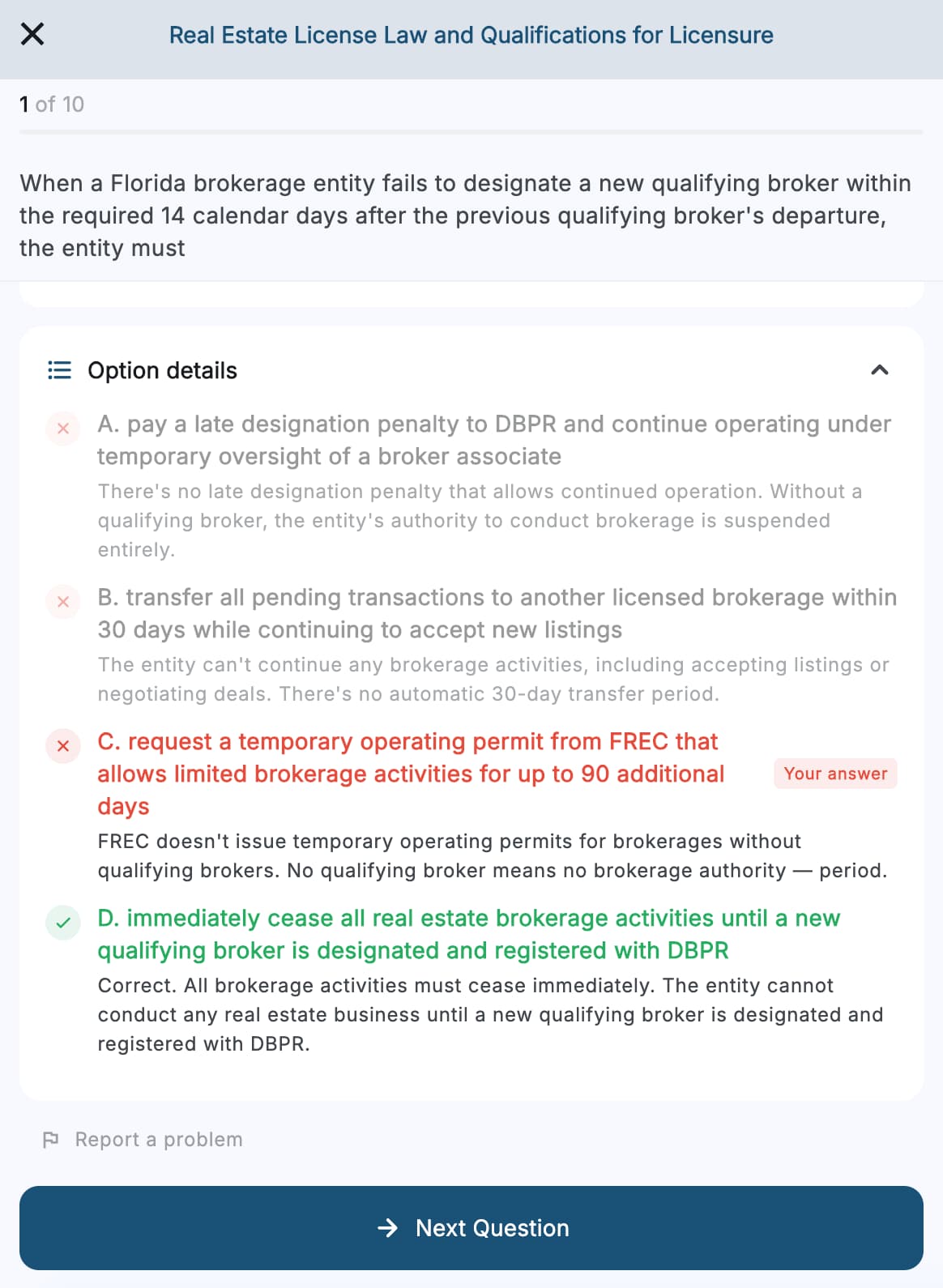
Start small today: try 5 Florida questions to test the application-level habit, check your readiness before scheduling, drill one calculation in Math Drill to start the daily math habit, or download Pass Florida when you are ready for the full question bank and Florida-specific drills.
Methodology
The 15-tip ranking by score impact (official weights / application practice / Florida-specific law / daily math / full timed exams / EXCEPT and NOT drilling / brokerage relationship separation / escrow timing / score-report use / confidence-vs-accuracy tracking / doc stamps and proration / two-pass timing / question-source rotation / course final vs state exam separation / data-driven scheduling), the situation-to-tip priority table, the 6-row Readiness Gate matrix, the 7-day final-week plan, the confidence-versus-accuracy tracker with its 8-topic high-risk list, and the EXCEPT/NOT 4-step drill protocol are independent Pass Florida coaching pedagogy derived from observed patterns in Florida candidate self-study, not DBPR rules or Pearson VUE process documents. The Florida Real Estate Commission (FREC), which sits under DBPR, controls the broader licensing framework that these tips live inside. The plan should flex based on actual readiness data; the calendar is not the boss. Studying with Pass Florida or any other exam-prep tool does not guarantee passage of the state exam.
Product Note
Pass Florida publishes this guide and offers the exam-prep app linked on this page. Pass Florida is independent exam preparation, not a DBPR-approved pre-licensing course, a tutoring service, a Pearson VUE scheduling tool, a licensing-activation service, a legal service, or a guarantee of passage.
Sources
- DBPR Real Estate Sales Associate Candidate Information Booklet, effective January 2025
- DBPR Candidate Information Booklets
- Pearson VUE Florida Real Estate and Appraisers licensing exams
- F.S. Chapter 475, real estate brokers, sales associates, schools, and appraisers
- F.S. 475.278, brokerage relationships and duties
- F.S. 475.25, discipline and escrow violations
- F.A.C. Division 61J2, Florida Real Estate Commission
- F.A.C. 61J2-14.008, escrow definitions
- F.A.C. 61J2-14.009, sales associate deposit delivery
- F.S. 201.02, documentary stamp tax on deeds
- F.S. 201.08, documentary stamp tax on notes and written obligations
- F.S. 196.031, homestead exemption
This post is exam-prep strategy content for Florida Real Estate Sales Associate candidates. It is not legal, licensing, tax, or professional advice. DBPR topic weights, the 19-content-area outline, the 75-points passing grade, the 100-question / 3.5-hour exam format, Florida statutes (including F.S. Chapter 475, F.S. 475.278, F.S. 475.25, F.S. 201.02, F.S. 201.08, F.S. 196.031), F.A.C. Chapter 61J2 rules (including 61J2-14.008 and 61J2-14.009), the documentary stamp tax rates ($0.70 per $100 on deeds in most counties, $0.35 per $100 on notes, with the Miami-Dade exception), escrow timing rules, and Pearson VUE scheduling logistics can change between exam windows. For your specific licensing path, verify against the current DBPR Candidate Information Booklet, the current Pearson VUE Florida Real Estate page, the current Florida Statutes and Florida Administrative Code, and your pre-license course provider. Studying with Pass Florida or any other exam-prep tool does not guarantee passage of the state exam.