QUICK ANSWER
Florida-specific real estate exam content is the material where the answer depends on Florida law, FREC rules, DBPR procedure, Florida tax rules, or Florida exam wording. The biggest Florida-only gaps are F.S. Chapter 475, F.A.C. Chapter 61J2, brokerage relationships, escrow deadlines, documentary stamp tax, homestead, landlord-tenant timelines, the Real Estate Recovery Fund, and radon disclosure. If you used national prep, study this layer separately before you sit for the Florida sales associate exam.
Use this page as a Florida-only gap list. It tells you what national prep often misses, which numbers deserve memory space, and where to practice next.
What this guide covers
- Official source map
- Why Florida-specific real estate exam content matters
- What "Florida-specific" actually means
- The Florida-specific content map
- FREC and DBPR: know who does what
- Brokerage relationships under F.S. 475.278
- Escrow and trust account rules
- License status, education, and renewal rules
- Documentary stamp tax and Florida closing math
- Homestead exemption, Save Our Homes, and millage
- Landlord-tenant rules: security deposits and notices
- The Real Estate Recovery Fund
- Radon and Florida disclosure questions
- What national prep usually misses
- Florida-specific quick reference
- Mistakes students make
- 5 Florida-specific practice questions
- Related exam concepts
- How to study Florida-specific content in 7 days
- Frequently asked questions
Official Source Map
Use the DBPR Candidate Information Booklet for the exam outline, Florida Statutes Chapter 475 and F.A.C. Chapter 61J2 for license-law rules, Florida Department of Revenue sources for tax rates, and Pearson VUE for scheduling mechanics.
Use the official Florida statutes, F.A.C. rules, and Department of Revenue materials for the actual regulatory text. Use the explanations, pedagogy, and embedded practice questions in this guide as exam-prep coaching.
| Claim in this guide | Primary source | Why it matters |
|---|---|---|
| Sales associate exam format: 100 multiple-choice questions, 75 points or higher to pass, 19 content areas | DBPR Sales Associate Candidate Information Booklet | The official baseline for all Florida-specific exam content |
| FREC is the Florida Real Estate Commission, an administrative body that disciplines licensees | F.S. 475.02 | Tested in scenarios about who decides probable cause, who can suspend a license, and who handles administrative discipline |
| FREC discipline framework including up to $5,000 administrative fine per count, reprimand, probation, suspension, and revocation | F.S. 475.25 | Tested in scenarios about administrative penalties (not criminal penalties) for licensee misconduct |
| Brokerage relationship duties: transaction broker, single agent, and no brokerage relationship | F.S. 475.278 | The Florida-only relationship structure; dual agency is illegal in Florida |
| Escrow conflicting demands procedure and 15-business-day FREC notice | F.A.C. 61J2-10.032 and F.S. 475.25(1)(d) | Tested in scenarios where a broker has conflicting demands on a deposit |
| Documentary stamp tax rates on deeds ($0.70 per $100 in most counties; $0.60 single-family in Miami-Dade; $1.05 non-single-family in Miami-Dade) and notes/mortgages ($0.35 per $100) | Florida Department of Revenue documentary stamp tax (grounded in F.S. 201.02, F.S. 201.031, and F.S. 201.08) | The Florida-only closing math; tested in calculation questions |
| Florida homestead exemption (first $25,000 layer + 2026 additional maximum of $26,411 on non-school taxes) and Save Our Homes assessment cap | Florida Department of Revenue property tax and exemptions and 2026 additional homestead exemption adjustment | The Florida-only property tax structure; tested in calculation and concept questions |
| Residential security deposit rules: 15-day notice for return without claim, 30-day notice of claim, 15-day tenant objection window | F.S. 83.49 | Tested in landlord-tenant scenario questions |
| Residential nonpayment and noncompliance notices: 3-day nonpayment notice, 7-day curable noncompliance notice, 7-day noncurable termination notice | F.S. 83.56 | Tested when the stem is about rent default or lease noncompliance, not ordinary periodic tenancy termination |
| Tenancy termination without specific term: 7 days weekly, 30 days monthly, 30 days quarterly, 60 days yearly | F.S. 83.57 | Tested in ordinary periodic-tenancy notice scenarios |
| Radon disclosure language must appear in real estate sales and rental contracts | F.S. 404.056 | Tested in disclosure scenarios |
| Real Estate Recovery Fund creation, eligibility, payment limits, and automatic license suspension after payment | F.S. 475.482 and F.S. 475.484 | Tested through per-transaction and per-licensee cap scenarios |
| F.S. Chapter 475 is the umbrella statute for Florida real estate licensing | F.S. Chapter 475 | The structural source of all the brokerage and license-law content |
| F.A.C. Chapter 61J2 implements F.S. Chapter 475 | F.A.C. Chapter 61J2 | The administrative rules that put the statute into practice |
| DBPR exam overview and Pearson VUE scheduling materials | DBPR Bureau of Education and Testing and Pearson VUE Florida Real Estate | The official process layer |
Why Florida-Specific Real Estate Exam Content Matters
Florida-specific content matters because many Florida sales associate exam answers change when FREC rules, Chapter 475, Chapter 61J2, state tax rates, and Florida disclosure laws enter the scenario.
The Florida sales associate exam is not just a national real estate test with a few Florida questions added at the end. The official DBPR candidate information booklet lists a 100-question sales associate exam built from real estate principles, practices, law, math, and Florida-specific regulatory content. Some topics feel familiar if you studied with national materials. Others change sharply once Florida statutes and FREC rules enter the question.
That is where students get surprised.
They know what agency means, but Florida asks whether a transaction broker is a fiduciary. They know earnest money belongs in escrow, but Florida asks which deadline applies after a broker receives conflicting demands. They know property taxes use assessed value, but Florida asks how the homestead exemption applies to school taxes. They know closing costs exist, but Florida asks whether the deed stamp rate is $0.70, $0.60, $0.35, or something else.
The hard part is not that every Florida rule is complex. The hard part is that many Florida rules are specific. You cannot always reason your way to the answer from general real estate knowledge.
This guide is built for the exact search intent behind "florida-specific real estate exam content": what you need to know, why national prep misses it, which numbers deserve memory space, and how to study the state-specific layer without turning your notes into a pile of random facts.
For the full exam map, read the 19-topic Florida real estate exam outline. For a broader difficulty breakdown, use how hard is the Florida real estate exam. This page is narrower: it is your Florida-only gap list.
What "Florida-Specific" Actually Means
Florida-specific means the answer depends on a Florida statute, Florida administrative rule, Florida agency, Florida brokerage relationship, Florida tax calculation, or Florida deadline.
Florida-specific content is not limited to questions that say "according to Florida law." It is any exam content where the answer depends on a Florida rule, Florida agency, Florida form of brokerage, Florida tax calculation, or Florida deadline.
| Content type | Generic prep teaches | Florida exam asks |
|---|---|---|
| Agency | Broker may represent buyer, seller, or both depending on state law | Florida has transaction broker, single agent, and no brokerage relationship. Dual agency is illegal. |
| Escrow | Deposits must be handled carefully | Sales associate delivery, broker deposit timing, conflicting demands, EDO limits, and trust account rules. |
| Taxes | Property taxes and transfer taxes exist | Documentary stamp rates, Miami-Dade exception, intangible tax, millage, homestead, Save Our Homes. |
| Licensing | Complete education, apply, pass an exam | DBPR, FREC, license status, post-licensing, inactive status, renewal, discipline. |
| Disclosures | Material facts must be disclosed | Florida radon language, brokerage relationship disclosures, known facts affecting value, and specific state disclosure rules. |
| Landlord-tenant | Security deposits and notices are regulated | Florida security deposit timelines, claim notices, and rental notice periods. |
The exam often hides Florida-specific content inside an ordinary scenario. A question about a buyer's deposit is not only a contract question. It may be an escrow deadline question. A question about a seller's duties may not be a general ethics question. It may be a brokerage relationship question under F.S. 475.278.
That is why students can pass national practice tests and still feel underprepared on the real Florida exam. The vocabulary looks familiar, but the legal answer changes.
FLORIDA-SPECIFIC PRACTICE
Generic prep teaches the idea. The Florida exam tests the rule.
Turn the rule in this guide into Florida-specific scenario practice, then explain why each plausible distractor is wrong.
The Florida-Specific Content Map
The highest-yield Florida-specific clusters are FREC and DBPR, Chapter 475, Chapter 61J2, brokerage relationships, escrow, Florida closing math, homestead, landlord-tenant law, Recovery Fund, and disclosures.
Use this as your high-level map before you memorize details.
| Cluster | What to know | Main exam risk |
|---|---|---|
| FREC and DBPR | Who regulates licensees, what FREC can do, and where DBPR fits | Picking a criminal penalty when the question asks about administrative discipline |
| Chapter 475 | License law, compensation, violations, duties, discipline | Treating Florida rules like generic agency rules |
| Chapter 61J2 | FREC administrative rules, escrow, education, records | Missing deadlines and account limits |
| Brokerage relationships | Transaction broker, single agent, no brokerage relationship | Thinking transaction broker is fiduciary or dual agency is allowed |
| Escrow and trust accounts | Deposit deadlines, conflicting demands, EDOs, reconciliation | Confusing calendar days, business days, and party responsibilities |
| Florida math | Doc stamps, intangible tax, property tax, proration | Using the right formula with the wrong Florida rate |
| Homestead and property tax | Two-part exemption, school tax rule, Save Our Homes cap | Subtracting the full exemption in the wrong tax category |
| Landlord-tenant law | Security deposits, claim notices, rental notices | Mixing up deposit deadlines with residential termination notices |
| Recovery Fund | Limits, eligible damages, license consequences | Confusing per-transaction and aggregate caps |
| Disclosures | Radon, brokerage, material facts, relevant state disclosures | Assuming disclosure means inspection or remediation |
If you are short on time, start with brokerage relationships, escrow, Florida math, FREC discipline, and homestead. Those topics produce a lot of high-confidence wrong answers because they sound familiar until the Florida detail appears.
FREC and DBPR: Know Who Does What
DBPR administers Florida real estate licensing, FREC regulates and disciplines real estate licensees under Chapter 475, and courts handle criminal penalties.
Florida's real estate licensing system is usually tested through two names: DBPR and FREC.
DBPR is the Department of Business and Professional Regulation. It administers licensing for many regulated professions in Florida. FREC is the Florida Real Estate Commission. It operates under Chapter 475 and regulates real estate licensees.
Under F.S. 475.02, FREC has seven members:
| Member type | Number |
|---|---|
| Licensed brokers with at least 5 years of active experience | 4 |
| Licensed broker or sales associate with at least 2 years of active experience | 1 |
| Consumer members who have never held a real estate license | 2 |
| Total | 7 |
Members are appointed by the Governor and confirmed by the Senate. At least one member must be 60 years of age or older.
The exam does not usually ask you to write an essay about FREC. It asks whether you can tell the difference between administrative authority and court authority.
FREC can discipline a license. Under F.S. 475.25, disciplinary actions can include fines, reprimand, probation, suspension, revocation, denial of a license application, and other licensing penalties. The statute authorizes administrative fines up to $5,000 for each count or separate offense.
FREC cannot send someone to jail. FREC does not impose criminal imprisonment. Courts handle criminal penalties.
That distinction matters on exam questions. If the question asks what FREC may do, look for licensing consequences. If the answer choice says imprisonment, jail, or criminal sentence, you are probably looking at the wrong authority.
FREC Trap
The word "fraud" can make a student jump to criminal punishment. Slow down. A fraudulent act may lead to both criminal and administrative consequences, but if the question is about FREC, the answer is about the license.
For a deeper law and discipline review, use the FREC rules and violations guide and the Florida Statute 475 guide.
Brokerage Relationships: The Florida Topic National Prep Misses Most
Florida tests transaction broker, single agent, and no brokerage relationship. Transaction brokerage is presumed, and Florida does not allow disclosed or nondisclosed dual agency.
If national prep hurts students anywhere, it is here.
Many national resources teach agency with buyer agency, seller agency, subagency, disclosed dual agency, and designated agency. Florida does not test the same system for sales associates. Florida's brokerage relationship statute creates three relationship types:
| Relationship | Fiduciary? | Core idea | Default? |
|---|---|---|---|
| Transaction broker | No | Limited representation to one or both parties | Yes, unless another relationship is established in writing |
| Single agent | Yes | Full fiduciary representation of one party | No |
| No brokerage relationship | No | No representation, but limited statutory duties remain | No |
The official wording matters. Florida's transaction broker is not a fiduciary. The transaction broker provides limited representation. That is different from single agency, where fiduciary duties apply.
Under F.S. 475.278, a transaction broker owes duties such as dealing honestly and fairly, accounting for funds, using skill, care, and diligence, disclosing known facts that materially affect residential value and are not readily observable, presenting offers and counteroffers, limited confidentiality, and other statutory duties.
Single agent duties go further. Students often remember them with COLD:
| Letter | Duty |
|---|---|
| C | Confidentiality |
| O | Obedience |
| L | Loyalty |
| D | Disclosure |
Single agents also owe the duties shared by other relationship types, such as accounting for funds and dealing honestly.
No brokerage relationship is narrower. A licensee still must deal honestly and fairly, disclose known facts that materially affect residential value and are not readily observable, and account for funds entrusted to the licensee.
Two Florida rules deserve a box around them:
| Rule | Why students miss it |
|---|---|
| Dual agency is illegal in Florida | National prep may discuss disclosed dual agency as allowed in some states. |
| Commission does not determine representation | Being paid by one party does not automatically create single agency with that party. |
If you want one topic to review twice, make it brokerage relationships. It is conceptual, statutory, and full of attractive wrong answers. The full breakdown is in Florida brokerage relationships explained.
Escrow and Trust Account Rules
Florida escrow questions turn on who received the money, when the broker received it, whether there are conflicting demands, and which business-day deadline applies.
Escrow is Florida-specific because the exam cares about exact deadlines, account limits, and broker responsibilities. You cannot treat it as a general "hold client money carefully" topic.
Start with the timeline.
| Event | Florida exam rule to know |
|---|---|
| Sales associate receives an escrow deposit | Deliver it to the broker no later than the end of the next business day |
| Broker receives the deposit | Place it in escrow no later than the end of the third business day after receipt |
| Broker receives conflicting demands | Notify FREC within 15 business days |
| Broker receives conflicting demands | Institute a settlement procedure within 30 business days after the last demand |
| Escrow disbursement order request | FREC will not issue an EDO when the disputed amount exceeds $50,000, and the EDO route applies only to broker-held funds |
The Florida administrative rule most students need for conflicting demands is Rule 61J2-10.032, which covers the 15-business-day notice and 30-business-day settlement procedure timing. The 61J2-14 rule family covers deposit definitions, sales associate delivery, broker deposit timing, broker records, and escrow account handling.
The money limits also matter.
| Account type | Broker personal funds allowed |
|---|---|
| Sales escrow account | Up to $1,000 |
| Property management escrow account | Up to $5,000 |
Those amounts are allowed so the broker can maintain the account. They are not permission to mix operating funds freely with trust funds.
The exam also expects you to separate three ideas:
| Term | Meaning |
|---|---|
| Commingling | Mixing personal or business funds with escrow funds beyond allowed limits |
| Conversion | Using or controlling another person's money as if it were your own |
| Escrow dispute | A disagreement between parties about who is entitled to funds |
Conversion is more serious than commingling. If a broker takes escrow money to pay an office bill, that is not just poor bookkeeping. That is use of someone else's money.
For a full review, see Florida real estate escrow and trust account rules.
License Status, Education, and Renewal Rules
For the Florida sales associate exam, know the 63-hour pre-license course, 45-hour first-renewal post-license requirement, 14-hour later renewal education, and the difference between inactive and null-and-void status.
This article is about exam prep, not how to complete your 63-hour course. Pass Florida is not a pre-license course and not continuing education. Still, the state exam can ask about license status and education rules, so you need the language.
| Topic | Florida rule to know |
|---|---|
| Sales associate pre-license education | 63-hour FREC Course I before initial licensure |
| Passing score | 75 points or higher on the 100-question sales associate exam |
| First renewal | 45-hour post-license education for sales associates before the first renewal |
| Later renewals | Continuing education is required on a two-year cycle |
| Post-license missed | License becomes null and void, which is more severe than ordinary inactive status |
Do not blur these categories:
| Status | What it means |
|---|---|
| Active | Licensee may perform real estate services through a registered employer |
| Voluntary inactive | Licensee chose inactive status and may not practice |
| Involuntary inactive | Licensee failed to renew or meet a requirement and may not practice |
| Null and void | License is no longer valid and generally requires starting over |
The exam likes consequences. If a question asks what happens when a first-renewal post-license deadline is missed, do not pick a soft answer like "pay a late fee and keep practicing." The consequence is harsher.
For the licensing path itself, use how to get a Florida real estate license and how long a Florida real estate license takes.
Documentary Stamp Tax and Florida Closing Math
Florida closing math usually tests the right rate and base: deed stamps use consideration, note and mortgage stamps use loan amount, and intangible tax uses the Florida-secured new mortgage amount.
Florida closing math is a major reason generic prep feels incomplete. A national book can teach transfer taxes, but it will not always drill Florida's rates and exceptions.
You need five core numbers:
| Florida tax | Rate | Base |
|---|---|---|
| Documentary stamp tax on deeds | $0.70 per $100 in most counties | Sale price or consideration |
| Documentary stamp tax on deeds in Miami-Dade single-family transactions | $0.60 per $100 | Sale price or consideration |
| Documentary stamp tax on deeds in Miami-Dade non-single-family transactions | $1.05 per $100 ($0.60 + $0.45 surtax) | Sale price or consideration |
| Documentary stamp tax on notes and mortgages | $0.35 per $100 | Loan amount |
| Intangible tax on new mortgages | 2 mills, or $0.002 per dollar | Loan amount |
The Florida Department of Revenue explains documentary stamp tax on deeds, notes, written obligations, and mortgages in its official documentary stamp tax materials. The Miami-Dade deed exception is the trap worth memorizing: single-family residential transfers use the lower $0.60 rate, while many non-single-family Miami-Dade transfers add the $0.45 surtax.
Example 1: Deed Stamps Outside Miami-Dade
A home in Orange County sells for $410,000.
| Step | Calculation |
|---|---|
| Divide by 100 | $410,000 / 100 = 4,100 |
| Apply deed rate | 4,100 x $0.70 |
| Tax | $2,870 |
Example 2: Miami-Dade Single-Family Deed Stamps
A single-family home in Miami-Dade County sells for $410,000.
| Step | Calculation |
|---|---|
| Divide by 100 | $410,000 / 100 = 4,100 |
| Apply Miami-Dade single-family deed rate | 4,100 x $0.60 |
| Tax | $2,460 |
The wrong answer will often be $2,870, because that is the correct standard rate applied to the wrong county.
Example 3: Mortgage Stamps and Intangible Tax
A buyer borrows $328,000.
| Tax | Calculation | Result |
|---|---|---|
| Mortgage doc stamps | $328,000 / 100 x $0.35 | $1,148 |
| Intangible tax | $328,000 x $0.002 | $656 |
| Total mortgage taxes | $1,148 + $656 | $1,804 |
For a full math review, use documentary stamps for the Florida real estate exam, closing cost documentary stamps, and the Florida real estate math formulas guide.
Homestead Exemption, Save Our Homes, and Millage
For 2026 Florida exam prep, memorize the first $25,000 homestead layer, the 2026 additional maximum of $26,411 on non-school levies, the school-tax trap, and the Save Our Homes cap.
Homestead is a Florida exam favorite because the basic rule sounds easy until school taxes appear.
Florida's general homestead exemption is taught as two parts, but the second part is now inflation-adjusted. For 2026, the Florida Department of Revenue lists the additional maximum as $26,411.
| Assessed value slice | Exemption | Applies to |
|---|---|---|
| First $25,000 | Up to $25,000 | All property taxes, including school taxes |
| $25,001 to $50,000 | No exemption | No exemption in this middle band |
| Above $50,000 | Up to $26,411 for 2026 | Non-school taxes only |
The exam trap is school taxes. For school taxes, only the first $25,000 exemption applies. For many non-school taxes, the additional layer can apply too.
School Tax Example
Assessed value: $225,000 School millage: 7 mills Homestead: full exemption available
| Step | Calculation |
|---|---|
| School taxable value | $225,000 - $25,000 = $200,000 |
| Tax | $200,000 x 7 / 1,000 |
| Result | $1,400 |
If you subtract $50,000 before applying the school millage, you get $1,225. That answer feels reasonable, but it applies the second exemption to the wrong tax.
Non-School Tax Example
Assessed value: $225,000 County millage: 7 mills Homestead: full exemption available
| Step | Calculation |
|---|---|
| Non-school taxable value | $225,000 - $25,000 - $26,411 = $173,589 |
| Tax | $173,589 x 7 / 1,000 |
| Result | $1,215.12 |
Same value. Same millage. Different tax type. Different exemption. If your course or a practice question uses a fixed $25,000 second layer, follow the number given in that question. For current 2026 examples, use the DOR CPI-adjusted amount.
Save Our Homes is the other Florida-specific property tax concept to know. The Florida Constitution limits annual increases in assessed value for qualifying homesteaded property to the lower of 3 percent or the change in the Consumer Price Index. When the property is sold, the new owner is assessed under the current value rules rather than inheriting the seller's old capped assessment.
For more worked examples, use the Florida homestead exemption exam guide.
THE FLORIDA-ONLY LAYER
These are the rules where one Florida detail flips the answer.
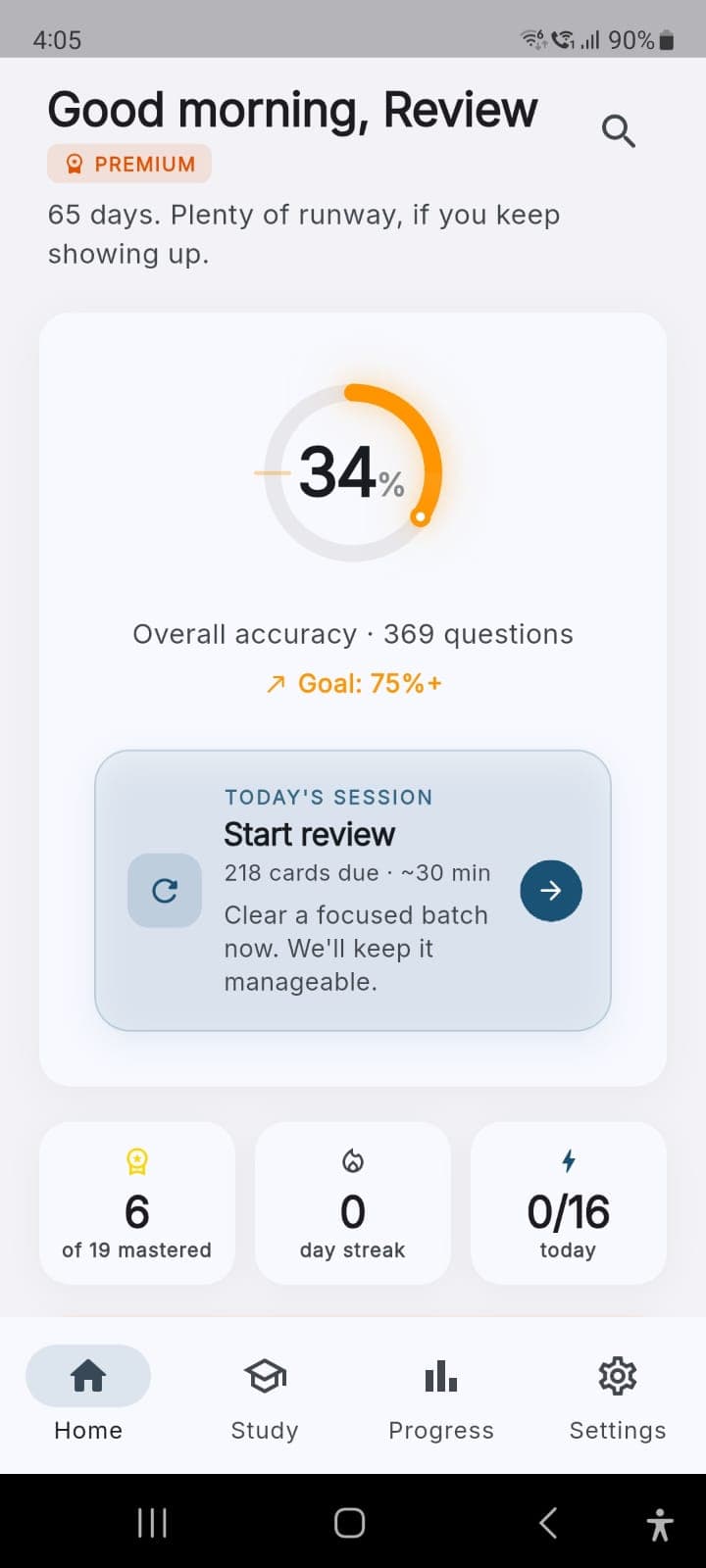
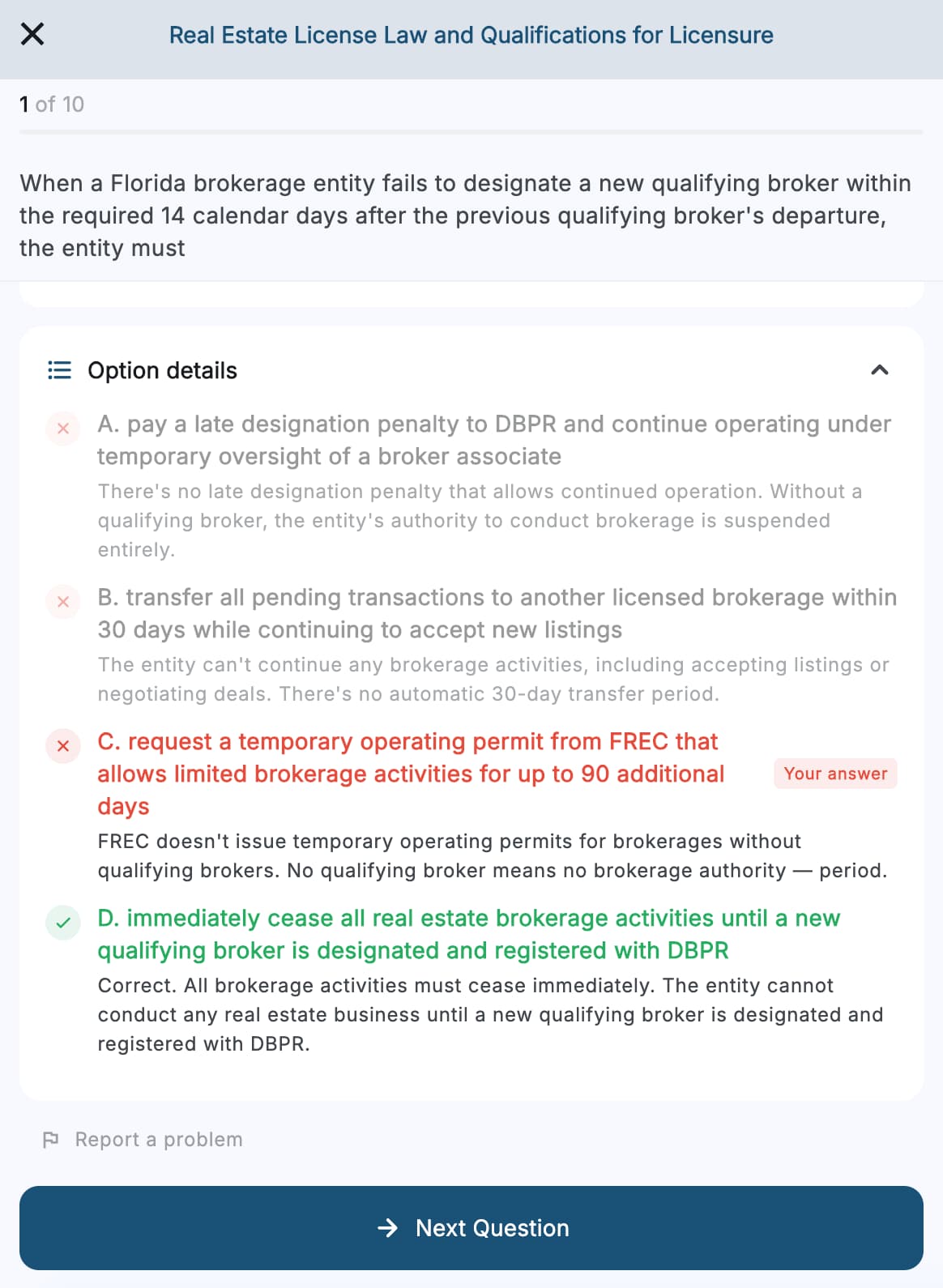
Transaction broker versus single agent, the Miami-Dade deed rate, the school-tax homestead trap, the 15 and 30 business-day escrow deadlines. Pass Florida drills all of it as Florida-specific scenarios: 1,142 questions, a 19-topic diagnostic, and a Trap Library, for one $39.99 purchase. No subscription. No copied exam questions.
Landlord-Tenant Rules: Security Deposits and Notices
Florida landlord-tenant questions usually test 15 days, 30 days, 15 days for deposits, plus 3-day and 7-day violation notices and 7/30/60 periodic-tenancy notices.
Florida landlord-tenant law is not the largest exam topic, but it is easy to score if you know the timelines.
Under F.S. 83.49, security deposit handling has a simple decision tree:
| Situation | Deadline |
|---|---|
| Landlord has no claim against the deposit | Return the deposit within 15 days after the tenant leaves |
| Landlord intends to make a claim | Send written notice within 30 days |
| Tenant receives a claim notice | Tenant has 15 days to object |
The notice of claim must be sent by certified mail to the tenant's last known mailing address or by e-mail when the statute allows it. If the landlord fails to send the required notice within the statutory window, the landlord loses the right to impose a claim on the deposit. That consequence is often the point of the question.
Florida rental notice periods are another small but testable area. Keep lease violation notices separate from ordinary periodic-tenancy termination under F.S. 83.57.
| Notice | Source | Common use |
|---|---|---|
| 3-day notice | F.S. 83.56 | Nonpayment of rent, excluding Saturday, Sunday, and legal holidays |
| 7-day curable notice | F.S. 83.56 | Noncompliance that can be corrected |
| 7-day noncurable notice | F.S. 83.56 | Serious violation or repeat conduct where cure is not offered |
| 7-day periodic notice | F.S. 83.57 | Terminating a week-to-week tenancy without a specific term |
| 30-day periodic notice | F.S. 83.57 | Terminating a month-to-month or quarter-to-quarter tenancy without a specific term |
| 60-day periodic notice | F.S. 83.57 | Terminating a year-to-year tenancy without a specific term |
Do not mix violation notices with ordinary termination notices. A 3-day notice is not a general cancellation tool. It is tied to nonpayment of rent. A month-to-month periodic tenancy uses the current 30-day F.S. 83.57 notice, so avoid outdated summaries.
For a fuller review, read Florida real estate exam landlord-tenant law.
The Real Estate Recovery Fund
The Florida Real Estate Recovery Fund can pay qualifying actual or compensatory damages, but the exam usually tests the $50,000 per-transaction cap, $150,000 per-licensee cap, and automatic license suspension after payment.
The Florida Real Estate Recovery Fund appears intimidating because it involves claims, judgments, and license consequences. For exam purposes, keep the structure clean.
The Recovery Fund exists to compensate qualifying members of the public who suffer monetary damages because of certain acts by a real estate licensee in a brokerage transaction. It is not a general insurance fund for every bad real estate outcome.
The key limits come from F.S. Chapter 475.
| Recovery Fund point | Exam memory hook |
|---|---|
| Maximum per transaction | $50,000 |
| Maximum per licensee | $150,000 |
| Damages covered | Actual or compensatory damages, not punishment or pain and suffering |
| License consequence after payment | License is suspended until repayment rules are satisfied |
The per-transaction limit and per-licensee aggregate limit are often placed in the same answer set. If one injured buyer has a $70,000 judgment from one transaction, the Fund does not pay $70,000 just because the judgment says $70,000. The transaction cap matters.
If multiple claims involve the same licensee, the aggregate cap matters. That is where the larger number belongs.
Radon and Florida Disclosure Questions
Florida radon disclosure requires statutory warning language in sale documents and rental agreements for buildings, but the exam trap is that disclosure is not the same as mandatory testing or remediation.
Florida's radon disclosure is worth knowing because students overread it.
F.S. 404.056 requires specific radon warning language in contracts for the sale of buildings and in rental agreements for more than 45 days. The point is notice. It does not mean the seller must test for radon. It does not mean the seller must remediate radon before closing. It does not mean vacant land needs the same building disclosure.
That is the exam lesson: a required disclosure is not always a required inspection, repair, or guarantee.
The same reasoning helps with other disclosure questions. Ask what the law actually requires. Is the licensee required to disclose a known material fact? Is a specific form or warning required? Is testing required? Do not add obligations that are not in the rule.
What National Prep Usually Misses
National prep often misses Florida's exact brokerage relationship model, escrow deadlines, tax rates, homestead treatment, license-status consequences, and state disclosure language.
National prep is not useless. It can help with property rights, contracts, basic financing, valuation, fair housing, and real estate vocabulary. The problem is that it often teaches those topics at the wrong layer for Florida.
Here is the gap:
| National prep habit | Florida exam problem |
|---|---|
| Teaches general agency law | Florida uses a distinct brokerage relationship statute |
| Explains escrow in broad terms | Florida tests deadlines, conflicting demands, EDOs, and account limits |
| Covers transfer taxes generically | Florida tests exact documentary stamp and intangible tax rates |
| Reviews property tax concepts | Florida adds homestead, school tax treatment, and Save Our Homes |
| Covers licensing basics | Florida tests DBPR, FREC, post-license consequences, and status language |
| Uses broad disclosure language | Florida includes specific statutory disclosure language and duties |
The student mistake is not choosing national prep. The mistake is assuming national prep finished the job.
If you already completed a pre-license course, you do not need to restart from zero. You need targeted Florida practice, especially on the topics where one word changes the answer.
Florida-Specific Quick Reference
Use this quick reference to memorize the Florida-only numbers that create exam answers, including FREC membership, escrow deadlines, doc stamp rates, homestead, landlord-tenant notices, Recovery Fund caps, and radon disclosure.
Use this table as a review sheet. Verify current law against official sources as you study, especially if your exam date is far in the future.
| Topic | Number or rule | Why it matters |
|---|---|---|
| Sales associate exam | 100 multiple-choice questions | DBPR candidate booklet structure |
| Passing score | 75 points or higher | Minimum passing grade |
| FREC members | 7 | Composition questions test exact categories |
| FREC fine | Up to $5,000 per count or separate offense | Administrative discipline |
| Transaction broker | Default relationship unless otherwise established | Not fiduciary |
| Dual agency | Illegal in Florida | National prep may teach it as allowed elsewhere |
| Sales associate escrow delivery | Next business day to broker | Person receiving funds matters |
| Broker escrow deposit | End of third business day after broker receives funds | Deadline wording matters |
| Conflicting demands notice | 15 business days | Broker must notify FREC |
| Settlement procedure | 30 business days | Separate from the 15-day notice |
| Sales escrow personal funds | Up to $1,000 | Avoid confusing with property management |
| Property management personal funds | Up to $5,000 | Different account limit |
| Deed stamps | $0.70 per $100 in most counties | Standard deed rate |
| Miami-Dade single-family deed stamps | $0.60 per $100 | Common exception |
| Mortgage stamps | $0.35 per $100 | Loan amount, not sale price |
| Intangible tax | 2 mills, or $0.002 per dollar | New mortgage amount |
| Miami-Dade non-single-family deed stamps | $1.05 per $100 | $0.60 base plus $0.45 surtax |
| Homestead | First $25,000 plus 2026 additional maximum of $26,411 | School tax gets only the first $25,000 |
| Save Our Homes cap | Lower of 3 percent or CPI | Applies to assessed value increases |
| Security deposit, no claim | 15 days | Return deadline |
| Security deposit, claim | 30 days | Notice deadline |
| Nonpayment of residential rent | 3 days, excluding Saturday, Sunday, and legal holidays | F.S. 83.56 notice trigger |
| Month-to-month tenancy termination | 30 days | F.S. 83.57 ordinary periodic-tenancy notice |
| Week-to-week tenancy termination | 7 days | F.S. 83.57 ordinary periodic-tenancy notice |
| Year-to-year tenancy termination | 60 days | F.S. 83.57 ordinary periodic-tenancy notice |
| Recovery Fund | $50,000 per transaction, $150,000 per licensee | Do not confuse the two caps |
| Radon disclosure | Required for sale of buildings and rentals over 45 days | Notice, not mandatory testing |
Mistakes Students Make
The biggest Florida-specific mistakes are treating transaction broker like dual agency, memorizing numbers without triggers, using the wrong tax base, chasing pending laws, and ignoring federal topics inside the Florida outline.
Mistake 1: Treating transaction broker like dual agency
Transaction broker is Florida's default limited representation relationship. It is not dual agency, and it is not fiduciary representation. If an answer choice says a transaction broker owes loyalty or obedience, slow down.
Mistake 2: Memorizing numbers without the trigger event
"15 days" is not enough. Fifteen days for what? Landlord return of a deposit with no claim? Tenant objection to a deposit claim? Broker notice to FREC after conflicting demands? The exam tests the event plus the number.
Mistake 3: Using the right formula with the wrong base
Doc stamps on deeds use sale price or consideration. Mortgage stamps and intangible tax use loan amount. Property tax uses taxable value after exemptions. If you choose the wrong base, the formula will still look tidy while producing the wrong answer.
Mistake 4: Overstudying pending or headline laws
Students sometimes chase every Florida real estate news update. That can waste time. The safer move is to anchor your study in the official candidate information booklet, Chapter 475, Chapter 61J2, and tested exam concepts. Know major current rules, but do not build your study plan around pending bills or social media summaries.
Mistake 5: Ignoring federal content inside a Florida exam
Florida-specific study does not mean federal law disappears. Fair housing, RESPA, TRID, financing rules, and anti-discrimination concepts still matter. The key is to know when the answer is driven by federal law and when a Florida rule narrows the answer.
For federal topics with Florida exam framing, use Florida real estate exam fair housing guide and RESPA and TRID for the Florida real estate exam.
5 Florida-Specific Practice Questions
These five original questions test the Florida-specific traps national prep often misses: FREC authority, brokerage relationships, Miami-Dade deed stamps, homestead school taxes, and security deposit claims.
These are original practice questions written to teach the rule. They are not copied from the state exam.
Question 1: FREC Authority
Which penalty may FREC impose for a license law violation?
- A. Imprisonment for up to one year
- B. An administrative fine up to the statutory limit per offense
- C. Garnishment of the licensee's wages
- D. Criminal restitution ordered by a judge
Answer and explanation
Answer: B.
FREC is an administrative licensing body. It can discipline a license, including fines within the statutory limit. Imprisonment and criminal restitution come from courts. Wage garnishment is also not a FREC licensing penalty.
Question 2: Brokerage Relationship
A Florida broker works with a buyer and seller in the same transaction without a written single-agent agreement. Which relationship is presumed unless another relationship is established?
- A. Dual agency
- B. Transaction brokerage
- C. Single agency for both parties
- D. No brokerage relationship with both parties
Answer and explanation
Answer: B.
Transaction broker is the presumed relationship in Florida unless a different relationship is established as required by statute. Dual agency is illegal in Florida. A broker cannot be a single agent for both parties in the same transaction.
Question 3: Miami-Dade Deed Stamps
A single-family residence in Miami-Dade County sells for $500,000. What deed stamp rate should be used?
- A. $0.35 per $100
- B. $0.60 per $100
- C. $0.70 per $100
- D. $1.05 per $100
Answer and explanation
Answer: B.
Miami-Dade single-family residences use $0.60 per $100 for deed stamps. The $0.70 rate is the standard deed rate in most counties. The $0.35 rate applies to notes and mortgages. The $1.05 figure applies to certain non-single-family Miami-Dade deed transactions.
Question 4: Homestead School Taxes
A homesteaded property has an assessed value of $180,000. The school district millage is 6 mills. Which taxable value should be used for the school tax calculation?
- A. $130,000
- B. $155,000
- C. $180,000
- D. $75,000
Answer and explanation
Answer: B.
Only the first $25,000 of the homestead exemption applies to school taxes. $180,000 minus $25,000 equals $155,000. Subtracting the full $50,000 would be the trap.
Question 5: Security Deposit Claim
A tenant leaves, and the landlord intends to claim part of the security deposit for damage. What must the landlord do within the Florida statutory period?
- A. Return the full deposit within 15 days no matter what
- B. Send written notice of the claim within 30 days
- C. File a lawsuit within 3 days
- D. Ask FREC for an escrow disbursement order
Answer and explanation
Answer: B.
If a Florida landlord intends to impose a claim on the security deposit, the landlord must send written notice within 30 days. The 15-day rule applies when there is no claim. FREC escrow disbursement orders relate to broker escrow disputes, not ordinary landlord security deposit claims.
Related Exam Concepts
Pair this Florida-specific gap list with the brokerage, escrow, Chapter 475, FREC discipline, math, doc stamp, homestead, landlord-tenant, study-plan, and practice-question resources.
| If this topic was weak | Study this next | Why |
|---|---|---|
| Brokerage relationships | Brokerage relationships explained | Florida's relationship categories are different from many national agency summaries. |
| Escrow | Escrow and trust account rules | Deadlines and account limits are common traps. |
| Chapter 475 | F.S. Chapter 475 real estate guide | License law drives many state-specific questions. |
| FREC discipline | FREC rules and violations | Helps separate administrative penalties from criminal penalties. |
| Florida math | Math formulas guide | Florida math is formula plus rate selection. |
| Doc stamps | Documentary stamps guide | One county exception can change the answer. |
| Homestead | Homestead exemption guide | The school tax distinction is easy to miss. |
| Landlord-tenant | Landlord-tenant law guide | Short topic, high value if you know the timelines. |
| Full exam plan | 30-day study plan | Turns this checklist into a schedule. |
| Practice | Free Florida practice questions | Tests whether the Florida details are sticking. |
How to Study Florida-Specific Content in 7 Days
Study Florida-specific content in seven days by isolating Chapter 475, brokerage relationships, escrow, Florida math, landlord-tenant law, disclosures, mixed practice, and final missed-rule review.
If your exam is close, do not try to reread your whole course. Use a targeted plan.
| Day | Focus | Output |
|---|---|---|
| 1 | FREC, DBPR, Chapter 475 | Write a one-page discipline and license status sheet |
| 2 | Brokerage relationships | Build a three-column duty chart |
| 3 | Escrow and trust accounts | Memorize deadlines, dollar limits, and dispute procedures |
| 4 | Florida math | Drill deed stamps, mortgage stamps, intangible tax, millage, and homestead |
| 5 | Landlord-tenant and disclosures | Review security deposit timelines and radon wording |
| 6 | Mixed practice | Answer Florida-only questions and mark every missed trigger word |
| 7 | Final review | Redo missed questions and rewrite the quick reference from memory |
Your goal is not to memorize every statute line. Your goal is to recognize the trigger. When a question says "conflicting demands," your brain should move to escrow dispute procedure. When it says "school tax," your brain should move to the first $25,000 homestead exemption. When it says "Miami-Dade single-family," your brain should move to $0.60 per $100.
That is how Florida-specific content becomes manageable.
Frequently Asked Questions
What is Florida-specific real estate exam content?
Florida-specific real estate exam content is the exam material controlled by Florida statutes, FREC rules, DBPR procedure, Florida taxes, Florida disclosures, and Florida licensing rules. It includes topics like Chapter 475, brokerage relationships, escrow deadlines, documentary stamp tax, homestead exemption, landlord-tenant timelines, license discipline, and the Real Estate Recovery Fund.
Is the Florida real estate exam mostly national or state-specific?
The Florida sales associate exam includes both general real estate principles and Florida law. The official DBPR candidate booklet lists a 100-question exam with topics covering real estate law, principles, practices, math, brokerage relationships, finance, valuation, and Florida regulatory material. Treat it as a mixed exam, not a purely national exam.
Why is national real estate exam prep not enough for Florida?
National prep often teaches general concepts without Florida's exact statutory rules. That is risky for brokerage relationships, escrow, documentary stamp tax, homestead exemption, FREC discipline, license status, and landlord-tenant timelines. Florida questions often turn on the exact state rule, not the broad concept.
What Florida-specific topic should I study first?
Start with brokerage relationships and escrow. Brokerage relationships are different in Florida because transaction broker is the default and dual agency is illegal. Escrow is heavy on deadlines, business days, account limits, and dispute procedures. After that, study Florida math, FREC discipline, homestead, and landlord-tenant timelines.
Are the practice questions in this guide copied from the Florida exam?
No. They are original teaching questions. Pass Florida does not copy state exam questions. The goal is to teach the rules and traps so you understand the content instead of memorizing leaked or unreliable material.
Does Pass Florida replace the 63-hour pre-license course?
No. Pass Florida is exam prep only. It is not a 63-hour pre-license course and not continuing education. Use it after or alongside your required coursework to prepare for the Florida sales associate exam.
How many Florida-specific questions should I practice?
Practice enough to see patterns. A few questions can teach definitions, but Florida-specific readiness comes from repeated exposure to scenarios. You want to know whether you can identify the trigger word, choose the right rule, and explain why the wrong answer is wrong.
What is the fastest way to improve on Florida-specific content?
Make a missed-rule list. For every missed question, write the rule in one sentence and add the trigger phrase that should have alerted you. For example: "school tax means only the first $25,000 homestead exemption applies" or "conflicting demands means notify FREC within 15 business days." Review that list daily.
Ready to Build the Florida-Specific Layer?
The best next step is to test Florida-specific rules under timed pressure, then download Pass Florida when you need full-topic practice across the 19-area outline.
Florida-specific real estate exam content is where the exam stops rewarding general familiarity and starts rewarding exact Florida judgment.
You need to know who FREC is, what F.S. Chapter 475 requires, how Florida brokerage relationships work, when escrow deadlines start, which tax rate applies, and what a disclosure actually requires.
The good news: this material is learnable. It is a collection of rules, triggers, and traps. Once you organize it by topic, the exam starts to feel less random.
Start with the free Florida practice exam to test mixed state-specific wording, then check your readiness before scheduling. When you want full-topic repetition across the Florida-only layer, see what the one-time purchase includes or download Pass Florida.
Methodology
The Florida-specific content map (16-row brokerage-relationships-through-disclosures cluster table), the 6-row generic-vs-Florida-specific comparison table, the FREC-vs-DBPR jurisdictional framing, the brokerage relationship deep dive (transaction broker, single agent, no brokerage relationship), the escrow timing pedagogy with the 15-business-day FREC conflicting-demands deadline framing, the doc stamp calculation walkthrough with the Miami-Dade exception, the homestead exemption mechanics and Save Our Homes assessment cap explanation, the landlord-tenant timeline framework separating F.S. 83.49 deposits, F.S. 83.56 violation notices, and F.S. 83.57 periodic-tenancy termination, the Recovery Fund eligibility framing, the radon disclosure language requirement, the 5 embedded original practice questions with answer explanations, the 7-day Florida-specific study plan, the Florida-specific quick reference, and the "what national prep usually misses" framing are independent Pass Florida coaching pedagogy derived from observed candidate-error patterns and the Florida regulatory framework, not DBPR or FREC process documents. The 5 practice questions are written at exam-style difficulty but are original constructions; they are not reproduced or reconstructed Pearson VUE live exam items. The Florida Real Estate Commission (FREC), which sits under DBPR, controls the broader licensing framework that the Florida-specific content lives inside.
For your specific licensing path, verify against the current DBPR Candidate Information Booklet, the current F.S. Chapter 475, the current F.A.C. Chapter 61J2, the current Florida Department of Revenue documentary stamp tax materials, and the current Florida Department of Revenue homestead and property tax exemption materials before relying on any rule paraphrase in this post. This guide is exam-prep coaching, not legal advice and not a DBPR determination. Studying with Pass Florida or any other exam-prep tool does not guarantee passage of the state exam.
Product Note
Pass Florida publishes this guide and offers the exam-prep app linked on this page. Pass Florida is independent exam preparation, not a DBPR-approved pre-licensing course, a tutoring service, a Pearson VUE scheduling tool, a licensing-activation service, a legal service, or a guarantee of passage.
Sources
- DBPR Florida Real Estate Sales Associate Candidate Information Booklet, effective January 2025
- DBPR Florida Real Estate Law Book
- DBPR Bureau of Education and Testing real estate exam overview
- Pearson VUE Florida Real Estate exam page
- F.S. Chapter 475, real estate brokers, sales associates, schools, and appraisers
- F.S. 475.02, Florida Real Estate Commission
- F.S. 475.25, discipline
- F.S. 475.278, brokerage relationships
- F.S. 475.482, Real Estate Recovery Fund
- F.S. 475.484, payment from the Real Estate Recovery Fund
- F.A.C. Chapter 61J2, Florida Real Estate Commission
- F.A.C. 61J2-10.032, notice requirements
- F.A.C. 61J2-14.008, escrow definitions
- F.A.C. 61J2-14.009, real estate sales associate escrow delivery
- F.A.C. 61J2-14.010, real estate broker escrow handling
- F.A.C. Division 61J2, Florida Real Estate Commission Division gateway
- F.S. 83.49, residential security deposits
- F.S. 83.56, residential termination of rental agreement
- F.S. 83.57, termination of tenancy without specific term
- F.S. 201.02, documentary stamp tax on deeds
- F.S. 201.031, Miami-Dade discretionary surtax on documents
- F.S. 201.08, documentary stamp tax on notes and written obligations
- F.S. 199.133, nonrecurring intangible tax
- Florida Department of Revenue documentary stamp tax
- Florida Department of Revenue property tax and exemptions
- Florida Department of Revenue 2026 additional homestead exemption adjustment
- F.S. 404.056, radon disclosure
This post is Florida-specific exam-prep coaching content for Florida Real Estate Sales Associate candidates. It is not legal, tax, lending, appraisal, title, brokerage, licensing, or policy advice and is not a DBPR determination. F.S. Chapter 475 statutes (including F.S. 475.02, F.S. 475.25, F.S. 475.278, F.S. 475.482, and F.S. 475.484), F.A.C. Chapter 61J2 rules (including F.A.C. 61J2-10.032 notice requirements and the 61J2-14 escrow rule family), F.S. 83.49 / 83.56 / 83.57 landlord-tenant statutes, F.S. 404.056 radon disclosure requirements, F.S. 201.02 / 201.031 / 201.08 documentary stamp rates, F.S. 199.133 intangible tax, FREC discipline boundaries, homestead and Save Our Homes mechanics, millage rate calculations, and state disclosure rules can change between exam windows and annual Florida statute revision cycles. The Florida-specific content map, brokerage relationship pedagogy, escrow timing pedagogy, doc stamp calculation framework, homestead/Save Our Homes/millage explanations, landlord-tenant timeline framing, Recovery Fund explanation, 5 embedded original practice questions, 7-day Florida-specific study plan, and "what national prep misses" framing are observational Pass Florida coaching pedagogy, not DBPR or FREC process documents. The 5 practice questions are written at exam-style difficulty but are original Pass Florida constructions; they are not copied or reconstructed Pearson VUE exam questions. For your specific exam appointment, verify against the current DBPR Candidate Information Booklet, the current F.S. Chapter 475, the current F.A.C. Chapter 61J2, and the current Florida Department of Revenue documentary stamp tax and property tax exemption materials. Studying with Pass Florida or any other exam-prep tool does not guarantee passage of the state exam.