READ THE RATE IN CONTEXT
DBPR pass rates are monthly population snapshots, not a prediction of your result. The newest row used here is May 2026, published in the June 2026 FREC Division Report. Use the figures to judge preparation risk, then use fresh, timed practice to judge your own readiness.
QUICK ANSWER
The Florida real estate sales associate exam pass rate usually sits near the halfway mark for first-time takers. Recent DBPR monthly reports show first-time pass rates in the high 40s to low 50s, retaker pass rates around the high 20s to mid 30s, and overall pass rates in the high 30s to mid 40s depending on the month. The exam is passable, but average preparation is not enough. The candidates who beat the odds practice application-level questions, Florida-specific law, math, EXCEPT/NOT wording, and full timed exams. The [first-try routine](/blog/pass-florida-real-estate-exam-first-try) sequences exactly that into a week-by-week plan.
WHO THIS GUIDE IS FOR
Florida sales associate exam candidates trying to interpret pass-rate numbers without panic, first-time test-takers calibrating their expected risk, retake candidates trying to understand why retaker rates are lower than first-time rates, and anyone using a different state's pass rate as a (misleading) benchmark for Florida. Pair with the pass-rate trend analysis for the multi-year story behind why the numbers slipped, the why-did-i-fail guide for the 7-reason failure breakdown and retake plan, the retake plan guide for the day-by-day execution, the how-to-pass guide for the first-time-pass strategy, the 30-day study plan for the structured weekly calendar, the 19 official exam topics guide for the topic-weight map, the tricky questions strategy guide for question-format training, and the math formulas guide for the calculation families. Not legal or licensing advice.
EXAM PREP ONLY
The Florida sales associate exam is a closed-book, computer-based licensing exam administered by Pearson VUE on behalf of DBPR. DBPR's current Sales Associate Candidate Information Booklet (CIB) states 100 multiple-choice questions, three and a half hours, 19 content areas, and a passing grade of at least 75. The exam covers Florida real estate principles and practices, real estate law, real estate mathematics, F.S. Chapter 475 Part I, and F.A.C. Chapter 61J2. This article interprets DBPR pass-rate data as a preparation signal. It does not replace the required 63-hour FREC-approved course, DBPR application steps, Pearson VUE scheduling rules, fingerprinting, post-licensing, continuing education, legal advice, or official sources.
Source: June 2026 FREC Division Report, which contains May 2026 exam-performance data.
May 2026 first-time pass rate: 48%. Plan for serious preparation, not casual review.
May 2026 retaker pass rate: 31%. If your first method failed, change the method before adding more hours.
May 2026 overall pass rate: 40%. This combined figure includes first-time and repeat attempts, so it is not your personal probability.
KEEP EXAM PREP SIMPLE
The pass rate is a warning, not a prediction.
Treat pass-rate data as context, not a forecast. Your useful signal is performance on fresh, timed, Florida-specific questions.
The number that should change how you prepare
About half of first-time takers fail the Florida real estate exam. In some recent DBPR monthly reports, slightly more than half fail. That is not a scare tactic. That is DBPR exam-performance data from Division of Real Estate meeting materials.
The Florida Department of Business and Professional Regulation publishes monthly exam-performance summaries that separate first-time takers, repeaters, and all attempts. Most prep companies cite a vague "50% pass rate" and move on. The full data is more specific than that. And more useful.
This guide separates the reported results from study recommendations. The monthly summaries show outcomes, but do not measure study methods or explain why a candidate passed or failed.
In the reporting periods cited here, first-time pass rates are near half and repeater pass rates are lower. These are different groups, so the gap does not establish that a particular study method caused failure. Our coaching advice is to practice applying rules, review calculations, use Florida-specific material, and check readiness with unfamiliar timed questions. Those recommendations are not causal findings from the DBPR reports.
If you want the full test format first, start with the Florida real estate exam guide. If you want the actual study strategy, read how to pass the Florida real estate exam. This page answers the data question: what do the pass rates say about how you should prepare?
PASS RATE OR PASS RATE TREND?
This page explains the current pass-rate reality and how to respond. If you want the multi-year story behind why the numbers slipped, read the pass-rate trend analysis.
What this guide covers
- Official source map
- The real numbers
- Why about half fail the first time
- Why retakers do worse
- Why state-to-state comparisons are tricky
- What this means for your preparation
- Pass rate quick reference table
- Frequently Asked Questions
Official Source Map
Use DBPR monthly Exam Performance Summary reports (released via FREC and FREAB Division reports) for current pass-rate context. Use the DBPR Sales Associate CIB for exam format and scoring. Use Pearson VUE for scheduling, retake timing, and fee details. Use the preparation framework in this article as study coaching only.
| Claim in this guide | Primary source | Why it matters |
|---|---|---|
| May 2026 DBPR exam performance: FL Sales Associate first-time 48% (987 of 2,044), retakers 31% (684 of 2,181), all attempts combined 40% (1,671 of 4,225) | June 2026 FREC Division Report PDF with May 2026 exam-performance data | The newest monthly row available in the cited official reports |
| March 2026 DBPR exam performance: FL Sales Associate first-time 51%, retakers 31%, all attempts 41% | April 2026 FREC Division Report PDF with March 2026 exam-performance data | A useful comparison showing normal month-to-month movement |
| December 2025 DBPR exam performance: first-time 48%, retakers 29%, all attempts 38% | February 2026 FREAB Exam Performance Summary PDF with December 2025 data | The earlier reference point, included for trend context |
| The exam is closed book, 100 multiple-choice questions, three and a half hours, 19 content areas, with a passing grade of at least 75 | DBPR Sales Associate Candidate Information Booklet PDF | The exam-format anchor that controls everything else in this guide |
| Pearson VUE fact sheet sets the 24-hour retake wait and the $36.75 sales associate exam fee | Pearson VUE Florida candidate fact sheet PDF | The vendor-side scheduling and fee anchor |
| Pearson VUE administers the Florida Real Estate Sales Associate exam on behalf of DBPR | Pearson VUE Florida Real Estate and Appraisers licensing exams | The official testing-vendor page |
| The pre-license course is valid for 2 years and the DBPR application window is 2 years from the date DBPR received the application | DBPR real estate sales associate requirements PDF | Prevents the retake-plan mistake of treating attempts as unlimited outside the eligibility window |
| F.S. Chapter 475 governs the broker / sales associate licensing framework that the exam tests | F.S. Chapter 475, Florida Senate | The statutory backbone for the Florida-specific content the exam over-indexes on |
| The 4-factor failure framework, retaker-pattern analysis, and preparation recommendations are study heuristics | Pass Florida coaching methodology | These are not DBPR, FREC, or Pearson VUE rules |
The real numbers
The Florida real estate Sales Associate exam is administered by Pearson VUE on behalf of the DBPR. Monthly Exam Performance Summary reports break results down by attempt type.
| Metric | Rate |
|---|---|
| First-time takers | high 40s to low 50s in recent reports |
| Retakers | high 20s to mid 30s in recent reports |
| Overall (all attempts) | high 30s to mid 40s in recent reports |
| Monthly graded sales associate exams | roughly 3,700 to 5,100 in recent reports |
The May 2026 exam-performance summary in the June FREC Division Report shows FL Sales Associate first-time takers passing at 48% (987 of 2,044 candidates), retakers at 31% (684 of 2,181 attempts), and all attempts combined at 40% (1,671 of 4,225 graded exams). March 2026 came in at 51%, 31%, and 41%. December 2025 was 48%, 29%, and 38%. The month changes. The broad pattern stays remarkably steady.
Here are the same numbers in one place:
| Report month | First-time | Retaker | Overall |
|---|---|---|---|
| May 2026 | 48% (987 / 2,044) | 31% (684 / 2,181) | 40% (1,671 / 4,225) |
| March 2026 | 51% | 31% | 41% |
| December 2025 | 48% | 29% | 38% |
The exact number moves month to month. The pattern does not: first-timers hover around the halfway mark, retakers lag meaningfully below first-timers, and the overall rate looks worse because repeat attempts pull the average down.
The overall rate includes both first-timers and retakers. Because retakers pull the average down, the number you see quoted most often can understate how first-time takers perform and overstate how safe retaking feels. First-timers do better than the headline number suggests. Retakers do worse. The distinction matters for how you interpret the data.
Exam trap alert: the pass rate is not your personal probability
The pass rate is a population statistic. It mixes serious candidates, casual candidates, first-time career switchers, people who crammed, people using stale national prep, people who practiced daily, and people retaking with no new plan. It does not know your study method.
Treat the pass rate as a diagnostic signal. If you prepare like the average candidate, expect average risk. If you prepare with topic-weighted, Florida-specific, application-level practice, you have changed the inputs.
Preparation checks the pass-rate report cannot make for you
The reports do not identify the causes of failure. Use these four checks as study advice, not as explanations proved by the statewide data.
Can you apply a rule as well as recall it?
A course result is useful feedback, but it is a different assessment. Try unfamiliar scenarios and explain why each incorrect answer fails. The tricky questions strategy guide gives a method for reading those questions.
Have you practiced calculations across topics?
Calculations appear in computations, appraisal, taxes, financing, and legal descriptions. Use the math formulas guide to check setup, units, and rounding, then bring those skills into mixed practice.
Does your practice score reflect unfamiliar questions?
Correct answers on a memorized set can overstate readiness. Use fresh questions under time limits and review uncertain answers as well as wrong ones. A school score does not translate directly into a state-exam score.
Does your material cover Florida's outline?
Compare your resources with the official topic outline, including Florida licensing, escrow, relationships, taxes, and disclosures. A national resource may be useful, but check its Florida coverage rather than assuming either that it is complete or that it is inadequate. Use the 19 topics guide as a coverage checklist.
Mistakes students make after seeing the pass rate
The pass-rate number causes two opposite mistakes:
- Some students panic and buy every resource they can find.
- Some students dismiss the number because they passed the course final.
- Some treat the exam like a memory test because school quizzes rewarded memory.
- Some skip math because it feels uncomfortable.
- Some use a national app and assume Florida-specific law is a small add-on.
- Some retake quickly without changing the method that failed.
The correct response is calmer: use the data to aim your preparation. Study the highest-weighted topics first, practice Florida-style scenarios, drill math early, and use your weak areas to decide the next session.
Why Retakers Do Worse
This is the most counterintuitive part of the data. It is also the most instructive.
People who retake the Florida real estate exam pass at a lower rate than first-time takers. Recent DBPR reports show retakers trailing first-time takers by roughly 15 to 20 percentage points.
The two groups are not interchangeable: repeat attempts come from candidates who previously failed. These monthly totals do not follow the same people over time or record their study methods, resources, or time between attempts. The gap therefore cannot show whether a particular person improved, or what caused the difference.
For your next attempt, review the evidence you do have: your result report, missed practice questions, and any official exam review you request. Then choose a specific change to test, such as more practice on weak topics, calculation setup, or timed reading. The 30-day study plan can help organize that work.
Why State-to-State Comparisons Are Tricky
Florida's first-time pass rate looks low when candidates compare it with casual online claims about other states. Be careful with that comparison. State real estate exams do not all use the same blueprint, question count, cut score, reporting method, or candidate pool.
Florida publishes large monthly exam volumes, and those numbers include serious candidates, career changers, rushed candidates, repeaters, and people using stale national prep. Another state may report differently, test a different mix of state and national content, or publish only certain attempt categories.
The useful takeaway is not "Florida candidates are weaker." It is "Florida is a high-volume, Florida-specific exam, and average preparation is risky." Comparing state averages is less useful than comparing your practice method to the Florida outline.
The state average includes everyone. You do not have to be average. Students who follow a structured, weighted study plan should not interpret the average as destiny.
What This Means for Your Preparation
The data points to three things that separate students who pass from students who do not.
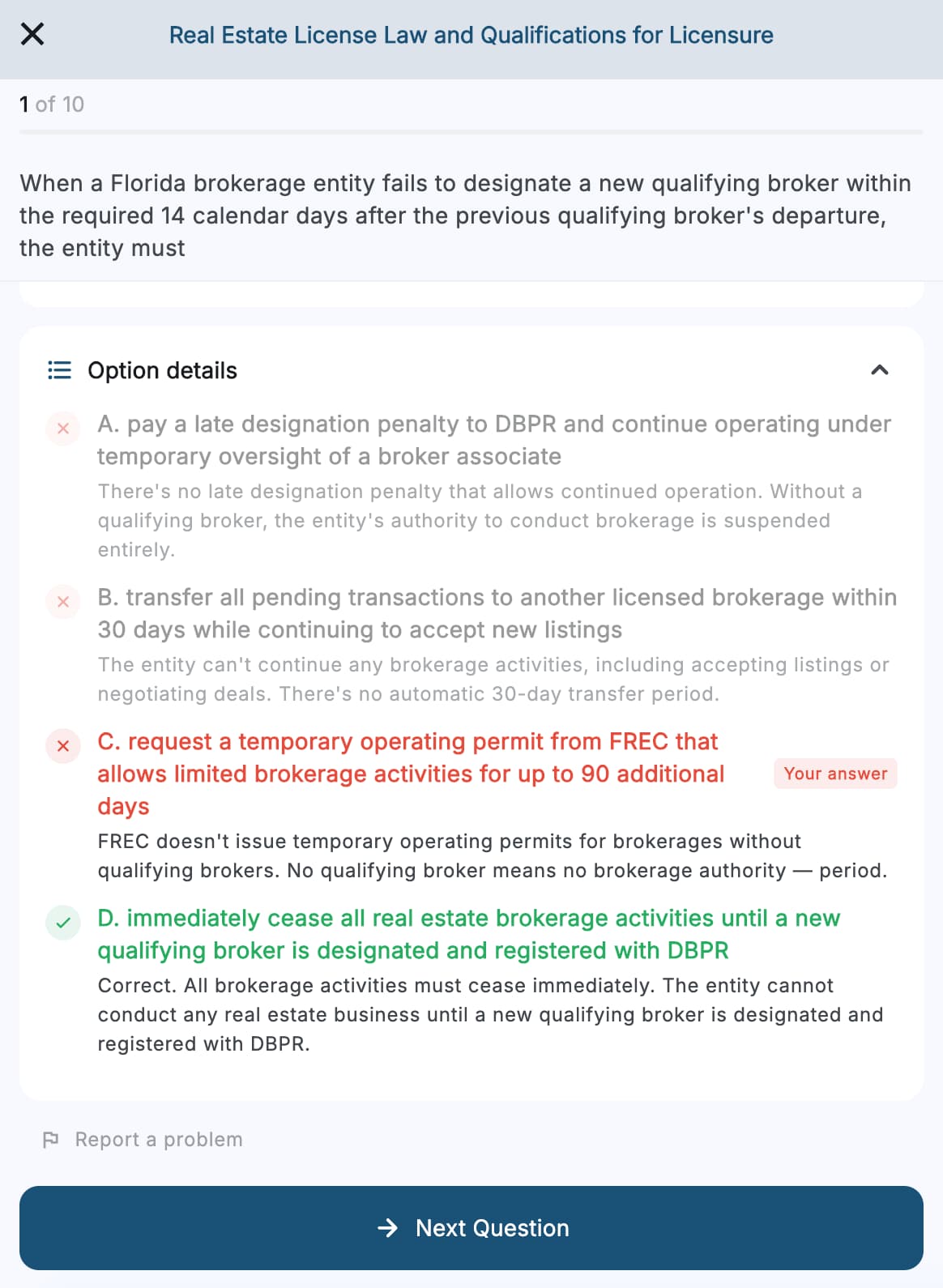
Scenario-based practice. The exam tests application, not recall. If your practice questions are all definitions and facts, you are training for a different test. Practice with questions that put you in a situation and ask what happens next, using the free practice-question bank organized by the 19 content areas. The practice exam with full explanations gives you a sample of what real exam questions look like.
Dedicated math preparation. The exam repeatedly tests the same calculation families: proration, documentary stamps, commission, millage, LTV, appraisal and investment math, and legal description acreage. Students who practice them protect points that rushed candidates give away. The math formulas guide covers every formula type with step-by-step examples and the traps that show up most often.
Full-length timed simulations. Not topic quizzes. Full 100-question, 210-minute exams that make the real thing feel familiar before you are sitting in the testing center. Students who have done this twice before exam day handle the pressure differently than students experiencing it for the first time.
The 50% fail rate is real. It does not have to be yours.
Pass rate quick reference table
| Data Point | Number | What It Means |
|---|---|---|
| First-time pass rate | high 40s to low 50s | About half fail on first attempt |
| Retaker pass rate | high 20s to mid 30s | Retakers do worse, not better |
| Overall pass rate | high 30s to mid 40s | Includes all attempts combined |
| Monthly graded sales associate exams | roughly 3,700 to 5,100 | Large volume of graded attempts; preparation is not measured |
| Questions on exam | 100 | Multiple choice, computer-based |
| Passing score | 75% | 75 correct out of 100 |
| Math questions | Computation appears directly in the outline and inside related topics | High-leverage points many candidates delay |
| Florida-specific law and rules | Substantial share of the outline | National prep tools can underweight these |
| Retake timing | 24-hour wait before scheduling a new Pearson VUE appointment | Availability and eligibility window matter |
| Retake cost | $36.75 | Per attempt |
| State-to-state comparisons | Use caution | Blueprints, reporting, and candidate pools differ |
| Pre-licensing course validity | 2 years | Time window to pass the exam |
Screenshot this table. It is every number you need to understand the exam landscape.
Make the Pass Rate Work in Your Favor
Pass Florida is built around the patterns in this data.
The diagnostic exam benchmarks you across all 19 content areas before you start studying. Instead of guessing where you are weak, you know. That is the first thing the data says matters: targeted preparation beats general review.
Every practice question is scenario-based and weighted to match the real exam distribution. That addresses the second pattern: students need application-level questions, not definition recall.
The exam simulator runs full 100-question, timed sessions under real conditions. That addresses the third pattern: familiarity with the format reduces exam-day pressure. By the time you sit for the real thing, you have already practiced the rhythm.
Frequently Asked Questions
What is the Florida real estate exam pass rate?
First-time takers usually pass around the high 40s to low 50s depending on the month. Retakers pass at a lower rate, often around the high 20s to mid 30s in recent DBPR reports. The overall pass rate across all attempts is usually lower than the first-time rate because retakers pull the combined number down. These figures come from DBPR Exam Performance Summary reports.
Why is the Florida real estate exam pass rate so low?
The monthly reports do not measure the causes. They record exam results, not preparation quality, study habits, or candidate circumstances. Review your coverage of Florida rules, calculations, application questions, and timed practice as practical preparation checks.
Why do retakers have a lower pass rate than first-time takers?
Repeaters are a different group selected by a previous failed attempt. The published monthly totals do not track individual progress or study methods, so they cannot establish why the rates differ. Use your own result report and practice history to choose a focused retake plan.
Is the Florida real estate exam harder than other states?
Florida's first-time pass rate is lower than many candidates expect, but state-to-state difficulty comparisons are messy because each state uses its own exam blueprint, cut score, reporting method, and candidate pool. Florida processes thousands of graded sales associate exams each month, and many candidates underestimate the Florida-specific law and scenario wording. Students who follow a structured study plan should not treat the state average as their personal ceiling.
How many times can you take the Florida real estate exam?
There is no simple "three strikes" cap in the normal sales associate path, but each retake costs $36.75 and must be scheduled through Pearson VUE while your DBPR exam eligibility is still valid. The monthly data cannot predict your next result or establish the effect of a study method. If you fail, use your result report, practice history, and DBPR's exam review process if needed, then change how you prepare before sitting again.
What score do you need to pass the Florida real estate exam?
You need 75 correct answers out of 100 questions (75%). There is no penalty for wrong answers, so you should answer every question even if you are guessing. Pearson VUE provides an official result report immediately after the exam. If you fail, DBPR rules also allow you to request a review of the questions you answered incorrectly within the review window.
How long do most people study for the Florida real estate exam?
A practical plan for many candidates is 4 to 6 weeks after completing the 63-hour pre-licensing course. The number of weeks matters less than the quality of preparation. Students who practice with scenario-based questions, drill the math, and take full timed practice exams are preparing for the state exam, not just re-reading the course. The 30-Day Study Plan maps a complete preparation schedule at 60 to 90 minutes per day.
What is the pass rate for the Florida real estate broker exam?
The broker exam has a similar pass-rate structure, though the candidate pool is smaller and more experienced. Recent DBPR reports still show first-time broker rates around the mid-to-high 40s, with retakers lower. Field experience helps, but it does not replace exam-specific preparation. The broker exam has 100 questions and requires a 75% score, the same structure as the sales associate exam.
Does the Florida real estate exam pass rate change by month?
The pass rate changes month to month but stays within a recognizable band. Recent first-time sales associate rates have landed in the high 40s to low 50s. Do not plan around supposedly easier months. Pearson VUE draws from a large question bank, and each exam is generated to match the same DBPR content specifications.
What percentage of Florida real estate exam questions are math?
Several questions involve calculations, and the exact mix varies by exam form. These can cover commission splits, property tax and millage rates, proration, documentary stamp tax, LTV ratio, GRM, cap rate, NOI, area calculations, and appreciation/depreciation. The math formulas guide covers every formula type. Students who practice them consistently convert those questions into correct answers.
Make exam prep the part you control
The pass-rate data says the same thing over and over: average preparation is risky. The next step is to swap the same-method retake for a method that matches what the exam actually tests.
Try a free Florida question | Run the readiness calculator | Download Pass Florida
Methodology
This guide interprets Florida real estate sales associate exam pass-rate patterns: first-time takers, retakers, overall pass rates, monthly fluctuation, and what those numbers imply for preparation. It uses DBPR Division of Real Estate monthly Exam Performance Summary reports (released through FREC and FREAB meeting documents) as the primary data source, and treats the pass rate as a population statistic, not as a prediction for any individual candidate.
Verify the most recent monthly cut against the current FREC Division Report before quoting a specific current rate. The 4-factor failure framework (recall-vs-application gap, delayed math, school-exam overconfidence, generic prep underweighting Florida law), the retaker-pattern analysis, and the preparation recommendations in this guide are Pass Florida observational coaching pedagogy and are not DBPR, FREC, or Pearson VUE process documents.
Pass Florida is not affiliated with DBPR, FREC, Pearson VUE, or any pre-license course provider, and Pass Florida does not guarantee passage of any state exam. Pass Florida does not replace the FREC-approved 63-hour pre-license course, DBPR application steps, Pearson VUE scheduling rules, fingerprinting, post-licensing, continuing education, or consultation with a qualified licensed professional. Its role is targeted practice with Florida-specific exam-style questions, not legal, licensing, or brokerage advice.
Real-world retake decisions involve specific DBPR application windows (2 years from the date the application was received by DBPR), Pearson VUE scheduling rules, retake fees, and (in some fact patterns) education re-requirements that change over time. Verify current windows, fees, and rules with DBPR and Pearson VUE directly before making a real-world decision based on the population-level patterns in this guide.
Official sources are listed below.
Product Note
Pass Florida publishes this guide and offers the exam-prep app linked on this page. Pass Florida is not affiliated with DBPR, FREC, Pearson VUE, or any pre-license course provider, and Pass Florida does not guarantee passage of any state exam.
Sources
- June 2026 FREC Division Report PDF (May 2026 exam performance)
- April 2026 FREC Division Report PDF (March 2026 exam performance)
- March 2026 FREC Division Report PDF (February 2026 exam performance)
- February 2026 FREAB Exam Performance Summary PDF (December 2025 data)
- DBPR Real Estate Sales Associate Candidate Information Booklet PDF
- Pearson VUE Florida Real Estate and Appraisers licensing exams
- Florida real estate candidate fact sheet, Pearson VUE PDF
- DBPR real estate sales associate requirements PDF
- DBPR Division of Real Estate
- F.S. Chapter 475, Real Estate Brokers, Sales Associates, Schools, and Appraisers, Florida Senate
This is independent exam-prep guidance, not legal, licensing, or scheduling advice. Pass Florida is not affiliated with DBPR, FREC, Pearson VUE, or any pre-license provider, and no study tool can guarantee a passing result. Monthly rates and testing rules can change, so use the linked official sources for decisions about an actual application or appointment.