VERIFY BEFORE RELYING
This article is exam-prep and licensing-decision content for the Florida real estate sales associate exam. F.S. (Florida Statutes) 475, F.A.C. (Florida Administrative Code) Chapter 61J2, the DBPR (Department of Business and Professional Regulation) Candidate Information Booklet, FREC (Florida Real Estate Commission) policy, Pearson VUE policies, fees, mutual recognition lists, and the FinCEN Residential Real Estate Reporting Rule status can change. Always verify a current rule against the Florida Statutes Chapter 475, the DBPR Candidate Information Booklet, the Pearson VUE Florida real estate page, and DBPR directly before booking an exam attempt or paying a fee.
QUICK ANSWER
The Florida real estate sales associate exam is a closed-book, 100-question, multiple-choice exam administered by Pearson VUE for DBPR. You get 3.5 hours and need 75 points to pass. DBPR publishes one integrated blueprint with 19 weighted content areas. It does not publish a fixed national-versus-state question split. Prepare by official topic weight, then use timed practice to find and repair your weakest areas before you book.
EXAM GUIDE PLUS PASS FLORIDA
Use this guide to understand the exam. Use Pass Florida to practice the way Florida tests.
Use current official exam facts for logistics and fresh Florida practice for readiness. Do not treat either one as a passing guarantee.
Start with the exam Florida actually publishes
The Florida exam becomes much less confusing once you separate official facts from study-site folklore. DBPR publishes the format, passing grade, and percentage assigned to each of 19 content areas. It does not publish a fixed 55-question national section and 45-question state section for the sales associate exam.
That distinction changes how you study. The exam is one integrated test. Florida license law, brokerage practice, contracts, financing, property rights, federal law, and calculations can appear in the same run of questions. Build your plan from the official weights and your own weak areas, not from an unofficial state-versus-national split.
This guide is the booklet, translated. Every fact below traces to the Florida Department of Business and Professional Regulation, Florida Statute 475, the Florida Real Estate Commission's administrative rules (F.A.C. 61J2), or Pearson VUE's published candidate handbook. Every rule and number should be read with the linked primary source.
Read it once now, bookmark it, and come back to it during study. Every other resource you use (your textbook, your practice app, the flashcards you make at the kitchen table) will make more sense once you understand the test as Florida has designed it.
The essentials are simple: 100 questions, 3.5 hours, 75 to pass, 19 content areas, $36.75 per attempt, and a first-time pass rate that usually sits near the halfway mark in recent DBPR reporting. You must complete the 63-hour pre-license course, file the DBPR application, submit fingerprints, and receive exam eligibility before you sit.
If you are still at the licensing-stage decision point, pair this with the Florida license step-by-step guide, the license cost breakdown, and the best Florida pre-license course comparison. This page answers the exam itself. Those pages answer the path around it.
What this guide covers
- What is the Florida real estate exam?
- How is the Florida real estate exam structured?
- What's on the Florida real estate sales associate exam?
- Who qualifies to take the Florida real estate exam?
- How much does the exam cost? The full fee breakdown
- Where and when can I take the exam?
- What is the current Florida real estate exam pass rate?
- What score do I need to pass? Understanding the 75%
- What happens on test day?
- How long should I study? A week-by-week plan
- How do I retake the exam if I fail?
- The one decision that matters most: how you practice
- Your next 30 minutes
- Frequently Asked Questions
What is the Florida real estate exam?
The Florida real estate exam is the state licensing examination every candidate must pass to be issued a sales associate license. Officially, it's the Sales Associate Examination, administered by Pearson VUE on behalf of the Florida Department of Business and Professional Regulation (DBPR), under authority of Florida Statute 475 and the rules of the Florida Real Estate Commission (FREC) in administrative code 61J2.
It's the sole knowledge-based gate between a prospective agent and a license. No interview, no skills test, no continuing review. One exam, one passing score, one result.
The test is identical for every candidate regardless of brokerage, geography, or education. A Tampa candidate with a law degree sits for the same 100 questions as an Orlando career-switcher. What varies is the specific draw of questions from Pearson VUE's rotating bank, built to the topic-weight specification the DBPR publishes in its Candidate Information Booklet.
Framing matters. The exam isn't a trivia test. It's a competence filter. A check that a person about to hold fiduciary responsibility for someone else's largest financial transaction can apply Florida real estate law under pressure. Once you accept that framing, how you study changes.
How is the Florida real estate exam structured?
The core format is published by DBPR, so the structure should not be a surprise.
Total questions: 100 multiple-choice, four options, one correct. No multi-select, no essays, no penalty for guessing.
Time allotted: 3.5 hours (210 minutes). About 2 minutes per question with no review buffer, though most candidates finish under 3 hours.
Passing score: 75. Each question counts equally.
Format: Computer-based at a Pearson VUE test center. No paper version.
Official blueprint: DBPR allocates the exam across 19 content areas whose published percentages total 100%. Those areas mix Florida-specific law, general real estate principles, federal law, transaction practice, and calculations. The booklet does not support converting that blueprint into a fixed 55/45 national-state construction.
Topic weighting. Within those 100 questions, 19 distinct content areas are tested, each with a published weight from the DBPR booklet. The heaviest topic is Real Estate Brokerage Activities & Procedures at 12% of the exam. The lightest topics (Planning & Zoning, Real Estate Markets) are worth 1%. That's a 12x difference. A candidate who studies every chapter for equal time wastes study hours on topics worth a single question while under-preparing on topics worth a dozen. We break down every topic in the 19-topics guide.
Result reporting: After the exam, the test center gives you an official photo-bearing result report. DBPR says 75 points or higher passes. Passing the exam does not by itself mean you may begin practicing; your license must be issued and placed with an employing broker before you perform licensed services. If you fail, use the score-report guide before choosing a retake date.
Exam trap alert: do not invent a second blueprint
Treat the official 19-area outline as the source of truth. A question about escrow, homestead, brokerage relationships, and RESPA can appear in the same exam because DBPR describes one continuous 100-question test. Florida-specific material still matters enormously, but there is no official fixed state-question count to memorize.
The practical rule: do not build your study plan around chapter order. Build it around point weight and weakness. Start with the 19-topic breakdown, then use the topic-weight analysis to decide what deserves the most hours. For the full step-by-step method, follow our guide on how to pass the Florida real estate exam.
What's on the Florida real estate sales associate exam?
Nineteen content areas, grouped across four broad domains: Florida-specific license law, national real estate principles, transaction practice, and math. Full per-topic weights and breakdowns live in the 19-topics guide. Here's the map of what gets tested most.
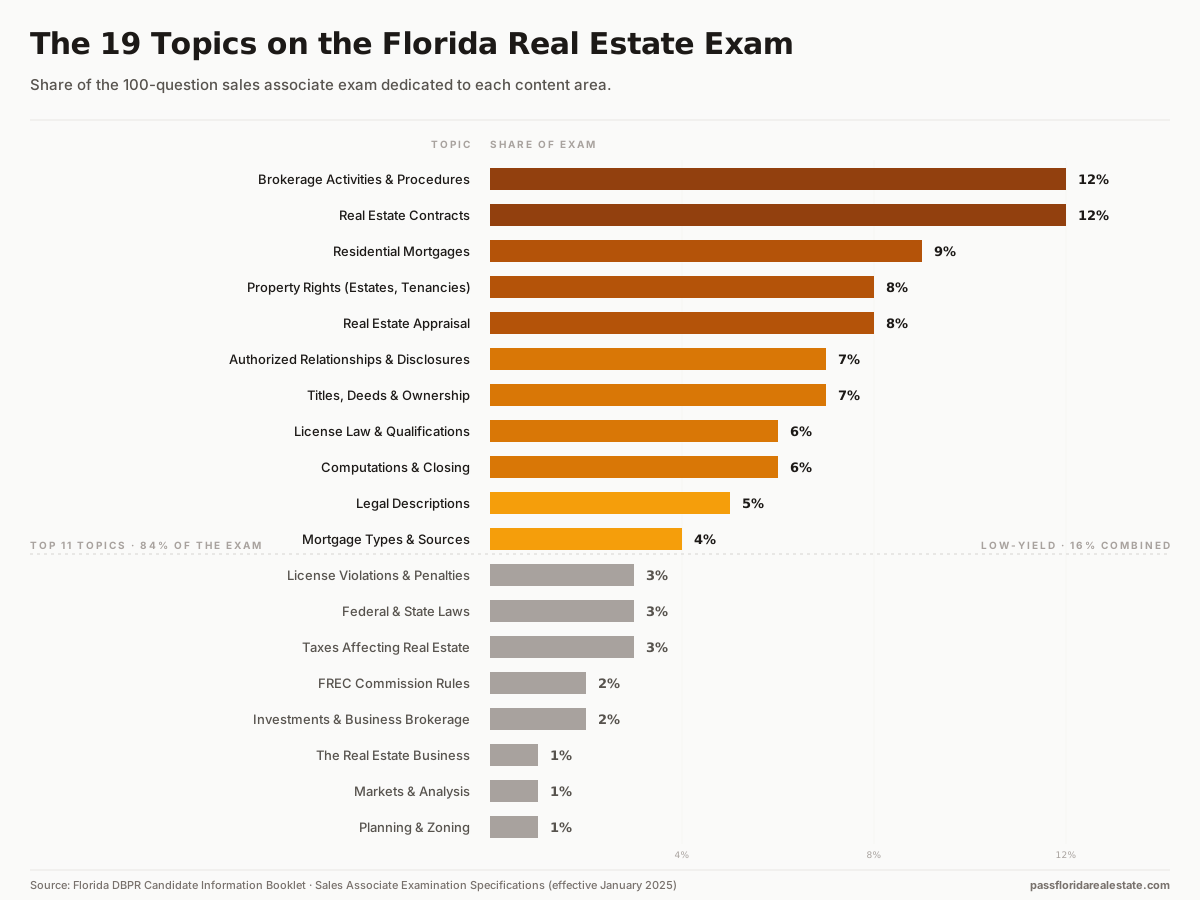
Source: Florida DBPR Candidate Information Booklet, Sales Associate Examination Specifications, effective January 2025. Top 11 topics account for 84% of the 100-question exam; the bottom 8 topics combined account for just 16%.
Real estate contracts (12%). Contract essentials, Florida-specific disclosures (lead paint, property condition, energy efficiency), listing agreement types, and termination conditions. Contracts guide.
Real estate brokerage activities (12%). How agents operate under Florida rules. Escrow timing (end of the third business day after receipt, F.S. 475.25(1)(k)), the three authorized brokerage relationships (transaction broker, single agent, no brokerage relationship), and the six statutory duties of a transaction broker.
Residential mortgages and mortgage types (13% combined). Conventional, FHA, VA, USDA loans and their Florida applicability. Discount points, LTV, PITI, escrow. RESPA and TRID disclosures. Mortgages & lending.
Property rights (8%). Estates, tenancies, ownership forms. Fee simple vs life estate. Tenancy by the entireties (Florida's protected marital tenancy). HOA rules. Florida water rights (littoral, riparian).
Real estate appraisal (8%). The three approaches to value (sales comparison, cost, income) and when each applies. Depreciation types, USPAP principles, CMA vs BPO vs appraisal. Appraisal guide.
Authorized relationships, duties, and disclosures (7%). A dedicated section on what agents owe under each Florida brokerage relationship. The six transaction-broker duties appear repeatedly.
Titles, deeds, and ownership restrictions (7%). Deed warranties: general warranty (broadest), special warranty, bargain and sale, quitclaim (no warranty). Title insurance. Encumbrances. Florida homestead protection.
Real estate computations and closing (6%). Proration, commission splits, documentary stamps, intangible taxes. Where most candidates bleed points. Math formulas reference.
Real estate license law and violations (9% combined). Two content areas covering what constitutes a violation, penalties, and FREC discipline. Escrow violations are tested disproportionately because Florida treats them as uniquely serious.
Legal descriptions (5%). Metes and bounds, government rectangular survey, lot-and-block. A section is 640 acres; a township is 36 sections. Both directions of that math get tested.
Federal and state laws (3%). Fair Housing Act and its protected classes, ADA, RESPA, CERCLA, antitrust applied to real estate.
Everything else (roughly 4%). The real estate business, markets and analysis, investments, real estate taxes, planning and zoning. Each 1 to 3%. Low-yield study hours.
The math, broken out
Roughly 10 of the 100 questions are math. They are integrated with the content (there is no separate math section) but the math types are predictable:
- Proration (taxes, rent, interest, using the 360-day banker's year)
- Commission (full, split, and percentage problems)
- Capitalization rate (investment valuation)
- Loan-to-value ratio
- Documentary stamps ($0.70 per $100 on deed; $0.35 per $100 on note)
- Intangible tax ($0.002 per $1 on new mortgages)
- Area calculation (square feet, acreage, sections)
- Depreciation
- Closing cost / seller's net
- Mill rate for property tax
The math is not algebraically difficult. Most of it is two-step multiplication. What trips candidates up is setting up the right equation under time pressure, often within a word problem designed to obscure which variable is missing. That's why a visual guide to proration exists. The mechanics are learnable. The word-problem reading is the hard part.
Who qualifies to take the Florida real estate exam?
Florida sets five statutory requirements for sales associate exam eligibility, codified in F.S. 475.17:
- At least 18 years old on the exam date. No exceptions.
- High school diploma or equivalent (GED). Proof is not required at application, but the statute applies and can be audited.
- Completion of a 63-hour pre-license course from a Florida-approved provider (sometimes called "Course I"). Your course must be on the FREC-approved list. A generic online real estate course from another state does not count.
- Electronic fingerprints submitted through a DBPR-listed Livescan vendor. Vendor prices vary, commonly around $50 to $75, and the print record must reach DBPR as part of the application process.
- Approved application on file with DBPR. The current RE 1 application lists a $62.75 fee. Processing time varies, and applications with background-history review can take longer.
Not disqualifying, but sometimes feared: a criminal record does not automatically bar licensure, but it requires disclosure. The FREC evaluates rehabilitation and passage of time. Denial is possible, particularly for crimes involving dishonesty or violation of fiduciary duties.
Not required: a college degree, a sponsoring broker, real estate experience, or Florida residency. You can be a resident of any state and hold a Florida sales associate license.
For a fully itemized walkthrough of every form, fee, and deadline, see how to get your Florida real estate license.
How much does the exam cost? The full fee breakdown
The exam fee is $36.75 per attempt, paid to Pearson VUE at registration. That is a small fraction of what it takes to stand for the test. Most candidates spend about $299.50 to $574.50 before optional exam prep to reach exam day, depending on the course provider and fingerprinting vendor.
| Item | Fee (2026) | Paid to |
|---|---|---|
| Pre-license course (63-hour) | $150 to $400 | Course provider |
| DBPR application fee | $62.75 | DBPR |
| Livescan electronic fingerprints | $50 to $75 typical vendor range | Livescan vendor |
| Exam fee (per attempt) | $36.75 | Pearson VUE |
| Typical pre-exam and exam total | $299.50 to $574.50 |
Optional but commonly incurred:
- Exam-prep app or course: $39.99 (Pass Florida) to $400+ (enterprise prep)
- Retake fees on failure: $36.75 per retake
- Background check review fee (rare): $53.50
- 45-hour post-license course after passing: $100 to $250 before first renewal
- Realtor association, MLS, E&O, lockbox, and brokerage costs after activation
Documentation on fees comes from the DBPR Division of Real Estate fee schedule. Course costs vary by provider. For the full picture of what the license actually costs once you start practicing, see the Florida real estate license cost breakdown.
Where and when can I take the exam?
The Florida real estate exam is administered at Pearson VUE test centers throughout the state and in nearly every major U.S. city. Florida operates more than 20 test centers, with multiple locations in Miami, Orlando, Tampa, Jacksonville, Fort Lauderdale, and every major metropolitan area. Schedule directly at pearsonvue.com/fl/realestate.
Availability: Dates and times vary by test center. Pearson says appointments may be made up to one calendar day before the exam, subject to availability. Book earlier if you need a particular location or time.
Rescheduling: Pearson VUE says you must cancel or reschedule at least two full calendar days before the appointment to avoid a penalty. Do not translate that automatically into a rolling 48-hour rule. Check the deadline shown in your account.
Out-of-state candidates: You can take the Florida exam at any Pearson VUE center nationwide, including outside Florida, once your application is approved. You do not need to be in Florida to sit for the Florida exam.
What counts as "on time": Pearson VUE recommends arriving 30 minutes before your appointment. Arrive more than 15 minutes late and you may be marked a no-show, forfeiting the fee.
What is the current Florida real estate exam pass rate?
The March 2026 FREC Division Report lists February 2026 sales associate pass rates of 49% for first-time candidates and 31% for repeat candidates. That is a monthly snapshot, not your personal probability of passing. Rates change by reporting period and candidate group, so use the current Division Report when you need a current benchmark.
The exam is criterion-referenced. You pass by reaching the published standard of 75 points, not by beating other candidates. The pass-rate data is useful because it shows that pre-license course completion alone does not guarantee exam readiness.
Four patterns recur in candidates who fail:
- Practice-app mismatch. Most failing candidates studied with apps built around basic recall (What does DBPR stand for?). The real exam tests application. They see the first scenario-based question and realize they practiced a different game.
- Under-weighted Florida law. National-principles textbooks cover real estate broadly. They do not cover Florida's brokerage relationships, escrow rules, or constitutional homestead protections at the depth a Florida candidate needs. The official blueprint gives substantial weight to Florida license law and brokerage practice, so a general-only text leaves a serious gap.
- Math avoidance. Candidates who dread math skip the chapter and absorb the deficit as a 10-point cost on exam day. That's the difference between a 78 pass and a 68 fail.
- False confidence. A single practice exam scored at 80% doesn't mean ready. It usually means the practice exam was easier than the real one. This is the gap Pass Florida's Confidence Calibration Engine was built to detect.
We go deeper in why 50% of Florida candidates fail and why did I fail the Florida real estate exam.
The practice-score trap. A high score is only useful when the questions are fresh, Florida-specific, mapped to the official blueprint, and completed under realistic timing. Repeating a familiar free quiz can measure memory instead of readiness. Take our 5-question diagnostic to sample the wording before you commit to a study plan.
Mistakes students make
The same mistakes show up every cycle:
- Studying every chapter equally even though the topic weights are not equal.
- Memorizing vocabulary without practicing scenario stems.
- Treating Florida law as a small add-on to national real estate principles.
- Avoiding math until the final week.
- Booking the exam after one easy practice score instead of two full timed mocks.
- Ignoring the score report after a failed attempt and starting over from page one.
None of these are character flaws. They are study-design errors. Fix the design and the score usually moves.
What score do I need to pass? Understanding the 75%
The minimum passing score is 75 out of 100. No scaled score adjustment, no curve, no bonus for difficult questions. Each question is worth one point.
You pass with 75, 80, 95, or 100. You fail with 74, 73, or 40. The difference between pass and fail is one question.
Some candidates chase higher scores. The state gives nothing for it. A license issued at 75% is identical to a license issued at 95%. Your future clients will never see your exam score.
What does matter is the cushion. Passers tend to land at 78 to 82, suggesting most successful candidates clear 75 by three to seven points. That's what to aim for in practice: not 75, but 80. On test day, adrenaline, an unfamiliar question draw, or a single misread can cost five points you didn't expect.
You receive an official photo-bearing result report immediately after the exam. Save it with your licensing records. If a later official review changes an answer key, DBPR says an amended report may follow, so use the written result and any subsequent DBPR notice as your record.
What happens on test day?
Pearson VUE runs a strict sequence at every Florida test center. Knowing the steps removes the two worst sources of test-day loss: surprise, and the small procedural errors that can turn months of study into a forfeit at the door.
Arrive 30 minutes early. Check-in takes 15 to 20 minutes on a normal day. If you're not in the lobby 15 minutes before your slot, Pearson VUE reserves the right to mark you a no-show and forfeit the fee.
Bring two forms of ID. One must be government-issued photo ID (driver's license, passport, state ID, or military ID) and its name must match your DBPR application exactly. The second can be a credit card, bank card, or any signed document. Name mismatches are the single most common reason candidates get turned away. If your application reads "Maria Gonzalez-Perez" and your license reads "Maria Gonzalez Perez," you may be denied entry. Audit your documents a week before.
What you leave in the locker: phone, smartwatch, fitness tracker, jewelry beyond a wedding band, hat, scarf (religious accommodations excepted), food, water, and any personal notes. No exceptions.
Calculator and supplies: Follow the current DBPR calculator guide and the instructions in your Pearson VUE confirmation. Do not rely on an article to decide whether a specific calculator will be admitted. The center controls personal-item storage and the materials allowed at your workstation.
At the workstation, a short tutorial loads. You can flag questions, work through back and forth, and review. The timer at the top of the screen is the only clock you'll use. Unscheduled breaks are allowed (step out) but the timer continues to run. Most candidates don't break.
When you submit, the machine calculates your score the moment your cursor lifts. The screen shows pass or fail, usually with a numerical score on a failure and a simple "pass" on a success. On your way out, the front desk prints your score report. You walk out of the building knowing whether the last three months worked.
How to prepare for the final 24 hours is covered in the complete exam-day checklist and week-before strategy.
How long should I study? A week-by-week plan
The honest answer: it depends on your starting point, your weekly hours, and your comfort with math. The pattern among passers is consistent: 4 to 10 weeks of focused study after the 63-hour pre-license course. Shorter than three weeks is rare among passers. Longer than twelve often ends in burnout without score improvement.
Intensity matters more than duration. Plan for 60 to 100 total study hours, concentrated in the final two weeks. An eight-week schedule that mirrors the approach most successful first-try candidates follow:
Week 1: Foundation
- Read the DBPR Candidate Information Booklet cover to cover.
- Review the 19 content areas and their weights. Understand that the top three areas (Brokerage Activities, Contracts, Mortgages) are worth 33% of the exam combined.
- Take a diagnostic practice exam. Do not grade yourself harshly. The goal is to identify weakness, not confirm strength.
Weeks 2 to 3: Florida-specific law
- F.S. 475 sections on licensing, escrow, and commissions.
- FREC composition and administrative rules (61J2).
- The three brokerage relationships, with worked examples.
- Complete 50 to 75 application-level questions on Florida-specific content each day.
Week 4: National principles and federal law
- Fair Housing, ADA, RESPA, TRID.
- Agency in general (fiduciary duty, authority types).
- Environmental regulations applicable to Florida (flood zones, CERCLA).
Week 5: Contracts and titles
- Contract essentials and the Florida-specific disclosures.
- Deed types with warranty implications.
- Liens and encumbrance hierarchy.
Week 6: Math concentration
- Commission, proration, documentary stamps, intangible tax, cap rate, LTV, area.
- Work 10 to 15 math problems daily. Do not skip this week. Math avoidance is a top failure driver.
Week 7: Mortgages, appraisal, property rights
- The least-studied trio that combined is 29% of the exam.
- Loan types with their distinguishing Florida-applicable features.
- The three approaches to value.
- Estates and tenancies with the tenancy-by-entireties distinction.
Week 8: Full mock exams
- Two full 100-question, 3.5-hour timed mock exams on different days.
- Review every missed question and the statute it tests.
- Sleep the night before. Do not study the morning of the exam.
If you have less runway, compress weeks 2 to 5 into one week each and keep weeks 6 to 8 at full length. If you have more runway, expand weeks 6 and 7. Those are where most candidates under-invest.
A printable version of this schedule is available at the 30-day study plan.
How do I retake the exam if I fail?
Failing the first attempt is common. The path forward is clearly defined.
When can I retake? Use the instructions in your Pearson VUE account after the failed attempt. Availability and account processing can change. A fast booking is not always a wise booking; first identify what cost you points.
What does it cost? The retake fee is $36.75 per attempt, paid to Pearson VUE at re-registration. Your DBPR application expires two years after the date DBPR received it if you have not passed. Your course completion also has its own two-year validity window.
Is there a limit? Florida does not publish a lifetime attempt cap. F.S. 475.181 says the application expires two years after the date received if you have not passed, and the pre-license course is invalid for licensure if you do not pass within two years after course completion. If a clock expires, confirm the required reapplication, fee, fingerprint, or course steps with DBPR before paying Pearson VUE again.
What should I do differently on retake? Shift from broad rereading to diagnosis. Your result report is not a take-home copy of the exam, so combine it with what you remember, your practice history, and a fresh timed diagnostic. Repair the highest-weight weak areas first. This is the approach in the failed-exam retake plan.
The one decision that matters most: how you practice
Ask yourself a question you might not want to answer: when you get a practice question right, do you know which Florida statute the answer comes from? If not, you're building confidence on the wrong foundation. And Florida is going to charge you $36.75 to find out.
The DBPR builds its questions at what testing researchers call application level and above. Scenarios that demand you apply Florida law, not recite it. Most free PDFs, most YouTube channels, and many paid apps default to the easier format: What does FREC stand for? Those feel productive because you get them right. They don't build the skill the real exam tests.
Three signals separate calibrated practice from filler:
- Statute-referenced explanations. Every answer should cite the Florida statute or FREC rule it tests. If you can't trace the reasoning back to a primary source, the question isn't calibrated.
- Scenario stems. A question that opens "A broker receives a $5,000 deposit on a property listed by another brokerage." is calibrated. A question that opens "Which of the following is a type of lien?" is not.
- Distractor craftsmanship. On the real exam, all four options are plausible. One correct, three designed to tempt. Weaker practice material gives itself away with two obviously wrong choices per question. Train on that and you'll freeze the first time you see four credible options.
This is the editorial principle. You don't need a paid app to meet it. A candidate studying only the DBPR booklet and the Florida statutes has the same raw material every test-prep publisher starts with. Pass Florida is our answer to the principle: 1,142 scenario-based questions, each with the statute it tests, a Trap Library for Florida's EXCEPT-format questions, and a Confidence Calibration engine that flags overconfidence before exam day. It costs $39.99 once, with no copied exam questions, and no subscription pressure. Use ours, use someone else's, or build your own from the booklet. What matters is that you practice at the level the exam actually asks.
Ten minutes, five real questions. Before you buy anything, take the 5-question Florida real estate diagnostic. No sign-up, no email. Five scenario-based questions across the heaviest-weight content areas: brokerage, transaction-broker duties, math, property rights, license law. Each one with the Florida statute it tests. At the end you'll get a score, a topic-by-topic breakdown of where you lost points, and an honest read on how ready you are.
Frequently Asked Questions
Is the Florida real estate exam hard?
It is demanding but passable with focused preparation. The March 2026 FREC Division Report lists a 49% first-time pass rate for February 2026. The challenge comes from the breadth of 19 content areas, Florida-specific rules, calculations, close answer choices, and 3.5-hour pacing.
How many times can I take the Florida real estate exam?
Florida does not publish a lifetime attempt cap for this exam, but your application and course-validity clocks matter. Each new reservation requires the current exam fee. Check your dates with DBPR, then see the retake guide for the decision process.
What's the difference between the Florida real estate sales associate exam and the broker exam?
The sales associate exam is the entry-level license exam covered in this guide: 100 questions, 3.5 hours, 75% pass, required before you can practice. The broker exam is taken after at least 24 months of active licensure plus an additional 72-hour broker pre-license course. It is a separate 100-question exam weighted more heavily on brokerage operations, trust fund accounting, and office supervision.
Can I take the Florida real estate exam online?
No. The Florida real estate sales associate exam must be taken in person at a Pearson VUE test center. There is no proctored online version as of 2026. Pearson VUE tests elsewhere have added online delivery in some states; Florida has not.
Is the Florida real estate exam the same as the Florida broker exam?
No. They are separate exams with different content specifications. This guide covers the sales associate exam. The broker exam has its own weighting emphasizing supervisory and trust-account content.
How many questions are on the Florida real estate exam?
100 multiple-choice questions, each with four options, one correct answer.
How long is the Florida real estate exam?
3.5 hours (210 minutes). Most candidates finish in under 3 hours.
Do I need to be a Florida resident to get a Florida real estate license?
No. Florida does not require residency. You can be a resident of any state (or even another country, in some cases) and hold a Florida sales associate license.
Can I take the Florida real estate exam in Spanish?
DBPR's sales associate application says candidates who wish to take the examination in Spanish must make that request when scheduling with the computer testing vendor. ESL candidates may also be allowed one approved foreign-language translation dictionary under DBPR rules. Read Florida Real Estate Exam in Spanish or ESL before you schedule.
What happens after I pass the Florida real estate exam?
You receive your license and then have 24 months to complete a 45-hour post-license course (different from the pre-license course). You also need a sponsoring broker to activate your license for active practice. See passed the Florida real estate exam: next steps.
Does my Florida real estate license work in other states?
Florida has mutual recognition agreements with 10 states, meaning licensees from those states can get a Florida license with a shortened process. Florida licensees moving elsewhere need to check the target state's reciprocity rules.
Is the Florida real estate exam multiple choice?
Yes. All 100 questions are multiple choice with four answer options. No essays, no multi-select, no fill-in-the-blank.
How much math is on the Florida real estate exam?
Approximately 10 of the 100 questions involve math. The math types (proration, commission splits, documentary stamps, cap rate, LTV, area) are predictable. See the math formulas reference.
Your next 30 minutes
Reading a guide isn't studying. If you close this tab and go back to what you were doing yesterday, nothing changes. So here's what to do in the next thirty minutes that will change what tomorrow's study session looks like.
Minutes 1 to 10. Take the 5-question Florida real estate diagnostic. No sign-up, no email. Five scenario-based questions, statute-referenced explanations, and a score at the end that tells you honestly how far you are from ready. You now have a calibration point you didn't have this morning.
Minutes 11 to 20. Open the DBPR Candidate Information Booklet and look at the topic-weight table. If you've been studying in chapter order, check whether your time allocation matches the weights. For most candidates, it doesn't. That's the single biggest correction you can make this week.
Minutes 21 to 30. Pick the topic you're weakest on (the one you'd rather not think about, ideally the one the diagnostic flagged) and commit to drilling it first in your next study session. Not the topic you enjoy. The one you've been avoiding. Florida's exam doesn't test what you know. It tests what you don't.
On exam day, your job is smaller than the whole exam: read the question in front of you, choose the best supported answer, and protect enough time to review flagged items. A passing score is built one decision at a time. You can start with the next question here.
Ready to pass Florida on the first try?
If this guide helped you see the exam clearly, the next step is practice that matches the test.
Confirm logistics with the official provider and use fresh timed work to decide whether you are ready.
Try a free Florida question | Run the readiness calculator | Download Pass Florida
Methodology
This guide treats the Florida real estate sales associate exam as a testing system, not a list of facts. The factual anchors come from primary sources: F.S. 475 (Real Estate Brokers and Sales Associates), F.A.C. Chapter 61J2 (FREC administrative rules), the DBPR Real Estate Sales Associate Candidate Information Booklet (Sales Associate Examination Specifications, 100-question / 75-point / 3.5-hour format, 19 content areas with published weights, two forms of ID, calculator restrictions, score-report timing), the current DBPR RE 1 application ($62.75 application fee), F.S. 475.181 (the two-year application and course clocks), and the Pearson VUE Florida Real Estate materials ($36.75 exam fee and test-center procedures). Livescan pricing is a vendor range, not a DBPR-set fixed fee. Pass-rate ranges come from DBPR's Exam Performance Summary reporting and represent directional patterns, not a guarantee of any individual candidate's odds.
The topic-weight pedagogy, practice-score framing, 8-week study plan, test-day walkthrough, next-30-minutes routine, and "three signals of calibrated practice" framework are Pass Florida coaching methods, not DBPR, FREC, or Pearson VUE rules. Fee and policy claims were rechecked on August 20, 2026; verify the live DBPR and Pearson VUE pages before paying or changing an appointment.
This article does not promise a passing result on the Florida sales associate examination, does not promise admission at Pearson VUE, and does not replace DBPR, FREC, Pearson VUE, the course provider, a tutor, or qualified licensed Florida professional guidance. Outcomes depend on candidate preparation, current statutory and rule updates, fee changes, and test-day execution.
Product note. Pass Florida publishes this guide and offers the exam-prep app linked on this page. We do not claim to use copied exam questions, promise passage, replace the 63-hour FREC-approved pre-license course, or replace DBPR processes, FREC rule interpretation, Pearson VUE scheduling, course-provider records, a tutor, or qualified licensed Florida professional guidance.
Sources
- Florida Statutes Chapter 475, Real Estate Brokers and Sales Associates
- F.S. 475.181, application and course validity clocks
- Florida Administrative Code Chapter 61J2 (FREC rules)
- DBPR RE 1 Sales Associate Application
- DBPR Real Estate Sales Associate Candidate Information Booklet
- Pearson VUE Florida Real Estate page
- Pearson VUE Florida DBPR Real Estate and Appraiser Fact Sheet
- DBPR Real Estate Associate Requirements for Licensure
- DBPR Florida Real Estate Commission
This is educational exam-prep content, not legal or licensing advice and not a promise of admission or passage. The official anchors are the 100-question, 75-point, 3.5-hour format and DBPR's 19-area blueprint. DBPR does not publish a fixed national-versus-state question split for this exam. Verify statutes, rules, fees, and test-day procedures with DBPR and Pearson VUE before acting. Pass Florida is an independent study tool sold for one $39.99 purchase with no subscription.