QUICK ANSWER
If you failed the Florida real estate exam, do not restart with the same textbook and hope more hours fix it. Use your official exam result report, any content-area feedback available, and a fresh Florida-specific diagnostic to identify weak areas. Then spend 14 days on targeted practice, take two full timed exams, and rebook only when your practice scores are around 80% with no major topic consistently weak.
If you are still at the test center or deciding what the result means, start with the Florida real estate exam-day hub.
What Happens If You Fail the Florida Real Estate Exam
Failing the Florida real estate exam feels terrible. It also gave you something that first-time takers do not have: data.
You sat through a 100-question, 210-minute exam under real conditions. You saw how the questions are phrased. You felt the time pressure. You know what the testing center looks like, sounds like, and feels like. First-time takers do not have any of that. You do.
More importantly, you have an official exam result report. Use whatever feedback it gives you, then confirm the pattern with a fresh diagnostic. First-time takers spend their entire study period guessing where they are weak. You have a real starting point.
The pass rate data is a warning sign, not a verdict on you. Failing does not mean you cannot do this. It means your preparation had specific gaps that the exam found. This guide shows you how to find those gaps, close them, and prepare for your next attempt. If you missed by only a few points, use the failed Florida real estate exam by 1 point plan first. Worried about limits? See how many times you can take the Florida real estate exam: there is no fixed attempt cap while your eligibility clocks are still valid. Print the Retake Action Plan Checklist to track every step.
What this guide covers
- How to read your result report
- The 14-day retake plan
- How to turn weak areas into a schedule
- 5 strategic shifts for retakers
- When to rebook
- What to do differently on exam day
- How Pass Florida helps retakers
- FAQ
RETAKE WITH A MAP
Turn your result report into a targeted plan.
Use the 19-topic diagnostic to identify the weak areas behind the score, then confirm the repair in fresh timed questions before retesting.
The Retaker Problem (and How to Avoid It)
The problem is not that retakers cannot pass. The problem is that many retakers study the same way. Same textbook, same chapters, same school practice exam. More hours of the same method often produces the same result. A retaker who builds a plan from the result report and a diagnostic is not repeating the first attempt. They are correcting it.
Every step in this guide is designed to make your second attempt different from your first, not just longer.
Free download: Print the Retake Action Plan Checklist and check off each step as you work through the 14-day plan below.
How to Read Your Result Report
Pearson VUE and DBPR candidate materials say candidates receive an official exam result report immediately after finishing the exam. Verify the information on it before you leave the test center.
Use every detail the report gives you. If it includes content-area feedback, rank those areas by DBPR exam weight. If it does not give enough detail to explain the miss, pair the report with a fresh Florida-specific diagnostic so you can rebuild the weak areas instead of guessing. If you are wondering whether your retake will repeat the same questions, read is the Florida real estate exam the same every time? before you build your study plan around memory.
If the result report still leaves you unsure why you missed, read the Florida real estate exam review session guide before scheduling another attempt. DBPR says failed candidates may request a review of the questions they answered incorrectly, but the request must be made within 21 days, only the most recent exam may be reviewed, and the review session has strict security rules. The review can be useful for narrow fails, repeat fails, and confusing wording patterns, but it is not always the best next move.
If you need a worksheet before using this full 14-day schedule, start with the Florida real estate exam score report study plan. It helps you rank weak topics by DBPR weight and decide whether you need 7 days, 14 days, or a longer pause.
If your failed attempt was months ago, use the Florida real estate exam retake after a long break page first. A long break adds eligibility, stale knowledge, and current-law update checks to the normal retake plan. If you have failed five or more times, start with the failed Florida real estate exam 5 times reset plan so you can diagnose the repeat pattern before using this 14-day schedule.
Step 1: List the Weak Areas You Can Identify
Write down every weak content area the report identifies. If the report does not give enough detail, use your diagnostic results and your memory of the exam to build a first target list.
Step 2: Weight Them by Exam Importance
Not all weak areas are equally expensive. A weakness in Brokerage Activities, which is 12% of the exam, can cost more points than a weakness in Planning and Zoning, which is 2%.
Here are the weights for the highest-value topics:
| Content Area | Exam Weight |
|---|---|
| Real Estate Brokerage Activities | 12% |
| Real Estate Contracts | 12% |
| Residential Mortgages | 9% |
| Property Rights, Estates, Tenancies | 8% |
| Real Estate Appraisal | 8% |
| Authorized Relationships and Disclosures | 7% |
| Titles, Deeds, and Ownership Restrictions | 7% |
| License Law and Qualifications | 6% |
| Real Estate Computations and Closing | 6% |
If Brokerage Activities and Contracts both feel weak, give both serious time. Each is listed at 12% in the DBPR outline. The full 19-topic breakdown shows the exact weight and question count for every area.
Step 3: Identify the Type of Mistake
Look at each weak area and ask: did you not know the material, or did you know it but apply it wrong?
Content gaps mean the material was unfamiliar. You did not know the rule, the number, or the distinction. The fix is straightforward: study that specific content until you know it cold.
Application errors mean you knew the concept but picked the wrong answer in a scenario. You might know what a transaction broker is but misapply the duty when the question describes a specific situation. The fix is practice questions on that topic, not re-reading the textbook chapter.
Math errors mean you used the wrong formula, applied the steps in the wrong order, or made an arithmetic mistake. The fix is drilling the formula family until the setup is automatic. The math formulas guide covers the calculation patterns with step-by-step scenarios.
Most students who fail have a mix of all three. Sorting them matters because each type requires a different study approach.
The 14-Day Retake Plan
You have already completed the 63-hour pre-licensing course. You have already studied once. You do not need another 30 days. You need 14 focused days that target the specific gaps your result report and diagnostic revealed.
This plan assumes 60 to 90 minutes of study per day.
Days 1 to 3: Diagnose and Map
Day 1: Read your result report using the process above. List every weak area you can identify. Rank those areas by exam weight. This is your target list. Everything you study for the next two weeks comes from this list. Strong topics stay mostly on the shelf.
Day 2: Take a full diagnostic practice exam (100 questions, timed). Not to test yourself emotionally. To get a second data point on your weak areas and see if any supposedly strong areas are actually soft. Score it by topic. Compare it to your official result report. To rehearse timed conditions first, use the free timed practice exam, then drill weak topics in the free practice-question bank.
Day 3: Build your study schedule for the next 11 days. Assign each remaining day a primary topic from your target list. Heaviest-weighted topics get more days. If Brokerage Activities and Math are both weak, they each get 2 days. A topic worth 2% gets part of one day.
Days 4 to 9: Targeted Content and Practice
This is the core of the plan. Each day, study one topic from your list.
The session structure (60 to 90 minutes):
- 15 minutes: Review the rules, facts, and distinctions for that topic. Use the study guide for a focused summary of what the exam actually tests per topic.
- 45 to 60 minutes: Practice questions on that topic only. Scenario-based, not recall. Get 20 to 30 questions in. Review every wrong answer immediately.
- 10 minutes: Write down the specific facts or rules you missed. These become your review flashcards for the final days.
If your weak area is math: Dedicate two full sessions to it. One for commission, doc stamps, and proration. One for cap rate, LTV, property tax, and area calculations. Use the math formulas guide for worked scenarios, and print the cheat sheet for quick reference during practice.
If your weak area is Florida-specific content: Focus on the areas that catch the most students. Brokerage relationships, escrow rules, FREC deadlines, documentary stamp tax rates, homestead mechanics, and Florida disclosure duties. The Florida-specific content guide covers these with the exact numbers and a printable reference table.
Day 10: Full Practice Exam #1
Take a complete 100-question, timed practice exam. No notes. No phone. No pauses. Use only the kind of basic calculator you plan to use on exam day. Simulate real conditions as closely as possible.
Score it by topic area. Compare your results to both your official result report and your Day 2 diagnostic. The weak areas should show improvement. If any area is still below your target, it gets priority on Days 11 and 12.
Days 11 and 12: Fix the Remaining Gaps
Review every question you got wrong on the Day 10 practice exam. Sort them by topic. Identify whether each miss was a content gap, an application error, or a math mistake. Drill the specific gaps.
If you scored above 80% on the practice exam with no single topic below 65%, you are in strong position. If you are still between 70 and 75%, these two days are critical. Spend them on your two weakest remaining topics and nothing else.
Day 13: Full Practice Exam #2
One more full simulation. Same rules: 100 questions, 210 minutes, no notes, no phone, and only your permitted calculator.
The readiness threshold: Two consecutive practice exams above 80% with no single topic consistently below 65% is a strong readiness signal. If you hit this, book your retake for the next available date. If you are at 75 to 79%, you are close but consider one more week of targeted practice on your softest areas before sitting.
Day 14: Light Review and Rest
Review your flashcards from the "facts I missed" notes you wrote during Days 4 through 9. Skim the math cheat sheet one more time. Check off the final items on your retake checklist. Do not cram. Do not take another practice exam. Your brain needs time to consolidate what you have studied.
Go to bed early. Your exam is tomorrow.
How to Turn Your Result Report into a Study Schedule
Your official result report is the first basis for your retake preparation. If it gives content-area feedback, use that feedback. If it is not detailed enough, combine it with a Florida-specific diagnostic. Here is how to convert the weak areas into a day-by-day schedule.
Step 1: List and Weight Your Weak Areas
Write down every weak content area you can identify. Then look up each area's exam weight from the table below:
| Content Area | Exam Weight | Questions (~) |
|---|---|---|
| Real Estate Brokerage Activities | 12% | 12 |
| Real Estate Contracts | 12% | 12 |
| Residential Mortgages | 9% | 9 |
| Property Rights, Estates, Tenancies | 8% | 8 |
| Real Estate Appraisal | 8% | 8 |
| Authorized Relationships and Disclosures | 7% | 7 |
| Titles, Deeds, and Ownership Restrictions | 7% | 7 |
| License Law and Qualifications | 6% | 6 |
| Real Estate Computations and Closing | 6% | 6 |
| Legal Descriptions | 5% | 5 |
If Brokerage Activities and Contracts are both weak, they both deserve priority. The full 19-topic breakdown shows the exact weight for every area.
Step 2: Assign Days by Weight
You have 6 core study days in the 14-day plan (Days 4 through 9). Assign them in proportion to exam weight:
- A 12% topic (Brokerage Activities) gets 2 full days
- A 7% to 8% topic (Property Rights, Appraisal, Authorized Relationships, Titles/Deeds) gets 1 full day each
- A 1% to 3% topic (Planning and Zoning, Markets and Analysis) gets half a day, combined with another small topic
If math was a weak area, give it 2 of the 6 days regardless of which content topics flagged. Math spans multiple topic areas, and fixing setup errors can move your score quickly. The math formulas guide has step-by-step scenarios for the major calculation types. The Math Formulas Reference page has the quick-reference formulas.
Step 3: Set the Readiness Threshold Before You Book
Do not schedule your retake until you hit two consecutive practice exams around 80% or higher with no major topic consistently below 65%. That is the threshold where your data is strong enough to act on.
Example Schedule
A student whose result report and diagnostic point to Brokerage Activities, Contracts, and Math:
| Day | Focus |
|---|---|
| 4 | Brokerage Activities: office requirements, advertising, escrow basics |
| 5 | Brokerage Activities: commission structures, entity types, discipline |
| 6 | Contracts: five elements, void vs voidable, rescission vs novation |
| 7 | Math: commission, doc stamps, proration |
| 8 | Math: cap rate, GRM, LTV, property tax, area |
| 9 | Weakest remaining topic from Day 10 diagnostic |
Your schedule will look different. The structure stays the same: heaviest topics get the most days, math gets dedicated time if it was weak, and strong topics do not become the center of the plan.
5 Strategic Shifts That Help Retakers Improve
1. Your result report is a map, not a verdict
The report tells you how the attempt ended. Open it the day you get it. If it lists weak areas, circle them. If it does not give enough detail, take a diagnostic and use both pieces of data. Rank the weak areas by exam weight. That ranked list becomes your study plan for the next two weeks.
2. Less material, more depth
Your first attempt probably covered all 19 topics somewhat. Your retake should cover 5 to 8 topics deeply. Focus on the weak ones. Strong topics still need light maintenance, but they should not dominate the retake plan.
3. Practice questions over re-reading
If re-reading the textbook worked, you would have passed. It did not. Switch to active practice: scenario-based questions, timed sessions, immediate review of every wrong answer. The discomfort of getting questions wrong is where the learning happens.
4. Do not rebook out of frustration
Some students fail on a Tuesday and try to rebook immediately. The earliest available appointment is a logistics question. Readiness is a study question. Two weeks of targeted preparation produces a fundamentally different result than two days of frustrated re-reading.
5. The exam did not change. Your approach has to.
Same textbook plus more hours often leads to the same result. If you change your study method, you are no longer repeating the same attempt.
When to Rebook Your Exam
The logistics:
- Pearson VUE's current fact sheet says candidates who fail must wait 24 hours before scheduling a reexamination
- Reservations may not be made at the test center
- The current published Pearson VUE fee for the Florida real estate salesperson exam is $36.75, but verify the fee before paying
- There is no fixed lifetime cap on Florida sales associate exam attempts under F.S. 475.181
- Your DBPR application expires two years after it is received if you have not passed the exam by then (F.S. 475.181). Successful 63-hour course completion also becomes invalid if you do not pass within two years of the course completion date. If you have already failed multiple times and are pushing toward those two-year boundaries, treat your timeline as the hard constraint, not the soft one.
- Rebook through Pearson VUE online or by phone
- If you schedule an exam review, your request must be received within 21 days of the original grade notification, only the most recent administered exam may be reviewed, and the review session has strict security rules (only the candidate may attend; original booklets are not retained, only a clean copy is provided)
The strategy:
Do not book your retake until you have hit the readiness threshold: two practice exams around 80% or higher, with no major topic consistently below 65%. Booking first and studying second creates time pressure that leads to rushing, which is exactly the pattern this plan is trying to avoid.
If you follow the 14-day plan above, you can realistically sit for the retake 2 to 3 weeks after your first attempt. That is fast enough to retain what you learned from your first round of studying, and long enough to meaningfully improve on the areas that cost you points.
Exam Day: What to Do Differently This Time
You have sat in that chair before. You know the check-in process, the biometric scan, the silence of the testing room. None of that will catch you off guard this time. Use that familiarity to focus entirely on the questions.
Write your key math formulas on the scratch board when the testing rules allow it. Commission, doc stamps, proration, cap rate, LTV, property tax. Get them out of your head and onto the board while they are fresh. This reduces memory pressure when calculation questions appear.
Slow down on the first read. Last time, you may have skimmed a question and picked the answer that matched what you thought it asked. Scenario questions are built so that the wrong answers match common misreadings. Read the full question before looking at the choices. Read it once for the situation, once for what it is actually asking. The tricky questions strategy guide covers the specific reading techniques for EXCEPT/NOT questions, double negatives, and extraneous information in word problems.
Watch for EXCEPT and NOT. These words flip the question. "All of the following are true EXCEPT" means you are looking for the false statement. It is common to lose easy points by missing one of these words. If you mark every EXCEPT and NOT on your scratch board as you encounter them, you are less likely to answer the opposite question.
Use the flag system strategically. You already know how it works from your first attempt. This time, do not just flag hard questions. Flag any question where you are torn between two answers. Answer it with your best guess, flag it, and come back after you have finished everything else. Fresh eyes on a flagged question often spot the detail you missed the first time.
Let the data decide. If you hit 80% or above on two full practice exams with no single topic below 65%, you have a strong readiness signal. That is not optimism. That is evidence that your second preparation cycle is different from your first.
How Pass Florida Helps Retakers Specifically
The app is designed for exactly this situation.
Weak Area Blitz. After your diagnostic and practice sessions, the app keeps your weakest content areas visible so you do not drift back to comfortable topics.
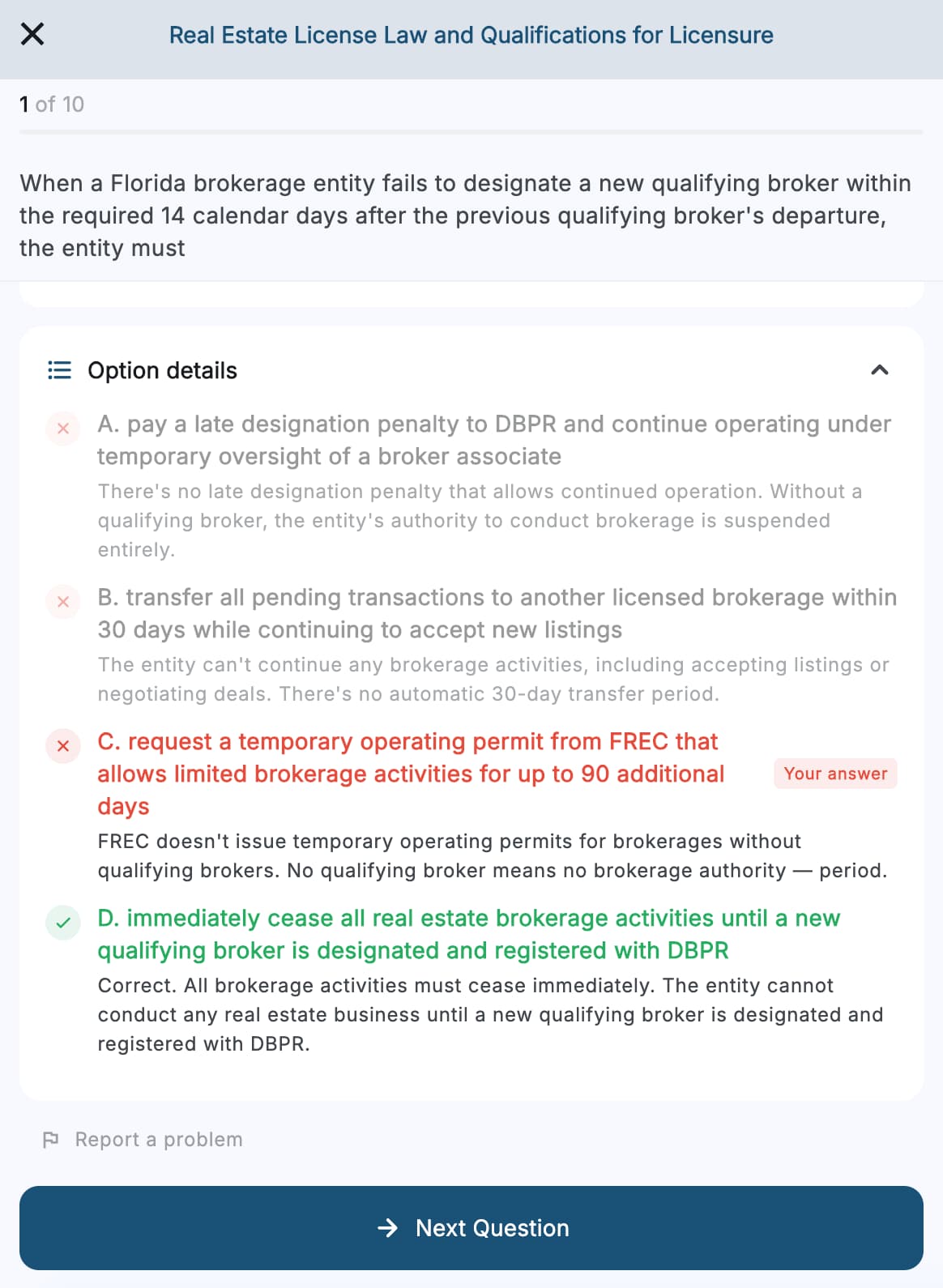
Topic Practice. If your result report and diagnostic point to Brokerage Activities and Contracts, you can drill those topics directly instead of mixing them into broad review.
The Math Coach. If math cost you points, the Math Coach walks through the 14 Florida math calculation types step by step. Not just the correct answer. The full setup, so you can see where your approach broke down.
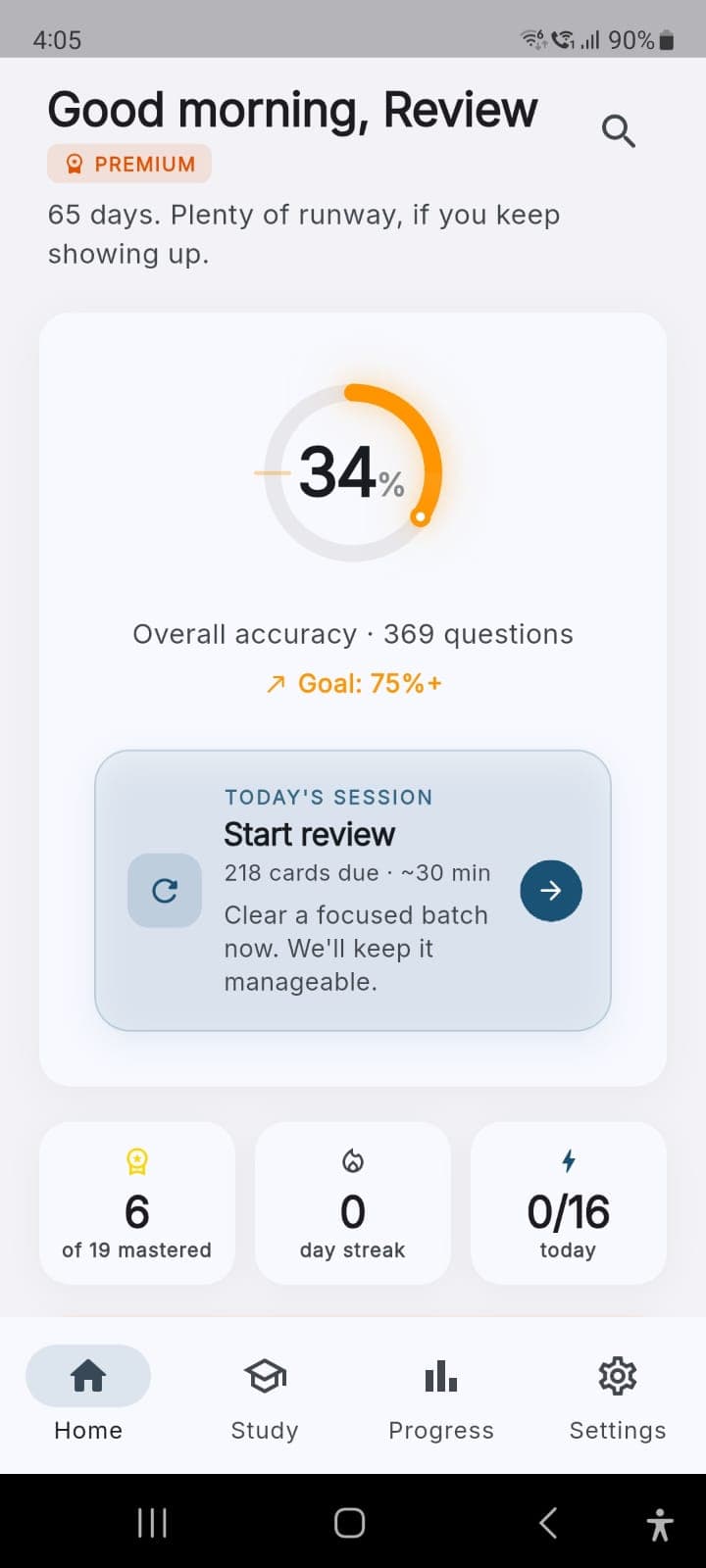
Readiness tracking. Instead of guessing whether you are ready to rebook, Pass Florida shows your topic-level accuracy, weak areas, confidence gaps, math performance, and Exam Style results in one workflow.
Ready to Retake with a Better Map?
The goal is not to study harder in a panic. It is to make your second attempt different from your first. Use the next practice set to prove what improved, not to repeat questions you already remember.
Try a free Florida question | Run the readiness calculator | Download Pass Florida
Frequently Asked Questions
How soon can I retake the Florida real estate exam, and what does it cost?
Pearson VUE's current fact sheet says candidates who fail must wait 24 hours before scheduling a reexamination, and reservations may not be made at the test center. The current published salesperson exam fee is $36.75, but verify the fee on Pearson VUE before scheduling, and see the full exam-cost and retake-fee breakdown. There is no fixed lifetime cap on Florida sales associate exam attempts, but your DBPR application window matters. For most students, the better move is 2 to 3 weeks of targeted preparation, not a fast rebook with the same approach.
What is the biggest mistake retakers make?
Studying the same way. Many retakers re-read the same textbook, retake the same school practice exam, and hope more hours will produce a different result. The students who improve change their method: they target the weak topics shown by their result report and diagnostic, switch from passive review to scenario-based practice questions, and drill math formulas until the setup is automatic. More hours of the same approach is not a strategy. A different approach is.
How do I know if I need more than 14 days before retaking?
Your practice exam scores tell you. If you are scoring above 80% on full timed exams with no single topic below 65% by Day 13, 14 days may be enough. If you are still between 70% and 75%, add one more week of targeted drilling on your weakest areas. If you are below 70%, add two weeks and consider whether your study method has actually changed from your first attempt. The timeline should flex around your readiness, not around a calendar.
Is the Florida real estate exam different each time you take it?
Yes. Each exam is generated from a question pool, so you will not see the exact same questions. However, the content areas, their weights, and the difficulty level remain consistent. A question about escrow deposit deadlines on your first attempt will be a different question about escrow deposit deadlines on your second attempt, but it tests the same rule. Studying the concepts is what matters, not remembering specific questions.
Should I take a prep course before retaking the Florida real estate exam?
Only if your first preparation method was self-study with no structured practice questions. If you already used a prep tool and still failed, the issue is not the absence of a course. It is the study method. Switching from passive review to active scenario-based practice, targeting the weak topics your result report and diagnostic point to, and drilling math formulas will produce more improvement than adding another course on top of the same approach.
What does the Florida real estate exam score report show?
Pearson VUE and DBPR materials say candidates receive an official exam result report immediately after the exam. Use whatever detail the report provides, and verify that the information on the report is correct before leaving the test center. If the report does not give enough content-area detail to build a study plan, take a fresh Florida-specific diagnostic and compare that result with what you remember from the exam.
This post is exam preparation content for the Florida Real Estate Sales Associate exam. It is not legal, tax, financial, lending, appraisal, brokerage, insurance, title, closing, or professional advice. For real-world decisions, verify current requirements with the official source or consult a qualified licensed Florida professional.
Methodology
The sequence prioritizes high-weight weak topics, timed practice, and math recovery before rebooking.
Product note. Pass Florida is our Florida-specific exam prep app. This page references our own product, so the relationship is direct and disclosed. We do not claim to use copied exam questions, guarantee passage, or provide legal advice.
Sources
- Pearson VUE Florida Real Estate & Appraisers licensing exams
- Florida real estate candidate fact sheet, Pearson VUE PDF
- DBPR Real Estate Sales Associate Candidate Information Booklet
- DBPR Examination Reviews and Hearings
- DBPR real estate sales associate requirements PDF
- Florida Statutes Chapter 475, Florida Senate