Study Guide20 min read2026-02-24

    I Passed the Florida Real Estate Exam. Now What? Step-by-Step Guide (2026)

    Why Most New Licensees Waste Their First 90 Days on the Wrong Tasks in the Wrong Order

    You passed. The exam is done. But the exam was the gate, not the finish line. Most new licensees lose weeks because they do not know the exact sequence: score report, DBPR processing, broker selection, RE 11 activation, post-licensing education, MLS access. Do them out of order and you wait longer. Skip one and your license never activates. The Florida real estate exam tested whether you understood real estate law. What comes next tests whether you can turn that knowledge into a functioning career. If you have not taken the exam yet or want to review your odds, the Florida exam pass rate data shows exactly what you are up against.

    How long does DBPR take to process your application? Seven to ten business days after you pass, sometimes faster if your fingerprints and background check cleared during pre-licensing. Do you need to find a broker before your license is active? Yes, because your license is issued to a broker, not to you as an individual. What is the RE 11 form? The application to activate your license under a sponsoring broker. What happens if you do not complete 45 hours of post-licensing education before your first renewal? Your license becomes null and void. Not suspended. Not inactive. Null and void. You must start the entire process over, including the 63-hour pre-licensing course and the state exam. The Florida-specific content guide covers the post-licensing rule as exam content. This guide covers how to actually complete it. What changed with the NAR settlement? Written buyer brokerage agreements are now required before showing homes, and commission structures have shifted. The brokerage relationships guide explains the legal framework. This guide explains what it means for your first day on the job.

    This is the complete timeline from your score report at Pearson VUE to your first listing agreement, with every form, every fee, every deadline, and every decision that determines whether your first year builds momentum or burns through savings.

    The short version: Score report (immediate at Pearson VUE) confirms a passing score of 75 or higher. DBPR processes your application in 7 to 10 business days. Choose a broker during the wait. Your broker submits the RE 11 form to activate your license. Complete 45 hours of post-licensing education before your first renewal (18 to 24 months) or your license becomes null and void. Your license is issued to your broker, not to you. Written buyer brokerage agreements are now required before showing homes under the NAR settlement. Realistic first-year income: $25,000 to $65,000. Exam day to first listing: 30 to 90 days.

    Timeline: Exam day to first listing ~30-90 days | Critical Deadline: 45-hour post-licensing before first renewal | 2026 Update: NAR settlement buyer agreement requirements


    What This Guide Covers


    Your Score Report and What It Means

    Your score report prints immediately at Pearson VUE after you finish the exam, and it confirms whether you passed, but it is not your license and it does not authorize you to practice real estate. A passing score is 75 or higher out of 100 questions on the Sales Associate Exam. You receive the report before you leave the testing center. The proctor does not hand it to you. You pick it up at the front desk or it prints automatically at a designated station, depending on the Pearson VUE location.

    What Your Score Report Contains

    The report shows your overall pass/fail result and a percentage breakdown by content area. The Florida Sales Associate Exam covers 19 content areas weighted differently, from Real Property (7%) to Business Ethics (3%). Your score report groups these into broader categories and shows how you performed in each. If you passed, the breakdown is useful for understanding your strengths as you begin your career. If you scored particularly high in contracts or brokerage relationships, that knowledge base transfers directly into practice. If you passed but scored low in a specific area, you know where your ongoing learning should focus.

    The report does not show which specific questions you got right or wrong. Pearson VUE does not release question-level data. The report also does not include a license number, a license effective date, or any authorization to practice. It is a test result, not a credential.

    What to Keep and What to Bring Forward

    Keep your score report. Store a photo of it on your phone and file the paper copy somewhere you will not lose it. You will not need it for DBPR processing because Pearson VUE transmits your results electronically, but brokers sometimes ask to see it during interviews, and you will want it if any processing question arises during the 7-to-10-day application review. The score report is your proof of passage until your license appears in the DBPR system.

    You should also keep the candidate handbook and any receipts from your exam fee ($36.75 paid to Pearson VUE) and your DBPR application fee ($83.75). These are deductible business startup expenses once you activate your license and begin practicing.

    What the Score Report Does Not Authorize

    Your score report does not list a license number. It does not authorize you to negotiate contracts, show homes, solicit listings, or represent clients in any capacity. Until your license is activated under a sponsoring broker through the RE 11 process, you are a person who passed an exam. That distinction matters because practicing real estate without an active license is a third-degree felony under Florida Statute 475.42, carrying penalties of up to $5,000 in fines and up to five years of imprisonment. This is not a technicality. It is the most serious licensing violation in the statute.

    The mistake that costs new agents time: Assuming the score report means you can start working. Some new licensees contact sellers, begin marketing themselves as agents on social media, or print business cards with a "Licensed Real Estate Agent" title before their license is active. This creates legal exposure under F.S. 475.42 and can delay or jeopardize your application if DBPR discovers unlicensed activity during processing. Wait for DBPR processing and license activation before doing anything that could be construed as practicing real estate.


    DBPR Processing: The 7-to-10-Day Wait

    The Department of Business and Professional Regulation processes your application after you pass, and the typical timeline is 7 to 10 business days, though applications with complete fingerprints and clean backgrounds often clear in 5 to 7. DBPR does not wait for you to submit anything new after exam day. Your DBPR application fee ($83.75) and your fingerprint submission (Live Scan electronic fingerprinting, typically $50 to $80 depending on the vendor) were both completed during your pre-licensing phase. Pearson VUE transmits your exam results to DBPR electronically on the same day you test. The system is automated. There is no paper score report to mail.

    What Happens During Processing

    Step Timeline Notes
    Exam results transmitted to DBPR Same day (electronic) Pearson VUE sends automatically
    Background check verification Already completed Submitted with pre-licensing application
    Fingerprint verification Already completed Live Scan submitted during pre-licensing
    Application review 5 to 10 business days DBPR reviews all documents
    License status updated After review complete Check on MyFloridaLicense.com

    Track your application status at MyFloridaLicense.com. The portal updates when your status changes. You do not need to call DBPR unless your application has been pending for more than 15 business days, which is uncommon for straightforward applications.

    What to Do During the Wait

    This is not dead time. The DBPR processing period is when you should be researching brokers, scheduling interviews, and narrowing your list. You cannot activate your license without a sponsoring broker, so the broker decision is on your critical path. Use the 7 to 10 days to complete the research described in the next section. By the time DBPR clears your application, you should already know which broker you want to join.

    If your fingerprints were not submitted during pre-licensing, or if DBPR requests additional documentation, your timeline extends. Check the portal daily and respond to any requests within 48 hours. Delays in responding to DBPR requests are the number one cause of processing timelines stretching past 10 business days.

    The mistake that costs new agents time: Waiting passively during DBPR processing. The agents who start their careers fastest are the ones who use this window to interview brokers, compare compensation structures, and make a decision. The ones who wait until their license clears to start broker research add two to four weeks to their timeline.


    Choosing a Broker: The Decision That Shapes Your First Year

    Your broker determines your training, your compensation, your daily support system, and in many ways your probability of surviving the first year, which makes broker selection the single most consequential decision in this entire guide. New agents focus on commission splits. Experienced agents will tell you that training quality, lead generation, and mentorship access matter more than the split percentage, especially in year one when you do not yet have a client base.

    What to Evaluate

    Interview at least three brokers before committing. Prepare specific questions for each meeting, and pay attention to how each office answers them.

    Training program. Does the brokerage provide structured training for new agents? How long does it last? Is it classroom-based, one-on-one, or self-guided? A brokerage that hands you a login to a video library is not the same as one that assigns you a mentor and reviews your first five transactions. Ask what the training program looked like for agents who joined in the last six months. Ask to speak with one of those agents.

    Lead generation. Does the brokerage provide leads, or are you expected to generate all of your own business? If they provide leads, what is the conversion rate? What is the additional split or referral fee on brokerage-provided leads? Some offices advertise lead generation but charge 35% to 50% referral fees on those leads, which changes the math significantly.

    Mentorship and support. Is there a designated mentor for new agents? Can you shadow experienced agents on listings and showings? What happens when you have a question about a contract at 8 PM on a Saturday? The quality of support during your first five transactions determines whether those deals close smoothly or become learning experiences that cost you money.

    Culture and environment. Is this an office where agents collaborate, or one where they compete? Are there regular office meetings? Do agents socialize? Culture affects retention. New agents who feel isolated leave the industry at higher rates than those who feel connected to their office.

    Technology and tools. Does the brokerage provide a CRM? Transaction management software? Marketing templates? A website with IDX? Some brokerages include these in your desk fee. Others expect you to purchase everything independently. Know the total technology cost before you sign.

    Market presence. How many active listings does the office have? What is the office's market share in your target area? An office with strong listing inventory gives you floor time opportunities (answering calls from buyers who see the office's signs or listings online). An office with low inventory means fewer inbound opportunities. This is not the deciding factor, but it is relevant data for your first six months when you do not yet have your own listing inventory.

    Three Broker Models

    Model Typical Split Training Leads Best For
    National franchise (Keller Williams, RE/MAX, Coldwell Banker) 50/50 to 70/30 Structured programs, brand resources Varies by office New agents wanting structure
    Independent brokerage 60/40 to 80/20 Varies widely Rarely provided Agents with existing networks
    Team (within any brokerage) 50/50 to 70/30 for team leads Hands-on mentorship Team leader provides New agents wanting immediate deals

    Red Flags to Watch For

    Red flag 1: No structured training but a high split. An 80/20 split sounds attractive until you realize you do not know how to write a listing agreement, run a comparative market analysis, or handle a home inspection negotiation. The brokerage is offering a high split because they are not investing in your development. For most first-year agents, a lower split with comprehensive training produces more total income than a high split with no support.

    Red flag 2: Pressure to sign immediately. A broker who tells you that the offer is only available today, or that they only have one desk left, is using urgency tactics. Good brokerages recruit continuously. If they will not give you a week to compare options, they are prioritizing their recruitment numbers over your career decision.

    Red flag 3: No clear answers about fees. Ask for a complete fee schedule in writing before you sign anything. Desk fees, transaction fees, E&O insurance, franchise fees, technology fees, and marketing fees should all be disclosed upfront. If a broker cannot produce a written fee schedule during your interview, that is a meaningful data point about how they run their business.

    The mistake that costs new agents time: Choosing a broker based entirely on the commission split percentage. The split matters, but it is one variable in a larger equation. A 50/50 split with a mentor who walks you through your first 10 deals, provides leads, and teaches you how to conduct a listing presentation will almost certainly produce more first-year income than an 80/20 split where you sit alone at a desk with no training and no leads.


    Commission Splits and What to Negotiate as a New Agent

    Commission splits determine how much of each transaction fee you keep and how much goes to your broker, and understanding the real-world structure is different from the exam math calculations you studied for the test. The exam gives you a sale price, a commission rate, and a split percentage, then asks you to multiply. Real-world compensation involves layers of fees, caps, and structures that the exam does not test.

    How Splits Work in Practice

    When a transaction closes, the total commission (typically 5% to 6% of the sale price, though this is always negotiable) is split between the listing brokerage and the buyer's brokerage. Your brokerage then splits its portion with you based on your agreement. If the total commission is 6%, each side gets 3%. If your split with your broker is 60/40, you keep 60% of your brokerage's 3%, which is 1.8% of the sale price.

    Typical First-Year Split Structures

    Structure How It Works First-Year Reality
    50/50 You keep 50%, broker keeps 50% Common at training-heavy brokerages. Lower per-deal income, but more support.
    60/40 You keep 60%, broker keeps 40% Standard starting split at many offices. May increase with production.
    70/30 You keep 70%, broker keeps 30% Available at some brokerages for experienced agents or high producers. Rare for true beginners.
    100% commission You keep 100%, pay a flat monthly fee Requires high volume to be profitable. No training, no leads, no mentorship. Not recommended for first-year agents.
    Cap model Standard split until you hit a cap, then 100% Popular at Keller Williams and similar. Benefits high producers. First-year agents rarely hit the cap.

    What Is Negotiable

    Your starting split is sometimes negotiable, especially if you bring relevant experience (sales background, existing network, marketing skills). What is more commonly negotiable: the timeline for split increases. Ask what production level triggers a better split and get it in writing. A brokerage that says "we will revisit your split after a year" without specific criteria is making a vague promise.

    What Is Not Negotiable

    Franchise fees, E&O insurance costs, and MLS dues are fixed costs that no broker can waive. These are pass-through expenses. If a broker says they do not charge a franchise fee, it is because they are not a franchise, not because they negotiated it away.

    The Full Cost Picture

    Fee Type Typical Range Who Sets It
    Commission split 50/50 to 70/30 Broker (negotiable)
    Desk fee $0 to $500/month Broker
    Transaction fee $100 to $500 per closing Broker
    E&O insurance $200 to $500/year Insurance provider
    Franchise fee 3% to 8% of gross commission Franchise (if applicable)
    Technology fee $50 to $200/month Broker

    The mistake that costs new agents time: Focusing only on the split percentage and ignoring the fee structure. An agent with a 70/30 split who pays $400/month in desk fees, $350 per transaction, and a 6% franchise fee keeps significantly less than the number suggests. Calculate your net per transaction, not your gross split, before signing with any brokerage.


    Activating Your License: The RE 11 Form

    The RE 11 is the Sales Associate Licensure Application that ties your license to a specific sponsoring broker, and until your broker submits it and DBPR processes it, your license remains inactive and you cannot practice real estate. This is the step that formally bridges the gap between "person who passed the exam" and "licensed real estate sales associate."

    Two Critical Points

    First, your broker submits the RE 11 form, not you. You do not download this form and mail it yourself. Your sponsoring broker (or their office manager) files it with DBPR on your behalf. This means you cannot activate your license until you have selected a broker and that broker has agreed to sponsor you. If your broker delays submitting the RE 11, your activation delays. Ask your broker what their typical submission timeline is and confirm it has been filed.

    Second, your license is issued to your broker, not to you as an individual. This is a fundamental concept from your exam preparation, but it has real-world implications now. You cannot practice independently. You cannot list a property under your own name. Every transaction you conduct is under the supervision and authority of your sponsoring broker. If you leave your broker, your license becomes inactive until a new broker files a new RE 11.

    The Activation Checklist

    1. Pass the Florida real estate exam (75+ score)
    2. Wait for DBPR to process your application (7 to 10 business days)
    3. Select a sponsoring broker (see broker selection)
    4. Sign your Independent Contractor Agreement (ICA) with the broker
    5. Broker submits the RE 11 form to DBPR (online or paper)
    6. DBPR processes the RE 11 (typically 3 to 5 business days)
    7. Your license status changes to "Active" on MyFloridaLicense.com
    8. You may now practice real estate under your broker's supervision

    Most brokerages submit the RE 11 electronically through the DBPR online portal at MyFloridaLicense.com, which is faster than paper submission. Electronic submissions typically process in 3 to 5 business days. Paper submissions mailed to DBPR in Tallahassee can take 10 to 15 business days due to mail transit and manual processing. If your broker still uses paper forms, this is worth knowing because it adds one to two weeks to your activation timeline. Ask your broker which submission method they use before you sign your ICA.

    The mistake that costs new agents time: Assuming your license is active the moment you sign with a broker. The RE 11 still needs to be filed and processed. Some new agents have scheduled listing appointments or buyer consultations before their license was officially active, which creates a legal problem. Verify your status on MyFloridaLicense.com before conducting any real estate activity.


    Post-Licensing Education: 45 Hours Before First Renewal

    Florida requires every new sales associate to complete 45 hours of post-licensing education before their first license renewal, and the consequence for missing this deadline is the most severe penalty in the licensing system: your license becomes null and void. The Florida-specific content guide covers this rule as exam content. Here is how to handle it as a practicing agent.

    Null and void is not the same as inactive or suspended. If your license goes inactive, you complete continuing education and pay a fee to reactivate. If your license becomes null and void, you start over. That means repeating the 63-hour pre-licensing course, retaking the state exam, resubmitting your application, and waiting for DBPR processing again. Months of work and thousands of dollars, gone because of a missed deadline.

    When Is the Deadline?

    Your first renewal date depends on when your license was issued. Florida real estate licenses renew on a biennial cycle, with two possible expiration dates: March 31 or September 30 of even-numbered years. DBPR assigns your renewal date based on your license number. Your first renewal period is 18 to 24 months from your initial license date, depending on where your activation falls in the cycle.

    For example: if your license activates in March 2026, your first renewal is likely September 2027, giving you approximately 18 months. If your license activates in October 2026, your first renewal is likely March 2028, giving you approximately 17 months. The window varies, but it is always less than two years for your first renewal. Check your exact renewal date on MyFloridaLicense.com the day your license activates. Write it down. Set calendar reminders at six months, three months, and one month before the deadline. The cost of redundant reminders is zero. The cost of missing the deadline is your entire career to date.

    Online vs Classroom

    The 45-hour post-licensing course is available online and in classroom settings from FREC-approved providers. Online courses offer flexibility for agents who are actively selling. You can complete modules between showings, during slow prospecting weeks, or in the evenings after client work. Classroom courses offer structure and networking with other new agents who are facing the same challenges you are. Both satisfy the requirement identically. The choice comes down to your schedule and learning style, not the quality of the credential.

    Expect the course to take two to four weeks if you study a few hours per day, or one to two weeks if you dedicate full days. Some providers offer accelerated weekend formats. Regardless of the format, you cannot rush through the material faster than the provider allows. Florida-approved courses include minimum seat-time requirements that prevent students from clicking through screens at unrealistic speeds.

    When to Start

    Start your post-licensing education within the first six months of licensure. This is not a legal requirement. It is a risk management strategy. Agents who wait until month 16 or 17 of an 18-month renewal cycle are gambling that nothing will interrupt their schedule. A busy closing month, a family emergency, or a technical issue with the course provider can turn a manageable deadline into a career-ending one.

    Many agents complete post-licensing education in the first 90 days while they are still building their client base and have more flexible schedules. The content also reinforces practical skills like contract writing, listing presentations, and buyer representation that you need immediately.

    After Your First Renewal

    Once you complete the 45-hour post-licensing course and renew your license for the first time, your continuing education requirement drops to 14 hours every two years (3 hours of Core Law, 3 hours of Ethics, and 8 hours of specialty education). This is a much lighter ongoing obligation, but missing it still results in your license becoming involuntarily inactive.

    The mistake that costs new agents time: Treating post-licensing education as something to worry about later. "Later" arrives faster than new agents expect, especially when they are busy with their first transactions. The agents who complete post-licensing early never have to think about it again. The agents who procrastinate risk the single worst outcome in Florida real estate licensing.


    Joining Your Local Board, MLS, and Becoming a REALTOR

    You need MLS access to list properties, search active inventory, and run comparative market analyses, and MLS access requires membership in your local board of REALTORS, which is a separate process from state licensure with its own fees and timeline. Your state license authorizes you to practice real estate. Your MLS membership gives you the tools to actually do it.

    Three Memberships, Three Purposes

    Membership Required? What It Provides Typical Annual Cost
    Local board of REALTORS Required for MLS MLS access, lockbox/key access, local forms $200 to $500
    MLS (through local board) Required to list/search Property search, listing input, CMA tools $300 to $800
    National Association of REALTORS (NAR) Optional "REALTOR" designation, national advocacy, Code of Ethics $156 (2026 rate)

    The Difference Between "Real Estate Agent" and "REALTOR"

    Every REALTOR is a real estate agent. Not every real estate agent is a REALTOR. "REALTOR" is a trademarked term that requires NAR membership and adherence to the NAR Code of Ethics. You can practice real estate without being a REALTOR, but most agents join because their local board requires NAR membership for MLS access, and because the designation carries consumer recognition.

    In Florida, most local boards require NAR membership as a condition of board membership. This means that in practice, joining your local board to get MLS access also means joining NAR and paying NAR dues. Florida Realtors, the state association, provides a directory of local boards and can help you identify which board serves your market area. Verify the specific membership requirements with your local board, as they vary.

    Cost Breakdown for MLS and Board Access

    Fee Component Typical Range Frequency
    Local board dues $200 to $500 Annual
    MLS access fee $300 to $800 Annual (some boards charge quarterly)
    NAR dues $156 (2026 national rate) Annual
    Florida Realtors dues $140 to $165 Annual
    One-time application/initiation fee $100 to $300 Once at enrollment
    Total first-year cost $900 to $1,800 Varies by board

    Your total cost to join the local board, MLS, and NAR (if required) will typically range from $900 to $1,800 for the first year, depending on your local board. This is in addition to your brokerage fees. Some brokerages cover a portion of these costs for new agents as part of their onboarding. Others deduct board fees from your first commission check. Ask the specific policy during your broker interviews so there are no surprises.

    Lockbox and Key Access

    To show listed properties, you need electronic lockbox access (Supra eKey is the most common system in Florida). This is typically provided through your local board membership and requires an additional fee ($100 to $200/year) or app subscription. Without lockbox access, you cannot open listing doors, which means you cannot show homes to buyers or preview properties for listing appointments.

    The mistake that costs new agents time: Activating their license but delaying board and MLS enrollment. Your license is active, but without MLS access you cannot list properties, search inventory for buyers, or run CMAs for listing presentations. Every day without MLS access is a day you cannot fully function as an agent. Start the board enrollment process the same week your license activates.


    First-Year Income: What the Numbers Actually Say

    Realistic first-year income for a Florida real estate sales associate ranges from $25,000 to $65,000, and the gap between those numbers depends on whether you work full-time or part-time, your broker's lead generation, your existing network, and how quickly you close your first transaction. The numbers you see on brokerage recruiting websites ("six figures your first year!") are either exceptional outliers or misleading calculations.

    What the Data Shows

    The National Association of REALTORS reports that the median gross income for members with two years or less of experience was approximately $23,000 in their 2024 Member Profile. Florida agents in major metro markets (Miami, Orlando, Tampa, Jacksonville) tend to earn more than the national median due to higher property values, but first-year agents in any market face the same ramp-up period.

    The $25,000 to $65,000 range accounts for agents who work full-time in active markets and close four to eight transactions in their first year. On a median Florida home sale of approximately $400,000 at a 3% commission per side, a first-year agent with a 50/50 split earns roughly $6,000 per closing. Five closings produce $30,000 before expenses. Eight closings produce $48,000 before expenses. After startup costs, board fees, and brokerage fees, the net figure drops. These are not discouraging numbers. They are accurate numbers. Building a sustainable real estate business takes time, and agents who understand the ramp-up period plan their finances accordingly rather than panicking when month three produces zero income.

    Income Timeline

    Month What Is Happening Typical Income
    Months 1 to 2 License activation, board enrollment, training, prospecting begins $0 (startup phase)
    Months 3 to 4 First client contacts, showings, listing presentations $0 to minimal (pipeline building)
    Months 5 to 7 First deal under contract, 30 to 45 day closing timeline First commission check ($3,000 to $8,000)
    Months 8 to 12 Repeat clients, referrals starting, systems established $15,000 to $40,000 cumulative

    Startup Costs

    Before you earn your first commission, you will spend money to get started. Budget for these costs before you activate your license.

    Expense Estimated Cost
    Pre-licensing course (already completed) $300 to $500
    State exam fee (already paid) $36.75
    DBPR application fee (already paid) $83.75
    Local board, MLS, and association fees $900 to $1,800/year
    E&O insurance $200 to $500/year
    Lockbox/key access $100 to $200/year
    Business cards and marketing materials $200 to $500
    CRM software $0 to $50/month
    Total first-year startup (beyond pre-licensing) $2,000 to $4,000

    Cash Reserves

    Financial advisors who work with real estate agents typically recommend having three to six months of living expenses saved before going full-time. Most new agents do not earn a commission check for 60 to 120 days after license activation. If you do not have cash reserves and cannot sustain a period without income, consider the part-time approach described in the next section.

    The mistake that costs new agents time: Underestimating the ramp-up period and running out of money before their pipeline matures. The agents who leave the industry in year one usually do not leave because they lack skill. They leave because they run out of financial runway. Plan your cash reserves before you activate your license, not after.


    Part-Time vs Full-Time: Making the Decision

    Part-time real estate is legally permitted and practically possible, but it limits your availability, slows your reputation building, and typically produces one-third to one-half the income of full-time agents in the same market. The decision between part-time and full-time is not binary. It is a financial calculation based on your current income, savings, risk tolerance, and timeline.

    Comparison

    Factor Full-Time Part-Time
    Client availability Immediate response, flexible showing schedule Limited to evenings and weekends
    Broker requirements All brokerages accept full-time Some brokerages require full-time; verify before signing
    Income trajectory Faster pipeline, more closings Slower pipeline, fewer closings
    Risk No other income during ramp-up Existing income provides safety net
    Typical first-year closings 4 to 8 transactions 1 to 4 transactions
    Time to first closing 60 to 120 days 90 to 180 days
    Broker mentorship access Full access during business hours Limited to scheduled sessions
    Post-licensing scheduling Easier to fit into slower periods Must balance with job and clients

    When Part-Time Makes Sense

    Part-time makes sense if you have a stable income source you cannot afford to lose, if your savings are below the three-to-six-month reserve threshold ($15,000 to $30,000 for most households), or if you want to test whether real estate suits you before committing fully. Many successful full-time agents started part-time and transitioned once their pipeline produced consistent closings. A part-time agent who closes two transactions in six months ($6,000 to $12,000 in gross commission at a typical 50/50 to 60/40 split) has demonstrated proof of concept before taking the full-time leap.

    When Full-Time Makes Sense

    Full-time makes sense if you have adequate savings ($15,000 to $30,000 or three to six months of living expenses), if your current employment income is replaceable with four to six real estate closings per year, or if you are in a market where buyer and seller schedules require midweek availability. In competitive markets like South Florida, where the median home price exceeds $500,000 and inventory moves quickly, part-time agents struggle to win listings against full-time agents who can respond immediately and schedule showings on 24-hour notice. In lower-volume markets like the Panhandle or rural Central Florida, part-time is more viable because the pace of transactions accommodates a less flexible schedule.

    The Transition Plan

    If you start part-time, set a specific trigger for transitioning to full-time. A common trigger: "When my trailing three-month real estate income exceeds 50% of my employment income, I transition." A vague plan to "go full-time eventually" is not a transition plan. It is a way to stay part-time indefinitely.

    The mistake that costs new agents time: Not verifying their broker's part-time policy before signing. Some brokerages require agents to be available during specific hours or to attend mandatory weekly meetings during business hours. If you are part-time and your employer does not allow midday absences, you need a broker who accommodates that schedule. Ask this question during your broker interview, not after you sign.


    2026 Update: NAR Settlement Impact on New Agents

    The National Association of Realtors settlement, effective August 17, 2024, changed how buyer agents are compensated and how buyer representation is documented, and new agents entering the market in 2026 need to understand these changes because they affect daily practice from your first buyer consultation forward. The brokerage relationships guide covers the legal framework and the four EBBA form types in detail. This section focuses on what the settlement means for a new agent starting out.

    What Changed

    Written buyer brokerage agreements are now required before touring homes. Before the settlement, many buyer agents showed homes without formal representation agreements. That practice ended. You must have a signed buyer brokerage agreement before showing any property to a buyer client. In Florida, this means one of four Exclusive Buyer Brokerage Agreement (EBBA) forms, depending on the type of representation. The brokerage relationships guide details each form type and when to use it.

    Compensation offers were removed from the MLS. Before the settlement, listing agents could advertise buyer agent compensation on the MLS. That information is no longer displayed. Buyer agent compensation is now negotiated independently of the MLS, typically in the purchase contract or through separate agreements.

    Compensation must be specific and objectively ascertainable. Your buyer brokerage agreement must state your compensation clearly. A specific percentage, a flat fee, or an hourly rate. Vague language does not satisfy the requirement.

    What This Means for New Agents

    The settlement makes buyer representation a conversation you must have at the beginning of every buyer relationship, not a formality you handle at closing. Before August 17, 2024, an agent could meet a buyer at an open house, drive them to three more properties, and never discuss compensation until a contract was written. That workflow no longer exists. Under the settlement terms, you must present a buyer brokerage agreement, explain your compensation structure (whether 2.5%, 3%, a flat $5,000 fee, or an hourly rate), and get the agreement signed before you open the first door.

    In Florida specifically, this means using one of the four Exclusive Buyer Brokerage Agreement (EBBA) forms updated in January 2026: EBBA-8sa (Single Agent), EBBA-8tb (Transaction Broker), EBBA-8tn (Consent to Transition), or EBBA-8nr (No Brokerage Relationship). The form you use depends on the brokerage relationship type you establish with the buyer. Most new agents working as transaction brokers (the default relationship type in Florida) will use the EBBA-8tb.

    New agents who cannot clearly explain their value, their services, and their compensation structure during a buyer consultation will lose clients to agents who can. This is a skill your brokerage training should cover. During your broker interviews, ask specifically how they train new agents on buyer consultations and buyer brokerage agreements. If the broker does not have a structured answer, that is a red flag. The settlement created a new competency requirement for agents, and your broker should be equipping you to meet it.

    HB 607: A Watch Item

    HB 607, a bill that proposes eliminating post-licensing education requirements and shifting FREC regulatory authority, passed the Florida House in 2025 but died in the Senate. A similar version is pending in the Commerce Committee. The Florida-specific content guide covers the bill's status in detail. As of 2026, HB 607 has not been enacted. FREC's current structure, post-licensing requirements, and continuing education rules remain unchanged. Plan around current law, not pending legislation.

    The mistake that costs new agents time: Treating the buyer brokerage agreement as a bureaucratic nuisance instead of a business conversation. The settlement requires the agreement, but the real issue is whether you can articulate why a buyer should work with you. Agents who treat the agreement as a form to be signed lose clients. Agents who treat it as an opportunity to demonstrate their value win them.


    The 4 Decisions That Define Your First Year

    Every step in this guide matters, but four decisions carry disproportionate weight in determining whether your first year builds a sustainable career or burns through your savings and motivation.

    1. Which broker. Training, splits, and culture matter more than brand name. A 50/50 split with mentorship outperforms 80/20 with no support for most first-year agents. Interview at least three brokerages. Ask about training structure, lead generation, and new agent retention rates. The broker selection section covers the full evaluation framework.

    2. Full-time or part-time. Part-time agents close fewer deals and build reputation slower. Full-time is not required, but it changes the income math significantly. If you go part-time, set a specific trigger for transitioning. If you go full-time, have three to six months of living expenses saved.

    3. When to complete post-licensing. Early completion of the 45-hour requirement removes the null-and-void risk entirely. Waiting until month 17 of an 18-month window is legal but dangerous. Complete it in your first 90 days while your schedule is flexible and the content reinforces skills you need immediately.

    4. How to present buyer representation. The NAR settlement changed how you get paid for buyer work. Agents who cannot explain their value in a buyer consultation lose clients to agents who can. This is the new baseline competency. Make sure your brokerage trains you on it, and practice the conversation before your first buyer meeting.


    Post-Exam Quick Reference Table

    Step or Task Timeline or Detail Common Mistake
    Score report Immediate at Pearson VUE Treating it as a license
    DBPR processing 7 to 10 business days Waiting passively instead of researching brokers
    Background check Already completed during pre-licensing Assuming you need to submit again
    Fingerprints Already completed during pre-licensing Assuming you need new prints
    Choose a broker During DBPR processing wait Choosing based on split alone
    Sign Independent Contractor Agreement At broker onboarding Not reading the fee schedule
    RE 11 form submission Broker submits after you sign Thinking you file it yourself
    License activation 3 to 5 business days after RE 11 Starting work before status shows "Active"
    Join local board Same week as license activation Delaying and losing weeks of MLS access
    MLS access After board enrollment (1 to 5 days) Assuming license activation includes MLS
    REALTOR membership (NAR) Often required by local board Not budgeting for the additional dues
    Lockbox/key access After board enrollment Scheduling showings before key access is set up
    E&O insurance Before first transaction Discovering you need it after a client hires you
    Buyer brokerage agreement Required before showing homes Showing homes without a signed agreement
    Post-licensing education (45 hours) Complete within first 90 days (recommended) Waiting until month 17 of 18-month window
    Null and void penalty Miss first renewal deadline Assuming you can reactivate like a normal lapse
    Commission split negotiation Before signing ICA Not getting split increase triggers in writing
    First closing 30 to 90 days after activation (typical) Underestimating the pipeline ramp-up period
    Startup costs $2,000 to $4,000 beyond pre-licensing Not budgeting before activation
    First-year income $25,000 to $65,000 (realistic range) Believing recruiter income projections
    HB 607 Watch item, not enacted Planning around a law that does not exist yet
    Continuing education 14 hours every 2 years (after first renewal) Confusing with 45-hour post-licensing requirement

    Screenshot this table. Every row is a decision point or deadline that affects your first year.


    5 Real-World Decision Scenarios

    These are not exam questions. They are decisions new agents actually face in their first 90 days. Work through each one before checking the answer.


    Scenario 1: The Split Negotiation

    Broker A offers a 50/50 commission split with a structured 12-week training program, a designated mentor, and brokerage-generated leads (at a 30% referral fee on lead-provided deals). Broker B offers an 80/20 split with no training program, no mentor, and no leads. You are a first-year agent with no existing real estate network. Which broker is likely to produce more total income in your first year?

    Answer and Reasoning

    Broker A is the better choice for most first-year agents.

    The math favors Broker A despite the lower split. A first-year agent with no network needs training to learn listing presentations, buyer consultations, contract writing, and negotiation. Without these skills, the 80/20 split at Broker B applies to zero closings. A 50/50 split on five closings produces more income than an 80/20 split on one closing.

    Consider a $350,000 sale at 3% per side ($10,500 to your brokerage). At Broker A with 50/50, you keep $5,250. At Broker B with 80/20, you keep $8,400. But if Broker A's training and leads help you close five deals in year one while Broker B's lack of support means you close only two, Broker A produces $26,250 versus Broker B's $16,800. The split percentage is less important than the number of transactions.

    The exception: if you already have a strong network of potential buyers and sellers from a previous career (real estate adjacent fields like mortgage, insurance, or construction), Broker B's higher split may make sense because you are bringing the leads yourself.


    Scenario 2: The Post-Licensing Gamble

    You activated your license in March 2026. Your first renewal is September 2027. It is now June 2027, and you have not started your 45-hour post-licensing course. You have three buyer clients, two active listings, and a closing scheduled for July. What is the risk, and what should you do?

    Answer and Reasoning

    The risk is severe, and you should start the post-licensing course immediately.

    You have three months to complete 45 hours of education while managing an active business. The course itself takes approximately two to three weeks of concentrated study (or four to six weeks at a few hours per day). That leaves a narrow margin for completion, FREC processing of your certificate, and any technical or scheduling issues.

    If you miss the September 2027 deadline, your license becomes null and void. Not inactive. Null and void. Your active listings would need to be reassigned to another agent in your brokerage. Your buyer clients would need new representation. You would need to retake the 63-hour pre-licensing course, pass the state exam again, and restart the entire licensing process.

    The correct action: enroll in an online post-licensing course today and complete it within the next three to four weeks. Do not wait until August. Do not assume you can fit 45 hours into a busy closing month. And recognize that this situation was avoidable. Agents who complete post-licensing in their first 90 days never face this scenario.


    Scenario 3: The Buyer Agreement

    A potential buyer calls you on a Saturday afternoon and wants to see a house listed in your MLS area. They found your number on a yard sign from one of your listings. They are pre-approved, motivated, and want to tour the home today. You have not signed a buyer brokerage agreement with them. Can you show the home?

    Answer and Reasoning

    No. Under the NAR settlement rules effective August 17, 2024, you must have a signed buyer brokerage agreement before touring a home with a buyer client.

    This is the scenario that new agents encounter most frequently, and it is the one where the pressure to skip the agreement is strongest. The buyer is ready. The home might sell to someone else. Signing paperwork feels like it will slow things down or scare off the client.

    The correct action: explain to the buyer that a written agreement is required before you can show any property. Offer to meet them at a nearby coffee shop or at the property to review and sign the agreement before the showing. Most buyers understand the requirement when you explain it professionally. The agents who lose clients over this are usually the ones who present the agreement apologetically instead of confidently.

    Have a digital version of your EBBA form ready on your phone or tablet at all times. The brokerage relationships guide covers the four EBBA form types and when each applies.


    Scenario 4: The Part-Time Question

    You earn $60,000 at your full-time job. You have $8,000 in savings. You just activated your real estate license and want to sell part-time. Your broker requires weekly Monday morning meetings at 9 AM. Your employer does not allow schedule modifications. What should you verify before committing to this broker?

    Answer and Reasoning

    You have a scheduling conflict that must be resolved before you sign.

    The mandatory Monday morning meeting at 9 AM conflicts with your employment schedule. If your employer does not allow modifications and you cannot attend, you will either miss meetings (violating your broker agreement) or miss work (risking your primary income). Neither outcome is acceptable.

    The correct action: ask the broker whether the meeting requirement is flexible, whether remote attendance is an option, or whether the meeting is truly mandatory versus strongly encouraged. If the broker requires in-person attendance with no exceptions, this is not the right brokerage for your current situation.

    This is not a reason to avoid real estate. It is a reason to find a broker who accommodates part-time schedules. Many brokerages have evening meetings, optional attendance policies, or recorded sessions for agents who cannot attend live. The part-time section of this guide covers what to ask during broker interviews.

    Also evaluate your $8,000 savings. That covers approximately two to three months of startup costs and living expenses if you were to go full-time, which is below the recommended three to six month reserve. Part-time is the appropriate choice until your savings or real estate income can support a full-time transition.


    Scenario 5: The MLS Delay

    Your license is active. Your broker has submitted the RE 11 form and DBPR shows your status as "Active - Sales Associate." A homeowner in your neighborhood approaches you at a community event and asks you to list their home. You have not yet joined your local board of REALTORS or MLS. What is the problem?

    Answer and Reasoning

    You cannot effectively list the property without MLS access.

    The MLS (Multiple Listing Service) is where listings are published and distributed to buyer agents. Without MLS access, your listing will not appear in the database that buyer agents search. It will not syndicate to Zillow, Realtor.com, or other consumer portals through the standard IDX feed. Buyer agents will not see it. Your seller's property will be invisible to the vast majority of potential buyers.

    You are legally authorized to practice real estate with an active license. But practically, listing a home without MLS access is like opening a store with no sign on the door. You can do it. You should not.

    The correct action: tell the homeowner you would be happy to list their home and that you are completing your board enrollment this week. Join your local board and MLS immediately. Most board enrollments process in one to five business days. Schedule the listing appointment for after your MLS access is confirmed.

    This scenario is why the reference table recommends joining your local board the same week your license activates. Every day of delay is a day you cannot serve clients who are ready to work with you.


    What to Do Next

    If you got all five right: You understand the post-exam landscape and the practical decisions ahead. Focus your energy on broker interviews and timeline execution. Start with the reference table above and work through each row as a checklist.

    If you got three or four right: Review the scenario you missed. The decision you got wrong is likely the step that will trip you up in practice. Reread the relevant content section, especially the "mistake that costs new agents time" callout at the end of each section. The knowledge is close. The practical application needs one more pass.

    If you got two or fewer right: Print the reference table and work through each step in order. This guide is your 90-day roadmap. Bookmark it and revisit it at each milestone: DBPR clearance, broker selection, RE 11 submission, license activation, board enrollment, and first listing. The agents who succeed in year one are not the ones who know the most. They are the ones who execute each step in the right order without skipping any.


    How Pass Florida Prepares You for What Comes After the Exam

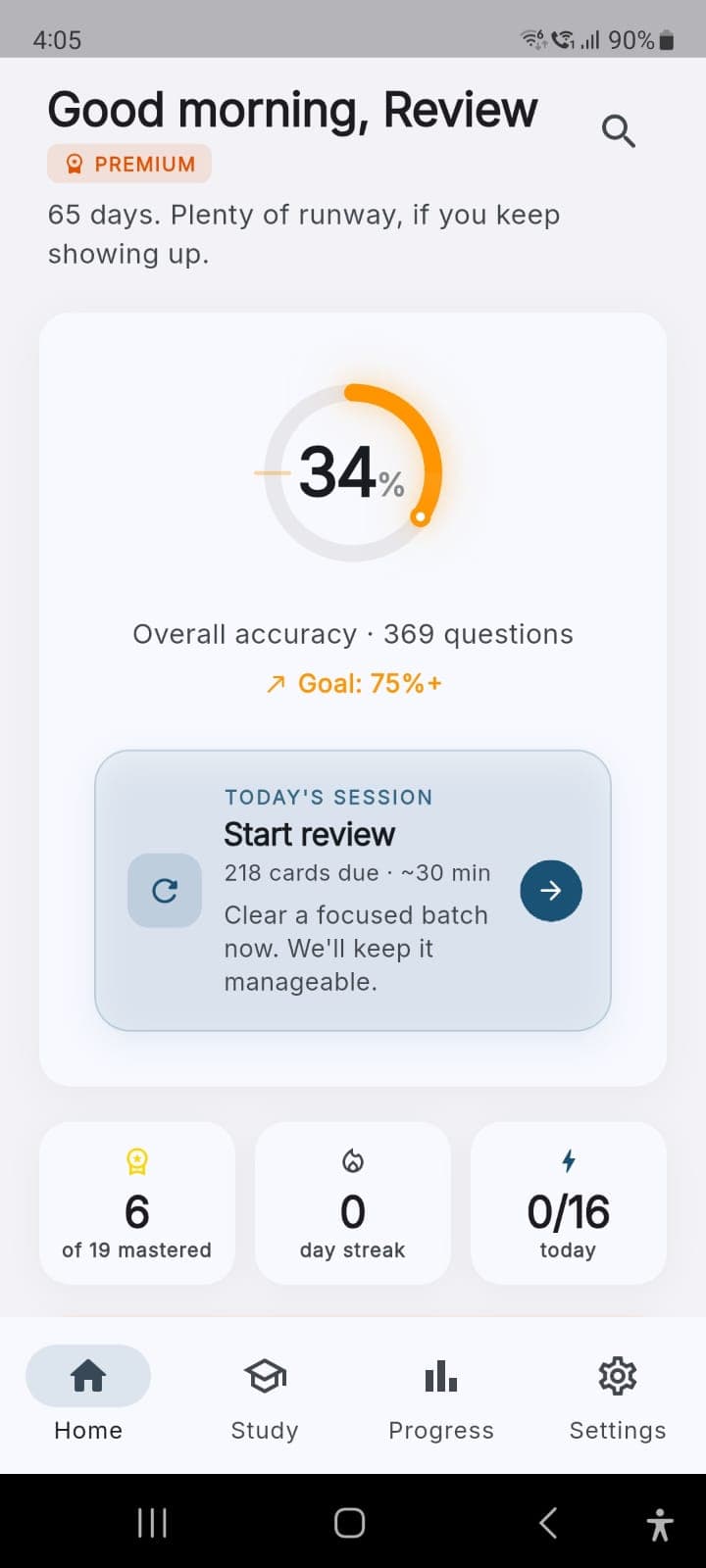
    Everything in this guide assumes you passed the exam on your first attempt. The fastest path from pre-licensing to first listing runs through a passing score, and a passing score comes from preparation that targets your specific weak areas before exam day.

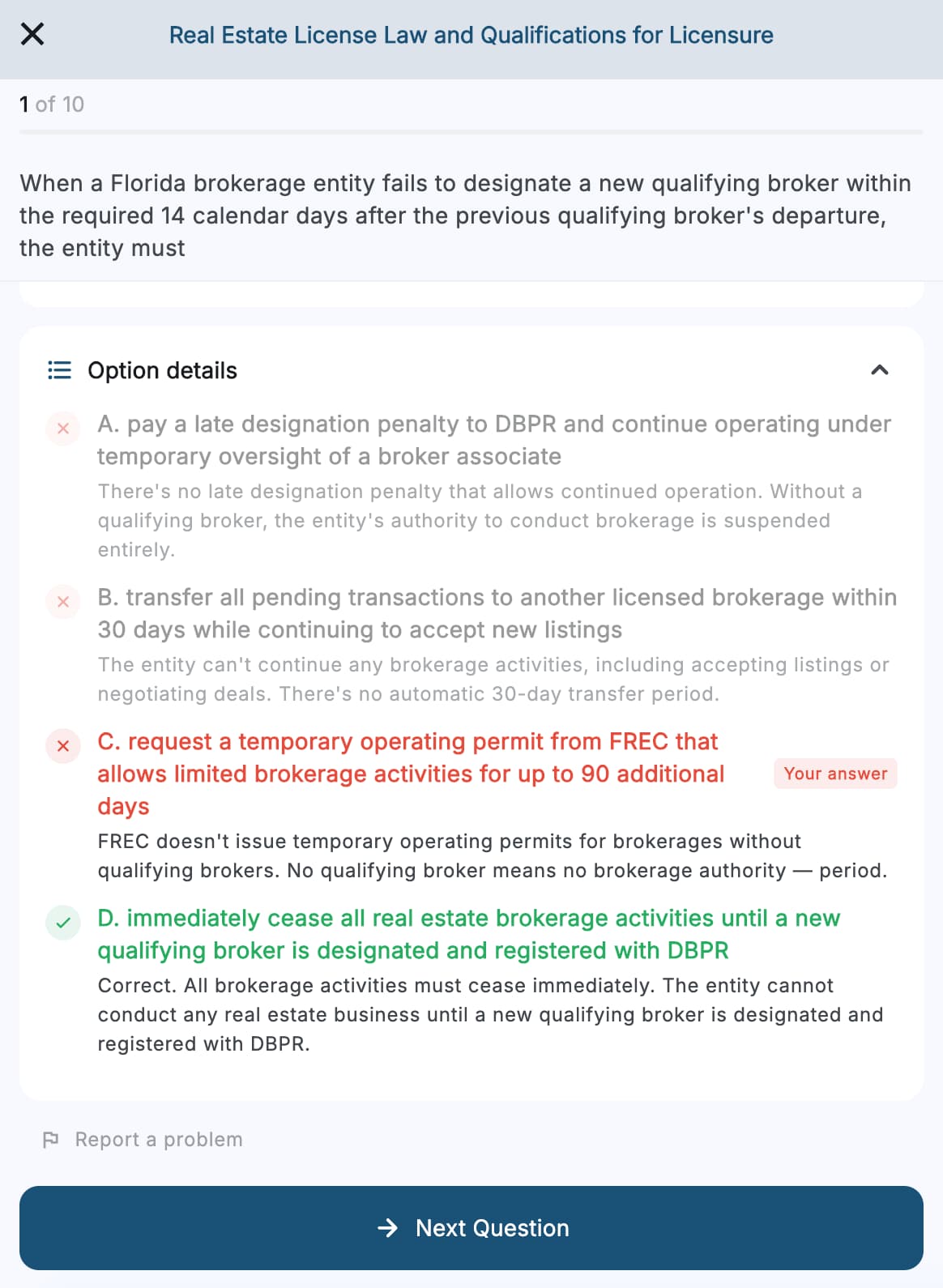
    Adaptive practice across all 19 content areas identifies the topics where you lose points and drills them until they are automatic. The exam is the gate. Getting through it efficiently is the first step to every timeline in this guide.

    Diagnostic testing measures your readiness in 20 minutes and shows you exactly which content areas need work. Students who use adaptive diagnostics pass at higher rates because they study what they do not know, not what they already understand.

    Florida-specific scenarios test the state-level content, including brokerage relationships, contract law, and closing costs, that makes up over 40% of the exam. National prep courses miss this material. Pass Florida does not.

    Download Pass Florida and take a free diagnostic across all 19 content areas. In 20 minutes, you will see exactly which topics need work and which ones you can move past.


    Frequently Asked Questions

    What do I do right after passing the Florida real estate exam?

    Keep your score report from Pearson VUE and begin researching brokers immediately. Your exam results are transmitted to DBPR electronically, and processing takes 7 to 10 business days. Use that time to interview brokers, compare compensation structures, and select a sponsoring broker. You cannot practice real estate until your license is activated under a broker.

    How long does it take to get my Florida real estate license after passing the exam?

    From exam day to active license typically takes 2 to 4 weeks. DBPR processes your application in 7 to 10 business days. After that, your broker submits the RE 11 form, which takes another 3 to 5 business days to process. The total timeline depends on how quickly you select a broker and how quickly that broker submits the RE 11.

    How do I activate my Florida real estate license?

    Your sponsoring broker submits the RE 11 (Sales Associate Licensure Application) to DBPR on your behalf. You do not file this form yourself. Once DBPR processes the RE 11, your license status changes to "Active" on MyFloridaLicense.com. You must have a sponsoring broker to activate your license because Florida issues real estate licenses to brokers, not to individual sales associates.

    What is the RE 11 form?

    The RE 11 is the Sales Associate Licensure Application that ties your real estate license to a specific sponsoring broker. It is filed by your broker (not by you) through the DBPR portal. Until the RE 11 is submitted and processed, your license remains inactive and you cannot practice real estate. The form is also used when you transfer to a new broker.

    How do I choose a real estate broker in Florida?

    Interview at least three brokerages and evaluate their training program, lead generation, commission split, fee structure, mentorship program, and office culture. Ask to speak with agents who joined in the last six months. Prioritize training and support over split percentage in your first year. Read the broker selection section of this guide for a complete evaluation framework and red flags to watch for.

    What is the 45-hour post-licensing requirement?

    Florida requires every new sales associate to complete 45 hours of post-licensing education before their first license renewal. The course is available online or in-classroom from FREC-approved providers. Your first renewal occurs 18 to 24 months after license activation, depending on where your activation date falls in the renewal cycle. Check your exact deadline on MyFloridaLicense.com.

    What happens if I do not complete post-licensing education?

    Your license becomes null and void. This is not the same as inactive or suspended. Null and void means you must restart the entire licensing process: complete the 63-hour pre-licensing course again, pass the state exam again, and resubmit your application to DBPR. There is no grace period, no extension, and no appeal. The Florida-specific content guide covers this rule in detail.

    How much does a first-year real estate agent make in Florida?

    Realistic first-year income ranges from $25,000 to $65,000, depending on whether you work full-time or part-time, your broker's lead generation, your existing network, and your market. Most new agents do not receive their first commission check for 60 to 120 days after license activation. Budget $2,000 to $4,000 in startup costs beyond pre-licensing and have three to six months of living expenses saved if going full-time.

    Do I need to be a REALTOR to sell real estate in Florida?

    No. "REALTOR" is a trademarked designation requiring NAR membership. You can practice real estate with only a state license. However, most local boards in Florida require NAR membership as a condition of board membership, and board membership is required for MLS access. Since MLS access is essential for listing and searching properties, most practicing agents become REALTORS as a practical matter, not a legal requirement.

    What is the NAR settlement and how does it affect new agents?

    The National Association of Realtors settlement, effective August 17, 2024, requires written buyer brokerage agreements before touring homes and removed compensation offers from the MLS. For new agents, this means you must be able to explain your value and services to buyer clients at the first meeting, sign a written agreement before showing any property, and negotiate your compensation directly rather than relying on MLS-published offers. The brokerage relationships guide covers the settlement framework and EBBA forms in detail.


    Related:

    What to Expect on Florida Real Estate Exam Day: Arrival to Score Report

    Florida Real Estate Exam Pass Rate and What It Means for Your Preparation

    The Florida-Specific Content Your Prep Course Probably Skipped

    Brokerage Relationships on the Florida Real Estate Exam Explained

    How to Calculate Real Estate Commission on the Florida Exam

    The 19 Topics on the Florida Real Estate Exam and How Much Each Is Weighted

    Florida Real Estate Contracts Guide: Every Rule the Exam Tests

    The 30-Day Study Plan for the Florida Real Estate Exam

    How to Pass the Florida Real Estate Exam on Your First Attempt

    Florida Real Estate Practice Exam: Free Questions With Full Explanations

    Ready to Pass the Florida Real Estate Exam?

    Download Pass Florida and start studying with questions that actually match the exam.