QUICK ANSWER
For the Florida real estate exam, escrow rules usually test numbers, timing, and who is holding the money. A sales associate must deliver a deposit to the broker by the end of the next business day. The deposit must be placed in escrow by the end of the third business day after receipt, and receipt by a sales associate counts as receipt by the broker for that three-business-day rule. If a broker holds disputed escrow funds, the broker must notify the Florida Real Estate Commission (FREC) within 15 business days and start a settlement procedure within 30 business days. Sales escrow personal funds are capped at $1,000. Property management escrow personal funds are capped at $5,000.
Florida escrow questions feel simple until the answer choices start mixing business days, calendar days, title companies, brokers, good-faith doubt, conflicting demands, and personal funds limits.
That is why escrow belongs near the top of your Florida real estate exam study plan. It sits inside Real Estate Brokerage Activities and Procedures, one of the heaviest areas on the sales associate exam. It also connects to brokerage relationships, FREC discipline, contracts, and commission handling.
The topic is not hard because the ideas are complicated. It is hard because the exam expects precision.
If you already know the rules and want to test them, use the Florida real estate escrow practice questions page after this guide.
Use this rule:
| If the question asks | Look for |
|---|---|
| When deposit must move | Next business day and third business day |
| Who holds the funds | Broker vs title company vs attorney |
| What happened to the money | Commingling vs conversion |
| Who wants the money | Conflicting demands vs good-faith doubt |
| What procedure applies | EDO, mediation, arbitration, or interpleader |
| Which account type | Sales escrow vs property management escrow |
Work through the Monday-deposit example in the Florida exam study guide’s brokerage section, then return here for the escrow exceptions and procedures.
Start with the right practice
If escrow questions are costing you points, drill brokerage activities first, then add violations practice when the question involves penalties, Recovery Fund, or FREC discipline.
| If you miss this escrow pattern | Practice here |
|---|---|
| Deposit timing, trust accounts, title company vs broker | Brokerage activities practice |
| Commingling, conversion, penalties, Recovery Fund | Violations and penalties practice |
| Deposit clauses, release language, financing contingencies | Contracts practice |
| Mixed timed exam pressure | Free Florida practice exam |
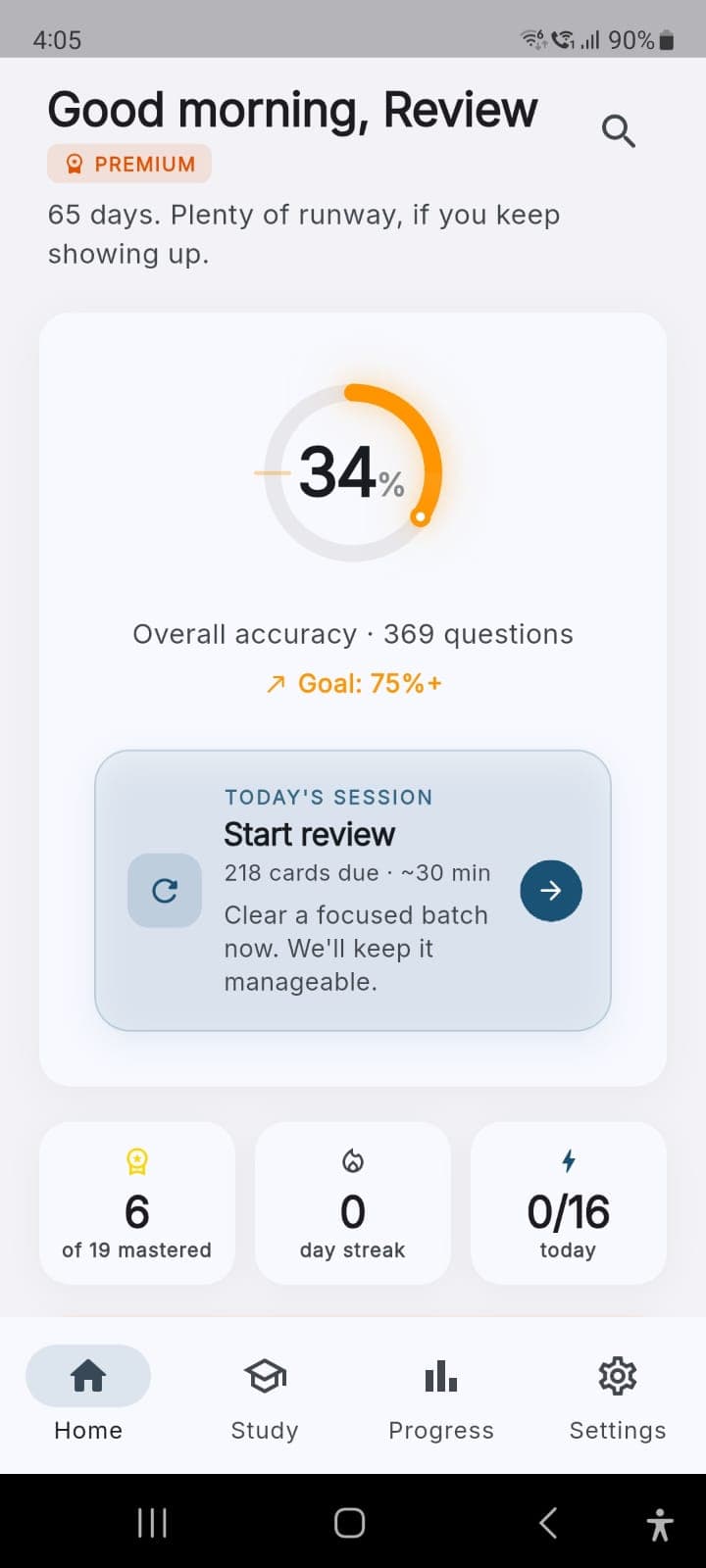
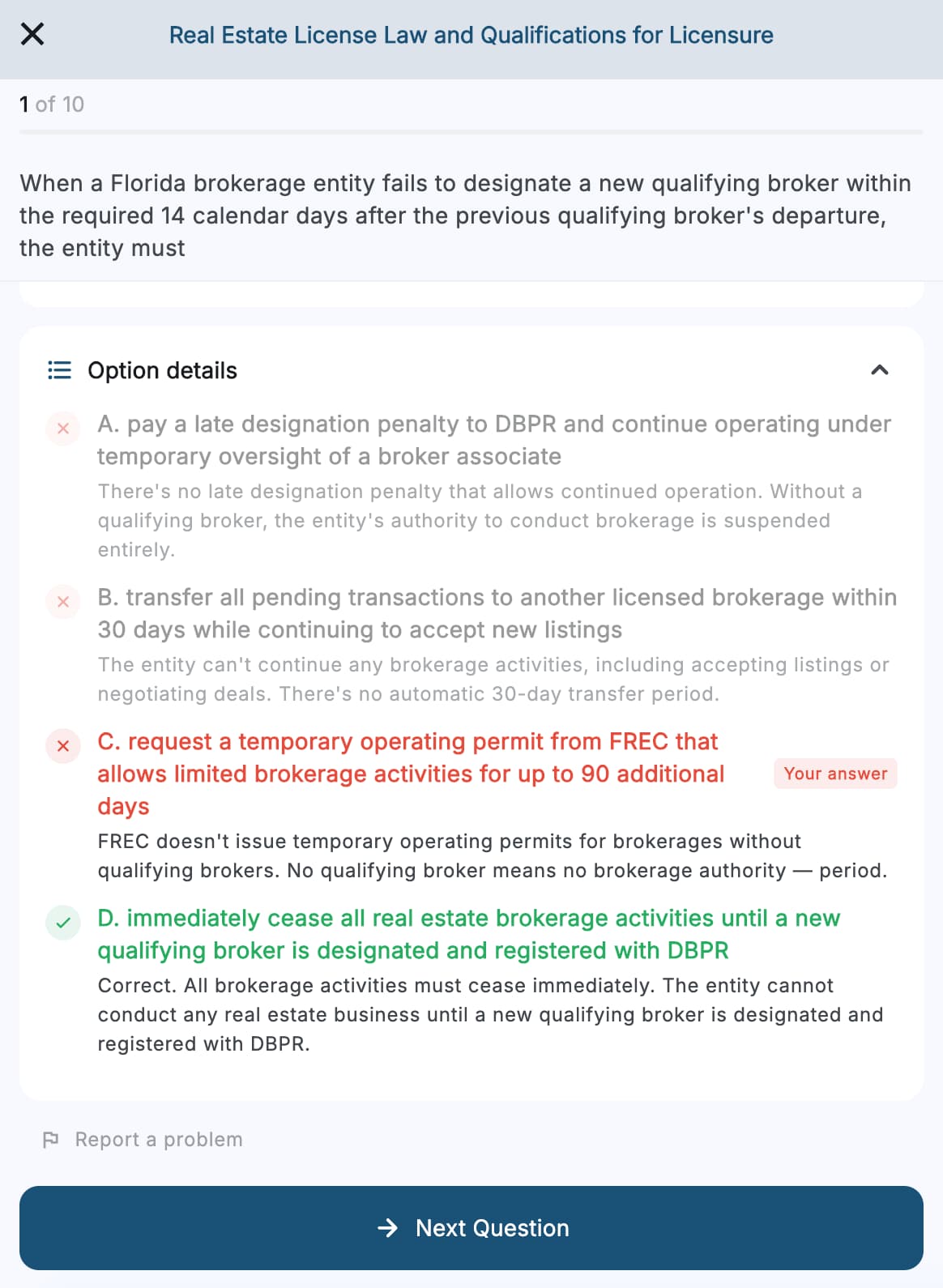
| Mobile drills and weak-area review | Download Pass Florida |
BROKERAGE ACTIVITIES PRACTICE
Turn escrow deadlines into automatic answers.
Practice Florida escrow scenarios by identifying the triggering event, deadline, and broker duty before choosing an answer.
What this guide covers
- What the exam tests on escrow
- Official source map
- The escrow numbers to know first
- The deposit clock: one business day and three business days
- Where escrow funds can be held
- Can the broker hand the deposit to the seller?
- Escrow disputes: conflicting demands and good-faith doubt
- When the dispute rules do not apply
- Monthly reconciliation and broker records
- Personal funds in escrow accounts
- Commingling vs conversion
- Interest-bearing escrow accounts
- Postdated checks and noncash deposits
- Penalties for escrow violations
- Recovery Fund connection
- 2026 FinCEN update
- Five escrow scenarios
- Mistakes students make
- Related exam concepts
- How to study escrow
- FAQ
What the exam tests on escrow
The Florida exam tests escrow as a broker responsibility topic inside Real Estate Brokerage Activities and Procedures, especially deadlines, holders of funds, disputes, commingling, and recordkeeping.
The Florida exam tests escrow as a broker responsibility question. It wants to know whether you can spot the right deadline, the right holder of funds, and the right broker action after a dispute.
Expect escrow questions to ask about:
- How fast a sales associate must deliver a deposit to the broker
- How fast a broker must place funds into an escrow account
- What happens when escrow is held by a title company or attorney
- What a broker must do after conflicting demands
- Which settlement procedures can resolve an escrow dispute
- How commingling differs from conversion
- How much personal money a broker may keep in a sales escrow account
- How long brokerage records must be kept
That is the exam core. Fancy closing language matters less than the clock, the holder, and the broker's next step.
Official source map
The escrow facts in this guide trace to the DBPR sales associate CIB, FREC rules in Florida Administrative Code 61J2, and Florida Statutes Chapter 475.
| Exam fact | Official source to know |
|---|---|
| Escrow is tested under Brokerage Activities and Procedures | DBPR sales associate CIB |
| Sales associate delivery timing | F.A.C. 61J2-14.009 |
| Broker escrow placement, authorized accounts, personal-funds caps | F.A.C. 61J2-14.010 |
| FREC notice and nonresponding-party procedure | F.A.C. 61J2-10.032 |
| Monthly reconciliation and broker records | F.A.C. 61J2-14.012 and F.S. 475.5015 |
| Escrow dispute procedures and discipline | F.S. 475.25 |
| Recovery Fund connection | F.S. 475.482 and F.S. 475.484 |
The escrow numbers to know first
The most tested escrow numbers are 1 business day, 3 business days, 15 business days, 30 business days, $50,000, $1,000, $5,000, and 5 years.
Start with the numbers. Then learn the exceptions.
| Rule | Number |
|---|---|
| Sales associate delivers deposit to broker | End of next business day after receipt |
| Broker places deposit into escrow | End of third business day after receipt |
| Broker requests title company or attorney verification when required | Within 10 business days after each deposit is due |
| Broker gives seller's broker verification or no-verification notice | Within 10 business days after request |
| Conflicting demands or good-faith doubt notice to FREC | Within 15 business days |
| Broker starts settlement procedure | Within 30 business days |
| Nonresponding party after proper notice | 7 business days to respond |
| Mediation completion window | 90 days after last demand |
| FREC EDO practical limit | No EDO if dispute exceeds $50,000 |
| Sales escrow personal funds cap | $1,000 |
| Property management escrow personal funds cap | $5,000 |
| Broker record retention | At least 5 years |
That table is the night-before-exam version. The rest of this guide explains the traps behind it.
The deposit clock: one business day and three business days
A Florida sales associate has until the end of the next business day to deliver a deposit to the broker, and the deposit must be placed in escrow by the end of the third business day after receipt.
Florida has two deposit deadlines that students often collapse into one.
Under F.A.C. Rule 61J2-14.009, a sales associate who receives a deposit must deliver it to the broker or employer by the end of the next business day following receipt.
Under F.A.C. Rule 61J2-14.008, "immediately" means the deposit must be placed in an escrow account no later than the end of the third business day following receipt.
Here is the trap: receipt by a sales associate or other brokerage representative counts as receipt by the broker for the three-business-day rule.
Example 1: sales associate receives the deposit
A sales associate receives a buyer's deposit on Wednesday. There are no holidays.
| Step | Deadline |
|---|---|
| Sales associate delivers deposit to broker | End of Thursday |
| Deposit must be placed in escrow | End of Monday |
Why Monday? The three business days after Wednesday are Thursday, Friday, and Monday. Saturdays, Sundays, and legal holidays do not count.
Example 2: broker receives the deposit directly
A buyer hands the deposit directly to the broker on Thursday. There are no holidays.
| Step | Deadline |
|---|---|
| Sales associate delivery rule | Not involved |
| Deposit must be placed in escrow | End of Tuesday |
Why Tuesday? Friday is day 1, Monday is day 2, Tuesday is day 3.
Exam trap alert: do not start the clock from contract signing
The deposit clock does not start just because the contract was signed. It starts when the deposit is received by the broker, sales associate, or another representative of the brokerage firm.
If the question says the contract was signed Monday but the deposit was received Wednesday, count from Wednesday.
Where escrow funds can be held
Broker-held escrow must go into an authorized escrow or trust account, while a contract may also place the deposit with a title company or attorney.
Florida does not say "put it anywhere safe." The rule names authorized places.
A broker who receives deposit funds must place them in an insured escrow or trust account at one of these:
| Authorized holder | Exam note |
|---|---|
| Bank located and doing business in Florida | Common broker escrow option |
| Savings and loan association | Same trust-account concept |
| Trust company | Must be qualified to hold trust funds |
| Credit union | Florida authorized depository |
| Title company having trust powers | Very common in Florida closings |
| Attorney trust account if designated in the contract | Attorney regulatory rules also apply |
At least one broker must be a signatory on broker-maintained escrow accounts. If the brokerage entity has more than one broker licensee, one broker may be designated as the signatory.
The title company or attorney verification rule
When a deposit is placed, or is supposed to be placed, with a title company or attorney, the licensee who prepared or presented the sales contract must include the title company or attorney's name, address, and phone number on the contract.
If the deposit is with a title company or attorney, the licensee's broker may need to request written verification of receipt within 10 business days after each deposit is due under the sales contract. There is an important exception when the title company or attorney was nominated in writing by the seller or seller's agent.
After the broker makes that written request, the broker has 10 business days to provide the seller's broker with either:
- A copy of the written verification, or
- Written notice that verification was not received
If the seller is not represented by a broker, the broker gives that notice directly to the seller.
Exam trap alert: escrow held by title company is not the same as escrow held by broker
Many FREC notice rules apply when the broker is holding the disputed trust funds. If the title company or attorney holds the funds, the broker does not notify FREC just because the contract fell apart. The title company or attorney handles the dispute under the rules that apply to that holder.
Can the broker hand the deposit to the seller?
A broker should not hand escrow money to the seller just because the seller asks; the broker needs proper authorization, a contract exception, or a settlement procedure.
No, not just because the seller asks.
F.S. 475.25 requires entrusted funds to be held in an authorized escrow or trust account until disbursement is properly authorized. A broker cannot simply decide the seller should get the buyer's earnest money before closing.
Use this exam wording:
| Scenario | Correct exam answer |
|---|---|
| Seller asks broker to release deposit before closing | Broker should not release without proper authorization |
| Buyer and seller sign release instructions | Broker may disburse according to the authorization |
| Contract terms clearly authorize return under financing contingency | Broker may be able to return funds under the statutory exception |
| Broker is unsure who is entitled | Good-faith doubt procedure applies |
Escrow disputes: conflicting demands and good-faith doubt
If a broker holds disputed escrow funds, conflicting demands or good-faith doubt trigger written notice to FREC within 15 business days and a settlement procedure within 30 business days.
Escrow disputes usually start one of two ways.
| Situation | Meaning |
|---|---|
| Conflicting demands | Buyer and seller both demand the same escrow money |
| Good-faith doubt | Broker has legitimate doubt about who is entitled to the funds |
Under F.A.C. Rule 61J2-10.032, if a broker receives conflicting demands for trust funds in the broker's escrow account, the broker must notify FREC in writing within 15 business days of the last party's demand.
If the broker has good-faith doubt about who is entitled to trust funds held in the broker's escrow account, the broker must notify FREC within 15 business days after having that doubt.
Then the broker must institute one of the settlement procedures within 30 business days.
The four settlement procedures
The four procedures come from F.S. 475.25:
| Procedure | What it means | Exam note |
|---|---|---|
| Escrow Disbursement Order | Broker asks FREC to determine entitlement | Not used if the dispute exceeds $50,000 |
| Arbitration | Parties submit to arbitration with consent | Binding |
| Mediation | Parties use mediation with written consent | Must be completed within 90 days after last demand |
| Interpleader or court action | Broker asks a court to decide | Often used when EDO is not available |
If the broker properly uses one of these escape procedures and follows the resulting order or judgment, the broker is protected from an administrative complaint for failure to account or deliver the escrowed property.
EDO: the $50,000 trap
An Escrow Disbursement Order sounds like the cleanest option, so students choose it too quickly.
FREC will not issue an EDO when the escrow dispute exceeds $50,000. In that situation, the broker must use another procedure, most commonly interpleader, unless the parties agree to mediation or arbitration.
If a broker requests an EDO and the dispute settles or goes to court before the order is issued, the broker must notify FREC within 10 business days.
The nonresponding-party rule
Rule 61J2-10.032 now includes a useful procedure when one party does not respond.
If one party to a failed transaction does not respond to the broker's inquiry about whether that party is making a demand or releasing the funds, the broker may send a certified notice, return receipt requested, or email notice to the party's DBPR address of record.
That notice must say:
- A demand has been placed by the other party
- A response must be received by the seventh business day after the notice is dispatched
- The broker's mailing address, phone number, and email address
If the nonresponding party does not respond within 7 business days, that failure is treated as authorization for the broker to release the funds to the other party.
This is not the first rule to memorize, but it is exactly the kind of newer procedural detail that can appear in a tricky question.
When the dispute rules do not apply
The FREC escrow-dispute notice rule does not automatically apply when a title company or attorney holds the funds, or when a statutory exception allows release without FREC notice.
Do not overuse the FREC dispute rule.
The 15-business-day notice rule applies when the broker is holding the funds and there are conflicting demands or good-faith doubt.
It does not automatically apply when:
| Situation | Why |
|---|---|
| Title company holds the deposit | The broker is not maintaining the disputed trust funds |
| Attorney holds the deposit | Attorney trust-account rules apply |
| Buyer in good faith fails the financing clause | Statute allows return to buyer without FREC notice or settlement procedure |
| Buyer cancels a residential condo contract under the statutory rescission right | Statute allows return to purchaser in that setting |
| HUD earnest money under covered HUD residential sales contract | Rule 61J2-10.032 has a HUD contract exception |
The financing-clause exception is especially testable. If the buyer in good faith fails to satisfy the financing clause, the broker may return the deposit to the purchaser without notifying FREC and without using one of the settlement procedures.
Monthly reconciliation and broker records
Florida brokers who maintain trust accounts must reconcile them monthly, review and sign the reconciliation, and keep brokerage records for at least 5 years.
Escrow is not only about deposits and disputes. The broker also has recordkeeping duties.
F.A.C. Rule 61J2-14.012 requires a monthly written reconciliation comparing the broker's total trust liability with the reconciled bank balance of all trust accounts.
The reconciliation must include:
- Date the reconciliation was done
- Date used to reconcile balances
- Bank name
- Account name
- Account number
- Account balance and date
- Deposits in transit
- Outstanding checks by date and check number
- Itemized list of the broker's trust liability
- Other items needed to reconcile the bank balance with the broker's records
- Date of receipt and source of funds where needed
An accountant or bookkeeper may prepare the reconciliation, but the broker must review, sign, and date it.
If trust liability and bank balances do not match, the reconciliation must explain the difference and describe corrective action. Returned checks, service charges, non-sufficient funds checks, negative balances, shortages, and overages should not be ignored.
Under F.S. 475.5015, brokerage records must generally be retained for at least 5 years. If the records become part of litigation, they must be kept for at least 2 years after the civil action or appeal concludes, and the total retention period still cannot be shorter than the 5-year minimum.
Personal funds in escrow accounts
A broker may keep up to $1,000 of personal or brokerage funds in a sales escrow account and up to $5,000 in a property management escrow account.
Brokers may keep a small amount of personal or brokerage funds in escrow accounts to cover bank charges and minimum balance requirements.
The limits are strict:
| Account type | Maximum personal or brokerage funds |
|---|---|
| Sales escrow account | $1,000 |
| Property management escrow account | $5,000 |
| Any escrow account | Cannot exceed $5,000 |
If a broker keeps $3,500 in a property management escrow account, that can be allowed. If the same $3,500 is in a sales escrow account, that exceeds the $1,000 sales limit and becomes commingling.
The 30-day correction window
Rule 61J2-14.010 gives a broker a reasonable amount of time to correct escrow errors if there is no shortage of funds and the errors do not pose a significant threat of economic harm to the public.
For this rule, reasonable time means 30 days from the date the last reconciliation statement was performed or should have been performed.
Do not turn that into a free pass. It is a narrow correction rule for certain errors, not permission to mishandle funds.
ESCROW IS PURE DEADLINE RECALL
Drill the business-day clock until it is automatic.
Escrow questions reward exact timing: next business day, third business day, 15 and 30 business days. Pass Florida drills them as Florida scenarios with 1,142 questions, a Trap Library, and a 19-topic diagnostic, for one $39.99 purchase. No subscription. No copied exam questions.
Commingling vs conversion
Commingling means mixing escrow with personal or business funds; conversion means using escrow money without authorization.
The exam loves this distinction.
| Term | Meaning | Example |
|---|---|---|
| Commingling | Mixing escrow funds with personal or business funds | Broker deposits buyer's escrow into operating account |
| Conversion | Unauthorized personal use of funds | Broker uses escrow money to pay rent or payroll |
Commingling can happen by mistake. Conversion means the money was used without authorization.
Seen on the exam
A broker puts a buyer's $20,000 deposit into the broker's operating account and then uses $5,000 to pay office expenses.
| Act | Violation |
|---|---|
| Putting escrow funds into operating account | Commingling |
| Spending $5,000 for office expenses | Conversion |
If the answer choice says both commingling and conversion, choose both.
Intent to repay does not fix conversion. If escrow funds were used without authority, the violation already happened.
Interest-bearing escrow accounts
Florida escrow funds may be placed in an interest-bearing account only with written permission of all parties and a written statement of who gets the interest.
A broker may place escrow funds in an interest-bearing account, but only if the requirements in F.A.C. Rule 61J2-14.014 are met.
The written agreement must state:
- All parties give written permission
- Who receives the interest
- When the interest will be disbursed
Without written permission of all parties, do not choose the answer that puts escrow funds into an interest-bearing account.
If the broker is designated to receive the interest, the principal is transferred to a non-interest-bearing escrow account for disbursement, and the interest goes to the broker's operating account. If another party receives the interest, principal and interest are handled according to the rule and the written agreement.
Postdated checks and noncash deposits
For exam purposes, a postdated check should be disclosed and handled so the broker can still comply with the deposit rule once it can be deposited.
A postdated check is dangerous for exam purposes because it is easy to treat it like ordinary cash.
For the exam, remember this:
| Item | Exam treatment |
|---|---|
| Cash, check, or wire received as deposit | Escrow timing rules apply |
| Postdated check | Must be disclosed and handled carefully |
| Promissory note or securities | Deposit can include money or equivalent, but conversion and placement rules matter |
If a brokerage acting as escrow agent accepts a postdated check, the safe exam answer is that the postdated nature must be disclosed and noted in the contract, and the broker must be able to comply with the deposit rule once the instrument can be deposited.
Do not choose an answer that hides a postdated check from the seller.
Penalties for escrow violations
Escrow violations can support FREC discipline, including probation, suspension, revocation, reprimand, denial, and administrative fines up to $5,000 per count.
F.S. 475.25 allows FREC to discipline a licensee through probation, suspension, revocation, reprimand, denial of an application, and administrative fines up to $5,000 for each count or separate offense.
F.A.C. Rule 61J2-24.001 gives disciplinary guideline ranges. For exam purposes, know the direction more than every row:
| Violation type | Why it matters |
|---|---|
| Failure to account or deliver escrowed property | Serious trust-account violation |
| Failure to deposit money into escrow when required | Can lead to suspension or revocation |
| Fraud, dishonest dealing, breach of trust | Higher risk of revocation |
| Intentional rule violations | Treated more severely than no-intent errors |
F.S. 475.42 also creates criminal penalties for certain violations. Most violations under subsection (1) are second-degree misdemeanors unless a different punishment is prescribed, and some conduct can also be prosecuted under other criminal statutes.
For the exam, do not soften escrow violations. FREC treats trust money seriously.
Recovery Fund connection
The Recovery Fund is a consumer-protection fund tied to certain licensee misconduct, not a broker escrow account, and its $50,000 cap is separate from the $50,000 EDO limit.
The Florida Real Estate Recovery Fund is not the same thing as a broker escrow account, but the exam often places both concepts near each other because both involve consumer protection.
Under F.S. 475.482, the Recovery Fund can reimburse certain people who suffer monetary damages because of a licensed broker or sales associate's act in a Florida real estate brokerage transaction.
Under F.S. 475.484, the key payout caps are:
| Recovery Fund cap | Amount |
|---|---|
| Same transaction | $50,000 aggregate |
| Claims against one broker or sales associate | $150,000 aggregate |
Do not confuse this $50,000 Recovery Fund cap with the $50,000 EDO limit. They are related only because the numbers are the same. They come from different exam concepts.
2026 FinCEN update: do not over-study it for the Florida exam
FinCEN reporting is not the core Florida sales associate escrow rule, and Florida escrow, FREC, trust-account, and dispute rules should come first in exam prep.
FinCEN reporting is not where your escrow study should start.
The rule was supposed to require reporting for certain non-financed residential real estate transfers to legal entities or trusts. But on March 19, 2026, a federal district court vacated the rule. Florida Realtors reported that FinCEN stated reporting persons are not currently required to file real estate reports while the order remains in force.
What this means for your exam prep:
| Question | Exam-safe answer |
|---|---|
| Did FinCEN reporting replace Florida escrow law? | No |
| Should you memorize FinCEN details before the core escrow rules? | No |
| Could the rule return if litigation changes? | Possible, but it is not the core sales associate escrow rule |
| What should you know now? | Florida escrow, FREC, trust account, and dispute rules still matter most |
If your course provider adds a current-law update, read it. But do not let a federal reporting dispute distract you from the Florida escrow deadlines that are far more likely to be tested.
Five escrow scenarios
Practice escrow by asking three questions in every scenario: who received the money, who holds it now, and whether there is a dispute.
Work these before you move on.
Scenario 1: sales associate receives the deposit
A sales associate receives an earnest money deposit on Wednesday. There are no legal holidays. By when must the deposit be placed in escrow?
Answer: By the end of Monday.
The sales associate must deliver the deposit to the broker by the end of Thursday. But receipt by the sales associate counts as receipt by the broker for the three-business-day placement rule. Thursday is day 1, Friday is day 2, Monday is day 3.
Scenario 2: title company holds the deposit
A contract fails. The title company holds the escrow deposit. Buyer and seller disagree about who should receive the money. Must the broker notify FREC within 15 business days?
Answer: No, not merely because the title company holds a disputed deposit.
The FREC notice rule applies when the broker maintains the disputed funds in the broker's escrow account. If the title company holds the money, the title company handles release under its own procedures.
Scenario 3: EDO over $50,000
A broker holds a $75,000 deposit. Buyer and seller both demand it. Can FREC issue an EDO?
Answer: No. The amount exceeds $50,000.
The broker must use another settlement procedure, such as interpleader, unless the parties consent to mediation or arbitration.
Scenario 4: $3,500 in the wrong account
A broker keeps $3,500 of brokerage funds in a sales escrow account to cover bank fees. Is that allowed?
Answer: No.
Sales escrow accounts are capped at $1,000 in personal or brokerage funds. The $5,000 limit applies to property management escrow accounts.
Scenario 5: operating account mistake plus spending
A broker deposits a buyer's $12,000 earnest money into the brokerage operating account, then uses $2,000 to pay office rent.
Answer: Both commingling and conversion.
Putting escrow money into the operating account is commingling. Spending part of it is conversion.
Mistakes students make
Most escrow mistakes come from counting calendar days, starting the clock from the wrong event, or missing who is holding the funds.
| Mistake | Fix |
|---|---|
| Counting calendar days instead of business days | Exclude Saturdays, Sundays, and legal holidays |
| Starting every clock from contract execution | Start from receipt or demand, depending on the rule |
| Thinking associate receipt does not count | Associate receipt counts for the three-business-day rule |
| Treating title-company escrow like broker-held escrow | FREC notice rules depend on who holds the funds |
| Choosing EDO for every dispute | EDO is not available above $50,000 |
| Reversing $1,000 and $5,000 | Sales is $1,000, property management is $5,000 |
| Calling every mistake conversion | Mixing is commingling, using is conversion |
| Over-studying FinCEN instead of Florida rules | Florida escrow rules remain the exam core |
Related exam concepts
Escrow connects most directly to brokerage activities, contracts, FREC discipline, Chapter 475, and Florida-specific exam content.
| Concept | Why it matters |
|---|---|
| Brokerage relationships | Accounting for funds is a duty across all Florida relationship types |
| FREC rules and violations | Escrow violations can become disciplinary cases |
| Florida real estate contracts | Deposit terms, financing clauses, cancellation rights, and escrow release all start in the contract |
| Florida Statute 475 | Chapter 475 controls broker duties and discipline |
| Commission calculations | Compensation and escrow are different kinds of money handling |
| Florida-specific exam content | Escrow is one of the Florida-specific areas national prep can under-teach |
How to study escrow
Study escrow with number flashcards first, then move to mixed scenarios that force you to identify timing, holder, dispute procedure, and violation label.
Use a flashcard for each number, then use scenario questions.
Start here:
- Next business day
- Third business day
- 10 business days for title or attorney verification
- 15 business days to notify FREC
- 30 business days to start a procedure
- 90 days for mediation
- $50,000 EDO limit
- $1,000 sales escrow personal funds
- $5,000 property management escrow personal funds
- 5 years for records
Then practice scenarios. The real exam is less likely to ask, "What is the rule?" and more likely to ask, "What should the broker do next?"
FAQ
How many business days does a Florida broker have to place escrow funds?
The deposit must be placed in escrow by the end of the third business day following receipt. Saturdays, Sundays, and legal holidays do not count as business days.
How quickly must a sales associate deliver a deposit to the broker?
A sales associate must deliver the deposit to the broker or employer by the end of the next business day after receiving it.
Does receipt by the sales associate count as receipt by the broker?
Yes. Rule 61J2-14.009 says receipt by a sales associate or other brokerage representative constitutes receipt by the broker for the three-business-day deposit rule.
When must a broker notify FREC about an escrow dispute?
When the broker holds the disputed funds and receives conflicting demands, the broker must notify FREC within 15 business days of the last party's demand. If the broker has good-faith doubt, the broker must notify FREC within 15 business days after having that doubt.
What are the four Florida escrow settlement procedures?
The four procedures are Escrow Disbursement Order, arbitration, mediation, and interpleader or other court action.
Can FREC issue an EDO for a $75,000 escrow dispute?
No. FREC will not issue an Escrow Disbursement Order for disputes exceeding $50,000.
What is the difference between commingling and conversion?
Commingling is mixing escrow funds with personal or business funds. Conversion is using escrow funds without authorization. A broker can commit both in the same fact pattern.
How much personal money can a broker keep in escrow?
A broker may keep up to $1,000 in personal or brokerage funds in a sales escrow account and up to $5,000 in a property management escrow account.
Can escrow funds be placed in an interest-bearing account?
Yes, but only with written permission of all parties. The written agreement must say who gets the interest and when the interest is disbursed.
Does a broker need an escrow account if the brokerage does not hold escrow funds?
No. A brokerage is not legally required to maintain an escrow account if it does not maintain escrow funds.
Does the broker notify FREC if a title company holds a disputed deposit?
No, not under the broker-held escrow dispute rule. The FREC notice requirement applies when the broker maintains the disputed trust funds.
Is the FinCEN residential real estate reporting rule currently active?
A federal court vacated the rule on March 19, 2026. FinCEN says reporting persons do not currently have to file Real Estate Reports while the order remains in force.
Ready to drill escrow rules in scenario form?
The best next step is to practice escrow as brokerage activities first, then add violations practice for commingling, conversion, penalties, and Recovery Fund questions.
Escrow rewards pattern recognition. Candidates who answer it well memorize the 10 most-tested numbers (1 / 3 / 10 / 15 / 30 / 90 / $50,000 / $1,000 / $5,000 / 5 years), then drill scenarios that force them to identify the holder of funds + the dispute procedure + the violation label.
Before you leave, test the rule in a fresh Florida scenario and explain why the distractors fail.
Practice brokerage activities | Practice violations and penalties | Take the free practice exam | Download Pass Florida
Sources and Methodology
This guide separates official Florida rules from exam-prep framing.
- Florida Statutes: F.S. 475.25, F.S. 475.42, F.S. 475.482, F.S. 475.484, and F.S. 475.5015.
- Florida Administrative Code: F.A.C. 61J2-14.008, 61J2-14.009, 61J2-14.010, 61J2-14.012, 61J2-14.014, 61J2-10.032, and 61J2-24.001.
- DBPR / FREC exam source material, especially the sales associate CIB topic outline for Real Estate Brokerage Activities and Procedures.
- Florida Realtors escrow guidance and its March 2026 FinCEN status update for the current federal reporting note.
The examples, timing drills, mistake table, and study sequence are exam-prep teaching patterns. They are not DBPR, FREC, Florida Realtors, broker, title, attorney, or court instructions.
Product note. Pass Florida publishes this guide and offers the exam-prep app linked on this page. It does not guarantee passage.
Official source links:
- F.A.C. Rule 61J2-14.008, Definitions
- F.A.C. Rule 61J2-14.009, Real Estate Sales Associate
- F.A.C. Rule 61J2-14.010, Real Estate Broker
- F.A.C. Rule 61J2-14.012, Broker's Records
- F.A.C. Rule 61J2-14.014, Interest-Bearing Escrow Accounts
- F.A.C. Rule 61J2-10.032, Notice Requirements
- F.A.C. Rule 61J2-24.001, Disciplinary Guidelines
- F.S. 475.25, Discipline
- F.S. 475.42, Violations and penalties
- F.S. 475.482, Real Estate Recovery Fund
- F.S. 475.484, Payment from the fund
- F.S. 475.5015, Brokerage business records
- Florida Realtors, Florida's Escrow Laws and Rules
- Florida Realtors, Court Decision on FinCEN Real Estate Rule
- DBPR Real Estate Sales Associate Candidate Information Booklet
This post is exam preparation content for the Florida Real Estate Sales Associate exam. It summarizes the Florida escrow / trust account framework, deposit-timing rules, dispute procedures, personal-funds caps, commingling-vs-conversion distinction, monthly reconciliation requirements, 5-year record retention rule, Recovery Fund framework, and 2026 FinCEN status note. It is not legal advice, brokerage advice, title advice, closing advice, or a substitute for the Florida Statutes, Florida Administrative Code, qualified Florida real estate counsel, your broker's escrow procedures, DBPR, FREC, Florida Realtors, or another qualified professional. Verify any statute, deadline, dispute procedure, or personal-funds cap against the primary source before applying it to a real escrow transaction. Pass Florida is an educational study tool sold for one $39.99 purchase with no subscription.