QUICK ANSWER
EXCEPT and NOT questions on the Florida real estate exam are hard because they reverse your normal habit. Instead of finding the true statement, you must find the false one. Use True/False Labeling: catch the trigger word, label each answer choice true or false, then choose the false choice. For LEAST likely questions, choose the weakest fit, which may not be completely false.
EXAM PREP ONLY
This article is exam-prep study material. Florida statutes, F.A.C. (Florida Administrative Code) rules, DBPR (Department of Business and Professional Regulation) guidance, FREC (Florida Real Estate Commission) rules, and Pearson VUE exam procedures can change. Verify a current rule against the [Florida Statutes](https://www.flsenate.gov/Laws/Statutes/2025), the [F.A.C. 61J2 chapter](https://flrules.elaws.us/fac/61j2), the [DBPR Real Estate Sales Associate Candidate Information Booklet (CIB)](https://www2.myfloridalicense.com/servop/testing/documents/RE_sales_cibs.pdf), or your pre-license provider before applying it to a real transaction.
WHO THIS IS FOR
Use this post if your practice score is decent but you keep losing points to wording. It is especially useful if your miss log says things like "I knew this," "I picked a true answer," "I missed the word NOT," or "two answers looked right." If you are missing the underlying topic itself, use this method after repairing the content rule.
What this guide covers
- How EXCEPT, NOT, FALSE, INCORRECT, and LEAST likely stems change the job
- The True/False Labeling method for Florida exam questions
- A 60-second process for negative-stem questions
- 10 Florida-specific practice questions with answer walkthroughs
- How to tell a wording miss from a content miss
What the exam tests about EXCEPT and NOT questions
EXCEPT and NOT questions test whether you can reverse the task, evaluate every answer choice, and choose the false or least-fitting statement instead of the familiar true one.
You can know the material and still miss this format.
That is what makes EXCEPT and NOT questions so frustrating. A regular question asks you to find the correct answer. Your brain gets used to scanning for the true statement. Then the exam says:
All of the following are duties of a transaction broker EXCEPT.
Now the right answer is the wrong statement.
If you keep reading on autopilot, you will pick a true statement because it sounds familiar. That is not a content problem. That is a reading-process problem.
The Florida sales associate exam is built around knowledge, understanding, and application of real estate principles, Florida license law, real estate practice, and real estate math. Negative-stem questions can appear inside any of those topics. You may see them in brokerage relationships, escrow rules, contracts, property rights, appraisal, mortgages, math formulas, or FREC violations.
That is why this format deserves its own practice session. It cuts across the entire exam.
BEFORE YOU DO ANOTHER MIXED TEST
Separate the trap from the topic.
Practice the wording trap, name the controlling word, and explain why each tempting distractor fails before moving to the next question.
Why EXCEPT and NOT questions cost so many points
EXCEPT and NOT questions cost points because partial recognition is not enough. You have to prove three choices are true before selecting the one false or least-fitting answer.
A standard multiple-choice question can reward partial knowledge.
Example:
Which of the following is required for a valid Florida real estate contract?
A. Notarization B. Competent parties C. Recording D. Witness signatures
If you know competent parties is required, you can pick B and move on. You do not need to fully explain why A, C, and D are wrong.
Now flip the format:
All of the following are required for a valid Florida real estate contract EXCEPT.
A. Offer and acceptance B. Consideration C. Competent parties D. Notarization
Now partial knowledge is not enough. You must know that A, B, and C are true requirements and that D is the exception.
That is the difference. Standard questions often let you recognize one correct fact. EXCEPT and NOT questions ask you to evaluate every answer choice.
Exam trap alert: familiarity is dangerous here
On a regular question, a familiar phrase usually helps.
On an EXCEPT question, a familiar phrase can hurt you. Three answer choices are usually familiar because they are true. The correct answer may sound less familiar, awkward, or slightly outside the list.
When you see EXCEPT, NOT, FALSE, or INCORRECT, do not hunt for the familiar choice. Hunt for the false one. When you see LEAST, hunt for the answer that fits the stem the least, even if it is not totally false in every possible context.
The True/False Labeling method
The True/False Labeling method is: catch the trigger word, label A through D as true, false, or unsure, choose the false answer, then insert it back into the stem.
This is the method I would teach every Florida candidate before they sit for Pearson VUE.
Step 1: Catch the trigger word
Before you look at the answer choices, find the reversal:
- EXCEPT
- NOT
- FALSE
- INCORRECT
- LEAST likely
- Which is not required
- Which is not true
Do not let yourself read the answers until you have mentally named the job:
- EXCEPT / NOT / FALSE / INCORRECT: "I am looking for the false answer."
- LEAST likely: "I am looking for the weakest fit."
Step 2: Label each answer choice
Read A, B, C, and D one at a time. Ask:
Is this statement true by itself?
Label each choice:
- T for true
- F for false
- ? if you are unsure
Do not compare choices yet. Just label.
Step 3: Count your labels
For EXCEPT, NOT, FALSE, and INCORRECT questions, the ideal pattern is:
T, T, T, F
The F is your answer.
For LEAST likely questions, you may see four technically possible answers. In that format, choose the answer that least fits the exact category, timing, or role in the stem.
If you get two false choices, you probably missed the scope of the question. Re-read the stem. Is it asking about validity, enforceability, recording, discipline, duties, qualification, or tax calculation?
If all four choices look true, you probably missed a small qualifier.
If all four choices look false, you probably forgot that the question is asking for the exception.
Step 4: Insert your answer back into the stem
Before submitting, test the sentence.
All of the following are required for a valid contract EXCEPT notarization.
Does that make sense?
Yes. A Florida real estate sales contract must satisfy contract requirements, but notarization is not one of the basic validity elements.
Submit.
The first 60 seconds of every EXCEPT question
In the first 60 seconds, read the stem twice, name the topic and scope, label all four choices, then pick the false choice or flag the question.
If you can install one habit before exam day, install this one. The first 60 seconds of any negative-stem question decides whether you fall into a trap or evaluate the choices cleanly.
| Seconds 0 to 15 | Read the stem twice. Out loud in your head. Find and underline the trigger word (EXCEPT, NOT, FALSE, INCORRECT, LEAST). |
|---|---|
| Seconds 15 to 25 | Identify the topic and the exact category (validity, duty, exemption, disclosure, calculation). State it to yourself in one sentence: "I am looking for the choice that is not a transaction broker duty" or "I am looking for the least likely escrow remedy." |
| Seconds 25 to 50 | Label all four choices T, F, or ?. Do not stop after the first F. Label every choice. |
| Seconds 50 to 60 | Count the labels. If the pattern is T, T, T, F, pick the F. If the trigger is LEAST, pick the weakest fit. If the pattern is something else, re-read the stem for a scope word you missed. |
If you still cannot decide after 60 seconds, flag the question and move on. EXCEPT questions punish the second-guess loop more than any other format. Trust your first labeling pass unless you find a concrete reason to revise.
The method in action
Question:
All of the following are TRUE about a single agent relationship in Florida EXCEPT.
A. The licensee owes fiduciary duties to the principal B. The licensee owes loyalty and obedience C. The licensee may represent both buyer and seller as fiduciaries in the same transaction D. The licensee must disclose known facts that materially affect residential property value and are not readily observable
Label it:
- A is true. Single agency is fiduciary representation.
- B is true. Loyalty and obedience belong to single agency.
- C is false. Florida does not allow disclosed or undisclosed dual agency. A single agent represents one side.
- D is true. Current F.S. 475.278 includes material-fact disclosure in the single-agent duty list.
Answer: C.
Notice what happened. If you read too quickly, A, B, and D all sound important, and C sounds plausible if you learned agency from a national course. But the Florida rule is specific. That is why EXCEPT questions punish fuzzy knowledge.
The three main EXCEPT and NOT traps
The three main traps are almost-true answers, category confusion, and scope shifts where a true statement belongs to the wrong rule, role, timing, or context.
Trap 1: The almost-true answer
This is an answer that would be true if one word changed.
Example:
All of the following are exempt from Florida real estate licensing requirements EXCEPT.
A. A property owner selling the owner's own property B. An attorney acting within the scope of legal duties C. A salaried onsite apartment employee performing leasing work at that apartment community D. A friend negotiating a sale for another person in exchange for a referral fee
D is the answer. The friend may sound harmless, but negotiating for another person for compensation triggers Chapter 475 unless a narrow exemption applies.
The phrase "referral fee" is the trap. Compensation does not have to be a formal commission.
Trap 2: Category confusion
This happens when the question asks about one category but includes a true fact from another category.
Example:
Which of the following is NOT a duty of a Florida transaction broker?
A. Deal honestly and fairly B. Account for all funds C. Loyalty to the principal D. Use skill, care, and diligence
C is the answer. Loyalty belongs to single agency, not transaction brokerage.
The word "duty" feels right. The category is wrong.
Trap 3: Scope shift
This happens when the answer is true in a different context, but not in the context the question asks about.
Example:
All of the following are required for a valid deed in Florida EXCEPT.
A. Competent grantor B. Identifiable grantee C. Words of conveyance D. Recording in the county public records
D is the answer. Recording matters for notice and priority. It is not required for a deed to be valid between the parties.
The scope word is "valid." If the question asked about constructive notice, recording would matter.
Where to drill first
Drill negative-stem questions first in brokerage relationships, escrow, contracts, FREC violations, and other list-heavy Florida topics where one category is easy to swap for another.
Use this as a study triage map, not as an official frequency chart or a promise about your exact form.
| Negative-stem topic | Practice priority | Why it shows up |
|---|---|---|
| Brokerage relationships | Very high | Transaction broker and single agent duties overlap but are not identical |
| Escrow and trust accounts | Very high | Timing, deposits, EDO (Escrow Disbursement Order), mediation, arbitration, and interpleader are easy to reverse |
| Contracts | High | Validity, enforceability, offer, acceptance, consideration, and Statute of Frauds get mixed |
| FREC violations | High | Discipline, criminal violation, civil damages, and Recovery Fund are separate categories |
| Appraisal | Medium | Cost, sales comparison, and income approaches get mixed with tax assessment terms |
| Property rights | Medium | Estates, deed types, fixtures, and ownership rights are list-heavy |
| Math and closing costs | Medium | The arithmetic is simple, but the setup can be reversed |
| Homestead and property tax | Medium | School versus non-school exemption rules are easy to overapply |
The 10-second checklist
Before selecting an answer, identify the trigger word, topic, exact category, three true choices, one false or least-fitting choice, and whether the final sentence makes sense.
Use this on every EXCEPT or NOT question:
- What is the trigger word?
- What topic is being tested?
- What exact category is the stem asking about?
- Which three choices are true?
- Which one choice is false, or least fitting if the stem says LEAST?
- Does the full sentence make sense with my selected answer?
If you cannot answer item 3, do not choose yet. Most wrong answers happen because the student does not know the category.
10 Florida EXCEPT and NOT practice questions
These 10 practice questions force you to label each answer choice before opening the explanation, so you practice the reading habit and the Florida rule together.
Use True/False Labeling before opening each answer. Do not skim the explanation first. The value is in the labeling.
Question 1
All of the following are TRUE about an estate for years EXCEPT.
A. It has a definite start date and end date B. It automatically terminates at the end of the lease period without notice C. It automatically renews at the end of the lease period unless terminated D. It can survive a transfer of title to a new owner
Answer and Walkthrough
A is true. An estate for years has a definite beginning and a definite ending date.
B is true. No notice is required because the ending date is already built into the lease.
C is false. Automatic renewal points to a periodic estate, not an estate for years.
D is true. A sale of the property does not automatically erase the existing leasehold estate.
Answer: C. Trap type: category confusion. The question tests whether you can separate estate for years from periodic estate.
Question 2
Which of the following is NOT required for a valid Florida real estate sales contract?
A. Offer and acceptance B. Consideration C. Competent parties D. A written description of the property's physical condition
Answer and Walkthrough
A is true. Mutual agreement is required.
B is true. Consideration is required.
C is true. The parties must have legal capacity.
D is false. A contract needs enough description to identify the property, but a written description of the property's physical condition is not a basic validity element.
Answer: D. Trap type: scope shift. The question asks about contract validity, not seller disclosure or inspection issues.
Question 3
All of the following may be grounds for FREC discipline EXCEPT.
A. Failure to handle escrow funds within the required timeframe B. Advertising without the licensed name of the brokerage firm C. Sharing a fee with an unlicensed person for services requiring a license D. Charging a commission rate higher than 6% when the seller agreed in writing
Answer and Walkthrough
A is true. Escrow mishandling can lead to discipline under Chapter 475 and F.A.C. 61J2 rules.
B is true. Florida advertising rules require the licensed brokerage name.
C is true. Paying an unlicensed person for licensed services is a Chapter 475 problem.
D is false. FREC does not set a standard commission rate. Commission rates are negotiable.
Answer: D. Trap type: almost true. Many students have heard 6% so often that they treat it like a legal ceiling. It is not.
Question 4
Which of the following is NOT TRUE about the Florida homestead exemption for Florida exam study?
A. The first $25,000 exemption can apply to all taxing authorities, including school taxes B. The additional exemption is tied to assessed value above $50,000 and applies to non-school levies C. The exemption applies automatically to every residential property in Florida D. The property must generally be the owner's permanent residence as of January 1
Answer and Walkthrough
A is true. The first $25,000 exemption is the broad exemption. The later additional exemption is where students must watch the school versus non-school split.
B is true. F.S. 196.031 separates the first exemption from the additional exemption tied to assessed value above $50,000 and non-school levies.
C is false. Homestead is not automatic for every residential property. The owner must qualify and apply.
D is true. January 1 is the key qualification date.
Answer: C. Trap type: almost true. A primary residence can qualify. A rental, vacation home, or unfiled property does not automatically receive the exemption.
Question 5
All of the following are TRUE about a transaction broker relationship in Florida EXCEPT.
A. It is presumed unless a single-agent or no-brokerage relationship is established in writing B. The licensee must account for all funds C. The licensee may disclose the seller's motivation for selling without permission D. The licensee must use skill, care, and diligence in the transaction
Answer and Walkthrough
A is true. Transaction brokerage is presumed under F.S. 475.278 unless another relationship is established in writing.
B is true. Accounting for all funds is a transaction broker duty.
C is false. Limited confidentiality prevents disclosure of protected information such as motivation, price flexibility, and certain financing preferences unless waived.
D is true. Skill, care, and diligence are part of the transaction broker duty list.
Answer: C. Trap type: category confusion. Transaction broker is limited representation, but limited confidentiality still matters.
More Florida EXCEPT and NOT practice questions
The second half of the drill mixes transaction broker, appraisal, listing agreement, documentary stamp, advertising, and property-characteristic traps.
Question 6
Which of the following is NOT one of the three main appraisal approaches tested on the Florida real estate exam?
A. Sales comparison approach B. Cost approach C. Income capitalization approach D. Assessed value approach
Answer and Walkthrough
A is true. Sales comparison uses comparable sales.
B is true. Cost estimates land value plus replacement or reproduction cost minus depreciation.
C is true. Income capitalization converts income into value.
D is false. Assessed value is a property tax concept, not one of the three appraisal approaches.
Answer: D. Trap type: category confusion. "Assessed value" sounds like valuation, but it belongs to taxation, not appraisal methodology.
Question 7
All of the following are required in a written Florida listing agreement EXCEPT.
A. A definite expiration date B. A description of the property C. The fee or commission D. The buyer's pre-approval letter
Answer and Walkthrough
A is true. A written listing agreement must have a definite expiration date.
B is true. The property must be described.
C is true. The fee or commission must be included.
D is false. A buyer's pre-approval letter is not part of the seller's listing agreement with the broker.
Answer: D. Trap type: scope shift. The question is seller-to-broker. The wrong choice brings in a buyer-side document.
Question 8
Which of the following is NOT TRUE about Florida documentary stamp taxes?
A. In most Florida counties, the deed documentary stamp tax is $0.70 per $100 of consideration B. Miami-Dade deed tax uses a $0.60 per $100 rate, with a surtax issue for property other than single-family residences C. Documentary stamp tax on promissory notes is $0.35 per $100 D. Deed documentary stamp taxes are paid by the buyer in Florida transactions
Answer and Walkthrough
A is true. Most Florida counties use $0.70 per $100 on deeds.
B is true. Miami-Dade has a different deed-tax structure, including the $0.60 per $100 rate and a surtax issue outside single-family residences.
C is true. Notes use $0.35 per $100.
D is false. Deed doc stamps are customarily paid by the seller, while note doc stamps are associated with the borrower's note. Contract terms can allocate costs differently, so "paid by the buyer" is too broad.
Answer: D. Trap type: almost true. Students mix up deed tax and note tax.
Question 9
All of the following are Florida real estate advertising violations EXCEPT.
A. Advertising in a way that makes a reasonable person unable to tell they are dealing with a real estate licensee B. Placing an ad that omits the licensed name of the brokerage firm C. Running a team ad where the team name appears no larger than the registered brokerage name and the ad clearly identifies the brokerage D. Using a team name that suggests the team is a separate brokerage company
Answer and Walkthrough
A is true. Florida advertising must make clear that the public is dealing with a real estate licensee.
B is true. The licensed brokerage name must appear.
C is false. This is the compliant answer, so it is the exception. Team advertising is allowed when it follows the brokerage-name and team-name rules.
D is true. Team names cannot use words that suggest the team is a separate real estate brokerage or company.
Answer: C. Trap type: scope shift. The stem asks for the non-violation. Choice C describes compliant conduct.
Question 10
Which of the following is NOT a physical characteristic of real property?
A. Immobility B. Indestructibility C. Uniqueness D. Portability
Answer and Walkthrough
A is true. Land cannot be moved.
B is true. Land itself is considered indestructible, even though improvements can be damaged or destroyed.
C is true. Every parcel has a unique location.
D is false. Portability belongs to personal property, not real property.
Answer: D. Trap type: category confusion. The answer sounds like a property characteristic, but it belongs to the wrong property type.
Score yourself
Score the drill by both result and reason. A 9 or 10 means the format is under control, while lower scores should be sorted by trap type.
| Score | What it means | What to do next |
|---|---|---|
| 9 to 10 | The format is under control | Move into mixed timed practice |
| 7 to 8 | The method works, but a few categories are fuzzy | Review the trap type behind each miss |
| 5 to 6 | You are seeing the trigger word but not applying the labels consistently | Drill 20 negative-stem questions in isolation |
| 0 to 4 | The format and the underlying content both need work | Review the topic first, then repeat the practice set |
Do not just count correct answers. Classify your misses:
- Did you miss the trigger word?
- Did you label too fast?
- Did you confuse two categories?
- Did you know the rule but miss the scope?
- Did you pick a true statement because it sounded familiar?
That diagnosis is more useful than the raw score.
Format miss or content miss?
A format miss means you knew the rule but mishandled the wording. A content miss means you could not label the choices even after slowing down.
Do not repair every miss the same way. A wrong answer on an EXCEPT question usually comes from one of two problems.
| Miss type | What it looks like | Repair |
|---|---|---|
| Format miss | You knew the rule after reading the explanation, but you picked one of the true choices | Drill negative-stem questions only until the trigger-word habit becomes automatic |
| Content miss | You did not know which choices were true or false even after slowing down | Re-study the underlying topic before doing more mixed questions |
| Scope miss | You knew the general rule but missed a word like valid, recorded, disclosed, required, customary, or prohibited | Add the scope word to your miss log and write the rule in one precise sentence |
| Confidence miss | You labeled correctly, then changed the answer without a concrete reason | Keep your first label unless the second pass finds a specific word you missed |
This is where many candidates waste time. If the problem is format, rereading the chapter will not fix it. If the problem is content, doing more EXCEPT questions without repairing the rule will only make the same miss faster.
Mistakes students make
The biggest mistakes are reading the answers before the stem, trusting familiar wording, labeling only two choices, missing scope words, and practicing only in mixed tests.
Mistake 1: Reading the answers before catching the stem
If you start with the answer choices, your brain begins looking for true statements. On EXCEPT and NOT questions, that is the wrong job.
Mistake 2: Treating "sounds familiar" as "correct"
Most answer choices in this format sound familiar because three of them are true. Familiarity is not enough.
Mistake 3: Labeling only two choices
Students often compare the two most tempting answers and ignore the other two. That defeats the purpose. Label all four.
Mistake 4: Missing scope words
Valid, enforceable, recorded, disclosed, required, customary, allowed, and prohibited are not interchangeable. Read the scope word twice.
Mistake 5: Practicing only in mixed tests
Mixed practice is important, but it is not the best way to build a new reading habit. Isolate EXCEPT and NOT questions first. Then return to mixed practice.
How to practice this format
Practice EXCEPT and NOT questions in isolation first, then return to mixed timed sets once the trigger-word habit turns on automatically.
Start with isolated practice
Do 20 to 30 EXCEPT and NOT questions in a row. The goal is not just content review. The goal is to make the trigger-word response automatic:
See EXCEPT. Stop. Label choices. Pick the false one.
Then return to mixed practice
After the method feels natural, go back to a mixed set. The real exam will not announce, "Here comes a negative-stem question." You need the habit to turn on quickly inside a normal timed test.
Track the format separately
Your overall practice score may hide the problem.
If your standard-question accuracy is 82% but your EXCEPT/NOT accuracy is 55%, your overall score can look acceptable while the format is quietly costing you the exam.
Track it separately for one week. If the gap is more than 10 percentage points, drill the format directly.
Use the Trap Library
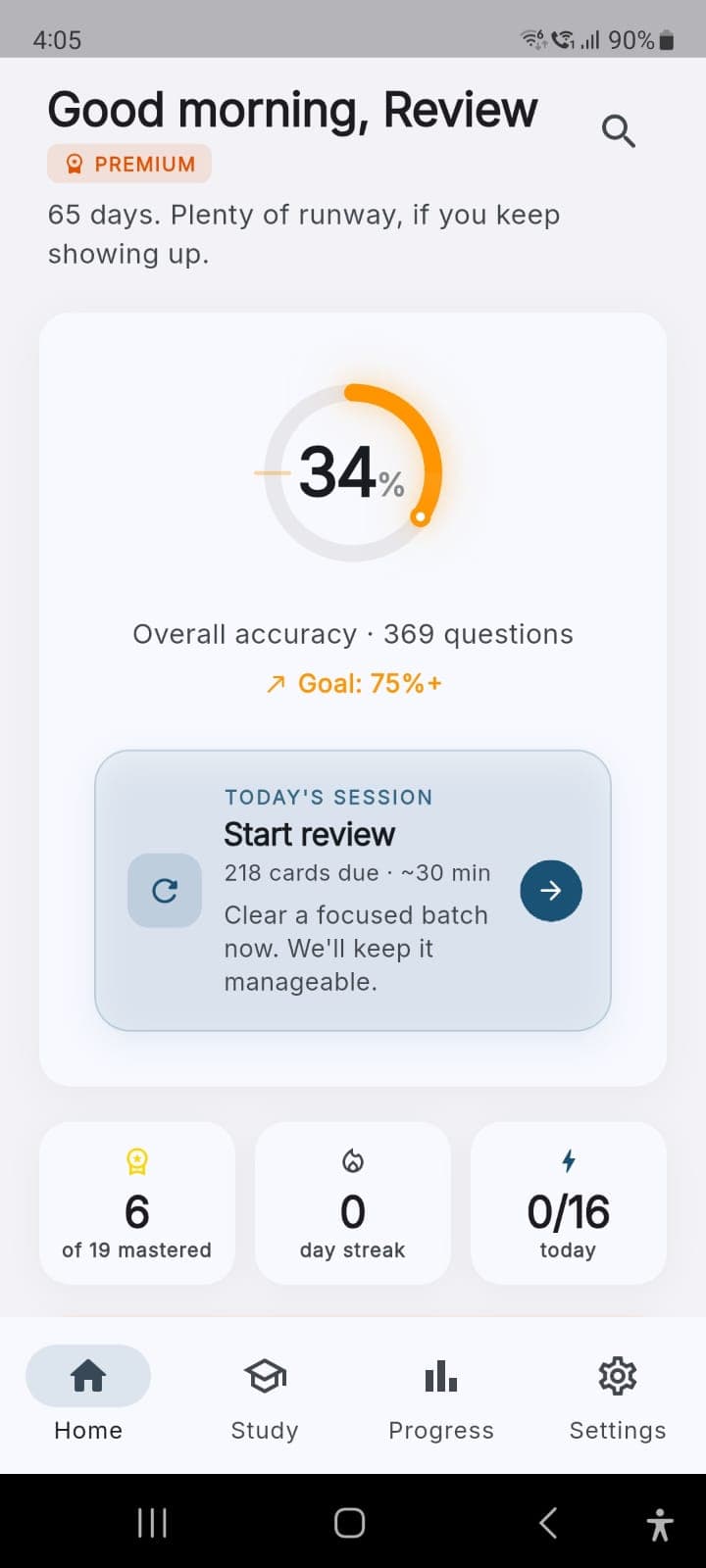
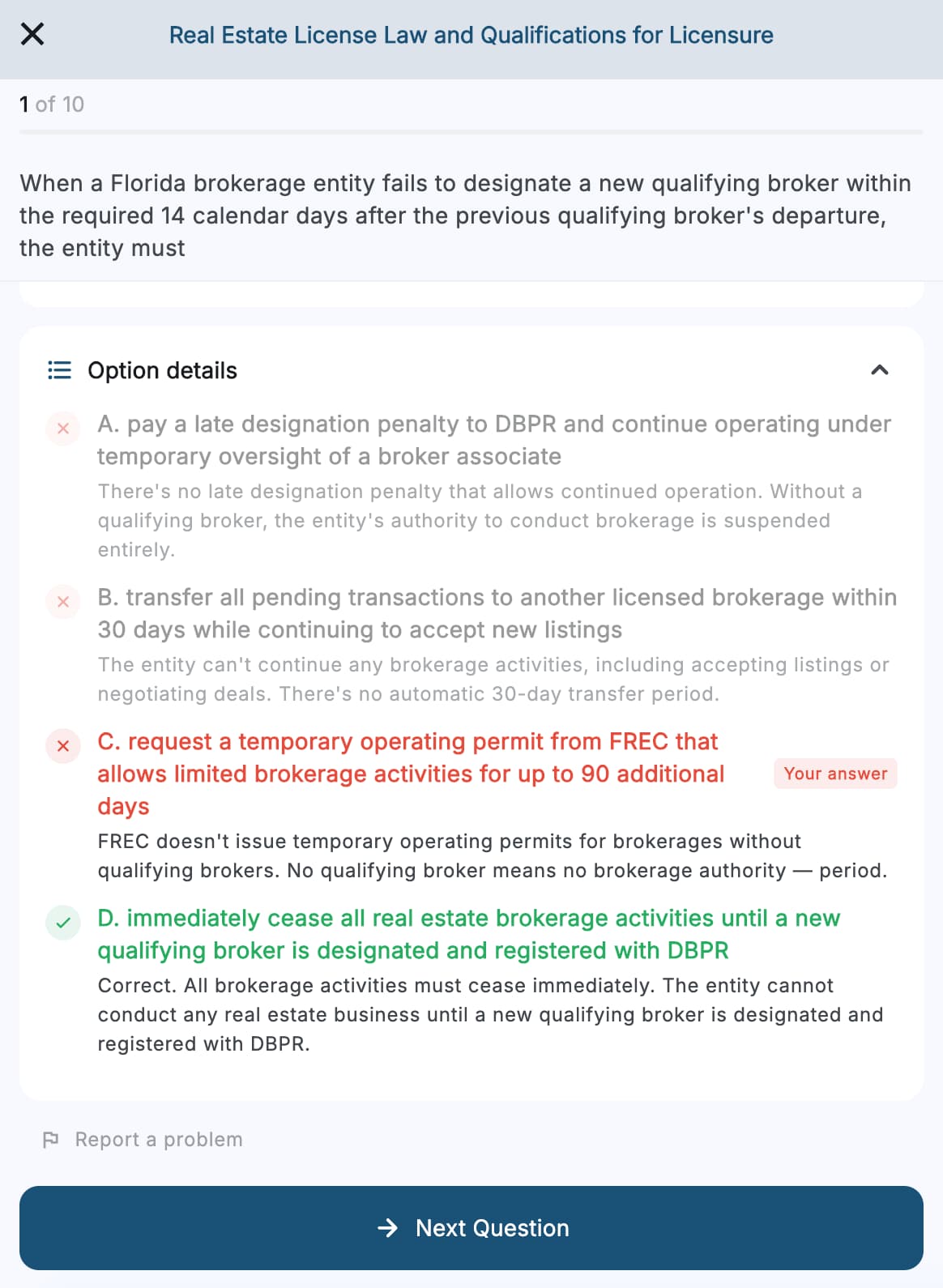
Pass Florida's Trap Library lets you practice EXCEPT and NOT questions across Florida's 19 content areas instead of waiting for them to appear randomly.
Related exam concepts
Pair EXCEPT and NOT practice with topic guides for brokerage relationships, escrow, homestead, documentary stamps, math, FREC violations, and full mixed practice.
| Related concept | Why it helps |
|---|---|
| Tricky Florida real estate exam questions | Covers the broader trap-question family |
| Practice exam with free questions | Gives mixed application practice after isolated drill |
| Why students fail after passing practice tests | Explains why easy practice can inflate readiness |
| Florida Statute 475 | Helps with license-law EXCEPT questions |
| Brokerage relationships | Helps separate transaction broker, single agent, and no brokerage duties |
| Escrow and trust account rules | Helps with timing and dispute-process reversals |
| Florida homestead exemption | Helps with school and non-school tax traps |
| Documentary stamps and closing costs | Helps with deed, note, Miami-Dade, and who-pays wording |
| Florida real estate exam math formulas | Helps when negative stems appear inside computation questions |
| Florida real estate exam math cheat sheet | Gives a printable formula reference before mixed math practice |
| Retake action plan checklist | Helps retakers isolate wording misses from rule gaps |
| How to pass the Florida real estate exam | Places this format inside the full study plan |
Ready to drill EXCEPT and NOT questions in scenario form?
The next step is to try a free question, run a readiness check, or download Pass Florida when negative-stem misses are still showing up in practice.
EXCEPT and NOT questions are fixable.
You do not need a new textbook for this. You need a repeatable reading process and enough Florida-specific practice to make it automatic.
Start with the checklist in this post. Then take a small mixed set. If your wrong answers still cluster around negative wording, drill the format directly before you spend another week rereading notes.
Use the next practice set to prove what improved, not to repeat questions you already remember.
NEGATIVE-STEM DRILL
Stop donating points to wording.
Try a free Florida question first. If EXCEPT and NOT questions are still in your miss log, use the Trap Library inside the app for repeated Florida-specific practice.
Methodology
This guide uses Florida exam-prep miss patterns, the DBPR Candidate Information Booklet (CIB) reference framework, current Florida statute and administrative rule checks, and the internal Pass Florida article standards used across the 2026 exam-prep cluster. It teaches practical study patterns derived from common candidate mistakes, not Pearson VUE testing rules or DBPR licensing policy.
The practice questions were written to test the format, not to copy any live exam item. Each one targets a Florida real estate exam concept that appears in the official content universe: license law, brokerage relationships, escrow, contracts, appraisal, taxation, documentary stamps, advertising, property rights, and contract validity.
This article does not guarantee passage on the Florida sales associate examination. Outcomes depend on candidate preparation, content recall, test-day execution, and Pearson VUE scoring.
Product note. Pass Florida publishes this guide and offers the exam-prep app linked on this page. We do not claim to use copied exam questions, guarantee passage, or replace official DBPR, FREC, Pearson VUE, pre-license provider, or qualified professional guidance.
Sources
- DBPR Real Estate Sales Associate Candidate Information Booklet
- DBPR Candidate Information Booklets
- Pearson VUE Florida Real Estate
- Florida Statutes Chapter 475
- F.S. 475.278, brokerage relationships and duties
- F.S. 475.25, discipline
- F.S. 196.031, homestead exemption
- F.S. 201.02, deed documentary stamp tax
- F.S. 201.031, Miami-Dade surtax
- F.S. 201.08, note and mortgage documentary stamp tax
- DBPR FREC printable law book
- F.A.C. 61J2-10.025, advertising
- F.A.C. 61J2-10.026, team or group advertising
- F.A.C. 61J2-14.008, escrow definitions
- F.A.C. 61J2-14.009, sales associate deposit delivery
FAQ
What are EXCEPT questions on the Florida real estate exam?
EXCEPT questions are negative-stem questions. They usually give three true statements and one false statement. Your job is to select the false statement. Related trigger wording includes NOT, FALSE, and INCORRECT. LEAST likely questions are similar, but they may ask for the weakest fit rather than a statement that is completely false.
Why do I keep missing EXCEPT and NOT questions?
You are probably reading them with a standard-question habit. Standard questions train you to find a true answer. EXCEPT and NOT questions require the opposite. You need to label each choice true or false before selecting, then choose the false choice.
What is the best method for EXCEPT questions?
Use True/False Labeling. Catch the trigger word, label each answer choice as T or F, choose the F, then insert the answer back into the stem to make sure the sentence works.
Are EXCEPT questions more common on Florida-specific topics?
They can appear anywhere, but Florida-specific topics are especially vulnerable because the rules have close categories: transaction broker versus single agent, escrow notice versus settlement procedure, school versus non-school homestead exemption, deed tax versus note tax, and discipline versus criminal violation.
Should I skip EXCEPT questions and come back later?
Skip only if you cannot label the choices after one careful pass. If you understand the topic, it is usually better to spend the extra 15 to 30 seconds and answer it while the facts are fresh.
How much time should I spend on an EXCEPT question?
Spend a little more time than a standard question. The extra time is usually worth it because these questions require evaluating all four choices. If you are stuck after about two minutes, flag it and move on.
What words should I watch for besides EXCEPT and NOT?
Watch for FALSE, INCORRECT, LEAST, except when, not required, not allowed, and all of the following except. Any of those words means you should switch to the True/False Labeling method. For LEAST questions, remember that the answer may be the weakest fit rather than a statement that is completely false in isolation.
Do EXCEPT questions test memorization or understanding?
Both, but they punish incomplete understanding more than standard questions do. To answer correctly, you often need the full category list, not just one familiar fact.
How do I practice EXCEPT questions if my course does not separate them?
Create your own set from missed questions, use this article's 10-question drill, then use a tool that lets you isolate trap formats. Pass Florida's Trap Library was built for this exact issue.
Are the practice questions in this post copied from the real exam?
No. They are original Florida exam-style questions written for study. They teach the same tested concepts and reading patterns, but they are not copied exam items.
What should I do after this practice set?
Review every miss by trap type. If the miss was category confusion, study the related topic. If the miss was a stem-reading error, drill more negative-stem questions. Then return to mixed practice.
Is this enough to pass the Florida real estate exam?
No single article is enough, but this skill protects points across the whole exam. Pair it with the 19-topic breakdown, free practice questions, and how to pass guide.
This post is exam preparation content for Florida real estate sales associate candidates. It summarizes patterns observed in candidate practice and does not guarantee passage, provide legal advice, provide tax advice, or replace DBPR, FREC, Pearson VUE, a pre-license provider, or qualified professional guidance. Verify any statute, F.A.C. rule, fee, or exam topic against the primary source before applying it to a real transaction. Pass Florida is an educational study tool sold for one $39.99 purchase with no subscription.