VERIFY BEFORE RELYING
Three items in particular can change before the next refresh: (1) the FinCEN Residential Real Estate Rule appeal at the U.S. Court of Appeals for the Fifth Circuit, which could restore the filing duty if FinCEN wins; (2) any later Florida legislation or special-session action that revives the substance of HB 607 (FREC restructuring, education-requirement repeal); and (3) the next DBPR Sales Associate Candidate Information Booklet revision, which can change content-area weighting. For exam purposes, study this as a framework. For a real transaction, lease, or compliance decision, verify against the current primary source and qualified Florida counsel before relying on any specific status here.
QUICK ANSWER
The Florida sales associate exam format has not changed in 2026: 100 multiple-choice questions, 3.5 hours, and a passing grade of 75 points or higher. The 19-topic outline is still the foundation. What changed is the current-law layer around it: buyer agreement practice after the NAR (National Association of Realtors) settlement, Florida flood disclosure updates, electronic landlord-tenant notices, commercial unauthorized occupant removal, public lodging removal rules, condominium disclosure and inspection updates, and the elimination of the business rent tax. The biggest correction: FinCEN's residential real estate reporting rule was vacated by a federal court on March 19, 2026, and FinCEN says reporting is not required while that court order remains in force. HB 607 also died in Commerce Committee on March 13, 2026, so the Florida Real Estate Commission (FREC) still exists and post-license education is still required.
WHO THIS GUIDE IS FOR
Florida sales associate candidates studying for the exam in 2026 who want a triage between high-priority current-law updates and low-priority headlines they should not over-study. Useful whether you are starting fresh or already deep into the 19-topic outline and want to layer the 2026 corrections on top. Pair this guide with the 19-topic guide for the core content outline, the brokerage relationships guide for the Florida statutory framework that the NAR settlement does not replace, and the landlord-tenant guide for Chapter 83 context.
What this guide covers
- What changed on the Florida real estate exam in 2026
- What did not change in 2026
- The 2026 update priority list (high / medium / low / low-to-watch)
- NAR settlement: practice change, not Florida statute
- FinCEN residential real estate reporting: the March 19, 2026 vacatur and what to study
- SB 948: flood disclosure for sellers and landlords (F.S. 689.302 + F.S. 83.512)
- HB 615: electronic landlord-tenant notices (F.S. 83.505)
- HB 7031: business rent tax eliminated (October 1, 2025)
- HB 913: condo resale 7-day cancellation and milestone inspections
- SB 322: commercial unauthorized occupant removal
- SB 606: public lodging overstay rules
- HB 607: died in committee, do not study as current law
- Fee status for 2026
- What to study first
- 2026 changes quick reference table
- FAQ
What Changed on the Florida Real Estate Exam in 2026
The honest answer is calmer than most headlines make it sound.
The Florida real estate sales associate exam is still the same core exam. It still tests real estate principles, Florida license law, brokerage practice, contracts, ownership, valuation, financing, math, and closing procedures. If you already studied the 19 Florida real estate exam topics, you are not starting over.
What changed is the current-law layer around a few topics the exam already cares about:
- Buyer brokerage agreements and compensation practice after the NAR settlement
- Florida flood disclosure for sellers and landlords
- Electronic delivery of Chapter 83 landlord-tenant notices
- Business rent tax elimination
- Condominium resale cancellation and milestone inspection updates
- Commercial unauthorized occupant removal
- Public lodging overstay removal rules
- FinCEN residential real estate reporting status
- HB 607 status, because it did not become law
This matters because students often do the wrong kind of updating. They hear "2026 changes" and panic, then spend hours memorizing a bill that died or a federal reporting rule that is not currently enforceable. That is not smart prep.
The better move is simple: keep the core exam plan, add the current-law corrections, and do not over-study items that are not part of the DBPR content outline.
BEFORE YOU CHASE EVERY HEADLINE
Make sure the core 19 topics are already solid.
Practice the law currently in force and label proposals, effective dates, and editorial forecasts separately.
What Did Not Change in 2026
Start here. Most of the exam is unchanged.
| Exam item | 2026 status |
|---|---|
| Number of questions | 100 multiple-choice questions |
| Time limit | 3.5 hours |
| Passing score | 75 points or higher |
| Testing provider | Pearson VUE |
| Test location | Physical test center required |
| Content outline | 19 content areas |
| Pre-license course | 63 hours |
| Sales associate post-license education | 45 hours before first renewal |
| Continuing education | 14 hours each renewal cycle after first renewal |
| FREC | Still exists |
| DBPR application | Still required |
| Pearson VUE exam fee | Still paid per attempt |
If you are deciding what to study today, do not let update anxiety pull you away from high-weight topics. Brokerage activities, property rights, valuation, contracts, agency relationships, math, and closing calculations still do more for your score than any one 2026 headline.
For the full weighting, use the Florida real estate exam topics breakdown and the 19-topic exam guide.
The 2026 Update Priority List
Not every update deserves the same study time.
| Priority | Update | How to treat it |
|---|---|---|
| High | Flood disclosure under F.S. 83.512 and F.S. 689.302 | Study the seller and landlord rules |
| High | Electronic notice under F.S. 83.505 | Know the signed addendum requirement |
| High | HB 607 died | Do not study FREC abolishment as current law |
| Medium | Condo resale 7-day cancellation and milestone inspection updates | Know the numbers and transaction type |
| Medium | Business rent tax eliminated | Know commercial rent sales tax is gone |
| Medium | NAR buyer agreement practice | Know the industry practice, but do not confuse it with a Florida statute |
| Low to watch | FinCEN RRE rule | Know it was vacated and not currently enforceable |
| Low | Public lodging overstay rule | Know the broad property-rights pattern |
That is the real ranking. Flood disclosure, electronic notice, license education, condo disclosure, and property possession rules are closer to the exam than a federal reporting rule currently blocked by court order.
NAR Settlement: Know the Practice Change, But Do Not Overstate It
The NAR settlement is real. It changed industry practice. It is also not the same thing as a Florida Statute or FREC rule.
According to NAR, as of August 17, 2024, an MLS participant working with a buyer must have a written agreement with the buyer before touring a home, including in-person and live virtual tours. NAR also says written buyer agreements must specify compensation in an objectively ascertainable way, and the compensation cannot be open-ended.
For the exam, the safest way to study this is as a brokerage practice update, not as a replacement for Florida brokerage relationship law.
What to know
- Buyer agreements come before touring for MLS participants working with buyers.
- Compensation must be specific, such as a percentage, flat fee, hourly rate, or clear formula.
- Buyer broker compensation is no longer displayed as an MLS offer of compensation.
- Broker compensation is negotiable.
- This does not eliminate Florida's brokerage relationship rules under F.S. 475.278.
What not to over-study
Do not memorize form numbers. Do not treat NAR settlement practice as if it replaced Chapter 475. Do not assume every Florida exam question about agency now becomes a NAR settlement question.
The Florida exam still cares more about single agent, transaction broker, no brokerage relationship, designated sales associate, disclosure timing, fiduciary duties, and limited representation. Use the brokerage relationships guide for that framework.
Exam trap alert
If a question asks about Florida statutory brokerage relationships, answer from Florida law. If a question asks about MLS participant buyer touring practice after August 17, 2024, answer from the written buyer agreement rule.
Those are related, but they are not identical.
FinCEN Residential Real Estate Reporting: The Important 2026 Correction
This is the biggest correction in this post.
FinCEN built a nationwide residential real estate reporting rule for certain non-financed transfers of residential real property to legal entities and trusts. FinCEN's FAQ says a Real Estate Report was to be filed for reportable transfers with closing dates on or after March 1, 2026.
Then the status changed.
FinCEN's Residential Real Estate Newsroom states that on March 19, 2026, the U.S. District Court for the Eastern District of Texas issued an order vacating the Residential Real Estate Rule. FinCEN also states that while the court's order remains in force, reporting persons are not required to file Real Estate Reports and are not subject to liability if they fail to do so. FinCEN, with the Department of Justice, has appealed.
That means the correct current-law status is (FinCEN appeal is still active at the Fifth Circuit, so this status can change):
| FinCEN item | Current status |
|---|---|
| Rule finalized | Yes |
| Original reporting start | March 1, 2026 |
| Court order | Rule vacated March 19, 2026 |
| Appeal | Yes |
| Filing currently required while vacatur remains | No |
What students should study
Know the concept, because it is a visible industry compliance issue:
- Residential real property transfer
- Non-financed transfer
- Transferee entity or trust
- No exception applies
- Reporting person identified through the rule's cascade
But do not study it as an active filing requirement unless your school, DBPR, Pearson VUE, or FinCEN updates the status. As of this update, the exam-safe answer is that the rule is a watch item, not a currently enforceable filing duty.
Exam trap alert
The old version of this topic said "FinCEN reporting begins March 1, 2026." That was true before the court order. It is not the current status after March 19, 2026.
For a 2026 current-law question, do not answer as if reporting is currently required while the vacatur remains in force.
SB 948: Flood Disclosure for Sellers and Landlords
Flood disclosure is one of the most exam-relevant 2025 Florida updates because it touches sellers, landlords, developers, residential property, leases, and disclosure duties.
F.S. 689.302 requires a seller to complete and provide a flood disclosure to a purchaser of residential real property at or before the time the sales contract is executed.
F.S. 83.512 requires a landlord to provide a separate flood disclosure to a prospective tenant of residential real property at or before execution of a rental agreement for a term of 1 year or longer.
Seller rule
The seller disclosure includes whether the seller knows of flood damage during the seller's ownership, whether the seller filed a claim with an insurance provider related to flood damage, and whether the seller received assistance for flood damage.
The exam point is simple: flood disclosure is no longer just about federal assistance or a narrow insurance-claim memory. It is a broader known-flood-risk disclosure.
Landlord rule
For residential leases of 1 year or longer, the landlord must give the separate flood disclosure before or at lease execution.
If the landlord violates the section and the tenant suffers substantial loss or damage to the tenant's personal property due to flooding, the tenant may terminate by written notice and surrender possession no later than 30 days after the damage or loss.
Substantial loss or damage means repair or replacement cost is 50% or more of the personal property's market value on the date of flooding.
Numbers to know
| Number | Meaning |
|---|---|
| 1 year or longer | Lease term that triggers the landlord flood disclosure |
| 50% | Substantial loss threshold for tenant personal property |
| 30 days | Tenant's termination window after flood damage or loss |
For more Chapter 83 context, use the Florida landlord-tenant law guide.
HB 615: Electronic Landlord-Tenant Notices
Florida now allows email delivery of certain landlord-tenant notices, but it is not automatic.
Under F.S. 83.505, a landlord or tenant may electronically deliver required notices by email only if:
- Both parties signed an addendum to the rental agreement agreeing to electronic delivery.
- Both parties provided valid email addresses for that purpose.
- The addendum clearly advises that the election is voluntary.
- Either party can revoke the agreement or update the email address.
A notice sent properly by email is deemed delivered when sent, unless the email is returned as undeliverable.
Exam trap alert
Email is not automatically valid just because both people have each other's email address. The signed addendum is the point.
If the question says the landlord emailed a termination notice but never had a signed electronic notice addendum, do not treat the email as valid legal notice under this rule.
HB 7031: Business Rent Tax Eliminated
Florida eliminated the business rent tax beginning October 1, 2025.
This matters because older commercial leasing materials may still teach a 2% state sales tax on commercial rent. That is outdated for current-law study.
Exam version
A commercial tenant leases space for $8,000 per month. How much Florida state sales tax applies to monthly commercial rent after October 1, 2025?
The answer is zero.
Do not calculate 2%. The tax was repealed.
This is a small update but an easy point if it appears.
HB 913: Condo Resale Cancellation and Milestone Inspections
HB 913 made several condominium and cooperative association changes. For exam purposes, focus on two buckets.
Condo resale cancellation
Under F.S. 718.503, a resale condominium buyer may void the agreement by written notice within 7 days, excluding Saturdays, Sundays, and legal holidays, after execution and receipt of required condominium documents.
Do not confuse the condo resale 7-day period with:
- 15 days for certain developer condominium contracts
- 3 days for HOA disclosure cancellation patterns
The exam likes similar numbers. Match the number to the transaction.
Milestone inspections
The Florida Senate summary for HB 913 says milestone inspection requirements now apply to condominium and cooperative buildings that are three habitable stories or more in height, instead of simply three or more stories.
The update also adds reporting and repair-start requirements around milestone inspections.
For exam purposes, do not memorize every association governance change in HB 913. Know the condo resale 7-day cancellation rule, the difference between resale and developer condo cancellation, and the three-habitable-story milestone inspection language.
SB 322: Commercial Unauthorized Occupant Removal
SB 322 created a nonjudicial procedure for a commercial property owner to request that the sheriff remove an unauthorized person from commercial real property. It took effect July 1, 2025 (Chapter 2025-112, Laws of Florida).
The Florida Senate summary says an owner may request immediate sheriff removal when the person is not authorized to occupy the property and is not a current or former tenant. The owner must contact the sheriff and file a complaint under penalty of perjury listing facts that show eligibility.
Exam trap alert
Unauthorized occupant is not the same thing as tenant.
If the person is a current or former tenant under a written or oral rental agreement authorized by the property owner, do not use the shortcut. Tenant disputes still follow landlord-tenant procedure.
This pairs naturally with property rights and ownership and landlord-tenant law.
SB 606: Public Lodging and Food Service Overstay Rules
SB 606 affects public lodging and public food service establishments. For real estate exam purposes, the lodging side is the relevant piece. The lodging and guest-removal provisions took effect July 1, 2025 (Chapter 2025-113, Laws of Florida); a separate food-service operations-charge provision takes effect July 1, 2026.
The Florida Senate summary says a law enforcement officer may arrest a guest of a public lodging or food establishment who remains after a request to leave has been provided.
This is not a major sales associate exam topic, but it helps with a broader distinction:
- A tenant with a lease has tenancy rights.
- A public lodging guest who fails to leave after proper request is not treated the same way.
- A property owner or operator still needs lawful process.
Do not spend a full study session on this. Learn the distinction and move on.
HB 607: Died, So Do Not Study It as Current Law
HB 607 created a lot of noise because it proposed major DBPR changes, including removing post-license and continuing education requirements for real estate licensees and transferring powers away from FREC.
But the official 2026 bill page says CS/HB 607 died in Commerce Committee on March 13, 2026.
That means:
- FREC still exists.
- Sales associate post-license education is still 45 hours before the first renewal.
- Continuing education is still required after the first renewal cycle.
- DBPR still operates within the current real estate licensing structure.
- You should not answer exam questions as if HB 607 became law.
This is one of the most important "non-changes" in 2026. Students who study headlines instead of enacted law can easily miss a license education or FREC question.
Use the license renewal guide, how to get a Florida real estate license, and FREC rules and violations guide for current requirements.
Fee Status for 2026
The exam fee is still a practical issue, even if it is not usually a content-outline question.
| Fee item | 2026 note |
|---|---|
| Pearson VUE exam fee | Still paid per attempt |
| DBPR application fee | Full application fee applies unless a current waiver exists |
| Fingerprints | Vendor cost varies |
| Retake fee | Paid again for each attempt |
The important point: do not rely on old waiver references unless DBPR has an active waiver in place when you apply.
For the deeper cost breakdown, use Florida real estate license cost and Florida real estate exam cost and hidden fees.
What to Study First
Here is the practical study order I would give a student sitting in front of me.
1. Keep the main exam plan
Do not rebuild your study plan because of 2026 updates. Keep working through:
- License law
- Brokerage relationships
- Brokerage activities
- Contracts
- Property rights
- Valuation
- Financing
- Math
- Closing statements and doc stamps
- Fair housing
- Landlord-tenant law
Use the 30-day Florida real estate exam study plan if you need structure.
2. Add the high-value updates
Spend one focused session on:
- Flood disclosure: seller rule, landlord 1-year lease rule, 50%, 30 days
- Electronic notice: signed addendum, valid emails, deemed delivered when sent unless returned
- HB 607: died, not current law
- Condo resale: 7 days, excluding weekends and legal holidays
- Business rent tax: zero after October 1, 2025
3. Treat NAR and FinCEN carefully
Know the NAR buyer agreement practice. Do not confuse it with Florida statutory brokerage relationship law.
Know that FinCEN's rule was vacated and is not currently enforceable while the court order remains in force. Do not answer current-law questions as if the March 1 reporting duty is active.
4. Drill the updates inside questions
Updates only matter if you can recognize them in a question stem. That is where students slip.
Examples:
- "Lease for 18 months" should trigger landlord flood disclosure.
- "Email notice" should trigger signed addendum.
- "Resale condominium" should trigger 7 days.
- "Commercial rent after October 1, 2025" should trigger zero business rent tax.
- "HB 607 passed?" should trigger no, died in committee.
2026 Changes Quick Reference Table
| Topic | Current 2026 status | Study note |
|---|---|---|
| Exam format | Unchanged | 100 questions, 3.5 hours, 75 points or higher to pass |
| Pearson VUE | Unchanged | Physical test center required |
| 19 content areas | Unchanged | Keep the main outline |
| FREC | Still exists | HB 607 died |
| Post-license education | Still required | 45 hours before first renewal |
| Continuing education | Still required | 14 hours after first renewal cycle |
| NAR settlement | Practice change in effect | Written buyer agreement before touring for MLS participants |
| FinCEN RRE rule | Vacated by court order | No filing required while order remains in force |
| Flood disclosure | Updated | Seller disclosure and landlord 1-year lease disclosure |
| Electronic notices | Updated | Valid only with signed addendum and valid email addresses |
| Business rent tax | Eliminated | Do not calculate 2% after October 1, 2025 |
| Condo resale cancellation | Updated | 7 days, excluding Saturdays, Sundays, and legal holidays |
| Condo milestone inspections | Updated | Three habitable stories or more |
| Commercial unauthorized occupants | Updated | Sheriff removal process if statutory conditions fit |
| Public lodging overstays | Updated | Guest remaining after request to leave can be arrested |
How Pass Florida Fits These Updates
Pass Florida is built for Florida-specific practice, not generic national prep.
That matters with update topics because a national question bank can easily miss the difference between:
- Florida transaction broker rules and NAR buyer agreement practice
- Current flood disclosure and older seller-only summaries
- Electronic notice with a signed addendum and ordinary email
- Condo resale cancellation and developer condo cancellation
- A proposed HB 607 change and current FREC law
- A FinCEN rule that was supposed to start and a FinCEN rule currently blocked by court order
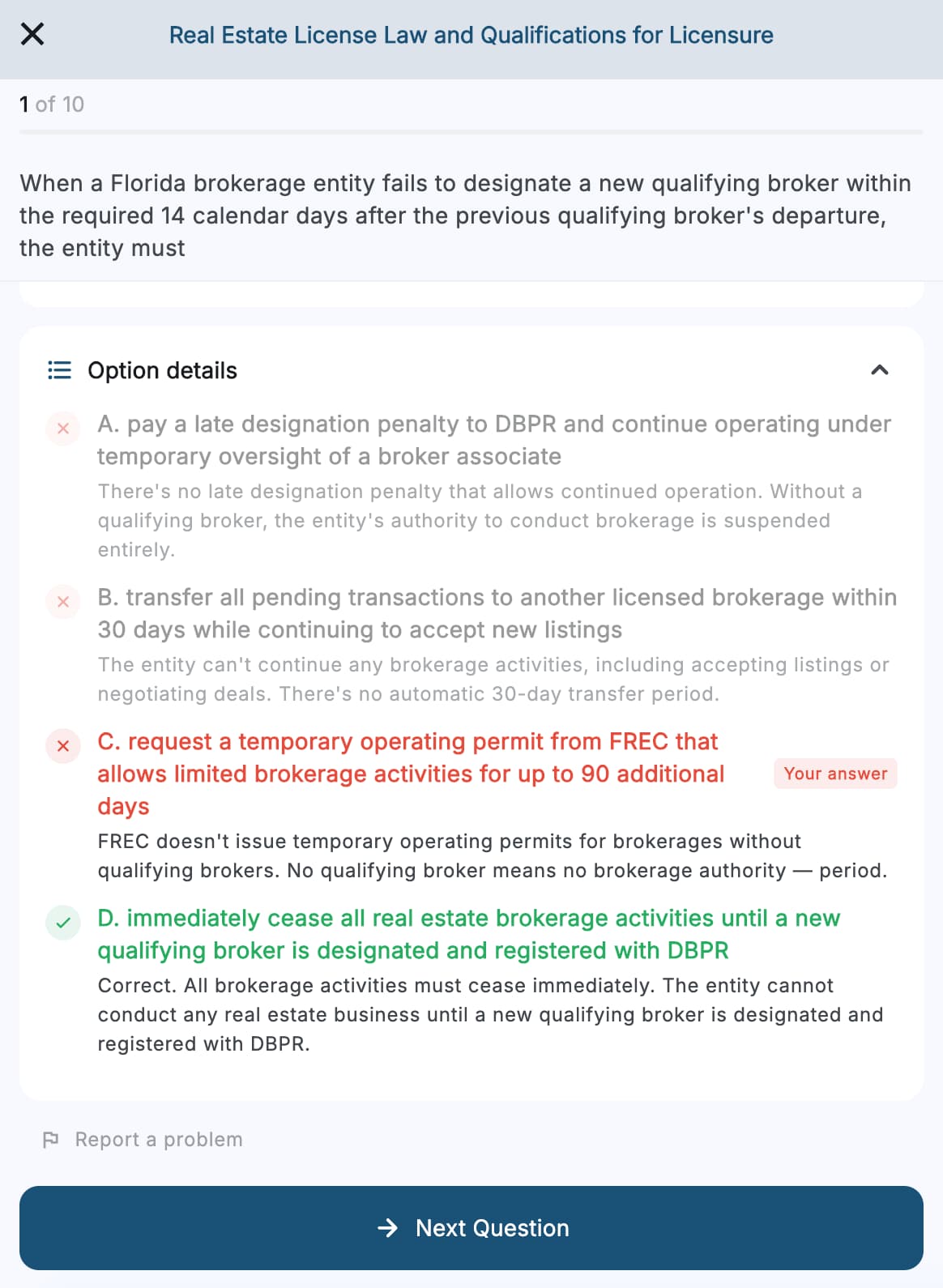
The app gives you 1,142 Florida-specific questions, 19 content-area diagnostics, Math Coach, Trap Library, Confidence Calibration, offline access, optional sync, and lifetime updates for $39.99 once. Start with the free sample, then buy only if it helps. It is exam prep only and does not replace the 63-hour course, DBPR processes, Pearson VUE scheduling, post-license education, continuing education, or legal guidance.
Methodology
The FinCEN section reflects the March 19, 2026 court order, and HB 607 is treated as a failed bill because it died in Commerce Committee on March 13, 2026. The article separates enacted law, industry practice, federal watch items, and non-changes so students do not study proposals as if they were current exam law.
**Appeal-active trigger.can flip.
Product Note
Pass Florida publishes this guide and offers the exam-prep app linked on this page. Pass Florida is independent exam prep and is not a DBPR-approved 63-hour pre-license course, post-license course, continuing education course, or legal/compliance service. It does not guarantee passage.
Sources
- DBPR Real Estate Sales Associate Candidate Information Booklet
- Florida Administrative Code Rule 61J2-2.029, Examination Areas of Competency
- F.A.C. 61J2-3.008, Pre-licensing Education for Broker and Sales Associate Applicants
- F.A.C. 61J2-3.020, Post-licensing Education for Active and Inactive Broker and Sales Associate Licensees
- F.A.C. 61J2-3.009, Continuing Education for Active and Inactive Broker and Sales Associate Licensees
- Pearson VUE, Florida Real Estate and Appraisers licensing exams
- NAR, Written Buyer Agreements 101
- FinCEN, Residential Real Estate Newsroom
- FinCEN, Residential Real Estate Reference Materials
- F.S. 83.505, Electronic delivery of notices
- F.S. 83.512, Disclosure of flood risks to prospective tenant
- F.S. 689.302, Disclosure of flood risks to prospective purchaser
- F.S. 718.503, Condominium developer and resale disclosure
- Florida Senate Bill Summary, HB 7031 Taxation
- Florida Senate Bill Summary, HB 913 Condominium and Cooperative Associations
- Florida Senate Bill Summary, SB 322 Property Rights
- Florida Senate Bill Summary, SB 606 Public Lodging and Public Food Service Establishments
- Florida Senate Bill Summary, SB 948 Flood Disclosure
- Florida Senate, CS/HB 607 2026 bill status
FAQ
Did the Florida real estate exam format change in 2026?
No. The format remains 100 multiple-choice questions, 3.5 hours, and a passing grade of 75 points or higher.
Did the 19 Florida real estate exam topics change in 2026?
The exam still follows the same 19 content areas. The updates are current-law and practice updates inside existing topics.
Is FinCEN residential real estate reporting required right now?
No, not while the March 19, 2026 court order remains in force. FinCEN says reporting persons are not required to file Real Estate Reports and are not subject to liability for failing to do so while the order remains in force. FinCEN and the Department of Justice have appealed.
Should I still know what the FinCEN rule was about?
Yes, lightly. Know that it concerned certain non-financed residential transfers to entities and trusts. But do not make it a major study block while the rule is vacated.
Did HB 607 abolish FREC?
No. CS/HB 607 died in Commerce Committee on March 13, 2026. FREC still exists.
Is Florida post-license education still required in 2026?
Yes. Sales associates still need 45 hours of post-license education before first renewal. Do not study HB 607 as if it removed that requirement.
What changed with flood disclosure?
Sellers must provide residential flood disclosure at or before the sales contract is executed. Landlords must provide a separate flood disclosure for residential leases of 1 year or longer at or before lease execution. The landlord remedy uses the 50% personal-property loss threshold and 30-day termination window.
Can Florida landlords and tenants use email notices now?
Yes, but only if both parties signed the required addendum and provided valid email addresses. Email notice is not automatically valid without that opt-in.
Is Florida's business rent tax gone?
Yes. HB 7031 repealed the business rent tax beginning October 1, 2025. For current-law study, commercial rent state sales tax is zero.
What is the condo resale cancellation period?
For resale condominium contracts under F.S. 718.503, the buyer may void within 7 days, excluding Saturdays, Sundays, and legal holidays, after execution and receipt of required documents. Do not confuse this with the 15-day developer condo period.
Is the NAR settlement directly tested on the Florida licensing exam?
Treat it as a practice update, not a confirmed replacement for Florida license law. Know the written buyer agreement before touring rule for MLS participants, but keep your main focus on Florida brokerage relationships under F.S. 475.278.
What should I study first for the 2026 exam?
Study the core 19 topics first. Then add flood disclosure, electronic notice, condo resale cancellation, business rent tax elimination, HB 607 status, and a light review of NAR and FinCEN status.
This post is exam preparation content for the Florida Real Estate Sales Associate exam. It is a current-law snapshot and is not legal, tax, lending, compliance, brokerage, title, closing, or professional advice. Regulatory status can change between exam windows; pending appeals can restore or invalidate rules without notice. Verify against the primary source before relying on any specific status here. Studying with Pass Florida or any other exam-prep tool does not guarantee passage of the state exam.