QUICK ANSWER
The Florida House passed HJR 203 on February 19, 2026 by a vote of 80 to 30. The resolution would have placed a constitutional amendment on the November 2026 ballot eliminating non-school property taxes on the state's 5.1 million homesteaded properties through a 10-year phased increase in the homestead exemption. The bill died in the Senate Appropriations Committee on March 13, 2026 without a hearing. Governor Ron DeSantis is now calling for a third special legislative session before the August 1, 2026 ballot certification deadline. As of May 20, 2026, no date has been set, no Senate companion has been filed, no proposal has been finalized, and Florida property tax law remains unchanged. Save Our Homes is intact. The $50,000 homestead exemption is intact. F.S. 196.24 is in effect. This is a tracker post and will be updated as the story develops.
This is the most consequential fiscal policy debate in Florida in decades. It's also the most misreported one. Most of the social-media discussion treats property tax elimination as something that has already happened or is about to happen automatically. Neither is true.
What is true is more interesting. The Florida House has been actively pushing property tax elimination on homesteaded properties since November 2025. The Governor has been publicly pressing for it since 2024. The Florida Senate has refused to take up the House's plan and has not filed its own companion resolution. The 60-day regular session ended March 13 without a deal. The April 28 to May 1 special session pointedly excluded property taxes from its agenda. And the August 1, 2026 deadline for getting a constitutional amendment on the November 2026 ballot is approaching with no proposal in final form.
This post walks where things actually stand, what each of the seven House Joint Resolutions proposed, why the bills have not passed despite popular support, what's at stake for Florida real estate transactions and the licensure exam, and what to watch for over the next 90 days. We'll update this post as the situation develops.
If you're studying for the Florida real estate exam right now, the practical answer is short: every property tax calculation you'll be tested on operates under current rules. The millage rate formula, the Save Our Homes 3% cap, the $25,000 base homestead exemption, the $25,000 non-school homestead exemption, and portability rules under F.S. 196.031 are all unchanged. Pass Florida's millage rate post and the math topics tested on the exam reflect the current framework.
For everyone else in the Florida real estate transaction ecosystem (agents, brokers, candidates, homeowners, investors), read on.
Where things stand as of May 20, 2026
HJR 203 passed the Florida House 80 to 30 on February 19, 2026. It died in the Senate Appropriations Committee without a single hearing.
Hard facts only, no speculation, current as of today.
Florida property tax law: Unchanged. F.S. 196.24 and the property tax provisions of Article VII of the Florida Constitution remain in effect. The full structure of homestead exemptions, the Save Our Homes 3% assessed value cap under F.S. 193.155, portability under F.S. 193.155(8), and the $50,000 total homestead exemption ($25,000 base plus $25,000 non-school portion) are all current.
Legislative status: All seven House Joint Resolutions filed during the 2026 regular session (HJR 201, 203, 205, 207, 209, 211, 213) failed to pass both chambers. HJR 203 was the only one to receive a floor vote. It passed the House 80-30 on February 19 but died in the Senate Appropriations Committee on March 13 when the regular session adjourned. No Senate companion measure was filed at any point during the regular session.
Special sessions held in 2026: The April 28 through May 1 special session focused on congressional redistricting (House passed 83-28, Senate 21-17), AI consumer protections, and medical freedom policies. Property tax reform was deliberately excluded from the agenda.
Future special session: Governor DeSantis has publicly stated multiple times since April 29 that a third special session focused specifically on property taxes will be called. As of May 20, 2026, no date has been set, no formal call has been issued, and no specific proposal has been finalized. DeSantis's most recent public statement on May 18 indicated the special session would happen "by the end of July."
Ballot certification deadline: August 1, 2026 is the deadline for the Florida Legislature to pass a joint resolution with a 60% supermajority in both chambers to place a constitutional amendment on the November 2026 ballot. The Secretary of State's certification process extends through late August.
Voter approval threshold: Any constitutional amendment placed on the November ballot must receive 60% voter approval to take effect. A Stetson University Center for Public Opinion Research poll suggested 77% support if the question reaches voters, though Florida amendments often see support erode during the campaign window.
What's actually being proposed
Seven joint resolutions were filed in the 2026 regular session by the House Select Committee on Property Taxes, operating under House Speaker Daniel Perez. Each resolution took a different approach to the same general goal: eliminating or reducing the non-school portion of property taxes on homesteaded properties.
The proposals fall into three categories.
Immediate full elimination (most aggressive). HJR 201 would have exempted all 5.1 million homesteaded properties from all non-school property taxes effective immediately upon constitutional ratification. The Florida Revenue Estimating Conference estimated this would cost local governments $18.3 billion annually in lost revenue.
Phased elimination through homestead exemption increases (moderate). HJR 203 (sponsored by Rep. Monique Miller, R-Palm Bay) would have increased the homestead exemption by $100,000 per year for ten years, reaching complete elimination of non-school property taxes on homesteaded properties by January 2036. This was the only resolution to pass the House floor.
Smaller targeted reductions (least aggressive). HJR 205 took a narrower approach, costing local governments an estimated $6.7 billion annually rather than HJR 201's $18.3 billion. The remaining resolutions (HJR 207, 209, 211, 213) sat between these two endpoints with varying mechanisms.
The fiscal impact range across all seven proposals: $6.7 billion to $18.3 billion in annual lost revenue to local governments, every year, going forward. For context, Florida's total local government property tax collection was approximately $55 billion in 2025 across all parcel types. The seven proposals were targeting roughly 30 to 35 percent of total property tax collections (the homesteaded portion) for elimination or reduction.
| Resolution | Approach | Est. annual cost to local governments | Status |
|---|---|---|---|
| HJR 201 | Immediate full elimination of non-school taxes on homesteads | $18.3 billion | Died in House Ways and Means |
| HJR 203 | Phased: $100K/year homestead exemption increase for 10 years | $10+ billion at full phase-in | Passed House 80-30, died in Senate Appropriations |
| HJR 205 | Targeted reductions | $6.7 billion | Died in House Ways and Means |
| HJR 207, 209, 211, 213 | Various mechanisms | Range between above | Died in committee or Second Reading |
KEY INSIGHT · THE PUBLIC SAFETY MANDATE (THE "POISON PILL")
All seven resolutions shared a critical common provision: each one required local governments to maintain public safety budgets (law enforcement, firefighters, first responders) at FY 2025-2026 or FY 2026-2027 levels (whichever was higher), beginning with the 2027-2028 local fiscal year. This is the most consequential and least-discussed provision of the package. It means local governments would have lost $6.7B–$18.3B in property tax revenue but would not have been allowed to cut public safety spending to offset the loss. They would have needed to cut everything else (parks, libraries, road maintenance, code enforcement, transit, social services, water and sewer infrastructure) or raise other taxes and fees. The Florida League of Cities has called this provision a "poison pill" that complicates implementation without producing real savings, and internal Republican Caucus disagreement on it has stalled multiple resolutions.
What none of the proposals would have done: eliminated property taxes on second homes, investment properties, Airbnbs, vacation rentals, commercial properties, or properties owned by snowbirds and other part-time residents. Approximately 70 percent of Florida property tax revenue comes from non-homesteaded properties. That 70 percent would have remained on the rolls.
What's emerging for the planned summer special session: a "glide path" or phased approach over six years rather than HJR 203's ten-year framework. DeSantis stated on April 29 that "our goal would be: Homestead properties would be exempt from property tax." He also acknowledged the timeline would be graduated rather than immediate. No specific bill language has been published.
Why the bills haven't passed despite popular support
A 77 percent voter support number is unusual. Most contested constitutional amendments in Florida poll in the 50 to 65 percent range even when they ultimately pass. Property tax elimination polls higher than any recent ballot question. And yet none of the seven 2026 resolutions cleared both chambers. Three reasons explain the gap between popular support and legislative outcome.
Reason one: House Speaker Daniel Perez and Governor DeSantis are at odds on the proposal. Perez's House passed HJR 203 on February 19. DeSantis publicly criticized the phased approach as insufficient. The Senate, led by President Ben Albritton, did not pass the bill. Each leader has been waiting for the other to make a complete proposal. On April 24, Perez stated publicly: "For the last 18 months or so, [DeSantis has] been stating to the public and on Fox News and on anyone that's willing to listen, that he's going to abolish property taxes. I'm still waiting for a proposal that has anything to do with property taxes, even if it's an increase of the homestead exemption by $5,000." That standoff has continued through May.
Reason two: the public safety budget mandate has divided Republican legislators. The provision requiring local governments to maintain law enforcement, firefighter, and first responder budgets at FY 2025-26 or 2026-27 baselines is a state-level unfunded mandate. Some Republican legislators view this as an appropriate consumer protection. Others view it as preempting local fiscal autonomy and shifting costs rather than reducing them. The Florida League of Cities has called the provision a "poison pill" that complicates implementation without producing real savings. The internal Republican Caucus disagreement on this single provision has stalled multiple resolutions.
Reason three: rural counties face disproportionate impact. Florida's 67 counties have very different property tax revenue mixes. Urban counties (Miami-Dade, Broward, Hillsborough, Orange, Duval) generate large absolute property tax revenues with substantial non-homestead contributions. Rural counties (Liberty, Lafayette, Glades, Hardee, Jefferson) depend more heavily on homestead property tax revenue and have less commercial and tourism-related property to fall back on. DeSantis has floated using state surplus funds as a temporary grant program for 32 of the 67 counties most affected. Incoming Speaker Sam Garrison has publicly opposed that backfill approach. The rural-county question has not been resolved.
The opposition coalition DeSantis has identified publicly: "teacher unions, local politicians, local bureaucrats, business groups, and politicians in both parties." That coalition has held together for two legislative cycles. The 2025 effort failed. The 2026 effort failed. Whether a July 2026 special session breaks the coalition depends on the specific bill language and the political incentives Senate leadership faces with the August 1 ballot deadline approaching.
CURRENT RULES STILL APPLY · STUDY ACCORDINGLY
Reform is uncertain. The exam content is not.
Every property tax calculation on the Florida sales associate exam operates under current F.S. 196 and F.S. 200 rules: millage, $50K homestead exemption (with the school vs. non-school split), Save Our Homes cap, portability. Pass Florida's Math Coach walks all of them. $39.99 once.
What's at stake for Florida real estate
If a property tax constitutional amendment passes both the legislature in summer 2026 and the voters in November 2026, the effects on Florida real estate would arrive across a multi-year implementation window. Even under HJR 203's phased 10-year approach, the structural changes to how Florida finances local government would reshape the real estate market.
For homeowners with existing homesteads. A phased increase in the homestead exemption would reduce annual property tax liability on primary residences. The exact amount depends on assessed value, current millage rates, and which version of the legislation passes. A homeowner with a $400,000 assessed value home and a 20-mill total levy currently pays roughly $7,000 annually in property taxes (after the $50,000 homestead exemption). Under HJR 203's first-year phase-in, that bill could drop by roughly $2,000. Under HJR 201's immediate full elimination, the non-school portion (roughly 60 percent of total) would have disappeared entirely.
For prospective home buyers. Property taxes affect monthly housing affordability through escrow. Lower property tax bills translate directly into lower monthly housing costs at the same purchase price, which expands buyer purchasing power. This could push home prices higher as buyers compete with newly increased buying power. The market dynamics here cut both ways for affordability.
For real estate investors and second-home owners. No relief. Non-homesteaded properties continue paying full property taxes under all seven proposals. Investment property cap rates and rental property cash flow analysis are unaffected by the homestead-only reform.
For local government services. Significant restructuring. With $6.7 billion to $18.3 billion in annual revenue gone and public safety budgets locked at current levels, every other category of local government service would face budget pressure. Code enforcement, parks, libraries, planning departments, transit, water and sewer infrastructure, and affordable housing programs would compete for whatever non-public-safety revenue remains.
For the licensure exam content. Currently unaffected. The Florida sales associate exam tests property tax calculations under existing F.S. 196 rules. Even if a constitutional amendment passes in November 2026, statutory implementation would take years. The 2026 and 2027 exam content cycles will continue testing current rules.
The August 1 deadline and what to watch over the next 90 days
The procedural path to placing a constitutional amendment on the November 2026 ballot has a hard deadline. Three patterns are worth watching over the next 90 days.
Pattern 1: Specific bill language. DeSantis has been promising a property tax proposal for 18 months without publishing specific bill text. Speaker Perez has been publicly asking for that text. The first concrete signal that the third special session is real will be DeSantis releasing a proposal with actual legislative language, not just press conference rhetoric. Watch for a formal Governor's call for special session that includes specific bill text.
Pattern 2: Senate companion filing. Florida bills typically need both House and Senate versions to reach final passage. The House has passed its version (HJR 203) and could revive it. But the Senate has not filed any property tax resolution in either the 2025 or 2026 sessions. Senator Hooper has indicated the Senate would file a "less aggressive alternative," but no language has been published. Watch the Senate pre-filing window for any property tax resolution. A Senate filing with a credible sponsor is the second concrete signal.
Pattern 3: Public safety budget compromise. The "poison pill" provision requiring local public safety budgets to stay at baseline levels has divided Republicans and unified opposition. A modified version that addresses the unfunded-mandate concern (perhaps allowing public safety budgets to be adjusted with inflation, or removing the mandate entirely) would substantially change the political math. Watch for any signal that this provision is being renegotiated.
If all three patterns develop by mid-July, the August 1 deadline is achievable. If even one is missing, the constitutional amendment slips to the November 2028 ballot at the earliest (Florida votes on amendments only in general election cycles, and 2028 is the next opportunity if 2026 is missed).
DeSantis has acknowledged this himself: "There will be a special session to do the property tax, and my sense would be, we'll get there, probably on the first try, but if not, there will be more of those sessions until they put something on the ballot." The phrase "until they put something on the ballot" implicitly acknowledges that 2026 may not be the year.
Current Florida property tax structure (still in effect as of May 20, 2026)
Until any new constitutional amendment passes and takes effect, every Florida property tax rule operates as it has for years. Current law:
| Provision | Statute | Current rule |
|---|---|---|
| Homestead exemption (first $25K) | F.S. 196.031 | Applies to all property taxes including school. |
| Homestead exemption (second $25K) | F.S. 196.031(1)(b) | Applies only to non-school taxes; assessed-value $50K–$75K bracket. Total max exemption: $50K. |
| Save Our Homes cap | F.S. 193.155 | Annual assessed-value increases capped at 3% or CPI, whichever is lower. Homesteaded properties only. |
| Portability | F.S. 193.155(8) | Up to $500K of SOH savings transferable to new homestead within 3 years of abandoning prior homestead. |
| Non-homestead 10% cap | F.S. 193.1554 | 10% annual cap on assessed-value increases for non-homesteaded residential and certain other property types. |
| Millage rates | F.S. 200.069 | Set annually by each taxing authority. Combined typical: 15–25 mills (1.5%–2.5% of taxable value). |
None of this changes until a constitutional amendment passes both the legislature and the voters. As of May 20, 2026, none has.
What this means for Pass Florida candidates studying right now
Short version: every property tax topic on the Florida real estate sales associate exam is current and unchanged.
The exam tests millage rate calculations, the assessed-value-to-taxable-value flow, homestead exemption application, Save Our Homes mechanics, portability rules, and special assessments under current F.S. 196 and F.S. 200 provisions. None of these have changed in 2026. The Pass Florida question bank covers all of them. The Millage Rate post walks the full formula with worked examples on Florida prices.
If a constitutional amendment passes in November 2026, statutory implementation requires DBPR rulemaking, county property appraiser system updates, and tax collector software changes. The earliest practical effect on exam content would be the 2027-2028 testing cycle, and even that depends on FREC updating the exam content outline. Anyone taking the exam in 2026 or early 2027 will be tested on current rules.
If you're studying for the Florida real estate exam right now, focus on understanding the current property tax framework deeply. That framework is what the exam tests, and that framework remains the foundation that any reform will modify rather than replace entirely.
Ready to study under current rules?
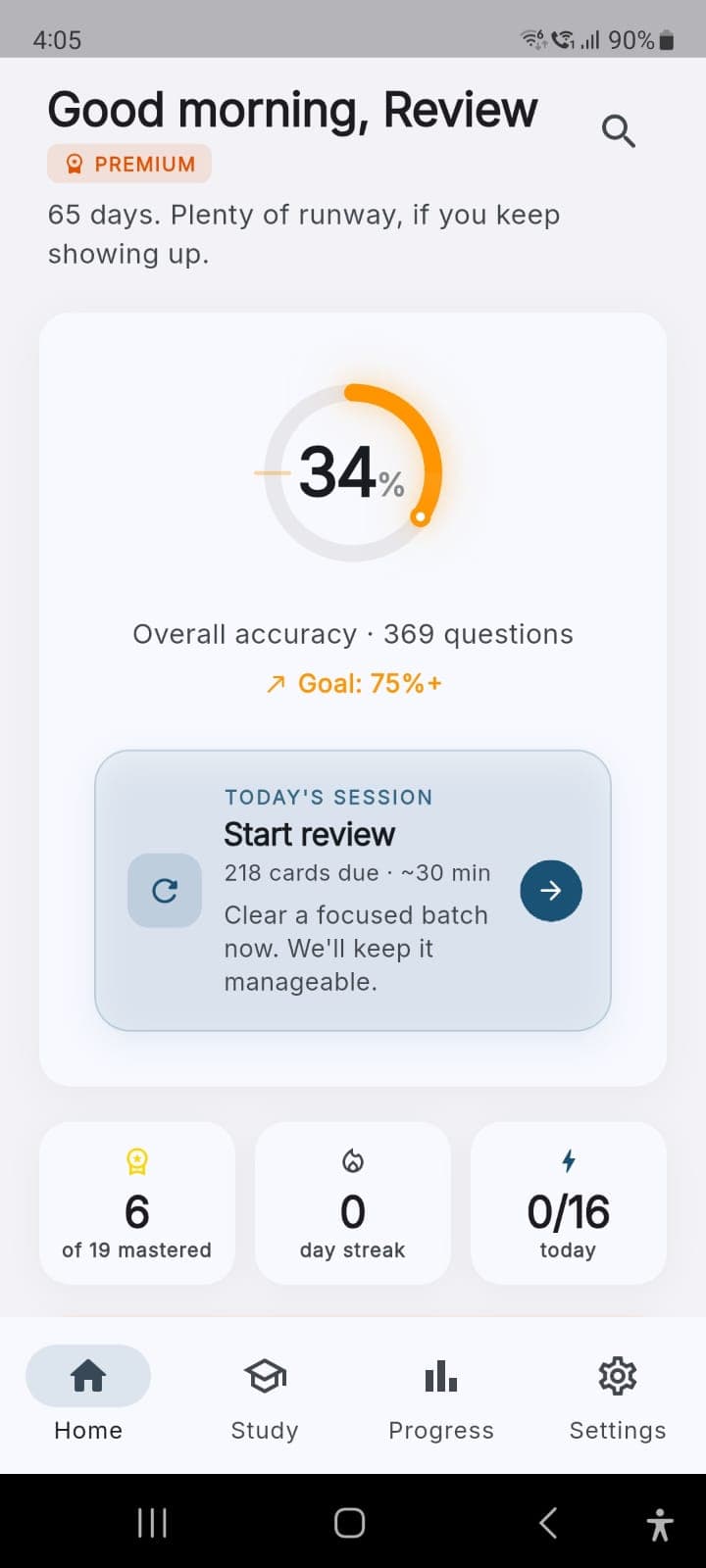
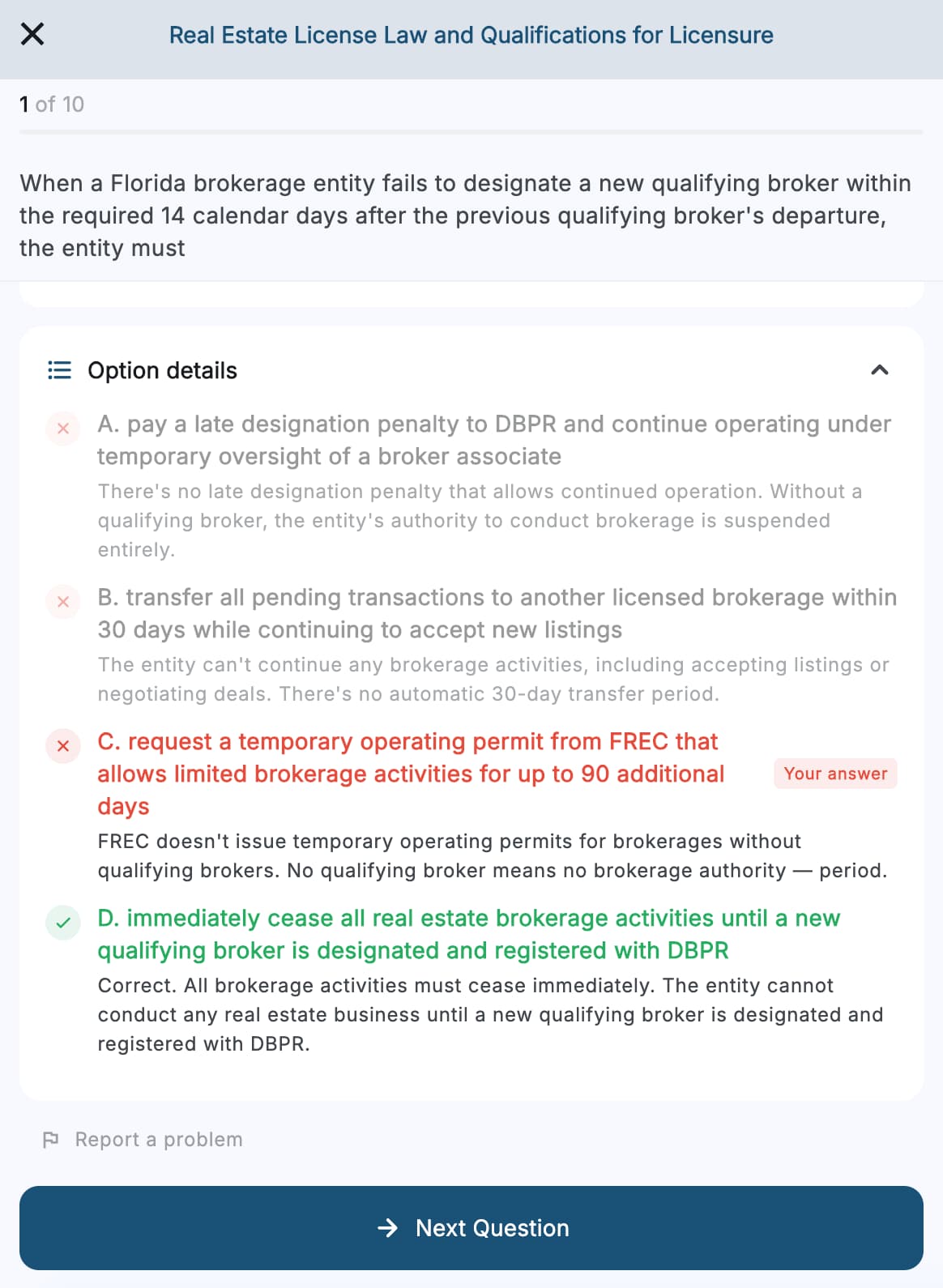
The Florida real estate exam tests 14 distinct math topics across 100 questions, with property tax calculations (millage rates, homestead exemptions, Save Our Homes, special assessments) appearing on roughly 6 to 8 of those questions. Pass Florida's Math Coach walks every formula step-by-step with worked examples on real Florida prices. The question bank includes targeted property tax practice across all 19 exam content areas. $39.99 once. Lifetime access on iOS and Android. No subscription. No fake reviews.
For calculation practice, use the millage rate guide and the homestead exemption walkthrough. For broader licensing context, the Florida exam changes guide explains which 2026 updates affect candidates and which headlines are not testable yet.
FAQ
Did Florida pass property tax reform in 2026?
No. All seven property tax House Joint Resolutions filed during the 2026 regular session (HJR 201, 203, 205, 207, 209, 211, 213) failed to pass both chambers. HJR 203 was the only resolution to clear the House floor, passing 80-30 on February 19, 2026. It died in the Senate Appropriations Committee on March 13, 2026 when the regular session adjourned, without a Senate hearing. As of May 20, 2026, Florida property tax law under F.S. 196 and Article VII of the Florida Constitution remains unchanged.
What is HJR 203?
HJR 203 is a Florida House Joint Resolution sponsored by Rep. Monique Miller (R-Palm Bay) that would have placed a constitutional amendment on the November 2026 ballot to phase out non-school property taxes on homesteaded properties over 10 years by increasing the homestead exemption by $100,000 per year. It passed the Florida House 80-30 on February 19, 2026 but died in the Senate Appropriations Committee on March 13, 2026 without a hearing.
When is the next Florida property tax special session?
Governor Ron DeSantis has publicly stated since April 29, 2026 that a third special legislative session focused on property taxes will be called. As of May 20, 2026, no date has been formally set. DeSantis indicated on May 18 that the session would happen "by the end of July." The hard deadline is August 1, 2026, which is the cutoff for placing a constitutional amendment on the November 2026 ballot. If the deadline is missed, the next opportunity is the November 2028 general election ballot.
Will Florida eliminate property taxes on homesteaded properties?
Not yet, and not automatically. For elimination to take effect, the Florida Legislature must pass a joint resolution with a 60% supermajority in both chambers by August 1, 2026 to place the question on the November 2026 ballot. Florida voters then must approve the amendment with at least 60% support. A Stetson poll suggested 77% voter support if the question reaches the ballot, but the legislature has not yet passed a resolution and the political path to passage remains uncertain.
Does Florida property tax reform affect investment properties or second homes?
No. All seven 2026 proposals targeted only homesteaded primary residences (the 5.1 million properties claimed by Florida residents as their primary home). Non-homesteaded properties including investment properties, second homes, vacation rentals, Airbnbs, commercial properties, and snowbird-owned residences would continue to pay full property taxes under every version of the proposed reform. Approximately 70% of Florida property tax revenue comes from non-homesteaded properties and is unaffected by the homestead-only reform.
How does property tax reform affect the Florida real estate exam?
It doesn't, yet. The Florida sales associate exam tests property tax calculations under current F.S. 196 (homestead exemptions) and F.S. 200 (millage rates and TRIM notification) provisions. None of these have changed in 2026. Even if a constitutional amendment passes in November 2026, statutory implementation through DBPR rulemaking and FREC content-outline updates would take years. The 2026 and 2027 exam content cycles will continue testing current rules: the $50,000 homestead exemption (split into the $25K base and $25K non-school bracket), the 3% Save Our Homes cap, portability, the 10% non-homestead cap, and current millage rate math.
Methodology
What this post covers. The Florida property tax reform effort during the 2026 legislative session, including the seven House Joint Resolutions filed (HJR 201, 203, 205, 207, 209, 211, 213), the House and Senate dynamics that have prevented passage through May 2026, the planned third special session for July or August 2026, the August 1, 2026 ballot certification deadline, the practical implications for Florida real estate transactions and licensure exam content, and patterns to watch over the next 90 days. Current as of May 20, 2026.
Why this post takes no political position on the bills' merits. Property tax elimination is a contested fiscal policy question with substantive arguments on both sides regarding homeowner relief, local government revenue capacity, public safety funding, and rural-county fiscal viability. Pass Florida is an exam-prep tool, not an industry lobbying organization. Our job is to describe what's actually proposed, what's actually happened, and what it would mean for our candidates if reform passes. Pass Florida supports candidates' ability to make informed decisions under whatever framework Florida adopts.
This is a tracker post. We will update this post as the story develops. The "Where things stand" section is current as of May 20, 2026. The "What's actually being proposed" and "Current Florida property tax structure" sections describe permanent context. The "What to watch" patterns are forward-looking analysis based on the political and procedural dynamics through May 2026.
Data sources. Florida House Joint Resolutions 201, 203, 205, 207, 209, 211, and 213 (filed during the 2026 regular legislative session), Florida Policy Institute bill summary (February 6, 2026), Florida Revenue Estimating Conference fiscal impact estimates, Office of Economic and Demographic Research property tax distribution and benefits analysis (September 22, 2025), Florida Statutes Chapter 196 (homestead exemptions) and Chapter 200 (taxation), Article VII of the Florida Constitution, WFLA reporting on the planned third special session (May 6, 2026), WFLX reporting on the regular session conclusion (March 13 and 16, 2026), Florida Politics coverage by A.G. Gancarski (April 29 and May 11, 2026), news4jax reporting on DeSantis statements (May 18, 2026), WPTV reporting on the August deadline pressure (May 19, 2026), Local10 coverage of the Perez-DeSantis disagreement (April 24, 2026), Barnes Walker legal tracker (May 2026), Stetson University Center for Public Opinion Research poll, and Florida League of Cities position statements.
What this post does not predict. Whether the third special session will actually be called, whether the Florida Senate will pass any property tax resolution, whether a constitutional amendment will reach the November 2026 ballot, and whether voters would approve such an amendment if it reaches the ballot. Legislative outcomes depend on factors not knowable in advance.
Sources
- Florida House HJR 201, 203, 205, 207, 209, 211, 213 (2026 regular session)
- Florida Policy Institute, "Bill Summary: HJR 201, 203, 205, 207, 209, 211, and 213" (February 6, 2026)
- Office of Economic and Demographic Research (EDR), "Property Taxes: Homestead Distribution and Benefits" (September 22, 2025)
- Florida Revenue Estimating Conference (REC) fiscal impact estimates
- Florida Statutes Chapter 196 (Homestead Exemptions)
- Florida Statutes Chapter 200 (Taxation)
- Florida Constitution Article VII (Finance and Taxation)
- WFLA, "3rd special session to vote on property tax set for July" (May 6, 2026)
- WFLX, "Florida session ends without property tax plan" (March 13 and 16, 2026)
- Florida Politics, A.G. Gancarski coverage (April 29 and May 11, 2026)
- news4jax, "Here we come!" DeSantis property tax coverage (May 18, 2026)
- WPTV, "Gov. Ron DeSantis renews push for Florida property tax overhaul" (May 19, 2026)
- Local10, "DeSantis wants property tax action, but lawmakers say show them a plan first" (April 24, 2026)
- Barnes Walker, "Florida Property Tax Update: What Actually Happened in the 2026 Legislative Session" (May 2026)
- Stetson University Center for Public Opinion Research property tax poll
- Florida League of Cities position statements
All information verified May 20, 2026. This is a tracker post and will be updated as the story develops.