Study Guide26 min read2026-02-27

    Florida Landlord-Tenant Law on the Real Estate Exam: Deadlines, Deposits, and Notices (2026)

    Why Landlord-Tenant Questions Punish Students Who Memorize the Numbers Without Knowing Which Deadline Applies to Which Party

    Fifteen days. Thirty days. Fifteen days again. Three days. Seven days. Seven days again. Landlord-tenant law on the Florida real estate exam is not one deadline. It is a series of deadlines that sound almost identical but belong to completely different situations, apply to different parties, and carry different consequences when missed. The topic falls under Topic 10 of the Sales Associate Exam, Federal and State Laws Pertaining to Real Estate, and accounts for roughly 4 to 5% of the exam. That is 4 to 5 questions. Enough to make or break a score hovering near the 75 passing threshold.

    What is 15 days? The time a landlord has to return a security deposit when the landlord has no claim against it. What is 30 days? The time a landlord has to send a written claim notice by certified mail when the landlord does intend to claim. What is the other 15 days? The time the tenant has to object after receiving that claim notice. What is 3 days? The notice period for nonpayment of rent, excluding weekends and holidays. What is 7 days? Either a curable violation notice or a non-curable violation notice, depending on whether the tenant can fix the problem. Students who memorize the numbers without knowing which number attaches to which party and which situation pick the wrong answer. And those wrong answers sit right next to the correct answer in the multiple-choice options, because the exam puts 15 and 30 as separate choices on the same question. That is where the 52 to 56% first-time pass rate shows up in landlord-tenant questions.

    The 2025 legislative session added three new laws that directly affect landlord-tenant practice. HB 615 allows electronic notice between landlords and tenants under specific conditions. SB 948 expanded flood disclosure obligations to landlords with leases of one year or longer. SB 322 and SB 606 created expedited removal procedures for unauthorized occupants that contrast sharply with the traditional eviction process for tenants. The 2026 changes guide covers each law as a standalone update. This guide places those updates in context, showing how they modify the Chapter 83 framework the exam has always tested.

    This guide covers every deadline, every deposit rule, every notice type, every landlord obligation, every tenant remedy, and every 2025 update the exam tests. Work through it once for understanding and use the reference table and practice scenarios for review.

    The short version: Chapter 83, Part II governs residential landlord-tenant law. Security deposits: 15 days to return (no claim), 30 days to send claim notice by certified mail, 15 days for tenant to object. Three holding options: non-interest account, interest-bearing (5% simple or 75% annualized), surety bond (deposits + $500). Eviction notices: 3-day (nonpayment, excludes weekends), 7-day curable, 7-day non-curable (repeat within 12 months), 15-day month-to-month termination. Self-help eviction is illegal (F.S. 83.67). Landlord must maintain habitability. Tenant can withhold rent after 7-day written notice. HB 615: email notice valid only with signed addendum. SB 948: flood disclosure for leases 1+ year, 50% damage threshold, 30-day termination. SB 322/606: expedited sheriff removal for unauthorized occupants only.

    Exam Weight: ~4-5% (Federal and State Laws Pertaining to Real Estate) | Difficulty: High | Math: None


    What This Guide Covers


    Chapter 83 Part II: The Framework

    Florida's Residential Landlord and Tenant Act, Chapter 83, Part II of the Florida Statutes, is the single statute that governs nearly every landlord-tenant question on the exam, and the first distinction it demands is knowing that Part II applies to residential tenancies only. Part I covers non-residential (commercial) tenancies. The rules are different. The deadlines are different. The obligations are different. If a question describes a retail store lease or a warehouse rental, Part II does not apply. If a question describes an apartment, a house, a condo, or a duplex, Part II controls.

    The statute divides into sections that map directly to exam content areas. Knowing which section covers which topic helps you navigate questions that test multiple rules in a single scenario.

    Statute Section Subject Exam Relevance
    F.S. 83.43 Definitions (dwelling unit, landlord, tenant, rent, security deposit) Defines terms the exam uses in question stems
    F.S. 83.46 Rent: amount, time, place of payment Tested when questions ask about payment defaults
    F.S. 83.49 Security deposit rules and return timelines Heavily tested: 15-day, 30-day, and 15-day sequence
    F.S. 83.51 Landlord obligations (habitability, maintenance) Tested in habitability and repair scenarios
    F.S. 83.52 Tenant obligations (cleanliness, compliance) Tested alongside landlord obligations for comparison
    F.S. 83.56 Termination of rental agreement (notice types) Heavily tested: 3-day, 7-day, 15-day notices
    F.S. 83.60 Tenant remedies (withhold rent, terminate) Tested when questions ask about tenant options
    F.S. 83.67 Prohibited practices (self-help eviction) Tested in eviction process questions

    Chapter 83 connects to several other exam topics. Leasehold estates (estate for years, periodic estate, estate at will, estate at sufferance) are covered in the property rights guide. The requirement that leases exceeding one year must be in writing under the Statute of Frauds is covered in the contracts guide. Chapter 83 picks up where those topics leave off. It governs what happens after the lease is formed: how deposits are handled, how violations are addressed, how the tenancy ends, and what each party owes the other during the term.

    The deadline that costs the most points: Applying Part II rules to a commercial lease scenario. Part II is residential only. If the question describes a commercial tenant and asks about the notice period, Part II deadlines do not apply. Commercial tenancies under Part I follow different default rules and are largely governed by the lease contract itself rather than statutory timelines.

    How the exam tests this: A question describes a warehouse tenant who has not paid rent for two months. Which notice must the landlord provide before filing for eviction? Students who pick "3-day notice" are applying the Part II residential rule. The correct answer references the lease terms or the Part I default, not the Part II statutory timeline. The exam puts residential and commercial scenarios in the same question pool to test whether you know which framework controls.


    Security Deposit Rules: The Complete Timeline

    F.S. 83.49 establishes a three-stage timeline for security deposits that the exam tests more frequently than any other landlord-tenant rule, and the critical detail is not the number of days but which party has the obligation at each stage. Stage one belongs to the landlord. Stage two belongs to the landlord. Stage three belongs to the tenant. Miss which party acts at which stage and the deadline becomes meaningless.

    The Three-Stage Timeline

    Stage Party Action Deadline Method
    1. No claim Landlord Return the full deposit 15 days after lease termination Any reasonable method
    2. Claim intended Landlord Send written notice of intent to claim 30 days after lease termination Certified mail to tenant's last known address
    3. Tenant objection Tenant Object to the landlord's claim 15 days after receiving the landlord's notice Written objection

    The certified mail requirement in Stage 2 is not optional. A landlord who sends the claim notice by regular mail, by email (without an HB 615 addendum), or by text message has not met the statutory requirement. The notice must go by certified mail to the tenant's last known mailing address.

    What Happens at Each Stage

    Stage 1: No claim. The landlord inspects the property, finds no damage beyond normal wear and tear, and has no reason to withhold any portion of the deposit. The landlord must return the full deposit within 15 days of lease termination. Not 15 business days. Fifteen calendar days.

    Stage 2: Claim intended. The landlord inspects the property and identifies damage, unpaid rent, or other charges authorized by the lease. The landlord must send a written notice by certified mail within 30 days of lease termination. The notice must itemize the claimed amounts and inform the tenant of the right to object within 15 days. If the landlord fails to send this notice within 30 days, the landlord forfeits the right to impose any claim on the deposit. The money goes back to the tenant regardless of the actual damage.

    Stage 3: Tenant objection. The tenant receives the landlord's claim notice and has 15 days to object in writing. If the tenant does not object within 15 days, the landlord may deduct the claimed amount from the deposit. If the tenant objects, the landlord may still deduct the claim but must hold the disputed funds and resolve the matter through a court proceeding.

    Fee in Lieu of Security Deposit

    Some landlords collect a non-refundable fee instead of a traditional security deposit. Under Florida law, a fee in lieu of a security deposit is not governed by the same return rules. Because the fee is non-refundable by definition, the landlord has no obligation to return it at lease termination. The 15-day and 30-day timelines do not apply. The exam may present a scenario where a tenant paid a fee instead of a deposit and ask what the landlord must return. The answer is nothing, because a fee in lieu is not a security deposit.

    The deadline that costs the most points: Confusing the 15-day no-claim return with the 30-day claim notice. Both involve the landlord. Both start from lease termination. But one is for returning money and the other is for claiming money. Fifteen days = "here is your deposit back." Thirty days = "I intend to keep some or all of it." The exam puts both numbers as answer choices. Students who reverse them get the question wrong even though they knew a deadline existed.

    How the exam tests this: A tenant's lease terminates on March 1. The landlord discovers carpet damage and intends to claim against the security deposit. By what date must the landlord send written notice of the claim? The answer is March 31 (30 days). Students who pick March 16 (15 days) are applying the no-claim return deadline to a claim situation. Students who pick "no deadline exists" do not know F.S. 83.49. The Florida-specific content guide covers this same scenario from a broader exam-context perspective.


    Security Deposit Holding Options

    F.S. 83.49 requires the landlord to hold the security deposit in one of three specific ways and to notify the tenant within 30 days of receiving the deposit, and the exam tests both the holding options and the notification requirement. The landlord cannot keep the deposit in a personal checking account. It cannot sit in a lockbox. It must be held in one of the following:

    Option Where Interest to Tenant Key Detail
    Non-interest-bearing account Separate account in a Florida banking institution None Simplest option; no interest calculation
    Interest-bearing account Separate account in a Florida banking institution 5% simple interest per year or 75% of annualized average interest rate (whichever the landlord selects) Landlord chooses which rate to pay
    Surety bond Posted with the clerk of the circuit court None from bond (5% simple interest per year paid by landlord separately) Bond amount = total deposits held + $500

    The 30-Day Disclosure Requirement

    Within 30 days of receiving the security deposit, the landlord must notify the tenant in writing of:

    1. The name and address of the depository (bank or institution)
    2. Whether the deposit is held in an interest-bearing or non-interest-bearing account
    3. The rate of interest, if applicable

    This 30-day disclosure is separate from the 30-day claim notice at lease termination. Two different 30-day deadlines, triggered by two different events. One happens when the deposit arrives. The other happens when the lease ends. Students who merge them into one deadline miss questions that test the disclosure requirement independently.

    Interest Calculation on the Exam

    If the landlord holds the deposit in an interest-bearing account, the tenant is entitled to receive the deposit plus accrued interest at lease termination (assuming no claim). The exam may present a calculation: a $2,000 deposit held for one year at 5% simple interest equals $2,100 at return. The tenant receives the deposit and the interest. Not one or the other. Both.

    The deadline that costs the most points: Forgetting the 30-day disclosure requirement entirely. Most students memorize the deposit return timelines but never learn that the landlord must also notify the tenant about where and how the deposit is held within 30 days of receiving it. The exam can test this as a standalone question: "Within how many days of receiving a security deposit must a landlord notify the tenant of the depository?" Thirty days. Not 15. Not at lease termination. Thirty days from receipt.

    How the exam tests this: A landlord collects a $1,500 security deposit and places it in an interest-bearing account at 5% simple interest per year. The lease runs for two years with no violations. At termination, what must the landlord return? The answer is $1,650 ($1,500 deposit + $150 interest). Students who answer $1,500 forget the interest obligation. Students who answer "nothing, the landlord can keep the interest" do not know the statute. The deposit and the interest belong to the tenant when no claim exists.


    Eviction Notices: Which Notice, How Many Days

    Chapter 83 establishes four distinct notice types that a landlord must use before initiating an eviction, and the exam tests whether you can match each notice to its triggering event, its day count, and its cure option. No notice, no eviction. The wrong notice, no eviction. The right notice with the wrong day count, still a problem. Each notice is a prerequisite. Get the prerequisite wrong and the entire eviction fails.

    Notice Trigger Days Cure? Calendar Rule
    3-day notice Nonpayment of rent 3 days Yes (pay or vacate) Excludes weekends and legal holidays
    7-day notice (curable) Lease violation tenant can fix 7 days Yes (cure or vacate) Calendar days
    7-day notice (non-curable) Violation that cannot be fixed, or same violation repeated within 12 months 7 days No (vacate only) Calendar days
    15-day notice Termination of month-to-month tenancy 15 days N/A (no violation required) Calendar days, before end of monthly period

    The 3-Day Notice: Nonpayment of Rent

    The 3-day notice is the most commonly tested notice type. It applies exclusively to nonpayment of rent. The landlord delivers a written notice stating the amount of rent due and giving the tenant 3 days to pay or vacate. Three critical rules govern this notice:

    Weekends and legal holidays are excluded. If the landlord serves the notice on a Wednesday, Thursday is day one, Friday is day two, and Monday is day three (Saturday and Sunday are skipped). This exclusion applies only to the 3-day notice. The 7-day and 15-day notices use calendar days with no exclusions.

    Partial payment does not cure the notice. If the tenant owes $1,200 and pays $800 within the 3-day period, the notice is not cured. The full amount must be paid. However, if the landlord accepts a partial payment, many courts treat that acceptance as a waiver of the 3-day notice, requiring the landlord to start the process over.

    The notice must be delivered properly. Personal delivery, leaving with a person of suitable age at the premises, or posting on the door and sending by mail. Email is valid only with an HB 615 addendum.

    The 7-Day Curable Notice

    A curable violation is one the tenant can fix. Unauthorized pet. Excessive noise. Unapproved alterations to the unit. The landlord delivers a 7-day notice identifying the violation and giving the tenant 7 calendar days to cure the violation or vacate. If the tenant cures the violation within 7 days, the tenancy continues. If the tenant does not cure and does not vacate, the landlord may proceed with eviction.

    The 7-Day Non-Curable Notice

    Two situations trigger a non-curable 7-day notice. First, violations that by their nature cannot be fixed (destruction of property, criminal activity on premises). Second, the 12-month repeat rule: if the tenant commits the same type of violation within 12 months of receiving a previous 7-day curable notice for the same issue, the landlord may issue a non-curable 7-day notice. The tenant committed the violation, received notice, cured it, and then committed the same violation again within 12 months. No second chance. Seven days to vacate. No cure option.

    The 15-Day Notice: Month-to-Month Termination

    The 15-day notice is not an eviction notice. It is a termination notice for month-to-month tenancies. No violation is required. Either party, landlord or tenant, may terminate a month-to-month tenancy by giving 15 days written notice before the end of any monthly period. If the tenant's rent is due on the first of the month and the landlord delivers notice on March 10, the tenancy terminates at the end of April (because March 10 is fewer than 15 days before March 31).

    The deadline that costs the most points: Applying calendar days to the 3-day notice. The 3-day notice is the only notice type that excludes weekends and legal holidays. Students who count three calendar days from a Thursday (Thursday, Friday, Saturday = day three is Saturday) get the timing wrong. Day three is Monday. The exclusion rule is the single most tested detail about the 3-day notice.

    How the exam tests this: A landlord serves a 3-day notice for nonpayment of rent on a Friday. On what day does the 3-day period expire? Day one is Monday (Saturday and Sunday excluded). Day two is Tuesday. Day three is Wednesday. The notice expires Wednesday. Students who pick Monday are counting three calendar days from Friday. Students who pick Sunday are ignoring the exclusion entirely. The exam provides all of these as answer choices.


    The Complete Eviction Process

    The Florida eviction process is a court-supervised sequence that begins with proper notice and ends with the sheriff physically removing the tenant, and the exam tests two principles above all else: the landlord must follow every step, and self-help eviction is always illegal. A landlord who changes the locks, removes the tenant's belongings, shuts off utilities, or physically blocks access to the unit has violated F.S. 83.67 and is liable for damages.

    The Seven Steps

    Step Action Who Acts Detail
    1 Serve the appropriate notice Landlord 3-day, 7-day, or 15-day depending on the situation
    2 Wait for the notice period to expire Both parties Tenant may cure (if applicable) or vacate
    3 File eviction complaint with the county court Landlord Only after notice period expires with no cure or vacatur
    4 Tenant served with summons and complaint Court/process server Tenant receives the court filing
    5 Tenant has 5 days to respond Tenant File an answer or motion with the court
    6 Court enters judgment Court Summary judgment if no response; hearing if tenant responds
    7 Writ of possession executed by sheriff Sheriff Tenant removed from the property; 24-hour posting before removal

    Self-Help Eviction Is Always Illegal

    Under F.S. 83.67, a landlord who attempts to remove a tenant by any means other than the court-supervised process is liable for actual and consequential damages or 3 months rent, whichever is greater. Self-help includes:

    • Changing the locks
    • Removing doors or windows
    • Shutting off utilities (water, electricity, gas)
    • Removing the tenant's personal property
    • Physically blocking access to the unit

    The prohibition applies regardless of whether the tenant owes rent, has violated the lease, or has been given notice. Until a court enters a judgment and the sheriff executes a writ of possession, the tenant has legal possession of the property. The landlord cannot circumvent the court process.

    Squatter vs Tenant: The Binary Distinction

    The exam now tests a critical distinction sharpened by SB 322 and SB 606. The distinction is binary.

    Tenant (with a lease, including expired). A person who has or had a lease agreement, even one that has expired, is treated as a tenant. Removal requires the full court eviction process. A holdover tenant (someone who stays after the lease expires without signing a new one) is still a tenant for eviction purposes.

    Unauthorized occupant (squatter, no lease). A person who never had a lease and has no legal right to occupy the property is an unauthorized occupant. Under SB 322/606, commercial and vacation property owners can request expedited removal through the sheriff without going through court eviction.

    Category Has/Had a Lease? Removal Process
    Current tenant Yes (active lease) Full court eviction only
    Holdover tenant Yes (expired lease) Full court eviction only
    Unauthorized occupant (squatter) No Expedited sheriff removal (SB 322/606) for commercial/vacation; court process for residential

    The deadline that costs the most points: Missing the 5-day response window. After the tenant is served with the eviction complaint, the tenant has only 5 days to file an answer with the court. If the tenant does not respond, the landlord can request a default judgment. Five days. Not 10. Not 15. Not 30. Students who answer "30 days" are applying a general civil litigation timeline to a summary eviction proceeding.

    How the exam tests this: A landlord discovers that a person has been living in a commercial property with no lease and no permission. What is the landlord's legal remedy? Students who pick "file a formal eviction through the courts" are applying the tenant eviction process to a non-tenant. The correct answer under SB 322 is that the owner can request expedited removal through the local sheriff by providing proof of ownership and an affidavit. Students who pick "the landlord can change the locks" are choosing self-help, which is illegal regardless of the occupant's status. The property rights guide covers ownership rights in the broader context of real property interests.


    Landlord Obligations: Habitability

    Under F.S. 83.51, the landlord must maintain the dwelling unit in a condition that meets the requirements of applicable building, housing, and health codes, and the exam tests whether you can distinguish between the landlord's specific statutory obligations and the tenant's assumption of risk. The landlord does not promise the unit will be perfect. The landlord promises the unit will be habitable.

    The Statutory Obligations

    Obligation What It Requires Exception
    Building codes Comply with all applicable building, housing, and health codes None
    Structural integrity Maintain roofs, windows, doors, floors, steps, porches, exterior walls, foundations None
    Plumbing Maintain plumbing in reasonable working condition None
    Hot water Provide reasonable hot water None
    Heat Provide heat during winter months (when available in the building) Units without heating systems
    Running water Provide running water None
    Pest control Provide extermination for roaches and other pests Single-family homes and duplexes (tenant responsibility)
    Locks and keys Provide functioning locks on exterior doors and windows None
    Garbage removal Provide garbage receptacles and arrange for removal (multi-unit) Single-family homes (tenant responsibility)
    Smoke detectors Provide functioning smoke detection devices None (required for all residential units)

    The Single-Family Exception

    Pest control and garbage removal obligations shift to the tenant in single-family homes and duplexes. In a multi-unit building (apartment complex, triplex, or larger), the landlord handles pest control and garbage. In a single-family home or duplex, those responsibilities default to the tenant unless the lease states otherwise. The exam uses this exception to test whether students apply the multi-unit rule universally or know the carve-out for single-family properties.

    "Reasonable Time" Is Not a Fixed Number

    When a tenant reports a maintenance issue that falls under the landlord's statutory obligations, the landlord must make repairs within a "reasonable time." The statute does not define a specific number of days. This is deliberate. What counts as reasonable depends on the nature of the repair. A broken front door lock demands faster action than a cosmetic ceiling stain. The exam will not ask "how many days does the landlord have to make repairs?" because the statute does not provide a fixed answer. If the exam presents a choice like "7 days" or "14 days" for a general repair obligation, that answer is likely wrong because no statutory deadline exists.

    The deadline that costs the most points: Assuming a fixed repair timeline exists. Students who memorize the 15-day, 30-day, and 7-day deadlines from other sections assume the statute must also specify a repair deadline. It does not. The standard is "reasonable time," and the exam tests whether you know the difference between a deadline that exists (security deposit return, eviction notice) and one that does not (general repair obligation).

    How the exam tests this: A tenant in a multi-unit apartment building reports a cockroach infestation to the landlord. Who is responsible for extermination? The answer is the landlord. Pest control is the landlord's obligation in multi-unit buildings. Students who pick "the tenant" are applying the single-family exception to a multi-unit property. Students who pick "the local health department" are confusing code enforcement authority with contractual landlord obligations. The Florida-specific content guide covers this alongside other Florida-specific maintenance rules.


    Tenant Remedies

    When a landlord fails to maintain the dwelling unit as required by F.S. 83.51, the tenant has three statutory remedies, but every remedy begins with the same prerequisite: a 7-day written notice to the landlord. No notice, no remedy. The tenant cannot skip the notice and go straight to withholding rent. The notice is the trigger. Without it, the tenant's subsequent actions have no legal basis.

    The Three Remedies

    Remedy What the Tenant Does Prerequisite When It Applies
    Withhold rent Stop paying rent until the landlord makes repairs 7-day written notice to landlord specifying the deficiency Landlord fails to repair within a reasonable time after receiving notice
    Terminate lease End the lease and vacate 7-day written notice to landlord specifying the deficiency Landlord fails to repair within a reasonable time after receiving notice
    Sue for damages File a civil lawsuit for actual damages 7-day written notice to landlord (in most cases) Landlord's failure caused quantifiable harm

    The Rent Withholding Process

    The tenant sends a written notice identifying the specific maintenance deficiency. The notice gives the landlord 7 days to begin making repairs. If the landlord does not begin repairs within 7 days, the tenant may withhold rent. The tenant does not send the withheld rent to the court unless the landlord files an eviction action. If the landlord files for eviction based on nonpayment and the tenant raises the habitability defense, the court may require the tenant to deposit the withheld rent into the court registry.

    SB 948 Lease Termination Remedy

    SB 948, effective October 1, 2025, created an additional termination remedy specific to flood disclosure. If a landlord fails to provide the required flood disclosure form for a lease of one year or longer, and the tenant's property sustains damage equal to or exceeding 50% of fair market value from flooding, the tenant may terminate the lease within 30 days of the flooding event. Two thresholds must be met: the 50% damage level and the 30-day action window. The 2026 changes guide covers SB 948 in the context of all five 2025 Florida laws.

    Retaliation Is Prohibited

    Under F.S. 83.64, a landlord may not retaliate against a tenant for exercising rights under the statute. If a tenant sends a 7-day habitability notice and the landlord responds by raising rent, reducing services, or threatening eviction, that response constitutes prohibited retaliation. The tenant can use the landlord's retaliatory conduct as a defense in any subsequent eviction proceeding.

    The deadline that costs the most points: Skipping the 7-day written notice. Students who pick "the tenant may immediately withhold rent" when the landlord fails to make repairs are picking the wrong answer. The 7-day notice comes first. Always. Even if the condition is dangerous. Even if the landlord already knows about the problem. The statute requires the written notice before the remedy activates.

    How the exam tests this: A tenant discovers that the hot water heater has stopped working. The tenant has complained verbally to the landlord twice with no response. Can the tenant withhold rent? Not yet. The tenant must first send a written 7-day notice specifying the deficiency. Verbal complaints, no matter how many, do not satisfy the statutory prerequisite. Students who pick "yes, the tenant has already given notice" confuse verbal complaints with the required written notice. The answer that the tenant must send written notice before withholding rent is correct regardless of prior verbal communication.


    2025-2026 Updates in Context

    Three 2025 Florida laws directly modify how Chapter 83 operates in practice, and the exam tests each one not as a standalone law but as an update to the landlord-tenant framework you already know. HB 615 changes how notices are delivered. SB 948 adds a new landlord disclosure obligation. SB 322/606 draws a sharper line between tenants and unauthorized occupants. Each law plugs into a specific section of Chapter 83. Understanding where it plugs in matters more than memorizing the bill number.

    HB 615: Electronic Notice (July 1, 2025)

    HB 615 allows landlords and tenants to deliver required Chapter 83 notices by email, but only under specific conditions.

    Requirement Detail
    Written addendum Both parties must sign a written addendum to the lease allowing electronic notice
    Valid email addresses Both parties must provide valid email addresses in the addendum
    Voluntary Either party may revoke the electronic notice agreement at any time
    Scope Applies to all notices under Chapter 83: lease termination, rent increase, maintenance requests, eviction notices
    Without addendum Traditional delivery methods required: personal delivery, mail, or posting

    The change that catches students off guard: Assuming email is automatically valid for legal notice. It is not. HB 615 did not make email a default notice method. It made email an available notice method with a specific opt-in: a signed written addendum. Without the addendum, an emailed 3-day notice for nonpayment of rent is legally insufficient. The landlord who sends it without the addendum has not given valid notice regardless of whether the tenant read the email.

    The practical impact on Chapter 83 notice delivery is significant. Consider the eviction notice section. A 3-day notice for nonpayment previously required personal delivery, leaving with a suitable person, or posting plus mailing. With an HB 615 addendum in place, email is now a fourth option. But without that addendum, the traditional methods remain the only valid options. Every notice question on the exam now has a potential HB 615 layer: was an addendum signed?

    SB 948: Flood Disclosure for Landlords (October 1, 2025)

    SB 948 added a new obligation to the landlord obligations framework. Landlords entering leases of one year or longer must provide a separate flood disclosure form at or before lease execution.

    This plugs directly into the habitability and disclosure obligations under F.S. 83.51. Before SB 948, the landlord's disclosure obligations focused on the condition of the unit. SB 948 adds flood history to that list for longer-term leases.

    The tenant remedy is specific: if the landlord fails to disclose and flooding causes damage to the tenant's property at or above 50% of fair market value, the tenant may terminate within 30 days. This remedy exists alongside the general tenant remedies already in Chapter 83 but is triggered by a different failure (disclosure omission rather than habitability breach).

    SB 322/606: Squatter Removal and the Eviction Boundary (July 1, 2025)

    SB 322 and SB 606 sharpen the line between the court eviction process and the expedited removal process for unauthorized occupants.

    Before these bills, removing any person from property generally required a court proceeding. SB 322/606 created an alternative for commercial and vacation property owners: provide proof of ownership and an affidavit that the occupant has no lease, and the sheriff can remove the person without a court order. Criminal penalties for squatters causing $1,000 or more in property damage include second-degree felony charges.

    This plugs directly into the eviction process. The seven-step court process still applies to every person who has or had a lease. SB 322/606 provides a faster track only for unauthorized occupants on commercial and vacation properties. Residential squatters on non-vacation properties still require court proceedings. The distinction the exam tests is lease vs no lease, not residential vs commercial.

    The deadline that costs the most points: Confusing HB 615 opt-in with automatic applicability. Every Chapter 83 notice question now requires asking: was a signed addendum in place? Without the addendum, electronic notice is invalid. With it, electronic notice is a valid delivery method. Students who pick "the email notice is valid" without checking for the addendum pick the wrong answer.

    How the exam tests this: A landlord wants to send a lease termination notice by email to a month-to-month tenant. The lease does not include an electronic notice addendum, and no separate addendum has been signed. Is the email notice valid? The answer is no. Under HB 615, electronic notice requires a signed written addendum from both parties with valid email addresses. Without the addendum, the email is legally insufficient regardless of whether the tenant received and read it. Students who pick "yes, email is always valid" do not know about the addendum requirement. Students who pick "electronic notice is never valid" do not know about HB 615.


    The 5 Landlord-Tenant Traps That Generate Wrong Answers

    These 5 mistakes account for nearly every incorrect landlord-tenant answer on the exam. Each trap produces a specific wrong answer that appears as a distractor in the answer choices.

    Trap 1: Confusing 15-Day Return With 30-Day Claim Notice

    Both deadlines start from lease termination. Both belong to the landlord. But 15 days is for returning the deposit when the landlord has no claim. Thirty days is for sending a claim notice when the landlord intends to keep some or all of the deposit. If the question says the landlord intends to claim, the answer is 30 days. If the question says the landlord has no claim, the answer is 15 days. The exam puts 15 and 30 as adjacent answer choices.

    Trap 2: Applying Calendar Days to the 3-Day Notice

    The 3-day notice for nonpayment of rent excludes weekends and legal holidays. The 7-day and 15-day notices do not. Students who count three calendar days from a Friday arrive at Monday. The correct answer is Wednesday (Saturday, Sunday excluded; Monday is day one, Tuesday day two, Wednesday day three). One notice type excludes weekends. The other three do not. Memorize which one.

    Trap 3: Treating Partial Payment as a Cure for the 3-Day Notice

    A tenant who owes $1,500 and pays $1,000 within the 3-day period has not cured the notice. The full amount must be paid. Partial payment is not a cure. However, if the landlord accepts the partial payment, courts may treat acceptance as waiver. The exam tests the rule, not the exception. The rule: partial payment does not cure the 3-day notice.

    Trap 4: Applying Part II Rules to Commercial Leases

    Chapter 83, Part II is residential only. The 3-day notice, the 7-day notice, the security deposit timelines, and the habitability requirements all apply to residential tenancies. Commercial leases fall under Part I and are primarily governed by the terms of the lease agreement. A question about a warehouse, retail space, or office building is not a Part II question.

    Trap 5: Assuming Squatter Removal Applies to All Holdover Tenants

    SB 322/606 expedited removal is for unauthorized occupants who never had a lease. A holdover tenant is someone who had a lease that expired. The holdover tenant still requires the full court eviction process. The question may describe a tenant whose lease expired two months ago and who refuses to leave. That person is a holdover tenant, not a squatter. Court eviction required. Not sheriff removal.


    The 4 Landlord-Tenant Distinctions That Cost the Most Points

    If you read nothing else in this guide twice, read this.

    1. 15 days (no claim) vs 30 days (with claim). Both are landlord deadlines. Both start from lease termination. Fifteen days is the deadline for returning the full deposit when the landlord has no claim against it. Thirty days is the deadline for sending a written claim notice by certified mail when the landlord intends to keep some or all of the deposit. If the landlord has no claim and misses the 15-day window, the tenant can demand return. If the landlord has a claim and misses the 30-day window, the landlord forfeits the right to claim entirely. The consequences of missing each deadline are different because the deadlines serve different purposes.

    2. 7-day curable vs 7-day non-curable. Both are 7-day notices. Both address lease violations. A curable violation is one the tenant can fix: unauthorized pet, excessive noise, unapproved roommate. The tenant gets 7 days to cure or vacate. A non-curable violation is one that cannot be fixed (destruction of property) or a repeat of the same curable violation within 12 months. The tenant gets 7 days to vacate. No cure option. The 12-month repeat rule is the mechanism that converts a curable violation into a non-curable one.

    3. Tenant with expired lease vs unauthorized occupant. A holdover tenant is someone who had a valid lease that expired. The holdover tenant may have no current lease, but the prior lease creates a legal relationship that requires court eviction to terminate. An unauthorized occupant (squatter) never had a lease. Under SB 322/606, commercial and vacation property owners can seek expedited sheriff removal for unauthorized occupants. The distinction is binary: prior lease or no prior lease. Prior lease = court eviction. No prior lease = expedited removal (for eligible property types).

    4. 30-day deposit holding disclosure vs 30-day claim notice. Both are 30-day deadlines. Both involve the landlord communicating with the tenant about the security deposit. But the 30-day holding disclosure happens at the beginning of the tenancy (within 30 days of receiving the deposit) and tells the tenant where and how the deposit is held. The 30-day claim notice happens at the end of the tenancy (within 30 days of lease termination) and tells the tenant the landlord intends to claim against the deposit. Beginning vs end. Disclosure vs claim. Same number. Different events.


    Landlord-Tenant Quick Reference Table

    Screenshot this table. Every row is a potential exam question.

    Concept Rule or Detail Exam Trap
    Governing statute (residential) Chapter 83, Part II, F.S. Part I is commercial; do not apply Part II to commercial
    Security deposit return (no claim) 15 calendar days from lease termination Students confuse with 30-day claim notice
    Security deposit claim notice 30 calendar days, certified mail, to last known address Missing this deadline forfeits the entire claim
    Tenant objection to claim 15 days after receiving landlord's claim notice Third deadline in the sequence; belongs to tenant
    Fee in lieu of deposit Non-refundable; no return obligation Students apply deposit return rules to fees
    Deposit holding: non-interest account Separate account, Florida banking institution Cannot be landlord's personal account
    Deposit holding: interest-bearing 5% simple interest/year or 75% annualized rate Tenant receives deposit + interest at termination
    Deposit holding: surety bond Total deposits + $500, filed with clerk of circuit court $500 is above total deposits, not per deposit
    30-day deposit disclosure Notify tenant of depository within 30 days of receiving deposit Different from 30-day claim notice at termination
    3-day notice Nonpayment of rent; excludes weekends and holidays Only notice that excludes weekends
    7-day curable notice Tenant can fix the violation; 7 calendar days Cure = fix the problem and stay
    7-day non-curable notice Cannot fix or repeat within 12 months; 7 calendar days 12-month repeat converts curable to non-curable
    15-day notice Month-to-month termination; no violation needed Not an eviction notice; either party can issue
    Eviction filing After notice period expires with no cure or vacatur Cannot file before notice period expires
    Tenant response to eviction 5 days to file answer with court Not 30 days; summary eviction timeline
    Self-help eviction Illegal under F.S. 83.67; damages or 3 months rent Applies even if tenant owes rent or violated lease
    Habitability standard Building codes, structural, plumbing, hot water, locks "Reasonable time" for repairs, no fixed deadline
    Pest control Landlord in multi-unit; tenant in single-family/duplex Single-family exception is frequently tested
    Tenant rent withholding 7-day written notice to landlord first Verbal notice does not satisfy the requirement
    Retaliation Prohibited under F.S. 83.64 Landlord cannot raise rent or evict in response
    HB 615 electronic notice Valid only with signed written addendum from both parties No addendum = email notice is invalid
    SB 948 flood disclosure Required for leases 1+ year; 50% damage, 30-day termination Applies to landlords, not just sellers
    SB 322/606 squatter removal Expedited sheriff removal for unauthorized occupants Does not apply to holdover tenants with prior lease

    5 Landlord-Tenant Exam Scenarios

    Question 1: The Missed Claim Deadline

    A tenant's lease terminates on April 1. The landlord discovers damage to the unit and intends to claim $800 against the $1,200 security deposit. The landlord sends a claim notice by certified mail on May 5. What is the result?

    • A. The landlord may deduct $800 from the deposit
    • B. The landlord may deduct $800 but must return the remaining $400 within 15 days
    • C. The landlord has forfeited the right to claim against the deposit and must return the full $1,200
    • D. The tenant must object within 15 days or the claim is automatically approved
    Answer and Breakdown

    The answer is C.

    Under F.S. 83.49, a landlord who intends to impose a claim on the security deposit must send written notice by certified mail within 30 days of lease termination. April 1 + 30 days = May 1. The landlord sent the notice on May 5, which is 34 days after termination. The 30-day deadline has passed. The consequence is forfeiture: the landlord loses the right to impose any claim on the deposit regardless of the actual damage. The full $1,200 must be returned.

    A is wrong because the landlord missed the statutory deadline. The damage may be real, but the right to claim against the deposit expired on May 1. B is wrong for the same reason: no portion of the deposit can be retained once the 30-day window closes. D is wrong because the tenant objection period (15 days) only begins after the landlord sends a timely claim notice. A late notice does not start the objection clock. It forfeits the claim entirely.


    Question 2: The Curable vs Non-Curable Notice

    A tenant in a residential apartment has an unauthorized dog in the unit. The landlord issues a 7-day curable notice. The tenant removes the dog within 7 days. Four months later, the landlord discovers the tenant has acquired a different unauthorized dog. What type of notice should the landlord issue?

    • A. A new 7-day curable notice, because it is a different dog
    • B. A 7-day non-curable notice, because the same type of violation occurred within 12 months
    • C. A 3-day notice for nonpayment, because the pet fee was not paid
    • D. A 15-day termination notice
    Answer and Breakdown

    The answer is B.

    Under Chapter 83, if a tenant commits the same type of lease violation within 12 months of receiving a prior 7-day curable notice for that violation, the landlord may issue a 7-day non-curable notice. The violation type is "unauthorized pet," not "unauthorized dog named Rex." A different dog is the same type of violation. Four months is within the 12-month window. The tenant cured the first violation but repeated the same category of violation. No second cure. Seven days to vacate.

    A is the trap for students who interpret "same violation" too narrowly. The statute addresses the type of violation, not the specific pet. B correctly applies the 12-month repeat rule. C has no basis in the facts: the question says nothing about unpaid pet fees or unpaid rent. D is for month-to-month terminations without cause, not for lease violations.


    Question 3: The HB 615 Electronic Notice

    A landlord sends a lease termination notice to a month-to-month tenant by email. The tenant reads the email and acknowledges receipt. The lease contains no electronic notice addendum, and no separate addendum has been signed. Is the notice valid?

    • A. Yes, because the tenant acknowledged receipt
    • B. Yes, because email is a standard method of communication
    • C. No, because HB 615 requires a signed written addendum allowing electronic notice before email is a valid delivery method
    • D. No, because lease termination notices can never be sent electronically
    Answer and Breakdown

    The answer is C.

    HB 615 (effective July 1, 2025) allows electronic notice between landlords and tenants, but only when both parties have signed a written addendum to the lease and both have provided valid email addresses. Without the addendum, email is not a valid notice method under Chapter 83 regardless of whether the tenant received and read the email. Receipt does not cure the absence of the required addendum.

    A is the most dangerous wrong answer. Students assume that if the tenant got the email and acknowledged it, the notice must be valid. Actual receipt is irrelevant without the legal prerequisite in place. The addendum is the prerequisite. B assumes email is inherently valid for legal notice. It is not, at least not for Chapter 83 notices without the addendum. D goes too far in the other direction. HB 615 specifically authorizes electronic notice for all Chapter 83 notices, including lease terminations, but only with the addendum. Electronic notice is not categorically prohibited. It is conditionally permitted.


    Question 4: The Holdover Tenant

    A residential tenant's one-year lease expired two months ago. The tenant continues to occupy the unit, paying rent monthly, which the landlord has been accepting. The landlord now wants the tenant to leave. What must the landlord do?

    • A. Request expedited removal through the sheriff under SB 322
    • B. Serve a 15-day written notice to terminate the month-to-month tenancy, then file for eviction if the tenant does not vacate
    • C. Change the locks, because the lease has expired and the tenant has no right to occupy
    • D. File for eviction immediately without providing any notice
    Answer and Breakdown

    The answer is B.

    A tenant whose lease has expired but who continues to occupy the unit with the landlord's acceptance of rent has created a month-to-month tenancy. The tenant is not a squatter. The tenant is not an unauthorized occupant. The prior lease and ongoing rent acceptance establish a periodic tenancy. To terminate, the landlord must serve a 15-day written notice before the end of any monthly period. If the tenant does not vacate after proper notice, the landlord may then file for court eviction.

    A is wrong because SB 322/606 expedited removal applies to unauthorized occupants who never had a lease. This tenant had a lease and has been paying rent that the landlord accepted. This is a holdover tenant with an implied month-to-month tenancy, not a squatter. C is self-help eviction, which is illegal under F.S. 83.67 regardless of lease status. The landlord who changes the locks is liable for actual damages or 3 months rent. D is wrong because the eviction process requires proper notice before filing. The landlord cannot skip the notice step.


    Question 5: The Interest-Bearing Deposit Return

    A landlord holds a tenant's $2,000 security deposit in an interest-bearing account at 5% simple interest per year. The lease runs for two years with no violations and no damage at termination. The landlord has no claim against the deposit. What must the landlord return and by when?

    • A. $2,000 within 30 days
    • B. $2,000 within 15 days
    • C. $2,200 within 15 days
    • D. $2,200 within 30 days
    Answer and Breakdown

    The answer is C.

    When a landlord has no claim against the security deposit, the full deposit must be returned within 15 days of lease termination. When the deposit was held in an interest-bearing account, the landlord must return the deposit plus accrued interest. The calculation: $2,000 at 5% simple interest for 2 years = $2,000 + ($2,000 x 0.05 x 2) = $2,000 + $200 = $2,200. The 15-day deadline applies because the landlord has no claim.

    A uses the correct amount minus interest and the wrong deadline (30 days is for claim notices, not no-claim returns). B returns the correct deposit amount but omits the interest the tenant earned. The tenant is entitled to both the deposit and the interest. D calculates the amount correctly but applies the wrong deadline. Thirty days is the claim notice deadline. Fifteen days is the no-claim return deadline. The landlord has no claim here, so 15 days is the correct timeline.


    What to Study Next

    If you got all five right: Landlord-tenant law is solid. Move to brokerage relationships, which carries 7% of the exam and connects to landlord-tenant through property management duties. Or test across all topics with the free practice exam.

    If you got three or four right: Review the four distinctions section and the reference table for the specific pair you missed. The 15 vs 30 day distinction and the curable vs non-curable distinction are the two pairs that cost the most points. Come back to these scenarios in two days. The concepts are there. The precision needs one more pass.

    If you got two or fewer right: Landlord-tenant law is a gap that will cost you exam points across the Florida and federal laws section. Print the reference table, study each content section above, and work through the scenarios daily until the deadlines and notice types feel automatic. Pair this guide with the 30-day study plan to structure your review across all 19 topics.


    How Pass Florida Drills Landlord-Tenant Law Until the Deadlines Are Automatic

    Landlord-tenant law is the topic where knowing the numbers is not enough. Memorizing 15, 30, 15, 3, 7, 7, and 15 takes two minutes. Matching each number to its situation, party, and consequence takes structured practice with scenarios that change one variable at a time.

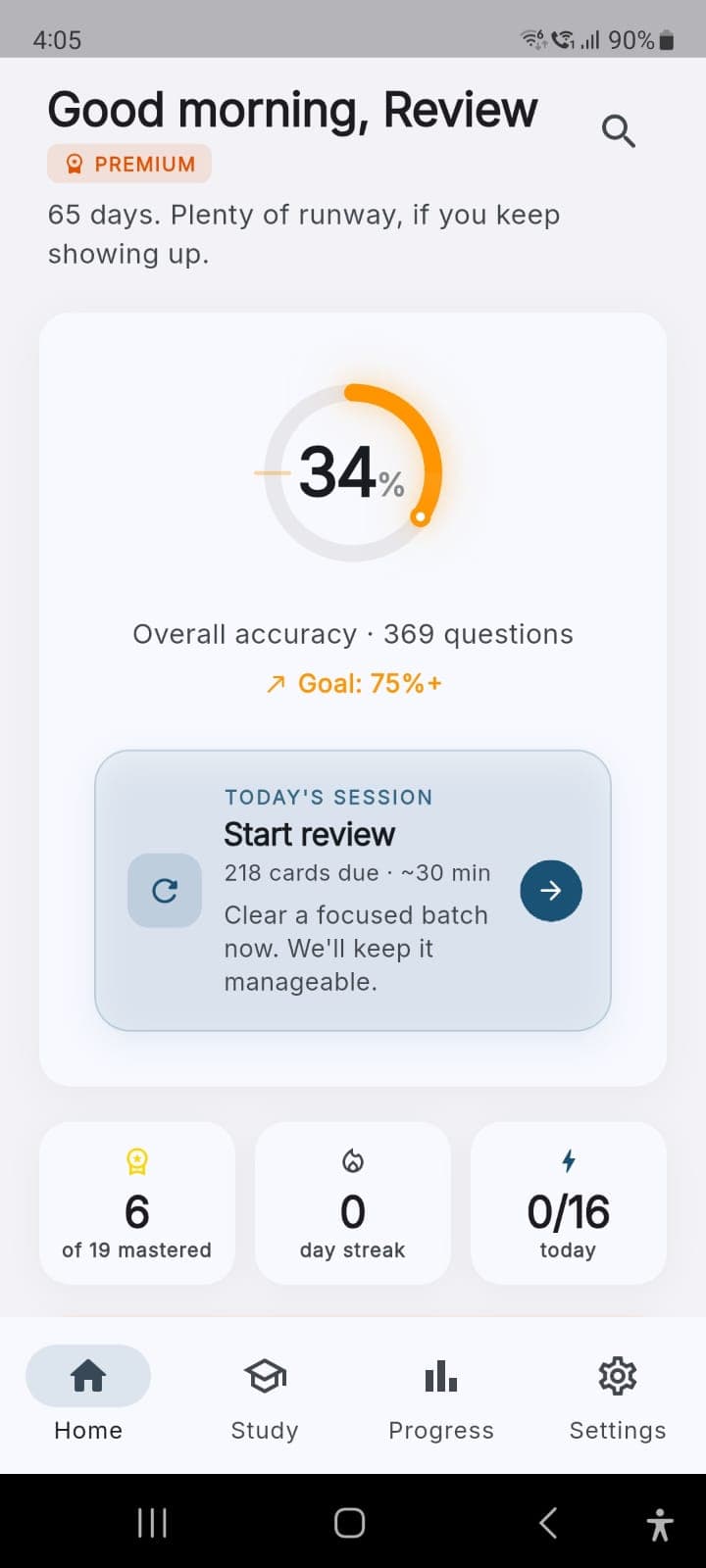
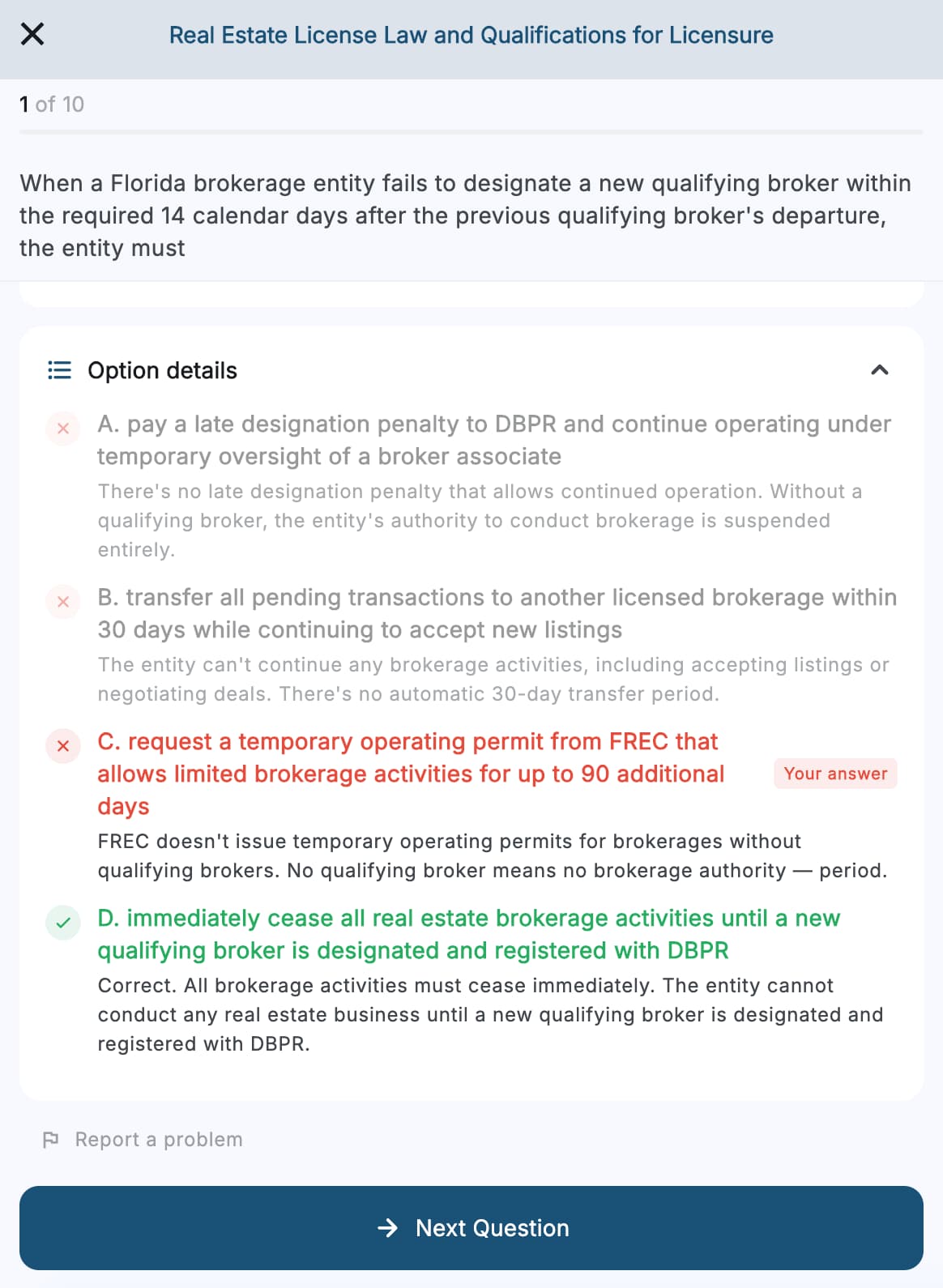
    Adaptive targeting detects whether you confuse the 15-day no-claim return with the 30-day claim notice, whether you apply calendar days to the 3-day notice, or whether you miss the 7-day written notice prerequisite for tenant remedies. When you miss one deadline, the engine feeds you more questions on that specific timeline until your accuracy is consistent. It does not waste your time on deadlines you already have down.

    Confidence calibration catches students who feel strong on landlord-tenant law because they can recite the numbers but consistently reverse which number applies to which situation. Reciting numbers is step one. Applying the right number to the right party in the right scenario is step two. The app measures whether your confidence matches your accuracy and surfaces the gap before exam day reveals it.

    Scenario rotation presents the same fact pattern with one changed variable. A deposit return with no claim: 15 days. The same scenario with a claim: 30 days. The same scenario with a missed deadline: forfeiture. By changing one fact, the app trains you to identify which detail in the question drives the answer, not just which number "sounds right."

    Download Pass Florida and take a free diagnostic across all 19 content areas. In 20 minutes, you will see exactly which landlord-tenant deadlines need work and which ones you can move past.


    Frequently Asked Questions

    How long does a Florida landlord have to return a security deposit?

    15 calendar days from lease termination if the landlord has no claim against the deposit. If the landlord intends to impose a claim, the landlord has 30 days to send a written notice by certified mail describing the claim. The tenant then has 15 days to object to the claim. These are three separate deadlines in sequence: 15 (no claim return), 30 (claim notice), 15 (tenant objection). The security deposit section covers the full timeline with examples.

    What happens if a landlord misses the 30-day claim notice deadline?

    The landlord forfeits the right to impose any claim on the security deposit. The full deposit must be returned to the tenant regardless of actual damage. This is not a procedural technicality. It is a statutory forfeiture. A landlord who discovers $2,000 in damage but sends the claim notice on day 34 has lost the right to claim any of it. The money goes back to the tenant.

    Can a landlord send eviction notices by email in Florida?

    Only if both parties have signed a written addendum to the lease allowing electronic notice under HB 615 (effective July 1, 2025). Both parties must also have provided valid email addresses. Without the signed addendum, email is not a valid delivery method for any Chapter 83 notice, including eviction notices. Traditional delivery methods (personal delivery, mail, or posting) remain required without the addendum.

    What is the difference between a 7-day curable and 7-day non-curable notice?

    A curable 7-day notice gives the tenant 7 days to fix the violation (remove an unauthorized pet, stop excessive noise) or vacate. A non-curable 7-day notice gives the tenant 7 days to vacate with no option to fix the problem. Non-curable notices apply to violations that cannot be corrected (destruction of property, criminal activity) or to the same type of violation repeated within 12 months of a prior curable notice. The eviction notices section covers each notice type with examples.

    Does the 3-day eviction notice include weekends?

    No. The 3-day notice for nonpayment of rent excludes weekends and legal holidays when counting the three days. If served on a Friday, day one is Monday, day two is Tuesday, day three is Wednesday. This exclusion applies only to the 3-day notice. The 7-day and 15-day notices count calendar days with no exclusions.

    What are a landlord's habitability obligations in Florida?

    Under F.S. 83.51, the landlord must maintain the dwelling in compliance with building, housing, and health codes. Specific obligations include structural maintenance, plumbing, hot water, heat, running water, functioning locks, smoke detectors, and pest control (in multi-unit buildings). Single-family homes and duplexes shift pest control and garbage removal to the tenant. There is no fixed deadline for repairs. The standard is "reasonable time." The landlord obligations section covers every obligation and the single-family exception.

    Can a tenant withhold rent if the landlord fails to make repairs?

    Yes, but only after sending a 7-day written notice to the landlord specifying the maintenance deficiency. Verbal complaints do not satisfy the statutory requirement. If the landlord fails to begin repairs within a reasonable time after receiving the written notice, the tenant may withhold rent. The tenant remedies section covers the full process.

    What is a fee in lieu of a security deposit?

    A non-refundable fee that some landlords collect instead of a traditional security deposit. Because the fee is non-refundable by definition, the 15-day return and 30-day claim notice rules do not apply. The landlord has no obligation to return the fee at lease termination. The exam may present this as a scenario where students mistakenly apply deposit return rules to a non-refundable fee.

    Is self-help eviction legal in Florida?

    No. Under F.S. 83.67, a landlord who changes locks, removes belongings, shuts off utilities, or physically blocks access to the unit is liable for actual and consequential damages or 3 months rent, whichever is greater. Self-help eviction is prohibited regardless of whether the tenant owes rent or has violated the lease. Removal must go through the court process and be executed by the sheriff.

    How does SB 948 affect landlords?

    SB 948 (effective October 1, 2025) requires landlords entering leases of one year or longer to provide a separate flood disclosure form at or before lease execution. If the landlord fails to provide the disclosure and the tenant's property sustains damage equal to or exceeding 50% of fair market value from flooding, the tenant may terminate the lease within 30 days of the flooding event. The 2026 changes guide covers SB 948 in the context of all 2025 Florida laws.

    What is the difference between a squatter and a holdover tenant?

    A holdover tenant had a valid lease that expired and continues to occupy the unit. Removal requires the full court eviction process. A squatter (unauthorized occupant) never had a lease and has no legal right to be on the property. Under SB 322/606, commercial and vacation property owners can request expedited removal through the sheriff for unauthorized occupants. The distinction is binary: prior lease or no prior lease.

    How much interest does a tenant earn on a security deposit held in an interest-bearing account?

    The tenant receives either 5% simple interest per year or 75% of the annualized average interest rate, whichever the landlord selects. The interest accrues during the tenancy and must be returned to the tenant along with the deposit at lease termination (assuming no claim). If the landlord holds the deposit in a non-interest-bearing account, no interest is owed. If the landlord posts a surety bond, the landlord must pay the tenant 5% simple interest per year directly.


    Related:

    The Florida-Specific Content Your Prep Course Probably Skipped

    Florida Real Estate Exam in 2026: Every Change You Need to Know

    Florida Real Estate Exam: 19 Topics Ranked by Weight and Difficulty

    Florida Real Estate Exam Pass Rate and What It Means for Your Preparation

    Property Rights and Ownership Types on the Florida Real Estate Exam

    Florida Real Estate Contracts Guide: Every Rule the Exam Tests

    Florida Brokerage Relationships Explained: Transaction Broker vs Single Agent vs No Brokerage

    Florida Real Estate Escrow and Trust Account Rules

    Fair Housing on the Florida Real Estate Exam: Protected Classes, Violations, and Exemptions

    How to Pass the Florida Real Estate Exam on Your First Attempt

    The 30-Day Study Plan for the Florida Real Estate Exam

    Florida Real Estate Practice Exam: 50 Free Questions With Full Explanations

    Florida Real Estate Exam Tricky Questions: The Strategy Guide

    How to Get a Florida Real Estate License: Step-by-Step Guide

    Ready to Pass the Florida Real Estate Exam?

    Download Pass Florida and start studying with questions that actually match the exam.