01 / Apply one agreed split at a time.
Commission and splits
Price × rate × brokerage share × associate share
$420,000 × 0.06 × 0.50 × 0.60 = $7,560 to the associate. These are assumed rates for the example, not required commission rates.
Practice Florida real estate math with 11 free questions on commissions, transfer taxes, prorations, loan amounts, and closing entries. Get a score, an explanation of every choice, seven worked examples, and an interactive proration exercise. No account needed.
Rules in effect through . Reviewed . Review and sources
Quiz mode · Test yourself
11 practice questions on computations and closing, scored, each with a full explanation after you answer. Every question is also written out below if you would rather study at your own pace.
All 11 questions and explanations are free. Computations and Closing carries 6% of the published sales associate outline, about 6 questions for this topic. Math also appears in other sections. This short set does not predict your state-exam score.
01 / Know what each formula answers
Read the units as part of the formula. Convert a percentage to a decimal before multiplying or dividing, and keep intermediate calculations unrounded unless instructed otherwise.
01 / Apply one agreed split at a time.
Price × rate × brokerage share × associate share
$420,000 × 0.06 × 0.50 × 0.60 = $7,560 to the associate. These are assumed rates for the example, not required commission rates.
02 / Use original cost as the denominator.
Profit or loss ÷ original cost × 100
A $60,000 profit on a $240,000 cost is 25%. Dividing by a $300,000 selling price gives a 20% margin, a different measure. Include the costs the problem tells you to include.
03 / A partial $100 is a whole taxable unit.
Whole $100 units, rounded up × the applicable rate
$352,150 produces 3,522 units. Outside Miami-Dade, 3,522 × $0.70 = $2,465.40. Identify the document and county before choosing the rate.
04 / Do not round the base to the next $100.
Taxable Florida-secured amount × 0.002
On a fully taxable $280,050 obligation with sufficient Florida collateral, $280,050 × 0.002 = $560.10. Collateral-value and allocation limits can change the base.
05 / Count the days, then assign the debit and credit.
Period amount ÷ period days × allocated days
With $3,650 annual taxes, a 365-day basis, and 181 seller days, the seller's share is $1,810. The contract or problem supplies the day-of-closing convention.
06 / Keep feet, square feet, and acres separate.
Rectangle: length × width; acres: square feet ÷ 43,560
150 ft × 200 ft = 30,000 sq ft. At $12 per sq ft, the indicated amount is $360,000. At a price per acre, convert the area to acres first.
07 / Use net operating income and a decimal rate.
Value = annual net operating income ÷ cap rate
$84,000 ÷ 0.07 = $1,200,000. Gross rent and cash flow after debt payments are different figures; use the income measure specified for the method.
08 / Use the lender's stated value basis.
LTV = loan ÷ lending value; loan = value × LTV
At 80% of the lower of $300,000 appraisal and $310,000 price, the loan is $240,000. The $70,000 price balance is before closing costs and credits.
09 / One mill is $1 per $1,000 of taxable value.
Taxable value × mills ÷ 1,000
18 mills is 0.018, not 18% or 0.18. Determine taxable value separately for school and non-school levies when their exemptions differ.
6% is 0.06. One point is 1% of the loan amount, so two points on $240,000 are $4,800. One mill is 0.001. A 7% cap rate used with $84,000 annual NOI should produce a value much larger than $84,000, not $5,880.
02 / Identify the document first
These are ordinary taxable-document rules. An exemption, refinancing, prior tax payment, or special collateral arrangement can change the result. The practice examples state their assumptions.
01 / Base: Taxable consideration
$0.70 per $100 or portion
Use consideration, which can include more than cash. Do not automatically substitute the buyer's loan amount.
02 / Base: Taxable consideration
$0.60, plus $0.45 surtax when applicable, per $100 or portion
No surtax on a document transferring only a qualifying single-family residence. Vacant land does not qualify for that exception.
03 / Base: Indebtedness evidenced
$0.35 per $100 or portion; $2,450 cap
Keep the note provision separate from the recorded-mortgage provision. A later recorded security instrument can require additional tax.
04 / Base: Indebtedness secured
$0.35 per $100 or portion; no cap
For a note and mortgage covering the same debt, apply the payment and prior-tax rules. Do not simply charge full documentary stamps twice.
05 / Base: Taxable amount secured by Florida real property
2 mills, or 0.002
A separate tax. No $100-unit rounding. The taxable amount cannot exceed the value of the Florida real-property collateral; mixed collateral can require allocation.
For $352,150, division by 100 gives 3,521.5 units, so use 3,522. At $0.70, that is $2,465.40. For exactly $352,100, use 3,521 units. Even one cent above an exact $100 boundary creates another documentary-stamp unit.
Intangible tax uses a different calculation. A fully taxable $280,050 base gives $280,050 × 0.002 = $560.10, without changing the base to $280,100.
Florida DOR, documentary stamp rates and examples · Florida DOR, intangible tax and collateral limits
A standalone taxable $1 million note under F.S. 201.08(1)(a) produces $3,500 before applying the $2,450 cap. A recorded $1 million mortgage under subsection (1)(b), with no exemption or prior tax payment, produces $3,500 without that cap.
When a note and mortgage cover the same debt, the statute directs payment on the mortgage at recordation and notation on the note. If a security instrument is recorded later, apply the prior-payment provisions. Do not use the note cap to cap the mortgage, or add two full stamp charges for the same obligation. Intangible tax and deed tax remain separate.
No. If a problem says the seller pays deed stamps or the buyer pays a particular charge, use that allocation. Do not turn it into a rule that every contract allocates the cost that way. Florida DOR states that parties to a taxable document are liable regardless of who agrees to pay, subject to the rules for exempt parties.
For intangible tax, DOR identifies the lender as the taxpayer and permits the lender to pass the amount to the borrower. The taxable base is limited to the Florida-secured amount and cannot exceed the Florida real-property collateral's value.
Florida DOR, documentary stamp rates and examples · Florida DOR, intangible tax and collateral limits
03 / Calculate, then explain the entry
Identify the period, day-count method, closing-day owner, and whether the money was paid or collected. Then use the same facts in both the math and the closing entry.
Change one fact, then explain the result
The starting example uses June 30 in a non-leap year, actual days, and seller ownership of the closing day. That gives 181 seller days. Adjust the facts below, then compare the entry.
Use the day count required by the problem. A 360-day method needs its own stated allocation; switching the year basis does not recount the calendar days.
Closing adjustment
$1,810.00
Seller debit · Buyer credit
Allocate the seller's 181 days. The buyer will pay the annual bill and receives the seller's share now.
$3,650.00 ÷ 365 × 181 = $1,810.00
Keep the daily rate unrounded; round the final adjustment to cents.
This is an expense exercise. Rent collected in advance is income and follows the separate example below. The written examples remain available without JavaScript.
Expense still unpaid
With $3,650 annual taxes, 365 days, and 181 seller days, the seller's share is $1,810. If the buyer pays the bill later, debit the seller and credit the buyer $1,810.
Expense prepaid by seller
For an otherwise reimbursable expense using those same figures, the buyer has 184 days. $3,650 ÷ 365 × 184 = $1,840. Debit the buyer and credit the seller $1,840.
A prorated entry is not a new tax assessment. It allocates the stated expense between the parties. Rent already collected by the seller needs a separate income analysis. FREC Course I syllabus, computations and related math objectives · CFPB, 12 C.F.R. 1026.38 Closing Disclosure entries
Use actual calendar days when instructed: January through June has 181 days in a non-leap year and 182 in a leap year. If the buyer owns June 30, remove that day from the seller's allocation. An actual-day leap-year calculation may use 366 as its annual basis when the problem calls for it.
A stated 30-day-month, 360-day method uses its own allocation. For example, a problem that expressly assigns 180 seller days on a 360-day basis with $3,600 annual taxes gives $1,800. Do not mix actual calendar days with a different method unless the question expressly tells you to. The contract or question controls the convention.
FREC Course I syllabus, computations and related math objectives · Work through the June 30 example →
04 / Keep the two sides straight
A buyer debit increases the amount due from the buyer; a buyer credit offsets it. A seller debit reduces the seller's proceeds; a seller credit increases the amount due to the seller.
On a small screen, scroll the comparison sideways to see both parties.
| Item | Buyer | Seller | Reason |
|---|---|---|---|
| Purchase price | Debit | Credit | The buyer owes the price; the seller is entitled to it before deductions. |
| Earnest money still available at closing | Credit | No automatic separate credit | The deposit reduces the buyer's remaining funds due. The seller already has the full price credited. |
| New loan proceeds | Credit | No separate seller credit | Loan proceeds help fund the buyer's purchase. They do not increase the agreed selling price. |
| Seller's old mortgage paid off | No charge in this payoff scenario | Debit | The seller's debt is paid from proceeds. Assumption of an existing loan is a different transaction. |
| Seller's share of an unpaid annual expense | Credit | Debit | The buyer will pay the bill later and receives the seller's share now. |
| Buyer's share of an expense prepaid by seller | Debit | Credit | The buyer reimburses the seller for the buyer's part of a cost already paid. |
| Buyer's share of rent already collected by seller | Credit | Debit | The seller passes the buyer's rental income to the buyer. Rent received is income, not a prepaid expense. |
| A general seller credit toward buyer costs | Credit | Debit | Apply the agreed, permitted credit once. A seller-paid item already deducted elsewhere must not be counted again. |
CFPB, 12 C.F.R. 1026.38 Closing Disclosure entries governs the Closing Disclosure's transaction summaries. These study labels explain the direction of the entry; a modern form may label its sections “Due from Borrower” and “Paid Already by or on Behalf of Borrower.”
Seller worksheet / Question calc-10
The seller pays the stated costs and payoff. No prorations, other fees, or credits apply.
Closing check 1
Check contract deadlines and contingencies, loan approval, title and survey matters, required repairs, insurance, the preclosing inspection, and the amount needed to close. The FREC syllabus includes these preliminary steps, not just arithmetic.
FREC Course I syllabus, computations and related math objectives
Closing check 2
On the standard five-page Closing Disclosure, review the loan terms and projected payments on page 1; itemized costs on page 2; cash to close and transaction summaries on page 3; loan disclosures on page 4; and loan calculations, other disclosures, and contact information on page 5. Use the form applicable to the transaction.
Closing check 3
Match the deposit still held to the credit shown, distinguish costs paid before closing from costs still due, confirm seller and lender credits, and compare the final terms with the Loan Estimate and contract. A cost shown as already paid should not be collected a second time.
Closing check 4
For the buyer, compare total charges with the loan, deposit, and other credits. For the seller, deduct payoffs, allocated costs, and adjustments from the credited price. Closing costs, buyer cash to close, and seller net proceeds are three different totals.
The $122,000 worksheet result is cash remaining after the specified costs and mortgage payoff. It does not tell you the seller's profit on the investment or taxable capital gain. Those calculations need the relevant cost or tax basis and adjustments.
For a basic profit-on-cost question, selling price minus the stated cost gives dollar profit; divide by original cost for the percentage. For a target-net problem with only a percentage commission and fixed deductions, selling price = (target net + fixed deductions) ÷ (1 − commission rate). If other charges vary with price or require tax-unit rounding, include those separately rather than applying that shortcut unchanged.
FREC Course I syllabus, computations and related math objectives · Compare profit and margin →
05 / Work the problem before revealing the answer
Write a labeled setup, calculate, then check the reasoning. Each example explains why a tempting shortcut gives a different answer.
Worked example 01
A parcel cost $240,000 and sells for $300,000. Ignore all other costs. What is the profit percentage based on original cost?
$60,000 profit, or 25% of cost.
The denominator is original cost. Dividing by $300,000 gives 20%, the margin on the selling price. The syllabus asks you to distinguish cost, selling price, and profit. This is not a calculation of taxable capital gain.
Worked example 02
A new taxable $280,050 loan is secured solely by a Florida property worth $350,000. Its mortgage is recorded, no exemption or prior tax payment applies, and the question asks only for documentary stamps on the secured debt plus intangible tax. What is the total?
$1,540.45 in these two loan taxes.
The intangible base keeps the exact debt amount. Do not add another full stamp charge for the note covering the same debt. Deed tax, recording fees, title charges, and other costs are outside this example.
Worked example 03
Compare two otherwise taxable Miami-Dade deeds, each for $352,150 consideration. One transfers only a qualifying single-family residence; the other transfers vacant land. No other exemption applies. How do the deed taxes differ?
$2,113.20 for the residence; $3,698.10 for the vacant land.
Do not use the $0.70 rate from the other Florida counties. The single-family exception removes the Miami-Dade surtax, not the underlying deed tax. The statute also addresses qualifying condominium and cooperative units.
Worked example 04
Annual taxes are $3,650, unpaid at closing. Closing is June 30 in a non-leap year. Use actual days, a 365-day year, and give the seller the closing day. What is the seller's adjustment?
$1,810 seller debit and buyer credit.
The buyer will pay the bill later, so the seller reimburses the buyer now. If the buyer instead owns June 30, the seller has 180 days and the adjustment is $1,800. A 360-day method is a different stated convention, not permission to mix day-count methods.
Worked example 05
The seller collected the full $3,000 June rent. Closing is June 10, the seller owns the closing day, and the problem uses June's actual 30 days. What adjustment gives the buyer the rent for June 11 through June 30?
$2,000 seller debit and buyer credit.
The seller already holds money belonging to the buyer's ownership period. This direction is different from reimbursing the seller for an expense the seller paid in advance. Read whether money was paid out or collected.
Worked example 06
Price is $310,000; appraisal is $300,000. The lender offers 80% of the lower amount. An $8,000 deposit remains available. The buyer owes $9,000 in costs at closing and receives a separate, permitted $3,000 seller credit. No other adjustments or financing apply. How much cash must the buyer bring?
$68,000 cash to close.
Twenty percent of the appraised value is only $60,000. The buyer also covers the $10,000 appraisal gap. Credit the deposit once, and do not subtract a seller credit again if it is already reflected in the costs supplied.
Worked example 07
In 2026, assessed value is $285,000 and the owner qualifies for the full first $25,000 and additional $26,411 homestead exemptions. Assume 18 non-school mills and 6 school mills, with no other exemptions or assessments. What is the combined tax?
$5,764.60 for the two stated levies.
The additional homestead exemption does not reduce school levies. Applying all 24 mills to the lower non-school base would understate the tax. The millage rates here are assumed for practice; they are not a county's quoted 2026 rates.
06 / Review every answer
Every question, calculation, wrong-choice explanation, and source is available without completing the quiz or signing in.
Try each question before opening its answer. These are original practice items, not actual or recalled Pearson VUE exam questions.
Question 1 · calc-1 · Commission through two splits
Answer A. $7,560
First find the total commission: $420,000 × 0.06 = $25,200. The listing brokerage’s half is $25,200 × 0.50 = $12,600. The associate receives $12,600 × 0.60 = $7,560. The 6% rate and both splits are assumed terms for this problem, not legally required commission rates.
Remember: Read what the question asks for. 25,200 is the total, 12,600 is the brokerage's half, and 15,120 would be 60 percent of the whole commission. The agent's share is 7,560.
B. $12,600
$12,600 is the listing brokerage’s half of the total commission, before paying its associate.
C. $15,120
$15,120 takes 60% of the entire commission and skips the equal split between brokerages.
D. $25,200
$25,200 is the full commission on the sale. It is not the listing associate’s share.
Sources: FREC Course I syllabus, computations and related math objectives
Report a problem with calc-1Question 2 · calc-2 · Deed stamps and partial $100 units
Answer B. $2,465.40
$352,150 ÷ 100 = 3,521.5 taxable units. Round up to 3,522 units, then multiply: 3,522 × $0.70 = $2,465.40. Rounding applies to the $100 units, not merely to the final tax amount. Orange County uses the general Florida deed rate; Miami-Dade is different.
Remember: The unrounded figure 352,150 times 0.007 gives 2,465.05, which skips the round-up rule. Using the note rate of 0.35 gives 1,232.70. The deed answer is 2,465.40.
A. $2,465.05
$2,465.05 multiplies the unrounded consideration by 0.007. Documentary stamps require the partial $100 unit to round up.
C. $1,232.70
$1,232.70 uses the $0.35 note or mortgage rate. This question asks about a deed outside Miami-Dade.
D. $246.54
$246.54 uses a rate one-tenth as large as the required deed rate.
Sources: F.S. 201.02, deeds and taxable consideration · Florida DOR, documentary stamp rates and examples
Report a problem with calc-2Question 3 · calc-3 · Documentary stamps on a note
Answer C. $980
$280,000 ÷ 100 = 2,800 units. Multiply by $0.35 to get $980. This is below the $2,450 cap for notes under F.S. 201.08(1)(a). The recorded-mortgage provision has no cap, and the statute supplies payment rules when a note and mortgage evidence the same debt.
Remember: Using the deed rate of 0.70 gives 1,960, which is double the correct note tax. The note rate is 0.35 per 100.
A. $1,960
$1,960 uses $0.70 per $100, the general deed rate rather than the note rate.
B. $560
$560 is the result of multiplying by 0.002, the intangible-tax rate. It does not answer the note-stamp question.
D. $2,800
$2,800 is the number of $100 units. Multiply those units by $0.35 to find the tax.
Sources: F.S. 201.08, notes, recorded mortgages, and prior payment · Florida DOR, documentary stamp rates and examples
Report a problem with calc-3Question 4 · calc-4 · The intangible-tax base
Answer D. $560
The entire $280,000 debt is taxable under these facts and is less than the collateral value. $280,000 × 0.002 = $560. Unlike documentary stamps, intangible tax does not round the base to the next $100. Do not apply this full-debt shortcut when collateral-value limits, mixed collateral, or an exemption change the taxable base.
Remember: Do not round for intangible tax, and do not use the 0.35 note rate. The intangible tax is 0.002 times the loan, which is 560.
A. $980
$980 uses the documentary-stamp rate of $0.35 per $100. The question asks for intangible tax.
B. $1,960
$1,960 applies the general deed-tax rate to the debt amount. Both the document and the rate are wrong here.
C. $5,600
$5,600 uses 0.02, or 2%. Two mills is 0.002, or 0.2%.
Sources: F.S. 199.133, nonrecurring intangible tax and its base · Florida DOR, intangible tax and collateral limits
Report a problem with calc-4Question 5 · calc-5 · Actual-day tax proration
Answer A. $1,810
Count actual seller days through June 30: 31 + 28 + 31 + 30 + 31 + 30 = 181. The daily rate is $3,650 ÷ 365 = $10. The seller’s share is 181 × $10 = $1,810. Because the taxes are unpaid and the buyer will pay the bill, this adjustment is a seller debit and buyer credit. Use the stated convention for the closing day.
Remember: Half of 3,650 is 1,825, but the period is not exactly half a year. The correct day count from January 1 through June 30 is 181 days, giving 1,810.
B. $1,825
$1,825 is exactly half of the annual tax. The 181-day period is not half of 365 days.
C. $1,800
$1,800 uses 180 days. Under the stated actual-day convention, the seller owns all 181 days through June 30.
D. $1,840
$1,840 is the remaining 184 days of the year, the buyer’s period under these facts.
Sources: FREC Course I syllabus, computations and related math objectives · CFPB, 12 C.F.R. 1026.38 Closing Disclosure entries
Report a problem with calc-5Question 6 · calc-6 · Square-foot area and price
Answer B. $360,000
Area is 150 ft × 200 ft = 30,000 sq ft. At $12 per sq ft, 30,000 × $12 = $360,000. The square-foot units cancel, leaving dollars. You would convert to acres first only if the price were stated per acre.
Remember: Length × width gives area. Adding side lengths does not. Identify whether the price is per square foot or per acre before multiplying.
A. $4,200
$4,200 comes from adding 150 and 200 and multiplying by $12. Adding side lengths does not give area.
C. $30,000
$30,000 is the area in square feet, not the dollar amount. Multiply by the price per square foot.
D. $43,560
43,560 is the number of square feet in one acre. It is not this lot’s price or area.
Sources: FREC Course I syllabus, computations and related math objectives
Report a problem with calc-6Question 7 · calc-7 · Income capitalization
Answer C. $1,200,000
For this direct-capitalization problem, value = annual NOI ÷ capitalization rate. Convert 7% to 0.07: $84,000 ÷ 0.07 = $1,200,000. Check it backward: $1,200,000 × 0.07 = $84,000. Use the supplied NOI, not gross rent or a figure after debt service.
Remember: Divide by the cap rate, do not multiply. Multiplying 84,000 by 0.07 gives 5,880, which is not a value.
A. $588,000
$588,000 comes from multiplying by 7 rather than dividing by the decimal rate 0.07.
B. $1,000,000
$1,000,000 would imply an 8.4% capitalization rate on $84,000 NOI. The required rate here is 7%.
D. $5,880
$5,880 multiplies income by 0.07. Capitalizing this annual NOI requires division.
Sources: FREC Course I syllabus, computations and related math objectives · IRS valuation guidelines, income approach
Report a problem with calc-7Question 8 · calc-8 · LTV and the appraisal gap
Answer D. $240,000
Use the lower amount specified: $300,000 appraised value, not the $310,000 price. $300,000 × 0.80 = $240,000 maximum loan. The price balance is $310,000 − $240,000 = $70,000, before closing costs, the deposit, and other credits. The lower-value basis is the usual Fannie Mae purchase calculation, with program-specific exceptions.
Remember: Do not use the higher contract price. 310,000 times 0.80 gives 248,000, but the lender uses the lower 300,000 value.
A. $248,000
$248,000 uses 80% of the higher contract price. The question specifies the lower of price and appraisal.
B. $300,000
$300,000 is the lending value before applying the 80% limit. It is not the loan amount.
C. $60,000
$60,000 is 20% of the appraised value. The question asks for the loan, and the price balance also includes an appraisal gap.
Sources: Fannie Mae, purchase loan-to-value calculation
Report a problem with calc-8Question 9 · calc-9 · 2026 homestead and millage
Answer A. $4,204.60
For non-school levies, subtract both exemptions: $285,000 - $25,000 - $26,411 = $233,589 taxable value. Then $233,589 × 18 ÷ 1,000 = $4,204.602, or $4,204.60. Florida DOR sets the 2026 additional exemption at $26,411.
Remember: $4,230 uses the old combined $50,000 exemption. $5,130 ignores exemptions. The additional exemption does not reduce school taxes, so the school taxable value would be $260,000; this question supplies a non-school rate only.
B. $5,130.00
$5,130 applies 18 mills to the full assessed value and ignores both stated exemptions.
C. $4,230.00
$4,230 uses the old combined $50,000 exemption and misses the inflation-adjusted 2026 amount.
D. $4,680.00
$4,680 subtracts only the first $25,000 exemption. The supplied 18 mills applies to non-school levies, which also receive the qualifying additional exemption.
Sources: Florida DOR, 2026 additional homestead exemption · F.S. 196.031, homestead exemptions and school levies
Report a problem with calc-9Question 10 · calc-10 · Seller net proceeds
Answer B. $122,000
Add the seller's costs. Commission is 400,000 times 0.06, which is 24,000. Deed stamps are 400,000 divided by 100, times 0.70, which is 2,800. The title charge is 1,200, and the mortgage payoff is 250,000. Total costs are 278,000. Net proceeds are 400,000 minus 278,000, which is $122,000.
Remember: A multi-step closing problem punishes skipped lines. The most common misses are forgetting the mortgage payoff ($372,000) and using the note rate of 0.35 instead of the deed rate of 0.70 on the stamps ($123,400).
A. $124,800
$124,800 omits the $2,800 deed-stamp charge from the seller’s costs.
C. $123,400
$123,400 uses the $0.35 note rate for the deed stamps instead of the stated $0.70 rate.
D. $372,000
$372,000 omits the $250,000 mortgage payoff. Net proceeds must reflect that debt payment.
Sources: F.S. 201.02, deeds and taxable consideration · FREC Course I syllabus, computations and related math objectives · CFPB, 12 C.F.R. 1026.38 Closing Disclosure entries
Report a problem with calc-10Question 11 · calc-11 · Earnest-money credit
Answer C. a buyer credit because it reduces the cash the buyer must bring
The $8,000 deposit is a buyer credit because it has already been paid toward the transaction and remains available. It reduces the remaining cash to close. The full price is still a buyer debit and seller credit; the deposit is not a second seller credit. If part of a deposit was already used for a closing charge, follow the Closing Disclosure rules so that amount is not counted twice.
Remember: A prior payment is not charged twice. The buyer receives credit for the deposit already made.
A. a buyer debit because the buyer paid it
The deposit has already been paid and remains available. Debiting it again would overstate what the buyer must bring.
B. a seller debit because the broker held it
A broker holding the deposit does not by itself create a seller debit. The question asks how to credit the buyer’s prior payment.
D. a seller credit because it is part of the price
The full purchase price is already a seller credit. Adding the deposit as another seller credit would double-count part of that price.
Sources: CFPB, 12 C.F.R. 1026.38 Closing Disclosure entries · CFPB, how to check a Closing Disclosure
Report a problem with calc-11Your next step toward exam day
Keep preparing with 1,142 questions across all 19 areas. Use Math Coach, review missed answers, work on weak topics, and take full-length timed exams in Pass Florida. Start with free access. The full package is $39.99 once, with no subscription.
Exam prep only. Not a substitute for the 63-hour course, DBPR steps, or Pearson VUE scheduling.
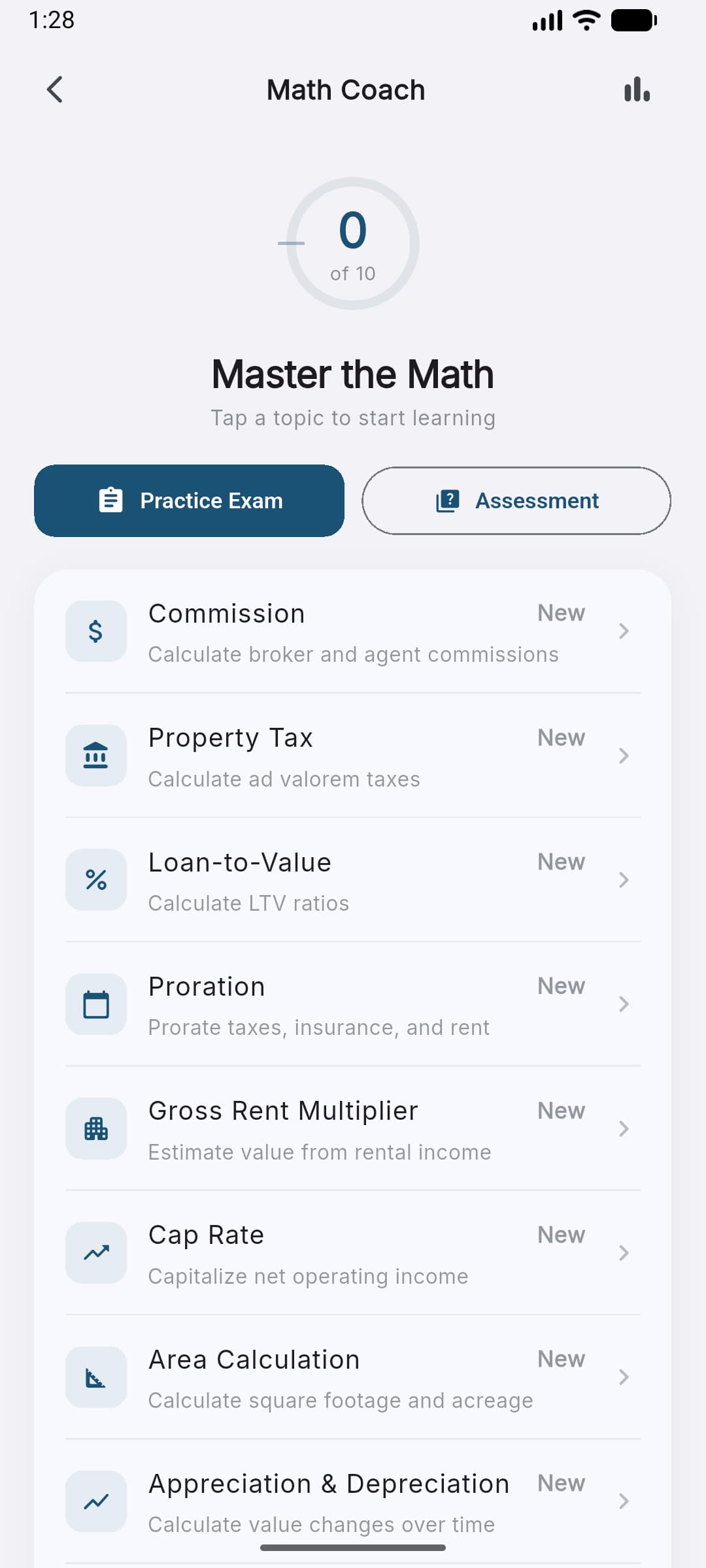
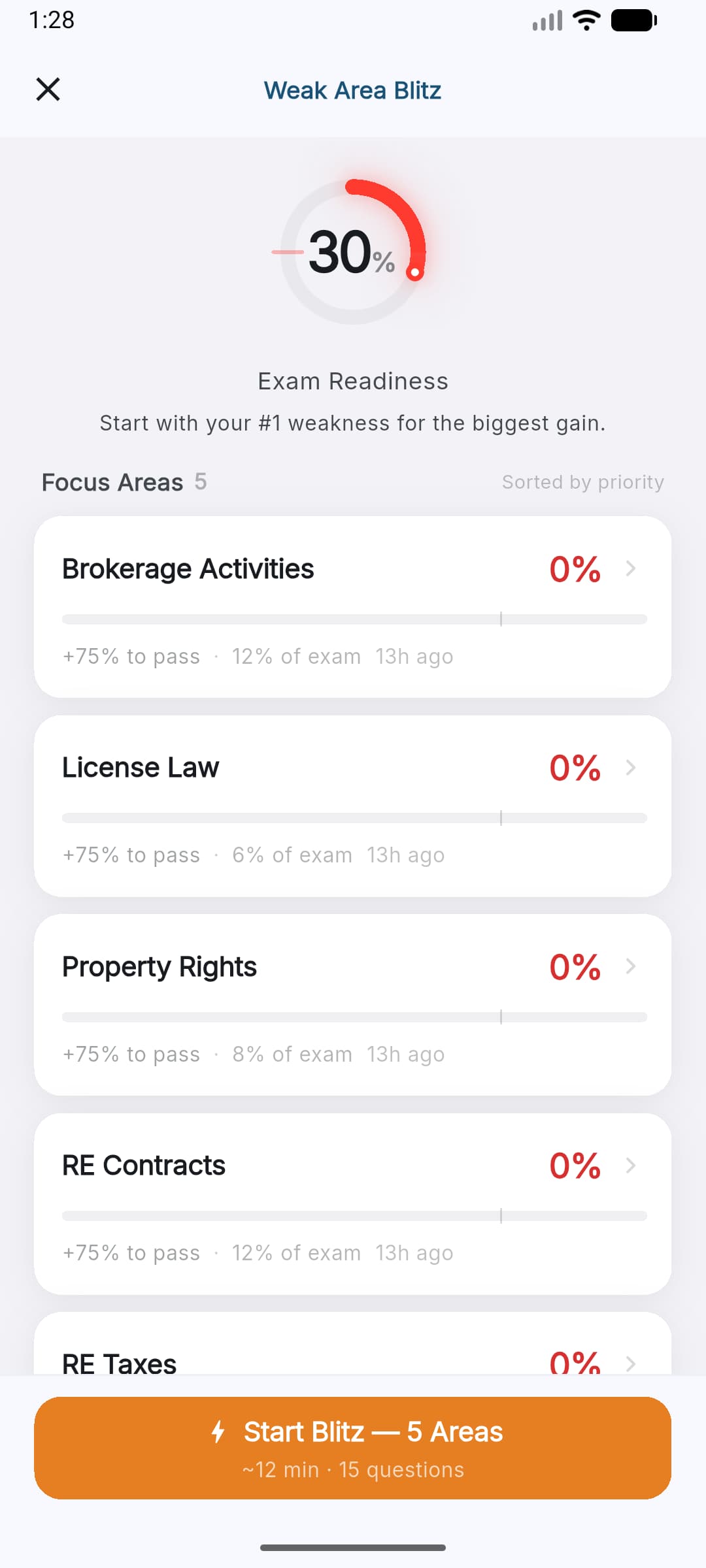
Study in your browser, or download for iPhone and Android. Offline study is available in the mobile app. Your free website quiz result does not transfer to the app.
07 / Connect the practice to the outline
The published Computations and Closing section has two main headings. The Course I syllabus develops these into computations, closing preparation, prorations, transfer taxes, other charges, entry rules, and Closing Disclosure review.
In this resource: The commission, tax, and proration questions; profit example; formulas; and practice lab.
Also review: Practice solving for selling price or original cost as well as profit. Math also appears in the mortgage, legal-description, appraisal, and property-tax sections.
In this resource: The debit-and-credit comparison, cash-to-close example, seller worksheet, and Closing Disclosure checks.
Also review: Use a complete sample Closing Disclosure to trace buyer and seller entries, prorations, prior payments, fees, and final totals.
DBPR sales associate exam outline, Section XIV supplies the 6% weight and two headings. FREC Course I syllabus, computations and related math objectives supplies the detailed objectives. Area, capitalization, LTV, and millage questions also reinforce the separate legal-description, appraisal, mortgage, and tax sections.
Write down the amount you need to find and the base each rate applies to. A commission split uses a brokerage share, a deed tax uses taxable consideration, and a loan calculation uses the lender’s stated value. Do not multiply until those labels make sense.
Keep the rounding rules separate. Documentary stamps use each $100 or portion of the applicable base. Intangible tax uses the taxable Florida-secured amount without rounding it to a $100 unit. For prorations, use the stated day count and keep the daily rate unrounded until the final amount unless the problem directs otherwise.
At closing, name the person who owes or receives each amount. A buyer credit reduces the remaining cash due. A seller debit reduces proceeds. Separate deposits, costs paid before closing, lender or seller credits, and the purchase price so the same money is not counted twice.
Questions about Florida real estate math
Real Estate Related Computations and Closing of Transactions carries 6% of the published 100-question sales associate exam outline, about 6 questions for that topic. That is not a promise of only 6 calculations across the whole exam. Mortgage finance, legal descriptions, appraisal, and property taxes have their own math objectives. This page offers 11 practice questions and seven worked examples.
Start with commissions and splits, profit on original cost, documentary stamps, intangible tax, prorations, and closing-statement totals. Then practice area, acreage, income capitalization, loan-to-value, and millage for the related exam areas. Write the base, rate, units, and person receiving the debit or credit before calculating.
The current DBPR candidate booklet permits calculators at test centers and lists the required features, including a silent, handheld, battery-operated, nonprinting device without an alphabetic keypad. It also contains specific device guidance. Check the current booklet and your testing instructions before exam day; do not assume a phone, stored notes, or every financial calculator is acceptable.
Divide the applicable consideration or indebtedness into $100 units and round any partial unit up. Then multiply by the applicable rate. For a $352,150 taxable deed outside Miami-Dade, 3,521.5 units becomes 3,522; at $0.70 per unit, the tax is $2,465.40. An exact multiple of $100 needs no additional unit.
Miami-Dade uses $0.60 per $100 or portion, plus a $0.45 surtax when applicable. The surtax does not apply to a document transferring only a qualifying single-family residence. Vacant land does not qualify for that exception. Other Florida counties generally use $0.70 per $100 or portion. Identify the county and transfer before choosing a rate.
The cap applies to the notes and written obligations described in F.S. 201.08(1)(a). The recorded-mortgage provision in F.S. 201.08(1)(b) has no cap. At $1 million of fully taxable debt, a standalone note under the capped provision reaches $2,450, while a recorded mortgage without prior tax payment produces $3,500. Apply the statutory credit rules if tax was already paid.
Do not simply double the charge when the note and mortgage evidence the same debt. F.S. 201.08 directs payment on the mortgage at recordation and notation on the note, and provides rules for prior tax payments. Deed stamps and nonrecurring intangible tax are separate taxes. An exam problem should tell you which documents and amounts to include.
No. Multiply the taxable amount secured by Florida real property by 0.002, then express the tax in cents. A fully taxable $280,050 obligation with sufficient Florida collateral produces $560.10. The taxable base cannot exceed the collateralized Florida property’s value, and mixed collateral can require allocation. The $100-unit rule belongs to documentary stamps.
Follow the contract or the convention stated in the question. Also identify whether the problem uses actual days, a 365- or 366-day year, or an expressly stated 360-day method. Do not assume that six calendar months is half a 365-day year. Under an actual-day non-leap-year convention, January 1 through June 30 is 181 days.
One common example is the seller’s share of an unpaid expense that the buyer will pay after closing. Another is rent the seller already collected for the buyer’s ownership period. By contrast, the buyer’s share of a reimbursable expense prepaid by the seller is a buyer debit and seller credit. Identify whether the item is income or an expense and who already received or paid the money.
A deposit already paid and still available at closing is credited to the buyer, reducing the remaining cash due. Do not charge it twice. If some deposit money was already used for a closing cost, reconcile that prior payment and the remaining deposit according to the Closing Disclosure instructions.
Closing costs are the transaction and loan charges. Buyer cash to close also accounts for the purchase-price balance, loan proceeds, the deposit, credits, and prorations. In a simple purchase, start with price plus costs and debit adjustments, then subtract the loan, available deposit, and credit adjustments. Do not subtract a credit twice if it is already included in a net cost figure.
Use the amount and eligibility stated in the problem. Florida DOR lists a maximum additional homestead exemption of $26,411 for 2026, applied to qualifying assessed value above $50,000 for non-school levies. The first exemption is up to $25,000. The additional exemption does not reduce school levies, so school and non-school taxable values can differ. Do not automatically subtract $51,411 from every assessment.
All 11 questions, 33 wrong-choice explanations, seven worked examples, and the proration exercise are free without an account. They are original practice items, not actual or recalled Pearson VUE questions or a substitute for required licensing education. Open the web app or download Pass Florida for Math Coach, more questions, missed-answer review, weak-area practice, and full-length timed exams.
Sources and editorial review
Published by Pass Florida. Reviewed on for rules in effect through .
This review checked the tax rates, exemptions, answer calculations, day-count assumptions, and closing entries against the cited primary sources. The published candidate booklet is effective January 2025 and the Course I syllabus is effective January 1, 2023.
The 2026 additional homestead exemption comes from DOR's January 2026 notice. Commission percentages, millage rates, loan terms, and costs in the examples are stated practice assumptions. Special transactions can require different rules; follow the facts supplied.
Found an error? Use the correction link under a question or send the question ID and supporting source.
Review a definition, worked example, or common exam trap before your next quiz.