Free · No signup · Scored · Statute-referenced

    Florida Real Estate Practice Questions by Topic

    The Florida sales associate exam pulls 100 questions from 19 official content areas. Practice them the way they are tested: one area at a time, scored, with a full explanation and the statute behind every answer. Pick a topic and start.

    176 original questions · Accuracy checked

    Choose a topicTake the timed practice exam

    Choose your mode

    Practice by topic or simulate the exam?

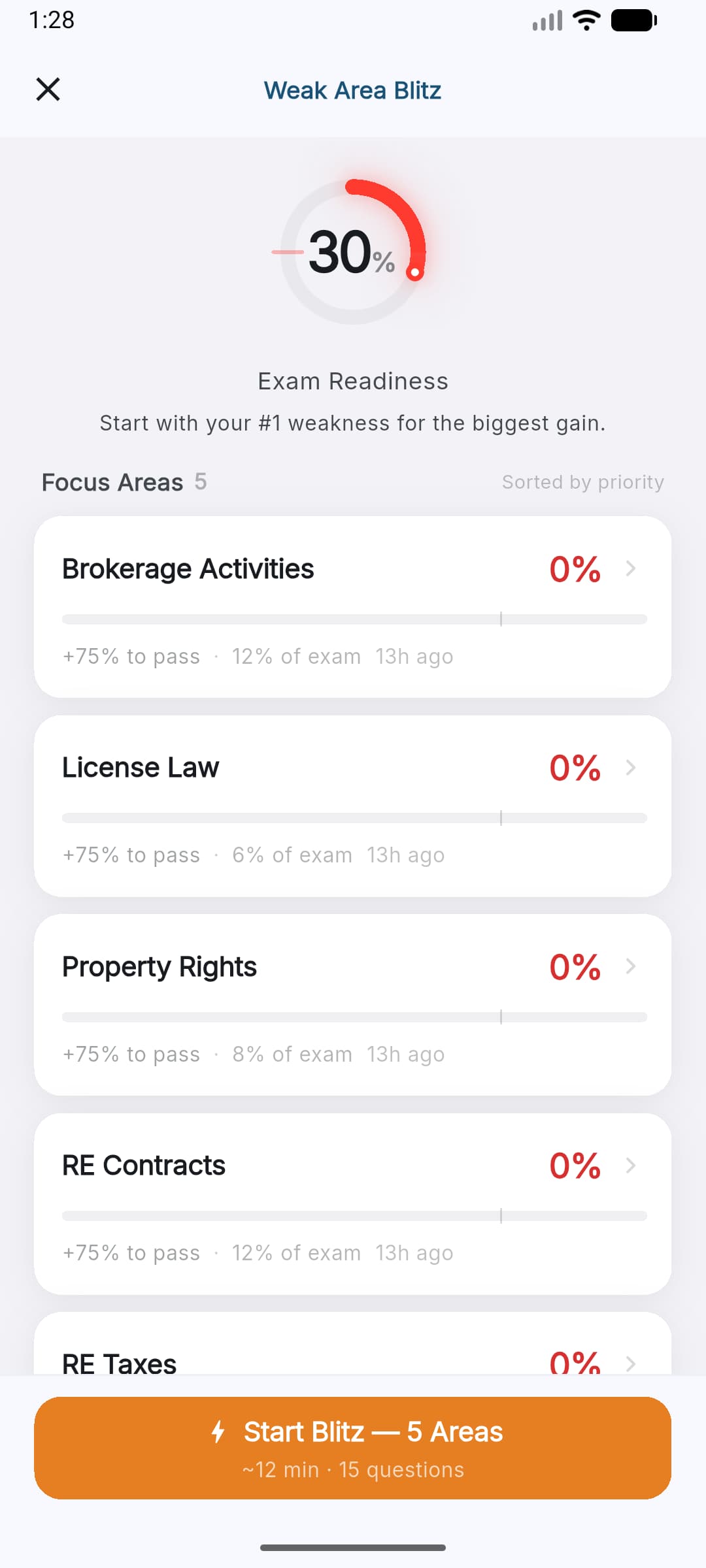
    Use topic practice to learn and repair weak areas. Use the timed practice exam to test recall without topic labels. If you do not know where to begin, the five-question diagnostic will point you toward a useful starting place.

    By topic

    Practice by topic

    All 19 official content areas, ordered by how heavily the exam weights them. Every set is scored, explained, and statute-referenced.

    Showing 19 topics

    Ready for mixed practice?

    Take the free timed Florida real estate practice exam

    25 scored questions · 30 minutes · blueprint-weighted · graded against the 75% passing line
    Start timed exam
    A study loop that works

    How to turn practice questions into a higher score

    Do not measure progress by the number of questions you finish. Measure it by whether you can explain why the tempting answer is wrong and apply the rule again in a new scenario.

    1. 1Choose one target

      Start with a high-weight area or a topic your recent results show is weak.

    2. 2Answer before studying

      Commit to an answer first. That exposes whether you know the rule or only recognize it.

    3. 3Repair the reason

      Read every explanation. Use the study guide for the underlying concept or the math formula reference for calculations.

    4. 4Prove it in mixed practice

      When the topic feels stable, take the timed practice exam without labels or notes.

    Exam blueprint

    How the 100 questions are split across the 19 areas

    The DBPR publishes a weighting for every content area. Those weights decide how many of the 100 questions each area is worth, so they also decide where your study time pays. The four heaviest areas below are worth 41 questions between them. The lightest seven are worth 13. Study in that order.

    What each area actually tests

    Area names on the DBPR outline are broad. Here is what each one asks you to do on test day, heaviest first.

    Brokerage Activities12% of the exam
    Real Estate Brokerage Activities and Procedures accounts for 12 percent of the Florida sales associate exam, or about 12 of 100 questions. Expect practical scenarios on escrow, advertising, commissions, broker supervision, business entities, unlicensed assistants, and antitrust. The 12 original questions below test the rules most likely to cost you points, with a primary source and plain-English explanation after every answer.
    Contracts12% of the exam
    Real Estate Contracts accounts for 12 percent of the Florida sales associate exam, or about 12 of 100 questions. Expect scenarios on contract formation, classifications, negotiation, termination, remedies, options, financing clauses, and mandatory disclosures. These 12 original questions focus on the decisions the exam makes easy to confuse, with a primary source and plain-English explanation after every answer.
    Residential Mortgages9% of the exam
    Residential Mortgages accounts for 9 percent of the Florida sales associate exam, or about 9 of 100 questions. Expect scenarios on loan instruments, Florida lien theory, mortgage clauses, government-backed and conventional loans, assumptions, buyer qualification, and foreclosure. These ten original questions give you a scored check of the rules and calculations candidates most often mix up, with a primary source after every answer.
    Property Rights8% of the exam
    Property rights accounts for about 8 of the 100 questions on the Florida sales associate exam. Expect fact patterns on estates, co-ownership, the bundle of rights, constitutional homestead, condominiums, cooperatives, timeshares, and association disclosures. These ten original questions focus on the distinctions that make otherwise plausible answers wrong, with a primary source after every answer.
    Appraisal8% of the exam
    Real Estate Appraisal accounts for about 8 of the 100 questions on the Florida sales associate exam. Expect the three approaches to value, comparable adjustments, depreciation, market value, highest and best use, USPAP, CMA, and BPO. These ten original questions combine the definitions, judgment calls, and formulas most likely to expose a weak spot, with a primary source after every answer.
    Authorized Relationships7% of the exam
    Authorized Relationships, Duties and Disclosures accounts for 7 percent of the Florida sales associate exam, or about 7 of 100 questions. Florida presumes transaction brokerage unless a single-agent or no-brokerage relationship is established in writing, and it prohibits dual agency. These nine original questions test the duty lists, disclosure timing, confidentiality rules, and exceptions you need to separate on exam day, with the controlling statute after every answer.
    Titles and Deeds7% of the exam
    Titles, Deeds, and Ownership Restrictions accounts for about 7 of the 100 Florida sales associate exam questions. Expect deed warranties, execution and delivery, recording and notice, title insurance, easements, liens, restrictions, and adverse possession. These nine original questions test the distinctions that turn a familiar definition into a scored answer, with a primary source after every explanation.
    License Law and Qualifications6% of the exam
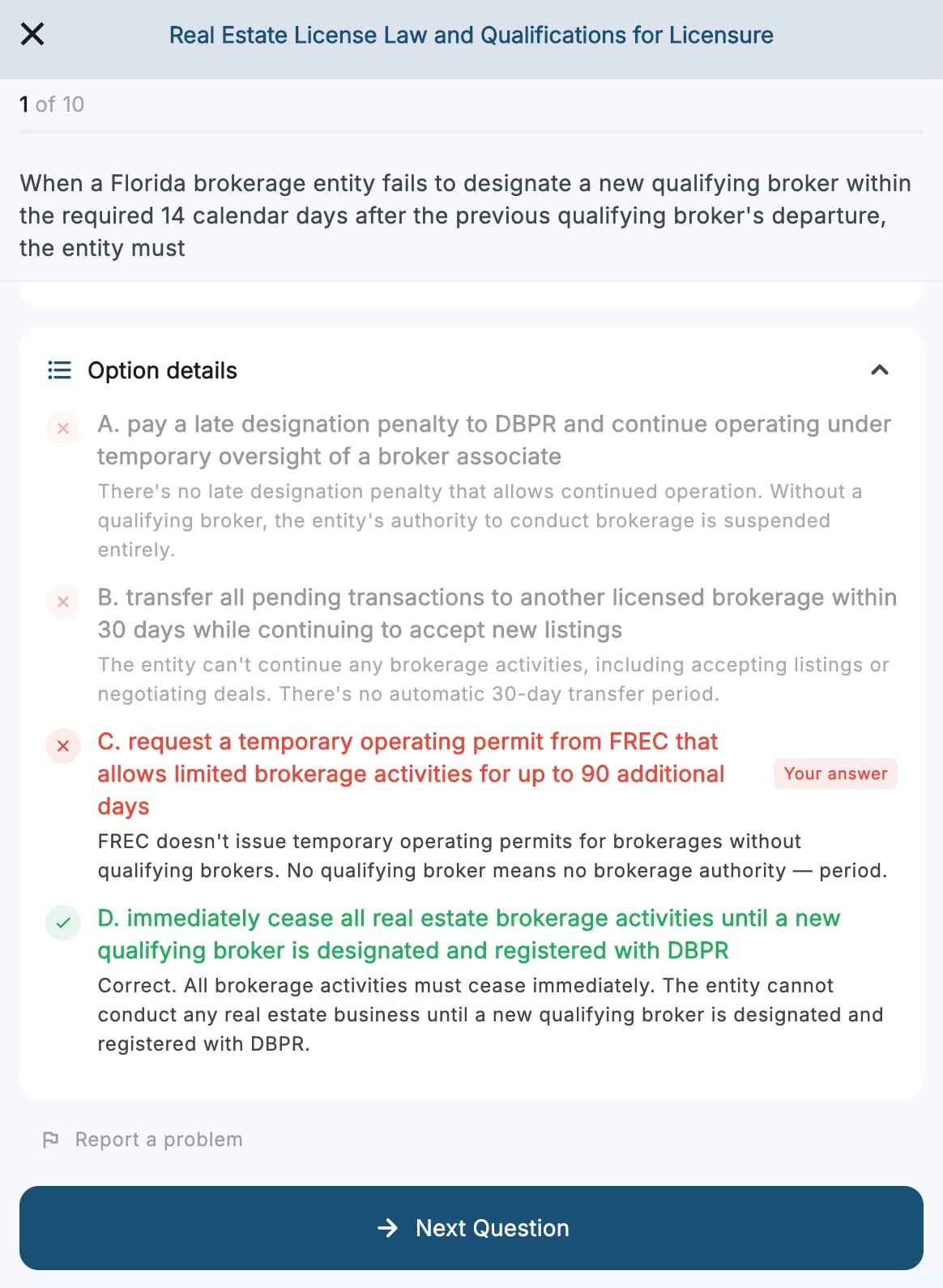
    License Law and Qualifications for Licensure accounts for about 6 of the 100 Florida sales associate exam questions. Expect exact rules on who needs a license, exemptions, applicant qualifications, education hours, broker experience, renewal, and license status. These eight original questions focus on numbers and exceptions that are easy to confuse, with a primary source after every answer.
    Computations and Closing6% of the exam
    Real Estate Computations and Closing of Transactions accounts for about 6 of the 100 Florida sales associate exam questions. You need to choose the formula, apply the correct Florida rate, and classify each closing item before calculating. These 11 original worked questions cover commissions, documentary stamps, intangible tax, prorations, area, value, loan-to-value, millage, and closing-statement entries, with an official source after every solution.
    Legal Descriptions5% of the exam
    Legal Descriptions accounts for about 5 of the 100 Florida sales associate exam questions. Expect the three description methods, township and section vocabulary, Florida's survey reference lines, and fractional-acreage math. These eight original questions move from identification to calculation, with a clear solution and authoritative source after every answer.
    Types of Mortgages and Financing4% of the exam
    Types of Mortgages and Sources of Financing accounts for about 4 of the 100 Florida sales associate exam questions. Expect mortgage-market roles, federal institutions, loan types, and fee calculations. These nine original questions distinguish origination from secondary-market activity and separate Fannie Mae and Freddie Mac loan purchases from Ginnie Mae's government-backed MBS guaranty, with an authoritative source after every answer.
    Violations and Penalties3% of the exam
    Violations, penalties, and procedures account for about 3 questions on the Florida sales associate exam. Know who handles each stage: DBPR investigates and prosecutes, a probable cause panel determines whether probable cause exists, an administrative law judge hears disputed material facts, and FREC issues the final order. These eight original questions also cover the $5,000-per-count fine, 10-year suspension limit, filing deadlines, and Recovery Fund limits, with the controlling source after every answer.
    Federal and State Laws3% of the exam
    Federal and state laws account for about 3 questions on the Florida sales associate exam. The official outline spans fair housing, federal land and environmental law, federal mortgage-lending law, and Florida's Residential Landlord and Tenant Act. These 11 original questions cover the seven Fair Housing Act classes, prohibited conduct, lead and CERCLA rules, RESPA and ECOA, disclosure duties, and Florida security-deposit deadlines, with a primary source after every answer.
    Taxes Affecting Real Estate3% of the exam
    Taxes affecting real estate account for about 3 questions on the Florida sales associate exam. Expect Florida property-tax rules and math plus federal income-tax basics. For the 2026 tax roll, the standard $25,000 homestead exemption still applies to all levies, while the additional non-school exemption is $26,411. These nine original questions cover millage, Save Our Homes, early-payment discounts, tax certificates, adjusted basis, and the principal-residence gain exclusion, with an official source after every answer.
    FREC and Commission Rules2% of the exam
    Real estate license law and commission rules account for about 2 questions on the Florida sales associate exam. FREC has seven Governor-appointed, Senate-confirmed members serving four-year terms. Four is a quorum. These eight original questions separate the roles of the Legislature, FREC, DBPR, and the Division of Real Estate, with the controlling 2026 source after every answer.
    Investments and Business Brokerage2% of the exam
    Real estate investments and business opportunity brokerage account for about 2 questions on the Florida sales associate exam. These eight original questions cover leverage, equity, risk, NOI, cash flow, capitalization rate, depreciation, Section 1031, and Florida's rule for brokering business opportunities, with an authoritative source after every answer.
    The Real Estate Business1% of the exam
    The real estate business is about 1 question on the Florida sales associate exam. These 8 original questions cover brokerage, development and construction, government's role, professional organizations, MLS cooperation, and federal tax classification. Each answer includes an explanation, a common trap, and a direct authoritative source.
    Markets and Analysis1% of the exam
    Real estate markets and analysis is about 1 question on the Florida sales associate exam. These 8 original questions cover local and segmented markets, DUST, supply and demand, buyer's and seller's markets, housing supply response, and months of inventory. Each answer includes an explanation, a common trap, and a direct authoritative source.
    Planning and Zoning1% of the exam
    Planning and zoning is about 1 question on the Florida sales associate exam. These 8 original questions cover the local planning agency, comprehensive-plan consistency, variances, special exceptions, lawful nonconforming uses, zoning, building codes, and Florida's 2026 compatibility rules. Each answer includes an explanation, a common trap, and a direct authoritative source.

    176+ free here, 1,142 in the app

    Free questions find your weak areas. The app helps you prove readiness with fresh timed sets.

    Pass Florida gives you 1,142 Florida-specific questions, diagnostics across all 19 exam areas, Trap Library, Math Coach, offline access on mobile, and one $39.99 purchase. No subscription. No copied exam questions.

    Get the full question bank
    FAQ

    Frequently asked questions

    Are these real Florida real estate exam questions?+

    No. These are original Pass Florida practice questions written at exam-style difficulty and checked against the official content outline, Florida statutes, FREC rules, and other primary sources. They are not copied or recalled Pearson VUE exam items.

    How many free Florida real estate practice questions are included?+

    There are 176 free questions across all 19 official content areas, each one scored and explained. The Pass Florida app adds the full 1,142-question bank and full-length timed exams.

    Are the practice questions really free?+

    Yes. Every question, score, and explanation on this page is free, with no signup and no email required.

    Do these questions match the real Florida exam topics?+

    Yes. The sets cover all 19 content areas in the official DBPR sales associate exam outline. The timed practice exam uses a blueprint-weighted mix, while the topic pages let you concentrate on one area at a time.

    Should I practice by topic or take a full practice exam?+

    Practice by topic when you are learning, repairing a weak area, or reviewing explanations. Take the timed practice exam when you want to test recall without topic labels, manage the clock, and see whether your knowledge holds up in a mixed set.

    Which Florida real estate exam topics should I study first?+

    Start with the highest-weight areas unless your results show a different weakness. Brokerage Activities and Contracts are worth about 12 questions each, Residential Mortgages about 9, and Property Rights and Appraisal about 8 each. Together, those five areas represent 49 of the 100 questions.

    What should I do after I answer a practice question incorrectly?+

    Read the explanation before trying another question. Identify the rule, formula, deadline, or wording distinction that changed the answer, then answer a fresh question on the same concept. A corrected guess is not the same as understanding the rule.

    Do I need an account to see the answers and explanations?+

    No. You can open every topic quiz, submit answers, see your score, and read the explanations without creating an account or providing an email address.

    Accuracy and editorial method

    How these questions are kept current

    Every topic was checked through August 31, 2026. We start with the official DBPR exam outline, then verify changing rules, amounts, deadlines, and definitions against the current Florida statute, FREC rule, or federal agency source that controls the answer.

    Each question is an original Pass Florida construction written to teach the tested distinction. No question is copied from Pearson VUE, DBPR, or another prep provider. When a rule can change, the topic page links to the primary source used for the explanation.