12% of the exam · 8 free questions

    Brokerage Activities Practice Questions

    Real estate brokerage activities and procedures is the single heaviest content area on the Florida sales associate exam at roughly 12 questions. It covers escrow handling, listing agreements, advertising rules, compensation flow, broker supervision, and antitrust. Work the questions below, then read every explanation.

    Exam prep only

    These questions explain how brokerage activities is tested on the Florida real estate sales associate exam. They are exam-prep practice, not legal, tax, or professional advice. All questions are original Pass Florida constructions, not reproduced Pearson VUE exam items.
    12%
    Of the 100-question exam
    12
    Questions on the real exam
    8
    Free questions here

    Brokerage activities and procedures is the heaviest-weighted area on the Florida exam, so a few extra points here move your whole score. The questions are rarely about definitions. They put you inside a brokerage scenario and ask which deadline applies, which listing pays, or which line a broker just crossed.

    Use The Procedure-First Filter: before you pick an answer, name the exact procedure the question is testing, the escrow clock, the compensation path, the advertising rule, or the antitrust line. Most wrong answers are real rules from a different procedure dropped in to pull you off the one being asked.

    Quiz mode · Test yourself

    Brokerage Activities Practice Questions

    8 scenario-based questions on brokerage activities, scored, each with a full explanation after you answer. Every question is also written out below if you would rather study at your own pace.

    8 questions
    ~6 min
    12% of the exam

    Every question explained

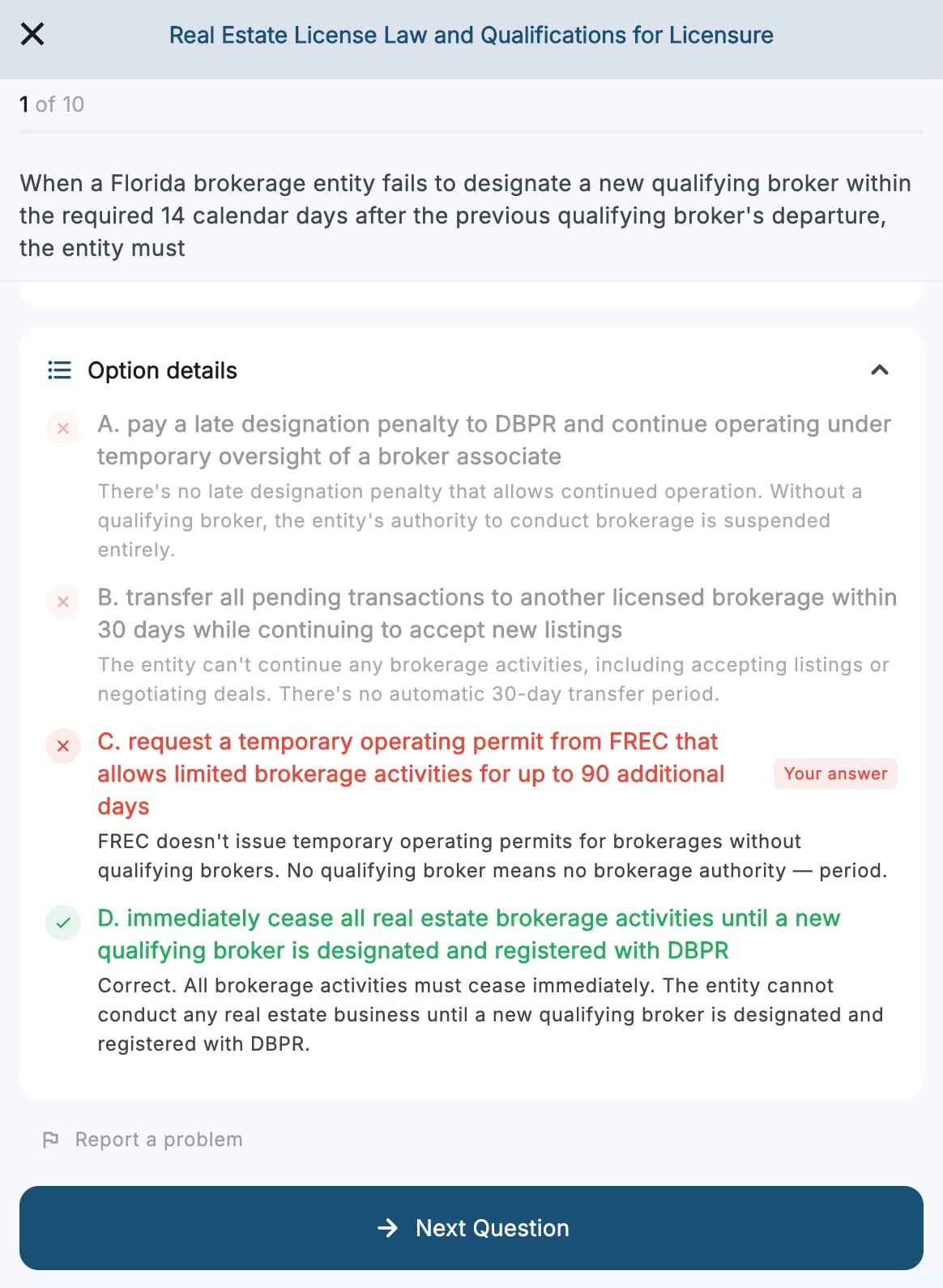
    Prefer to study at your own pace? Here are all 8 questions. Read each one and pick your answer, then reveal the correct answer, the reasoning, and the trap that catches most candidates.

    1. 1. A sales associate receives a 10,000 dollar earnest money deposit from a buyer on Monday. Under Florida rule, by when must the associate deliver that deposit to the broker, and by when must the broker place it in escrow?

      • A.The associate delivers it by the end of the next business day; the broker places it in escrow by the end of the third business day after the associate received it
      • B.The associate has three business days to deliver it; the broker then has three more business days to place it in escrow
      • C.Both the delivery and the escrow placement must happen immediately upon receipt
      • D.The associate may hold the deposit for up to ten days as long as the broker places it in escrow by closing
      Show answer and explanation

      Correct answer: A. The associate delivers it by the end of the next business day; the broker places it in escrow by the end of the third business day after the associate received it

      Why A is correct: A sales associate must deliver entrusted funds to the broker no later than the end of the next business day. The broker must then deposit the funds into the escrow account no later than the end of the third business day following receipt by the associate. The associate's receipt starts the broker's escrow clock.

      Trap: The next-business-day rule is the associate's delivery deadline, not the escrow placement deadline. The broker's escrow deadline is the third business day.

      Source: F.A.C. 61J2-14.008, 61J2-14.009

    2. 2. Two brokers from competing firms meet at a conference and agree to both charge sellers a 6 percent commission so neither undercuts the other. This agreement is

      • A.permissible because commission rates are set by local custom
      • B.price-fixing, an antitrust violation, even though the rate sounds standard
      • C.permissible if both brokers disclose the rate to their clients in writing
      • D.a tie-in arrangement under federal antitrust law
      Show answer and explanation

      Correct answer: B. price-fixing, an antitrust violation, even though the rate sounds standard

      Why B is correct: Commission rates are always negotiable between a broker and a client. Competing brokers agreeing to charge the same rate is price-fixing, a per se violation of antitrust law. The Sherman Antitrust Act carries criminal penalties for this conduct.

      Trap: There is no such thing as a standard or customary commission rate. Saying or agreeing that a rate is standard is itself an antitrust risk.

      Source: Sherman Antitrust Act; F.S. 475 brokerage practice

    3. 3. A sales associate posts a listing on her personal Instagram account with photos, the price, and her own name and phone number, but does not include the name of her brokerage. This advertisement is

      • A.acceptable because social media posts are personal and not regulated advertising
      • B.acceptable because the associate included her own contact information
      • C.a blind ad that violates Florida law because it omits the registered brokerage name
      • D.acceptable only if fewer than 100 people follow the account
      Show answer and explanation

      Correct answer: C. a blind ad that violates Florida law because it omits the registered brokerage name

      Why C is correct: All real estate advertising in Florida must include the registered name of the brokerage firm. An ad without the brokerage name is a blind ad and is prohibited. The rule applies to internet and social media advertising the same as to print and yard signs.

      Trap: Social media is not exempt. A licensee's personal post advertising a listing must still carry the brokerage name.

      Source: F.A.C. 61J2-10.025, advertising

    4. 4. At a closing, a grateful seller hands a sales associate a 500 dollar cash bonus to thank her for her work. The associate may

      • A.accept the bonus directly because it is a gift, not a commission
      • B.accept the bonus only if it is under 1,000 dollars
      • C.not accept it directly; all compensation must flow through her employing broker
      • D.accept it directly as long as she reports it to the broker within ten days
      Show answer and explanation

      Correct answer: C. not accept it directly; all compensation must flow through her employing broker

      Why C is correct: A sales associate may be compensated only by the broker with whom she is registered. She cannot accept payment for real estate services directly from a buyer, seller, or another broker. The compensation must flow through her employing broker.

      Trap: Calling it a gift or a bonus does not change the rule. Compensation for real estate services must pass through the broker.

      Source: F.S. 475.42(1)(d)

    5. 5. A seller signs a listing in which the broker earns a commission no matter who finds the buyer, including the seller. Which listing type is this?

      • A.Open listing
      • B.Exclusive agency listing
      • C.Exclusive right of sale listing
      • D.Net listing
      Show answer and explanation

      Correct answer: C. Exclusive right of sale listing

      Why C is correct: An exclusive right of sale listing guarantees the broker a commission regardless of who procures the buyer, including the seller. An exclusive agency listing lets the seller sell on their own without owing a commission. An open listing pays only the broker who finds the buyer.

      Trap: If the seller can find their own buyer and avoid paying, that is exclusive agency, not exclusive right of sale.

      Source: F.S. 475 brokerage practice

    6. 6. A sales associate commits a clear violation while handling a transaction. The employing broker had no personal knowledge of the associate's conduct. FREC's disciplinary authority extends to

      • A.the sales associate only, because the broker had no knowledge
      • B.the broker only, because all associate liability transfers to the broker
      • C.both the associate for the violation and the broker for failure to supervise
      • D.neither party until a court rules on the underlying conduct
      Show answer and explanation

      Correct answer: C. both the associate for the violation and the broker for failure to supervise

      Why C is correct: A broker is responsible for supervising every licensee registered under the brokerage. Lack of personal knowledge is not a complete defense, because the broker has a duty to maintain systems that would catch and prevent associate misconduct. FREC can discipline the associate for the violation and the broker for failure to supervise.

      Trap: Not knowing is not the same as not being responsible. The supervision duty exists regardless of the broker's personal involvement.

      Source: F.S. 475.25, FREC rule 61J2

    7. 7. A broker deposits a buyer's earnest money into the brokerage's general operating account, where it sits unused. Two weeks later the broker moves it to the proper escrow account. The broker has committed

      • A.conversion, because the funds were in the wrong account
      • B.commingling, because escrow funds were placed with business funds
      • C.no violation, because the money was never spent
      • D.a blind ad violation
      Show answer and explanation

      Correct answer: B. commingling, because escrow funds were placed with business funds

      Why B is correct: Placing escrow funds in the same account as the brokerage's business funds is commingling, even though the money was never spent. Conversion requires that the funds actually be used for the broker's benefit. Here the money sat unused, so the violation is commingling.

      Trap: Commingling does not require spending the money. Mixing it into the wrong account is enough.

      Source: F.A.C. 61J2-14.008; F.S. 475.25

    8. 8. A Florida listing agreement is drafted to renew automatically every 90 days until either party cancels, with no stated end date. Under Florida law this provision is

      • A.valid, because automatic renewal protects the broker's commission
      • B.valid, because the seller can cancel at any time
      • C.improper, because a Florida listing agreement must have a definite expiration date and may not automatically renew
      • D.valid only for exclusive right of sale listings
      Show answer and explanation

      Correct answer: C. improper, because a Florida listing agreement must have a definite expiration date and may not automatically renew

      Why C is correct: A Florida listing agreement must contain a definite expiration date. It may not contain a provision requiring the seller to notify the broker to cancel and may not automatically renew. An open-ended, self-renewing listing is improper.

      Trap: An automatic-renewal or no-end-date listing is a violation, not a convenience. The exam tests the definite-expiration requirement.

      Source: F.A.C. 61J2-10.027

    8 here, 1,002 in the app

    You found your gaps. Now close them across all 19 areas.

    Pass Florida gives you 1,002 Florida-specific questions, diagnostics across the 19 exam areas, Trap Library, Math Coach, offline access, and one $39.99 purchase. No subscription. No copied exam questions.

    Get the full question bank

    Frequently asked questions

    How many brokerage questions are on the Florida real estate exam?

    Real estate brokerage activities and procedures is about 12 percent of the 100-question Florida sales associate exam, which makes it the single heaviest content area. Expect roughly 12 questions covering escrow, listings, advertising, compensation, supervision, and antitrust.

    What is the broker's deadline to place earnest money in escrow in Florida?

    A broker must place entrusted funds into the escrow account no later than the end of the third business day after the sales associate received them. The sales associate must deliver the funds to the broker by the end of the next business day.

    Are these real Florida real estate exam questions?

    These are original, scenario-based questions written at the same difficulty and format as the Florida sales associate exam. They are not reproduced Pearson VUE exam items. Every answer cites the Florida statute or FREC rule it tests.