Capitalization rate
Annual NOI ÷ price or value
$60,000 ÷ $750,000 = 8%Measures property income before financing. It is not total return.
Practice investment math and Florida business brokerage with 8 free scored questions, clear answer explanations, a cash-flow calculator, and six worked scenarios. No account needed.
Rules in effect through . Reviewed . Review and sources
Quiz mode · Test yourself
8 practice questions on investments and business brokerage, scored, each with a full explanation after you answer. Every question is also written out below if you would rather study at your own pace.
01 / Follow the income statement
Start with potential income and work down one line at a time. This annual example shows why a property can have strong operating income but much less cash left for its owner.
Step 1
Start with the annual income at full occupancy and full collection.
Step 2
Subtract $5,000 of vacancy and collection loss. Add other income if the problem gives it; this example has none.
Step 3
Subtract $35,000 of operating expenses. Stop here for NOI and capitalization calculations.
Step 4
Subtract $42,000 of annual debt service. This example has no further cash adjustments.
Annual NOI ÷ price or value
$60,000 ÷ $750,000 = 8%Measures property income before financing. It is not total return.
Annual NOI ÷ capitalization rate
$60,000 ÷ 0.08 = $750,000Convert a percentage to a decimal before dividing.
Annual before-tax cash flow ÷ cash invested
$18,000 ÷ $150,000 = 12%Uses the investor's cash outlay, including acquisition costs when specified.
NOI is an income measure, not taxable income. A cap rate is an income-to-value ratio, not a guarantee of total return. OCC Commercial Real Estate Lending: NOI, cap rates, and expenses · IRS IRM 4.48.6: real property valuation
Property taxes, insurance, management, ordinary repairs and maintenance, and owner-paid utilities are operating expenses. Use the amounts and expense assumptions in the problem.
Mortgage principal and interest are debt service. Owner income taxes and noncash tax depreciation are not property operating expenses. A capital improvement is not an ordinary repair; handle it separately as the problem directs.
Some exam income statements deduct a reserve for replacements to reach NOI. Other analyses show it below NOI. The course syllabus includes reserves in its income-approach coverage. Follow the stated convention, compare figures prepared on the same basis, and never deduct a reserve twice.
02 / Make the formulas useful
Try the baseline, then increase vacancy or debt service. Notice that a larger mortgage payment changes cash flow without changing the property's NOI.
Try the calculation
Use annual amounts throughout. Change the vacancy loss or debt service and watch which results move.
Income at full occupancy and collection.
Enter a dollar amount, not a percentage.
Exclude mortgage payments and owner income taxes.
Principal and interest. Multiply a monthly amount by 12.
The denominator for the capitalization rate.
The initial cash outlay, including cash acquisition costs.
Your annual worksheet
$60,000.00 NOI − $42,000.00 debt service = $18,000.00
This is the cash left after operating expenses and debt service, before income tax or any additional cash adjustments. It is not total investment return.
Exam exercise: no other income, appreciation, sale proceeds, or additional capital outlays. Include a replacement reserve in operating expenses only if your problem uses that convention; do not deduct it again. Cash-on-cash excludes principal paydown as a separate return benefit. This worksheet does not calculate taxable income or value a business.
The worksheet uses the same annual income sequence as the example above. The return percentages answer different questions, so a higher cash-on-cash figure alone does not make one investment better.
Your next step toward exam day
Keep preparing with 1,142 questions across all 19 areas. Review missed answers, work on weak topics, and take full-length timed exams in Pass Florida. Start with free access. The full package is $39.99 once, with no subscription.
Exam prep only. Not a substitute for the 63-hour course, DBPR steps, or Pearson VUE scheduling.
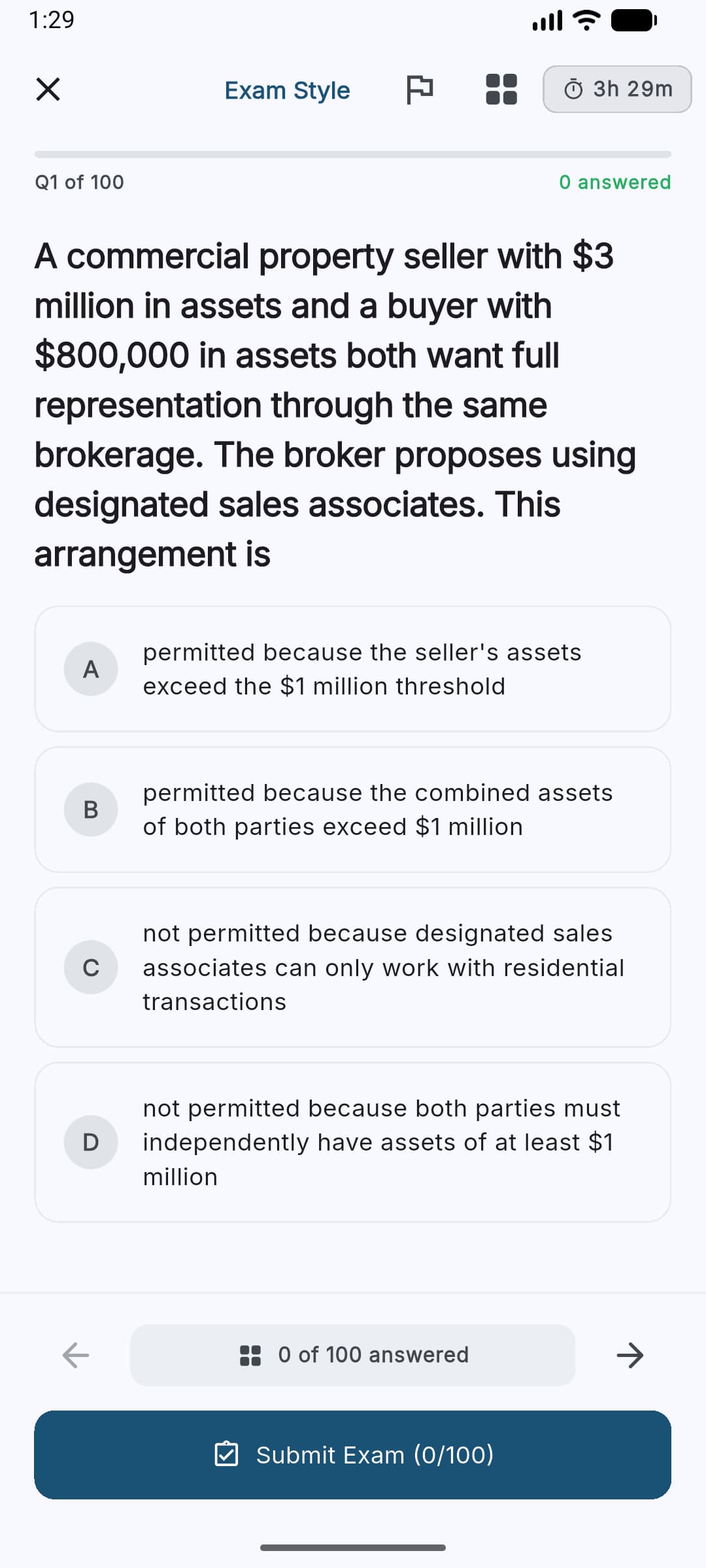
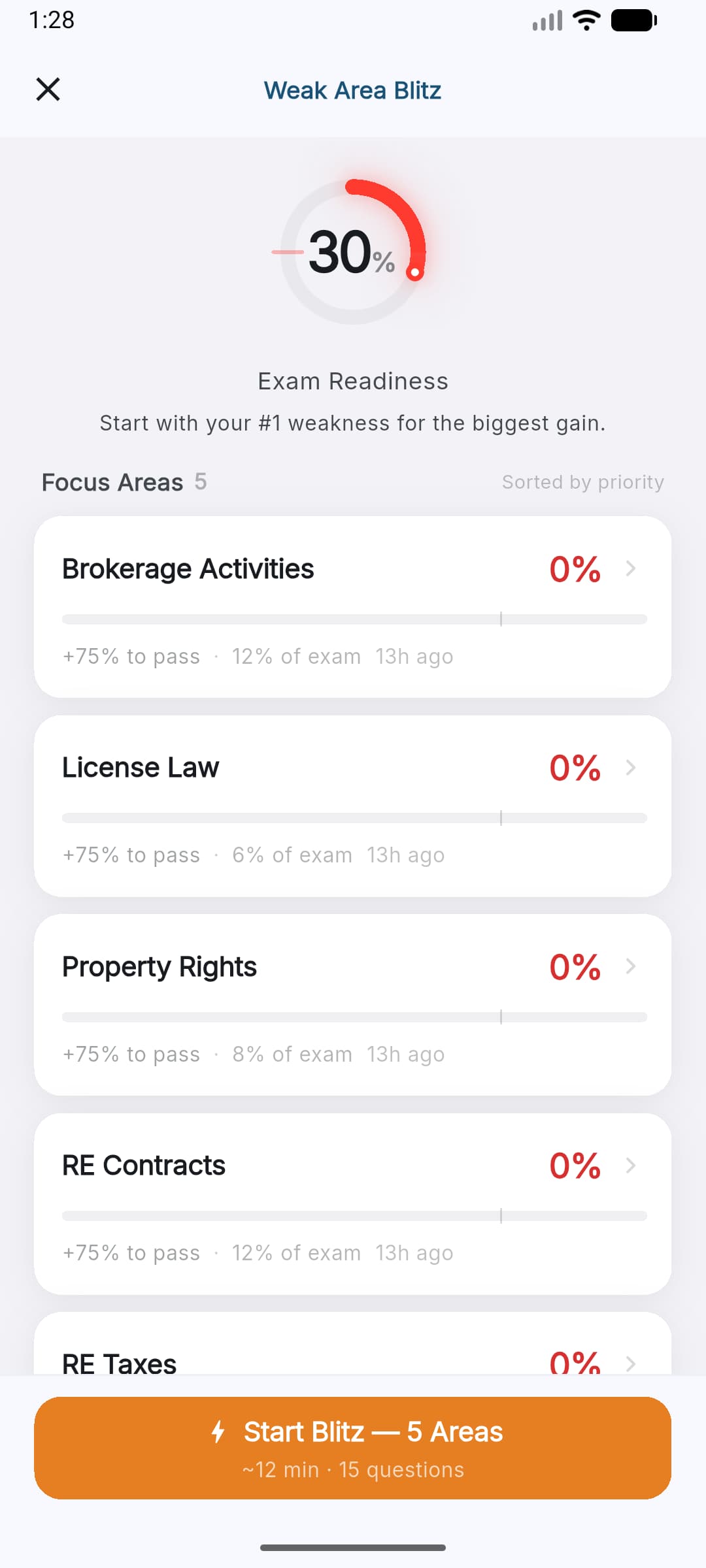
Study in your browser, or download for iPhone and Android. Offline study is available in the mobile app. Your free website quiz result does not transfer to the app.
03 / Know the investment
Section 17 names residential, commercial, industrial, agricultural, and business opportunities. Each requires a close look at income, costs, market conditions, and the interest being purchased.
A rented duplex or apartment building.
Look at: Rents, turnover, vacancy, and operating costs.
An office building or retail center.
Look at: Tenant credit, lease terms, location, and space demand.
A warehouse or manufacturing property.
Look at: Access, building suitability, tenant demand, and environmental conditions.
An income-producing farm or grove.
Look at: Water, soil, operating income, weather, and commodity exposure.
An operating café, including the assets agreed in the sale.
Look at: Earnings, inventory, equipment, contracts, and intangible value.
A real estate investment trust owns or finances income-producing real estate or related assets. Its investors hold an interest in the entity rather than directly owning a particular rental unit. Publicly traded REIT shares trade on exchanges; non-traded REITs may be difficult to sell and can restrict redemptions.
Rent can provide recurring income, and a rise in market value creates appreciation. Expenses, vacancies, and a falling market can reduce or reverse those benefits.
Principal repayment reduces the loan balance and can build equity. Borrowing lets an investor control more property with less cash, but also adds required payments and magnifies losses.
Eligible deductions may reduce taxable rental income. Rents and values may rise with inflation, but fixed leases, rising expenses, and tax limitations mean neither benefit is guaranteed.
Direct property ownership also involves local market exposure, management work, transaction costs, and access to suitable professional help. A building usually cannot be sold as quickly as an exchange-traded security. FREC Course I syllabus: Section 17, with Sections 16 and 18
An asset is something of economic value. Property equity is market value less debt secured by the property. Initial cash invested can also include closing costs and other cash outlays, so it is not automatically identical to current equity.
Basis generally starts with acquisition cost, including applicable acquisition costs. Capital improvements generally increase it; depreciation allowed or allowable generally reduces it. Basis measures tax investment, not current market value or the mortgage balance.
The basic sale calculation compares amount realized with adjusted basis. Amount realized generally reflects selling costs. A mortgage payoff affects cash received but does not replace adjusted basis in the gain calculation. Depreciation and the type of asset can affect how the gain is taxed.
In this syllabus context, the term describes lawful tax benefits that can reduce currently taxable investment income, such as eligible depreciation. It does not promise tax-free rent. Passive-activity, at-risk, and other limits can restrict deductions.
04 / Find the risk in the facts
The same investment can face several risks. In a question asking for the best answer, choose the risk most directly described by the event.
The property earns less than expected.
An employer closes, tenants leave, and vacancy increases.
Borrowing adds a payment obligation.
Rental income falls, but the lender still expects the scheduled debt service.
Inflation reduces what income can buy.
A fixed rent buys fewer services as insurance and maintenance prices rise.
Financing rates change.
An adjustable loan resets upward, or a balloon loan must be refinanced at a higher rate.
The investment cannot quickly become cash at an acceptable price.
An owner needs money this week, but the building may take months to sell.
Capital or repayment is at risk.
A market decline reduces resale value. A borrower's missed payments create default risk for a lender.
The syllabus groups market risk and default risk under safety risk. Financial risk and default risk can overlap, so pay attention to whose position is being described and what caused the problem. FREC Course I syllabus: Section 17, with Sections 16 and 18
05 / Borrowing works both ways
Assume a $200,000 property, a $160,000 interest-only loan at 6%, and $40,000 cash invested. Annual debt service is $9,600. Ignore acquisition costs, appreciation, taxes, and other cash adjustments for this example.
Stronger property income
$6,400 ÷ $40,000 = 16%. With stronger income, borrowing raises the cash return in this example.
Lower property income
-$1,600 ÷ $40,000 = −4%. When NOI drops, the same debt payment produces a cash shortfall.
This illustration uses interest-only financing so the effect is easy to see. An amortizing loan has principal payments too; compare the actual debt service when finding cash return. Principal paydown may build equity, but it is not spendable rental cash. FREC Course I syllabus: Section 17, with Sections 16 and 18
06 / Florida business-opportunity brokerage
Chapter 475 covers business enterprises and business opportunities. The key licensing facts are the service performed, whether it is for another, and compensation or the intent to receive it. Statutory exemptions still matter.
An owner selling their own business generally falls within the own-property exemption, read with the statute's definition of business interests. A paid intermediary cannot borrow that exemption simply because the owner is exempt. Section 475.011 also limits the exemption in certain transaction-paid agent or employee arrangements and contains other specific exceptions.
Both property and business brokerage bring buyers and sellers together, negotiate terms, and coordinate a closing. Business sales often add personal property, goodwill, and lease rights to the analysis, and the buyer market may extend beyond the local area. FREC Course I syllabus: Section 17, with Sections 16 and 18
What real property interest is included?
The value of the land, building, and real property interest being appraised. A profitable business in a leased space does not own that building simply because it operates there.
What is the continuing enterprise worth?
In business appraisal, analyze the operating enterprise as a continuing business. It may include real estate, personal property, and intangible value. The business total can differ from the value of its real estate alone.
Why are customers likely to return?
Goodwill reflects the value of expected repeat customer business, often connected with reputation and established patronage. It is intangible. A seller's price above equipment value is not automatically all goodwill; other assets and rights may explain the difference.
Federal tax rules also use a specific going concern intangible: the ability to keep operating and producing income through an ownership change. That narrower allocation term should not be confused with an appraisal of the whole operating enterprise. Treasury Regulation 1.197-2: goodwill and going concern value · IRS Form 8594 instructions: assets, goodwill, and going concern value
What have similar businesses sold for?
Compare relevant business sales and adjust for differences in size, earnings, risk, assets, and deal terms. A multiple is useful only when the underlying earnings measure and included assets are comparable.
What are the assets and liabilities worth?
Analyze the assets individually, using appropriate current values rather than blindly accepting book values. When valuing the owner's equity interest, account for the relevant liabilities. Consider intangible assets where the assignment calls for them.
What is the earning capacity worth?
Use supportable, appropriately adjusted earnings or cash flow and a rate or multiple consistent with that measure. A company's gross revenue is not its profit. A property's NOI and a business's earnings cannot be substituted for one another without analysis.
What would asset sales leave after winding down?
Estimate proceeds from selling assets separately, considering sale conditions, disposal costs, and obligations relevant to the interest valued. Orderly and forced sales can produce different figures. This is a different premise from continued operation.
The transfer may include inventory, equipment, a lease interest, customer relationships, and other rights. Avoid double-counting an asset already included in an earnings-based valuation. Identify the exact bundle of assets and liabilities and the interest being valued before adding figures together.
07 / From listing to handover
This study sequence connects the syllabus objective to a practical transaction. The contract and circumstances determine the precise order; some work happens in parallel.
Step 1
Identify the seller's authority, the assets or ownership interest being sold, the brokerage relationship, compensation terms, and confidentiality arrangements. Establish whether owned real estate or a lease is included.
Step 2
Review financial statements, tax returns, asset and inventory lists, debts, leases, contracts, and operating history. Use accounting, finance, and valuation expertise to test earnings and support the price.
Step 3
Present supportable information, protect confidential records under the agreed process, and check the buyer's ability to fund and operate the purchase. Do not promise earnings that the records do not support.
Step 4
Specify what transfers, the price and allocation, included or assumed obligations, deposits, financing, access to records, contingencies, and the closing arrangements. Asset and ownership-interest sales need different documents.
Step 5
Verify the records and assets. Resolve financing, liens, lease assignment or a new lease, and contract or permit transfer requirements. A buyer should not assume the seller's lease or operating approvals transfer automatically.
Step 6
Confirm the agreed conditions, final inventory and adjustments, transfer documents, funds, possession, and any training or transition work. Coordinate legal and tax work with the appropriate professionals.
Business brokerage requires corporate-finance, accounting, and valuation knowledge. A real estate license alone does not establish expertise in every business or authorize legal or tax work outside the licensee's qualifications. FREC Course I syllabus: Section 17, with Sections 16 and 18 · SBA: buying an existing business and due diligence · SBA: business valuation, sale agreements, and liquidation
08 / Connect investment and tax questions
The investment, appraisal, and tax sections share concepts. Keep these connections, but do not mistake a cash-flow calculation for a tax return.
Debt service includes principal and interest, but principal repayment is generally not a rental expense deduction. Eligible interest and depreciation can affect taxable income. Do not call NOI or cash left after the mortgage the taxable amount without making the applicable tax adjustments.
A rental building may qualify when placed in service. Under the usual MACRS General Depreciation System, residential rental buildings use 27.5 years and nonresidential real property generally uses 39 years, with straight-line depreciation and the mid-month convention. Other systems, property classes, and special provisions can change the treatment.
The general rule applies to exchanges of qualifying real property held for business or investment. A personal home, inventory or property held primarily for sale, and ordinary business equipment do not qualify merely because proceeds are reinvested. Money or non-like-kind property received can cause gain recognition.
An asset sale can include land, inventory, equipment, contracts, and goodwill with different tax treatment. IRS rules allocate consideration among the assets. Qualifying real estate may be eligible for Section 1031; that does not make the equipment or goodwill eligible too.
Same starting event
Both ordinary deferred-exchange periods run from this transfer. They are not consecutive periods.
Identification
Generally identify replacement property in writing, signed and delivered to the appropriate exchange party under the rules.
Receipt
Receive it by day 180 or the tax-return due date, including extensions, whichever is earlier.
These are the standard deferred-exchange deadlines, without special relief. A qualified intermediary is a common way to avoid actual or constructive receipt of proceeds, but eligibility and all exchange requirements still apply. IRS Form 8824 instructions: exchange deadlines and conditions · IRS: like-kind exchanges of real estate
Try before you reveal
Work out the answer first. Each explanation points to the fact, formula, or condition that decides the question.
Worked scenario 01
A property has $96,000 potential income, $6,000 vacancy loss, $30,000 operating expenses, and $36,000 debt service. There is no other income or cash adjustment. Find NOI and before-tax cash flow.
NOI is $60,000. Before-tax cash flow is $24,000.
$96,000 − $6,000 = $90,000 effective gross income. Subtract $30,000 to reach NOI, then subtract $36,000 debt service. Stopping after the mortgage answers a cash-flow question, not an NOI question.
Worked scenario 02
Annual NOI remains $60,000. What happens to indicated value if the supported capitalization rate rises from 8% to 10%?
Value falls from $750,000 to $600,000.
$60,000 ÷ 0.08 = $750,000; $60,000 ÷ 0.10 = $600,000. Hold NOI constant before comparing rates. These are direct-capitalization estimates, not a forecast of what a particular property will sell for.
Worked scenario 03
An owner has substantial equity in a warehouse but cannot sell it quickly at an acceptable price to meet an immediate cash need. Which risk is most directly illustrated?
Liquidity risk.
The clue is the difficulty converting the investment to cash promptly without an unacceptable price concession. Equity on paper does not mean that cash is available today. Falling market value could create a second risk, but it is not required by these facts.
Worked scenario 04
For a fee, an intermediary negotiates a café sale for its owner. Equipment, inventory, and business goodwill are included; no land is sold. Assume no statutory exemption. Is this outside Florida real estate licensing?
No. Chapter 475 includes business-opportunity brokerage.
The statutory trigger is the covered service for another with compensation or the intent to receive it. A deed is not required. An owner selling their own business and an intermediary acting for that owner are different licensing situations.
Worked scenario 05
A simplified liquidation estimate expects $220,000 from separate asset sales, $20,000 in disposal costs, and $70,000 of obligations to settle. What remains for the owner under these assumptions?
$130,000 in estimated net proceeds.
$220,000 − $20,000 − $70,000 = $130,000. The estimate uses asset-disposal proceeds and the stated costs and obligations. It does not value the company as an operating business or assume that goodwill can be sold separately at its book amount.
Worked scenario 06
In a standard deferred exchange, property is identified on day 40. The taxpayer's return due date, including any extension in effect, is day 150 after the transfer. No special deadline relief applies. Is receipt on day 170 timely?
No. The receipt deadline is day 150 in this example.
Use the earlier of day 180 or the applicable return due date, including extensions. Timely identification does not extend receipt. Both periods run from the original transfer; the 45-day period is not added to 180 days.
09 / Review every answer
Open the concept you want to review. Every question, answer, wrong-choice explanation, and source is available without completing the quiz or signing in.
Try each question before opening its answer. These are original practice items, not actual or recalled Pearson VUE exam questions.
Question 1 · inv-1 · Leverage can magnify gains and losses
Answer A. Leverage
Leverage means using borrowed funds to finance an investment. It can increase the investor’s return when income or appreciation outweighs the financing burden. It also adds payment obligations and can magnify a loss. Less cash at purchase does not mean less investment risk.
Remember: Identify the borrowing first. Whether leverage helps depends on the investment results and financing terms.
B. Appreciation
Appreciation is an increase in value. It can occur with or without borrowing.
C. Depreciation
Depreciation can mean a loss in value or a tax cost-recovery deduction. Neither describes using a loan.
D. Amortization
Amortization of a loan is repayment of principal over time through scheduled payments.
Sources: FREC Course I syllabus: Section 17, with Sections 16 and 18
Report a problem with inv-1Question 2 · inv-2 · Section 1031 is conditional tax deferral
Answer D. A Section 1031 like-kind exchange
Section 1031 may defer gain when real property held for investment or productive business use is exchanged for qualifying like-kind real property. It does not turn the transaction into permanent tax elimination. Receiving cash or non-like-kind property can produce recognized gain, and simply reinvesting sale proceeds does not by itself satisfy the exchange requirements.
Remember: For current Section 1031 questions, test the real property, its use, the exchange structure, and the deadlines.
A. The principal-residence exclusion, regardless of use
The home-sale exclusion has separate ownership and use requirements. These facts concern investment real estate.
B. A wraparound mortgage
A wraparound mortgage is a financing arrangement, not the like-kind exchange rule.
C. The transfer of a Florida homestead exemption
Florida homestead benefits concern property taxation and do not establish federal exchange eligibility.
Sources: IRS: like-kind exchanges of real estate · IRS Form 8824 instructions: exchange deadlines and conditions
Report a problem with inv-2Question 3 · inv-3 · A business sale can require a Florida license without a deed
Answer B. The appropriate real estate license for the brokerage activity
Chapter 475 includes business enterprises and business opportunities in its broker and real-property definitions. Negotiating the sale for another for compensation is a covered brokerage service even without a land transfer. A sales associate acts under the required direction and control; the license does not authorize independent brokerage. Statutory exemptions must be considered when the facts provide one.
Remember: The key facts are a covered service, for another, and compensation or the intent to receive it. A deed is not an extra requirement.
A. No real estate license because no land changes hands
Florida’s statutory definition expressly includes business enterprises and business opportunities.
C. Only a local business tax receipt
A local receipt does not replace the appropriate Chapter 475 license.
D. A real estate license only if the sale price exceeds $100,000
The statute does not create this $100,000 threshold for business-opportunity brokerage.
Sources: F.S. 475.01: business opportunities and the broker definition · F.S. 475.011: licensing exemptions and their limits
Report a problem with inv-3Question 4 · inv-4 · Debt service comes after NOI
Answer C. Before-tax cash flow
In this simplified calculation, before-tax cash flow equals NOI minus debt service. Mortgage debt service includes principal and interest. NOI is measured before those financing payments, while income tax and any additional owner-level adjustments require separate treatment.
Remember: NOI and cash flow can differ even for the same property in the same year.
A. Potential gross income
Potential gross income is the starting income figure before vacancy loss and expenses.
B. Net operating income
NOI deducts operating expenses but stops before mortgage principal and interest.
D. Capitalization rate
A cap rate is a ratio of annual NOI to value or price, not the dollars remaining after debt service.
Sources: OCC Commercial Real Estate Lending: NOI, cap rates, and expenses · IRS IRM 4.48.6: real property valuation
Report a problem with inv-4Question 5 · inv-5 · Separate land from depreciable property
Answer B. The qualifying rental building, but not the land
A qualifying rental building has a cost-recovery period; land is not depreciable. Allocate the basis between the land and the building using the applicable rules. Depreciation begins when the property is placed in service, meaning ready and available for its rental use, rather than automatically on the purchase date. Depreciation allowed or allowable generally reduces adjusted basis.
Remember: Tax depreciation is not proof that the property’s market value fell. A building can appreciate while its owner claims eligible depreciation.
A. The land only
Land does not qualify for depreciation; the qualifying building may.
C. The land and building in equal amounts
The land portion is excluded, and allocation is not automatically a 50/50 split.
D. Neither, because real estate cannot be depreciated
Federal tax law permits depreciation of qualifying rental buildings.
Sources: IRS Publication 527: rental income, expenses, and depreciation · IRS Publication 551: cost and adjusted basis
Report a problem with inv-5Question 6 · inv-6 · Calculate cap rate with NOI, not cash flow
Answer C. 8%
Divide annual NOI by price: $48,000 ÷ $600,000 = 0.08 = 8%. This is a property income ratio before financing. It is not the investor’s cash-on-cash return or a promise of total return after appreciation, sale costs, and taxes.
Remember: To estimate value instead, reverse the setup: value = NOI ÷ cap rate expressed as a decimal.
A. 6%
6% would correspond to $36,000 of NOI at this price, not $48,000.
B. 12.5%
12.5 is the result of dividing price by NOI. It is an income multiple, not the cap rate here.
D. 80%
0.08 converts to 8%, not 80%.
Sources: OCC Commercial Real Estate Lending: NOI, cap rates, and expenses · IRS IRM 4.48.6: real property valuation
Report a problem with inv-6Question 7 · inv-7 · Follow the income statement in order
Answer D. $60,000
First calculate effective gross income: $100,000 − $5,000 = $95,000. Then subtract operating expenses: $95,000 − $35,000 = $60,000 NOI. No mortgage payment, income tax, or tax depreciation is deducted to reach this answer. If a different problem specifies a replacement reserve, use its stated income-statement convention.
Remember: Deduct vacancy loss before operating expenses. Stop at the income measure the question asks for.
A. $95,000
$95,000 is effective gross income before operating expenses.
B. $65,000
$65,000 subtracts operating expenses but overlooks the $5,000 vacancy loss.
C. $140,000
$140,000 adds losses and expenses to income instead of subtracting them.
Sources: OCC Commercial Real Estate Lending: NOI, cap rates, and expenses · FREC Course I syllabus: Section 17, with Sections 16 and 18
Report a problem with inv-7Question 8 · inv-8 · The 45-day and 180-day exchange clocks run together
Answer A. The earlier of 180 days after the transfer or the tax-return due date, including extensions
The receipt deadline is the earlier of the 180th day after transfer of the relinquished property or the due date, including extensions, of the transfer-year tax return. The identification and receipt periods start with the same transfer. Identification generally must be in writing, signed, and delivered to the appropriate exchange party under the rules.
Remember: 45 + 180 is the wrong timeline. Timely identification does not extend the deadline to receive the replacement property.
B. 180 days after the end of the 45-day identification period
The periods run concurrently from the original transfer; they are not added together.
C. 365 days after the original transfer
The ordinary receipt limit is not one year.
D. Any later date approved by the qualified intermediary
A qualified intermediary cannot simply choose to extend the statutory deadlines.
Sources: IRS Form 8824 instructions: exchange deadlines and conditions · IRS Publication 544: gains, losses, and exchanges
Report a problem with inv-810 / Match your study to the outline
The eight scored questions are a sample. Use the guide, calculator, and scenarios to study the additional objectives, especially risks and business appraisal.
Five investment categories, benefits and tradeoffs, REITs, equity, basis, and tax terminology.
Income sequence, expense treatment, cap rate, indicated value, cash flow, and the calculation worksheet.
Business, financial, purchasing-power, interest-rate, liquidity, and safety risks, with recognizable scenarios.
Borrowing, equity, debt service, and an example showing both stronger and weaker income.
Florida licensing, goodwill, going concern value, four appraisal methods, expertise, and six sale steps.
DBPR candidate booklet: investments and business brokerage, 2% supplies the 2% weight and five headings. FREC Course I syllabus: Section 17, with Sections 16 and 18 Section 17 supplies the detailed investment and business-brokerage objectives. The cap-rate and income material also supports Section 16; depreciation and exchanges connect with Section 18. Questions 2 and 8 review those exchange connections.
Write down the requested result before doing the math. NOI stops before financing. Before-tax cash flow subtracts debt service. Cap rate uses the property value, while cash-on-cash return uses the investor’s cash outlay. Keep all income and payment figures on the same annual basis.
For business brokerage, first identify who is acting, whose business is being sold, and whether compensation is involved. Florida regulates business-opportunity brokerage even when no deed is transferred, subject to the statutory exemptions. Then identify what the buyer is acquiring: real estate, equipment, inventory, contractual rights, or an operating enterprise.
For an investment-risk question, find the event that changed: rent collection, borrowing, inflation, interest rates, resale timing, market value, or repayment. For a tax question, separate cash from taxable income and read every eligibility condition and deadline.
Investment and business-brokerage questions
The published DBPR sales associate outline assigns this area 2%, about two questions on the 100-question exam. It covers real estate as an investment, investment analysis, risk, leverage, and business brokerage. Section 17 of the Course I syllabus provides the detailed objectives. Income capitalization and exchange taxation also connect with Sections 16 and 18.
NOI is effective gross income minus operating expenses, before debt service. In a simplified question with no other cash adjustments, before-tax cash flow equals NOI minus mortgage principal and interest payments. For example, $60,000 NOI less $42,000 debt service leaves $18,000 before-tax cash flow.
Financing costs, owner income taxes, and tax depreciation are excluded from NOI. Ordinary property taxes, insurance, management, maintenance, and owner-paid utilities are operating expenses. Capital improvements are treated separately. For replacement reserves, follow the income-statement convention specified in the question and do not deduct the reserve twice.
Cap rate equals annual NOI divided by price or value. With $60,000 NOI and a $750,000 price, the rate is 8%. For indicated value, divide NOI by the capitalization rate as a decimal: $60,000 divided by 0.08 is $750,000. Use a supported rate and comparable income assumptions.
Cash-on-cash return divides annual before-tax cash flow by the cash invested. Cap rate divides annual NOI by property price or value. Financing affects cash flow and cash invested, so the two percentages may differ. Neither measure by itself includes appreciation or tells you the full after-tax return.
No. Borrowing can improve return on invested cash when investment performance supports the financing cost. It also creates payment obligations and can magnify losses. Compare the actual income and debt-service assumptions; a lower down payment alone does not prove that a deal is better.
Section 17 identifies business, financial, purchasing-power, interest-rate, liquidity, and safety risks. Safety risk includes market and default risk. Read the event in the question: vacancies concern operating performance, borrowing adds financial risk, inflation affects purchasing power, and a slow sale can create liquidity risk.
Brokering a business enterprise or business opportunity for another for compensation is covered by Chapter 475 even when no land is sold, unless a statutory exemption applies. The law expressly includes these interests in its definitions. An owner selling their own business and a paid intermediary acting for that owner are different cases.
An owner generally falls within the own-property exemption, read together with the Chapter 475 definition that includes business interests. That does not create a blanket exemption for a paid intermediary, agent, or employee. Section 475.011 contains conditions and other specific exemptions, so use the full facts in the question.
Goodwill reflects expected continued customer business. In business appraisal, going concern value concerns the enterprise as an operating business, potentially including tangible and intangible assets. In federal tax terminology, going concern value specifically includes the ability to keep operating through a change of ownership. Neither term means only the value of the building.
The Course I syllabus lists comparable sales, cost, income, and liquidation analysis. Compare business sales, examine asset values, analyze supportable earnings, or estimate proceeds from selling assets separately, depending on the assignment. Liquidation uses a different premise from continued operation. Book value and asking price are not automatically market value.
Review financial statements and tax records, asset and inventory lists, debts, leases, contracts, and the rights included in the sale. Confirm financing and any necessary landlord or other consents. Business brokerage requires finance, accounting, and valuation knowledge; legal and tax professionals handle work requiring their expertise.
Land is not depreciable. Under the usual MACRS General Depreciation System, residential rental buildings use 27.5 years and nonresidential real property generally uses 39 years. Straight-line depreciation and the mid-month convention apply to those categories. Alternative systems, other property classes, and special provisions can change the treatment.
A qualifying exchange generally defers recognition of gain rather than permanently eliminating it. In a standard deferred exchange, identify replacement real property within 45 days and receive it by the earlier of 180 days or the tax-return due date, including extensions. Both periods run from the original transfer. Cash, non-like-kind property, and other facts can trigger gain recognition.
No. Publicly traded REIT shares trade on exchanges, while non-traded REITs can be illiquid and have restricted redemption options. A REIT is an entity that owns or finances income-producing real estate or related assets. Buying its shares is different from directly owning a rental property, and returns are not guaranteed.
All eight questions, explanations of every answer choice, the calculator, and six worked scenarios are free without an account. Open the Pass Florida web app or download the mobile app to continue with all 19 topics, missed-answer review, weak-area practice, and full-length timed exams. These are original practice questions, not actual or recalled Pearson VUE exam items.
Sources and editorial review
Published by Pass Florida. Reviewed on for material applicable through .
This review checked all eight questions, each answer choice, the calculation examples, and business-brokerage coverage against the official outline, syllabus, Florida statutes, and federal sources.
The exam outline used is the January 2025 candidate booklet. The published Course I syllabus is effective January 1, 2023. Their publication dates do not mean a new 2026 syllabus was issued. Current IRS guidance supplies the tax rules, while the SEC and SBA sources support the REIT and business-sale explanations.
The examples are original teaching scenarios with stated assumptions. Investment results, property values, and a passing exam score are not promised. For an actual transaction, use the applicable facts and qualified advice.
Found an error? Use the correction link under a question or send the question ID and supporting source.
Review a definition, worked example, or common exam trap before your next quiz.