Florida Violations and Penalties Practice Questions and Answers
Know who investigates, who decides, and which deadline applies. Try 8 free scored questions, explanations of every choice, a seven-step complaint guide, and six worked scenarios covering FREC penalties and the Recovery Fund. No account needed.
8 practice questions on violations and penalties, scored, each with a full explanation after you answer. Every question is also written out below if you would rather study at your own pace.
8 questions
~6 min
3% of the exam
All 8 questions and explanations are free. Violations and Penalties carries 3% of the published sales associate exam outline, about 3 questions. This focused set does not predict your state-exam score.
01 / Follow the case
The seven-step complaint process
Use this sequence to learn each body's role. Dismissal, a correction notice, citation, or settlement can resolve a case before it reaches the later steps.
01
DBPR
Complaint and legal sufficiency
A legally sufficient complaint alleges facts that, if true, would violate an applicable law or rule. Written, signed complaints are the ordinary route. Anonymous complaints can qualify under the statute's additional conditions.
Investigators gather evidence. DBPR can dismiss a case when the evidence does not support prosecution. A consumer withdrawing the complaint does not require the department to stop investigating.
The panel decides whether the case has sufficient grounds to proceed. It may request more information or issue a letter of guidance instead of finding probable cause. This is not the final finding of a violation.
When prosecution proceeds, the administrative complaint sets out the alleged violations. The licensee receives notice and an opportunity to request a hearing. A stipulation or settlement may resolve the case.
Disputed material facts call for a formal hearing before a DOAH administrative law judge, who issues a recommended order. If no material facts are disputed, an informal FREC hearing may address the legal issues and penalty.
FREC enters the final order in the disciplinary case. Members who served on its probable cause panel do not take part in that final decision. Chapter 120 limits when FREC can reject an ALJ's findings of fact.
An adversely affected party can seek review within 30 days after rendition of the order under the appellate rules. Filing alone does not stay enforcement. A stay or supersedeas addresses whether the order is paused during review.
“I never made that disbursement” disputes a fact. “I admit the facts but think the fine is too high” does not. The ALJ's recommended order and FREC's final order are different documents.
Learn the event and the action together. These are separate statutory periods, not a single deadline for responding to every DBPR document.
Study reference: time periods and the events that start them
Event and period
Trigger and action
Respond to an investigative complaint20 days
After service of the complaint copy
The subject may submit a written response for DBPR to consider. This is the investigative response under 455.225(1)(b), not the hearing election on a later administrative complaint.
After a guilty or no-contest plea, conviction, or finding of guilt
Report in writing under 455.227(1)(t), regardless of adjudication. The duty covers a crime in any jurisdiction, including misdemeanors. Section 475.25(1)(p) separately states the felony reporting duty.
Ordinary complaint confidentiality10 days after probable cause
The probable cause determination
Complaint and investigative information ordinarily remain confidential until this point, or until the subject waives confidentiality earlier. Statutory exceptions include unlicensed-activity enforcement and authorized agency disclosures.
File an administrative complaint5 years, with a discovery alternative
The act, or its actual or reasonably diligent discovery
Section 475.25(5) allows five years after the act or five years after it was discovered or should have been discovered with due diligence. This is separate from Recovery Fund timing.
Make a Recovery Fund claim2 years, subject to a 4-year outside limit
The act, or its actual or reasonably diligent discovery
The claim must fall within the two-year act/discovery rule and cannot be made more than four years after the act. Later discovery does not remove the four-year limit.
Notify FREC of the civil action for a fund claimWhen the action starts
Commencement of the civil action
The statute calls for certified-mail notice to FREC at commencement. It permits FREC to honor an otherwise valid claim despite missing notice, so this omission is not an automatic disqualification.
Follow the Florida Rules of Appellate Procedure. This clock is separate from the citation dispute and crime-reporting periods, even though all three use 30 days.
For an actual proceeding, read the served document and its notice of rights for the applicable filing procedure and deadline. This study table does not replace a case-specific notice or address every procedural exception.
03 / Match the consequence to the forum
License discipline, civil liability, and criminal punishment
The same conduct can lead to more than one proceeding. The result of one does not automatically decide the others.
Administrative / FREC
Up to $5,000 per count
FREC can impose reprimand, license probation, suspension of up to 10 years under 475.25, revocation, and fines. It can also deny an application or renewal.
The statutory ceiling is not the default sanction. Apply the adopted guidelines and circumstances.
A notice of noncompliance gives an opportunity to correct a listed initial minor violation. For example, Rule 61J2-24.003 lists an initial failure to maintain the required office entrance sign. A citation carries a designated penalty and can become final discipline. It is not simply a warning.
The ordinary public-claim route is a limited remedy for qualifying misconduct in a Florida real property transaction. An unpaid judgment alone is not enough.
Start with these conditions
Covered licensee and transaction. The individual held a valid, current, active Florida license and acted solely as a licensee, without the ownership roles excluded by 475.482.
Qualifying judgment. Ordinarily, a final Florida civil judgment against the individual broker or sales associate is required. A judgment only against a brokerage entity is insufficient.
Collection and notice. Meet the execution, affidavit, and reasonable collection-effort requirements; credit other recoveries. Notify FREC by certified mail when the civil action starts.
Timely, eligible claim. Meet the two-year act/discovery rule and four-year outside limit, the appeal-related conditions, and all other requirements in 475.483.
Who is excluded, and which judgment exceptions matter?+
Section 475.483 excludes the judgment debtor's spouse or the spouse's personal representative, a licensee acting as single agent or transaction broker in the transaction, and specified ownership or own-account transactions. Inactive or unlicensed status at the time of the transaction and a judgment only against a brokerage entity also prevent eligibility under the listed conditions.
The statute permits a limited waiver of the final-judgment requirement following the licensee's death or qualifying bankruptcy-court action that prevents a judgment despite due diligence. A bankruptcy filing alone is not a blanket waiver. FREC may also honor an otherwise valid claim despite missing notice of the civil action.
A payment on the ordinary public-claim route under 475.482(1) automatically suspends the license on the payment date. Full repayment plus interest is required before reinstatement, subject to the federal bankruptcy-law exception stated in 475.484(7). No further administrative action is needed for that automatic suspension.
This is a separate statutory consequence. Do not apply the ordinary 10-year disciplinary suspension ceiling as a substitute for the fund repayment condition.
Why the escrow-disbursement-order route is different+
Under 475.482(2), a broker or sales associate who follows an escrow disbursement order and faces a qualifying judgment can seek the separate protection provided by the fund. The licensee must notify FREC of the action and diligently defend it, among the statutory conditions.
Section 475.483(3) addresses reasonable attorney fees and court costs for qualifying claims. The automatic suspension provision in 475.484(7) applies to the public-claim route under 475.482(1), not this separate escrow-order route. Do not extend the fee exception or the absence of automatic suspension to ordinary fraud claims.
Decide what should happen before opening the reasoning. The fund examples illustrate statutory caps; they do not determine a real claim's eligibility.
Worked scenario 01
The consumer gets a refund
After DBPR starts investigating alleged fraud, the broker repays the consumer. The consumer withdraws the complaint. Must DBPR close the case?
Show the answer and reasoning
No. Repayment and withdrawal do not require dismissal.
DBPR may continue investigating a withdrawn complaint. Section 475.25(1)(b) also makes clear that paying the loss after discovery does not erase the violation. Consumer harm and the regulatory case are related, but resolving one does not automatically resolve the other.
One licensee says the alleged escrow disbursement never happened. Another admits the material facts but argues that the proposed penalty is too severe. Which hearing route fits each?
Show the answer and reasoning
Disputed material facts: formal DOAH hearing. Undisputed material facts: informal FREC hearing.
The distinction is whether an important fact is disputed, not whether the licensee dislikes the proposed outcome. In a formal disciplinary hearing, the ALJ issues a recommended order and FREC enters the final agency order within Chapter 120's limits.
A disciplinary case establishes three separate counts subject to the $5,000-per-count fine ceiling. What is the combined statutory fine ceiling for those counts?
Show the answer and reasoning
$15,000. The maximum is not the automatic penalty.
Three counts × $5,000 = $15,000. FREC applies the relevant disciplinary guidelines and circumstances to determine the actual sanction. Other authorized sanctions and recoverable costs are separate from this fine calculation.
Two otherwise eligible consumers have unpaid compensatory judgments of $30,000 and $40,000 from the same transaction. Does each receive a separate $50,000 fund allowance?
Show the answer and reasoning
$50,000 is the combined transaction ceiling, not $70,000.
The $50,000 limit applies in the aggregate to the transaction, regardless of the number of claimants or parcels. It is a cap, not a promise of payment. These facts do not determine how an approved payment would be allocated between the claimants.
The fund has already paid $130,000 on judgments against one licensee. A new, separate transaction produces an otherwise eligible $40,000 unpaid compensatory claim. Assuming no other claims compete and funds are available, what remains under the licensee cap?
Show the answer and reasoning
$20,000 remains under the $150,000 aggregate licensee cap.
Subtract prior payments: $150,000 − $130,000 = $20,000. The new transaction's $50,000 ceiling does not reset the licensee's aggregate limit. The remaining cap is still subject to claim approval and all statutory conditions.
A licensee enters a no-contest plea to a misdemeanor in another state. Adjudication is withheld. Can the licensee wait until renewal to tell FREC?
Show the answer and reasoning
No. Report it in writing within 30 days of the plea.
Section 455.227(1)(t) reaches a crime in any jurisdiction, regardless of adjudication. It is broader than the separate felony provision in 475.25(1)(p). Reporting is required here; whether and how the underlying conduct supports discipline is a separate question.
Use the exact facts and provision. Similar words can describe different documents, grounds for discipline, or stages of the case.
Legally sufficient complaint and probable cause+
Legal sufficiency asks whether the alleged facts, if true, violate an applicable law or rule. Probable cause comes after investigation and asks whether there are grounds to proceed. Neither is the final adjudication. Under 455.225(4), a panel has at least two members. FREC's rule requires at least one current commissioner and permits a former commissioner as provided by statute; consumer-member participation is subject to the statutory conditions.
Fraud, concealment, misrepresentation, and culpable negligence+
A false material statement, withholding a material fact, dishonest dealing, and serious neglect of a duty can raise different grounds under 475.25(1)(b). Breach of trust concerns misuse of confidence or authority placed in the licensee. Read the facts and the charged provision. An honest mistake is not automatically intentional fraud, and actual financial loss is not required for every disciplinary violation.
Moral turpitude concerns seriously dishonest or morally wrongful conduct in the legal sense, not simply conduct someone dislikes. Section 475.25(1)(f) identifies crimes related to brokerage or involving moral turpitude, fraud, or dishonest dealing as disciplinary grounds. That is distinct from the broader duty to report a crime under 455.227(1)(t). Reporting a misdemeanor does not mean every misdemeanor automatically requires revocation.
A subpoena commands testimony or production of evidence. A stipulation records an agreement between the parties; a proposed settlement needs the applicable agency approval. A letter of guidance is a possible probable cause panel response instead of a probable cause finding. These documents serve different purposes and are not interchangeable with a final disciplinary order.
Immediate serious danger to public health, safety, or welfare can support emergency action with the procedural safeguards in 120.60(6). Under 455.225(8), the DBPR secretary or designee issues the final summary suspension order. A suspension or revocation proceeding must also be promptly instituted and acted upon. Do not assign this emergency authority to the ALJ or treat it as the ordinary seven-stage route.
Revocation, voluntary relinquishment, and a license issued by mistake+
Revocation removes the license. Voluntary relinquishment can resolve a disciplinary matter, with the accepted terms determining its consequences; it is not a way to erase the case. Section 475.25(2) separately permits revocation or cancellation of a license issued by mistake or inadvertence without prejudice to a later application. That limited provision is not a promise that every revoked license can be restored.
Rule 61J2-24.001 gives ranges for particular violations, including first and subsequent offenses. Aggravating or mitigating circumstances can justify a departure when established as the rule requires. Examples include harm, the number of counts, disciplinary history, license status, and financial hardship. Distinguish a guideline range from the statutory maximum and from a penalty imposed in a particular case.
Section 475.482 provides annual assessments of $3.50 for brokers and $1.50 for sales associates, with collection discontinued at the end of the renewal cycle when the fund exceeds $1 million. The assessment is not imposed again unless the fund falls below $500,000 because of authorized disbursements. Fines collected under 475.25 and 475.42 also go to the fund. These funding thresholds are separate from the claim payment caps.
All 8 violations and penalties questions and answers
Open the concept you want to review. Every question, answer, wrong-choice explanation, and source is available without completing the quiz or signing in.
Study mode · Every question explained8 questions, answer reasoning, and 24 explanations of the other choices+
Try each question before opening its answer. These are original practice items, not actual or recalled Pearson VUE exam questions.
Question 1 · vio-1 · DBPR investigation and legal sufficiency
A consumer submits a written, signed, legally sufficient complaint alleging a Florida real estate license-law violation. Which entity has responsibility for the initial investigation?
FREC commissioners personally investigating the alleged conduct
DBPR, through its investigative authority
A local Realtor association deciding state-license discipline
The circuit court entering a disciplinary order before investigation
Show answer and explanation
Answer B. DBPR, through its investigative authority
DBPR determines legal sufficiency and investigates qualifying complaints through the Division of Real Estate. Legal sufficiency means the alleged facts, if true, would violate an applicable law or rule. The probable cause panel has a later review role. A complaint can be dismissed or otherwise resolved without every stage of a contested disciplinary case.
Remember: DBPR investigates. The panel reviews probable cause. FREC enters the final disciplinary order when the case reaches that stage.
Why the other choices do not work
A. FREC commissioners personally investigating the alleged conduct
The commissioners are not assigned the department’s initial investigative role.
C. A local Realtor association deciding state-license discipline
An association’s professional standards process does not replace DBPR’s state-license investigation.
D. The circuit court entering a disciplinary order before investigation
A civil court does not conduct this initial administrative investigation.
Question 2 · vio-2 · Formal hearings and recommended orders
A licensee disputes material facts in an administrative complaint and requests a formal hearing. Who ordinarily hears that dispute?
FREC in an informal hearing that assumes no disputed material facts
A county court acting as the probable cause panel
The Florida Supreme Court as the initial fact-finder
A DOAH administrative law judge
Show answer and explanation
Answer D. A DOAH administrative law judge
A formal hearing on disputed material facts ordinarily goes to an administrative law judge at the Division of Administrative Hearings. The ALJ issues a recommended order. FREC enters the final agency order, subject to Chapter 120’s limits on changing findings of fact. When material facts are not disputed, an informal FREC hearing may be appropriate.
Remember: A formal administrative complaint is the charging document. Whether the hearing is formal depends on disputed material facts.
Why the other choices do not work
A. FREC in an informal hearing that assumes no disputed material facts
The question expressly says material facts are disputed, so the informal route does not fit.
B. A county court acting as the probable cause panel
A county court is not the probable cause panel or the DOAH hearing forum.
C. The Florida Supreme Court as the initial fact-finder
The Supreme Court is not the initial hearing forum for this disciplinary fact dispute.
Question 3 · vio-3 · The fine ceiling applies per count
Under F.S. 475.25, what is the maximum administrative fine FREC may impose for each count or separate offense?
$5,000
$1,000
$10,000
$25,000
Show answer and explanation
Answer A. $5,000
The statutory administrative fine ceiling is $5,000 for each count or separate offense. It is not a single $5,000 ceiling for an entire multi-count case. The actual penalty depends on the violation, applicable disciplinary guidelines, and circumstances; the maximum is not automatically imposed.
Remember: Identify both the amount and its unit: up to $5,000 per count.
Why the other choices do not work
B. $1,000
$1,000 is below the statutory per-count ceiling, even though a particular penalty may be that amount.
C. $10,000
$10,000 could be the combined ceiling for two separate counts, not one.
D. $25,000
$25,000 could be the combined ceiling for five separate counts, not one.
Question 4 · vio-4 · Administrative sanctions versus court penalties
Which group consists of administrative sanctions FREC may impose under F.S. 475.25?
Imprisonment and criminal probation ordered directly by FREC
Eviction and a criminal conviction entered by the probable cause panel
License probation, suspension, revocation, and reprimand
A civil damages judgment entered by a DOAH investigator
Show answer and explanation
Answer C. License probation, suspension, revocation, and reprimand
FREC can impose license probation, suspension of up to 10 years under 475.25, revocation, reprimand, and an authorized fine. It can also deny an application or renewal. Criminal sentences are imposed through the courts. The separate automatic Recovery Fund suspension has its own repayment conditions and should not be treated as an ordinary fixed-term suspension.
Remember: The forum matters. A criminal sentence, a civil judgment, and a license sanction are different consequences.
Why the other choices do not work
A. Imprisonment and criminal probation ordered directly by FREC
FREC does not sentence a licensee to imprisonment or criminal probation.
B. Eviction and a criminal conviction entered by the probable cause panel
The probable cause panel does not issue eviction orders or enter criminal convictions.
D. A civil damages judgment entered by a DOAH investigator
A DOAH ALJ is not an investigator and does not award this civil damages judgment in the disciplinary hearing.
Question 5 · vio-5 · Recovery Fund eligibility and shared caps
A consumer holds an unpaid final Florida judgment for fraud by an individual who held an active Florida real estate license and acted solely as a broker in a Florida property transaction, without an ownership role. Subject to the remaining statutory conditions, which fund may provide reimbursement?
FDIC deposit insurance
The Florida Real Estate Recovery Fund
The brokerage escrow account, automatically charged for the judgment
A fund guaranteeing every decline in a property’s market value
Show answer and explanation
Answer B. The Florida Real Estate Recovery Fund
The Real Estate Recovery Fund may pay eligible unpaid actual or compensatory damages when the statutory transaction, judgment, collection, timing, and claimant conditions are met. Claims from one transaction share a $50,000 ceiling. Payments on judgments against one licensee also face a $150,000 aggregate cap. An unpaid judgment alone does not establish eligibility.
Remember: Check eligibility first. The $50,000 limit belongs to the transaction, not separately to each claimant.
Why the other choices do not work
A. FDIC deposit insurance
FDIC insurance protects qualifying bank deposits; it is not the real estate misconduct remedy described.
C. The brokerage escrow account, automatically charged for the judgment
Escrow funds belong to the parties entitled to them and are not automatically available to pay this judgment.
D. A fund guaranteeing every decline in a property’s market value
The Recovery Fund does not insure investment performance or every property loss.
Question 6 · vio-6 · Citation authority and the dispute period
For an offense FREC has designated as eligible for a citation, who is authorized by F.S. 455.224 to issue that citation?
The Department of Business and Professional Regulation
The Division of Administrative Hearings
The local circuit court clerk
The Florida Department of Law Enforcement
Show answer and explanation
Answer A. The Department of Business and Professional Regulation
DBPR issues the citation; FREC designates citation offenses and penalties by rule. The licensee may dispute the citation with the department within 30 days after service. If it is not disputed within that period, it becomes a final order and constitutes discipline. A notice of noncompliance for a listed initial minor violation is a different procedure.
Remember: The board defines the citation offenses. The department issues the citation. The licensee’s dispute clock starts at service.
Why the other choices do not work
B. The Division of Administrative Hearings
DOAH handles formal administrative hearings; it does not issue this DBPR citation.
C. The local circuit court clerk
A court clerk does not exercise the citation authority given to the department.
D. The Florida Department of Law Enforcement
FDLE’s law-enforcement role is separate from this professional-regulation citation process.
Question 7 · vio-7 · Administrative complaint limitation and discovery
What filing limit does F.S. 475.25(5) state for an administrative complaint against a broker or sales associate?
One year after the act, with no discovery alternative
Two years after discovery, subject to a four-year outside limit
No filing limit applies to an administrative complaint
Five years after the act, or five years after it was discovered or should have been discovered with due diligence
Show answer and explanation
Answer D. Five years after the act, or five years after it was discovered or should have been discovered with due diligence
Section 475.25(5) provides two alternative five-year measures: one from the act, and one from actual or reasonably diligent discovery. The Recovery Fund has a separate two-year act/discovery rule and an absolute four-year limit. Do not substitute the fund’s claim period for the department’s administrative-complaint period.
Remember: First identify what is being filed: an administrative complaint or a Recovery Fund claim.
Why the other choices do not work
A. One year after the act, with no discovery alternative
The provision uses five-year measures, not a one-year limit.
B. Two years after discovery, subject to a four-year outside limit
Those are Recovery Fund claim limits, not the administrative-complaint rule asked here.
C. No filing limit applies to an administrative complaint
Question 8 · vio-8 · Felony reporting and the broader crime-reporting duty
A Florida real estate licensee enters a guilty or no-contest plea to a felony. Under F.S. 475.25(1)(p), when must the licensee notify FREC in writing?
Within 10 days of the plea
At the next license renewal
Within 30 days of the plea
Only after sentencing and formal adjudication
Show answer and explanation
Answer C. Within 30 days of the plea
The felony provision requires written notice within 30 days of the plea, conviction, or finding of guilt. Do not wait for sentencing or renewal. The broader duty in 455.227(1)(t) covers a crime in any jurisdiction, regardless of adjudication, and includes misdemeanors. Adjudication being withheld does not remove that reporting duty.
Remember: The felony question tests 30 days. It does not mean only felonies must be reported.
Why the other choices do not work
A. Within 10 days of the plea
Ten days is not the reporting period in this provision.
B. At the next license renewal
Renewal may occur after the reporting deadline and does not replace it.
D. Only after sentencing and formal adjudication
The plea itself triggers the stated duty, and the broader reporting law applies regardless of adjudication.
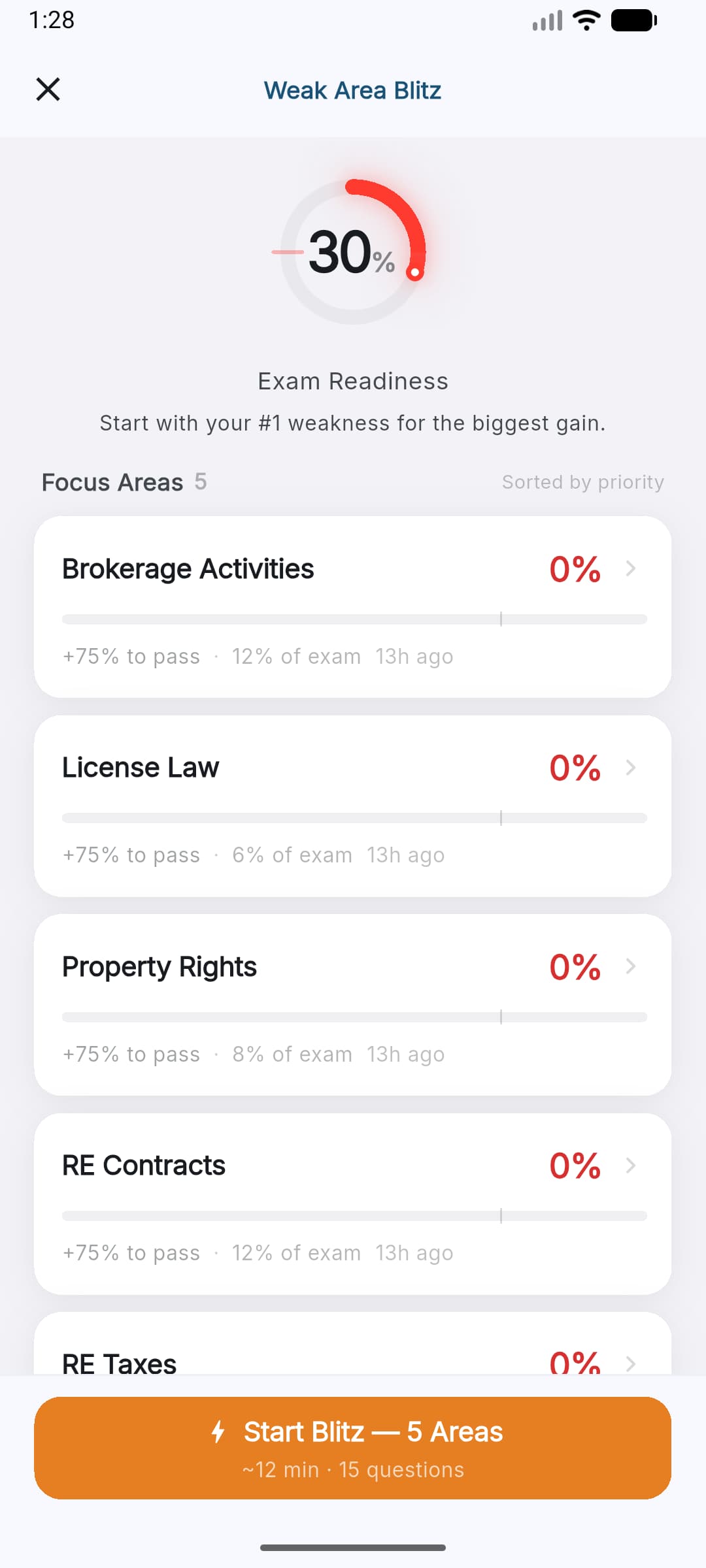
Keep preparing with 1,142 questions across all 19 areas. Review missed answers, work on weak topics, and take full-length timed exams in Pass Florida. Start with free access. The full package is $39.99 once, with no subscription.
1,142 questionsMath CoachTrap Library$39.99 once
Exam prep only. Not a substitute for the 63-hour course, DBPR steps, or Pearson VUE scheduling.
Study in your browser, or download for iPhone and Android. Offline study is available in the mobile app. Your free website quiz result does not transfer to the app.
08 / Check the full objective
How this resource maps to the exam outline
The published outline has six main headings for this area. Section 6 of the Course I syllabus supplies the detailed learning objectives.
A / Complaint process: seven steps+
In this resource: The process diagram, hearing comparison, and timeline.
Also review: Anonymous complaint conditions, panel composition, settlements, and judicial review.
Start with the decision-maker. DBPR investigates and prosecutes. The probable cause panel decides whether there are grounds to proceed. A DOAH judge handles disputed material facts; FREC enters the final disciplinary order.
Then identify the document and its trigger. An investigative complaint, notice of noncompliance, citation, and final order have different response rules. A 30-day deadline is only useful when you know what starts it.
For the Recovery Fund, check eligibility before doing the math. Apply the unpaid compensatory-damages limit, the shared transaction cap, and the aggregate licensee cap. Keep the separate claim deadlines and escrow-disbursement-order provisions in view.
Connect the penalty with the duty.
Review what a licensee must do before studying the consequences of a violation.
How much of the Florida real estate exam covers violations and penalties?+
The published DBPR sales associate candidate booklet assigns this area 3%, about three questions on the 100-question exam. Its six headings cover the complaint process, grounds for discipline, types of penalties, Recovery Fund, legal terms, and disciplinary guidelines. The free eight-question set samples these subjects; the guide maps them to the broader objectives.
Who investigates a Florida real estate license complaint?+
DBPR, through the Division of Real Estate, handles the investigation. The probable cause panel later determines whether there are grounds to proceed. FREC enters the final disciplinary order when the case reaches that stage. Not every investigated complaint results in prosecution or discipline.
Does a complaint have to be signed?+
A written, signed, legally sufficient complaint is the ordinary route under 455.225. An anonymous written complaint can also be investigated if it is legally sufficient, alleges a substantial violation, and the department has reason to believe the allegations after a preliminary inquiry. The statute also permits department-initiated investigations and qualifying confidential sources.
What is the difference between a formal and an informal hearing?+
A formal hearing addresses disputed material facts, ordinarily before a DOAH administrative law judge. The judge issues a recommended order and FREC enters the final agency order within Chapter 120’s limits. An informal FREC hearing applies when material facts are not disputed. Disagreement with the proposed penalty alone does not create a factual dispute.
What is the maximum FREC fine and suspension?+
Under 475.25, FREC may impose an administrative fine of up to $5,000 per count or separate offense and suspend a license for up to 10 years. These are statutory ceilings, not automatic penalties. The separate automatic suspension following certain Recovery Fund payments has its own repayment requirements.
Is a notice of noncompliance the same as a citation?+
No. Under Rule 61J2-24.003, a notice gives 15 days from receipt to correct a listed initial minor violation. A citation identifies a designated offense and penalty. Under 455.224, a citation not disputed within 30 days after service becomes a final order and constitutes discipline.
Must Florida real estate licensees report misdemeanors?+
Yes, when the reporting trigger in 455.227(1)(t) occurs. A guilty or no-contest plea, conviction, or finding of guilt for a crime in any jurisdiction must be reported to the board in writing within 30 days, regardless of adjudication. This includes misdemeanors. Section 475.25(1)(p) separately addresses felonies.
When does a complaint become public?+
Under 455.225(10), complaint and investigative information ordinarily remain confidential until 10 days after probable cause is found, or until the subject waives confidentiality earlier. The statute provides exceptions, including unlicensed-activity enforcement and authorized disclosures to law-enforcement or regulatory bodies. An ordinary complaint is not automatically public when filed.
Can DBPR continue after a consumer withdraws the complaint?+
Yes. Section 455.225 permits the department to continue investigating a withdrawn complaint. Repaying a loss after discovery also does not erase a violation under 475.25(1)(b). The consumer’s civil remedy and the state’s license-regulation duties are separate.
Does the Recovery Fund pay $50,000 to each claimant?+
No. Claims arising from one transaction share a $50,000 aggregate limit, regardless of the number of claimants or parcels. Payments on judgments against one licensee also cannot exceed $150,000 in the aggregate. Actual payment depends on eligibility, unpaid qualifying damages, the caps, and available funds.
Who can qualify for a Real Estate Recovery Fund claim?+
The ordinary public-claim route concerns qualifying misconduct by an individual who held a valid, current, active Florida license and acted solely as a licensee in a Florida real property transaction without the excluded ownership role. The claimant must meet the judgment, collection, timing, notice, and other conditions in 475.483. A judgment only against a brokerage entity is insufficient.
What are the Recovery Fund claim deadlines?+
Section 475.483 requires a claim within two years after the act or two years after it was discovered or should have been discovered with due diligence, and never more than four years after the act. The separate administrative-complaint limit in 475.25(5) uses five-year act or discovery measures.
Does a Recovery Fund payment automatically suspend the license?+
A payment on the ordinary public-claim route under 475.482(1) automatically suspends the license on the payment date. Reinstatement requires full repayment plus interest, subject to the federal bankruptcy-law exception stated in 475.484(7). The separate qualifying escrow-disbursement-order route under 475.482(2) is not subject to that automatic suspension provision.
Does the fund pay attorney fees, interest, or punitive damages?+
Ordinary public-claim payments cover eligible unpaid actual or compensatory damages, not punitive damages. Section 475.484 excludes treble damages, attorney fees, court costs, and interest except as provided in 475.483. Qualifying escrow-disbursement-order claims have separate provisions for reasonable attorney fees and court costs.
Can the same conduct lead to administrative, civil, and criminal cases?+
Yes. A license sanction, a civil damages judgment, and a criminal sentence serve different purposes. Section 475.42 states that the pendency or result of one proceeding does not stay or control the others. FREC does not impose imprisonment.
Are these questions free, and how can I keep preparing?+
All eight questions, 24 explanations of wrong choices, six worked scenarios, and the reference guide are free without an account. Open the Pass Florida web app or download the mobile app for more practice, missed-answer review, weak-area practice, and full-length timed exams across all 19 topics. These are original practice items, not actual or recalled Pearson VUE questions.
Sources and editorial review
Check the reasoning behind the answer.
Published by Pass Florida. Reviewed on for material applicable through .
This review checked the questions, deadlines, penalty distinctions, and fund examples against the published DBPR outline, FREC Course I syllabus, Florida statutes, and adopted FREC rules.
The 3% weight comes from the January 2025 candidate booklet. Section 6 of the published Course I syllabus, effective January 1, 2023, supplies the learning objectives. The cited disciplinary, citation, and noncompliance rules have adopted versions effective March 2, 2023; the probable cause rule is effective November 8, 2012. These publication dates are not presented as a newly issued 2026 syllabus.