Access to housing
Fair Housing Act
Discrimination in housing sales, rentals, advertising, and financing. Florida has its own fair housing law too.
Practice Florida fair housing, lending, disclosures, environmental law, and security deposits with 11 free scored questions. Learn why every answer is right or wrong, work through six scenarios, and check the official sources. No account needed.
Rules in effect through . Reviewed . Review and sources
Quiz mode · Test yourself
11 practice questions on federal and state laws, scored, each with a full explanation after you answer. Every question is also written out below if you would rather study at your own pace.
All 11 questions and explanations are free. Federal and State Laws carries 3% of the published sales associate exam outline, about 3 questions. This focused quiz does not predict your state-exam score.
01 / Find the governing law
Start here when two answer choices both sound plausible. A single mortgage transaction can involve several laws, but each addresses a different duty.
Access to housing
Discrimination in housing sales, rentals, advertising, and financing. Florida has its own fair housing law too.
Fair treatment in credit
Credit decisions and terms. Its prohibited bases include marital status and qualifying age, which are not separately named in the seven federal fair housing classes.
Settlement referrals
Giving or accepting things of value for covered settlement-service referrals. Disclosure alone does not make a prohibited kickback lawful.
Credit terms and costs
Consumer credit disclosures and specified protections, including rescission for certain transactions secured by a principal dwelling.
Public-facing business
Accessibility at places of public accommodation, including a real estate office open to clients. Existing facilities and new construction have different standards.
Residential tenancies
Security deposits, advance rent, access, rental notices, and prohibited landlord conduct. First confirm the tenancy is covered.
02 / Fair housing, with the exceptions in view
The federal Fair Housing Act and Florida's fair housing law protect access to housing. Credit protections and public-accommodation duties add separate layers.
The 1988 amendments added familial status and disability. Familial status includes qualifying households with children under 18, pregnancy, and people securing child custody. Other laws can add protections beyond these seven. U.S. DOJ: Fair Housing Act · F.S. 760.23: Florida fair housing protections
Directing buyers or tenants toward or away from neighborhoods because of a protected characteristic. Offer housing choices based on the client's stated needs, not your assumptions about where they belong.
Trying, for profit, to induce a sale or rental by claiming people of a protected class are entering the neighborhood. The fear-based pitch is the clue, even before a sale closes.
Discriminatory restriction of credit or related housing services in an area because of protected characteristics. A lender's legitimate, consistently applied risk assessment is a different issue.
Claiming an available home has been taken to exclude a protected applicant is unlawful. Advertising can also violate fair housing law even when a limited exemption applies to the underlying rental.
The federal single-family exemption has several conditions: a private individual owns no more than three such houses, uses no covered broker or agent services, and does not publish a prohibited discriminatory advertisement. If the seller does not live in the house and was not its most recent resident, only one such sale in a 24-month period can qualify. Read all conditions in 3603(b)(1). Jones v. Mayer confirms that the separate 1866 law bars private as well as public racial discrimination in property transactions.
The limited federal exemption covers rooms or units in a dwelling occupied, or intended to be occupied, by no more than four families living independently, when the owner occupies one unit. It does not remove the federal discriminatory-advertising prohibition or the separate ban on racial discrimination. State and local protections still need checking.
At least 80% of the occupied units must have at least one occupant aged 55 or older, with policies showing the intent to operate as older-person housing and compliance with age-verification rules. Count qualifying occupied units, not residents. The exemption concerns familial status; it does not excuse discrimination based on the other protected classes. Separate qualifying categories include housing solely occupied by people 62 or older and certain government-designated programs.
Certain noncommercial housing owned or operated by a religious organization may prefer members of that religion, provided religious membership is not restricted by race, color, or national origin. A qualifying private club not open to the public may limit incidental, noncommercial lodgings to its members. Neither label gives a general exemption for an ordinary commercial rental business. Review these limited categories alongside the separate civil-rights laws.
Fair Housing Act / Dwellings
Accommodation: a necessary reasonable change in a policy, practice, or service, such as a reserved parking space or qualifying exception to a no-pets policy.
Modification: a necessary reasonable physical change, such as grab bars. Under the Act's general rule, the person with a disability bears that expense; other laws can create different funding obligations.
Specified multifamily housing with four or more units first occupied after March 13, 1991 has separate design requirements. These cover all units in qualifying elevator buildings and ground-floor units in qualifying buildings without elevators.
ADA Title III / Public accommodations
An existing real estate office must remove architectural barriers when doing so is readily achievable under the applicable cost and resource factors. Age alone does not make a building exempt.
New construction and alterations have separate accessibility standards. Do not apply a blanket rule that every commercial building must be rebuilt, or that an ordinary dwelling is governed only by ADA Title III.
HUD complaint or private action?
HUD: generally file within one year after the discriminatory practice occurred or terminated. HUD investigates, offers conciliation, and either dismisses or finds reasonable cause and issues a charge. It must explain if the investigation cannot be completed within 100 days.
Private civil action: generally two years, with the statutory exclusion for time an administrative proceeding under the Act is pending. A private action can be brought in federal or state court. If HUD issues a charge, the separate election period for a federal civil trial is 20 days after receipt of the charge notice.
03 / Credit, referrals, and disclosure
A fair lending rule, a kickback prohibition, and a credit disclosure rule can appear in the same transaction. Identify what the question asks the person to do.
Regulation B lists race, color, religion, national origin, sex, marital status, age when the applicant can contract, public-assistance income, and good-faith exercise of Consumer Credit Protection Act rights. A housing loan can be covered by both ECOA and the Fair Housing Act. One law's list does not replace the other's.
For a federally related mortgage loan, a title company cannot pay a broker for sending settlement business under a referral agreement. Both giving and accepting the kickback are prohibited. Bona fide payment for actual services is different. Regulation X also recognizes cooperative brokerage and referral arrangements between real estate agents and brokers acting in a real estate brokerage capacity; do not extend that exception to mortgage-broker referrals.
Truth in Lending requires disclosure of consumer credit terms and costs. The normal rescission window for a covered transaction secured by a principal dwelling is three business days after the last of consummation, delivery of the rescission notice, and delivery of the material disclosures. The purchase-money mortgage used to acquire the home is exempt. This is not a general right to cancel a home purchase contract.
A person's marital status is expressly listed under ECOA. Familial status concerns children and related protected circumstances under the Fair Housing Act. A mortgage lender may be subject to both laws.
04 / Land, environmental risks, and disclosures
A disclosure duty does not always require testing or repairs. It also does not automatically protect an owner from environmental cleanup liability.
For most housing built before 1978, provide the EPA pamphlet, disclose known lead information, supply available reports, and include the required lead warning and acknowledgments before the buyer or tenant is bound. Buyers ordinarily get a 10-day inspection opportunity; the parties may change the period by written agreement, and the buyer may waive it. That buyer inspection right does not apply to renters. The disclosure rule itself does not require testing or removal. Keep signed disclosures for three years.
Superfund liability can reach current owners and operators, owners and operators at the time of disposal, arrangers, and transporters who selected the site. Liability can be strict and retroactive, and joint and several when the harm cannot be divided. A current owner cannot assume that buying after the contamination eliminates liability. Statutory defenses and landowner protections have conditions.
The Interstate Land Sales Full Disclosure Act covers qualifying developer lot sales and leases using the mail or interstate commerce, subject to exemptions. For a nonexempt transaction requiring registration, an effective Statement of Record and delivery of the property report before the buyer signs are required. A covered contract has a seven-day revocation right after signing, or a longer period if state law supplies one. It is not a cancellation right for every land purchase, and the buyer need not personally cross a state line.
Residential sale / F.S. 689.302
The statutory form addresses known damaging floods during ownership, flood-insurance claims, and disaster assistance. Being outside a mapped flood zone does not answer those questions.
Separately, Johnson v. Davis requires disclosure of known facts materially affecting value that are not readily observable and are unknown to the buyer. A buyer does not have to ask the right question to create that duty.
Residential rental / F.S. 83.512
Give the required flood disclosure in a separate document at or before execution of the rental agreement. Its questions cover known damaging floods during ownership, flood-insurance claims, and disaster assistance.
The form also explains that standard renters insurance does not cover flood damage. Do not apply this one-year lease trigger to the separate residential sales requirement.
Your next step toward exam day
Keep preparing with 1,142 questions across all 19 areas. Review missed answers, work on weak topics, and take full-length timed exams in Pass Florida. Start with free access. The full package is $39.99 once, with no subscription.
Exam prep only. Not a substitute for the 63-hour course, DBPR steps, or Pearson VUE scheduling.
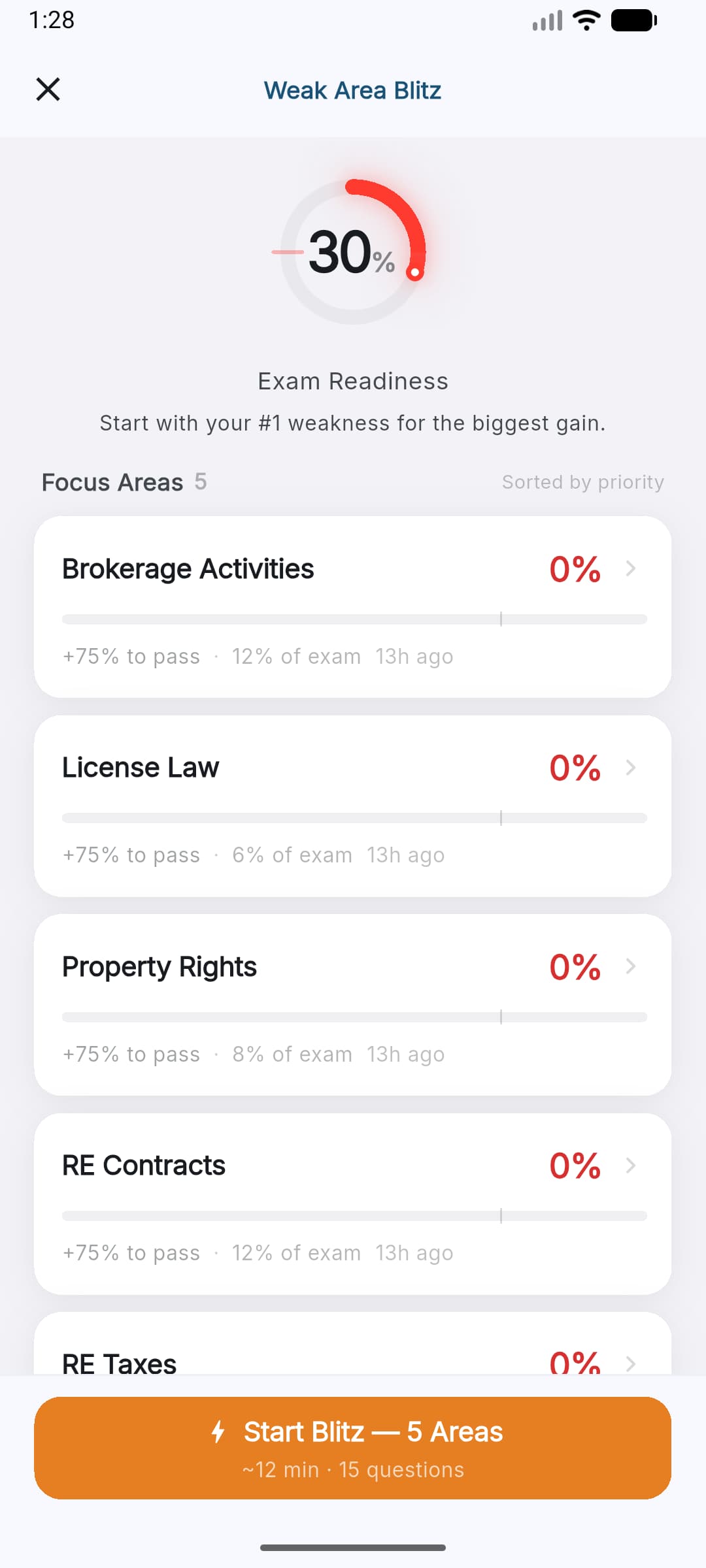
Study in your browser, or download for iPhone and Android. Offline study is available in the mobile app. Your free website quiz result does not transfer to the app.
05 / Florida residential landlord-tenant law
Start after the covered tenancy has terminated and the tenant has vacated. Choose the no-claim or claim route first. The tenant's objection clock begins only after receipt of the claim notice.
No claim
After termination, once the tenant has vacated
Return the security deposit and any required interest. This is the return deadline when the landlord does not intend to make a claim.
Claim intended
After termination, once the tenant has vacated
Send the required written notice of intent to claim, stating the reason, by certified mail to the last known address or by email under a valid 83.505 agreement.
Tenant objection
After the tenant receives the claim notice
The tenant may object in writing. If no timely objection is made, deduct the claim and return the remaining deposit within 30 days after the date of the claim notice.
F.S. 83.49: deposits and advance rent supplies these ordinary rules. If the landlord misses the required claim notice, the deposit cannot be retained or set off against the claim; a separate damages action may follow after its return. A tenant's late objection does not waive every independent claim. Section 83.49(5) also has an exception when a tenant fails to give the required notice for specified early departures or periodic-tenancy departures. Read that subsection and the rental agreement before applying a deadline to an actual dispute.
When a timely claim notice receives no timely objection, the balance must be returned within 30 days after the date of that notice. Do not add another 30 days after the tenant's 15-day objection period ends.
Rental security deposits held by a licensed broker follow 83.49. Its rental-deposit provisions take precedence over the conflicting FREC escrow-dispute notification and settlement procedures specified in 475.25.
Section 83.49 permits a separate noninterest-bearing Florida account, a qualifying interest-bearing Florida account, or the statutory surety-bond alternative. It does not require every deposit to earn interest. Under the interest-bearing account option, the landlord chooses at least 75% of the account's annualized average rate or 5% simple interest. The bond route requires 5% simple interest. Advance rent for a later rental period may be paid to the landlord when that period begins. The exemption for landlords renting fewer than five individual units concerns the handling-notice subsection, not the entire deposit law.
Knowing a tenant's email address is not enough. Section 83.505 requires a signed lease addendum with the specified voluntary consent, valid email addresses, and the right to revoke consent or update the address by written notice. Electronic delivery is effective when sent unless returned as undeliverable. Keep the sent notice and transmission evidence. Other lawful delivery methods remain available.
For repairs, reasonable notice means at least 24 hours and reasonable entry times are 7:30 a.m. to 8 p.m. The statute separately permits access for protection or preservation, emergencies, consent, and other specified circumstances. Do not apply the repair notice rule to every emergency entry or use access rights to harass a tenant.
For a month-to-month tenancy without a specific duration, give at least 30 days' notice before the end of the monthly period. The corresponding periods are 60 days for year-to-year, 30 days for quarter-to-quarter, and seven days for week-to-week. These rules do not replace the separate provisions governing fixed-term leases or termination for a breach.
For unpaid rent, the written demand gives three days after delivery to pay or surrender possession, excluding Saturdays, Sundays, and court-observed holidays. Other tenancy breaches have different provisions, including seven-day notices for specified noncompliance. An expired notice does not authorize a landlord to lock out the tenant or disconnect utilities to force a move.
When ownership or the rental agent changes, transfer covered deposits and advance rent with earned interest and an accurate accounting as required by 83.49(7). The money does not become the seller's profit. Florida also prohibits specified rental discrimination based on military status. The Course I syllabus separately asks you to study servicemember lease-termination rights and selling tenant-occupied property.
06 / Apply what you just learned
Choose your answer before opening the reasoning. Look for the one fact that changes the applicable rule.
Worked scenario 01
A community has 100 occupied units, with no special counting exclusions. Seventy-eight units have at least one resident aged 55 or older. There are 110 residents aged 55 or older overall. Has it met the 80% occupancy requirement?
No. Only 78% of the occupied units qualify.
78 ÷ 100 × 100 = 78%. The number of individual residents does not change the unit count. At least 80 of these 100 occupied units must qualify. Meeting that threshold still leaves the intent and age-verification requirements; it does not establish the whole exemption by itself.
Worked scenario 02
A covered Florida housing provider approves a necessary emotional support animal as a reasonable accommodation. Can it add the ordinary $300 pet fee solely because of the animal?
No. An approved required accommodation is not an ordinary pet-fee situation.
Section 760.27 bars extra compensation for the required accommodation. The resident can still be responsible for actual damage. When disability or need is not apparent, the statute permits specified supporting information; an internet certificate alone is not sufficient. Do not substitute the ADA service-animal definition for the housing accommodation analysis.
Worked scenario 03
A buyer of a covered 1976 home waives the lead inspection opportunity. The seller has a prior lead report. May the seller skip the report and disclosure paperwork?
No. Waiving the inspection opportunity does not waive the disclosure duty.
The seller must still supply known lead information, available reports, the pamphlet, and required contract disclosures before the buyer becomes bound. The inspection opportunity and the disclosure package are separate requirements. The rule itself does not require the seller to remove the lead.
Worked scenario 04
A title company promises a broker a $100 gift card for each referred settlement on a federally related mortgage loan. The broker tells the buyer about it. Does disclosure make the payment acceptable?
No. Disclosure does not cure this referral kickback.
The gift card is a thing of value offered for the referral. Both paying and accepting it are prohibited under the stated facts. A modest amount is not a safe harbor. Payment for a service actually performed must be analyzed separately; merely referring the buyer is not that service.
Worked scenario 05
A Florida home flooded during the seller's ownership. The seller knows the history materially affects value, but it is not readily observable and the buyer does not know. Does completing repairs remove the disclosure issue?
No. Apply the known, hidden, material-fact rule and the separate flood-disclosure statute.
Johnson v. Davis concerns known facts materially affecting value that the buyer does not know and cannot readily observe. A repair does not erase the stated knowledge or materiality. Section 689.302 separately requires residential flood disclosure at or before the sales contract, including the form's questions on known damaging floods, insurance claims, and assistance.
Worked scenario 06
A covered tenancy ends and the tenant vacates. The landlord timely serves the required claim notice for a valid $400 deduction from a $2,200 deposit. The tenant does not timely object. Assume no interest is due. What balance is returned, and which event starts its deadline?
$1,800, within 30 days after the date of the claim notice.
$2,200 − $400 = $1,800. Do not restart the balance-return clock when the tenant's 15-day objection period ends. The separate initial 30-day rule governs giving the claim notice after termination. If the ordinary claim-notice requirement applies and the landlord misses it, the deposit must be returned before pursuing a separate damages action.
07 / Review every answer
Open the concept you want to review. Every question, answer, wrong-choice explanation, and source is available without completing the quiz or signing in.
Try each question before opening its answer. These are original practice items, not actual or recalled Pearson VUE exam questions.
Question 1 · law-1 · The seven federal Fair Housing Act classes
Answer B. Race, color, religion, national origin, sex, familial status, and disability
The seven statutory classes are race, color, religion, national origin, sex, familial status, and disability. The 1988 amendments added familial status and disability protections. Familial status includes qualifying households with children under 18, pregnancy, and people securing custody of a child. These seven classes are not an exhaustive list of every protection supplied by other federal, state, or local laws.
Remember: Familial status concerns children and related protected situations. Marital status is separately named under ECOA.
A. Race, color, religion, age, occupation, marital status, and income level
This substitutes age, occupation, marital status, and income level for several of the statutory fair housing classes.
C. Race, color, religion, national origin, sex, occupation, and credit score
Occupation and credit score are not two of the seven named classes; familial status and disability are missing.
D. Race, color, religion, age, sex, marital status, and employment status
This leaves out national origin, familial status, and disability while adding categories not in the seven-class list.
Sources: U.S. DOJ: Fair Housing Act · F.S. 760.23: Florida fair housing protections · FREC Course I syllabus, effective January 1, 2023
Report a problem with law-1Question 2 · law-2 · Private-owner exemptions and racial discrimination
Answer D. No. The separate federal ban on racial discrimination still applies
Jones v. Alfred H. Mayer Co. held that 42 U.S.C. 1982 bars private as well as public racial discrimination in property sales and rentals. A limited Fair Housing Act exemption does not remove that separate protection. The single-family exemption itself has ownership, brokerage, advertising, and, in some sales, frequency conditions. Do not assume every sale by owner qualifies.
Remember: An exemption under one law does not switch off a separate civil-rights law.
A. Yes, because every private sale is outside federal civil-rights law
The 1866 civil-rights protection applies to private racial discrimination; private ownership does not remove it.
B. Yes, if the seller discloses the preference before an offer
Disclosing a discriminatory preference does not make a race-based refusal lawful.
C. Yes, if no real estate licensee takes part in the sale
The absence of a licensee does not eliminate the separate prohibition on racial discrimination.
Sources: U.S. Reports: Jones v. Alfred H. Mayer Co. (1968) · 42 U.S.C. 3603: limited housing exemptions
Report a problem with law-2Question 3 · law-3 · Blockbusting versus steering and redlining
Answer A. Blockbusting
Blockbusting uses representations about the entry or prospective entry of people of a protected class to induce sales or rentals for profit. The licensee’s fear-based solicitation is the key fact. Steering channels housing choices on a discriminatory basis. Redlining concerns discriminatory restriction of credit or related housing services in an area.
Remember: Inducing owners to sell through a protected-class fear pitch points to blockbusting.
B. Steering
Steering directs a buyer or tenant toward or away from housing; this question describes inducing owners to sell.
C. Redlining
Redlining concerns discriminatory geographic restrictions on credit or related housing services, not this listing solicitation.
D. A permitted property-value forecast
A protected-class fear pitch for profit is prohibited conduct, not a legitimate market forecast.
Sources: F.S. 760.23: Florida fair housing protections · U.S. DOJ: Fair Housing Act
Report a problem with law-3Question 4 · law-4 · Lead disclosure coverage and buyer inspection
Answer C. Most housing built before 1978
Most pre-1978 housing is covered. Before the buyer or tenant becomes bound, the required package includes the EPA pamphlet, known lead information, available reports, and the required contract warning and acknowledgments. Buyers ordinarily receive a 10-day inspection opportunity, which may be changed by written agreement or waived by the buyer. Renters do not receive that buyer inspection right. The disclosure rule itself does not require testing or lead removal.
Remember: Pre-1978 is the coverage clue. Disclosure, inspection opportunity, and removal are different duties.
A. Every dwelling built before 1991
1991 is associated with specified fair housing design requirements, not the lead-disclosure cutoff.
B. Only homes where a child has already suffered lead poisoning
Coverage does not depend on a child already being harmed or lead already being confirmed.
D. Only newly constructed housing
The rule primarily concerns older housing built before 1978, not new construction.
Sources: EPA: lead disclosures in sales and rentals
Report a problem with law-4Question 5 · law-5 · Florida known, hidden, material-fact disclosure
Answer B. A known fact materially affecting value that is not readily observable and is unknown to the buyer
The Florida Supreme Court’s rule concerns facts the seller knows that materially affect the home’s value, are not readily observable, and are unknown to the buyer. It is not a warranty against every unknown or future defect. A buyer’s failure to ask does not erase the duty. Florida also imposes a separate residential flood-disclosure requirement at or before execution of the sales contract under 689.302.
Remember: Look for all four elements: seller knowledge, material effect on value, not readily observable, and unknown to the buyer.
A. Every defect that might arise in the future, even if unknown
The rule does not require a seller to predict unknown future defects or insure against them.
C. Only defects the buyer asks about in writing
The duty can apply without a written question from the buyer.
D. Only defects that a government inspector has formally cited
A government citation is not a required element of the disclosure rule.
Sources: Florida Supreme Court: Johnson v. Davis (1985) · F.S. 689.302: residential seller flood disclosure
Report a problem with law-5Question 6 · law-6 · ADA duties at a public-facing brokerage office
Answer A. Remove architectural barriers when doing so is readily achievable
An office of a real estate broker is a place of public accommodation under Title III. In existing facilities, architectural barriers must be removed when that is readily achievable, meaning it can be done without much difficulty or expense under the applicable factors. New construction and alterations have separate accessibility requirements. Housing accommodations and covered multifamily design duties under the Fair Housing Act are related but distinct.
Remember: Identify the space and the work: an existing public-facing office, new construction, an alteration, or a dwelling.
B. Rebuild the entire office immediately, regardless of cost or circumstances
The existing-facility standard requires a case-specific readily-achievable assessment, not unconditional rebuilding.
C. Ignore accessibility because a real estate office is never a public accommodation
A real estate brokerage office open to clients is included among places of public accommodation.
D. Apply only the Fair Housing Act’s rules for residential bedrooms
Residential fair housing rules do not replace the office’s ADA Title III duties.
Sources: U.S. DOJ: ADA Title III technical assistance · F.S. 760.23: Florida fair housing protections
Report a problem with law-6Question 7 · law-7 · HUD complaint timing versus a private lawsuit
Answer D. One year after the discriminatory practice occurred or terminated
The HUD administrative complaint period is one year after the alleged discriminatory housing practice occurred or terminated. A private civil action has a separate general two-year period, with time excluded while an administrative proceeding under the Act is pending. DOJ explains that an individual may bring a private action in federal or state court. The administrative and court routes are not the same filing procedure.
Remember: HUD complaint: one year. Private civil action: generally two years, with the statutory exclusion for administrative proceedings.
A. 30 days after signing the listing agreement
The listing date and a 30-day period do not define the federal HUD complaint deadline.
B. Six months after the buyer receives a loan estimate
A loan estimate does not start this fair housing complaint period.
C. Two years after discovery in every case
The private-action period is distinct, and this is not a universal two-year discovery rule.
Sources: HUD: fair housing rights and complaint process · U.S. DOJ: Fair Housing Act
Report a problem with law-7Question 8 · law-8 · RESPA settlement-service kickbacks
Answer C. Section 8 of RESPA
RESPA Section 8, implemented through Regulation X, prohibits giving or accepting a thing of value under an agreement or understanding for a covered settlement-service referral. A gift card counts. Telling the buyer about it does not cure the prohibited arrangement. Bona fide compensation for actual services and the regulation’s specified exceptions require a different analysis.
Remember: A thing of value plus a covered settlement referral is the core warning sign. No minimum-dollar safe harbor applies to this fact pattern.
A. The Interstate Land Sales Full Disclosure Act
ILSA addresses qualifying developer land-sale practices and disclosures, not this settlement referral payment.
B. CERCLA
CERCLA addresses hazardous-substance cleanup liability, not referral kickbacks.
D. The lead-based paint disclosure rule
Lead disclosures concern covered older housing, not title-company referral compensation.
Sources: 12 C.F.R. 1024.14: RESPA referral fees
Report a problem with law-8Question 9 · law-9 · CERCLA current-owner liability
Answer A. Current ownership can create cleanup liability even if the buyer did not cause the contamination, subject to statutory defenses and protections
CERCLA identifies several potentially responsible parties, including current owners and operators. Liability can be strict and retroactive. It can also be joint and several when the harm is indivisible. A current owner’s lack of involvement in the original disposal does not, by itself, establish a defense. Statutory landowner protections and defenses have conditions; disclosure alone does not establish them.
Remember: Not causing the contamination does not automatically remove current-owner exposure.
B. Only the person who physically dumped the substances can be liable
CERCLA reaches more categories than the person who physically disposed of the waste.
C. Buying after the contamination always eliminates liability
Current owners are a listed category of potentially responsible parties, even when disposal happened earlier.
D. Disclosure of the contamination automatically grants immunity
Disclosure is not a blanket statutory immunity from cleanup liability.
Sources: EPA: Superfund liability
Report a problem with law-9Question 10 · law-10 · Florida deposit return when no claim is intended
Answer B. 15 days after termination
When no claim is intended, return the deposit and any required interest within 15 days after termination, once the tenant has vacated. The separate ordinary claim route requires the prescribed notice within 30 days after termination. A tenant then has 15 days after receiving that notice to object. An email claim notice must comply with 83.505; having an email address alone is not enough.
Remember: No claim: return in 15 days. Claim intended: notice in 30 days. Objection: 15 days from receipt.
A. Seven days after receiving a forwarding address
A forwarding-address request does not replace the stated no-claim return period.
C. 30 days after the landlord finishes inspecting
An inspection does not create a new 30-day no-claim deadline.
D. 45 days after termination
The statute does not supply a general 45-day no-claim return period.
Sources: F.S. 83.49: deposits and advance rent · F.S. 83.505: electronic rental notices
Report a problem with law-10Question 11 · law-11 · ECOA marital status versus FHA familial status
Answer C. Marital status
ECOA expressly lists marital status. The Fair Housing Act separately names familial status, which concerns qualifying households with children, pregnancy, and securing child custody. Religion, national origin, and race appear in both laws. A mortgage transaction can involve both statutes, and state or local law may supply additional protections.
Remember: Marital status and familial status are different terms. Do not swap one law’s protected list for another.
A. Religion
Religion is expressly protected under both ECOA and the Fair Housing Act.
B. National origin
National origin is expressly protected under both statutes.
D. Race
Race is expressly protected under both statutes.
Sources: 12 C.F.R. 1002.2(z): ECOA prohibited bases · U.S. DOJ: Fair Housing Act
Report a problem with law-1108 / Check the full objective
The published outline gives this area four main headings. The Course I syllabus adds detailed objectives in Section 7 and related mortgage and environmental sections.
In this resource: Protected classes, Jones v. Mayer, discriminatory conduct, limited exemptions, HOPA, disability accommodations, accessibility, and complaint routes.
Also review: Civil Rights Act of 1964, fair housing posters, brokerage-service discrimination, and the detailed exemption conditions in Course I Section 7.
In this resource: Lead disclosures, CERCLA liability, and ILSA property reports and cancellation.
Also review: The broader environmental objectives in Course I Section 19, including environmental hazards and due diligence. Review ILSA's different exemption categories in Section 7.
In this resource: RESPA referral restrictions, ECOA protected bases, TILA's purpose, and the purchase-money rescission exception.
Also review: Mortgage disclosures, advertising, credit terms, and the wider financing objectives in Course I Sections 12 and 13.
In this resource: Deposit and advance-rent handling, the 15/30/15 sequence, email notices, access, periodic termination, rental flood disclosures, and prohibited practices.
Also review: Landlord maintenance and tenant duties, servicemember termination rights, eviction procedures, and tenant-occupied sales in Course I Section 7. The seller-disclosure question connects to residential transaction duties.
DBPR sales associate exam outline, January 2025 supplies the 3% weight and four headings. FREC Course I syllabus, effective January 1, 2023 supplies the detailed objectives. Completing 11 questions is a starting point, not proof that every objective is mastered.
First identify what the person is doing. A housing decision points to fair housing law; a credit decision may involve both fair housing and ECOA. A payment for a settlement referral raises a different question under RESPA.
Read the exception as carefully as the rule. A private sale is not automatically exempt from fair housing law. A purchase-money mortgage does not carry the ordinary TILA rescission right. An approved housing accommodation is not an ordinary pet request.
For a deadline, name the starting event. Termination, sending a claim notice, and receiving that notice start different deposit-related periods. Write the event beside the number so you can apply the rule to a new scenario.
Questions about federal and state law practice
The published DBPR sales associate exam outline assigns this area 3%, about three questions on the 100-question exam. Its four headings are fair housing, federal land and environmental laws, federal mortgage-lending laws, and Florida residential landlord-tenant law. This free 11-question set samples the area; the guide links the topics to the broader course objectives.
Race, color, religion, national origin, sex, familial status, and disability. Familial status and disability were added in 1988. Familial status includes qualifying households with children under 18, pregnancy, and people securing child custody. Other federal, state, and local laws can provide additional protections.
Not automatically. The federal single-family exemption has limits on ownership, broker involvement, advertising, and, for certain sales, frequency. Even when it applies, the separate federal protection against private racial discrimination still applies under Jones v. Mayer and 42 U.S.C. 1982. State and local protections also need checking.
Steering channels people toward or away from housing because of protected characteristics. Blockbusting tries, for profit, to induce sales or rentals through representations about people of a protected class entering an area. Redlining restricts credit or related housing services in an area on a discriminatory basis. Identify the conduct before choosing the label.
At least 80% of the occupied units must have at least one occupant who is 55 or older, subject to HUD’s counting rules. The community also needs policies showing the required intent and compliance with age-verification rules. Count units, not people. This is a limited familial-status exemption, not permission to discriminate on other protected grounds.
An accommodation changes a rule, policy, practice, or service when necessary for equal use and enjoyment, such as a qualifying exception to a no-pets rule. A modification changes the physical premises, such as adding grab bars. Under the Fair Housing Act’s general rule, a necessary reasonable physical modification is at the disabled person’s expense; other laws can change funding duties.
No. Apply the reasonable-accommodation requirements and F.S. 760.27. When disability or need is not apparent, specified supporting information can be requested; an internet certificate alone is insufficient. A required approved accommodation cannot carry extra compensation such as a pet fee, but the resident remains responsible for actual damage.
A HUD complaint generally must be filed within one year after the discriminatory practice occurred or terminated. A private civil action generally has a two-year period, excluding time during which an administrative proceeding under the Act is pending. These are separate routes with additional procedural conditions.
Yes, an office open to the public is a place of public accommodation under ADA Title III. Existing facilities must remove architectural barriers when readily achievable. New construction and alterations have separate accessibility requirements. The Fair Housing Act’s residential accommodation and design requirements are distinct.
Most housing built before 1978 is covered, subject to exemptions. Before the buyer or tenant is bound, provide the required pamphlet, known lead information, available reports, and contract disclosures. Buyers ordinarily get a 10-day inspection opportunity that may be changed by written agreement or waived. Renters do not get that buyer inspection right. The rule itself does not require testing or removal.
A gift given under an agreement or understanding for a settlement-service referral involving a federally related mortgage loan can be a prohibited RESPA kickback. The thing of value need not be cash, and disclosure does not cure the violation. Bona fide payment for actual services and specifically permitted arrangements require separate analysis.
No. The normal TILA rescission rule concerns certain consumer credit transactions secured by a principal dwelling. The purchase-money mortgage used to acquire the home is exempt. For a covered transaction, the three-business-day period starts after the last required trigger: consummation, the rescission notice, or the material disclosures. It is not a universal cancellation right for a home purchase contract.
Johnson v. Davis requires disclosure of known facts materially affecting value that are not readily observable and are unknown to the buyer. Section 689.302 separately requires residential flood disclosure at or before execution of the sales contract. The current statutory form addresses known damaging floods during ownership, flood-insurance claims, and disaster assistance.
Under the ordinary rule, after termination and vacating, return the deposit within 15 days if no claim is intended. If claiming, give the prescribed notice within 30 days. The tenant has 15 days after receipt to object. If there is no timely objection, return the remaining balance within 30 days after the date of the claim notice. Section 83.49 includes exceptions, including specified early-departure notice circumstances.
Yes, when the required electronic-notice agreement under F.S. 83.505 is in place and the notice meets 83.49. The parties need a signed lease addendum with the statutory consent and email details. An address in an ordinary email exchange is not enough. Certified mail to the tenant’s last known address remains an authorized method.
Section 83.512 requires a separate flood-disclosure document at or before execution of a residential rental agreement with a term of one year or longer. Its form asks about known damaging floods during ownership, flood-insurance claims, and disaster assistance. Do not confuse this rental requirement with the separate residential seller disclosure in 689.302.
For a nonexempt transaction subject to the registration and disclosure requirements, the developer needs an effective Statement of Record and must deliver the property report before the buyer signs. Qualifying contracts have a seven-day revocation right after signing, or a longer period under state law. Different exemptions have different effects; this is not a rule for every land sale.
All 11 questions, 33 explanations of wrong choices, six worked scenarios, and the study guide are free without an account. Open the Pass Florida web app or download the mobile app for more practice, missed-answer review, weak-area practice, and full-length timed exams across all 19 topics. These are original practice items, not actual or recalled Pearson VUE questions.
Sources and editorial review
Published by Pass Florida. Reviewed on for material applicable through .
This review checked the questions, statutory distinctions, deposit timing, and worked scenarios against the published DBPR outline, FREC Course I syllabus, Florida statutes, federal regulations, agency guidance, and the cited court decisions.
The 3% weight comes from the January 2025 candidate booklet. The published Course I syllabus is effective January 1, 2023. Those dates do not represent a newly issued 2026 syllabus. The update includes the Florida email-notice and residential flood-disclosure provisions applicable by the stated cutoff.
HUD's older fair housing booklet is cited for its established complaint process and housing principles, not its historical dollar penalties. The statutes and regulations linked beside the relevant explanation supply the governing conditions.
Found an error? Use the correction link under a question or send the question ID and supporting source.
Review a definition, worked example, or common exam trap before your next quiz.