Property Rights Practice Questions
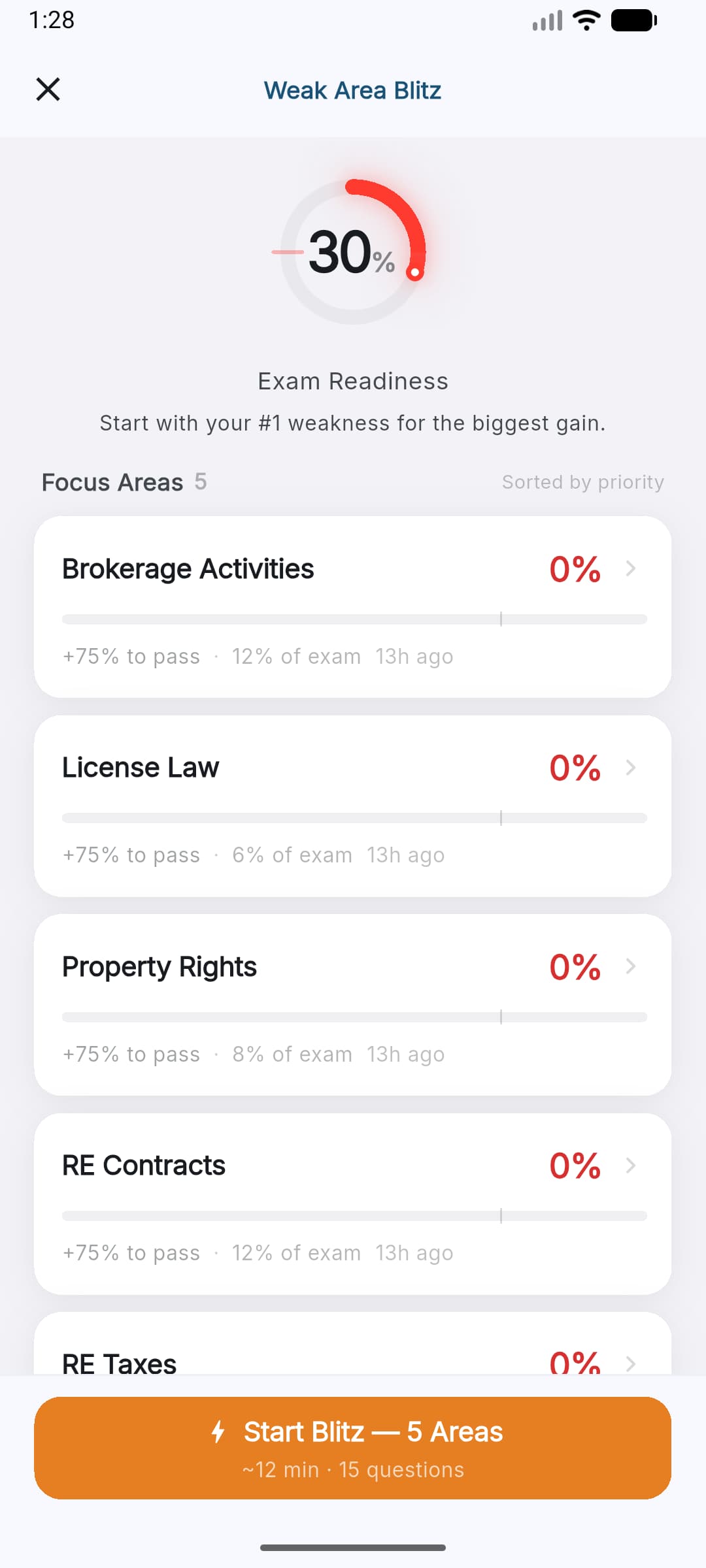
Property rights, estates, and tenancies is about 8 questions on the Florida sales associate exam. It covers freehold estates, the forms of co-ownership, the bundle of rights, homestead protection, and how condominiums and cooperatives are owned. Work the questions below, then read every explanation.
Exam prep only
Property rights questions hand you a fact pattern and ask you to classify it: which estate, which form of co-ownership, or which kind of ownership a condo or co-op buyer holds. The labels matter more than the math here.
Use The Classify-Then-Confirm Read. First name the estate or tenancy the facts describe, then confirm the one feature the exam is testing, such as survivorship, the right to devise, or creditor protection.
Quiz mode · Test yourself
Property Rights Practice Questions
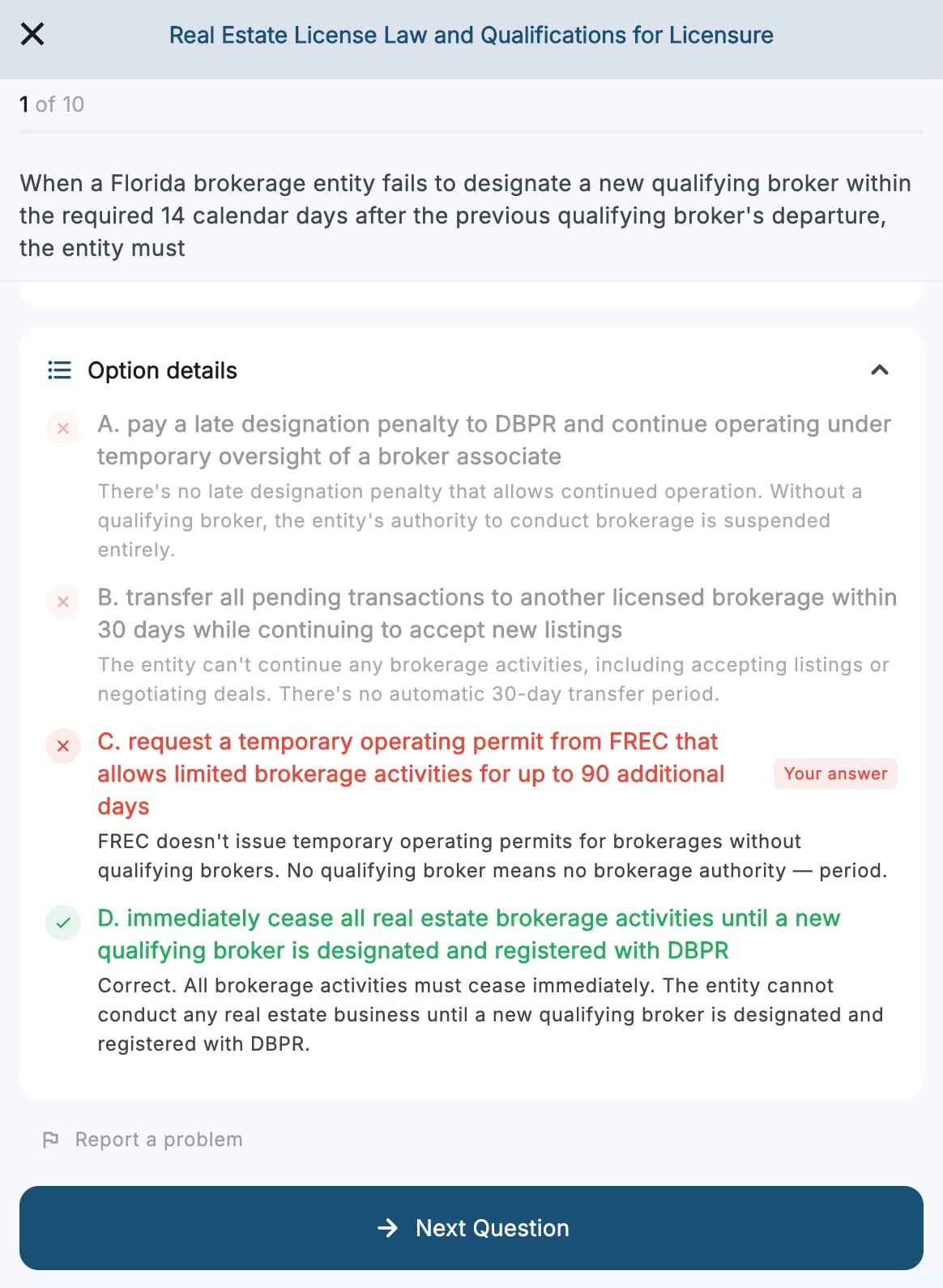
9 scenario-based questions on property rights, scored, each with a full explanation after you answer. Every question is also written out below if you would rather study at your own pace.
Every question explained
Prefer to study at your own pace? Here are all 9 questions. Read each one and pick your answer, then reveal the correct answer, the reasoning, and the trap that catches most candidates.
1. An owner holds property with rights that last forever, pass to heirs, and carry no conditions that could end the ownership. This estate is
- A.a life estate
- B.fee simple absolute, the highest and most complete form of ownership
- C.fee simple defeasible
- D.a leasehold estate
Show answer and explanation
Correct answer: B. fee simple absolute, the highest and most complete form of ownership
Why B is correct: Fee simple absolute is the greatest estate in real property. It is indefinite in duration, freely transferable during life or at death, and not subject to any condition that could cut it short. It carries the full bundle of rights.
Trap: Fee simple defeasible looks similar but carries a condition that can trigger forfeiture. Absolute means no such condition.
Source: F.S. Chapter 689, conveyances of land
2. A woman is granted the right to live in a home for the rest of her life, after which the home passes to her nephew. The nephew's future interest is called a
- A.reversion
- B.remainder, and the nephew is the remainderman
- C.leasehold
- D.fee simple defeasible
Show answer and explanation
Correct answer: B. remainder, and the nephew is the remainderman
Why B is correct: This is a life estate. When a life estate ends and the property passes to a named third party, that party holds a remainder and is called the remainderman. If the property instead returned to the original grantor, that future interest would be a reversion.
Trap: A remainder goes to a named third party; a reversion returns to the grantor. The life tenant also cannot commit waste, including failing to pay property taxes.
Source: F.S. Chapter 689, conveyances of land
3. Two business partners take title with equal shares, the right of survivorship, and all four unities of time, title, interest, and possession. This form of co-ownership is
- A.tenancy in common
- B.tenancy by the entireties
- C.joint tenancy with right of survivorship
- D.a life estate
Show answer and explanation
Correct answer: C. joint tenancy with right of survivorship
Why C is correct: Joint tenancy requires the four unities, often remembered as TTIP: Time, Title, Interest, and Possession. It includes the right of survivorship, so when one joint tenant dies, that share passes to the surviving joint tenants rather than to the deceased owner's heirs.
Trap: Break any one of the four unities and the joint tenancy becomes a tenancy in common, which has no survivorship.
Source: F.S. Chapter 689, conveyances of land
4. A married couple in Florida takes title to their home as a single legal unit, with survivorship and protection from the individual creditors of one spouse. This is
- A.tenancy in common
- B.joint tenancy
- C.tenancy by the entireties
- D.a partnership
Show answer and explanation
Correct answer: C. tenancy by the entireties
Why C is correct: Tenancy by the entireties is available only to married couples in Florida. The spouses own the property as one unit, the survivor automatically takes the whole on the death of the other, and the property is generally protected from a creditor of just one spouse.
Trap: Only married couples qualify for tenancy by the entireties. Two unmarried co-owners cannot use it.
Source: F.S. Chapter 689, conveyances of land
5. Two unmarried friends buy a property together. The deed says nothing about survivorship, and their shares are unequal. When one dies, that share passes to her heirs. This is
- A.joint tenancy
- B.tenancy by the entireties
- C.tenancy in common, the default co-ownership form
- D.a life estate
Show answer and explanation
Correct answer: C. tenancy in common, the default co-ownership form
Why C is correct: Tenancy in common is the default form of co-ownership. Owners can hold unequal shares, there is no right of survivorship, and a deceased owner's share passes to that owner's heirs or by will, not to the other co-owners.
Trap: Tenancy in common has no survivorship. Do not confuse it with joint tenancy, where the share goes to surviving co-owners.
Source: F.S. Chapter 689, conveyances of land
6. An owner sells the mineral rights under her land but keeps the right to live on and use the surface. This is possible because property ownership is best understood as
- A.a single, indivisible right that must be transferred all at once
- B.a bundle of separable rights, including possession, control, enjoyment, exclusion, and disposition
- C.only the right to exclude others
- D.limited to surface rights in Florida
Show answer and explanation
Correct answer: B. a bundle of separable rights, including possession, control, enjoyment, exclusion, and disposition
Why B is correct: Ownership is a bundle of rights: possession, control, enjoyment, exclusion, and disposition. Because the rights are separable, an owner can sell or lease one right, such as mineral rights, while keeping the others.
Trap: Ownership is not all-or-nothing. Individual rights in the bundle can be sold or leased separately.
Source: F.S. Chapter 689, conveyances of land
7. A Florida homeowner's primary residence is shielded from forced sale by most creditors, and the home cannot be left away from a surviving spouse or minor child without consent. This protection comes from
- A.the homestead tax exemption
- B.Florida's constitutional homestead protection under Article X, Section 4
- C.the Save Our Homes assessment cap
- D.federal bankruptcy law only
Show answer and explanation
Correct answer: B. Florida's constitutional homestead protection under Article X, Section 4
Why B is correct: Florida's constitutional homestead protection, in Article X, Section 4 of the Florida Constitution, shields a primary residence from forced sale by most creditors and limits how the home can be devised. It is separate from the homestead tax exemption, which lowers taxable value.
Trap: The constitutional homestead protection stops forced sale. The homestead tax exemption lowers property tax. They share a name but do different things.
Source: Florida Constitution, Article X, Section 4
8. A buyer purchases a unit in a building and receives fee simple title to the unit plus an undivided share of the pool, lobby, and parking. The buyer owns a
- A.cooperative interest
- B.condominium, with fee simple title to the unit and a shared interest in the common elements
- C.leasehold
- D.timeshare
Show answer and explanation
Correct answer: B. condominium, with fee simple title to the unit and a shared interest in the common elements
Why B is correct: A condominium owner holds fee simple title to the individual unit and an undivided share of the common elements, such as the pool, lobby, and parking. A cooperative owner, by contrast, owns shares in a corporation that owns the building and holds a proprietary lease on the unit.
Trap: Condo means fee simple ownership of the unit. Co-op means owning shares plus a proprietary lease, not the unit itself.
Source: F.S. Chapter 718, condominiums
9. A buyer purchases a brand-new condominium directly from the developer. Under Florida law, the buyer has a right to cancel within
- A.3 business days after signing
- B.15 days after signing the contract or receiving all required documents, whichever is later
- C.10 calendar days, with no extensions
- D.no cancellation period applies to new construction
Show answer and explanation
Correct answer: B. 15 days after signing the contract or receiving all required documents, whichever is later
Why B is correct: A buyer of a new condominium from a developer has a 15-day right to cancel, running from the later of signing the contract or receiving all required documents. A buyer of a resale condominium instead has a 7-business-day cancellation right, excluding Saturdays, Sundays, and legal holidays, after receiving the condominium documents.
Trap: The 15-day window is for new developer sales. Resale condominiums use a 7-business-day window. Do not mix them up.
Source: F.S. 718.503, condominium disclosure and cancellation
9 here, 1,002 in the app
You found your gaps. Now close them across all 19 areas.
Pass Florida gives you 1,002 Florida-specific questions, diagnostics across the 19 exam areas, Trap Library, Math Coach, offline access, and one $39.99 purchase. No subscription. No copied exam questions.
Get the full question bankFrequently asked questions
What are the four unities of joint tenancy?
Joint tenancy requires time, title, interest, and possession, often remembered as TTIP. All owners must take title at the same time, through the same document, in equal shares, with an equal right to possess the whole. Joint tenancy also includes the right of survivorship.
What is the difference between a condominium and a cooperative?
A condominium owner holds fee simple title to the individual unit plus an undivided share of the common elements. A cooperative owner holds shares in a corporation that owns the entire building and receives a proprietary lease for the unit. The condo owner owns real property; the co-op owner owns stock.
How many property rights questions are on the Florida exam?
Property rights, estates, and tenancies is about 8 percent of the 100-question Florida sales associate exam, so expect roughly 8 questions on estates, co-ownership, the bundle of rights, homestead, condominiums, and cooperatives.