6% of the exam · 8 free questions

    Florida License Law and Qualifications Practice Questions and Answers

    Practice Florida license law with 8 free questions on qualifications, exemptions, education, broker experience, renewal, and inactive status. Get a score, an explanation of every choice, and six worked scenarios. No account needed.

    Rules in effect through . Reviewed . Review and sources

    Start the 8-question quiz

    Full exam prep in Pass Florida. Free to start.

    Open the web appDownload the app

    Quiz mode · Test yourself

    License Law and Qualifications Practice Questions

    8 practice questions on license law and qualifications, scored, each with a full explanation after you answer. Every question is also written out below if you would rather study at your own pace.

    8 questions
    ~6 min
    6% of the exam

    All 8 questions and explanations are free. License Law and Qualifications for Licensure carries 6% of the published sales associate exam outline, about 6 questions. This focused set does not predict your state-exam score.

    01 / Put the hours in order

    63, 45, and 14: three different stages

    These are the ordinary education requirements without an applicable exemption. Read the renewal stage before choosing a number.

    Later renewal: 3 + 3 + 8 = 14 hours.

    Core Law and Ethics and Business Practices are part of the 14-hour total. They are not six extra hours on top. Completing the education and renewing with the required fee are separate obligations.

    Which education exemptions should you keep separate?

    Eligible Florida Bar member: An active member in good standing who is otherwise qualified is exempt from the sales associate prelicense course under Rule 61J2-3.008(8), and from ordinary CE under Rule 61J2-3.009(6). Bar membership alone does not waive postlicense education or the broker prelicense course.

    A four-year degree or higher in real estate: F.S. 475.17(6) exempts the holder of this degree from an accredited institution from prelicense and postlicense education. A degree in a different subject does not automatically qualify. This exemption does not itself remove CE, the state exam, or the other licensing requirements.

    An exemption from a course is not the same as an exemption from having a license. Check the supporting documents and the exact exemption claimed.

    F.A.C. 61J2-3.008, prelicense education · F.A.C. 61J2-3.009, continuing education · F.S. 475.17, qualifications, experience, and postlicense education · DBPR, education requirements and exemptions

    What if the first postlicense deadline is missed?

    Sales associate: Without an applicable exemption or approved extension, missing the required 45-hour postlicense education makes the license null and void. To return as a sales associate, complete the prelicense course and pass the state exam again.

    Broker: Missing required broker postlicense education also makes the broker license null and void. The statute separately allows a sales associate license after proof of the 14-hour CE course within six months after broker-license expiration. To operate as a broker again, the person must requalify through the broker prelicense course and exam.

    F.S. 475.17(5)(a) permits the commission to allow an additional six months for qualifying individual physical hardship. This is limited relief, not an automatic grace period or an exemption for being busy. Read the first expiration date on the license rather than assuming two full years from the exam date.

    F.S. 475.17, qualifications, experience, and postlicense education · F.A.C. 61J2-3.020, postlicense education

    02 / Separate eligibility from permission to work

    The standard sales associate route

    Meeting the entry qualifications starts the process. Education, application approval, examination, and activation each do a different job.

    1. Meet the basic qualifications

      Be at least 18 and hold a high school diploma or equivalent. A natural-person applicant must also meet the statutory standards of honesty, truthfulness, trustworthiness, character, and fair dealing. A college degree is not the ordinary entry requirement.

      F.S. 475.17, qualifications, experience, and postlicense education

    2. Apply and complete the background process

      Provide the required Social Security number, application information, documents, and fee. DBPR currently instructs applicants to submit the application before fingerprints, then use an FDLE-registered Livescan provider. Answer the background questions accurately; an application is not permission to practice.

      DBPR, standard sales associate application checklist

    3. Complete education and pass the state exam

      For the standard route, finish the approved 63-hour course unless exempt and obtain DBPR exam approval. You may apply before finishing the course, but you need valid course completion to sit for the exam. The state sales associate exam has 100 questions, 3.5 hours, and a passing score of 75.

      DBPR, sales associate examination and activation steps

    4. Activate before performing licensed services

      A new license is issued inactive unless activated. Complete the required activation and employment registration with the qualifying broker or owner-developer. A sales associate cannot operate as an independent broker or work for an employer who is not registered as that associate's employer.

      F.S. 475.42, active licensure and registered employment

    The exam format comes from the DBPR sales associate exam outline, Section II. The course, application, and activation references above explain the separate licensing steps. Pass Florida provides exam preparation; it does not issue a license or replace required FREC-approved education.

    What counts toward the broker's 24-month experience requirement?

    Under F.S. 475.17(2)(b), the standard path uses at least 24 months of active sales associate experience in one or more licensed brokers' offices during the preceding five years. It can include qualifying experience from the listed outside jurisdictions. Inactive time is not active work, and the months do not all need to be with the same broker.

    The statute also recognizes a current and valid sales associate license held for at least 24 months in the preceding five years while employed by a governmental agency for a salary and performing authorized duties. A separate path uses a current and valid broker license held for that period in a listed outside jurisdiction.

    A person licensed as a Florida sales associate during the preceding five years must also complete required sales associate postlicense education. The ordinary 72-hour course and exam do not replace experience. Endorsement is a separate application route.

    F.S. 475.17, qualifications, experience, and postlicense education · Count the qualifying months in the example →

    03 / Test every part of an exemption

    Who needs a license, and who is exempt?

    Covered services for another in expectation of compensation generally require an active license. F.S. 475.011 supplies specific exceptions. Match the activity, employment, payment, and other limits.

    One covered act can be enough.

    There is no five-sale threshold or automatic part-time exception. Offers, attempts, negotiations, and procuring prospects can fall within the statutory definition. Compensation may be promised or expected, so a transaction that produces no fee does not necessarily remove the licensing requirement.

    An owner handling the owner's real property

    F.S. 475.011(2) covers an owner selling, exchanging, or leasing its own real property. Read the limit for agents, employees, or independent contractors paid a commission or other compensation strictly on a transactional basis in the owner's ordinary business with the public. Being employed by the owner is not a blanket exemption.

    F.S. 475.011(2)
    A salaried employee in an apartment's onsite rental office

    The employee must work in a leasing capacity in that apartment community's onsite rental office and be salaried by the owner or the owner's registered broker. All of those facts matter. The exemption does not simply say that every salaried property manager is exempt.

    F.S. 475.011(4)
    A salaried condominium or cooperative manager

    The specific exemption covers the manager's activities relating to renting individual units when the arranged rentals are no longer than one year. A 14-month lease does not fit this duration limit. Keep this exemption separate from onsite apartment leasing.

    F.S. 475.011(5)
    Legal, accounting, and appointed roles

    An attorney at law or CPA must be acting within the scope of that professional role. An attorney in fact has a narrower exemption for executing contracts or conveyances only. The statute separately covers specified personal representatives, receivers, trustees, and magistrates. A title or power of attorney does not authorize an unrestricted brokerage business.

    F.S. 475.011(1)
    Specified salaried public and utility employees

    The employee must act within the scope of employment for the employer's use, with no compensation beyond salary, for a public utility, rural electric cooperative, railroad, or state or local governmental agency. A private side business negotiating for other owners is a different activity.

    F.S. 475.011(3)
    The limited apartment-tenant referral fee

    The apartment owner or property management firm may pay an unlicensed tenant in that complex a referral benefit worth no more than $50 per transaction. A rent credit counts as value. This does not authorize the tenant to advertise or promote tenant-procurement services to the public.

    F.S. 475.011(13)
    Other listed activities

    The statute also covers specified appraisers and supervised appraisal students, certain timeshare activities, transient rentals of licensed public lodging establishments, and defined business-enterprise transactions. Read the particular subsection. An exemption for one activity does not authorize a separate real estate sale or brokerage service.

    F.S. 475.011(6)-(12)

    A real estate license does not replace a separate credential required for another profession. In particular, the broker definition excludes appraisals reserved to appropriately credentialed appraisers under Part II. F.S. 475.01, definitions and the single-act rule

    04 / Identify the status before the remedy

    Inactive does not always mean the same thing

    Start with the reason for the status. Then determine whether renewal, reactivation, requalification, or limited statutory relief is available.

    A chosen inactive status

    Voluntarily inactive

    The licensee has requested inactive status. Licensed brokerage work is not permitted. The license can remain voluntarily inactive through proper renewals and required education; choosing inactivity does not cancel renewal obligations.

    A failure to renew

    Involuntarily inactive

    Ordinary nonrenewal causes this status under F.S. 475.182. Licensed work must stop. Reactivation depends on the time inactive, required education, fees, and the remaining qualifications.

    The license has ended

    Null and void

    This differs from an inactive license that is still eligible for ordinary reactivation. Missing required first-renewal postlicense education or remaining involuntarily inactive for more than two years can produce this result, subject to the applicable limited relief provisions.

    The involuntary-inactive education clock

    12 months or less
    At least 14 hours of prescribed CE.
    More than 12, fewer than 24 months
    28 hours of prescribed reactivation education.
    More than two years
    Automatic expiration; the license is null and void, subject to limited statutory relief.

    These are the intervals stated in F.S. 475.183. Fees and other requirements also apply. Check the exact dates and status with DBPR well before the two-year boundary.

    F.S. 475.183, reactivation and void licenses

    Does hardship automatically restore a void license?

    No. F.S. 475.183(4) permits commission reinstatement when the failure to comply resulted from qualifying illness or economic hardship. The individual must apply within six months after the license becomes void, meet the required continuing education, pay the appropriate fees, and otherwise qualify for renewal.

    This provision concerns relief under the inactive-status statute. The physical-hardship extension for first-renewal postlicense education appears separately in F.S. 475.17. Do not combine the two into a general promise that every void license can be fixed with a course.

    F.S. 475.183, reactivation and void licenses · F.S. 475.17, qualifications, experience, and postlicense education

    05 / Choose the right application route

    An outside license does not transfer automatically

    Florida permits nonresident licensure. Standard examination, mutual recognition, and endorsement are distinct routes with different conditions.

    Mutual recognition

    A qualifying nonresident

    Be a Florida nonresident at application, hold the qualifying current active license in good standing from a participating state, and meet the agreement's other requirements. Pass the 40-question Florida law exam with at least 30 correct.

    Which ten states have mutual recognition, and what happens after licensing?

    DBPR lists Alabama, Arkansas, Connecticut, Georgia, Illinois, Kentucky, Mississippi, Nebraska, Rhode Island, and West Virginia. The applicant must have obtained the qualifying license through that state's education and examination requirements and meet the agreement's other conditions.

    Florida postlicense and renewal requirements still apply unless a separate exemption applies. Do not assume the agreement waives 45-hour sales associate postlicense education or 60-hour broker postlicense education. Applicants with military service or an eligible spouse relationship should check DBPR's separate military and SCRA routes.

    DBPR, mutual recognition states, exam, and renewal requirements · Try the residency example →

    06 / Use the rule in a situation

    Six scenarios that catch common mistakes

    Decide what should happen before opening the explanation. These examples test the facts that a memorized hour count can miss.

    Worked scenario 01

    The right number of CE hours, the wrong renewal

    Nina's first sales associate renewal is approaching. She completes 14 hours of continuing education but none of the required 45-hour postlicense course. No education exemption or approved extension applies. Has she met the first-renewal education requirement?

    Show the answer and reasoning

    No. She still needs the 45-hour postlicense education.

    The 14-hour CE requirement belongs to later renewal periods. It does not replace first-renewal postlicense education. If Nina misses that postlicense deadline under these facts, her sales associate license becomes null and void. Completing a course and paying a renewal fee are also separate steps.

    Worked scenario 02

    A Florida attorney's first renewal

    Omar is an active Florida Bar member in good standing and otherwise qualified. He obtained a sales associate license without taking the 63-hour course. He has no real estate degree exemption. Does his Bar membership also waive the 45-hour postlicense course?

    Show the answer and reasoning

    No. The attorney exemption does not waive postlicense education.

    Rule 61J2-3.008(8) exempts an eligible Florida Bar member from sales associate prelicense education. DBPR expressly states that attorneys are not exempt from postlicense education. The separate continuing-education exemption in Rule 61J2-3.009(6) should not be mistaken for a first-renewal exemption.

    Worked scenario 03

    Twenty-six months held, eighteen months active

    Within the five years before a broker application, Lea worked as an active sales associate in a licensed broker's office for 18 months and was inactive for another 8 months. She finishes the 72-hour course. Does she meet the standard 24-month sales-associate experience requirement?

    Show the answer and reasoning

    No. Only 18 qualifying active months are given.

    Do not add inactive months to qualifying active experience. Completing the broker course does not replace the missing six months. The statute permits qualifying experience in one or more brokers' offices, so the months do not all need to be with one employer. Separate statutory experience paths must be evaluated on their own facts.

    Worked scenario 04

    Eighteen months involuntarily inactive

    Dev completed the required postlicense education years ago, but later failed to renew. His license has now been involuntarily inactive for 18 months. No disciplinary restriction or special exception applies. Is the ordinary 14-hour CE course enough for the reactivation education requirement?

    Show the answer and reasoning

    No. This interval calls for 28 hours of prescribed reactivation education.

    Eighteen months is more than 12 but fewer than 24. F.S. 475.183 requires the 28-hour course for that interval, together with the other reactivation requirements and applicable fees. Completing the course does not authorize work before the license is properly reactivated.

    Worked scenario 05

    A condominium manager arranges a 14-month lease

    A salaried condominium manager arranges a 14-month rental of an individual unit. She relies solely on the condominium-manager exemption in F.S. 475.011(5). Does the arrangement fit that exemption?

    Show the answer and reasoning

    No. That exemption limits the arranged rental to one year or less.

    The salary and manager role do not remove the duration limit. This does not fit subsection (5), and the question supplies no other exemption. Do not import the separate apartment-community onsite leasing exemption just because both roles involve rentals.

    Worked scenario 06

    An applicant moves before applying

    A Georgia licensee moves to Florida and becomes a Florida resident before submitting an application based on mutual recognition. The Georgia license is current, active, and in good standing. Does being licensed in a participating state satisfy every mutual-recognition condition?

    Show the answer and reasoning

    No. The applicant must also be a nonresident of Florida when applying.

    The state agreement is only one condition. This applicant does not fit the mutual-recognition route described by DBPR because of Florida residency at application. The standard route and a potentially eligible endorsement route are separate options, each with its own requirements. No outside license automatically authorizes Florida practice.

    07 / Know the terms around the questions

    Applications, authority, and the legal framework

    Use these references to connect the eight scored questions with the broader course objectives.

    The legal structure and its purpose

    Florida's licensing system developed to protect the public through qualifications, supervision, and discipline. The course distinguishes Chapter 20, F.S., for governmental organization; Chapter 455 for general professional regulation; Chapter 475 for real estate regulation; Chapter 120 for administrative procedure; and Chapter 61J2, F.A.C., for FREC's rules. A statute, a commission rule, and an association policy are different authorities.

    Broker, sales associate, and broker associate

    A sales associate performs the covered services under another person's direction, control, or management. A broker associate is qualified for a broker license but operates as a sales associate in another's employ. Calling someone an independent contractor does not remove Chapter 475 duties. Qualification level and the role in which a person currently operates are separate questions.

    Registration versus licensure

    Registration places required information about a person, entity, business, or employment relationship in the regulator's records. Licensure supplies the legal authority for the licensed activity, subject to current status and scope. Merely registering a company name or having a broker offer a job does not grant an individual a sales associate license.

    Background questions, no-contest pleas, and withheld adjudication

    Nolo contendere means no contest. Adjudication withheld does not mean that a plea or finding can automatically be omitted. The current RE 1 asks about specified convictions, findings, and pleas regardless of adjudication, along with current investigations and professional licensing matters. Read each question's scope and submit the required explanations and documents. A past issue calls for the applicable qualification review, not an invented rule that every record is a permanent bar.

    Sealed or expunged records

    Do not assume a record was sealed or expunged merely because a case ended or someone said it would be removed. The current RE 1 instructs applicants to verify the actual sealing or expungement before relying on it to answer no. Follow the applicable law and the current application instructions; request clarification from DBPR or counsel when the answer is uncertain.

    Course completion, approval, and activation

    A prelicense course certificate, DBPR's approval to sit for the exam, a passing exam result, and an active license are different milestones. DBPR permits a standard application before course completion, but requires valid course completion before the exam unless exempt. Check the certificate's two-year validity and the actual license status before assuming the next step is complete.

    Moving out of Florida after licensure

    A Florida resident licensee who becomes a nonresident has 60 days under F.S. 475.180 to notify the commission and comply with the nonresident requirements. This is a change-of-residency rule. It should not be treated as a universal deadline for every address, employer, or business change.

    08 / Review every answer

    All 8 license law and qualifications questions and answers

    Open the concept you want to review. Every question, answer, wrong-choice explanation, and source is available without completing the quiz or signing in.

    Study mode · Every question explained8 questions, answer reasoning, and 24 explanations of the other choices

    Try each question before opening its answer. These are original practice items, not actual or recalled Pearson VUE exam questions.

    1. Question 1 · lic-1 · When an active license is required

      Which person is performing a service that requires a current, active Florida real estate license, assuming no exemption applies to that paid service?

      1. An owner selling her own home for herself
      2. A buyer searching for a home to purchase for himself
      3. A person negotiating the sale of another owner’s property in expectation of a fee
      4. Only a person who sells more than five properties in one year
      Show answer and explanation

      Answer C. A person negotiating the sale of another owner’s property in expectation of a fee

      Negotiating a covered sale for another in expectation of compensation falls within the broker definition. F.S. 475.42 requires a valid, current, active license, and a sales associate must operate under the required registered employment arrangement. Payment need not already have occurred. F.S. 475.01(3) makes a single covered act sufficient; there is no five-sale minimum.

      Remember: Identify the activity, acting for another, and expected compensation. Then check a specific exemption. A job offer or an exam pass does not activate a license.

      Why the other choices do not work
      • A. An owner selling her own home for herself

        An owner handling her own property ordinarily fits the owner exemption; she is not providing a paid brokerage service for another.

      • B. A buyer searching for a home to purchase for himself

        A buyer looking for his own home is not acting as a compensated broker for another.

      • D. Only a person who sells more than five properties in one year

        The statute does not wait for a sixth sale. One covered act can require licensure.

      Sources: F.S. 475.01, definitions and the single-act rule · F.S. 475.42, active licensure and registered employment · F.S. 475.011, exemptions from real estate licensure

      Report a problem with lic-1
    2. Question 2 · lic-2 · The onsite apartment leasing exemption

      Which person’s stated duties fit a specific exemption from Florida real estate licensure?

      1. A salaried employee of an apartment-community owner who works in that community’s onsite rental office in a leasing capacity
      2. An independent property manager who negotiates leases for several owners for fees
      3. A person who negotiates sales for different sellers for commissions
      4. An auctioneer who sells other owners’ real estate for a fee
      Show answer and explanation

      Answer A. A salaried employee of an apartment-community owner who works in that community’s onsite rental office in a leasing capacity

      F.S. 475.011(4) exempts a salaried employee of the apartment-community owner, or of the owner’s registered broker, who works in that community’s onsite rental office in a leasing capacity. The location, employment relationship, pay structure, and activity all matter. The statute does not exempt everyone who is salaried or everyone who manages property.

      Remember: Apartment community, salaried employee, onsite rental office, and leasing capacity are the facts to match. Do not borrow the separate condominium-manager exemption.

      Why the other choices do not work
      • B. An independent property manager who negotiates leases for several owners for fees

        Managing and negotiating leases for multiple owners for compensation does not fit the specific salaried onsite employee exemption.

      • C. A person who negotiates sales for different sellers for commissions

        Negotiating for other sellers in return for commissions is covered brokerage activity, with no exemption stated.

      • D. An auctioneer who sells other owners’ real estate for a fee

        Auctioning real estate for others for compensation appears in the broker definition. An auctioneer label alone is not an exemption.

      Sources: F.S. 475.011, exemptions from real estate licensure · F.S. 475.01, definitions and the single-act rule

      Report a problem with lic-2
    3. Question 3 · lic-3 · Sales associate prelicense education

      A sales associate applicant follows the standard Florida examination route and has no education exemption. How many hours of approved prelicense education must the applicant complete before taking the state exam?

      1. 45 hours
      2. 72 hours
      3. 14 hours
      4. 63 hours
      Show answer and explanation

      Answer D. 63 hours

      The standard sales associate prelicense requirement is a 63-hour FREC-approved course. The course completion is valid for two years under DBPR’s checklist. An applicant may submit the licensing application before completing the course, but must have valid course completion before sitting for the state exam unless exempt. Course completion alone is not an active license.

      Remember: Sales associate: 63 before the exam, 45 before the first renewal, then 14 for later renewal periods. A broker’s ordinary prelicense course is 72 hours.

      Why the other choices do not work
      • A. 45 hours

        45 hours is the sales associate postlicense requirement before the first renewal, not the initial prelicense course.

      • B. 72 hours

        72 hours is the ordinary broker prelicense course. This applicant is seeking a sales associate license.

      • C. 14 hours

        14 hours is ordinary continuing education in later renewal periods; it is not the initial prelicense course.

      Sources: DBPR, standard sales associate application checklist · F.A.C. 61J2-3.008, prelicense education · F.S. 475.17, qualifications, experience, and postlicense education

      Report a problem with lic-3
    4. Question 4 · lic-4 · Qualifying broker experience

      A broker applicant uses the standard active-sales-associate experience path under F.S. 475.17. In addition to the required education and other qualifications, which experience meets the statutory minimum?

      1. 12 months of active work during the preceding 3 years
      2. 24 months of active sales associate work in one or more licensed brokers’ offices during the preceding 5 years
      3. 36 months of holding a license, including inactive months, at any time
      4. Any length of employment after completing the 72-hour broker course
      Show answer and explanation

      Answer B. 24 months of active sales associate work in one or more licensed brokers’ offices during the preceding 5 years

      This path requires at least 24 qualifying active months during the five years before application. The months may be in one or more licensed brokers’ offices and need not all be with one employer. F.S. 475.17 also recognizes specified salaried government-employment and outside-jurisdiction broker-license experience. Required sales associate postlicense education must also be completed when applicable.

      Remember: Use qualifying active experience, not merely time since the license was issued. The 72-hour course does not replace the experience requirement.

      Why the other choices do not work
      • A. 12 months of active work during the preceding 3 years

        This understates the required 24 months and substitutes the wrong lookback period.

      • C. 36 months of holding a license, including inactive months, at any time

        Inactive months do not count as active work on this path, and the statute uses a five-year lookback.

      • D. Any length of employment after completing the 72-hour broker course

        Completing the course does not remove the separate experience requirement.

      Sources: F.S. 475.17, qualifications, experience, and postlicense education

      Report a problem with lic-4
    5. Question 5 · lic-5 · Missing first-renewal postlicense education

      A Florida sales associate must complete the 45-hour postlicense requirement before the first renewal. No exemption or approved hardship extension applies. The deadline passes without completion. What happens to the license?

      1. It becomes involuntarily inactive and can be fixed with ordinary CE alone
      2. It is automatically suspended for one year
      3. It becomes null and void, and the person must requalify to practice as a sales associate
      4. It stays active if the renewal fee was paid
      Show answer and explanation

      Answer C. It becomes null and void, and the person must requalify to practice as a sales associate

      F.S. 475.17(3)(c) makes the sales associate license null and void when the required postlicense education is not completed before the first renewal. Requalification requires satisfactory completion of the sales associate prelicense course and passage of the state exam. The question excludes an education exemption or approved physical-hardship extension. Paying the fee does not replace the education.

      Remember: Missing required postlicense education is different from ordinary later nonrenewal. Do not substitute the 14-hour CE course or a late fee for requalification.

      Why the other choices do not work
      • A. It becomes involuntarily inactive and can be fixed with ordinary CE alone

        The statute specifies null and void for this missed first-renewal postlicense requirement, not ordinary involuntary inactivity.

      • B. It is automatically suspended for one year

        There is no automatic one-year suspension followed by reinstatement under this rule.

      • D. It stays active if the renewal fee was paid

        The fee and education are separate requirements. Payment alone does not preserve the license under these facts.

      Sources: F.S. 475.17, qualifications, experience, and postlicense education · F.A.C. 61J2-3.020, postlicense education

      Report a problem with lic-5
    6. Question 6 · lic-6 · The continuing education breakdown

      After the first renewal, what is the standard education requirement for a Florida real estate licensee who is not exempt during each subsequent two-year renewal period?

      1. 14 hours: 3 Core Law, 3 Ethics and Business Practices, and 8 specialty hours
      2. 14 hours of any real estate topic, with no required categories
      3. 45 hours: the sales associate postlicense course repeated every two years
      4. 28 hours of reactivation education for every active licensee
      Show answer and explanation

      Answer A. 14 hours: 3 Core Law, 3 Ethics and Business Practices, and 8 specialty hours

      The ordinary continuing-education requirement is 14 hours in each later two-year renewal period. Rule 61J2-3.009 and DBPR’s education guidance specify 3 hours of Core Law, 3 hours of Ethics and Business Practices, and 8 specialty hours. Required categories count within the 14-hour total. Renewing the license and paying the fee remain separate obligations.

      Remember: The equation is 3 + 3 + 8 = 14. Do not add the Core Law and ethics hours on top of 14, or use 45-hour postlicense or 28-hour reactivation education indiscriminately.

      Why the other choices do not work
      • B. 14 hours of any real estate topic, with no required categories

        The total alone is insufficient. The required Core Law and ethics categories must be satisfied.

      • C. 45 hours: the sales associate postlicense course repeated every two years

        45 hours is the sales associate first-renewal postlicense requirement, not a course repeated at every renewal.

      • D. 28 hours of reactivation education for every active licensee

        28 hours applies to the specified involuntary-inactive interval, not to every active licensee’s ordinary renewal.

      Sources: F.A.C. 61J2-3.009, continuing education · DBPR, education requirements and exemptions · F.S. 475.182, renewal and continuing education

      Report a problem with lic-6
    7. Question 7 · lic-7 · Basic applicant qualifications

      Which pair states two basic qualifications for a natural person applying for a Florida real estate license under F.S. 475.17?

      1. At least age 21 and a college degree
      2. At least age 18 and a high school diploma or equivalent
      3. Florida residency and United States citizenship
      4. At least age 25 and two years of sales experience
      Show answer and explanation

      Answer B. At least age 18 and a high school diploma or equivalent

      The applicant must be at least 18 and hold a high school diploma or equivalent. The statute also requires honesty, truthfulness, trustworthiness, good character, and a reputation for fair dealing. These two qualifications are not the entire application process: the required Social Security number, background review, education or a qualifying exemption, examination route, and licensure steps still matter. Florida residency is not required for the standard license route.

      Remember: Do not confuse the standard route’s qualifications with the nonresident condition for mutual recognition. A four-year degree is not the ordinary entry requirement.

      Why the other choices do not work
      • A. At least age 21 and a college degree

        The minimum age is 18, and the ordinary education threshold is high school or equivalent, not college.

      • C. Florida residency and United States citizenship

        Florida permits nonresident licensing, and citizenship is not one of the two qualifications specified in this question.

      • D. At least age 25 and two years of sales experience

        The age is too high, and prior real estate sales experience is not a basic entry requirement for a standard sales associate applicant.

      Sources: F.S. 475.17, qualifications, experience, and postlicense education · DBPR, standard sales associate application checklist · F.S. 475.180, nonresident requirements and the 60-day notice

      Report a problem with lic-7
    8. Question 8 · lic-8 · Involuntary inactivity beyond two years

      A Florida real estate license has been involuntarily inactive for more than two years. Unless the narrow statutory reinstatement provision applies, what is the result?

      1. The license becomes voluntarily inactive automatically
      2. The license remains inactive indefinitely if one late fee is paid
      3. The license becomes active when a broker offers employment
      4. The license automatically expires and becomes null and void
      Show answer and explanation

      Answer D. The license automatically expires and becomes null and void

      F.S. 475.183(2)(b) provides automatic expiration after more than two years of involuntary inactivity; an expired license is null and void. Before that point, the statute specifies at least 14 hours of prescribed CE for 12 months or less and 28 hours of prescribed education for more than 12 but fewer than 24 months, plus the other requirements and fees. The statute also allows limited reinstatement for qualifying illness or economic hardship, with an application within six months after becoming void.

      Remember: Voluntary and involuntary inactivity are different. Neither taking a course nor receiving a job offer automatically restores authority to practice.

      Why the other choices do not work
      • A. The license becomes voluntarily inactive automatically

        Involuntary inactivity does not automatically convert into a voluntary status to avoid expiration.

      • B. The license remains inactive indefinitely if one late fee is paid

        A late fee does not override the statutory expiration after more than two years.

      • C. The license becomes active when a broker offers employment

        Employment does not cure a void license. The required licensure or reinstatement process must be completed.

      Sources: F.S. 475.183, reactivation and void licenses · F.S. 475.42, active licensure and registered employment

      Report a problem with lic-8

    Your next step toward exam day

    Get more practice before exam day.

    Keep preparing with 1,142 questions across all 19 areas. Review missed answers, work on weak topics, and take full-length timed exams in Pass Florida. Start with free access. The full package is $39.99 once, with no subscription.

    1,142 questionsMath CoachTrap Library$39.99 once

    Exam prep only. Not a substitute for the 63-hour course, DBPR steps, or Pearson VUE scheduling.

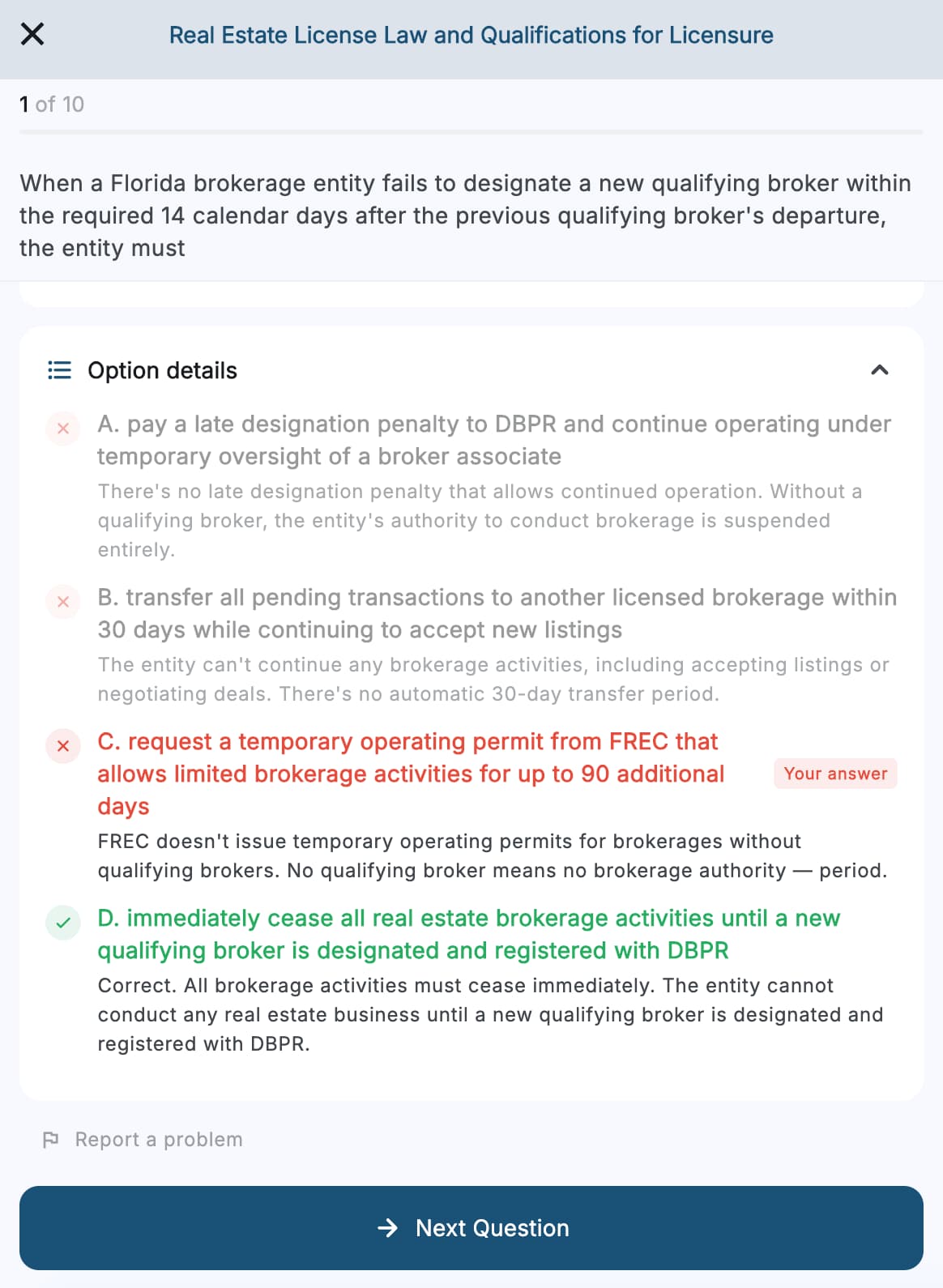
    Pass Florida app showing a practice question and answer explanation
    Understand the answer
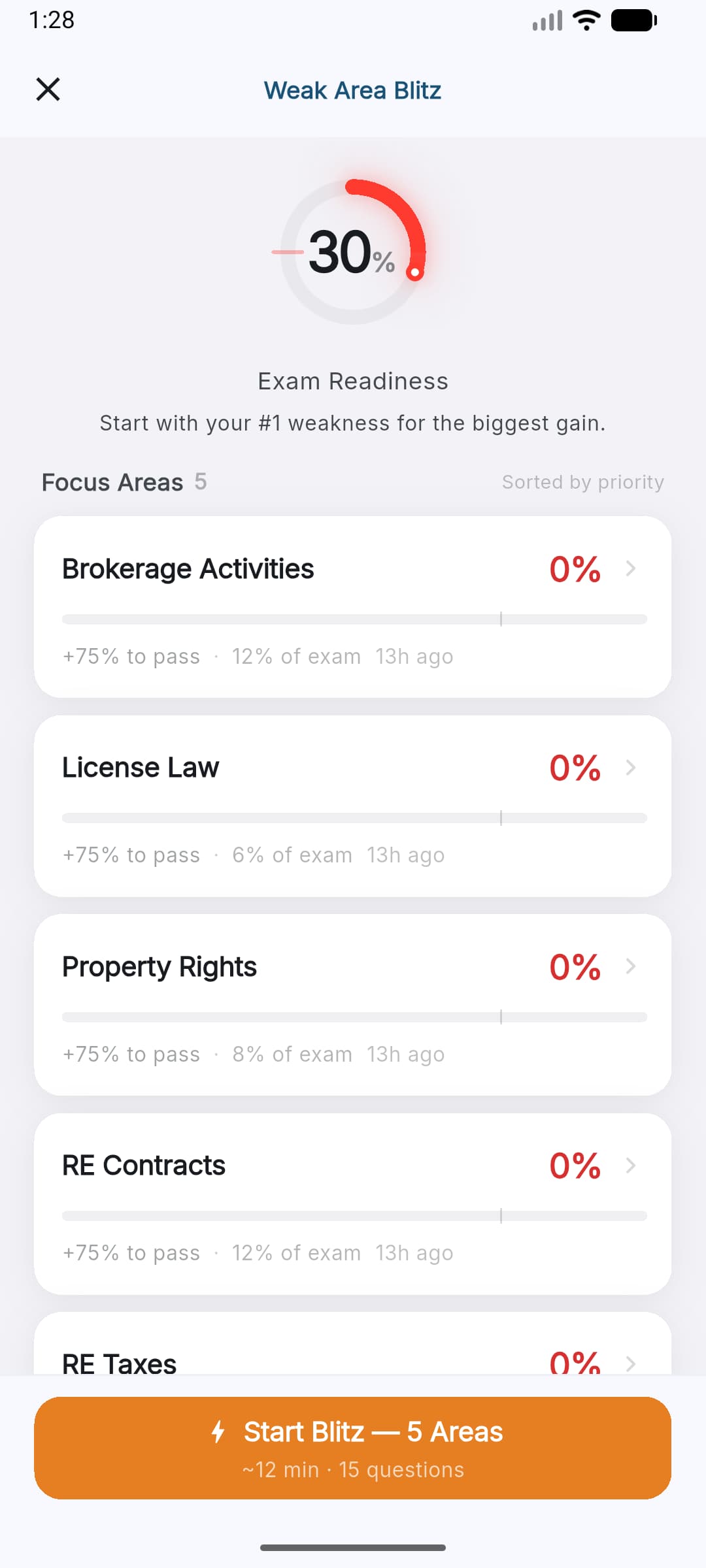
    Pass Florida app showing practice focused on weak areas
    Practice what needs work

    Study in your browser, or download for iPhone and Android. Offline study is available in the mobile app. Your free website quiz result does not transfer to the app.

    09 / Check the full exam outline

    What else should you study?

    The published License Law and Qualifications for Licensure outline has ten main headings. This map separates the scored questions and supporting references from topics that deserve more practice.

    A. Historical perspective of Florida real estate license law

    In this resource: The reference on the development and public-protection purpose of the licensing system.

    Also review: Review the course's historical context and the roles of DBPR, DRE, and FREC.

    B. Statutes and rules important to real estate

    In this resource: The statute-and-rule reference and linked authorities throughout the explanations.

    Also review: Distinguish Chapters 20, 455, 475, and 120 from Chapter 61J2 of the Administrative Code.

    C. General licensing provisions

    In this resource: Entry qualifications, application steps, background questions, nonresident routes, and residency changes.

    Also review: Review application time limits and rights, along with applicable military and fee-waiver provisions in the official materials.

    D. Sales associate qualifications for licensure

    In this resource: The standard route, 63-hour course, education exemptions, and exam-versus-activation distinction.

    Also review: Check course validity, exam approval, and the evidence required for a claimed exemption.

    E. Post-licensing education

    In this resource: The 45-hour and 60-hour requirements, first-renewal consequences, and attorney example.

    Also review: Study the separate consequences for sales associates and brokers and the limited hardship extension.

    F. Continuing education

    In this resource: The 14-hour requirement, 3 + 3 + 8 breakdown, and education-exemption distinctions.

    Also review: Keep first-renewal postlicense education separate from later CE and reactivation education.

    G. Broker requirements

    In this resource: The 72-hour course, 24-month experience test, qualifying paths, and active-month example.

    Also review: Recognize experience that qualifies, the five-year lookback, and required sales associate postlicense completion.

    H. Registration and licensure

    In this resource: The license-category reference and active-license checks.

    Also review: Distinguish an individual's license from entity, employer, and business registration.

    I. Real estate services

    In this resource: The activity, compensation, and exemption checks and the single-act rule.

    Also review: Apply the statutory definition to sales, leasing, auctions, business opportunities, and procuring prospects.

    J. Individuals exempt from a real estate license

    In this resource: The exemption reference, onsite apartment question, and condominium-manager scenario.

    Also review: Read each exemption's employment, compensation, activity, and duration limits.

    The inactive-status question also reinforces related commission-rule material. DBPR sales associate exam outline, Section II supplies the 6% exam weight and ten headings. FREC Course I syllabus, Sections 2 and 3 supplies the course objectives, including applications, education exemptions, real estate services, and nonresident licensure.

    How to approach a license law and qualifications scenario

    For a licensing question, identify the service, whose property or business is involved, and the compensation promised or expected. Then test the facts against a specific exemption. Part-time work and a single transaction do not create automatic exceptions.

    For an education question, identify the license category and the stage: prelicense, first renewal, later renewal, or reactivation. The 63, 45, and 14-hour sales associate requirements are not interchangeable. Brokers ordinarily use 72 hours before licensure and 60 before the first broker renewal.

    For a status question, identify what was missed and for how long. Failure to complete required first-renewal postlicense education differs from ordinary nonrenewal after that requirement was met. Neither an inactive license nor a passing exam alone authorizes licensed brokerage work.

    Questions about license law and qualifications practice

    Frequently asked questions

    How much of the Florida exam covers license law and qualifications?

    License Law and Qualifications for Licensure accounts for 6% of the published sales associate exam outline, about 6 questions on the 100-question exam. This page has 8 original practice questions and six worked scenarios. The official section has ten main headings, so the quiz is a focused sample rather than every possible question.

    Who needs an active Florida real estate license?

    A person performing a covered brokerage service for another in expectation of compensation generally needs a current active license unless a specific statutory exemption applies. A single covered act can be enough. Payment need not already have been received. A sales associate also needs the required registered employment relationship.

    What are the basic qualifications for a Florida sales associate?

    A natural-person applicant must be at least 18, have a high school diploma or equivalent, and meet the statutory character standards. The application process also requires a Social Security number, background review, the applicable education and exam requirements, and DBPR approval. Florida residency is not required for the standard route.

    What is the difference between the 63, 45, and 14-hour courses?

    For a sales associate without an applicable exemption, 63 hours is the prelicense course before the state exam, 45 hours is postlicense education before the first renewal, and 14 hours is continuing education for each later two-year renewal period. The later CE mix is 3 hours of Core Law, 3 of Ethics and Business Practices, and 8 specialty hours.

    Are attorneys and real estate degree holders exempt from the same education?

    No. An eligible active Florida Bar member in good standing is exempt from sales associate prelicense education and the ordinary CE rule, but not from required postlicense education solely because of Bar membership. An accredited four-year degree or higher in real estate provides a statutory exemption from prelicense and postlicense education. That degree exemption does not itself waive ordinary CE, the state examination, or other licensing requirements.

    How long is the 63-hour course completion valid?

    DBPR states that sales associate prelicense course completion is valid for two years from completion. An expired course certificate is not accepted for the state exam. You can submit the standard application before finishing the course, but must have valid course completion before sitting for the exam unless exempt. Course completion and DBPR exam approval are separate.

    How much experience does a Florida broker applicant need?

    On the standard sales-associate path, at least 24 months of qualifying active work in one or more licensed brokers’ offices during the preceding five years. Inactive months do not count as active experience. F.S. 475.17 recognizes separate government-employment and outside-jurisdiction broker-license paths. The ordinary broker prelicense course is 72 hours, with required sales associate postlicense education also completed when applicable.

    What happens if a sales associate misses the first postlicense deadline?

    Without an applicable exemption or approved extension, failure to complete the required 45-hour postlicense education before the first renewal makes the license null and void. The person must requalify through the prelicense course and state exam to practice as a sales associate again. Paying a renewal fee or taking 14 hours of ordinary CE does not substitute for that requirement.

    How is ordinary nonrenewal different from missing postlicense education?

    Ordinary nonrenewal after the postlicense requirement has been met causes involuntarily inactive status under F.S. 475.182. Missing required first-renewal postlicense education has a separate null-and-void consequence. Identify the unmet requirement before choosing the result. An inactive license does not authorize licensed brokerage work.

    When are 14 or 28 hours needed to reactivate an inactive license?

    For involuntary inactivity of 12 months or less, F.S. 475.183 calls for at least 14 hours of prescribed CE. For more than 12 but fewer than 24 months, it requires 28 hours of prescribed education. Other qualifications and fees apply. After more than two years, the license expires and becomes null and void, subject to the limited statutory hardship provision. Do not plan to reactivate at the boundary; check the exact record with DBPR.

    Which states have Florida real estate mutual recognition?

    DBPR lists Alabama, Arkansas, Connecticut, Georgia, Kentucky, Mississippi, Nebraska, Rhode Island, and West Virginia. Illinois's agreement ended December 31, 2025. The applicant must be a Florida nonresident when applying and meet the agreement’s licensing and other conditions. The Florida-specific law exam has 40 questions and requires 30 correct answers. Mutual recognition is not automatic permission to practice.

    Is endorsement the same as mutual recognition?

    No. DBPR offers a separate endorsement application for qualifying licensees from other U.S. jurisdictions. Its sales associate checklist requires at least five years of licensure and a license that is active or was active within the last two years. F.S. 455.2135 adds the applicable eligibility and screening conditions. An applicant should use the correct DBPR route rather than assume every outside license transfers or that every applicant takes the 40-question mutual-recognition exam.

    Can a no-contest plea or withheld adjudication be omitted from the application?

    Not simply because it was a no-contest plea or adjudication was withheld. The current RE 1 asks about specified pleas and findings regardless of adjudication. Follow the exact questions and provide required documentation. Before relying on sealing or expungement to answer no, verify that it actually occurred and follow the applicable law and application instructions.

    Are these free questions a licensing course, and where can I keep studying?

    These are original exam-prep questions, not actual or recalled Pearson VUE items or a substitute for required FREC-approved education. All 8 questions, 24 wrong-choice explanations, and six worked scenarios are free without an account. Open the web app or download Pass Florida for more practice, missed-answer review, weak-area practice, and full-length timed exams across all 19 exam areas.

    Sources and editorial review

    Check the reasoning behind the answer.

    Published by Pass Florida. Reviewed on for rules in effect through .

    This review checked the questions, explanations, and scenarios against the published DBPR sales associate outline, FREC Course I syllabus, cited Florida Statutes, adopted FREC rules, and DBPR application and education references for rules effective by the stated cutoff.

    The 6% weight and ten headings come from the January 2025 candidate booklet. The published Course I syllabus is effective January 1, 2023. Inactive-status material also supports Section 3 of that syllabus. Endorsement is included as a current application route, not described as an added heading in the published exam outline.

    Found an error? Use the correction link under a question or send the question ID and supporting source.

    1. DBPR sales associate exam outline, Section II
    2. FREC Course I syllabus, Sections 2 and 3
    3. F.S. 475.01, definitions and the single-act rule
    4. F.S. 475.42, active licensure and registered employment
    5. F.S. 475.011, exemptions from real estate licensure
    6. F.S. 475.17, qualifications, experience, and postlicense education
    7. F.S. 475.182, renewal and continuing education
    8. F.S. 475.183, reactivation and void licenses
    9. F.S. 475.180, nonresident requirements and the 60-day notice
    10. DBPR, standard sales associate application checklist
    11. DBPR RE 1, application and background-question instructions
    12. DBPR, sales associate examination and activation steps
    13. DBPR, education requirements and exemptions
    14. F.A.C. 61J2-3.008, prelicense education
    15. F.A.C. 61J2-3.009, continuing education
    16. F.A.C. 61J2-3.020, postlicense education
    17. DBPR, mutual recognition states, exam, and renewal requirements
    18. DBPR, sales associate endorsement checklist
    19. F.S. 455.2135, interstate mobility and endorsement

    Key terms for license law and qualifications

    Review a definition, worked example, or common exam trap before your next quiz.