QUICK ANSWER
The best way to practice Florida real estate exam questions daily is short, consistent sessions that reuse your misses, not occasional long cram sessions. A practical target for most candidates is 20 to 40 questions a day, every day, with every wrong answer reviewed until you understand why it was wrong. Use spaced repetition so the questions you miss come back at increasing intervals and actually stick. Consistency beats volume: 30 reviewed questions a day for three weeks teaches more than 600 questions in one weekend.
EXAM PREP ONLY
This is Florida sales associate exam-prep study guidance. The daily-question targets and routine are Pass Florida study frameworks based on common exam-prep practice, not official DBPR requirements or a guarantee of any result.
Most people study for the Florida real estate exam in bursts: nothing for four days, then a three-hour panic session. That pattern feels productive and works poorly. Memory does not reward intensity. It rewards repetition spaced over time.
The fix is a small daily practice habit. A consistent set of questions every day, with your misses reviewed and resurfaced, will move your score further than the same total crammed into one or two sittings. This page covers how many questions to do a day, a repeatable daily routine, and how to use spaced repetition so the questions stick.
If you are on a fixed countdown instead of building an open-ended habit, use a dated plan: the 30-day study plan, the 14-day plan, or passing in 7 days. This page is the daily engine those plans run on.
What this guide covers
- Why daily practice beats cramming
- How many questions should you do a day?
- A repeatable daily practice routine
- How spaced repetition makes questions stick
- Flashcards for the in-between minutes
- How to actually build the habit
- Frequently Asked Questions
Why daily practice beats cramming
Spacing the same practice over several days produces stronger, longer-lasting recall than massing it into one session, because each review interrupts the forgetting curve.
The reason daily practice works is the spacing effect, one of the most consistent findings in learning research. When you review material, forget some of it, and then review again, each repetition rebuilds the memory more durably than the last. Cramming skips that cycle. You see the material once, at high volume, and most of it fades before test day.
For an exam like the Florida sales associate test, this matters because the content is broad: 100 questions drawn from 19 content areas. You cannot hold all of it in short-term memory from a weekend session. You need the facts moved into durable memory, and spacing is how that happens.
There is a second benefit. Daily practice keeps you honest about weak areas. A candidate who drills a little every day notices that contracts questions keep tripping them up by day three. A candidate who crams notices it never, because there is no second day to reveal the pattern.
Consistency also lowers the emotional cost. Twenty minutes a day is sustainable. A four-hour block you keep postponing is not, and the guilt of postponing it makes the next session harder to start.
How many questions should you do a day?
For most candidates, 20 to 40 reviewed questions a day is a sustainable target, scaled up if your exam is close and down if you are pacing a longer runway.
There is no official number, and more is not automatically better. The right daily count balances three things: how close your exam is, how much time you have, and how thoroughly you review each miss. A reviewed question is worth several unreviewed ones, so quality sets the ceiling, not raw count.
Use this as a starting frame:
| Your situation | Suggested daily questions | Focus |
|---|---|---|
| 30 or more days out, building a base | 20 to 30 | Rotate all 19 areas, review every miss |
| 10 to 21 days out | 30 to 50 | Weight toward weak areas and heavy topics |
| Final week | 40 to 60, plus a timed mixed set | Mostly weak areas, then mixed timed practice |
| Coming off a failed attempt | 30 to 50 | Target the score-report weak areas first |
These are ranges, not rules. If you can only do 15 questions today, do 15. A short session you actually complete beats a long one you skip. The streak matters more than any single day's count.
The one rule that does hold: do not answer a question without reviewing why your answer was right or wrong. Twenty questions with full review teaches more than fifty you click through to see a score.
DAILY DRILLING
Build the habit on a real Florida question bank.
Use fresh Florida questions to test recall, review every miss, and track whether the same weak topics keep returning.
A repeatable daily practice routine
Start each session by reviewing yesterday's misses, then drill a focused topic set, then log new weak areas, so the loop compounds instead of resetting.
A good daily session is short and structured. The same loop every day removes the decision of what to study and lets the spacing do its work. A 20 to 30 minute version looks like this:
- Warm up on yesterday's misses (5 minutes). Re-answer the questions you got wrong yesterday before touching anything new. This is the single highest-value five minutes in the routine.
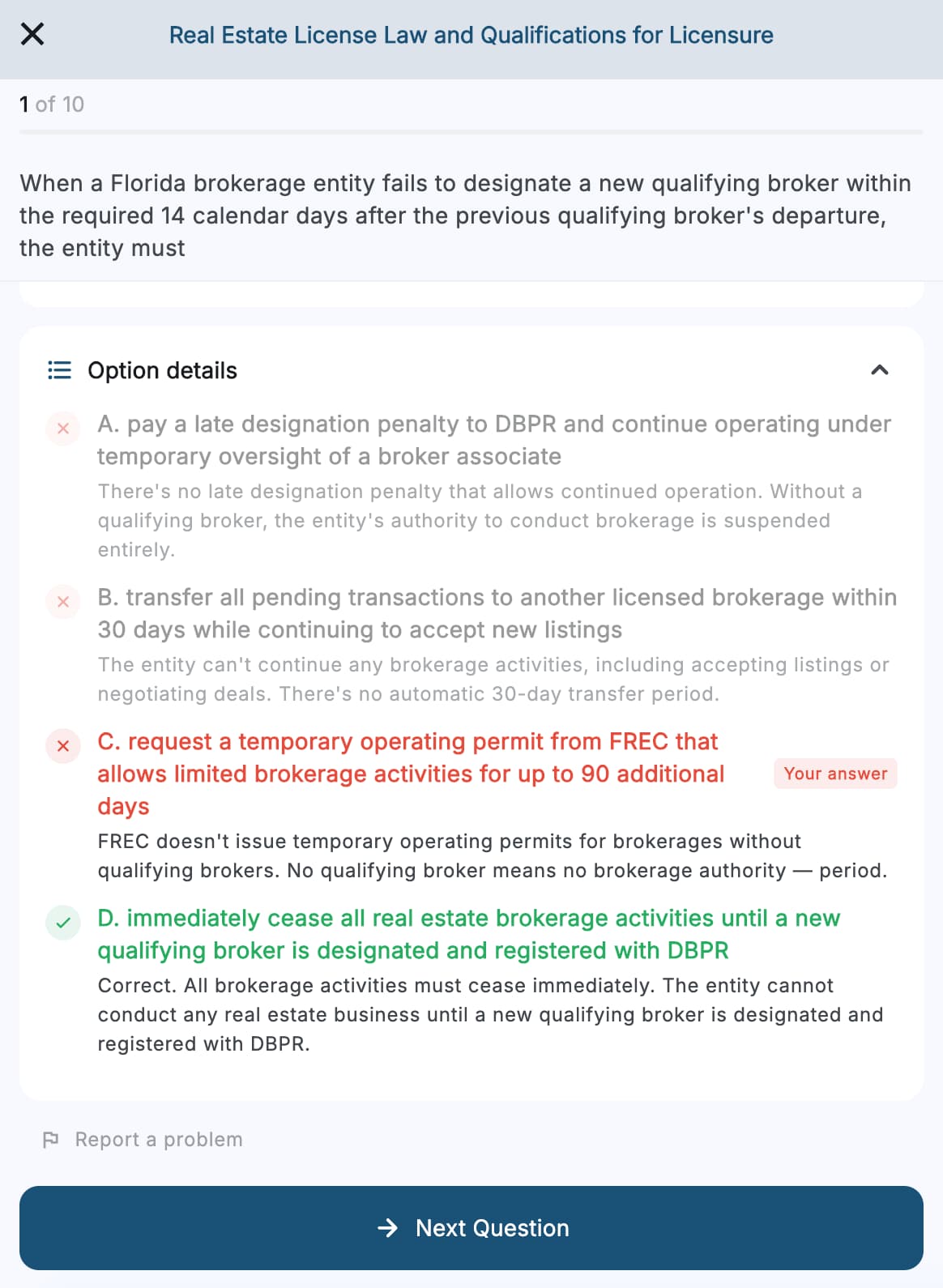
- Drill one focused set (10 to 15 minutes). Pick one content area, or your current weak area, and work 20 to 30 questions. Read the explanation on every one, not just the misses.
- Log the new misses (2 minutes). Note which area each miss came from. Over a week this list tells you exactly where to spend time.
- Close with a quick mix (5 minutes). End with 5 to 10 mixed questions across topics so you practice recognizing the subject without a label, the way the real exam presents it.
Once a week, replace one session with a longer timed set so you rehearse pacing and stamina. The free timed practice exam runs 25 questions and is built for that weekly checkpoint, while the app's Exam Style mode runs the full 100-question length. The free practice questions work for the daily sets.
The structure is what makes it sustainable. You are not deciding what to study each day. You are running the same loop, and the loop is designed so your weak areas keep resurfacing until they are not weak.
How spaced repetition makes questions stick
Spaced repetition resurfaces a question at growing intervals, soon after you miss it and then less often as you get it right, which moves it into durable memory efficiently.
Spaced repetition is the engine behind the warm-up step. Instead of reviewing everything equally, it shows you a question soon after you miss it, then again after a longer gap if you get it right, then a longer gap still. Questions you know fade into the background. Questions you miss keep coming back until they stick.
Done by hand, this means keeping a list of missed questions and re-testing them on a schedule: the next day, then a few days later, then a week later. That works, but it is tedious to track.
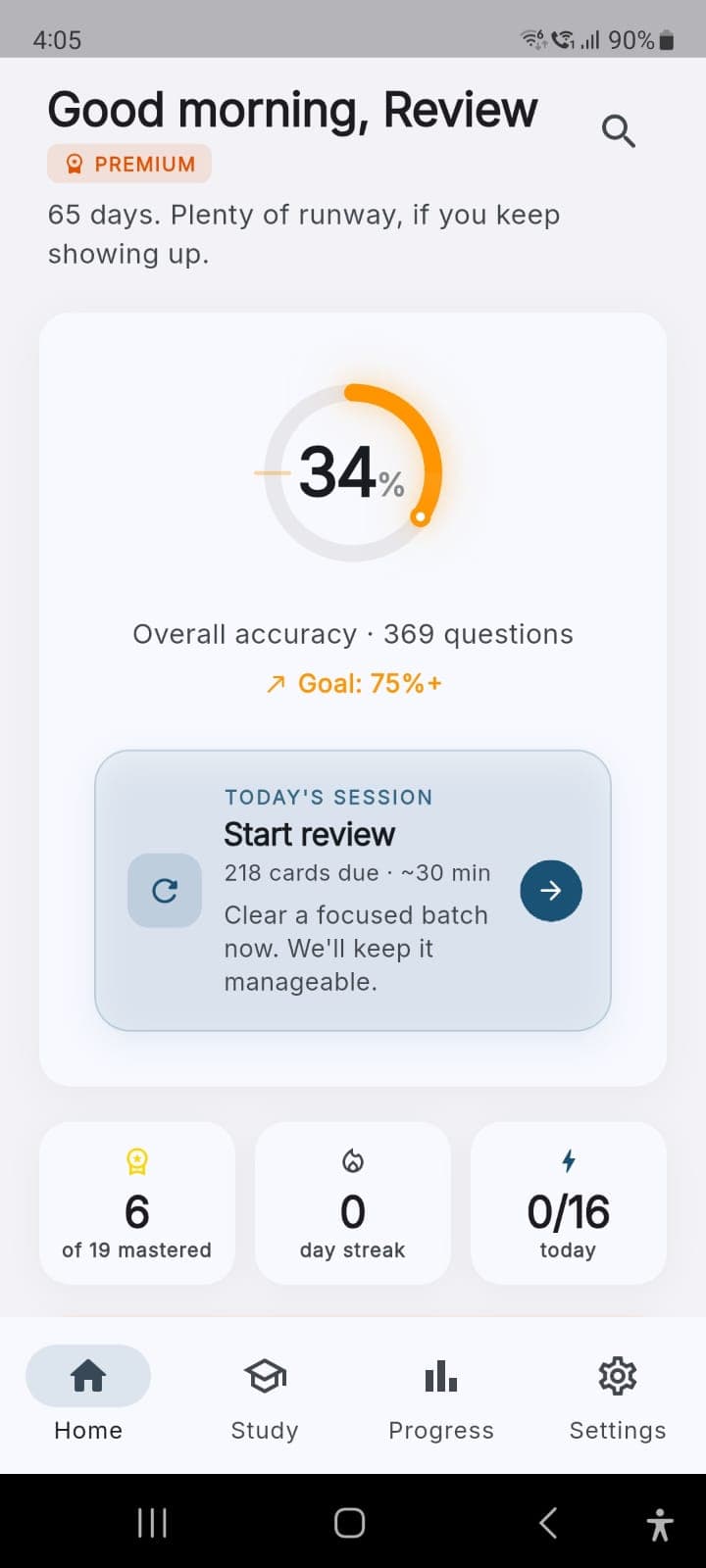
This is what the Pass Florida Quick Review mode automates. It maintains your spaced-repetition queue and resurfaces the questions you missed or flagged at increasing intervals, so the review happens at roughly the right time without you scheduling it. You just open the app and answer what it puts in front of you. The same idea drives Weak Area Blitz, which rebuilds a focused session out of your weakest content areas.
The takeaway is simple: do not review everything every day. Review what you are about to forget. That targeting is what makes a 20-minute daily habit punch above its weight.
Flashcards for the in-between minutes
Flashcards turn small gaps in your day into recall practice for terms, statutes, and formulas, which complements full question drilling.
Not every daily rep needs to be a full scenario question. A lot of the Florida exam is recall: definitions, statute numbers, the order of a process, doc stamp rates, the single-agent duties. Flashcards are built for exactly that, and they fit into the gaps a full question set cannot: a few minutes in line, between meetings, or before bed.
Use flashcards as the second track of your daily habit. Full questions build application and trap recognition. Flashcards keep the raw facts warm so you are not relearning vocabulary during scenario practice. The flashcard study guide covers how to build and run a deck, and the app's Flashcard mode runs a spaced deck you can swipe through in spare minutes.
A realistic daily split: one focused question session at your desk, plus two or three short flashcard bursts whenever you have a few idle minutes.
How to actually build the habit
Anchor practice to an existing daily event, set a floor you can reliably hit, and track the streak, because the habit, not any single session, is what raises your score.
Knowing the routine is easy. Doing it every day is the hard part. A few tactics make it stick.
Anchor it to something you already do. Attach practice to a fixed daily event: morning coffee, the train, lunch, right after dinner. Anchoring a new habit to an existing one is far more reliable than relying on motivation.
Set a floor, not just a target. Your target might be 30 questions, but your floor should be small enough that you do not skip it: five questions, or one flashcard burst. On bad days you hit the floor and keep the streak alive. Streaks are fragile, and a broken one is hard to restart.
Make the next session frictionless. Keep the app on your home screen. Offline access means a dropped signal is not an excuse, so a commute or a waiting room still counts.
Track the streak. Watching a streak grow is its own motivation, and it reframes the goal from "pass the exam someday" to "practice today," which is the only thing you actually control.
Forgive a missed day fast. One missed day is not a failure. Two in a row is the real risk, because it signals the habit is slipping. If you miss, do your floor amount the next day and move on.
Ready to start a daily Florida practice habit?
Start with a free question today, then build the daily loop on the full bank with spaced repetition in the app.
The score does not come from the day you cram. It comes from the twenty days you showed up for twenty minutes. Start the habit today, not the week before the exam.
QUICK REVIEW
Let spaced repetition run your daily reps.
Try a free question now, then download Pass Florida for the full 1,142-question bank, Quick Review spaced repetition, Weak Area Blitz, Flashcard mode, and offline daily practice for one $39.99 purchase. No subscription. No copied exam questions.
Frequently Asked Questions
How many practice questions should I do a day for the Florida real estate exam?
For most candidates, 20 to 40 reviewed questions a day is a sustainable, effective target. Scale up to 40 to 60 in the final week and down to about 15 on a busy day. The number matters less than reviewing every miss and showing up every day. A reviewed question is worth several unreviewed ones.
Is it better to practice every day or do long study sessions?
Daily practice wins for exam prep. The spacing effect means the same total practice spread across many days produces stronger, longer-lasting recall than one or two long sessions. Daily practice also surfaces your weak areas earlier, so you can fix them before test day.
What is spaced repetition and why does it help?
Spaced repetition resurfaces a question soon after you miss it, then at growing intervals as you get it right. It focuses your review on what you are about to forget instead of what you already know, which moves facts into durable memory efficiently. The Pass Florida Quick Review mode runs this queue automatically.
How long before the exam should I start daily practice?
As early as you can. A daily habit started 30 or more days out builds the most durable base with the least stress. If you have less time, a dated plan like the 14-day study plan compresses the same daily engine into a shorter runway.
Can I pass with only 20 minutes of practice a day?
Twenty minutes a day can be enough as a daily base for some candidates, especially when the sessions are consistent, reviewed, and spaced, and you add longer timed practice in the final week. It is a base to build on, not a guarantee, and your starting knowledge and runway matter. Twenty focused minutes a day for several weeks still adds up to a large, well-reviewed body of practice, and a single missed week does more damage than a few short days.
Methodology
The spacing effect, distributed practice, and retrieval (testing) practice are well-documented principles in learning research, described here in general terms; the two reviews cited in Sources, Dunlosky and colleagues (2013) and Roediger and Karpicke (2006), rate distributed practice and practice testing among the highest-utility study techniques. The daily-question ranges, the session routine, and the habit tactics are Pass Florida study frameworks based on common exam-prep practice. They are study guidance, not official DBPR requirements, and they do not guarantee passage.
Product note
Pass Florida publishes this guide and offers the exam-prep app linked on this page. Pass Florida is independent exam preparation, not a DBPR-approved 63-hour pre-license course, post-license course, or Pearson VUE scheduling service. It does not provide licensing credit and does not guarantee passage.
Sources
- DBPR Florida Real Estate Sales Associate Candidate Information Booklet
- Pearson VUE Florida Real Estate testing page
- Dunlosky, Rawson, Marsh, Nathan, and Willingham (2013), Improving Students' Learning With Effective Learning Techniques, Psychological Science in the Public Interest, 14(1) (rates distributed practice and practice testing as high-utility techniques)
- Roediger and Karpicke (2006), Test-Enhanced Learning: Taking Memory Tests Improves Long-Term Retention, Psychological Science, 17(3), 249-255 (retrieval practice improves long-term retention)
This post is exam preparation content for the Florida Real Estate Sales Associate exam. It is not legal, tax, financial, lending, appraisal, brokerage, insurance, title, closing, or professional advice. For real-world decisions, verify current requirements with the official source or consult a qualified licensed Florida professional.