Can you realistically pass in 7 days?
Answer five quick questions. You will get a practical readiness score and the next step to take before Pearson VUE.
How many hours have you studied after completing your pre-licensing course?
You can pass the Florida real estate exam in 7 days only if the week is review, not first exposure.
That is the honest answer. Seven days is enough time to triage, repair weak areas, drill math, and build test rhythm. It is not enough time to replace the required 63-hour course or learn Florida license law from zero.
Use The 7-Day Triage Sprint:
- Day 1: Diagnose.
- Days 2 to 4: Repair the biggest leaks.
- Day 5: Simulate.
- Day 6: Patch.
- Day 7: Protect easy points.
The week is not about touching everything. It is about refusing to waste time.
QUICK ANSWER
You may be able to pass the Florida real estate exam in 7 days if you already completed the 63-hour course, have a near-passing baseline, can study several focused hours, and use Florida-specific mixed practice. If you are starting cold, scoring far below passing, or avoiding math, a 7-day plan is a high-risk choice. The exam is administered by Pearson VUE on behalf of the Florida Department of Business and Professional Regulation (DBPR) and the Florida Real Estate Commission (FREC): 100 multiple-choice questions, 3.5 hours, 75 points to pass.
EXAM PREP ONLY
Use this plan if your 63-hour course is complete, your exam is in 7 days or fewer, and your most recent timed practice was at or near the passing range. This is a study triage guide, not a guarantee of passing, legal advice, licensing advice, or a replacement for DBPR, FREC, Pearson VUE, or course-provider instructions.
What this guide covers
- The 7-Day Triage Sprint framework
- Who should try a 7-day plan (and who should not)
- The must-have starting conditions
- Day-by-day breakdown (Day 1 diagnose, Days 2-4 repair, Day 5 simulate, Day 6 patch, Day 7 protect)
- A worked Day 1 diagnostic example
- What counts as a "leak" worth a day's repair
- The sit-or-reschedule gate (80/65 rule)
- The realistic daily time block
- If you have only Day 5 left: emergency recovery
- If you are retaking in 7 days
- What to skip in a 7-day plan
- FAQ, methodology, and sources
Who should try a 7-day plan?
A 7-day plan is reasonable only if your course is complete, your timed practice is near passing, and your misses are narrow enough to repair quickly.
| Starting point | 7-day plan fit | Better move |
|---|---|---|
| Finished course, scoring low 70s or better | Reasonable with discipline | Triage and timed practice |
| Finished course, scoring 60s | Possible but risky | Heavy weak-area repair |
| Finished course, scoring below 60 | Usually too thin | 14-day or 30-day plan |
| Still in the course | Not appropriate | Finish the course first |
| Failed recently with a score report | Good fit if gaps are specific | Score-report rebuild |
If you are not sure where you stand, take a diagnostic before reading another paragraph. Feeling ready is not data. If your test is two weeks out, the 14-day plan has more room for repair. If you have three weeks, use the 21-day study plan. If you have closer to a month, the 30-day plan is the better structure. If you already failed once, use the score-report study plan before restarting a generic calendar. The study-plan hub compares every timeline in one place.
The must-have starting conditions
You should not attempt a 7-day sprint without a completed course, a baseline score, several focused study blocks, math repair time, and a known reschedule option.
Before you commit to a 7-day sprint, check the basics.
| Starting condition | Green light | Red flag |
|---|---|---|
| Course status | 63-hour course complete or truly finished with the material | Still learning course chapters for the first time |
| Baseline score | Near passing or better on mixed Florida-specific practice | Below 60% or no diagnostic data |
| Study time | Several focused hours available on most days | Only 20-30 minutes at night after exhaustion |
| Math | You can repair setup errors with repetition | You are avoiding math entirely |
| Reschedule option | You know the deadline and can move the exam if data is bad | You feel locked in only because the date is close |
Pearson VUE's Florida page says appointments can be canceled or rescheduled without penalty only if done two full calendar days before the test. That timing matters. If your Day 5 data is weak and you still have a reschedule window, use the data instead of pride.
SHORT TIMELINE, CLEAN DATA
Use the week to find and fix the leaks.
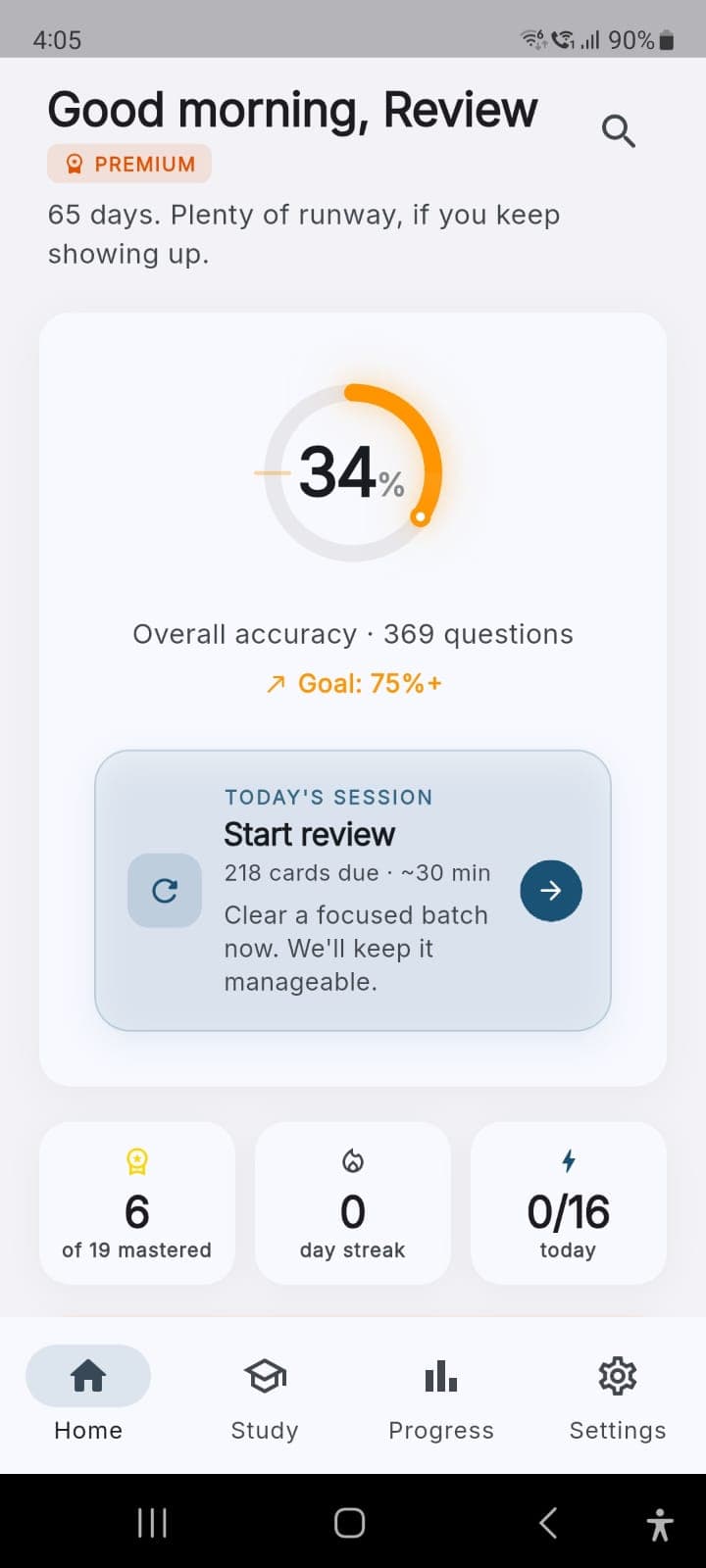
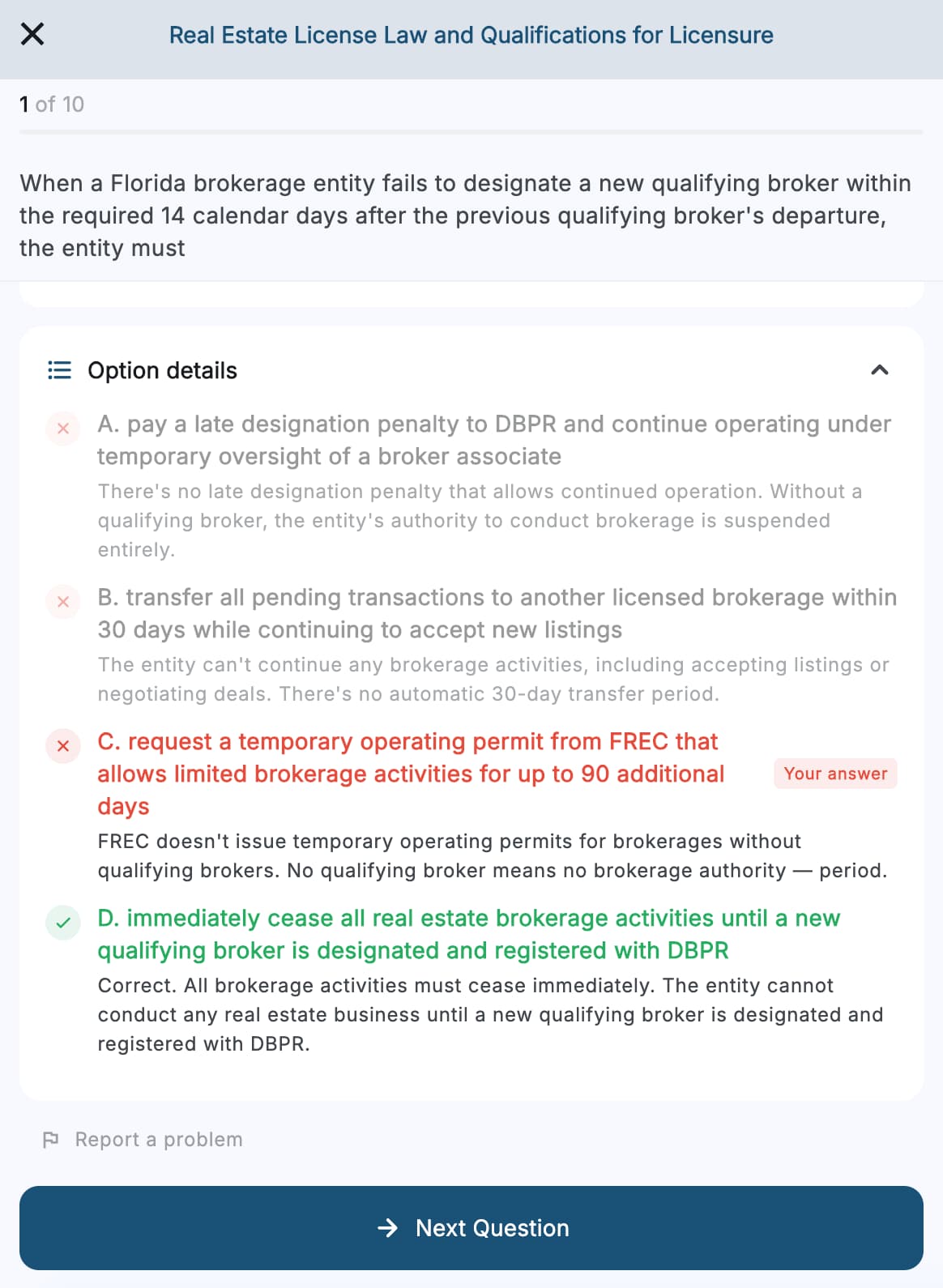
Pass Florida gives you Florida-specific questions, diagnostics, Math Coach, Trap Library, timed practice, offline access, optional sync, lifetime updates, and a one-time $39.99 paid upgrade after the free download.
The 7-Day Triage Sprint
The 7-day sprint is diagnose, repair, simulate, patch, then protect easy points. It works only when you stop trying to study everything.
Use this output target table to keep the week honest.
| Day | Main job | Output you should have before sleeping |
|---|---|---|
| 1 | Diagnose | A miss log with your two biggest leaks named |
| 2 | Repair license-law or brokerage leak | 40 mixed questions plus written fixes for each miss |
| 3 | Repair contracts, property, or disclosure leak | Mixed scenario set and trap-wording notes |
| 4 | Repair math setup | At least 25 math setups across multiple formula families |
| 5 | Simulate | One full 100-question timed score or two 50-question mixed scores |
| 6 | Patch | A short list of remaining weak rules and a targeted repair set |
| 7 | Protect | Logistics checked, formulas reviewed, no new heavy topic started |
Day 1: Diagnose, Then Cut
Take a mixed diagnostic. Then sort misses into four buckets:
- Florida law and FREC
- Contracts, brokerage relationships, and disclosures
- Math and closing calculations
- Wording traps and pacing
Pick the two buckets costing the most points. Those are your week.
Do not spend Day 1 making a beautiful schedule. Spend it finding the leaks.
Day 2: Florida License Law and Brokerage
Study the rules that create many scenario questions:
- Active license requirement
- Sales associate versus broker
- Compensation rules
- FREC discipline
- Brokerage relationships
- Escrow basics
Use Florida Statute 475, broker vs sales associate, and brokerage relationships.
End with 40 mixed questions. Review every miss.
Day 3: Contracts, Property, and Disclosures
Focus on:
- Offer, acceptance, counteroffer
- Valid, void, voidable, unenforceable
- Property rights and easements
- Deeds and title basics
- Radon, lead-based paint, CDD, HOA and material facts
Use contracts, property rights, and disclosures.
End with mixed scenarios, not chapter quizzes.
Day 4: Math Day
Do not avoid math in a 7-day plan. Math is one of the few areas where repeated setup practice can create fast improvement.
Use this order:
- Commission
- LTV and down payment
- Documentary stamps
- Proration
- Millage
- Cap rate and NOI
Read bad at math if anxiety is part of the problem. Use math formulas for a compact formula review.
Rule for the day: label before calculate.
Day 5: Full Timed Simulation
Take a full 100-question timed practice exam if possible. If your tool does not support that, take two 50-question mixed sets with a short break.
Do not check answers midstream. Do not pause for notes. The point is to test performance, not comfort.
After the test, calculate:
- Overall score
- Math score
- Worst topic
- Misses caused by wording
- Questions where you changed right to wrong
This is your sit-or-patch data.
Day 6: Patch, Do Not Cram
Patch the two largest problems from Day 5.
If the problem is math, do mixed math. If the problem is license law, drill license-law scenarios. If the problem is EXCEPT/NOT wording, practice question stems and answer elimination.
Good Day 6 work feels narrow. That is how you know it is working.
Day 7: Light Review and Exam Execution
Use the final day for:
- Formula cues
- Florida law flash review
- Miss-log review
- ID and test-center logistics
- Sleep and timing
Use the exam-day checklist and night-before checklist.
Do not try to learn a whole new subject on Day 7. Protect the points you already know how to earn.
A worked Day 1 diagnostic example
Day 1 should produce a miss log, not a pretty calendar. The goal is to name the two leaks most likely to cost points.
Day 1 is the day candidates most often waste. Here is what an honest 90-minute Day 1 looks like end to end.
The session. Take a 50-question mixed Florida-specific practice set under loose time. Do not look up answers as you go. When you finish, mark each miss with one of four codes:
- R: Rule gap. You did not know the rule.
- T: Trap gap. You knew the rule but missed the wording.
- M: Math setup gap. You used the wrong base, formula, or proration method.
- P: Pacing gap. You rushed or overworked the question.
Example result tally: You miss 14 of 50. Your miss log looks something like this.
| Topic | Misses | Code mix |
|---|---|---|
| Brokerage relationships and disclosures | 4 | R, R, R, T |
| Math (commission, doc stamps, proration) | 3 | M, M, M |
| Contracts (offer, acceptance, valid/void/voidable) | 3 | R, T, T |
| Property rights and easements | 2 | R, R |
| EXCEPT/NOT wording | 2 | T, T |
That is your week. The two biggest leaks are brokerage relationships (rule gaps, repair on Day 2) and contracts plus wording traps (mixed rule and trap gaps, repair on Day 3). Math (3 misses, all setup) gets Day 4. Property rights (2 misses) is a secondary repair to slot into Day 6 if time allows.
What you do not do: spread Days 2-4 evenly across all five topic clusters. Spread is what wastes a 7-day plan. The whole point of Day 1 is to license yourself to ignore most topics for the rest of the week.
What counts as a "leak" worth a day's repair
A leak is a repeated miss pattern, a structurally important topic gap, a recurring math setup error, or a wording trap that can show up across many questions.
Not every miss is a leak. Some misses are noise. The 7-day window has no time for chasing noise.
A miss earns a day of repair when at least one of these is true:
- It appears in three or more of your Day 1 misses across different question stems.
- The underlying rule is structurally important (license law, brokerage relationships, escrow, contracts, math families) and even one miss suggests a wider gap.
- It is math setup rather than arithmetic, because setup mistakes recur across formula families.
- It is a wording-trap pattern (EXCEPT/NOT, "best," "first," "most likely") that you can practice across many stems.
A miss does NOT earn a day of repair when:
- It is a one-off vocabulary gap with no exam volume behind it.
- It is a single arithmetic slip on math you otherwise set up correctly.
- It is a guess on a topic that rarely appears in mixed sets.
- It is a question you would have answered correctly if you had read more carefully (that is a pacing issue, not a topic issue).
The whole 7-day plan rests on this distinction: spend days repairing patterns, not specific questions.
The sit-or-reschedule gate
Use 80% overall with no major topic below about 65% as a practical practice buffer, not an official DBPR or Pearson VUE rule.
Use this before you commit emotionally to the exam date.
| Practice result by Day 5 or 6 | Decision |
|---|---|
| 80%+ with no major topic below about 65% | Sit is reasonable. |
| 75% to 79% with clear fixable misses | Sit may be reasonable if the trend is improving. |
| 70% to 74% | High risk. Consider one more repair cycle. |
| Below 70% | Reschedule if you can. |
| Math or law severely weak | Repair before sitting. |
The 80/65 gate is not a DBPR rule, a Pearson VUE rule, or a guarantee. It is a practical buffer. The real exam needs 75 points to pass, but a short-timeline candidate should not aim for exactly 75 in practice. Small wording misses, pacing fatigue, and math setup errors can move a near-pass score quickly.
For a deeper decision, read should I reschedule?.
Sit vs reschedule quick table
| Your situation | Better decision |
|---|---|
| 80%+ overall, no major topic below about 65%, logistics settled | Sit is reasonable |
| 75-79%, weak area is narrow, and you have one more repair day | Sit may be reasonable |
| 75-79%, but math or license law is unstable | Reschedule if you can |
| Below 70% on a full mixed set | Reschedule if you can |
| No full timed practice has been taken | Treat readiness as unknown |
| You are depending on luck, not score data | Reschedule if possible |
What to Skip in a 7-Day Plan
Skip:
- Rewriting every note
- Watching long videos on topics you already know
- Memorizing statute numbers without understanding rules
- Making perfect flashcard decks
- Reading the entire course textbook again
Keep:
- Diagnostics
- Mixed questions
- Math setups
- Wrong-answer explanations
- Timed practice
Rescheduling is not failure. Sitting unready because the date is close is the expensive mistake.
A Realistic Daily Time Block
A realistic 7-day sprint usually needs several focused hours per day because the review step matters as much as the question count.
If you can study only one hour per day, a 7-day sprint is probably too tight unless you are already scoring well. If you can make room for focused blocks, use this rhythm:
| Block | Time | Job |
|---|---|---|
| Warm-up | 15 minutes | Review yesterday's miss log. |
| Main drill | 60 to 90 minutes | Work the day's target topic. |
| Mixed set | 45 to 60 minutes | Answer new questions without notes. |
| Debrief | 30 minutes | Classify misses and write the repair. |
| Light close | 10 minutes | Review formula cues or rule cards. |
You do not need heroic all-night studying. You need enough time to answer, review, and repair. The debrief is where the week gets smarter.
If you have only Day 5 left
If the week collapses, take the best diagnostic you can, repair one narrow weakness, protect sleep, and do not pretend you can cover everything.
Sometimes the week shrinks. A scheduling change, a work crunch, or a family event collapses your 7-day plan into a 2-3 day plan. Here is what survives.
| Day count remaining | What to do first | What to drop |
|---|---|---|
| 3 days left | Take one full timed simulation today; debrief tomorrow; one targeted repair day; sit on day 4 | Daily topic rotations, light review, optional add-ons |
| 2 days left | One full timed simulation today; tomorrow is a single targeted repair day plus light review | All non-diagnostic content; do not attempt to cover everything |
| 1 day left | Use a 50-question mixed set as a final temperature check; protect sleep and logistics; review formula cues and rule cards only | Any deep topic study, full timed exam, or new material |
| Less than 24 hours | Sleep, hydrate, confirm logistics, and review the formula cues you already know; trust the work you have already done | Anything that would replace sleep |
The compressed plan is not the same as the full 7-day plan. It is what to do when the calendar disappears. The sit-or-reschedule gate still applies; if your data says reschedule and your Pearson VUE deadline allows it, reschedule even if the date is close.
If you are retaking in 7 days
A 7-day retake plan should start from your score report or miss log, not from the same routine that produced the failed attempt.
A retake week should be even more targeted.
Use the score report or your own miss log. Do not repeat the same study routine that produced the fail. Start with why did I fail?, then use retake planning or failed by one point if that fits your situation.
Retake rule: same studying produces same result more often than candidates want to admit.
FAQ
Can I pass the Florida real estate exam in 7 days?
Yes, but only if you already have a foundation from the required course and your baseline is close enough. Seven days is a triage window, not a full education plan.
How many hours per day should I study?
Plan for several focused hours per day, including one full timed simulation. Short sessions can work for maintenance, but a 7-day sprint needs depth.
What should I study first?
Start with a diagnostic. Then study the two areas costing the most points, not the topic that feels easiest.
Should I study math if I only have a week?
Yes. Math is often one of the best uses of a short window because setup habits improve with repetition.
What score should I have before sitting?
An 80% timed practice score is a stronger signal. A mid-70s score can still be risky, especially if one major topic is weak.
When is it too late to reschedule?
Pearson VUE's Florida testing page says you need to cancel or reschedule without penalty two full calendar days before the test. Check your own Pearson VUE account and appointment details before relying on any general rule.
Is Pass Florida a course?
No. Pass Florida is exam prep only. It helps you practice after or near the end of the required pre-license course.
Ready to run a 7-day triage with Florida-specific reps?
The triage sprint is the structure. The reps are what give the score a chance to move in a week.
Use the next practice set to prove what improved, not to repeat questions you already remember.
Try a free Florida question | Run the readiness calculator | Download Pass Florida
Methodology
It was built from the official Pearson VUE Florida Real Estate testing page, the Pearson VUE Florida Real Estate and Appraiser Fact Sheet, the DBPR Real Estate Sales Associate Candidate Information Booklet, Florida Statutes Chapter 475, and Pass Florida's triage framework for short study windows: diagnose, repair, simulate, patch, then decide. The 7-Day Triage Sprint structure, the four-code miss log (R/T/M/P), the "what counts as a leak" criteria, the sit-or-reschedule gate (80% practice score with no major topic below about 65%), the compressed Day-3/Day-2/Day-1 recovery table, and the realistic daily time block are practical study patterns derived from common candidate mistakes, not DBPR or Pearson VUE rules.
This post does not promise a passing result on the Florida real estate exam and is not a substitute for the required 63-hour pre-license course, the DBPR application process, Pearson VUE scheduling, or qualified professional guidance. A 7-day study window is a triage situation by definition; if your data after Day 1 says you are not close to passing, the most honest path is rescheduling rather than sitting an unprepared exam.
Product note. Pass Florida is our Florida-specific exam prep app. This page references our own product, so the relationship is direct and disclosed. We do not claim to use copied exam questions, promise passage, or replace official DBPR, Florida Real Estate Commission (FREC), Pearson VUE, course provider, broker, local real estate association, MLS, legal, tax, or professional guidance. Pass Florida is independent exam prep and is not a DBPR-approved 63-hour pre-license course or continuing education.
This post is exam preparation content for the Florida Real Estate Sales Associate exam and is not a guarantee of passing the exam. It is not legal, tax, brokerage, licensing, or professional advice. The Florida real estate exam, DBPR application process, Pearson VUE scheduling, and the 63-hour course requirements are governed by DBPR, FREC, and Pearson VUE; verify current fees, content outline, scheduling rules, course requirements, and reschedule policies directly with DBPR, FREC, your course provider, Pearson VUE, your broker, and qualified counsel before making study, scheduling, or career decisions based on this article.
Sources
- Pearson VUE Florida Real Estate & Appraisers licensing exams
- Pearson VUE Florida Real Estate and Appraiser Fact Sheet (PDF)
- DBPR Real Estate Sales Associate Requirements (PDF)
- DBPR Real Estate Sales Associate Candidate Information Booklet
- Florida Statutes Chapter 475 (real estate brokers, sales associates, schools)