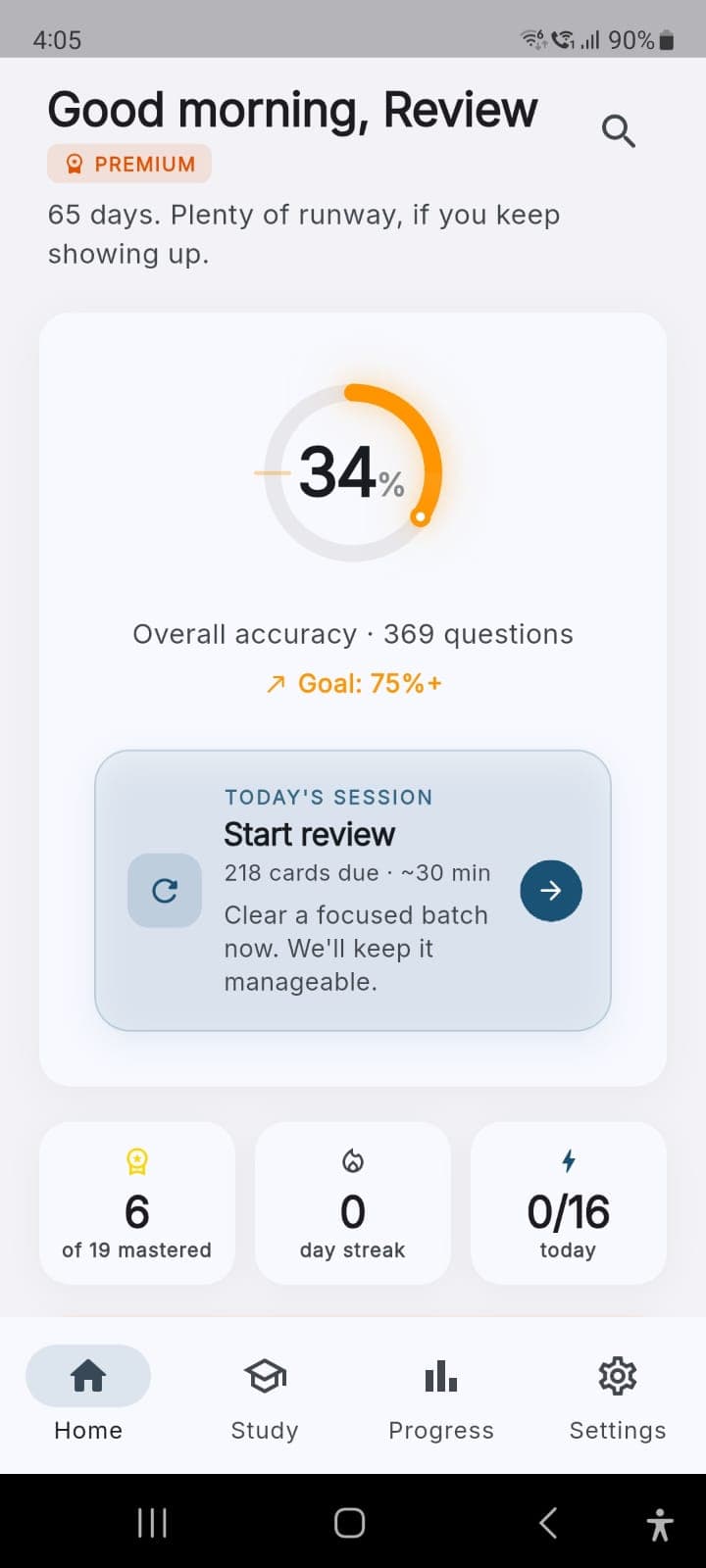
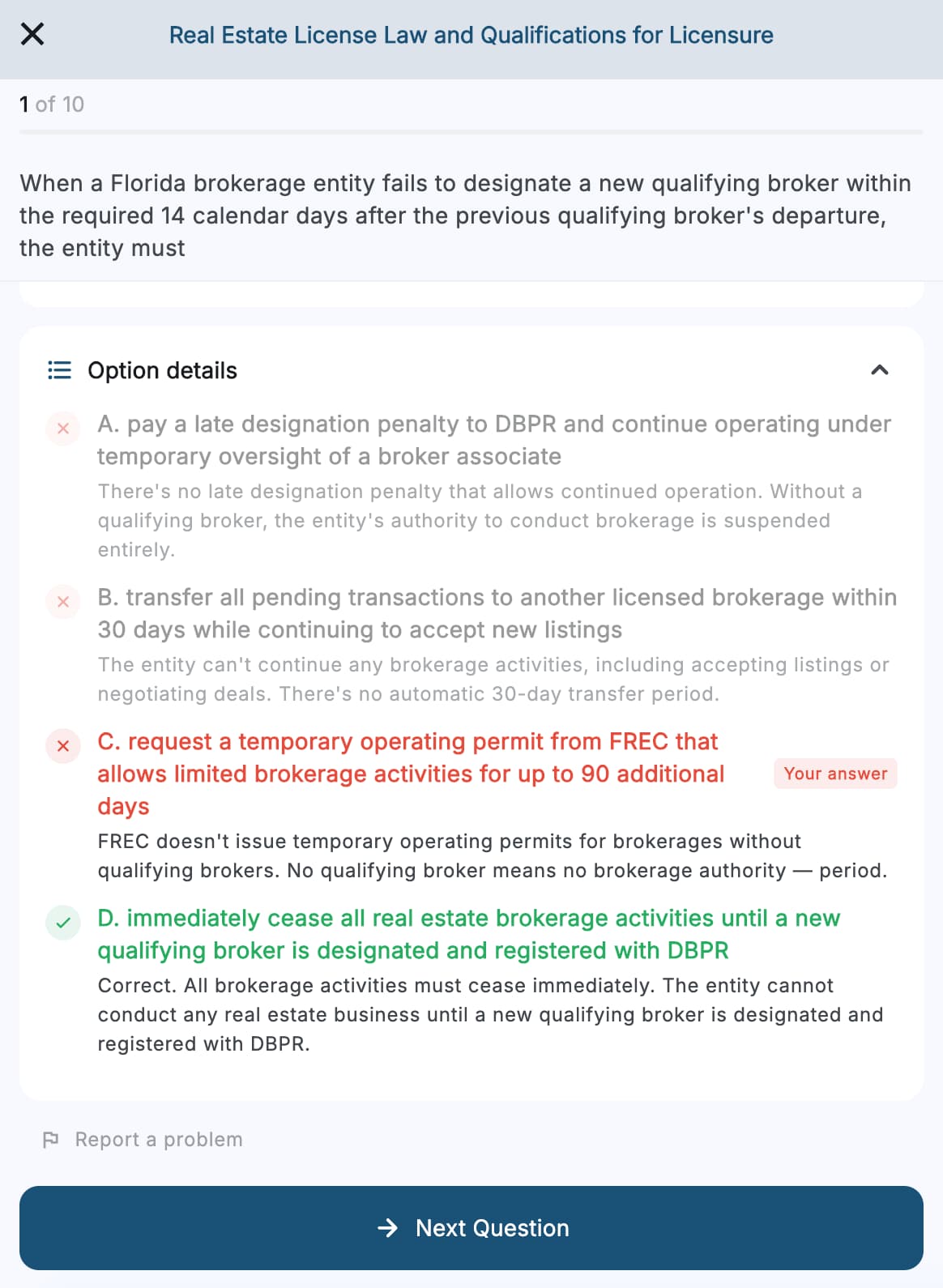
You can pass the Florida real estate exam with only practice questions if the questions are doing more than keeping you busy.
That is the catch.
Practice questions work when they force retrieval, expose weak topics, explain traps, repair math setup, and build timing. They fail when candidates memorize repeated answers, avoid explanations, use generic national questions, or keep taking random quizzes without learning why they missed.
Use The Questions-Only Gate before you trust this plan:
- You already completed the required 63-hour course or have the foundation handled.
- Your practice questions are Florida-specific.
- Every missed answer has an explanation you actually review.
- You drill math separately.
- You take timed mixed sets before exam day.
If one gate is missing, practice-only becomes practice-looking.
QUICK ANSWER
Yes, some candidates can pass the Florida real estate exam using only practice questions after completing the required course. The questions must be Florida-specific, scenario-based, explained, mixed by topic, strong on math, and timed. Practice-only is risky if you are learning the material for the first time or using generic questions without rule repair. The exam is administered by Pearson VUE on behalf of the Florida Department of Business and Professional Regulation (DBPR) and the Florida Real Estate Commission (FREC): 100 multiple-choice questions, 3.5 hours, 75 points to pass.
WHO THIS GUIDE IS FOR
Use this guide if your 63-hour course is complete and you are deciding whether practice questions alone can carry you to passing. If you have not completed the course, no practice-only plan can substitute; start with a Florida-approved 63-hour pre-license course. If you already failed once, the score-report study plan uses your specific gaps rather than a generic practice-only approach. If your test is days away and you are scrambling, the 7-day triage plan sits beside this guide.
What this guide covers
- The Questions-Only Gate (5 conditions to satisfy)
- When practice-only works (and when it does not)
- What "practice questions only" must not mean
- The Read, Explain, Repair Loop (5-step routine)
- Two worked-loop examples
- The four types of practice questions you need
- Why generic questions are risky for Florida candidates
- Is your practice tool good enough? (7-point checklist)
- What practice-only candidates must do with math
- The score-proof gate before test day
- A 14-day practice-only plan
- Signs practice-only is not enough
- How to review explanations without wasting time
- FAQ, methodology, and sources
When practice-only works
Practice-only can work when your problem is recognition, not first exposure.
Good fit:
- You completed the 63-hour course.
- You understand the basic vocabulary.
- Your diagnostic score is near passing or improving.
- You learn from explanations.
- Your misses are mostly wording, math setup, or weak-topic gaps.
- You can study consistently for at least one to four weeks.
Weak fit:
- You have not completed the course.
- You do not understand the core concepts.
- You miss explanations and just chase scores.
- You avoid math.
- You use repeated free questions until you memorize answers.
If you are still learning from zero, use the course and concept guides first. If you are trying to convert knowledge into performance, practice can be the main engine.
What "practice questions only" must not mean
Practice-only can work. Passive-question-clicking usually does not.
| Bad version | Better version |
|---|---|
| Answering repeated questions until they look familiar | Using fresh mixed sets so you must recognize the topic |
| Checking only whether you were right or wrong | Explaining why the correct answer wins |
| Chasing a high score on topic drills | Proving you can handle mixed Florida scenarios |
| Skipping math until test week | Running a separate math setup track |
| Using national questions because there are more of them | Using Florida-specific questions that match DBPR content areas |
| Treating free questions as full coverage | Using free questions as a sample, not the whole plan |
| Memorizing answer letters | Repairing the rule, trap, or formula setup behind each miss |
The honest version of practice-only still includes reading explanations, writing short repairs, drilling math, and taking timed mixed sets. It just uses questions as the center of the study system.
PRACTICE THAT TEACHES
Questions only works when every miss becomes a repair.
Use fresh Florida questions to test recall, review every miss, and track whether the same weak topics keep returning.
The read, explain, repair loop
Do not just answer questions. Run the loop.
- Read. Answer without notes.
- Explain. Say why the correct answer is right.
- Repair. If you missed, identify the exact rule or trap.
- Retest. Answer a new question on the same topic.
- Mix. Put the topic back into a mixed set.
The fifth step matters. A topic is not repaired until you can recognize it without a heading.
Worked loop example 1: an escrow rule question
You answer a question about how long a broker has to notify FREC after a conflicting demand on an escrow deposit. You picked 15 business days. The correct answer is 15 business days after the broker's good-faith doubt arose. You missed because you matched on "15" but not on the timing trigger.
- Read: You answered without notes and got the wrong choice.
- Explain: The correct answer wins because it identifies when the 15-day clock starts; your choice picked the number but not the trigger.
- Repair: Write the rule as a one-line cue: "Broker's escrow notice to FREC: 15 business days after good-faith doubt arises."
- Retest: Answer two more escrow-notice questions on the same rule.
- Mix: Put escrow back into a 25-question mixed set. If you recognize the rule without the heading "escrow," it is repaired.
Worked loop example 2: a math setup question
You answer a commission question with sale price $340,000, total commission 6%, 50/50 split between listing and selling brokerages, 60/40 split between selling associate and broker. You picked $20,400. The correct answer is $6,120 (the selling associate's share). You missed because you stopped at total commission instead of running the splits.
- Read: You did the arithmetic but answered a different question.
- Explain: The correct answer follows the full chain: $340,000 x 6% = $20,400 total commission; x 50% = $10,200 selling brokerage; x 60% = $6,120 selling associate. Your $20,400 answers "what is total commission," which the question did not ask.
- Repair: Add a one-line cue: "On split questions, label each percent's noun before multiplying."
- Retest: Answer two more commission questions with multi-level splits.
- Mix: Put commission back into a mixed set and confirm you finish the chain rather than stopping at the first percent.
Both examples illustrate the same point: the loop is not "answer, check, move on." The loop is "answer, understand why, repair, retest, mix."
The four types of practice questions you need
| Question type | Why it matters |
|---|---|
| Topic drill | Builds a rule family, such as escrow or brokerage relationships. |
| Mixed scenario | Forces topic recognition. |
| Math setup | Trains formula choice and number labels. |
| Timed exam | Tests stamina and pacing. |
If your practice system only gives topic drills, you may feel strong until the exam mixes everything together.
Why generic questions are risky
Generic real estate questions can teach broad concepts, but Florida candidates need Florida rules.
You need direct practice on:
- Chapter 475 license law
- FREC authority and discipline
- Brokerage relationships
- Escrow and trust accounts
- Florida disclosures
- Documentary stamps and Florida closing math
- Florida-specific application procedures
That is why a Florida-only practice tool usually beats a bigger generic bank. Size is not the strategy. Fit is.
Use Florida-specific exam content and the 19-topic breakdown to check coverage.
Is your practice tool good enough?
A practice-only plan rests on the quality of the questions. Use this 7-point checklist before committing.
| Criterion | Why it matters | Watch-out |
|---|---|---|
| Florida-specific question bank | Florida license law, FREC rules, escrow procedures, disclosures, and closing math differ from national | A bank that mixes 50 states will leave you under-prepared on Florida-only topics |
| Explanations on every answer | Misses without explanations cannot become repairs | Bare "the answer is C" feedback wastes a miss |
| Mixed-set mode | Topic recognition only develops when the question does not announce its topic | Topic-only drill mode alone hides the recognition gap |
| Full timed exam mode | Stamina is its own skill; 100 questions over 3.5 hours is different from 25 questions untimed | Tools without full-length timed exams cannot measure exam-day readiness |
| Math practice with worked setups | Setup errors recur across formula families; explanations matter more than a formula list | Tools that only show the answer hide why the setup was wrong |
| Diagnostics that name your weak topics | You should be able to see your weakest two or three areas by name, not by feeling | Pure "score" feedback is too coarse to direct study |
| Lawful original content | No legitimate exam-prep tool republishes copied DBPR/Pearson VUE questions; if a vendor implies otherwise, walk away | "Real exam questions" marketing is a copyright and ethics red flag |
If your tool fails three or more of these criteria, the issue is the tool, not your study habit. Move to a tool that passes them all, or pair the current tool with concept review and a separate Florida-specific math tool.
What practice-only candidates must do with math
Math cannot be left to random exposure.
Create a separate math track:
- Commission
- LTV and down payment
- Documentary stamps
- Proration
- Millage
- Cap rate and NOI
- Buyer funds and seller net
Use bad at math, math formulas, and buyer funds needed at closing if math keeps pulling your score down.
Practice-only fails when math is treated as "I will catch it when it appears." Math needs reps.
The score-proof gate before test day
Question volume is not readiness. Score proof is readiness.
Use this gate before you decide practice-only was enough:
| Proof point | Why it matters |
|---|---|
| At least one full 100-question timed practice exam | The real exam is a stamina test, not just a knowledge test |
| 80%+ on a recent mixed timed set | Gives a practical buffer above the 75-point passing score |
| No major topic below about 65% | Prevents one weak area from sinking an otherwise decent average |
| Math misses are explainable and repairable | Random math guessing is not readiness |
| You can explain wrong answers without looking at notes | Shows rule understanding, not answer memorization |
This 80/65 gate is not a DBPR rule, a Pearson VUE rule, or a guarantee. It is a practical readiness buffer. If your tool cannot produce mixed timed data, your practice-only plan is missing its proof step.
A 14-day practice-only plan
If you want a compact plan, use this:
| Days | Focus |
|---|---|
| 1 | Cold diagnostic and miss log |
| 2 to 4 | Top two weak topic families |
| 5 | Math family 1: commission, LTV, down payment |
| 6 | Brokerage, FREC, escrow |
| 7 | Mixed 50-question set and review |
| 8 | Math family 2: proration, millage, documentary stamps |
| 9 | Contracts, property rights, disclosures |
| 10 | EXCEPT/NOT and tricky wording |
| 11 | Full timed practice exam |
| 12 | Debrief and repair |
| 13 | Second timed or heavy mixed set |
| 14 | Light review and exam logistics |
If you have 30 days, use the 30-day study plan. If you have one week, use the 7-day triage plan.
Signs practice-only is not enough
Add concept review if:
- You miss the same rule after three explanations.
- You cannot explain why the correct answer is correct.
- You guess by familiar words.
- You cannot classify the topic.
- Your score does not move after several sessions.
There is no shame in using a hybrid approach. The goal is passing, not proving you can avoid reading.
How to review explanations without wasting time
The explanation is not there to make you feel better after a miss. It is there to tell you what to do next.
Use this three-line review:
Why I picked my answer:
Why the correct answer wins:
What I will look for next time:
Example:
Why I picked my answer: I saw "deposit dispute" and chose the first escrow option.
Why the correct answer wins: The question asked what the broker may do after the dispute notice period.
What I will look for next time: Timing words before escrow options.
This is faster than copying full explanations and stronger than just reading them. It turns each miss into a reusable warning.
FAQ
Can I pass the Florida real estate exam with practice questions only?
Yes, if you already have the foundation and the practice questions are Florida-specific, explained, mixed, timed, and strong on math.
Can practice questions replace the 63-hour course?
No. The course is required for eligibility. Practice questions help with exam readiness.
How many practice questions do I need?
There is no official number. You need enough to cover all content areas, repeat weak topics, drill math, and take full timed exams.
Is 1,000 practice questions enough?
It can be enough if the questions are Florida-specific, explained, mixed, timed, and reviewed properly. It is not enough if you simply click through them, memorize repeats, or avoid the explanations.
Are practice questions better than flashcards?
For exam readiness, yes. Flashcards help recognition. Practice questions test application.
What if I keep missing the same topic?
Stop adding more random questions. Repair the rule, answer targeted questions, then return to mixed practice.
Do I need copied real exam questions?
No. You need original practice that trains the same skills lawfully: rule recognition, math setup, wording precision, and timing.
Ready to run a Florida-specific practice plan?
The Questions-Only Gate and the Read-Explain-Repair Loop are the structure. The reps are what give the score a chance to move.
Use the next practice set to prove what improved, not to repeat questions you already remember.
Try a free Florida question | Run the readiness calculator | Download Pass Florida
Methodology
This guide uses the official Pearson VUE Florida Real Estate testing page, the Pearson VUE Florida Real Estate and Appraiser Fact Sheet, the DBPR Real Estate Sales Associate Candidate Information Booklet, the 19-topic content outline, and Pass Florida's practice-loop framework. It is designed for exam prep after the required 63-hour course, not as a course replacement. The Questions-Only Gate (5 conditions), the Read-Explain-Repair Loop (5 steps), the four practice-question-type taxonomy, the 7-point practice-tool checklist, the 80/65 score-proof gate, and the 14-day practice-only plan are practical study patterns derived from common candidate mistakes, not DBPR or Pearson VUE rules.
This post does not promise a passing result on the Florida real estate exam and is not a substitute for the required 63-hour pre-license course, the DBPR application process, Pearson VUE scheduling, or qualified professional guidance. The worked-loop examples (escrow notice rule and commission split) use constructed fact patterns designed to illustrate the loop; actual exam stems vary in wording, distractors, and answer-choice structure.
Product note. Pass Florida is our Florida-specific exam prep app. This page references our own product, so the relationship is direct and disclosed. We do not claim to use copied exam questions, promise passage, or replace official DBPR, Florida Real Estate Commission (FREC), Pearson VUE, course provider, broker, local real estate association, MLS, legal, tax, or professional guidance. Pass Florida is independent exam prep and is not a DBPR-approved 63-hour pre-license course or continuing education.
This post is exam preparation content for the Florida Real Estate Sales Associate exam and is not a guarantee of passing the exam. It is not legal, tax, brokerage, licensing, or professional advice. The Florida real estate exam, DBPR application process, Pearson VUE scheduling, and the 63-hour course requirements are governed by DBPR, FREC, and Pearson VUE; verify current fees, content outline, scheduling rules, course requirements, and reschedule policies directly with DBPR, FREC, your course provider, Pearson VUE, your broker, and qualified counsel before making study, scheduling, or career decisions based on this article.