QUICK ANSWER
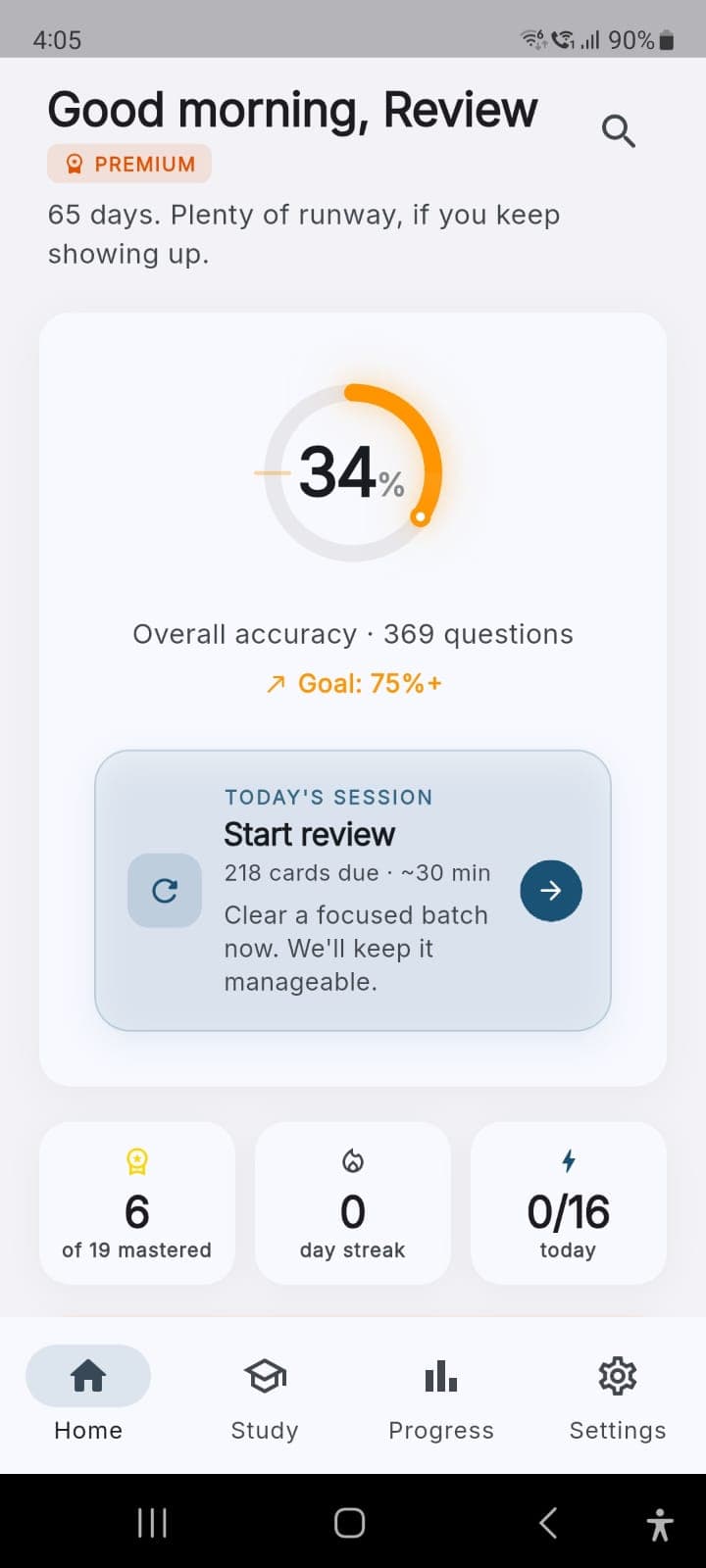
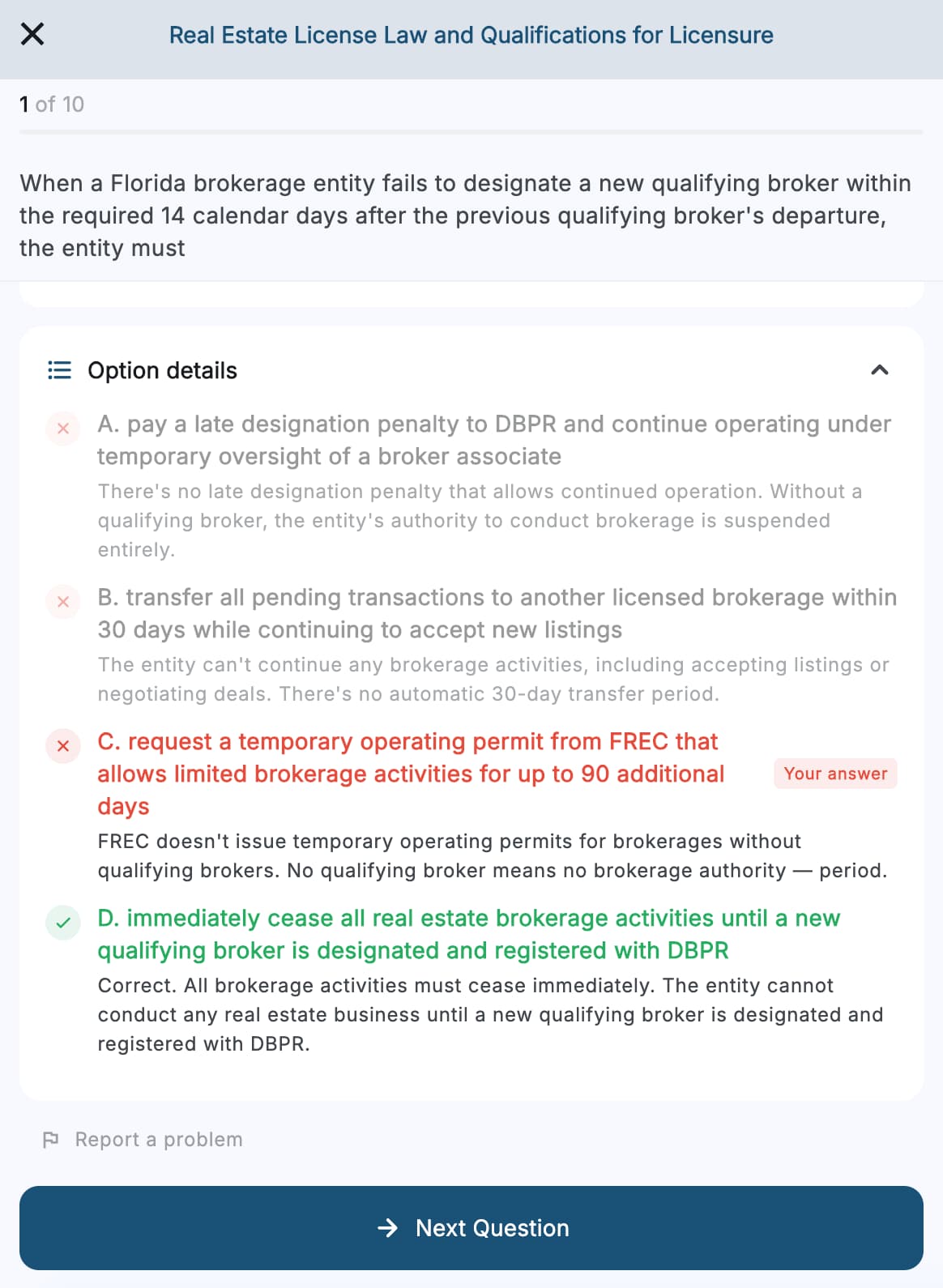
Yes, the real Florida real estate exam can feel harder than practice tests. The usual reason is a mismatch, not a secret second syllabus. Easy or repeated questions reward recognition. The state exam also requires you to apply Florida rules to unfamiliar facts, distinguish between close choices, solve calculations under time pressure, and switch among 19 content areas. Trust a practice score only when the questions are fresh, Florida-specific, mixed, timed, and fully reviewed.
Your score may be measuring memory of the bank, not exam readiness.
That usually means the question is testing exact Florida wording, sequence, or scope.
This is the kind of score you can use before deciding whether to book.
CHECK THE PRACTICE GAP
If practice feels easy, test the score before you trust it.
Use fresh Florida questions to test recall, review every miss, and track whether the same weak topics keep returning.
What this guide covers
- Official source map
- Why the real exam feels harder than practice tests
- Harder does not always mean more obscure
- If you walked out thinking "what was that?"
- The official clue is in the DBPR outline
- The Pearson practice-test caveat
- The six reasons practice tests feel easier
- Recognition is not readiness
- The false confidence pattern
- Practice-test calibration ladder
- Practice quality checklist
- Fast decision: can you trust your practice test?
- What to fix first
- A 7-day calibration reset
- Mistakes students make
- Related exam concepts
- Frequently asked questions
Official source map
Use the Florida Department of Business and Professional Regulation (DBPR) Sales Associate Candidate Information Booklet (CIB) for exam structure, content areas, and the official scope language of knowledge, understanding, and application. Use the current Florida Real Estate Commission (FREC) monthly Division Report for pass-rate context. Use the diagnostic tables in this guide as study coaching.
| Claim in this guide | Primary source | Why it matters |
|---|---|---|
| The Florida sales associate exam is closed book, 100 multiple-choice questions, three and a half hours, 19 content areas, with a passing grade of at least 75 | DBPR Sales Associate Candidate Information Booklet PDF and DBPR Real Estate Sales Associate Requirements PDF | The structural framing inside which the practice-vs-real-exam-calibration question lives |
| DBPR's CIB explicitly says the exam tests knowledge, understanding, and application of real estate principles, real estate law, and real estate mathematics | DBPR Sales Associate CIB | Application questions require more than recognizing a definition |
| May 2026 FL Sales Associate pass rates were 48% for first-time candidates and 31% for repeaters | June 2026 FREC Division Report PDF and Florida Real Estate Commission monthly Division Reports | The first-time and repeater gap is context for taking practice quality seriously |
| Pearson VUE real estate practice tests are general, not state-specific; state-specific practice tests are not available; the practice tests are not state regulated and contain no state-specific content particularly for Florida; there is one version of each real estate practice test; feedback reveals correct/incorrect answers without additional rationale | Pearson VUE Real Estate Practice Tests | Explains why a Pearson practice-test score can help with interface familiarity but cannot prove Florida-specific readiness |
| The Pearson VUE computer system allows candidates to mark questions for review and view a summary screen with answered, unanswered, skipped, and time-remaining information | Pearson VUE Florida Real Estate and Appraisers licensing exams and DBPR Sales Associate CIB | The two-pass timing method and the pacing diagnostic depend on this Pearson VUE feature |
| Real estate brokerage law that frames the exam content is in F.S. Chapter 475, Part I, and F.A.C. Chapter 61J2 | F.S. Chapter 475, Florida Senate and F.A.C. Chapter 61J2 | These are primary sources for Florida license law and Commission rules |
| The score thresholds, diagnostic tables, and seven-day reset are study recommendations | Pass Florida coaching methodology | They are not DBPR, FREC, or Pearson VUE rules |
Why the real Florida exam feels harder than practice tests
You may have passed several practice tests and still found the state exam unfamiliar. The stems were longer, two choices seemed defensible, a known rule appeared inside a new scenario, or a simple calculation took longer than expected.
That experience does not prove that the exam was unfair or that your study time was wasted. It usually means the practice score measured a narrower skill than the live exam. A quiz can accurately score the questions it contains while still giving weak evidence about a different mix of wording, content, and pressure.
The remedy starts with identifying the mismatch. Familiarity needs fresh questions. National content needs Florida-specific practice. Definition drills need scenarios. Untimed work needs a clock. Close distractors need a four-choice review.
Harder does not always mean more obscure
When candidates say the real exam was harder, they often mean one of four things. Only one of them means the material was actually obscure.
| "Harder" feeling | What probably happened | Repair |
|---|---|---|
| "The questions were longer" | The exam embedded the rule in a fact pattern | Drill scenario questions, not definition-only questions |
| "Two answers sounded right" | The exam tested an exact Florida distinction | Review why each wrong answer is wrong, especially close distractors |
| "The math felt slower" | You knew formulas but had not practiced setup under time | Drill setup labels before calculator work |
| "The topics felt random" | The exam mixed all 19 content areas | Use full timed mixed practice, not chapter-only quizzes |
| "I had never heard of that" | A true content gap existed | Return to the DBPR outline and repair the missing topic |
The useful question is not "Was the real exam harder?" The useful question is "Which kind of harder did I experience?" A wording problem, timing problem, Florida-specific problem, and content gap all need different repairs.
That is why repeating the same easy practice test usually does not help. It gives comfort, but it does not identify the failure mode.
Turn the exam-day reaction into a diagnosis
That reaction is common after a poorly calibrated practice cycle.
It usually sounds like one of these:
| What you thought | What it may mean |
|---|---|
| "The questions were nothing like my practice tests." | Your practice may have used recall questions instead of application questions |
| "I knew the topic, but not the answer." | You may know definitions but need scenario practice |
| "Two choices sounded right." | You may need tighter answer-choice elimination |
| "The math was not hard, but I froze." | You may need setup drills before calculator drills |
| "I ran out of focus." | You may need full timed practice, not short quizzes |
| "My score made no sense." | Your practice score may have hidden weak topics |
Write down what felt different while the experience is still fresh. Do not try to reconstruct protected exam questions. Record the category instead: unfamiliar wording, two close choices, a missing rule, a math setup problem, or loss of focus. That category tells you what to change.
The official clue is in the DBPR outline
DBPR's Real Estate Sales Associate Candidate Information Booklet says the exam is based on knowledge, understanding, and application of real estate principles and practices, real estate law, and real estate mathematics. It also lists 100 multiple-choice questions, 3.5 hours, and 19 content areas.
That wording matters.
The exam is not only checking whether you remember a term.
It is checking whether you can use a rule when the facts change.
| What weak practice tests measure | What the real exam often measures |
|---|---|
| Recognition of a familiar definition | Application of a rule to a new fact pattern |
| One topic at a time | Mixed topics under one clock |
| Obvious wrong answers | Close choices with one exact distinction |
| Untimed comfort | Pacing across 100 questions |
| National vocabulary | Florida law, FREC, brokerage, escrow, tax, and math details |
| Overall score only | Whether a high-weight weak topic can sink the attempt |
This is why a candidate can score 85% on a practice test and still feel shaken at Pearson VUE.
The practice score may have been real.
It just measured the wrong version of readiness.
The Pearson practice-test caveat
Pearson VUE's real estate practice tests can help you experience the look and feel of a computer-based multiple-choice test. They should not be treated as proof of Florida readiness.
Pearson's current real estate practice-test page states several important limits:
| Pearson VUE practice-test fact | Why it matters for Florida candidates |
|---|---|
| The real estate practice tests cover general real estate topics | General practice can help vocabulary but may miss Florida law and FREC rules |
| State-specific practice tests are not available | A Pearson real estate practice test is not a Florida state-specific readiness test |
| The tests are not state regulated and contain no state-specific content, particularly for Florida | A passing Pearson practice score cannot prove Florida content readiness |
| There is only one version of each test | Retaking the same test can inflate scores through recognition |
| Feedback shows correct/incorrect answers and reveals the correct answer, but no additional rationale is available | You may not learn why the tempting wrong answers were wrong |
| The practice test is online and self-administered, while the licensure exam is delivered at a Pearson Professional Center | Comfort at home is not identical to test-center pacing and pressure |
That does not make Pearson's practice tests useless. It makes them specific. Use them for computer-test familiarity and general-topic exposure. Do not use them as the final Florida readiness signal.
For Florida readiness, your practice must include Chapter 475, FREC rules, escrow, brokerage relationships, Florida disclosures, documentary stamps, Florida math, legal descriptions, and the DBPR 19-topic outline.
Six reasons practice tests feel easier
Use this as a diagnosis, not a scolding.
| Reason | What it feels like | What to do |
|---|---|---|
| The questions are too familiar | You know the answer before finishing the stem | Use fresh questions you have not seen |
| The questions are too generic | You know national terms but miss Florida details | Move to Florida-specific practice |
| The questions test recall | You can define terms but struggle with scenarios | Use application-style questions |
| The answer explanations are weak | You know the correct letter but not why others are wrong | Review every choice, not just the answer |
| There is no topic breakdown | Your overall score hides weak areas | Track all 19 content areas |
| Practice is untimed | You can solve slowly, but the real exam feels tight | Use full timed sets and two-pass practice |
If three or more of these describe your prep, the problem was probably not your effort.
It was the testing environment you used before the testing center.
Why did the wording feel unfamiliar?
The rule may be familiar while the fact pattern is new. Good practice changes names, timing, relationships, and irrelevant details so you must identify the controlling Florida rule rather than match a memorized sentence.
Why did two answers look correct?
Close distractors often differ by one condition, sequence, duty, or legal consequence. Ask which choice answers the exact question under the stated facts. During review, explain what fact would have made each rejected choice correct.
Are easy free practice tests useful?
Yes, for learning a topic or finding an obvious gap. They are weak as a final readiness measure if the items are repeated, untimed, generic, or mostly definitions. Use the free 25-question timed test as a checkpoint, then confirm readiness with a fresh 100-question Florida-specific simulation.
Recognition is not readiness
Recognition is fast and satisfying.
You see a phrase. Your brain says, "I know this." You pick the answer.
Application is slower.
You read a situation, identify the legal relationship, decide which facts matter, ignore tempting details, compare two plausible answers, and choose the one that fits Florida law.
That is the skill gap.
| Topic | Recognition practice | Application practice |
|---|---|---|
| Brokerage relationships | Identify transaction broker duties | Decide what a licensee may disclose when a party asks for confidential information |
| Escrow | Recall a deposit timeline | Apply the timeline after funds pass from buyer to associate to broker |
| Contracts | Name the elements of a valid contract | Separate validity from enforceability, recordability, and performance |
| Documentary stamps | Recall the general deed rate | Choose the right amount, county assumption, and rounding method |
| Property tax | Define millage | Calculate tax after exemptions and decide which value matters |
| FREC | Name the commission | Decide which penalties FREC can impose and which belong to courts |
The real exam can feel harder because it asks for transfer.
Transfer means you can use what you learned in a new setup.
If your practice did not train transfer, the live exam will feel like a different language even when it is testing the same content.
The false-confidence pattern
False confidence is not arrogance.
It is what happens when your practice tool rewards the wrong behavior.
| Practice habit | Confidence signal | Hidden risk |
|---|---|---|
| Retaking the same test | Score rises each time | You may be memorizing items |
| Studying only by chapter | Topic feels organized | Mixed exams feel chaotic |
| Reading explanations quickly | You feel familiar with the rule | You cannot apply it under pressure |
| Skipping math until the end | Overall score looks fine | Calculation questions drain time |
| Ignoring guessed-correct answers | Score looks higher | Luck hides weak judgment |
A guessed-correct answer should still count as a warning.
If you were unsure, guessed, and got it right, the score went up but readiness did not.
That is why confidence tracking matters. A strong prep tool should help you see not only what you got wrong, but what you got right for the wrong reason.
Practice-test calibration ladder
Use this ladder to judge how much weight to give a practice score.
| Practice result | Reliability as Florida readiness proof | Why |
|---|---|---|
| 90% on the same untimed bank | Low | Recognition and repeat exposure can inflate the score |
| 85% on a chapter quiz right after studying that chapter | Low to moderate | Useful for learning, weak for mixed-exam prediction |
| 80% on general national real estate practice | Moderate for vocabulary, low for Florida readiness | General topics do not prove Florida law or FREC rule performance |
| Passing Pearson VUE's general real estate practice test | Moderate for interface familiarity, low for Florida readiness | Pearson states state-specific practice tests are not available and Florida-specific content is not included |
| 75% to 79% on fresh timed Florida-specific mixed practice | Borderline | It is closer to the real task, but the margin is thin |
| 80%+ on fresh timed Florida-specific mixed practice with no major topic below 65% | Stronger | This tests freshness, timing, Florida content, and topic floors |
| 85%+ twice on fresh timed Florida-specific mixed practice with guessed-correct answers reviewed | Strongest practical signal | Better evidence that the score transfers under pressure |
The ladder is not an official DBPR scoring rule. It is a practical way to stop treating every practice score as equally meaningful.
If your current evidence sits in the top half of the ladder, improve the practice environment before trusting the score. If it sits near the bottom, protect sleep, review weak patterns, and avoid panic overstudying.
Practice quality checklist
Before you trust a practice score, run it through this checklist.
| Question | Trust the score if yes | Be careful if no |
|---|---|---|
| Were the questions fresh? | It tested reasoning | It may have tested memory |
| Was the set timed? | It tested pacing | It may overstate readiness |
| Did it cover all 19 DBPR content areas? | It matched the outline better | It may skip weak topics |
| Was it Florida-specific? | It tested Florida law and math | It may be national filler |
| Did it include scenario questions? | It tested application | It may be recall practice |
| Did explanations cover wrong answers? | You can learn from misses | You may memorize letters |
| Did you review guessed-correct answers? | Lucky points became learning | Your score may be inflated |
| Did you get topic-level results? | You can repair weak areas | The average may hide risk |
The best readiness score is not the highest score.
It is the most honest score.
Can you trust your practice-test score?
Use this table before you schedule, reschedule, or retake.
| Your latest practice result | What it means |
|---|---|
| 85% on familiar untimed questions | Encouraging, but not enough |
| 78% on fresh timed Florida-specific questions | More useful than the 85% |
| 82% overall with brokerage below 55% | Risky because a high-weight topic is exposed |
| 80% plus no major topic below 65% | Stronger readiness signal |
| 90% on national vocabulary only | Poor signal for the Florida exam |
| 70% on hard scenario practice | Painful, but useful because it shows the real repair list |
If your hard practice score drops, do not treat that as failure.
Treat it as finally finding the truth before Pearson VUE does.
What to fix first
Do not respond by studying every topic equally.
Use a priority order.
| Priority | Why it matters | Internal guide |
|---|---|---|
| Florida-specific high-weight topics | DBPR weights are not equal across the 19 areas | Florida real estate exam 19 topics |
| Tricky wording | EXCEPT, NOT, BEST, and close-answer choices turn knowledge into lost points | Tricky questions strategy |
| Math setup | Many misses happen before the calculator | Math formulas guide |
| Fresh timed practice | It reveals pacing and transfer issues | Passed practice but failed exam |
| App calibration | You need topic diagnostics and weak-area repetition | Florida real estate exam app |
This sequence works because it respects the way the exam feels difficult:
New facts. Close choices. Florida-specific rules. Time pressure.
A seven-day calibration reset
Use this if your practice scores looked good but the real exam felt harder than expected.
| Day | Work | Goal |
|---|---|---|
| 1 | Take a fresh 50-question timed Florida-specific set | Get an honest baseline |
| 2 | Review every miss and guessed-correct answer | Sort into rule, wording, math, or pacing |
| 3 | Drill the weakest high-weight topic | Repair the biggest score leak |
| 4 | Drill EXCEPT, NOT, BEST, and close-answer choices | Train reading discipline |
| 5 | Drill math setup before calculations | Slow the formula mistake pattern |
| 6 | Take a full 100-question timed practice exam | Test transfer and pacing |
| 7 | Decide: book, wait, or extend | Use data, not emotion |
Book only when the score is stable enough to survive stress.
A useful target is 80% or higher on fresh timed practice with no major topic still below 65%.
That is not an official DBPR rule. It is a practical readiness threshold.
Mistakes students make
| Mistake | Why it hurts |
|---|---|
| Blaming the real exam instead of auditing the practice | It keeps you using the same tool that misled you |
| Retaking the same practice bank until the score looks safe | Familiarity creates comfort, not transfer |
| Treating every practice question as equal | Weak high-weight topics matter more |
| Reading only the correct explanation | Wrong answers teach the traps |
| Skipping math because it is uncomfortable | Math can cost points and pacing |
| Practicing only when relaxed | The exam is timed, quiet, and pressure-heavy |
| Using national questions as the main tool | Florida-specific rules decide too many points |
The fix is not more panic.
The fix is better feedback.
Related exam concepts
| If you need this | Read this next |
|---|---|
| You passed practice but failed Pearson VUE | Passed practice tests but failed the Florida real estate exam |
| Wording and close answers are the problem | Florida real estate exam tricky questions strategy |
| You want a Florida-specific app | Florida real estate exam app |
| You need a sample set | Florida real estate practice exam free questions |
| You need the official topic map | Florida real estate exam 19 topics |
| You need math repair | Florida real estate exam math formulas |
| You are deciding whether to book | Should I take the Florida real estate exam before I am ready? |
| You missed by a few points | Failed Florida real estate exam by 1 point |
Frequently Asked Questions
Why is the real Florida real estate exam harder than practice tests?
The real exam often feels harder because it tests application, timing, Florida-specific rules, close answer choices, and mixed topics. Many practice tests measure recognition of familiar wording. Those are different skills.
Are practice tests useless for the Florida real estate exam?
No. Practice tests are useful when they are fresh, timed, Florida-specific, scenario-based, and reviewed by topic. They become misleading when they are familiar, generic, untimed, or mostly definition-based. If you have been relying on a static practice test PDF, see practice test PDF vs timed practice for why the format matters.
What practice score should I trust?
Trust a fresh timed Florida-specific score more than a familiar high score. A practical target is 80% or higher on a full timed set, with no major content area below 65%.
Are Pearson VUE real estate practice tests enough for the Florida exam?
No. Pearson VUE's real estate practice-test page says the practice tests cover general real estate topics and that state-specific practice tests are not available. They can help with computer-test familiarity, but they do not prove Florida-specific readiness across Chapter 475, FREC rules, escrow, brokerage relationships, Florida math, disclosures, and the DBPR 19-topic outline.
Why did I score high on practice but feel lost on the real exam?
Your practice may have rewarded recognition. The live exam may have required transfer: applying a rule to new facts, deciding which answer is most exact, and managing time without hints.
How can I tell if my practice questions are too easy?
They are probably too easy if you answer from memory, rarely see close answer choices, do little math, never see EXCEPT or NOT wording, and do not get topic-level feedback.
Is the real exam trying to trick me?
The better framing is that the real exam tests exact distinctions under time. It may feel tricky because answer choices are close, but many misses come from answering a familiar-looking question before identifying the controlling Florida fact.
Should I switch study tools?
Switch if your current tool is generic, mostly recall-based, or has no topic diagnostics. You do not need more questions for their own sake. You need better Florida-specific feedback.
Does Pass Florida copy real exam questions?
No. Pass Florida uses original Florida-specific practice questions built around the DBPR outline. It does not copy Pearson VUE exam questions.
Is this the same as the 63-hour course?
No. Pass Florida is exam prep only. It does not replace the Florida 63-hour pre-license course, post-license education, continuing education, DBPR application steps, fingerprints, or Pearson VUE registration.
What should I do if I already failed after passing practice tests?
Start with the passed practice tests but failed the Florida real estate exam guide. Save your score report, identify weak topics, use fresh timed practice, and avoid retaking until the new score is reliable.
What should I do if I have not taken the exam yet?
Take one fresh timed mixed set before you book. If the score drops compared with your normal practice score, use the drop as a warning and fix the weak areas first.
Ready to practice at the right difficulty?
If the real Florida real estate exam felt harder than practice tests, do not simply add more hours to the same routine. Improve the measurement: use fresh Florida-specific questions, timed mixed sets, topic-level results, and an honest review of guessed-correct answers. The seven-day reset above gives you a clean way to begin.
- Diagnose the practice-vs-real-exam gap directly: Passed practice but failed Pearson VUE
- Repair the last 10 points: Raise your Florida real estate exam score 10 points
- Try Florida-specific fresh practice: Try 5 questions
Methodology
This guide is for Florida sales associate candidates whose practice scores did not predict their Pearson VUE result. The framework uses the DBPR Candidate Information Booklet, which says the exam tests knowledge, understanding, and application of real estate principles, law, and math. It also uses Pearson VUE's stated practice-test limitations and the May 2026 pass-rate context in the June FREC Division Report.
The score thresholds, diagnostic tables, practice-quality checklist, and seven-day reset are Pass Florida study recommendations. They are not DBPR, FREC, or Pearson VUE rules. The 80% overall and 65% topic-floor benchmark is a planning target. It does not guarantee passage.
Official sources are listed below. Requirements, policies, exam outlines, content weights, and pass-rate distributions can change, so verify current details with the official source before making a real-world decision.
Sources
- DBPR Sales Associate Candidate Information Booklet PDF
- DBPR Real Estate Sales Associate Requirements PDF
- DBPR Candidate Information Booklets index
- June 2026 FREC Division Report PDF with May 2026 exam-performance data
- Florida Real Estate Commission monthly Division Reports
- Pearson VUE Real Estate Practice Tests
- F.A.C. Chapter 61J2, Florida Real Estate Commission
- F.S. Chapter 475, Real Estate Brokers, Sales Associates, Schools, and Appraisers, Florida Senate
- Pearson VUE Florida Real Estate and Appraisers Licensing Exams
- Pearson VUE Florida real estate candidate fact sheet PDF
Verified August 20, 2026. Pass Florida publishes this guide and offers the exam-prep app linked on this page. It is not affiliated with DBPR, FREC, Pearson VUE, or a pre-license course provider. No study resource guarantees passage.