VERIFY BEFORE RELYING
This article is exam-prep recovery content for Florida sales associate candidates after multiple failed attempts. The Pearson VUE 24-hour rescheduling minimum, the $36.75 Real Estate Salesperson exam fee, the DBPR (Department of Business and Professional Regulation) 21-day review request window, the FREC (Florida Real Estate Commission) 19-topic content outline percentages, course-validity rules, and DBPR eligibility timing can change. Always verify the current rule against the Pearson VUE Florida Real Estate fact sheet, the DBPR Real Estate Sales Associate Candidate Information Booklet (CIB), or DBPR directly before making a real licensing decision or paying for another attempt.
QUICK ANSWER
If you failed the Florida real estate exam 5 times or more, do not schedule the next attempt until you change the pattern. Pearson VUE says failed candidates must wait 24 hours before scheduling another examination, but that is only a minimum scheduling rule. After five attempts, pause, check your DBPR eligibility and course timing, review your score reports, identify the repeat failure pattern, rebuild by high-weight topics, and retake only after fresh timed practice shows stable readiness.
WHAT THIS PLAN CAN AND CANNOT DO
This plan can help you decide whether attempt six should be delayed, what data to collect, and how to rebuild the missing points. It cannot guarantee a pass, replace DBPR or Pearson VUE rules, diagnose test anxiety, or make the decision for your specific license file. If repeated failures are creating severe distress, talk to a qualified professional or trusted support person before you make another scheduling decision.
Another quick retake is likely to repeat the same miss pattern.
Use score reports, diagnostics, math, and wording drills to target the missing points.
Fresh timed practice is 80% or higher with no major topic below 65%.
FIVE ATTEMPTS IS A SIGNAL
The next attempt needs a different system.
Use the 19-topic diagnostic to identify the weak areas behind the score, then confirm the repair in fresh timed questions before retesting.
The first 48 hours after attempt 5: a decompression routine before any decision
The 48 hours after a fifth failed attempt are the highest-risk window for a bad decision. A rushed rebooking, a panic course purchase, a "let me just try one more" loop, or quitting outright all happen in this window. Use this routine instead.
| Hours 0 to 6 | Do not schedule anything. Do not buy anything. Eat. Sleep. Move your body. Tell one person in your life what happened. The nervous system needs to come down before any planning makes sense. |
|---|---|
| Hours 6 to 24 | Pull your most recent score report. Look at it once, then put it away. Do not study. Do not open practice questions. Write down two sentences: what you remember feeling hardest on the exam, and what you remember running out of time on. |
| Hours 24 to 36 | Read your last two score reports back-to-back. Look only at the topic breakdowns. Note which topics show up weak more than once. Do not start studying yet. The pattern is the point. |
| Hours 36 to 48 | Pull DBPR eligibility and course-completion timing. Confirm you can still test (eligibility, course not expired, fees available). Only after these four checks should you open a study plan. |
If hour 48 arrives and you have not picked a route (Pause / Rebuild / Retake from the decision grid above), give yourself another 48 hours. A fifth-attempt failure is not a 24-hour problem. The cheapest possible mistake right now is paying another $36.75 plus study time for a sixth attempt that repeats the same pattern.
Failed Florida real estate exam 5 times: start here
If you have failed the Florida real estate exam five times, you do not need a pep talk that pretends this feels fine.
It probably does not.
Five attempts can make the exam feel personal. You may feel embarrassed, angry, drained, or stuck between quitting and forcing one more booking just to make the feeling stop.
Pause for a moment.
Failing five times does not prove you cannot pass. It does prove that the current loop is not working.
That distinction matters.
The Florida sales associate exam is not just a memory test. DBPR's Candidate Information Booklet says the exam is based on knowledge, understanding, and application of real estate principles, real estate law, and real estate mathematics. That word application is usually where repeat failures happen.
You may know terms but miss scenarios.
You may understand a formula but choose the wrong setup.
You may recognize Florida law but miss the timing word.
You may know enough to score in the high 60s or low 70s but keep losing the same points under time pressure.
This page is for that moment. It is written for Florida sales associate candidates only. It is exam prep, not the 63-hour pre-license course and not continuing education.
What official rules say after multiple fails
There is no special public "five-fail" category in the published DBPR and Pearson VUE materials.
The mechanics are still the mechanics.
| Issue | What to know |
|---|---|
| Scheduling after failure | Pearson VUE's Florida real estate fact sheet says failed candidates must wait 24 hours before scheduling another examination |
| Exam fee | Pearson VUE lists the Real Estate Salesperson exam fee at $36.75 |
| Passing score | DBPR says the sales associate exam is graded on 100 points and 75 points or higher passes |
| Score report | DBPR says candidates receive an official result report immediately after completing the exam |
| Review option | DBPR says failed candidates may review questions they answered incorrectly under DBPR rules |
| Review deadline | DBPR says the review request must be made within 21 days from the examination date |
| Eligibility timing | Your DBPR application, exam authorization, and course completion timing can still matter |
The key point:
Just because you can schedule again does not mean you should schedule again today.
Pearson's 24-hour wait is a scheduling minimum. It is not a study recommendation.
If you have failed five or more times, your best next move is usually a reset, not a rush.
The DBPR review option is useful, but it is not a magic answer key. It can give a failed candidate an official look at missed questions through DBPR's review process, and that can be valuable after repeated attempts. It also takes time, may involve a review fee, and can affect the timing of any challenge. Use it as an information tool, not as proof that the next attempt should be delayed in every case.
| Situation | DBPR review value |
|---|---|
| You are stuck in the 68-74 range and cannot name the repeat miss pattern | High value. The review may show whether the gap is wording, topic knowledge, math setup, or scenario application |
| Your score reports are too broad to guide the next study block | High value if you are still inside the 21-day window |
| Your course proof, authorization, money, or work schedule is tight | Verify timing first. Do not delay automatically without checking your real constraints |
| You already know the weak topics and have fresh practice evidence improving | Optional. A focused repair plan may be enough |
| You want to challenge a question | Follow DBPR's review and challenge process carefully, and verify the current steps before relying on any article |
Use how many times can you retake the Florida real estate exam for the full retake rules and fee context.
The five-attempt decision table
Before another booking, use this table honestly.
| Your pattern | What it means | Better next step |
|---|---|---|
| Scores are rising attempt by attempt | The method may be improving, but the target is still not reached | Keep the rebuild, add timed full exams before scheduling |
| Scores are flat across attempts | You are repeating the same weakness | Pause and diagnose before paying again |
| Scores are dropping | Fatigue, anxiety, burnout, or poor timing may be affecting performance | Take a short break, rebuild confidence with smaller sets |
| You pass practice but fail Pearson VUE | Practice may be too familiar, too easy, untimed, or not Florida-specific | Use fresh full-length timed exams and question wording drills |
| Math keeps hurting you | Formula recognition is not automatic | Drill math daily before any new appointment |
| You cannot name the weak topics | You are studying by feeling, not data | Gather score reports and take a diagnostic |
| You are near a DBPR or course deadline | Official timing may be the bigger issue | Check DBPR status before choosing a study timeline |
The goal is not to talk you out of real estate.
The goal is to stop the failure loop from deciding for you.
Should you pause before attempt six?
Often, yes.
Not forever.
Just long enough to reset the pattern.
Pause if:
- You have taken two or more attempts within a short period without a different study method.
- Your scores are staying in the same range.
- You are mostly rereading or rewatching videos.
- You are avoiding math.
- You are memorizing familiar practice questions.
- You cannot explain why the last attempt failed.
- You are scheduling from embarrassment or frustration.
- Your sleep, focus, or confidence is clearly worse than before.
Keep moving if:
- You have a fresh score report and a clear weak-area map.
- You changed your study method after the last attempt.
- Your timed practice scores are now stable above 80%.
- Your weakest major topics are above 65%.
- You can finish a 100-question practice exam with review time left.
- Your DBPR and course timing are still safe.
This is not about being soft.
It is about not paying for the same attempt twice.
The pattern diagnosis
Most five-attempt students have one dominant pattern and one supporting pattern.
Find yours.
| Pattern | What it sounds like | What to change |
|---|---|---|
| Rereader | "I know the book, but the questions feel different." | Replace passive review with scenario practice |
| Practice memorizer | "I get 90% on my quizzes, but Pearson feels harder." | Stop repeating familiar questions and use fresh mixed sets |
| Math avoider | "I just hope I do not get much math." | Drill formula selection daily |
| Wording misreader | "I knew it, but I picked the wrong one." | Drill EXCEPT, NOT, first, next, best, may, and must |
| Topic balancer | "I study everything equally." | Weight the plan toward the official DBPR topic outline |
| Fast rebooker | "I just want to get it over with." | Schedule only after readiness data improves |
| Anxiety spiral | "I freeze when the test starts." | Use test-exposure practice and a calmer two-pass routine |
| Tool hopper | "I keep trying new prep every time I fail." | Choose one Florida-specific system and track weak areas consistently |
If you are not sure, read why did I fail the Florida real estate exam? and write down the two patterns that describe you most accurately.
Use your last three attempts as data
Do not analyze five attempts emotionally.
Analyze the last three attempts structurally.
Create a simple table.
| Attempt | Score | What felt hard | What your score report showed | What you changed afterward |
|---|---|---|---|---|
| Attempt 3 | ||||
| Attempt 4 | ||||
| Attempt 5 |
Then ask:
- Did the same topic appear weak more than once?
- Did math show up every time?
- Did timing get worse late in the exam?
- Did you change tools but not change the review method?
- Did you retake before full timed practice improved?
- Did your score move at least 5 points after each study block?
If the answer is "nothing changed," that is the diagnosis.
Not your intelligence.
The study loop.
The high-value topic triage
After five failed attempts, do not study all 19 topics equally.
DBPR's Candidate Information Booklet lists 19 content areas, but some carry far more weight than others. Brokerage Activities and Procedures and Real Estate Contracts are each listed at 12%. Residential Mortgages is 9%. Property Rights and Real Estate Appraisal are each 8%. Authorized Relationships and Titles are each 7%. License Law and Computations are each 6%.
That is where you rebuild first.
| Priority | Topic family | What to diagnose |
|---|---|---|
| 1 | Brokerage Activities and Procedures | Escrow, advertising, office rules, commission, business entities, associate duties |
| 2 | Contracts | Validity, enforceability, counteroffers, disclosures, breach, remedies |
| 3 | Residential Mortgages | Note vs mortgage, clauses, loan types, assumptions, qualifying, LTV |
| 4 | Property Rights | Estates, tenancies, condos, HOAs, homestead, ownership forms |
| 5 | Appraisal | Approaches to value, depreciation, GRM, cap rate, highest and best use |
| 6 | Authorized Relationships | Transaction broker, single agent, no brokerage relationship, disclosure duties |
| 7 | Computations | Commission, doc stamps, proration, millage, LTV, cap rate, GRM |
Use the 19-topic exam guide as the official-weight map.
The 30-day reset plan after five fails
This is not a cram plan.
It is a pattern-reset plan.
If you work full time, care for family, or can only study in short evening blocks, treat this as a 45-day plan with the same order. Do not compress the plan by skipping diagnosis or review. Compress by lowering daily volume, then extend the calendar until you can complete the same sequence with a clear head.
| Days | Focus | What to do |
|---|---|---|
| 1 to 2 | Stop and collect data | Gather score reports, check DBPR status, course date, and Pearson timing |
| 3 | Fresh diagnostic | Take a mixed Florida-specific diagnostic without notes |
| 4 to 7 | Heavy topic 1 | Rebuild the weakest high-weight topic with daily question review |
| 8 to 11 | Heavy topic 2 | Rebuild the second high-weight weakness |
| 12 to 14 | Math reset | Drill formula recognition, then mixed math under time |
| 15 to 17 | Wording reset | Drill EXCEPT, NOT, first, next, best, may, and must questions |
| 18 | Timed 50-question set | Measure transfer without exhausting yourself |
| 19 to 21 | Florida law repair | Escrow, FREC, license law, relationships, disclosures |
| 22 | Full timed exam | 100 questions, 210 minutes, no notes |
| 23 to 25 | Review and repair | Sort misses by topic, wording, math, timing, confidence |
| 26 | Fresh timed mixed set | Confirm whether the repair transferred |
| 27 to 28 | Final weak-area blocks | Two narrow repair sessions only |
| 29 | Final full or half test | Use readiness data, not emotion |
| 30 | Rebook decision | Schedule only if scores and eligibility are ready |
If you are scoring below 60 on fresh diagnostics, stretch this to 45 days.
If you are scoring 73 or 74 and the last attempts were narrow misses, use the last 10 points plan instead.
Tutoring vs app vs course review
After five failures, it is reasonable to ask whether you need outside help.
Here is the honest split.
| Option | Best when | Watch out for |
|---|---|---|
| Tutor | You cannot explain why answers are wrong, or you need someone to catch your reasoning errors live | A tutor who only rereads the textbook with you will not fix application errors |
| Florida-specific app | You need repetition, diagnostics, math, trap wording, and fresh practice on your own schedule | Do not just answer questions. Review misses deeply |
| Course review | You forgot large parts of the 63-hour course or your certificate timing is near expiration | A course is not the same as exam-style application practice |
| Study group | You need accountability and emotional momentum | Groups can spread wrong shortcuts if nobody checks official sources |
| Short pause | You are burned out, rushing, or emotionally flooded | A pause must have a restart date and plan |
The right answer can be a combination.
For example: use a tutor for two sessions to diagnose reasoning, then use an app daily for reps. Or take a short pause, then use a structured 30-day plan.
The wrong answer is doing the same thing again because changing feels uncomfortable.
Worked-scenario walkthrough: the 68 / 70 / 71 / 69 / 72 pattern
The stem. James has taken the Florida sales associate exam five times. His scores: 68, 70, 71, 69, 72. He has used three different prep tools, watched the same video lectures twice, and re-read his 63-hour textbook between attempts 3 and 4. He scores 80-85 percent on his practice tests at home. He has not pulled or read his DBPR score reports closely. He just wants to schedule attempt six this week and "get it over with." What is the actual diagnosis, and what is the realistic next step?
Step 1: Read the score pattern. 68 -> 70 -> 71 -> 69 -> 72. The trend is roughly flat with one outlier. The candidate is consistently in the 68-72 range across five attempts. This is not a knowledge collapse; it is a 3-7 point ceiling. The pattern is "stuck near passing," not "lost."
Step 2: Classify the gap. Passing is 75. James needs +3 to +7 points. That is a narrow-margin gap, not a foundation rebuild. A 30-day reset plan for a candidate scoring in the 50s does not apply here. The last 10 points plan is the right structural fit, not another full course retake.
Step 3: Diagnose the practice / Pearson VUE gap. James scores 80-85 percent at home but 68-72 percent at Pearson VUE. That delta points to two of the eight patterns in the pattern-diagnosis matrix above: Practice memorizer ("I get 90% on my quizzes, but Pearson feels harder") and possibly Anxiety spiral ("I freeze when the test starts"). Familiar-question memorization is the most common driver of this exact delta.
Step 4: Diagnose the data gap. James has not pulled or read his DBPR score reports closely. Without that data, he cannot name his repeat weak topics. He is studying by feeling, not data. This is the Tool hopper + Topic balancer pattern: studying everything equally with each new tool, instead of weighting toward repeat weaknesses.
The realistic decision tree for James:
| Option | Realistic next step |
|---|---|
| Schedule attempt six this week | High risk of repeating the 68-72 ceiling because the underlying pattern has not changed. |
| Cancel this week's plans, pull all five score reports, do a 7-day diagnostic | Identifies the repeat-weak topics. Without this, no study plan can target the actual gap. |
| File a DBPR review request for the most recent attempt | If the request is filed within the required window, James can use DBPR's review process to see missed questions. This is high-value information if timing and cost make sense. |
| Switch from familiar practice to fresh full-length timed exams | Closes the practice-Pearson delta. Stop repeating the same question bank. |
| Use the last 10 points plan structure | Narrow-margin plans target the 3-7 point gap better than a 30-day full reset. |
| Run two tutor sessions for reasoning diagnosis | Confirms whether the gap is content, wording, application, or timing. |
The expensive mistake. James's most expensive mistake right now is treating attempt six as another quick reschedule. The cost is not just the $36.75 fee. It is the fee plus another 2-3 weeks of study plus the morale cost of attempt six landing in the same 68-72 ceiling. The lower-risk path is to pause this week's attempt, pull all score reports, consider a DBPR review request if he is still inside the required window, identify repeat weak topics, and use the last-10-points plan to target the actual 3-7 point gap.
What the worked scenario shows. Five attempts in the 68-72 ceiling is a different problem than five attempts at 50, 55, 60, 62, 65 (which would require a foundation rebuild). The score pattern dictates the plan. Without reading the pattern, every retake feels like the same problem; with it, the diagnosis becomes specific and the plan becomes targeted.
The mental reset
This section matters.
A five-time failure can make every practice question feel like evidence against you. That is a bad study environment.
Use a smaller first win:
- 10 questions, untimed, one topic.
- Review every answer.
- Write one rule you recovered.
- Stop before you spiral.
Then build:
- 25 questions.
- 50 questions.
- Full timed exam.
The point is not to make the exam smaller than it is. The point is to stop your nervous system from treating every study session like another official failure.
A specific seven-day decompression schedule before any new study
If you cannot study without a tightness-in-the-chest reaction to practice questions, use this instead of the standard 48-hour routine. This is not therapy and not medical advice. It is a short anti-panic reset so you do not schedule, buy, or quit from the worst emotional moment. No score targets, no study volume, no tool switching.
| Day | Goal | What it looks like |
|---|---|---|
| 1 | Stop the loop | No questions. No videos. No score reports. Eat normally. Sleep. Move your body for 30 minutes. |
| 2 | Tell one person | Tell one trusted person what is going on. Not to ask advice; just to remove the secret. Secrecy magnifies shame, and shame distorts decisions. |
| 3 | Write the story | Write one page about what the five attempts have actually felt like. Not what you should feel. What you actually feel. Then close it. |
| 4 | Body before brain | Sleep 7-9 hours. Walk 30-45 minutes outside. Drink water. The nervous system precedes the study plan; do not skip this. |
| 5 | First small win | 10 untimed questions on your strongest topic. Review every answer. Write one rule you recovered. Stop. |
| 6 | Confirm the win | 10 more untimed questions on the same topic. Confirm the rule held. Stop. |
| 7 | Decide the route | Pick a route from the decision grid (Pause / Rebuild / Retake). Schedule the next 7 days. Do not look at Pearson VUE yet. |
After day 7, the standard study plan applies. The point of the decompression schedule is not to delay your career. The point is to stop treating every study session like evidence against you, so the next study cycle can produce signal instead of noise.
If test anxiety is a major factor, use the Florida real estate exam test anxiety guide before you rebook.
When you are ready to retake
Use this readiness checklist.
| Check | Ready signal |
|---|---|
| Official status | DBPR eligibility, course timing, and Pearson scheduling are clear |
| Score report | You know what the last attempts had in common |
| Diagnostic | Fresh mixed practice shows improvement |
| Full exam | 100-question timed practice is 80% or higher |
| Topic floors | No major topic is below 65% |
| Math | Formula setup is automatic enough under time |
| Wording | EXCEPT, NOT, first, next, and best-answer misses are reduced |
| Pacing | You can flag and move without panic |
| Confidence | You can explain why wrong answers are wrong |
If only one item is missing, repair it.
If several items are missing, do not book yet.
You are not delaying your career by waiting for readiness. You are protecting the next attempt from becoming attempt six with the same pattern.
Mistakes students make after five fails
Mistake 1: Booking from anger
Anger gives energy, but not precision. Schedule from readiness, not emotion.
Mistake 2: Buying another tool without changing review
New questions help only if your review process changes. A wrong answer should produce a rule, a pattern, and a retest.
Mistake 3: Treating math as optional
Math points are trainable. Avoiding them for five attempts is a pattern worth breaking.
Mistake 4: Ignoring the official review window
If you fail again, DBPR's booklet says the review request must be made within 21 days from the exam date. Decide quickly whether review is worth it.
Mistake 5: Studying the whole course equally
After five attempts, your best study time belongs to high-weight weak topics and repeat miss patterns.
Mistake 6: Letting shame set the schedule
Shame says "prove it now." A good retake plan says "prove it in practice first."
Related exam concepts
| Need | Read this next | Why |
|---|---|---|
| You failed three times | Failed the Florida real estate exam 3 times | Explains the first major repeat-failure reset |
| You need root-cause diagnosis | Why did I fail the Florida real estate exam? | Helps identify the failure pattern |
| You need a general retake plan | Failed Florida real estate exam retake plan | Gives the standard 14-day retake structure |
| You need retake rules | How many times can you retake the exam? | Covers attempts, fees, and eligibility timing |
| You passed practice but failed Pearson | Passed practice test but failed the real exam | Fixes false confidence |
| Anxiety is part of the loop | Florida real estate exam test anxiety | Gives a calmer test routine |
| You are stuck near passing | Last 10 points plan | Helps recover narrow-margin points |
FAQ
What if I failed the Florida real estate exam 5 times?
Pause before scheduling again. Check DBPR eligibility and course timing, gather score reports, take a fresh diagnostic, identify repeat miss patterns, then rebuild with high-weight topics, math, wording, and timed practice. Five failed attempts usually means the method needs to change.
Is there a limit if I failed Florida real estate exam 5 times?
The official materials reviewed here do not publish a fixed lifetime attempt cap for the Florida sales associate exam. The bigger practical limits are eligibility timing, course validity, exam fees, and whether your study method is changing before another attempt.
Should I take the exam again right away?
Usually no. Pearson VUE's 24-hour wait is a scheduling rule, not a study plan. After five attempts, retake only when fresh timed practice shows real improvement.
Should I get a tutor?
Consider a tutor if you cannot explain why answers are wrong, if the same topic keeps failing, or if practice explanations do not change your reasoning. A tutor should help you think through scenarios, not just reread the course.
What should I study first after five failures?
Start with the strongest repeat pattern from your score reports and diagnostic. If you do not have clear data, begin with the high-weight topics: brokerage activities, contracts, mortgages, property rights, appraisal, relationships, license law, and computations.
Can an app help after five failed attempts?
Yes, if the app gives fresh Florida-specific questions, diagnostics, math practice, trap wording, and explanations you actually review. An app will not help if you only race through questions and memorize answers.
Should I redo the 63-hour course?
Maybe, but only if your course proof is expired, your foundation is very weak, or DBPR requires updated education proof. Otherwise, most five-attempt students need exam-style repair more than another passive pass through the same material.
Does Pass Florida copy exam questions?
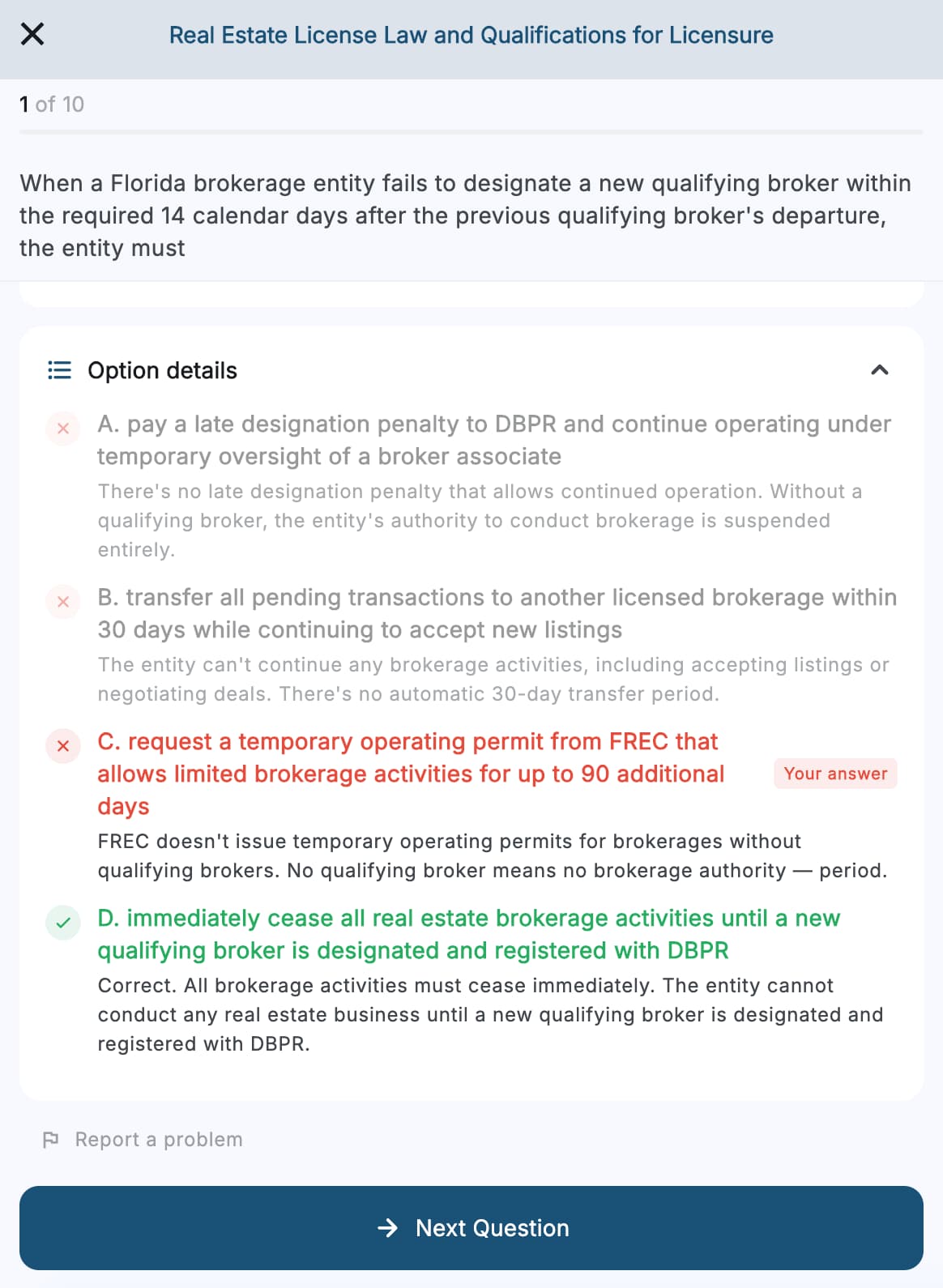
No. Pass Florida uses original Florida-specific practice questions and explanations. It is exam prep only, not a 63-hour pre-license course and not continuing education.
Ready to break the five-attempt ceiling?
Five attempts is a signal, not a sentence. The candidates who finally pass after a 5+ attempt streak consistently change three things: they read their actual score reports instead of guessing, they target high-weight repeat-weak topics instead of studying everything, and they replace familiar-question practice with fresh full-length timed sets.
Use the next practice set to prove what improved, not to repeat questions you already remember.
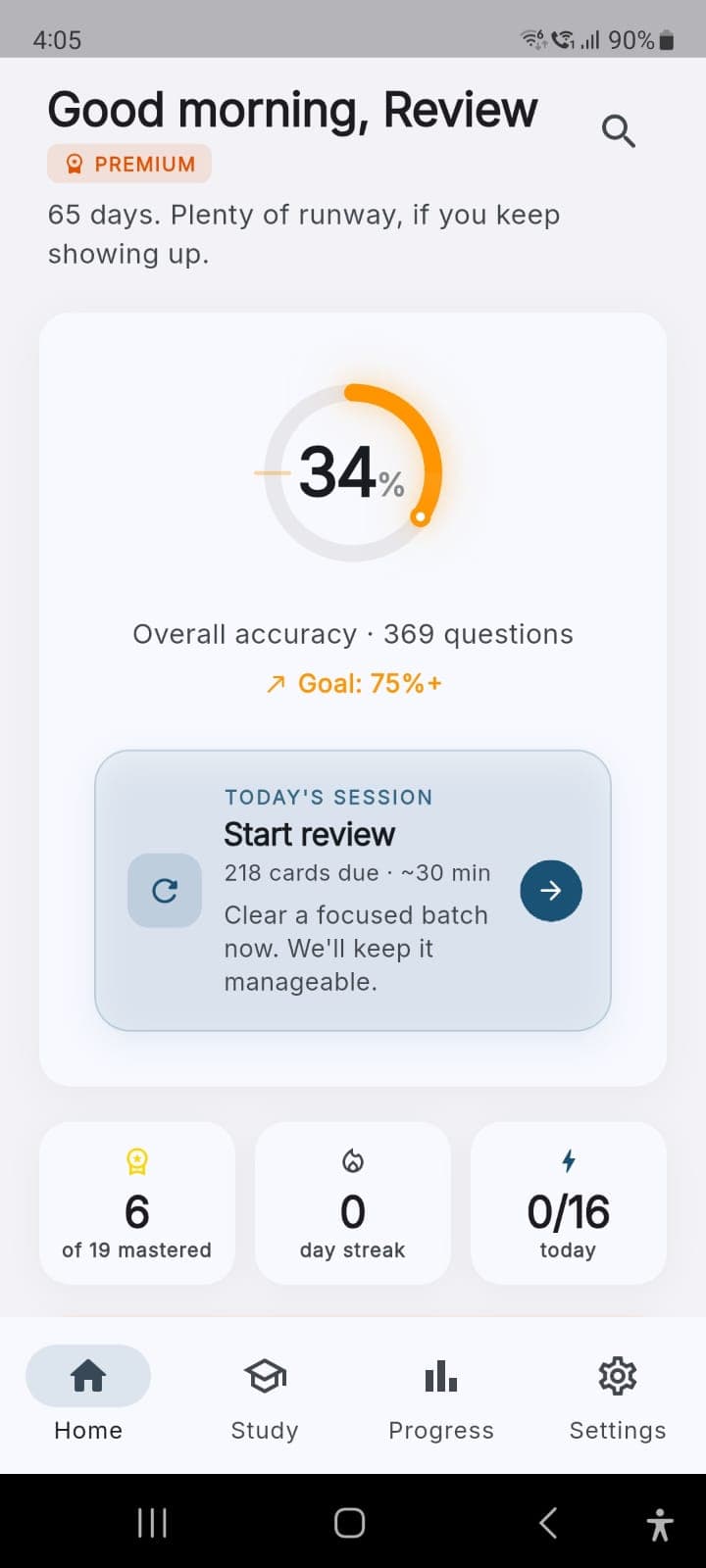
Try a free Florida question | Run the readiness calculator | Download Pass Florida
Methodology
This article was built for Florida sales associate candidates who have failed the state exam five or more times. It focuses on pattern diagnosis, study-loop redesign, official-rule context, and emotional-reset routines, not on the underlying real estate content. The first-48-hours decompression routine, the five-attempt decision table, the pattern-diagnosis matrix, the worked-scenario walkthrough, the 30-day reset plan, the seven-day decompression schedule, and the readiness checklist are practical study patterns derived from common candidate mistakes, not DBPR, FREC, or Pearson VUE rules.
The factual anchors come from primary sources: the Pearson VUE Florida Real Estate fact sheet for the post-failure scheduling wait and current salesperson exam fee, the DBPR Real Estate Sales Associate Candidate Information Booklet for the 100-question format, 19-topic outline, score-report framework, passing-score framework, and review-request timing, and DBPR's examination review page for review and challenge context. Topic-weight triage follows the DBPR CIB outline, including the highest-weight families such as brokerage activities, contracts, mortgages, property rights, appraisal, authorized relationships, license law, and computations.
This article does not promise a passing result on the Florida sales associate examination, does not promise admission at Pearson VUE, and does not replace DBPR, FREC, Pearson VUE, the course provider, or qualified licensed Florida professional guidance. Outcomes depend on candidate-specific paperwork facts, current DBPR policy, Pearson VUE scheduling availability, and the candidate's underlying preparation.
Product note. Pass Florida publishes this guide and offers the exam-prep app linked on this page. We do not claim to use copied exam questions, promise passage, replace the 63-hour FREC-approved pre-license course, or replace DBPR processes, FREC rule interpretation, Pearson VUE scheduling, course-provider records, or qualified licensed Florida professional guidance.
Sources
- Pearson VUE Florida Real Estate and Appraiser Fact Sheet
- DBPR Real Estate Sales Associate Candidate Information Booklet
- DBPR Examination Reviews and Hearings
- DBPR Real Estate Associate Requirements
This post is exam-prep recovery content for Florida sales associate candidates after multiple failed attempts. It summarizes pause / rebuild / retake decision frameworks, pattern diagnoses, and emotional-reset routines, and is not a guarantee of passing the exam, not legal advice, not licensing advice, not mental-health advice, and not a substitute for DBPR, FREC, Pearson VUE, the course provider, a tutor, or a qualified licensed Florida professional. If a fifth-or-later failure is producing severe emotional distress, contact a licensed mental health professional or your support system before any rebooking decision. Verify any rule, fee, deadline, or topic weight against the primary source before applying it to a real licensing decision. Pass Florida is an educational study tool sold for one $39.99 purchase with no subscription.