QUICK ANSWER
To raise your Florida real estate exam score 10 points, stop rereading everything and run a narrow repair plan: one or two high-weight DBPR topics, daily math setup, Florida law details, EXCEPT/NOT wording, and timed two-pass practice. A candidate stuck at 65 to 74 usually needs better point selection, not more random studying.
EXAM PREP ONLY
This is for Florida sales associate exam candidates who are scoring 65 to 74 on fresh mixed practice or who recently failed Pearson VUE near the 75 passing line. It is not a 63-hour pre-license course, continuing education, legal advice, tax advice, lending advice, brokerage advice, DBPR guidance, FREC guidance, or a Pearson VUE scheduling rule. The 10 Point Budget is a score-repair framework, not a score guarantee.
WHO THIS GUIDE IS FOR
Use this page if you are close enough that another broad reread feels wasteful but not close enough to trust luck. Pair it with the Florida real estate exam score report guide if you already tested, the retake plan guide if you need a calmer schedule, the question wording guide if EXCEPT/NOT stems keep costing points, and the math formulas guide if calculations are the fastest repair path.
Fix two heavy topics, math setup, and wording before another full exam.
Use a 7 to 14 day repair plan with diagnostics and fresh practice.
Wording traps, math, pacing, and one weak topic can be the difference.
How to Raise Your Florida Real Estate Exam Score 10 Points
Raise your Florida real estate exam score 10 points by turning the next week into a repair cycle: diagnose the score leak, fix the heaviest weak topic, drill math setup daily, train wording traps, then confirm with fresh timed practice.
The hardest score range is rarely the lowest score.
It is the almost-there range.
If you are scoring 65, 69, 71, 73, or 74, you already know enough to feel frustrated. You may pass some practice sets. You may understand the material when you review explanations. You may have finished the 63-hour pre-license course and still feel like the state exam keeps moving the target.
That feeling is common.
But the fix is not to study harder in every direction. The fix is to stop treating all points as equal.
DBPR's Candidate Information Booklet says the Florida real estate sales associate exam is closed book, has 100 multiple-choice questions, gives candidates three and a half hours, and covers 19 content areas. Those areas are not weighted evenly. Brokerage Activities and Procedures and Real Estate Contracts are each listed at 12%. Residential Mortgages is 9%. Property Rights and Appraisal are each 8%.
That means your last 10 points are usually not hidden in the whole textbook. They are hiding in a few repeatable places:
- A high-weight topic you are avoiding.
- Math setup you have not made automatic.
- Florida law details that look similar under pressure.
- EXCEPT, NOT, first, next, and best-answer wording.
- Timing decisions that let hard questions steal easy points.
This plan is for Florida sales associate candidates only. It is not a 63-hour pre-license course, and it is not continuing education. It is an exam prep repair plan for the last 10 points.
What this guide covers
- Official source map
- The 10 Point Budget
- How much is 10 points?
- The recovery dashboard
- First, read your score pattern correctly
- Find the easiest points first
- Step 1: repair one heavy topic at a time
- Step 2: make math boring
- Step 3: fix wording before you blame content
- Step 4: protect the easy points with timing
- The 7 Day Last 10 Points Plan
- If you have 14 days instead
- Score bands after the repair plan
- Mistakes students make when chasing the last 10 points
- Related exam concepts
- Frequently asked questions
Official source map
Use the DBPR Sales Associate Candidate Information Booklet for exam structure and topic weights, F.A.C. Rule 61J2-2.029 for the mathematics allocation, and the current FREC Division Report for pass-rate context.
Use the DBPR Sales Associate Candidate Information Booklet (CIB) for exam structure, content areas, and topic weights. Use the current FREC monthly Division Report for pass-rate context. Use the 10 Point Budget, repair blocks, day-plans, score bands, and 6-mistake diagnostic in this guide as study coaching.
| Claim in this guide | Primary source | Why it matters |
|---|---|---|
| The Florida sales associate exam is closed book, 100 multiple-choice questions, three and a half hours, 19 content areas, with a passing grade of at least 75 | DBPR Sales Associate Candidate Information Booklet PDF and DBPR Real Estate Sales Associate Requirements PDF | The test-day structure within which the 10-point repair plan operates |
| DBPR CIB topic weights drive the priority order in this guide: Brokerage Activities and Procedures at 12%, Real Estate Contracts at 12%, Residential Mortgages at 9%, Property Rights at 8%, Real Estate Appraisal at 8%, with math also surfacing inside computations, appraisal, legal descriptions, taxes, and investments | DBPR Sales Associate CIB | The high-weight topics are where the largest score gains are mathematically available |
| F.A.C. Rule 61J2-2.029 allocates 10 points to mathematics on the Florida sales associate examination | F.A.C. Rule 61J2-2.029, Examination Areas of Competency | The rule-level math weighting that justifies the daily-math repair block |
| The May 2026 FREC monthly Division Report shows April 2026 exam performance of 48% first-time pass rate and 32% repeater pass rate for the Florida sales associate exam | May 2026 FREC Division Report PDF and Florida Real Estate Commission monthly Division Reports | The pass-rate gap between first-timers and repeaters frames why a structured repair plan matters more than a second attempt without one |
| The Pearson VUE computer system allows candidates to mark questions for review and view a summary screen with answered, unanswered, skipped, and time-remaining information | Pearson VUE Florida Real Estate and Appraisers licensing exams and DBPR Sales Associate CIB | The two-pass timing method depends on the mark-for-review feature |
| Real estate brokerage law that frames the exam content is in F.S. Chapter 475, Part I, and F.A.C. Chapter 61J2 | F.S. Chapter 475, Florida Senate and F.A.C. Chapter 61J2 | The statutory and rule backbone for the Florida-law content areas this repair plan prioritizes |
| The 10 Point Budget, 90-Minute Repair Block, 7-Day Last 10 Points Plan, 14-Day variant, Score Pattern Triage table, Score Bands After the Repair Plan table, and 6-mistake honest-failure diagnostic are score-repair study heuristics | Pass Florida coaching methodology | These are not DBPR, FREC, or Pearson VUE rules |
The 10 Point Budget
The 10 Point Budget splits a near-pass score repair into five point sources: heavy topics, math setup, Florida law details, wording traps, and pacing.
You need a budget before you need a schedule.
Do not say, "I need to study everything." Say, "I need to recover 10 points."
Here is a realistic way to build that score gain.
| Point source | Target gain | Why it works |
|---|---|---|
| One or two heavy topics | 3 points | Brokerage, contracts, mortgages, property rights, and appraisal carry more weight than small topics |
| Math setup | 2 points | Many math misses come from choosing the wrong formula, not hard arithmetic |
| Florida law and deadlines | 2 points | Escrow, FREC, license law, disclosure, and relationship duties repeat often |
| Wording traps | 2 points | EXCEPT, NOT, first, next, best, may, and must can flip questions you already know |
| Pacing and careless misses | 1 point | A better two-pass method protects easy questions late in the exam |
This is not a promise that every student will gain exactly 10 points in a week. It is a practical score-repair model.
If you are at 73 or 74, you may only need four or five of these gains. If you are at 65, you probably need all five.
STUCK NEAR PASSING?
Find the points before you pay for another attempt.
The 10 Point Budget names where the points hide. Use the 19-topic diagnostic to identify the weak areas behind the score, then confirm the repair in fresh timed questions before retesting.
Try 5 Florida questions · check readiness · download the app
How Much Is 10 Points?
On the Florida sales associate exam, 10 points usually means about 10 more correct answers because the exam has 100 multiple-choice questions and a passing grade of 75.
On a 100-question exam, 10 points is roughly 10 more correct answers. That sounds obvious, but it changes the study plan.
You are not trying to become an expert in every chapter this week. You are trying to change 10 answer decisions.
| Current score | Approximate extra correct answers needed to reach 75 | What the plan should do |
|---|---|---|
| 65 | 10 | Repair multiple sources: two heavy topics, math, wording, and pacing |
| 68 | 7 | Repair two heavy topics plus one repeat trap category |
| 70 | 5 | Target the highest-weight weak topic, math setup, and wording traps |
| 72 | 3 | Stop broad studying; find the exact miss pattern |
| 74 | 1 | Protect against careless mistakes, but do not assume the next attempt is automatic |
The 74-to-75 jump is psychologically loud, but it is still a diagnostic problem. A one-point miss can come from a single careless math setup, a negative-stem miss, a pacing mistake, or one weak Florida law rule. The answer is not panic. The answer is evidence.
If you failed by one point, use the failed by 1 point guide alongside this plan. If you passed practice tests but failed the official exam, use the practice-score failure guide before trusting another practice average.
The recovery dashboard
The recovery dashboard tells you whether your next block should repair a topic, math setup, wording traps, pacing, or confidence errors.
Use this dashboard after every 50- or 100-question mixed set. It turns "I need 10 points" into visible evidence.
| Metric to track | Green light | Yellow light | Red light |
|---|---|---|---|
| Fresh timed mixed score | 80%+ twice | 75% to 79% | Below 75% |
| Lowest high-weight topic | 70%+ | 60% to 69% | Below 60% |
| Math setup | 80%+ on mixed math | One repeat formula confusion | Same formula missed twice |
| Wording traps | 0 to 1 EXCEPT/NOT miss | 2 trap misses | 3+ trap misses |
| Changed answers | Changes backed by a rule | Unsure changes | Changed right to wrong more than once |
| Time remaining | 20+ minutes | 10 to 19 minutes | Under 10 minutes or rushed final screen |
| Confidence calibration | High-confidence answers mostly correct | Some false confidence | High-confidence misses repeat |
The dashboard keeps the plan honest. A 78 with math collapsing is not the same as a 78 with one narrow Contracts gap. A 74 with 30 minutes left is not the same as a 74 where the final 15 questions were rushed.
Your next study block should come from the reddest row, not from the chapter you feel like reviewing.
First, Read Your Score Pattern Correctly
A 73 to 74 calls for precision, a 70 to 72 calls for two targeted repairs, and a 65 to 69 calls for a rebuild before another official attempt.
Start with the data you have.
If you already took the state exam, read your official result report and any instructions that came with it. If you are still in practice mode, use a fresh Florida-specific diagnostic and a full timed set.
Use this triage table.
| Current score | What it usually means | Best next move |
|---|---|---|
| 73 to 74 | Narrow miss | Fix wording traps, math setup, pacing, and the single weakest high-weight topic |
| 70 to 72 | Close but unstable | Repair two high-weight topics plus math or Florida law deadlines |
| 65 to 69 | Moderate gap | Stop full tests for a few days and rebuild by topic |
| Below 65 | Broad gap | Use a longer study plan before trying to squeeze 10 points quickly |
The emotional mistake is to treat 74 like failure and 65 like disaster. Neither is useful.
A 74 is feedback. A 65 is also feedback. They just call for different repair plans.
If you have already failed the official exam, use the Florida real estate exam score report guide before deciding whether to request a review or schedule again. If you are taking practice tests but have not sat for Pearson VUE yet, use the pass-rate calculator as a quick readiness check.
Find the Easiest Points First
The easiest point is the weak area that appears often on the DBPR outline and can improve quickly with focused practice.
The easiest point is not the easiest topic.
The easiest point is the topic where three things overlap:
- It appears often on the official outline.
- You are currently missing it.
- The rule can be improved quickly with focused practice.
That is why low-weight comfort topics are dangerous. Planning and Zoning may feel easier than Contracts, but it is listed at 1% in the DBPR outline. Contracts is listed at 12%.
If Contracts is weak, it gets priority.
Use this order when you are stuck at 65 to 74.
| Priority | Topic family | Why it can move the score |
|---|---|---|
| 1 | Brokerage Activities and Procedures | Escrow, advertising, commission, office rules, business entities, and associate duties show up in scenarios |
| 2 | Contracts | Validity, enforceability, offer and acceptance, disclosures, breach, and remedies are heavily tested |
| 3 | Residential Mortgages | Note vs mortgage, clauses, qualifying, financing types, and LTV can be repaired with clean categories |
| 4 | Property Rights and Appraisal | Ownership forms, estates, condo structures, approaches to value, depreciation, GRM, and cap rate repeat often |
| 5 | Computations and closing math | Formula selection turns panic points into predictable points |
| 6 | Authorized relationships and license law | Florida-specific duties, disclosures, FREC, DBPR, and license status rules are high value |
The full official-weight map is in the Florida real estate exam 19 topics guide.
Step 1: Repair One Heavy Topic at a Time
Repair one heavy weak topic at a time because Brokerage, Contracts, Mortgages, Property Rights, and Appraisal carry more scoring weight than small comfort topics.
Do not rotate through every topic in one sitting.
Pick the heaviest weak area and run a repair block.
The 90 minute repair block
Use this format:
| Minute | Task | What to produce |
|---|---|---|
| 0 to 10 | Review the topic outline | Name the subtopics you keep missing |
| 10 to 30 | Read only the weak rules | Stop before it becomes passive rereading |
| 30 to 65 | Do 25 to 35 topic questions | Use Florida-specific, application-style questions |
| 65 to 80 | Review misses by reason | Unknown rule, wording trap, wrong fact, rushed, or math setup |
| 80 to 90 | Write the next drill | Decide what tomorrow must repeat |
This is better than a three-hour reread because it forces transfer. You are not just seeing the rule. You are using it.
Repeat the same topic the next day if the score is still below 70. Move on only when the misses have a clear pattern and the next set improves.
Step 2: Make Math Boring
Math can move a borderline score quickly when you drill formula selection for 20 to 30 minutes a day instead of waiting for one long cram session.
Math is one of the fastest ways to raise your Florida real estate exam score 10 points because the rules are stable.
You do not need advanced math.
You need:
- Percentages.
- Multiplication and division.
- Formula recognition.
- A calm calculator routine.
- Enough repetition that the setup stops feeling personal.
Start with the categories that show up most often:
| Math family | What to drill | Common miss |
|---|---|---|
| Commission | Sale price, rate, total commission, broker split, associate split | Stopping at the broker's share when the question asks for the associate |
| Documentary stamps | Deed stamps, mortgage stamps, intangible tax | Using the sale price when the question asks for the note amount |
| Proration | Daily rate, seller days, buyer days, prepaid vs unpaid | Reversing debit and credit logic |
| Loan-to-value (LTV) and down payment | Loan amount divided by value, down payment percentage | Mixing loan amount and sale price |
| Cap rate and GRM | NOI, value, annual rent, monthly rent | Using gross income when NOI is required |
| Millage | Assessed value, exemptions, taxable value, mills | Forgetting to subtract exemptions before applying the rate |
Use the Florida real estate exam math formulas guide for the full setup. Then use the math drill for reps.
Do not spend one long night on math. Do 20 to 30 minutes a day for five to seven days.
That rhythm works because math confidence is built through recognition. The question should start to feel like, "This is an LTV setup," or "This is a deed stamp setup," before you touch the calculator.
THE FASTEST 2 TO 4 POINTS
Math moves a borderline score because the rules never change.
Twenty minutes a day beats one long cram night. Math Coach drills formula recognition across all 14 Florida calculation types with setup-first prompts, so commission, doc stamps, proration, LTV, cap rate, and millage stop producing clean answers to the wrong question. One $39.99 purchase, no subscription, no copied exam questions.
Open Math Coach · Use the calculator library · Download Pass Florida
Step 3: Fix Wording Before You Blame Content
If you knew the rule but answered the wrong job, the problem is wording, not content, so drill EXCEPT, NOT, first, next, best, may, and must stems separately.
Many students think they missed content when they really missed wording.
That matters because the repair is different.
If you did not know the rule, read the rule.
If you knew the rule but answered the wrong job, drill wording.
Use this missed-question audit.
| Miss pattern | What probably happened | Repair |
|---|---|---|
| You picked a true statement on an EXCEPT question | You missed the direction word | Drill EXCEPT, NOT, FALSE, and INCORRECT questions separately |
| You picked the final outcome instead of the first step | You missed sequence | Build a mini timeline before choosing |
| Two answers looked right | You did not identify the best fit | Ask which answer fits the exact role, fact, and Florida rule |
| You changed from right to wrong | You reacted to anxiety | Change only when you can name the rule that proves the new answer |
| You missed a number by one step | You solved the wrong variable | Reread the last sentence after calculating |
The fastest wording routine is:
- Read the last sentence first.
- Mark the direction word mentally.
- Name the topic.
- Predict the rule.
- Compare answers.
- Submit only after checking the job of the question.
Use Florida real estate exam question wording for the full wording system and EXCEPT and NOT questions for negative-stem practice.
Step 4: Protect the Easy Points With Timing
Use a two-pass timing method: collect confident points first, flag slow questions, return with remaining time, then confirm every item has an answer.
DBPR's booklet says candidates are given three and a half hours for the sales associate exam. That is 210 minutes for 100 questions.
The problem is not the average time per question.
The problem is that hard questions do not respect averages.
If you let one escrow dispute question or one contract-remedy question take six minutes, you are borrowing time from easier points later.
Use a two-pass method:
| Pass | Goal | Rule |
|---|---|---|
| First pass | Collect confident points | If you are stuck after about 90 seconds, flag and move |
| Second pass | Solve flagged questions | Return with a calmer brain and remaining time |
| Final sweep | Prevent blanks and careless math | Confirm every question has an answer |
DBPR's booklet notes that the computer system lets candidates mark questions for review and view a summary screen with answered, unanswered, skipped, and time remaining information. Use that feature. Do not keep a hard question open just because leaving it feels uncomfortable.
For a full rehearsal, use the Florida real estate full length practice exam strategy.
The 7 Day Last 10 Points Plan
The 7-day plan diagnoses first, repairs two heavy topics, drills math and Florida law, trains wording and pacing, then confirms readiness with a fresh timed mixed set.
This is for students already scoring around 65 to 74.
If you are below 65, use this as a starting framework, but give yourself more time. If you are above 75 and trying to build safety, use the plan lightly and focus on confirmation.
| Day | Focus | What to do |
|---|---|---|
| 1 | Diagnose | Take a fresh 50 to 100 question mixed set, record topic scores, timing, math, and wording misses |
| 2 | Heavy topic 1 | Repair Brokerage or Contracts with a 90 minute block |
| 3 | Heavy topic 2 | Repair the next weakest heavy topic |
| 4 | Math | Drill formula selection, then solve 30 mixed math questions |
| 5 | Florida law | Drill escrow, FREC, license law, relationships, disclosure, and duties |
| 6 | Wording and pacing | Drill EXCEPT, NOT, first, next, best, may, must, and a timed 50 question set |
| 7 | Confirmation | Take a fresh timed mixed set, review misses, and decide whether to schedule, keep, or delay |
This plan works only if you review misses properly.
Wrong answer review should not sound like, "I knew that."
It should sound like, "I missed this because I did not know the rule," or "I missed this because I answered a different question," or "I missed this because I rushed a formula."
That level of honesty is where the points come from.
If you have 14 days instead
With 14 days, repeat the same repair cycle twice so weak areas prove they transfer to fresh mixed questions.
Use the same plan, but give every weak area two passes.
| Days | Focus | Result you want |
|---|---|---|
| 1 to 2 | Diagnostic and score map | Know the exact topics costing points |
| 3 to 5 | Heavy topic repair | Brokerage, contracts, mortgages, property rights, or appraisal above 70% |
| 6 to 7 | Math repair | Formula setup feels familiar under time |
| 8 to 9 | Florida law repair | Escrow, FREC, relationships, license law, disclosures stable |
| 10 | Full timed exam | Score, time, topic floors, and wording patterns measured |
| 11 to 12 | Repair remaining gap | One narrow block, not general rereading |
| 13 | Fresh timed set | Confirm transfer to new questions |
| 14 | Light review | Sleep, formulas, trap words, ID and test-day checklist |
If your official exam is soon, pair this with the Florida real estate exam tips page and the exam day checklist.
CONFIRM THE REPAIR HELD
A repair plan is only finished when fresh questions prove it.
Before you keep or move the date, retest on questions you have not seen. Take the free timed practice exam to check your floors, then use the readiness calculator to turn the score into an honest sit-or-reschedule decision. Pass Florida gives you the full Florida-specific bank for repeated reps after each repair block.
Take the free practice exam · Run the readiness calculator · Download Pass Florida
Score bands after the repair plan
A practical readiness signal is 80% or higher on fresh mixed practice, no major topic below 65%, stable math, fewer wording misses, and enough time left to review flagged questions.
The official passing score is 75. Your practice target should usually be higher because practice conditions are familiar and Pearson VUE pressure is not.
Use these practical decision bands.
| Fresh practice result | Meaning | Next step |
|---|---|---|
| 85% or higher | Strong signal | Maintain, do light math, protect sleep |
| 80% to 84% | Ready range if topic scores are stable | Keep the date or schedule if other logistics are ready |
| 75% to 79% | Borderline | Repair the two biggest miss patterns and retest |
| 70% to 74% | Still too close | Do not rely on luck. Add focused days if possible |
| Below 70% | Repair incomplete | Return to topic blocks before another full exam |
Also check topic floors.
An 80 overall with Contracts at 45% is not as safe as it looks. Heavy-topic weakness can hurt more on a different question set.
A safer target is:
- 80% or higher on fresh mixed practice.
- No major topic below 65%.
- Math above 70%.
- Wording-trap misses clearly reduced.
- 20 to 30 minutes left on a full timed exam if possible.
Mistakes students make when chasing the last 10 points
The biggest mistakes are taking full tests without repairing anything, hiding in easy topics, ignoring lucky correct answers, and retaking just because the last score was close.
Mistake 1: Taking full tests every day
Full tests measure readiness. They do not automatically create readiness.
If every full test says the same thing, stop measuring and repair the weak area.
Mistake 2: Studying the topic that feels easiest
Comfort is not strategy.
If Contracts is weak, Contracts gets the block. If math is weak, math gets daily reps. If Brokerage is weak, do not hide in vocabulary.
Mistake 3: Reviewing only wrong answers
Review lucky correct answers too.
If you guessed correctly but cannot explain the rule, that is still a weak point.
Mistake 4: Treating math as a personality trait
"I am bad at math" is not a study plan.
The Florida real estate exam tests repeatable formula patterns. Start with setup, not shame.
Mistake 5: Ignoring wording traps
Students often know the rule but miss the job of the question.
That is why EXCEPT, NOT, first, next, best, may, and must deserve separate practice.
Mistake 6: Retaking because the last score was close
A 74 means you are close.
It does not mean the next attempt is automatic. Build a repair plan before paying again.
Mistake 7: Chasing one more full-length test instead of one visible repair
A full-length exam can confirm readiness, but it is inefficient if you already know the problem. If the last two sets both show math setup errors, do math. If they both show Brokerage weakness, do Brokerage. Measuring the same weakness again is not repair.
Related exam concepts
The best next article depends on the score leak: score report, math, wording, full-length timing, retake planning, readiness, or wrong-answer review.
| If this is your weak spot | Read this next | Why |
|---|---|---|
| You failed and need to interpret the result | Florida real estate exam score report | Shows what the report can and cannot tell you |
| You need higher-level study moves | Florida real estate exam tips | Prioritizes the biggest score movers |
| Math keeps costing points | Math formulas guide | Gives formulas, setup, and common traps |
| You do not know which topics matter most | 19 official exam topics | Matches study time to DBPR topic weights |
| The real exam wording feels tricky | Question wording guide | Trains trigger words and best-answer logic |
| You need a timed rehearsal | Full length practice exam strategy | Shows when and how to simulate Pearson VUE |
| You already failed once | Retake plan | Gives a calmer retake schedule |
| You are deciding whether to book | Readiness score guide | Turns practice scores into a booking decision |
| You keep reviewing misses casually | Wrong-answer review guide | Shows how to turn misses into targeted repairs |
| Negative stems cost points | EXCEPT and NOT questions | Drills the most common wording trap |
| Math anxiety is the blocker | Bad at math guide | Reframes math as repeatable setup patterns |
FAQ
Can I raise my Florida real estate exam score 10 points in one week?
Sometimes, yes, especially if you are already near passing and your misses are concentrated in math, wording, or one heavy topic. If your score is below 65, one week may not be enough unless you have unusually clear gaps and several hours per day.
How many more questions do I need to get right to raise my score 10 points?
Because the Florida sales associate exam has 100 multiple-choice questions and the passing grade is 75, a 10-point gain is roughly 10 more correct answers. The real study move is to identify which 10 answer decisions are easiest to change: high-weight topics, math setup, Florida law details, wording traps, and pacing.
I failed by one point. Do I still need a full plan?
Yes, but it can be narrower. A one-point miss does not mean the next attempt is automatic; the next exam form may emphasize a different mix of topics. Run the recovery dashboard, fix the reddest row, and confirm with fresh timed practice before paying again.
What should I study if I am stuck at 70 percent?
Start with your two weakest high-weight topics, then math, then wording traps. Do not split your best study time evenly across all 19 topics. Brokerage, contracts, mortgages, property rights, appraisal, relationships, license law, and computations usually deserve priority.
Should I reread the whole 63-hour course?
Usually no. If you are scoring 65 to 74, full rereading is often too broad. Read only the weak rules, then answer Florida-specific questions until the rule transfers to new scenarios.
Which topics can raise my score fastest?
The fastest topics depend on your diagnostic, but heavy DBPR topics move the score most: Brokerage Activities and Procedures, Real Estate Contracts, Residential Mortgages, Property Rights, Real Estate Appraisal, Authorized Relationships, License Law, and Computations.
How much math should I do each day?
Do 20 to 30 minutes daily until formula selection feels automatic. Mix commission, doc stamps, proration, LTV, cap rate, GRM, millage, and legal description math. Short daily math sessions usually work better than one long math night.
What practice score means I am ready?
A practical readiness signal is 80% or higher on fresh Florida-specific mixed practice, no major topic below 65%, math stable, and enough time left to review flagged questions. The official passing score is 75, but practice conditions are usually easier than test day.
Can math alone raise my score 10 points?
Usually not by itself, but math can contribute a fast 2 to 4 points when setup errors are the problem. The better plan is math plus one heavy topic plus wording repair. That combination is more realistic than trying to squeeze all 10 points from formulas alone.
Should I reschedule if I am still under 75 on practice?
If your exam date is flexible and you are still under 75 on fresh practice, adding focused study time is usually smarter than hoping the real exam feels easier. Check Pearson VUE and DBPR instructions for current scheduling and change rules before changing an appointment.
Does Pass Florida use copied exam questions?
No. Pass Florida uses original Florida-specific practice questions and explanations. It is exam prep only, not a 63-hour pre-license course and not continuing education.
Ready to repair the last 10 points?
If you are stuck at 65 to 74, use a diagnostic first, repair the highest-value leak, then download Pass Florida when you want daily Florida-specific reps instead of another passive reread.
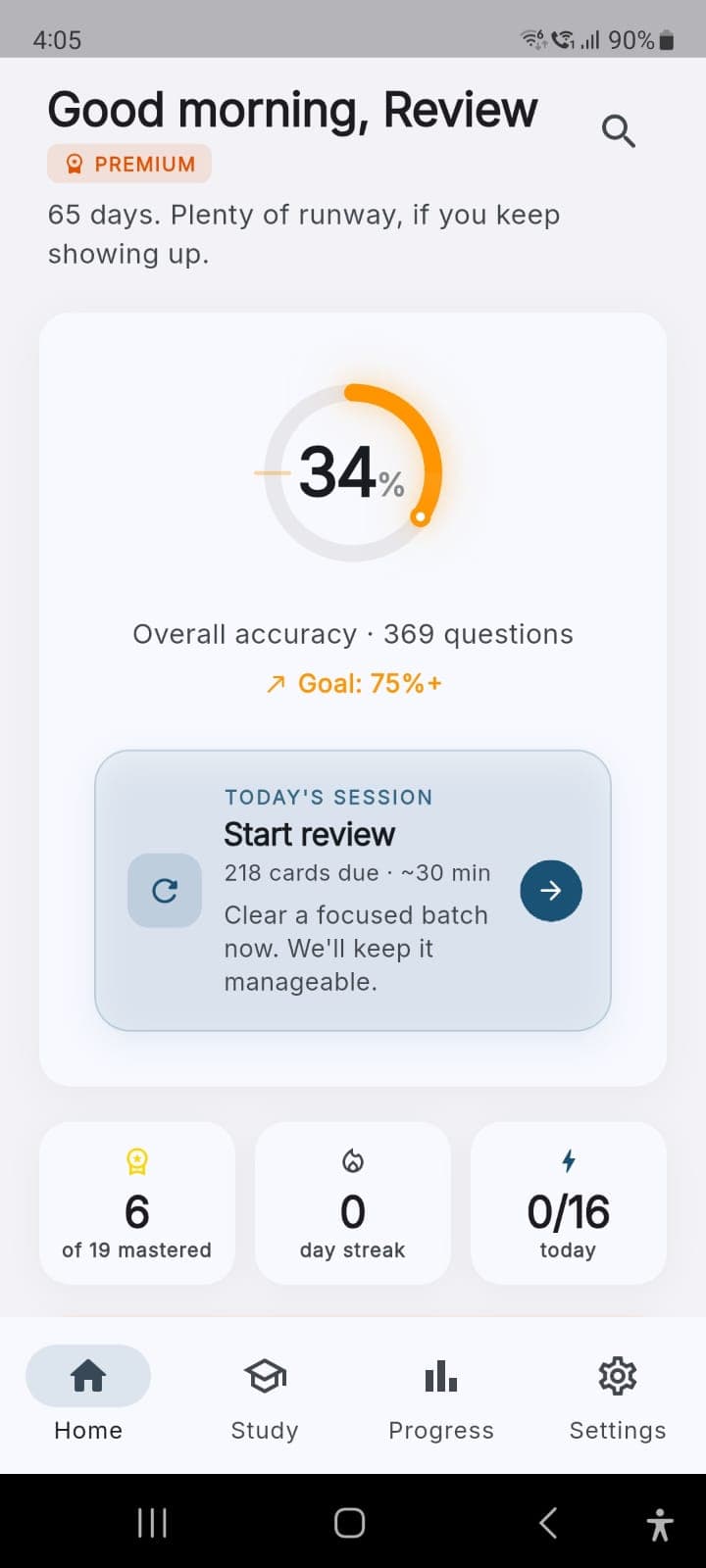
If you are stuck at 65-74, the next score jump usually does not come from another full reread or another full practice test. It comes from naming the 5 point sources in the 10 Point Budget, drilling the highest-weight DBPR topic block first, making math boring, and protecting easy points with a two-pass timing method.
REPAIR THE SCORE LEAK
Turn the last 10 points into daily reps.
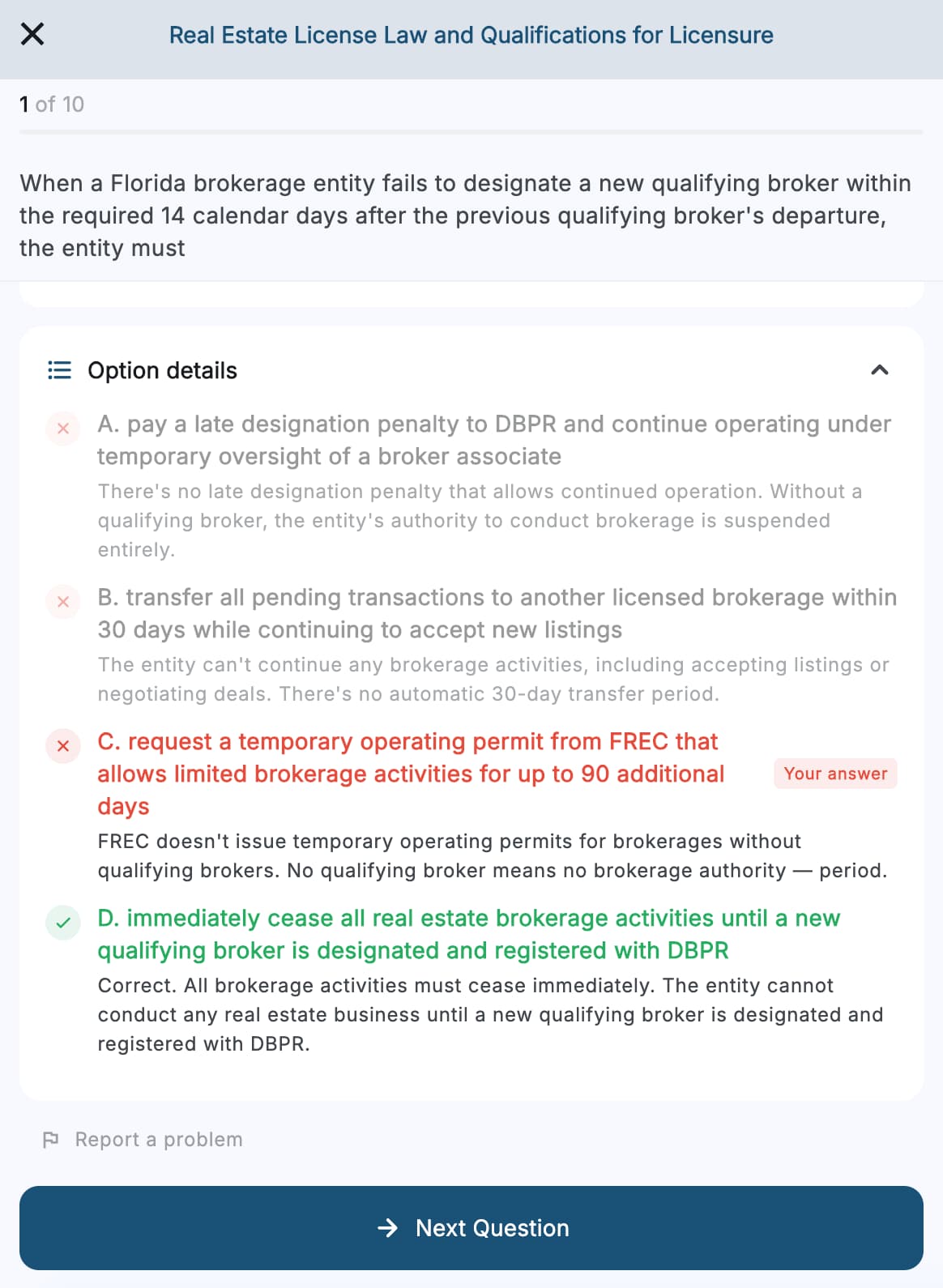
Start with a few Florida questions, check whether your practice score is actually ready, then use Pass Florida for topic repair, Math Coach, Trap Library, and Confidence Calibration.
Try 5 Florida questions · check readiness · download Pass Florida
Methodology
It anchors the score-repair priority order to the current DBPR Sales Associate Candidate Information Booklet (CIB) topic weights (Brokerage Activities and Procedures 12%, Real Estate Contracts 12%, Residential Mortgages 9%, Property Rights 8%, Real Estate Appraisal 8%), the F.A.C. Rule 61J2-2.029 10-point mathematics allocation, and the pass-rate context from the May 2026 Florida Real Estate Commission (FREC) monthly Division Report, which reports April 2026 exam performance of 48% first-time pass rate and 32% repeater pass rate for FL Sales Associate.
The 10 Point Budget, 90-Minute Repair Block, 7-Day Last 10 Points Plan, 14-Day variant, Score Pattern Triage table, Score Bands After the Repair Plan table, and 6-mistake honest-failure diagnostic are Pass Florida observational coaching pedagogy and are not DBPR, FREC, or Pearson VUE process documents. The 10-point score-gain estimate is a planning benchmark, not a guarantee of any specific score change for any specific candidate.
Pass Florida is not affiliated with DBPR, FREC, Pearson VUE, or any pre-license course provider, and Pass Florida does not guarantee passage of any state exam. Pass Florida does not replace the FREC-approved 63-hour pre-license course, DBPR application steps, Pearson VUE scheduling rules, fingerprinting, post-licensing, continuing education, or consultation with a qualified licensed professional. Its role is targeted practice with Florida-specific exam-style questions, not legal, tax, brokerage, lending, or licensing guidance.
Official sources are listed below. Requirements, policies, exam outlines, topic weights, and pass-rate distributions can change, so verify current details with the official source before making a real-world decision.
Product note
Pass Florida publishes this guide and offers the exam-prep app linked on this page. Pass Florida is not affiliated with DBPR, FREC, Pearson VUE, or any pre-license course provider, and Pass Florida does not guarantee passage of any state exam.
Sources
- DBPR Sales Associate Candidate Information Booklet PDF
- DBPR Real Estate Sales Associate Requirements PDF
- DBPR Candidate Information Booklets index
- F.A.C. Rule 61J2-2.029, Examination Areas of Competency
- F.A.C. Chapter 61J2, Florida Real Estate Commission
- F.S. Chapter 475, Real Estate Brokers, Sales Associates, Schools, and Appraisers, Florida Senate
- May 2026 FREC Division Report PDF
- Florida Real Estate Commission monthly Division Reports
- Pearson VUE Florida Real Estate and Appraisers Licensing Exams
- Pearson VUE Florida real estate candidate fact sheet PDF
This post is exam preparation content for the Florida Real Estate Sales Associate exam. It is not legal, tax, financial, lending, appraisal, brokerage, insurance, title, closing, valuation, pricing, career, or professional advice. Pass Florida is not affiliated with the Department of Business and Professional Regulation (DBPR), the Florida Real Estate Commission (FREC), Pearson VUE, or any pre-license course provider, and Pass Florida does not guarantee passage of any state exam. The 10-point score-gain estimate is a planning benchmark, not a guarantee of any specific score change. For real-world decisions, verify current requirements with the official source or consult a qualified licensed Florida professional.