QUICK ANSWER
A Florida real estate full-length practice exam is useful only after you have done enough topic practice for the score to mean something. For final readiness, simulate the official format: 100 multiple-choice questions, 210 minutes, closed book, no phone, no pauses, and fresh Florida-specific questions. A strong practice signal is 80% or higher, no major content area below 65%, math completed without panic, and enough time left to review flagged questions. Use the free 25-question timed practice exam as a shorter checkpoint, then use the full app bank for deeper timed work.
A full exam will mostly confirm broad gaps. Rebuild by topic first.
The test will show which topics, math setups, and pacing habits need repair.
Use one more timed run to confirm readiness, then move into final-week review.
What this guide covers
- Official source map
- Start with the right practice
- What a full-length practice exam is for
- When to take full-length practice exams
- How to simulate Pearson VUE at home
- Before you trust the score
- The 210-minute timing plan
- Score thresholds that actually help
- The review workflow after the test
- What to do after each score band
- How many full-length tests to take
- Where a shorter practice exam fits
- The week-before full-test rule
- Mistakes candidates make
- Related exam concepts
- FAQ
Official source map
Use the Florida Department of Business and Professional Regulation (DBPR) for official exam format and candidate instructions. Use Pearson VUE for appointment logistics. Treat the timing and score targets in this guide as study strategy, not official rules.
| Claim in this guide | Source anchor | Why it matters |
|---|---|---|
| The sales associate exam has one hundred multiple-choice questions | DBPR Sales Associate Candidate Information Booklet | Your final simulation should be 100 questions |
| Candidates are given three and a half hours | DBPR Sales Associate Candidate Information Booklet | Three and a half hours equals 210 minutes |
| The exam covers nineteen content areas | DBPR Sales Associate Candidate Information Booklet | A useful full exam needs broad topic coverage |
| A grade of 75 points or higher passes | DBPR Sales Associate Candidate Information Booklet | The 80% practice target is a cushion, not an official rule |
| The computer includes a tutorial, navigation tools, and a summary screen | DBPR Sales Associate Candidate Information Booklet | Your simulation should include flagging and review behavior |
| Pilot questions may be included and are not identified | DBPR Sales Associate Candidate Information Booklet | Answer every question instead of trying to guess what counts |
| Pearson VUE handles scheduling logistics | Pearson VUE Florida Real Estate page | Rescheduling and appointment details should be verified there |
The official facts tell you what to simulate. They do not tell you when to take practice exams, how to interpret an 82%, or how many repair blocks you need. That is where study strategy begins.
Start with the right practice
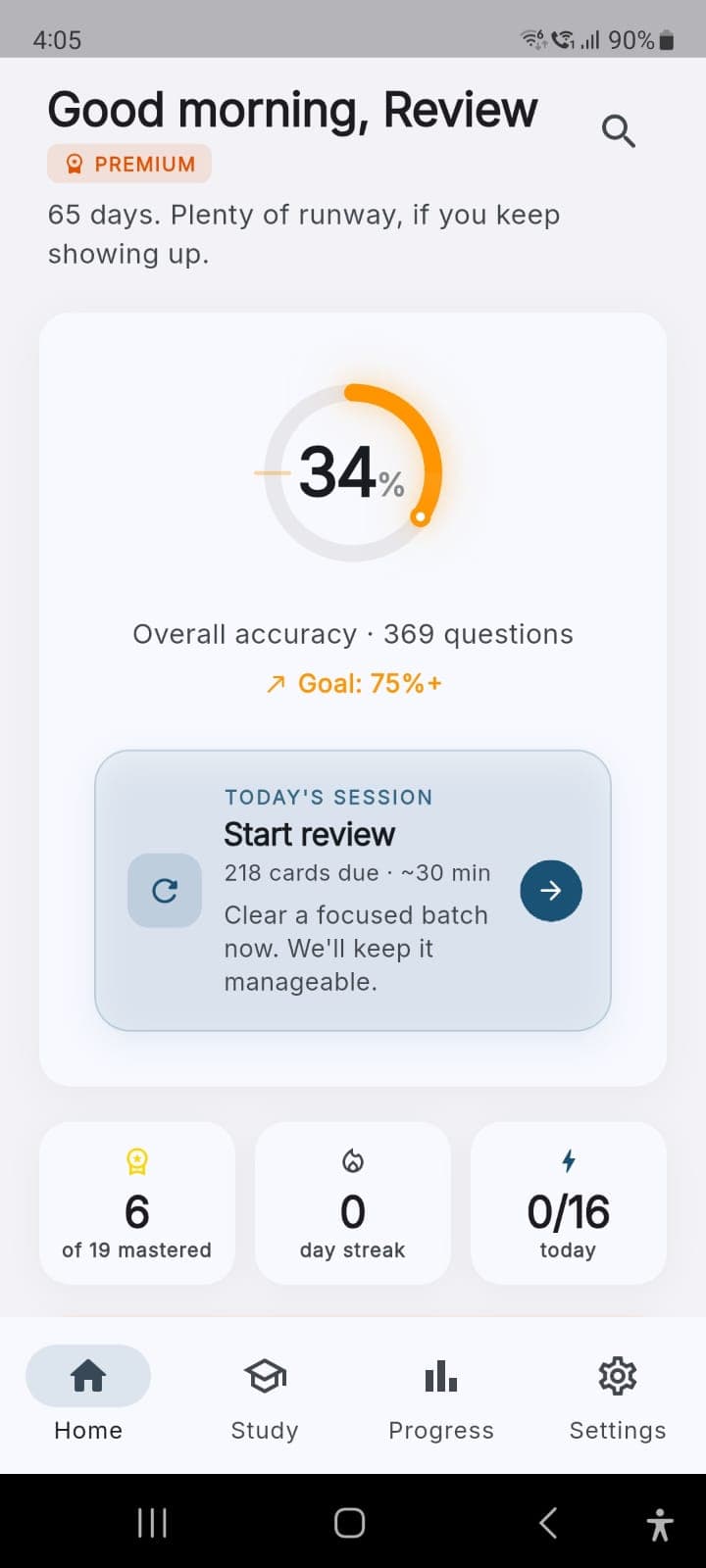
Use the free timed practice exam for a shorter checkpoint, the readiness calculator to interpret scores, and the full app bank when you need enough fresh questions for 100-question simulations.
| Need | Best next step | Why |
|---|---|---|
| You want a fast timed checkpoint | Take the free timed practice exam | 25 questions in 30 minutes from a blueprint-weighted pool spanning all 19 areas, no signup |
| You just took a longer practice test | Run the readiness calculator | Turns score, topic gaps, and timing into a readiness read |
| Math or formula setup broke during timing | Start Math Drill | Repairs formula recognition before another timed run |
| You need enough volume for serious timed prep | Download Pass Florida | Gives you the full Florida-specific bank and app practice flow |
Do not make the first click too small. If the searcher wants full-length practice strategy, the best next step is timed practice or download, not a five-question sample.
What a full-length practice exam is for
A full practice exam is a rehearsal for stamina, pacing, topic switching, math setup, and recovery from hard questions. It is useful only if it changes what you study next.
A full-length practice exam is not just a longer quiz.
It tests:
- Whether you can switch between all 19 topic areas
- Whether you can keep math calm under time
- Whether you flag hard questions early enough
- Whether you recover after a confusing stem
- Whether your topic practice transfers to mixed wording
- Whether your score is stable enough to trust
If you take a full exam too early, the score may scare you without teaching much. If you take it too late, the score may reveal a real problem when there is no time left to fix it.
Use full tests as checkpoints, not daily punishment.
When to take full-length practice exams
Most candidates should take one serious full-length simulation after topic practice has started working, then another after repair. In a 30-day plan, that usually means around day 21 and day 26 or 27.
Most students should take full-length practice exams at three possible points:
| Timing | Purpose | What to do with the result |
|---|---|---|
| Early baseline, optional | See how far you are from readiness | Build your topic plan, then stop full tests for a while |
| Middle checkpoint | Test whether topic work is transferring | Repair weak topics and pacing problems |
| Final confirmation | Decide whether to sit, reschedule, or add study time | Use score bands and topic floors |
For a 30-day plan, take your first serious full exam around day 21 and your second around day 26 or 27.
For a 14-day plan, take one full exam around day 11 and a second around day 13 if you have the energy and enough fresh questions.
In the final week, take one full timed exam about three or four days before the real test. Do not take a full exam the night before Pearson VUE.
If your exam is tomorrow and you have not taken a timed test, take a shorter 25- or 50-question timed set instead. At that point, protecting sleep and confidence matters more than forcing a late full simulation.
SIMULATE BEFORE YOU SCHEDULE
Make timed practice reveal the next repair block.
Use fresh Florida questions to test recall, review every miss, and track whether the same weak topics keep returning.
Take the free timed practice exam · check readiness · download Pass Florida
How to simulate Pearson VUE at home
Simulate the parts that affect score: 100 questions, 210 minutes, no notes, no phone, fresh Florida-specific questions, flagging behavior, and a review pass before submission.
Use this setup:
| Simulation rule | What to do |
|---|---|
| Question count | 100 questions for final readiness |
| Time limit | 210 minutes |
| Materials | No notes, books, flashcards, tabs, or videos |
| Phone | Out of reach and silent |
| Calculator | Use only the type you plan to use on exam day |
| Breaks | No casual pauses |
| Questions | Fresh Florida-specific questions |
| Review | Flag questions during the test, review after finishing |
| Environment | Quiet table, same sitting posture, no music |
The DBPR Candidate Information Booklet describes computer testing features such as a tutorial, navigation buttons, and a summary screen. During practice, mimic the behavior: answer what you can, flag what needs another pass, and check unanswered items before ending.
Do not review explanations during the exam. That turns the test into tutoring. Save explanations for the review block after the timer stops.
Before you trust the score
Trust a full practice score only if the questions were fresh, Florida-specific, timed, broad across topics, and completed without notes or mid-test explanations.
A practice score is useful only if the test was valid.
| Validity check | Trust the score more if... | Treat the score cautiously if... |
|---|---|---|
| Question freshness | The questions were new or mostly new | You had seen many questions before |
| Florida specificity | The set was built for Florida sales associate content | The set mixed national-only material with Florida content |
| Topic mix | The set covered all 19 content areas | It over-sampled your favorite topics |
| Timing | You used one uninterrupted 210-minute block | You paused the clock, took breaks, or split the exam |
| Materials | You used no notes, videos, tabs, or answer explanations | You looked up rules during the test |
| Review behavior | You flagged and returned like the exam system allows | You changed answers because explanations appeared mid-test |
| Score detail | You can see topic, math, and miss-reason patterns | You only have one overall percentage |
If two or more rows are in the cautious column, do not treat the score as a readiness verdict. Treat it as practice, repair what it exposed, and use a cleaner timed set next.
The 210-minute timing plan
Do not spend exactly 2.1 minutes on every question. Use two passes: answer the clear questions first, flag slow questions, then spend the second pass on math and hard wording.
The official exam gives you 210 minutes for 100 questions. That is 2.1 minutes per question on average.
Do not force every question into exactly 2.1 minutes. Hard questions will steal time from easy points.
Use this two-pass plan:
| Time window | Goal | What to do |
|---|---|---|
| Minutes 0 to 5 | Settle in | Read directions, breathe, start clean |
| Minutes 5 to 125 | First pass | Answer confident questions, flag hard ones, keep moving |
| Minutes 125 to 180 | Second pass | Return to flagged questions and math |
| Minutes 180 to 205 | Review | Check unanswered questions, rework only clear mistakes |
| Minutes 205 to 210 | Final sweep | Confirm every question has an answer |
If a question is not moving after about 90 seconds, flag it and move on. That is not giving up. That is protecting easier points.
Use these checkpoints during practice:
| Question number | Ideal time remaining |
|---|---|
| 25 | 155 minutes or more |
| 50 | 105 minutes or more |
| 75 | 55 minutes or more |
| 90 | 25 minutes or more |
| 100 | 20 to 30 minutes for review if possible |
If you reach question 50 with less than 80 minutes left, pacing is a real issue. The fix is not to read faster blindly. The fix is to flag sooner.
Score thresholds that actually help
The official passing score is 75 points, but a practice score of 75% is not a safe readiness target. Aim for 80% or higher plus no major content area below 65%.
Practice conditions are familiar. Pearson VUE is not. Test-day wording, pressure, fatigue, and topic mix can pull a borderline score down.
Use these score bands:
| Full practice score | Readiness meaning | Next step |
|---|---|---|
| 85% or higher | Strong | Maintain, review misses, avoid overstudying |
| 80% to 84% | Ready range | Check topic floors, then schedule or stay on final-week plan |
| 75% to 79% | Borderline | Repair 2 to 3 weak areas, then retest |
| 65% to 74% | Not ready yet | Add 1 to 3 focused study weeks |
| Below 65% | Rebuild phase | Stop full tests and rebuild by topic |
Now check topic floors.
An 82% overall score with Brokerage at 45% is not a safe 82%. Brokerage Activities and Procedures is one of the highest-weighted areas. A different practice form, or the real exam, can expose that gap.
| Topic pattern | What it means |
|---|---|
| Every topic 65% or higher | Healthy readiness profile |
| One low-weight topic below 65% | Watch it, but do not panic |
| One high-weight topic below 65% | Repair before scheduling |
| Two or more topics below 65% | Not ready yet |
| Math below 60% | Drill formulas before another full test |
Use the pass-rate calculator when you want a quick readiness read after a timed practice result.
The review workflow after the test
Review a full practice exam by saving the raw score, sorting misses by reason, building a narrow repair block, and retesting with fresh questions.
Do not review a full practice exam by scrolling through wrong answers casually.
Step 1: save the raw score
Write down:
- Overall score
- Time remaining
- Number of flagged questions
- Number of unanswered questions, if any
- Topic scores
- Math score
- EXCEPT/NOT score, if tracked
The score alone is not enough. Time remaining and topic pattern tell you what the score means.
Step 2: sort misses by reason
Use reason codes:
| Miss reason | What it means | Repair action |
|---|---|---|
| Rule unknown | You did not know the concept | Read the topic, then do 15 to 20 questions |
| Trigger missed | You knew the rule but missed the fact | Slow down and mark the trigger fact |
| Wording trap | EXCEPT, NOT, best answer, first action | Drill wording patterns |
| Formula setup | Wrong math formula or wrong number | Do formula-recognition drills |
| Rushed | You changed or guessed too fast | Use the two-pass method |
| Confidence gap | You guessed right but cannot explain why | Treat it like a miss |
Without reason codes, you only know that you missed points. With reason codes, you know what to fix.
Step 3: build a repair block
Your next study session should come from the practice exam result.
| Practice exam result | Next study block |
|---|---|
| Contracts below 65% | 30 to 50 contract questions plus short rule review |
| Brokerage below 65% | Brokerage procedures, escrow, commission, advertising, employer rules |
| Math below 60% | 20 formula-selection drills, then 20 calculation questions |
| Timing weak | 50-question timed set using two-pass timing |
| Wording traps high | 25 EXCEPT/NOT and first-action questions |
| All topics healthy | Light review and another full exam only if needed |
The repair block should be narrow. Do not respond to one weak topic by rereading the entire textbook.
Step 4: retest with a fresh set
After repair, avoid retaking the same full exam if you can. Familiar questions inflate the score.
Use a fresh 50-question mixed set or a second full 100-question exam. Your goal is transfer: can you apply the repaired rule to new wording?
What to do after each score band
Above 80%, verify topic floors. From 75% to 79%, repair the biggest weak areas. Below 75%, stop burning full exams and return to topic practice.
If you scored 85% or higher
Do not turn a strong score into three days of anxious overstudying.
Review misses, do light math, scan trap wording, and protect sleep. If this is your second strong full exam, move into the exam day checklist.
If you scored 80% to 84%
This is a good readiness range if topic scores are stable.
Check for any major topic below 65%. If none exists, schedule or keep your current exam date. If one exists, spend one to three days on that topic and do a short retest.
If you scored 75% to 79%
You are close, but close is not the same as safe.
Find the 2 to 3 areas costing the most points. Repair those. Take another full exam. Do not schedule based only on hope.
If you scored below 75%
Do not keep taking full exams every day.
That burns fresh questions and confidence. Move back to topic practice for one to three weeks depending on the score. Use how many practice questions before the Florida real estate exam to size the repair plan.
How many full-length tests to take
Most candidates should take two full simulations if question-bank depth allows. One shows what breaks. Two show whether repair worked.
Two full tests is usually enough.
Three can be useful if:
- Your first score was below 75%.
- You changed your pacing method.
- You had a major math weakness.
- You are retaking after a failed attempt.
- Your first two results were inconsistent.
More than three full exams can backfire if you are reusing the same question bank or taking them too close together.
The goal is not to collect practice exam scores. The goal is to reach a stable readiness profile.
Where a shorter practice exam fits
A shorter timed test is useful for a checkpoint, but it is not a full Pearson VUE simulation. Use it for diagnosis, not final readiness.
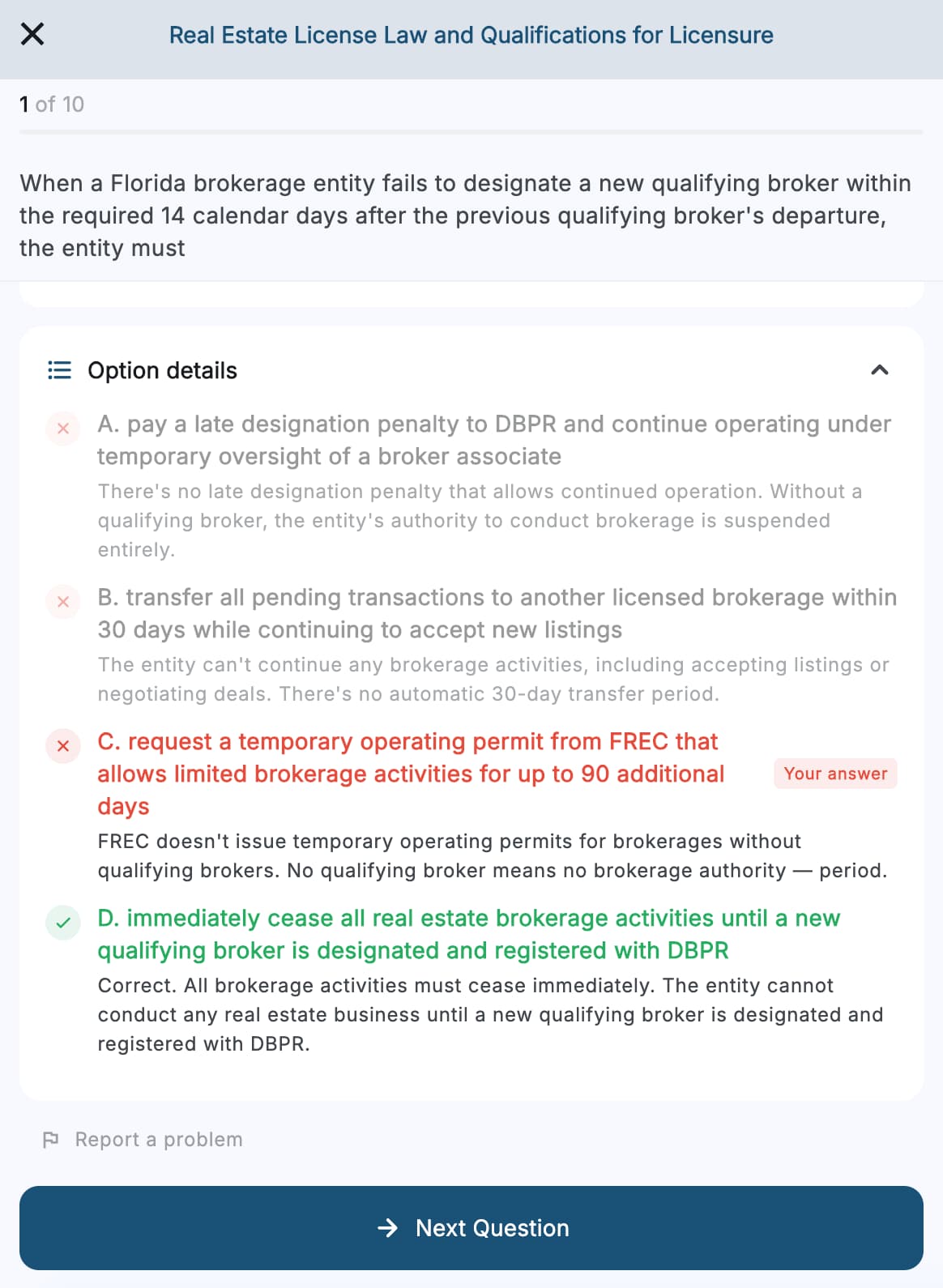
The free Florida real estate timed practice exam gives you 25 questions in 30 minutes from a pool spanning all 19 content areas. The draw is blueprint-weighted, so a light one-percent or two-percent area may not appear in every short set. Use it for style, explanations, pacing, and early weak spots.
It does not replace a 100-question simulation.
| Practice type | Best use | Limitation |
|---|---|---|
| 5-question sample | See wording and format | Too small for readiness |
| 25-question timed exam | Early timed diagnostic | Not enough for full stamina |
| 50-question timed set | Midweek repair test | Still shorter than Pearson VUE |
| 100-question full exam | Readiness confirmation | Needs a large fresh question block and review time |
Both short and full tests have a place. They answer different questions.
The week-before full-test rule
In the final week, take one full timed practice exam three or four days before the real exam. Shift the final day to light review, formulas, logistics, and sleep.
One final full test is useful. Two can be too much unless your schedule and energy are strong.
The best timing is three or four days before the real exam. That gives you time to repair a weak area without turning the final night into a panic session.
After that final full test, shift to:
- Missed-question review
- Math formulas
- Trap wording
- Exam day logistics
- Sleep
Use Florida real estate exam week before for the day-by-day schedule.
Mistakes candidates make
The biggest mistakes are taking a full exam too late, treating 75% as safe, reviewing only wrong answers, reusing the same test, and using full tests instead of focused repair.
| Mistake | Why it hurts |
|---|---|
| Taking the first full exam too late | A late weak score gives you anxiety, not repair time |
| Treating 75% as safe | The official passing score is 75, but practice needs a cushion |
| Reviewing only wrong answers | Guessed-right answers can hide weak understanding |
| Retaking the same full exam | Familiar questions make the score look better than readiness |
| Ignoring time remaining | An 80% score with one minute left is different from an 80% score with 30 minutes left |
| Taking full tests instead of repairing topics | Full tests reveal gaps; topic practice repairs them |
Related exam concepts
Pair this strategy with a timed practice exam, readiness calculator, time-management guide, exam-day walkthrough, and final-week schedule.
| If you need this | Read or use this next |
|---|---|
| A timed checkpoint now | Free timed practice exam |
| A readiness interpretation | Pass-rate calculator |
| What Pearson VUE feels like | Exam day what to expect |
| Final-week schedule | Florida real estate exam week before |
| Question count benchmark | How many practice questions before the exam |
| Why practice scores can mislead | Passed practice test, failed real exam |
| Wording and trap strategy | Florida real estate exam question wording |
Frequently Asked Questions
What is the best Florida real estate full-length practice exam strategy?
If time and question-bank depth allow, take two full 100-question timed exams under realistic conditions. Use 210 minutes, fresh Florida-specific questions, no notes, no pauses, and a structured review process. Aim for 80% or higher with no major topic below 65%.
When should I take my first full-length practice exam?
Take it after you have completed enough topic practice for the score to be useful. In a 30-day plan, that is usually around week three. In a 14-day plan, take it around day 11.
Should I take a full practice exam the day before Pearson VUE?
Usually no. The day before the exam should be light review, logistics, formulas, and sleep. A full exam the day before can create fatigue and anxiety without leaving enough time to fix a weak area.
What score should I get on a full practice exam before scheduling?
Aim for 80% or higher on a full timed exam, with no major content area below 65%. Scores of 75% to 79% are close but still vulnerable to test-day pressure and unfamiliar wording.
Is one full-length practice test enough?
One is better than none, but two is safer. The first full test reveals weak areas. The second tells you whether your repair work actually helped.
Should my practice exam have exactly 100 questions?
For final readiness, yes. Shorter sets are useful for diagnostics and topic repair, but the real Florida sales associate exam uses 100 multiple-choice questions. You need to know what 100 questions feels like.
How should I review a full practice test?
Save the overall score, time remaining, topic scores, math performance, and flagged questions. Then sort misses by reason: rule unknown, trigger missed, wording trap, formula setup, rushed answer, or confidence gap.
When should I flag a question and move on?
Flag it when you have no clear path after about 90 seconds, when a calculation setup is not coming together, or when two choices remain genuinely close. Choose a tentative answer if possible, flag it, and protect the time available for clearer questions.
What order should I use for the final review pass?
Answer every blank first. Then review flagged questions where you can identify a specific rule, fact, or calculation to reconsider. Leave pure second-guessing for last, and change an answer only when you can state the concrete reason the first choice was wrong.
When is a full-length practice result trustworthy?
Trust it more when the 100 questions were fresh, Florida-specific, broadly weighted, timed for 210 uninterrupted minutes, and completed closed book. The evidence is stronger when a second fresh simulation produces a similar score, major topic floors remain healthy, and you finish with time for review.
Can I use copied real exam questions for practice?
No. Do not use copied exam questions. Use original Florida-specific questions that teach the same rules and reasoning without copying secured exam content.
Ready to run a real timed simulation?
Start with the free timed practice exam if you need a short checkpoint. Use the full app bank when you need enough fresh Florida-specific questions for deeper timed simulation and repair.
Your full-length practice exam should be a rehearsal, not a ritual.
If time and question-bank depth allow, take two 100-question timed tests. Use 210 minutes. Simulate the closed-book setting. Review by topic and miss reason. Retest only after repair.
If you can score 80% or higher with no major topic below 65% and enough time left to review, the practice exam has done its job.
Use the free timed practice exam for a shorter checkpoint, check readiness after a timed score, use Math Drill if formulas broke under timing, or download Pass Florida when you need the full Florida-specific question bank with timed practice and Trap Library review.
Methodology
Scheduling context draws on the Pearson VUE Florida Real Estate page.
The 210-minute timing schedule, Q25/Q50/Q75/Q90/Q100 checkpoints, score-validity checklist, score-interpretation bands, 65% topic floor, miss-reason classification, repair-block workflow, two-full-exam recommendation, shorter-test comparison, and week-before guidance are Pass Florida coaching methods. They are not DBPR or Pearson VUE rules. The 80% practice target is a working benchmark set above the 75-point passing threshold as a cushion against test-day variability; it is not an official passing rule.
Product note. Pass Florida publishes this guide and offers the exam-prep app linked on this page. Pass Florida is independent exam preparation, not a DBPR-approved pre-licensing course, a Pearson VUE scheduling tool, a licensing-activation service, or a legal service, and does not guarantee passage.
Verified August 20, 2026. Exam format and appointment procedures can change. Check the current DBPR Candidate Information Booklet, Pearson VUE Florida page, and your appointment confirmation.