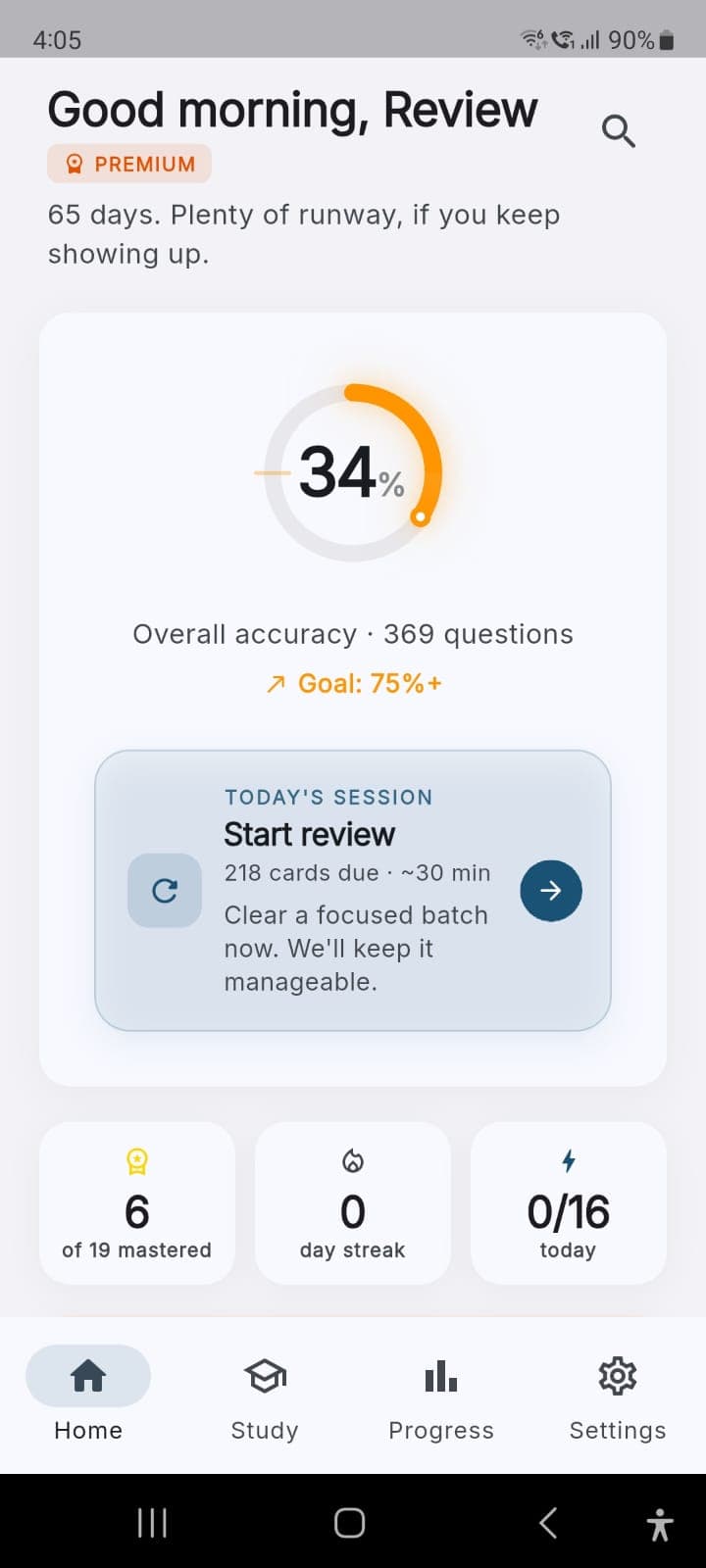
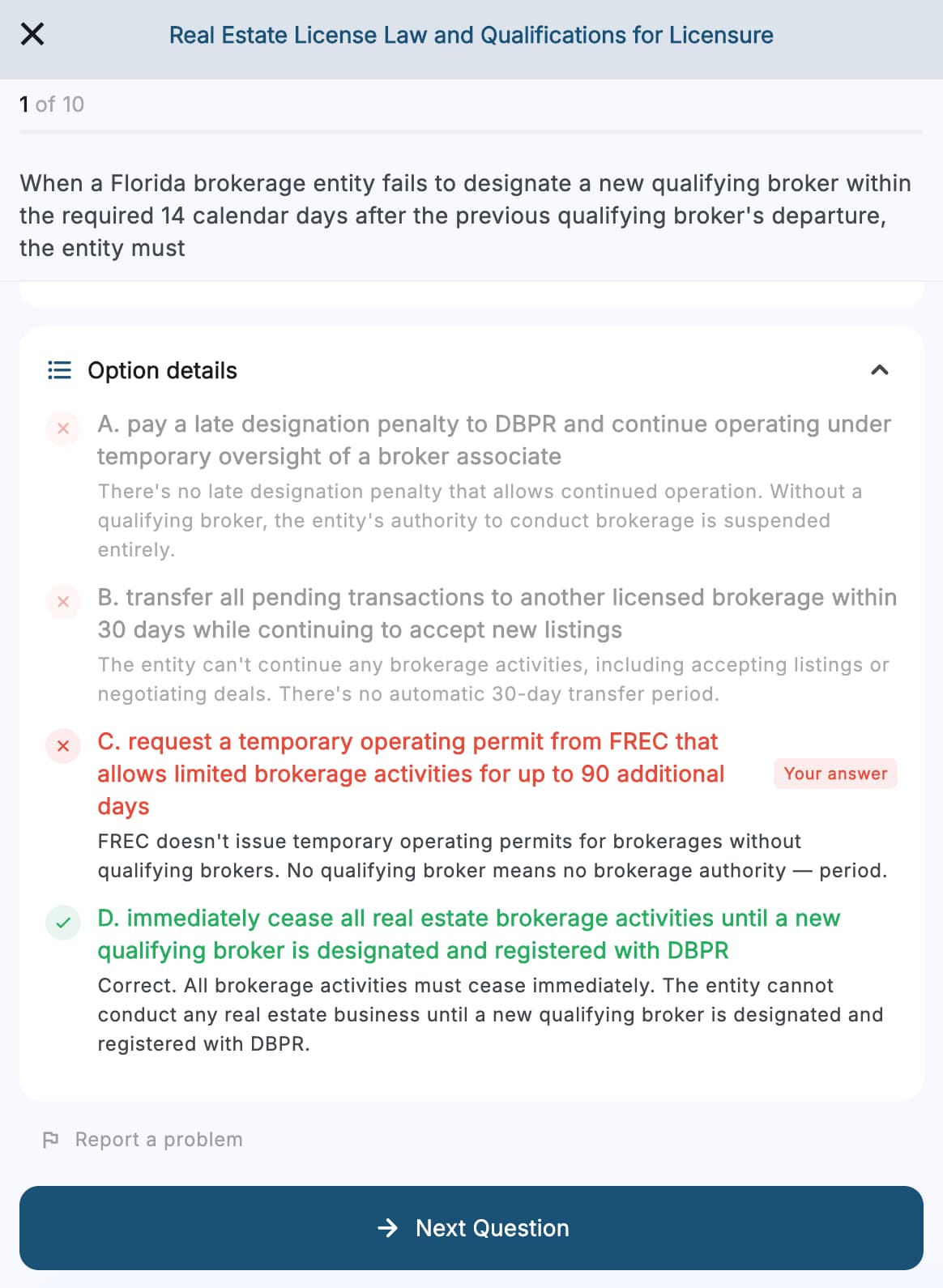
Flashcards can help you pass the Florida real estate exam, but only if they do the right job.
Bad flashcards ask, "What is a deed?" You flip the card, recognize the answer, and feel productive. Then the exam gives you a fact pattern about delivery, acceptance, recording, title transfer, or a special-purpose deed, and the card did not train the decision.
Good flashcards force retrieval. They make you answer the rule from memory, name the trap, and apply the Florida wording. The goal is not to collect 800 cards. The goal is to build a small deck that makes the most forgettable rules hard to miss.
If you just want cards to copy now, jump to the ready-to-use sample cards and the topic map. The rest of this guide explains how to build and review them so they actually stick.
QUICK ANSWER
The best Florida real estate exam flashcards are short, Florida-specific, and built around retrieval. Put one decision on the front, one plain-English rule on the back, and a short trap note when the topic is commonly confused. Use flashcards for definitions, deadlines, duties, formulas, and rule pairs. Do not rely on flashcards alone. The Florida exam is 100 multiple-choice questions across 19 content areas, so you still need mixed practice questions and timed review.
What this guide covers
- What flashcards are good for
- What flashcards are bad at
- The three-card system
- How to write a good Florida exam card
- Sample flashcards you can copy
- Topic map for your deck
- Math flashcards
- Trap cards
- How to review the deck
- Flashcards vs practice questions
- What not to put in the deck
- Frequently Asked Questions
What flashcards are good for
Flashcards are best for rules that must come back fast.
Use them for:
- Definitions that sound alike
- Florida-specific duties
- Deadline pairs
- Formula setup
- Disclosure triggers
- Math unit conversions
- Brokerage relationship duties
- Escrow timelines
- License-law numbers
- Appraisal approach selection
That matters because the Florida Department of Business and Professional Regulation (DBPR) sales associate outline is broad. The exam covers 19 content areas, including contracts, brokerage activities, mortgages, property rights, appraisal, relationships and disclosures, titles, computations, and license law. Flashcards help compress that spread into repeatable recall.
The strongest flashcard asks for retrieval, not recognition.
Weak front:
Transaction broker
Better front:
In Florida, what type of representation is presumed unless single agent or no brokerage relationship is established in writing?
Better back:
Transaction broker. It is limited representation, not fiduciary representation.
Trap: transaction broker is not dual agency. Florida does not allow dual agency.
That card makes you answer the rule, not merely recognize a word.
What flashcards are bad at
Flashcards are not enough for full exam readiness.
They are weak for:
- Long scenario judgment
- Multi-step math
- Reading stamina
- Timing under pressure
- Elimination between two tempting answers
- Spotting the controlling fact in a paragraph
The Florida real estate exam is not a vocabulary recital. It is multiple choice, closed book, and fact-pattern heavy. Flashcards can make rules available in memory. Practice questions teach you to use those rules when the exam hides them inside a story.
Use this split:
| Study need | Best tool |
|---|---|
| Remembering duties, dates, formulas, and pairs | Flashcards |
| Applying rules inside scenarios | Practice questions |
| Fixing repeated wrong-answer patterns | Wrong-answer log |
| Building speed and stamina | Timed mixed sets |
| Learning multi-step math | Worked examples plus practice |
The three-card system
Build three kinds of cards.
| Card type | Front asks | Back gives |
|---|---|---|
| Definition card | "What does this term mean?" | One plain definition |
| Decision card | "Which rule controls this fact pattern?" | Rule plus deciding clue |
| Trap card | "Which answer choice is tempting but wrong?" | Correct rule plus why the trap fails |
Most candidates overbuild definition cards and underbuild decision cards. That is backwards.
Use definition cards for pure terms:
- Fee simple
- Easement
- Novation
- Millage
- Cap rate
- Estoppel
Use decision cards for Florida exam choices:
- Transaction broker vs single agent
- Subject to vs assumption
- Cap rate vs GRM
- Sales comparison vs cost vs income approach
- Calendar days vs business days
- School taxes vs non-school taxes
Use trap cards for mistakes you personally make:
- You subtract mortgage payments from NOI.
- You confuse post-license with continuing education.
- You call transaction brokerage dual agency.
- You use gross income with a cap rate.
- You forget that the sales associate is paid through the broker.
How to write a good Florida exam card
Use this format.
Front
One specific question the exam could hide inside a fact pattern.
Back
Rule: One plain answer you can grade quickly.
Trap: One sentence explaining the wrong answer you are likely to choose.
Source: Course, statute, DBPR outline, or your wrong-answer log.
Keep the front short enough to answer in your head. Keep the back short enough to grade honestly.
Bad card:
FRONT
Explain all brokerage relationships in Florida.
That is not a flashcard. That is a chapter.
Better card:
Front
Florida licensee represents the seller as a fiduciary. Which brokerage relationship is this?
Back
Rule: Single agent.
Trap: Transaction broker is limited representation and not fiduciary representation.
Best card:
Front
What phrase should make you think "single agent" instead of transaction broker?
Back
Rule: Fiduciary duties such as loyalty, confidentiality, obedience, and full disclosure.
Trap: Transaction broker still has duties, but not fiduciary duties.
The best card trains the clue the exam uses.
Sample flashcards you can copy
Use these as models. Rewrite them in your own words before studying.
| Front | Back |
|---|---|
| What is the presumed brokerage relationship in Florida? | Transaction broker, unless single agent or no brokerage relationship is established in writing. Trap: transaction broker is not dual agency. |
| What makes single agency different from transaction brokerage? | Single agency is fiduciary. Transaction brokerage is limited representation and not fiduciary. |
| What must happen before a single agent changes to transaction broker? | The principal must give written consent before the change. |
| What are the three no brokerage relationship duties? | Deal honestly and fairly, disclose known material facts affecting residential value that are not readily observable, and account for funds. |
| Broker receives conflicting escrow demands. First deadline? | Notify the Florida Real Estate Commission (FREC) within 15 business days. Trap: business days, not calendar days. |
| After conflicting escrow demands, when must the broker institute a settlement procedure? | Within 30 business days after receiving conflicting demands, unless an exception applies. |
| Mediation must be completed by when before another escrow procedure is used? | Within 90 days after the last demand. |
| Sales associate pre-license course length? | 63 hours. |
| Sales associate first renewal education? | 45 hours of post-license education before the first renewal if prescribed. Trap: post-license is not the same as 14-hour continuing education. |
| Later renewal continuing education? | 14 hours each biennial license period. |
| What is the minimum passing score on the sales associate exam? | 75 points or higher. |
| How many questions and how much time? | 100 multiple-choice questions, 3.5 hours, or 210 minutes. |
| Deed documentary stamp rate? | $0.70 per $100 of consideration, rounded up to the next $100. Miami-Dade is the exception. |
| Note or mortgage documentary stamp rate? | $0.35 per $100, rounded up. Trap: do not apply the $0.70 deed rate to the note. |
| Intangible tax on a new mortgage? | 0.002 (2 mills) on the exact loan amount. Trap: no $100 rounding on intangible tax. |
| Miami-Dade deed stamp rate? | $0.60 per $100 for a single-family residence; $1.05 per $100 ($0.60 plus the $0.45 surtax) for anything else. |
| FREC quorum? | 4 of the 7 commission members. |
| One section equals how many acres? | 640 acres. A township is 6 miles square and holds 36 sections. |
| One acre equals how many square feet? | 43,560 square feet. |
| Broker experience requirement? | 24 months active within the preceding 5 years, plus the 72-hour broker course. |
Those are not enough for a full deck. They show the shape.
If the table feels too dense, turn the highest-value rows into actual cards like this:
Card example: brokerage relationship
Front
What is the presumed brokerage relationship in Florida?
Back
Rule: Transaction broker, unless single agent or no brokerage relationship is established in writing.
Trap: Transaction broker is limited representation. It is not dual agency.
Card example: escrow deadline
Front
A broker receives conflicting escrow demands. What is the first deadline?
Back
Rule: Notify FREC within 15 business days.
Trap: The 15-day notice deadline is business days, not calendar days.
Card example: math setup
Front
When a question gives sale price and commission rate, what do you solve first?
Back
Rule: Total commission = sale price x commission rate.
Trap: Broker split and associate share come after total commission.
Good cards usually have one of these words on the front:
- Which
- When
- What trigger
- What deadline
- What formula
- What trap
- What is the difference
Weak cards usually start with:
- Define
- Explain everything about
- List all
- Describe Chapter 475
Topic map for your deck
Do not make cards evenly across all topics. Build more cards where the exam has more weight and where you personally miss questions.
| Topic | Card examples to build |
|---|---|
| Brokerage activities | Escrow timelines, commission payment path, kickbacks, advertising, office rules |
| Contracts | Offer vs acceptance, counteroffer, novation, assignment, statute of frauds, option contracts |
| Mortgages | Note vs mortgage, mortgagor vs mortgagee, FHA vs VA, subject to vs assumption |
| Relationships and disclosures | Transaction broker, single agent, no brokerage, transition disclosure, material facts |
| Property rights | Freehold vs leasehold, joint tenancy vs tenancy in common, easement types, homestead |
| Titles and deeds | Deed requirements, delivery and acceptance, special-purpose deeds, liens |
| Appraisal | Sales comparison vs cost vs income, depreciation, NOI, GRM, cap rate |
| Math | Commission, prorations, documentary stamps, intangible tax, millage, acreage, IRV |
| License law | 63-hour course, post-license, continuing education, license status, violations |
| Federal and state laws | Fair housing, lead-based paint, radon, residential landlord-tenant security deposits |
Start with 80 to 120 strong cards. That is enough to build recall without turning review into a second textbook.
Then let your practice misses decide what gets added.
Math flashcards
Math flashcards should train setup, not just formulas.
Weak math card:
What is the commission formula?
Better:
Seller pays 6% commission on a $400,000 sale. What is total commission?
Back: $400,000 x 0.06 = $24,000.
Trap: do not split with the associate until the stem asks for associate share.
Best:
Front
When a question gives sale price and commission rate, what do you solve first?
Back
Rule: Total commission = sale price x rate.
Trap: Broker split and associate percent come after total commission.
Build cards for these setups:
| Setup | Card front |
|---|---|
| Commission | What do you calculate first before broker/associate split? |
| Documentary stamp on deed | What number do you round up to the next $100? |
| Documentary stamp on note | Which amount controls the tax: sale price or loan amount? |
| Intangible tax | What percentage is used for Florida nonrecurring intangible tax? |
| Proration | What daily rate method does the stem give: 365 or 360? |
| Millage | How do you convert mills to tax? |
| Cap rate | Does cap rate use gross income or NOI? |
| GRM | Does GRM use NOI or gross rent? |
| Acreage | How many square feet in one acre? |
| Government survey | How many acres in one section? |
For multi-step math, use practice questions after the card. A card can teach the setup. A question teaches the execution.
Trap cards
Trap cards are the highest-value cards in your deck because they are built from your own mistakes.
Use this structure:
Front
Tempting wrong answer: "A transaction broker is a dual agent." Why is this wrong?
Back
Rule: Florida does not allow disclosed or nondisclosed dual agency.
Why the trap fails: Transaction broker is limited representation, not fiduciary representation for both sides.
Make a trap card every time you miss for one of these reasons:
| Miss type | Card to create |
|---|---|
| You knew the definition but chose wrong | "What fact changes the answer?" card |
| You mixed two deadlines | "15 business days vs 30 business days" card |
| You used the wrong formula | "Which income number belongs here?" card |
| You missed a Florida-specific rule | "What is the Florida version?" card |
| You changed a right answer | "Why was the first answer right?" card |
Trap cards should feel a little uncomfortable. That is the point. They are your personal warning labels.
How to review the deck
Use flashcards as retrieval practice.
That means:
- Read the front.
- Answer out loud or write a short answer.
- Flip the card.
- Grade yourself honestly.
- If you missed it, say why before moving on.
Do not simply read the front and back. That feels easier because recognition is easier than recall. Space your reviews across the day rather than one block; the daily practice routine explains how spaced repetition makes both cards and questions stick.
A simple 14-day flashcard plan
| Day | What to do |
|---|---|
| 1 | Build 60 to 80 cards from your weakest topics |
| 2 | Review all cards, mark misses |
| 3 | Review missed cards plus 20 mixed old cards |
| 4 | Add cards from wrong-answer log |
| 5 | Review all deadline and formula cards |
| 6 | Take a mixed practice set, then make trap cards |
| 7 | Review only missed and trap cards |
| 8 | Review all cards quickly |
| 9 | Timed mixed set, then add cards only for repeated misses |
| 10 | Review math setup cards |
| 11 | Review relationship, escrow, and disclosure cards |
| 12 | Timed mixed set |
| 13 | Review the smallest high-yield deck only |
| 14 | Light review, no cramming marathon |
The deck should get smaller near test day, not bigger. Your final deck should be the rules you still forget, not every card you ever made.
Flashcards vs practice questions
Flashcards and practice questions do different jobs.
| Tool | Best use | Weakness |
|---|---|---|
| Flashcards | Recall rules fast | Weak for full scenarios |
| Practice questions | Apply rules in context | Can become guessing without review |
| Timed tests | Build pace and endurance | Weak for learning if you skip review |
| Wrong-answer log | Finds patterns | Requires honesty |
Use this sequence:
- Learn the rule.
- Make a flashcard.
- Drill the card until recall is fast.
- Answer practice questions.
- Turn misses into trap cards.
- Return to mixed practice.
That loop keeps flashcards from becoming busywork.
TURN CARDS INTO EXAM DECISIONS
Recall is useful only if it survives a fact pattern.
Start with the diagnostic, practice the weakest Florida topics, and use timed mixed sets to prove the improvement before test day.
What not to put in the deck
Leave these out:
- Long statutory quotes
- Entire disclosure forms
- Whole textbook paragraphs
- Vendor marketing claims
- Unverified pass-rate claims
- Copied state exam questions
- Cards that ask five things at once
- Cards you already know cold
Do not chase "real exam question" decks. The useful goal is not memorizing leaked wording. The useful goal is recognizing the lawful rule, the Florida-specific phrase, and the trap answer.
Frequently Asked Questions
Are flashcards good for the Florida real estate exam?
Yes, if they are used for retrieval. Flashcards are good for duties, deadlines, formulas, definitions, and rule pairs. They are not enough by themselves because the Florida exam also tests scenario judgment and math setup.
Should I use paper cards, Quizlet, Anki, or an app?
Use whichever tool you will actually review. Paper is simple and distraction-free. Quizlet-style decks are easy to search. Anki-style spaced repetition can be useful if you maintain it. A dedicated Florida practice app helps when you need scenarios, explanations, math setup, and timed work. The format matters less than whether the card forces recall and whether the content is Florida-specific.
Two cautions if you lean on Quizlet specifically. Its adaptive Learn and Test modes are now limited for free users who are not in a teacher-managed class, with full access tied to a paid subscription, so the spaced-repetition feature people want is partly behind the paywall. And Florida decks made by other students are unvetted user content with no guarantee they match current Florida rules, so verify any card against a primary source before you trust it. For a fuller breakdown, see Quizlet for the Florida real estate exam.
How many flashcards do I need?
Most candidates do better with 80 to 150 strong cards than with 600 weak cards. Start with your weak topics, then add cards only from repeated practice misses.
Should every flashcard be Florida-specific?
Not every card. Some concepts are national, like fee simple, easements, or cap rate. But your deck should clearly mark Florida-specific rules, such as brokerage relationships, escrow timing, license education numbers, and disclosure requirements.
Can flashcards replace practice questions?
No. Flashcards help recall. Practice questions train application. The Florida sales associate exam gives multiple-choice fact patterns, so you need both.
What is the best flashcard format?
One front, one answer, one trap. If the card needs three paragraphs on the back, split it into smaller cards.
Should I make cards from missed questions?
Yes. Those are the best cards. Do not copy the full question. Write the underlying rule and the reason you missed it.
Ready to test the rules you put on cards?
Flashcards build recall. Practice questions prove whether recall works under exam pressure. Once a rule feels easy on a card, test it in mixed Florida-style questions before you trust it on exam day.
Use the next practice set to prove what improved, not to repeat questions you already remember.
If you would rather start from cards someone else already built, print the 50 most-missed Florida terms recall cards from the free study PDF library.
Try a free Florida question | Run the readiness calculator | Download Pass Florida
Methodology
Florida-specific example cards draw on current 2025 Florida statutes and rules where applicable, including brokerage relationships, education requirements, renewal education, residential security deposits, and escrow notice timing.
The study-method guidance is based on the learning-science distinction between passive review and retrieval practice. Practice testing and distributed practice are consistently treated as stronger study methods than passive rereading in cognitive psychology research. This post applies that idea to Florida exam prep without claiming that flashcards alone are enough to pass.
Product note. Pass Florida is our Florida-specific exam prep app. This page references our own product, so the relationship is direct and disclosed. We do not claim to use copied exam questions, guarantee passage, or provide legal, tax, lending, brokerage, or testing-policy advice.
This post is exam preparation content for the Florida Real Estate Sales Associate exam. It is not legal, tax, lending, appraisal, brokerage, title, closing, or professional advice. For current official testing rules, use the DBPR Candidate Information Booklet and Pearson VUE instructions.
Sources
- DBPR Real Estate Sales Associate Candidate Information Booklet
- F.S. 475.17, qualifications and education
- F.S. 475.182, renewal and continuing education
- F.S. 475.278, brokerage relationships
- F.A.C. Rule 61J2-10.032, escrow notice requirements
- F.S. 475.25, escrow disputes and the 90-day mediation deadline
- F.S. 83.49, residential security deposits
- Dunlosky et al., Improving Students' Learning With Effective Learning Techniques
- Karpicke and Roediger, The Critical Importance of Retrieval for Learning