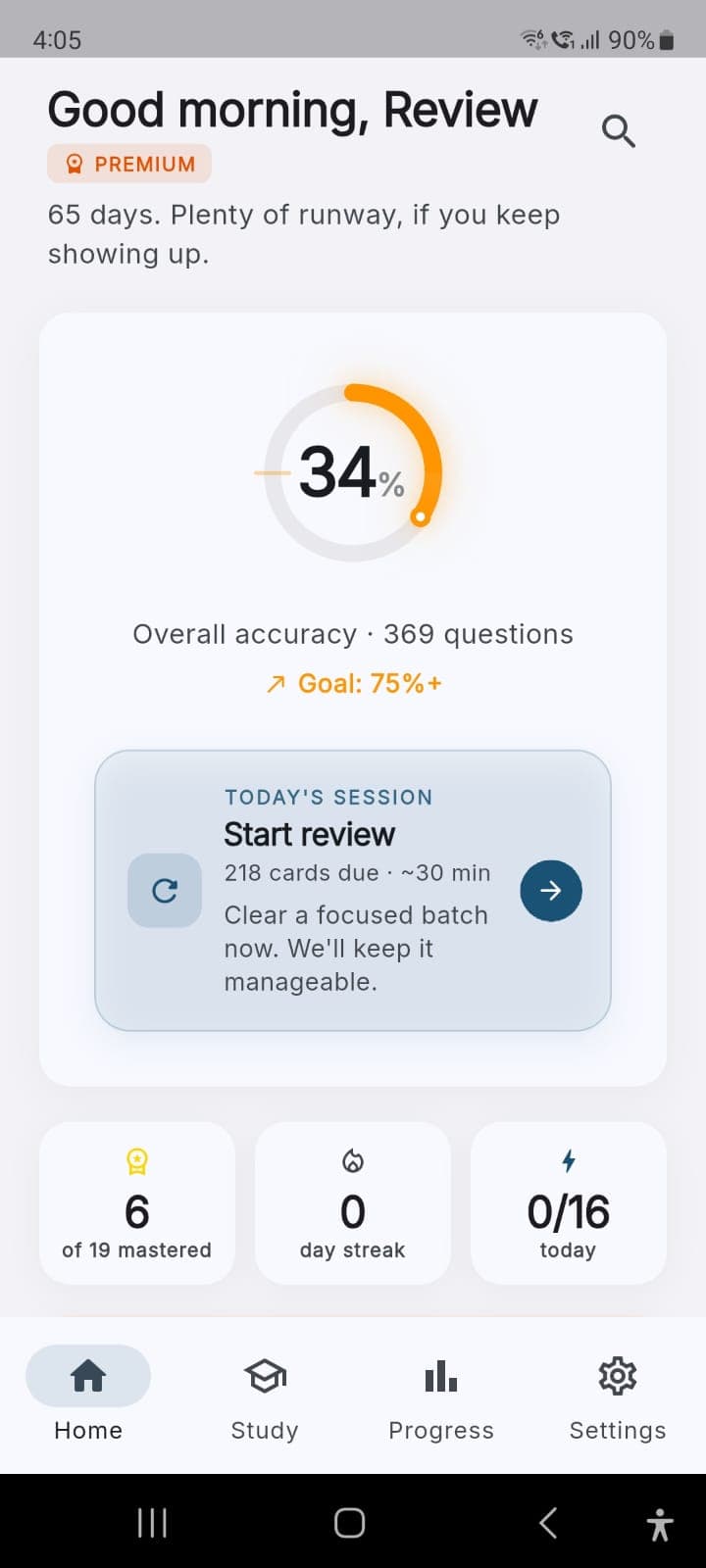
Wrong answers are not the problem. Unreviewed wrong answers are.
Most candidates miss questions, glance at the correct answer, think "that makes sense," and move on. That feels like review, but it is usually just recognition. The rule feels familiar once someone shows it to you.
The Florida real estate exam does not reward that feeling. It rewards being able to recognize the rule later, inside a new fact pattern, under time pressure.
That is why your wrong-answer review system matters.
QUICK ANSWER
The best way to review wrong answers for the Florida real estate exam is to diagnose the cause, audit all four choices, write the controlling rule in one sentence, and retest it with a fresh mixed set. Do not memorize the correct letter. Explain why the correct choice fits, why each distractor fails, and what fact would make a tempting choice correct.
What this guide covers
- Why wrong-answer review matters
- The five-step wrong-answer review loop
- The miss log template
- The 7 miss types
- How to review Florida-specific misses
- How to review math misses
- How to review wording traps
- What to do after an official exam fail
- When to stop reviewing and retest
- FAQ
Why wrong-answer review matters
The Department of Business and Professional Regulation (DBPR) candidate information booklet says the Florida sales associate exam has 100 multiple-choice questions, three and a half hours, and 19 content areas. That means the exam is broad enough that you cannot fix everything by rereading the whole course every time your score drops.
Wrong-answer review lets you study narrower.
Instead of saying:
I am bad at contracts.
You can say:
I keep missing contract questions when the stem changes an offer into a counteroffer.
That second version is useful. It tells you what to repair.
The best wrong-answer review does three things:
| Review task | What it prevents |
|---|---|
| Names the miss type | Random restudying |
| Rewrites the rule | Passive recognition |
| Retests in mixed practice | False confidence from topic-only drills |
If your score is stuck, your problem may not be effort. It may be that your review process is too vague.
The five-step wrong-answer review loop
Use this loop after every serious practice set.
Step 1: Do not read the explanation first
Before you read the explanation, ask:
- What did I think the question was testing?
- Which fact did I use to choose my answer?
- Which answer choice tempted me?
- Was I guessing, confident, or rushing?
This matters because the explanation tells you the correct rule. It does not tell you why your brain picked the wrong answer.
That part is your job.
Step 2: Tag the miss
Every wrong answer should get one tag.
Use one of these:
| Tag | Meaning |
|---|---|
| Definition | I did not know the term |
| Controlling fact | I missed the fact that changed the answer |
| Florida rule | I knew a general rule but missed the Florida version |
| Similar terms | I confused two close concepts |
| Math setup | I chose the wrong formula or base number |
| Wording trap | I missed words like except, first, best, must, or not |
| Confidence error | I was confidently wrong or changed away from the right answer |
One tag is enough. If you add five tags to every miss, the log becomes noise.
Step 3: Rewrite the rule in one sentence
Do not copy the full explanation.
Write one sentence you would understand tomorrow:
| Weak review | Better review |
|---|---|
| "Escrow rules." | "If a broker receives conflicting escrow demands, the Florida Real Estate Commission (FREC) must be notified within 15 business days." |
| "I forgot agency." | "Single agent is fiduciary; transaction broker is limited representation." |
| "Math mistake." | "Commission starts with sale price x rate before any broker/associate split." |
If you cannot write the rule in one sentence, you probably do not understand the miss yet.
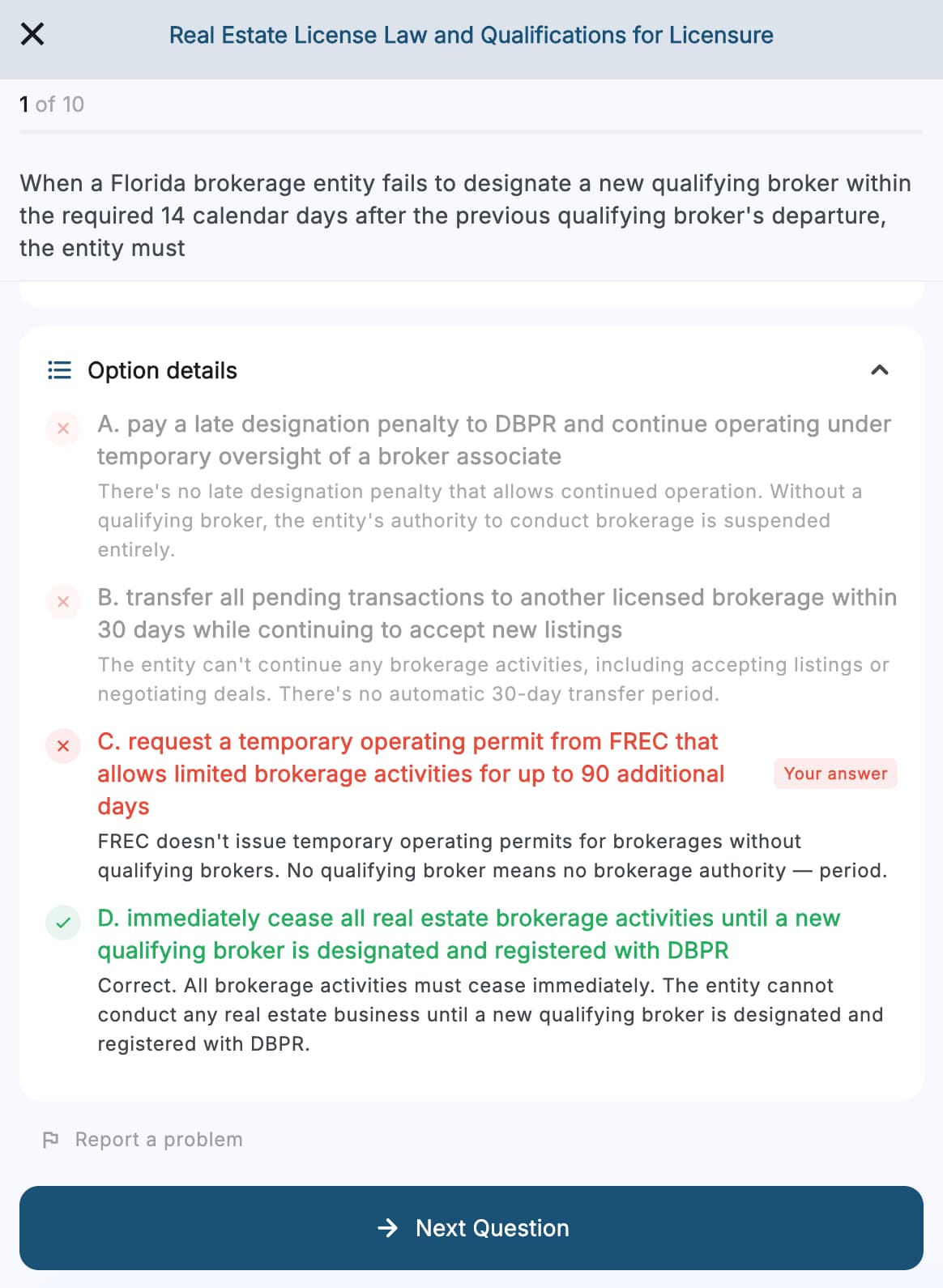
Step 4: Audit all four choices and name the trap
Reviewing only the correct choice leaves the distractors ready to fool you again. For all four choices, write one short line:
| Choice | Question to answer |
|---|---|
| Correct choice | Which rule and fact make it correct? |
| Wrong choice 1 | Which word, condition, or legal consequence makes it wrong? |
| Wrong choice 2 | What fact would need to change for this choice to become correct? |
| Wrong choice 3 | Is this from another topic, an incomplete rule, or a reversed sequence? |
Then circle the trap: the wrong answer that looked most reasonable to you.
Write it plainly:
| Correct rule | Trap to name |
|---|---|
| Transaction broker is limited representation | Calling it dual agency |
| Cap rate uses NOI | Using gross income |
| Documentary stamps on notes use loan amount | Using sale price |
| Counteroffer rejects original offer | Treating the original offer as still open |
The trap matters because it exposes the false rule or reading habit you are most likely to repeat.
Step 5: Retest mixed
After review, do not immediately take another quiz on the same topic and celebrate a higher score.
That can prove short-term memory, not exam readiness.
Use this sequence:
- Review the missed rule.
- Answer 5 to 10 focused questions if the topic is weak.
- Add a flashcard or trap card if needed.
- Take 25 mixed questions.
- Check whether the same miss returns without the topic label.
The real repair is complete only when the miss does not return in mixed practice.
First decide whether the problem is knowledge or execution
This split prevents you from using the wrong repair.
| Error family | Typical signs | Best repair |
|---|---|---|
| Rule or concept gap | You could not state the rule, confused two terms, or used a national rule instead of Florida's rule | Relearn the rule, make a contrast card, then answer fresh scenarios |
| Wording or process mistake | You knew the rule but missed EXCEPT, used the wrong fact, rushed the setup, or changed a sound answer without evidence | Mark the trigger word, rehearse the decision step, then retest under time |
A wording mistake does not need another chapter of reading. A rule gap does not disappear because you promise to slow down.
The miss log template
You do not need a complicated spreadsheet.
Use this format:
| Field | What to write |
|---|---|
| Topic | Escrow, agency, mortgages, contracts, math, appraisal |
| Miss type | Definition, fact, Florida rule, similar terms, math, wording, confidence |
| My wrong answer | The answer you picked or the idea behind it |
| Correct rule | One plain sentence |
| Trap | Why the wrong answer sounded right |
| Repair action | Flashcard, focused drill, formula setup, mixed retest |
| Retest result | Fixed, repeated, or still unclear |
Here is an example:
| Field | Example |
|---|---|
| Topic | Brokerage relationships |
| Miss type | Similar terms |
| My wrong answer | I treated transaction broker as dual agency |
| Correct rule | Florida does not allow dual agency; transaction broker is limited representation |
| Trap | The licensee can work with both sides, so "dual" sounded familiar |
| Repair action | Build a transaction broker vs single agent contrast card |
| Retest result | Retest in 25 mixed questions tomorrow |
That is enough.
The log should be short enough that you will actually use it.
The 7 miss types
1. Definition miss
A definition miss means you did not know the word well enough.
Examples:
- Novation
- Estoppel
- Easement appurtenant
- Tenancy at sufferance
- Subordination
- Hypothecation
Repair:
Make a short flashcard. Then answer a question that uses the term in context.
Do not stop at the definition.
2. Controlling-fact miss
A controlling-fact miss means you knew the topic but missed the fact that changed the answer.
This is common on Florida exam questions.
Examples:
- The stem says business days, but you answered calendar days.
- The stem says buyer assumes the mortgage, but you answered subject to.
- The stem asks for seller net, but you calculated gross commission.
- The stem says no brokerage relationship, but you used transaction broker duties.
Repair:
Underline the fact that changed the answer. Then rewrite the rule as:
When the stem says ______, the answer changes because ______.
3. Florida-rule miss
A Florida-rule miss means you knew a general concept but missed the Florida layer.
Examples:
- Brokerage relationships
- Escrow notice timing
- Education hours
- FREC and DBPR roles
- Florida documentary stamp tax
- Homestead and property tax concepts
Repair:
Write "Florida version" in your log and make a card that starts with:
In Florida, what is the rule for...
Generic real estate memory is not enough here.
4. Similar-terms miss
Similar-terms misses happen when two answers sound close.
Common pairs:
| Pair | What to compare |
|---|---|
| Void vs voidable | Whether the contract ever had legal effect |
| Assignment vs novation | Whether original liability remains |
| Subject to vs assumption | Whether buyer becomes personally liable |
| Cap rate vs GRM | NOI vs gross rent |
| Appraisal vs CMA vs BPO | Purpose and who performs it |
| Single agent vs transaction broker | Fiduciary vs limited representation |
Repair:
Make a contrast card, not two separate definition cards.
Example:
FRONT
Subject to vs assumption: which one makes buyer personally liable?

BACK
Assumption. Subject to leaves the original borrower liable unless released.
5. Math setup miss
Math misses usually come from setup, not arithmetic.
Before you calculate, ask:
| Question | Why it matters |
|---|---|
| What is the base number? | Sale price, loan amount, assessed value, or NOI |
| What unit is being used? | Percent, mills, dollars per $100, acres, square feet |
| What is the question asking for? | Total amount, one party's share, net, or rate |
| Does anything round first? | Documentary stamps and some unit-based questions |
Repair:
Write the formula trigger, not just the final number.
Weak review:
I got commission wrong.
Better review:
Commission starts with total sale price x commission rate. Splits come after total commission.
6. Wording-trap miss
Wording traps are not unfair. They are reading traps.
Watch for:
- Except
- Not
- Best
- First
- Most likely
- Must
- May
- All of the following
Repair:
Translate the question before answering.
Example:
| Stem wording | Rewrite |
|---|---|
| "All are true except..." | "Find the false statement." |
| "What should the broker do first?" | "Choose the first required step, not the final outcome." |
| "Best answer" | "More than one may be partly true. Pick the most complete one." |
7. Confidence error
A confidence error means your certainty is not calibrated.
There are two versions:
| Error | What it means |
|---|---|
| High confidence, wrong | You have a false rule |
| Changed right to wrong | You may be overthinking |
High-confidence wrong answers are urgent. They are the misses most likely to repeat.
Repair:
Write the false rule you believed, then write the correct rule under it.
Example:
False rule: Transaction broker means dual agent.
Correct rule: Florida does not allow dual agency. Transaction broker is limited representation.
How to review Florida-specific misses
Florida-specific misses deserve their own treatment because they often come from using a national real estate rule too broadly.
Use this review format:
| Prompt | Example |
|---|---|
| What was the national idea? | Agency relationship |
| What was the Florida version? | Transaction broker is presumed unless single agent or no brokerage relationship is established in writing |
| What fact in the stem mattered? | The licensee was not acting as a fiduciary |
| What trap answer sounded right? | Dual agent |
| What card should I make? | "What is the presumed brokerage relationship in Florida?" |
Good Florida-specific wrong-answer review often starts with these words:
- In Florida...
- Under Chapter 475...
- Under FREC rules...
- For a Florida sales associate...
- On the Florida exam...
That phrase forces your brain to look for the state-specific layer.
Florida topics that deserve extra wrong-answer attention
Do not review every topic with equal weight.
Spend more time on areas that are high-value, Florida-specific, or commonly confused:
| Topic | Common wrong-answer pattern |
|---|---|
| Brokerage relationships | Confusing transaction broker, single agent, and no brokerage relationship |
| Escrow | Missing business-day deadlines or settlement sequence |
| License law | Confusing DBPR, FREC, broker, and sales associate roles |
| Contracts | Missing counteroffer, assignment, novation, option, or cancellation facts |
| Mortgages | Confusing note, mortgage, lien theory, subject to, and assumption |
| Math | Choosing the wrong base number before calculating |
| Appraisal | Mixing sales comparison, cost, income, GRM, and cap rate |
If one of these repeats in your log, repair it before taking another full practice exam.
How to review math misses
Do not review math by staring at the correct answer.
Review the setup.
Use this worksheet:
| Step | Question |
|---|---|
| 1 | What is the question asking me to find? |
| 2 | What is the base number? |
| 3 | What formula or unit applies? |
| 4 | What should be rounded first, if anything? |
| 5 | What answer would be too high or too low? |
Example:
Miss: Used sale price instead of loan amount for note documentary stamps.
Correct setup: Note stamp tax uses the note or loan amount, not the sale price.
Trap: Deed stamps use consideration, so I grabbed the wrong base.
Repair: Make a deed stamp vs note stamp contrast card.
The key question is:
Did I miss because of arithmetic, or because I chose the wrong setup?
Most candidates need more setup practice than calculator practice.
How to review wording traps
For wording misses, do not write "read more carefully" in your log.
That does not fix anything.
Write the exact word that changed the task.
| Miss | Useful review note |
|---|---|
| Missed an EXCEPT question | "I was supposed to find the false statement." |
| Missed a FIRST question | "I chose the final solution instead of the first required step." |
| Missed a BEST question | "Two answers were partly true; one was more complete." |
| Missed a MUST/MAY question | "I treated permission as a requirement." |
Then make yourself slow down only on that type of question.
You do not need to read every easy question at half speed. You need to recognize the question types that have been costing points.
What to do after an official exam fail
If you failed the official Florida sales associate exam, separate two different review tasks.
1. Review the official score report and rules
The DBPR candidate information booklet says candidates receive an official exam result report immediately after completion. It also says candidates who fail are entitled to review only their most recent exam and only the questions they answered incorrectly, under DBPR-prescribed terms.
The same booklet says the review request must be made within 21 days from the exam date, and that review sessions are held at Pearson VUE testing centers. It also says there is no talking or note taking during the review session.
Pearson VUE's Florida Real Estate page adds that candidates who want to schedule a retake within 21 days of an exam review must contact customer service for an override. Confirm the current policy directly before scheduling.
2. Review your practice misses at home
The official review session is not a normal study session.
You should not rely on it as your main wrong-answer log. Build your own log from practice questions, score reports, and topic diagnostics so you can actually write, tag, and retest.
After a fail, your home review should answer:
- Which content areas were weakest?
- Which miss type repeated most?
- Did math misses come from setup or calculation?
- Did wording traps cost easy points?
- Was the score close enough for narrow repair, or low enough for foundation work?
Do not retake just because the next appointment is available.
Retake when the miss pattern has changed.
When to stop reviewing and retest
Wrong-answer review can become procrastination if you never return to practice.
Use this rule:
| Situation | Next move |
|---|---|
| Same miss appears 3 times | Stop mixed practice and repair that rule |
| Miss appears once and makes sense after review | Add a note, then keep going |
| You miss because of wording | Drill that question type |
| You miss because of math setup | Practice formula recognition |
| You reviewed 10 to 15 misses | Take a 25-question mixed retest |
| Mixed retest improves | Move to the next pattern |
| Mixed retest repeats the same miss | Repair again, narrower |
Your wrong-answer log should get shorter over time.
If it keeps growing without changing your score, you are collecting mistakes instead of repairing them.
A 30-minute wrong-answer review session
Use this when you do not have much time.
| Minute | Task |
|---|---|
| 0 to 5 | Pick the 5 most recent missed questions |
| 5 to 12 | Tag each miss by cause |
| 12 to 18 | Write one rule sentence for each miss |
| 18 to 22 | Audit all four choices and name the trap |
| 22 to 30 | Make one flashcard or take 10 focused questions |
That is enough to move a pattern.
The mistake is waiting until you have two hours and then rereading everything.
What not to do
Avoid these habits:
- Do not copy the full question into your notes.
- Do not memorize leaked or copied exam questions.
- Do not write "careless mistake" for every miss.
- Do not retake a full practice exam before reviewing the last one.
- Do not spend equal time on every wrong answer.
- Do not ignore high-confidence wrong answers.
- Do not rebuild your entire study plan after one bad quiz.
The goal is not a perfect notebook.
The goal is fewer repeated mistakes.
TURN MISSES INTO POINTS
A wrong answer is useful only after you tag the pattern.
Start with the diagnostic, practice the weakest Florida topics, and use timed mixed sets to prove the improvement before test day.
Frequently Asked Questions
Should I review every wrong answer?
Review every wrong answer briefly, but do not spend equal time on all of them. A one-time definition miss may need a quick flashcard. A repeated high-confidence miss deserves deeper repair.
What should I write in my wrong-answer log?
Write the topic, miss type, wrong answer, correct rule, trap, repair action, and retest result. Keep it short enough to use consistently.
Should I copy the full practice question into my notes?
Usually no. Copy the rule behind the question instead. If you copy full questions, you may train memory of that exact wording instead of the rule.
What if I keep missing the same topic?
Stop taking full practice exams for a moment. Rebuild that rule with a short lesson, flashcard, focused questions, and then a mixed retest.
How do I review math wrong answers?
Identify the setup mistake first. Ask what the question wanted, what base number controlled, what formula applied, and whether anything had to be rounded before calculating.
Can I review the official Florida exam questions I missed?
The DBPR candidate information booklet says failing candidates may review only their most recent exam and only incorrectly answered questions, under DBPR-prescribed terms. It also states the request must be made within 21 days and that review sessions have security restrictions, including no note taking. Confirm the current process with DBPR and Pearson VUE.
Should I retake right away after failing?
Only if your review shows a narrow, repaired miss pattern and scheduling rules allow it. If the same miss patterns are still active, another attempt may repeat the same result.
Ready to turn misses into points?
A wrong-answer log only helps if you retest the rule in mixed practice. That is where most candidates skip the step that actually changes the score.
Use the next practice set to prove what improved, not to repeat questions you already remember.
Try a free Florida question | Run the readiness calculator | Download Pass Florida
Methodology
This guide is written for Florida sales associate exam candidates who are using practice questions, diagnostics, score reports, or post-fail review to decide what to study next.
The study method uses retrieval practice, error tagging, four-choice analysis, and mixed retesting. It is designed for exam preparation and does not reproduce official exam questions.
Product note. Pass Florida is our Florida-specific exam prep app. This page references our own product, so the relationship is direct and disclosed. We do not claim to use copied exam questions, guarantee passage, or replace official DBPR, FREC, Pearson VUE, course-provider, or professional guidance.
Verified August 20, 2026. For current testing rules, review sessions, score reports, and licensing requirements, use DBPR and Pearson VUE.