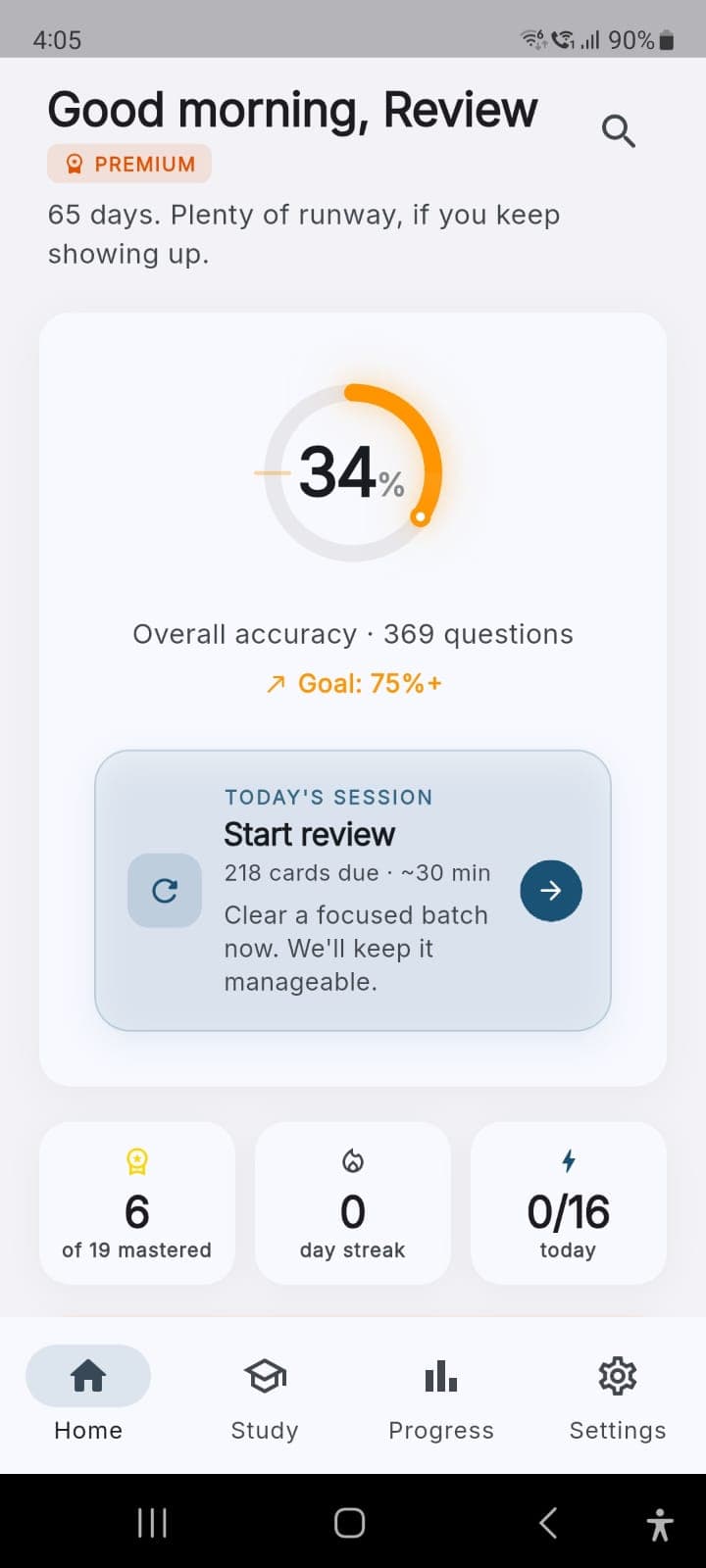
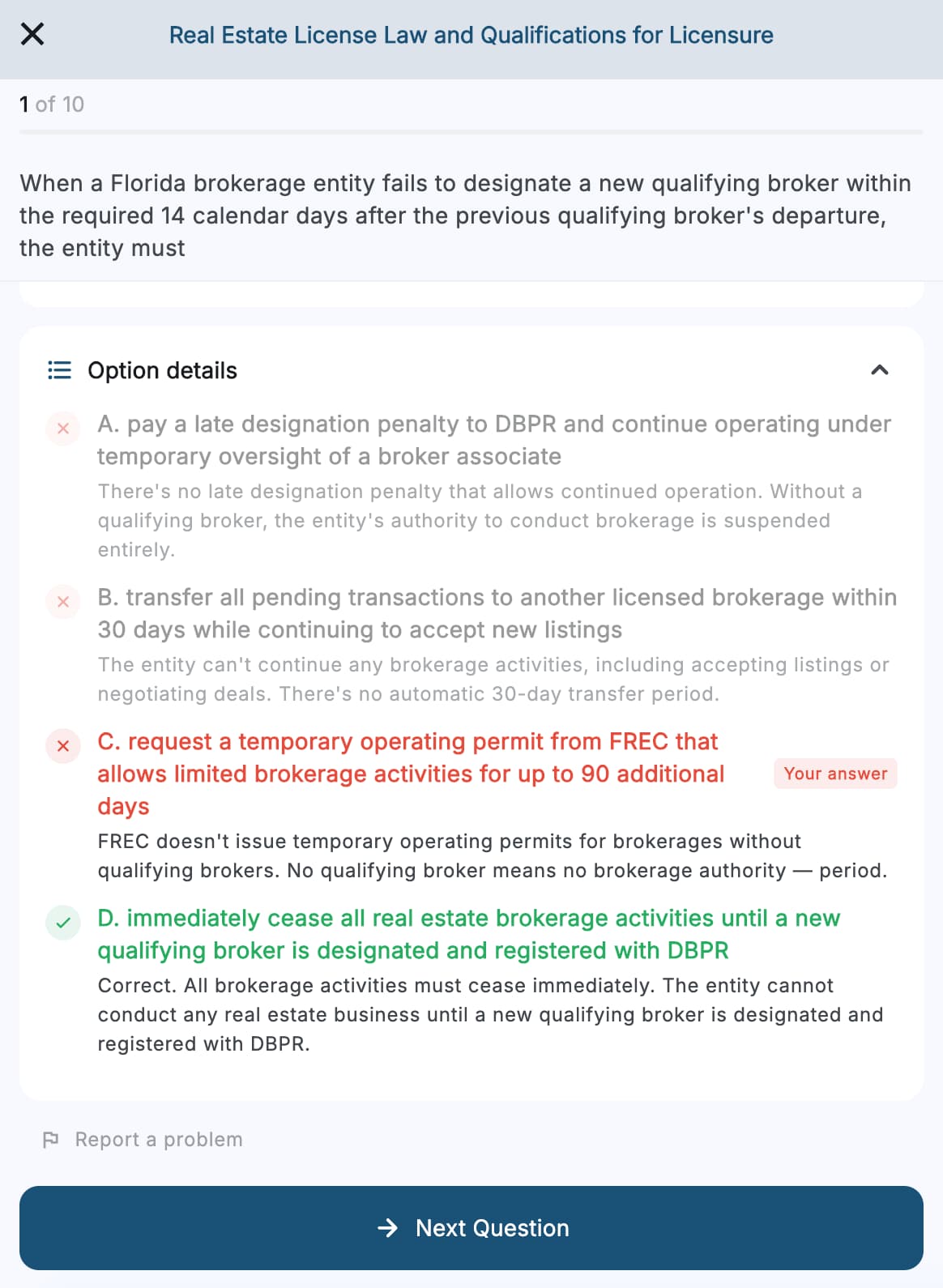
QUICK ANSWER
The best Florida real estate exam 14 day study plan is not a tiny version of the 63-hour course. It is a compression plan. Day 1 diagnoses the score. Days 2 to 10 attack high-weight Department of Business and Professional Regulation (DBPR) topics and math. Day 11 is a full timed exam. Day 12 repairs only what the exam exposed. Day 13 is a second full timed exam and go-or-move decision. Day 14 is light review and Pearson VUE logistics. If your first mixed diagnostic is below 60%, add time unless your score moves fast in the first four days.
If two weeks feels too compressed, use the 21-day Florida real estate exam study plan for a full week of additional repair and mixed practice. If only two days remain, go straight to the 48-hour score-protection plan. The study-plan hub compares every timeline, while the Florida real estate exam Study Guide provides the rule review assigned to each day.
What this guide covers
- The Two-Week Compression Rule
- Who this plan is for
- The 60/75/80 Gate
- The Weight-First Order
- The 14-day plan at a glance
- Day 1: Build the score map
- Days 2 to 6: High-weight recognition
- Days 7 and 8: Math repair
- Day 9: Appraisal and legal descriptions
- Day 10: The lower-weight sweep
- Day 11: Full timed practice exam 1
- Day 12: Repair only
- Day 13: Full timed practice exam 2
- Day 14: Light review and logistics
- The Go-Or-Move Decision
- What to do if you fall behind
- What to skip in a 14-day plan
- What to pair with this plan
- FAQ
The Two-Week Compression Rule
The Two-Week Compression Rule says 14 days works only when you are compressing course knowledge into exam recognition, not learning the 63-hour course from scratch.
A two-week study plan only works if the course material is already in your head somewhere.
That is the rule.
If you are still learning what a transaction broker is, what documentary stamps are, or why millage uses 1,000, fourteen days is not a study plan. It is a panic calendar.
But if you finished the 63-hour course, passed the course final, and now need to turn scattered knowledge into test-day recognition, two weeks can be enough.
The trick is compression.
Compression means every study session has to produce one of four outputs:
| Output | What it means |
|---|---|
| Score movement | Your weak topic score rises after drilling |
| Trap recognition | You can name why the wrong answer fooled you |
| Math setup | You choose the right formula before touching the calculator |
| Timed stability | Your score survives a full 100-question practice exam |
Re-reading chapters does not count unless it leads to one of those outputs.
The Florida sales associate exam is a 100-question, closed-book, computer-based exam with a 3.5-hour time limit and a passing score of 75. The DBPR candidate booklet organizes the exam into 19 content areas. Pearson VUE administers the exam for DBPR.
That is the public structure. Your job over 14 days is to make that structure usable under pressure.
Who this plan is for
Use this plan if you finished the 63-hour course, know the major vocabulary, and need a score-focused review window before Pearson VUE.
Use this plan if your situation is close to one of these cards.
You finished the course, know the major vocabulary, score around 75% or higher on mixed practice, and can study most days.
You are in the 60s or low 70s. Use the plan, but treat Day 4, Day 11, and Day 13 as evidence checks.
If the course is unfinished, your diagnostic is below 60%, or math is mostly guessing, add time before Pearson VUE.
Do not use a calendar to overrule the score.
The score is the signal.
The 60/75/80 Gate
Below 60% diagnostic is risky, 75 is the official passing score, and 80% is the Pass Florida practice-readiness target for a two-week window.
Pass Florida uses a simple planning gate for short study windows.
| Number | What it means | How to use it |
|---|---|---|
| 60 | Minimum diagnostic signal | Below this, two weeks is usually too short |
| 75 | Official passing score | This is the floor, not the practice target |
| 80 | Practical readiness target | Aim for this on two full timed practice exams |
The 75 score matters because it is the state threshold. The 80 target matters because practice conditions are kinder than Pearson VUE conditions.
At home, you can pause. You can drink coffee when you want. You can read a question in a familiar chair.
At the test center, the clock is louder.
That is why the 14-day plan does not end when you hit 75 once. It ends when your score is stable enough to trust.
The 80% target is a Pass Florida readiness framework, not a DBPR rule. DBPR sets the passing score at 75. We use 80% as a practical cushion because practice conditions are usually easier than test-center conditions.
DAY 1 DIAGNOSTIC
Measure before you commit to two weeks.
Start with a free Florida question, then use the readiness calculator to decide whether the 14-day plan is realistic before you lock in Pearson VUE.
Try a Florida question Check readiness Download Pass Florida
The Weight-First Order
In a 14-day plan, start with the highest-weight DBPR content areas and your weakest topics instead of studying every chapter evenly.
The textbook order is not the exam order.
The DBPR outline lists Real Estate Brokerage Activities and Procedures at 12% and Real Estate Contracts at 12%. Residential Mortgages is 9%. Property Rights and Real Estate Appraisal are 8% each. Titles, Deeds, and Ownership Restrictions is 7%. Those six areas alone account for roughly 56% of the exam outline.
That does not mean you ignore the rest. It means you do not spend Day 2 polishing a low-weight topic because it feels comfortable.
Use this priority stack:
| Priority | Topics | Why they come first |
|---|---|---|
| 1 | Brokerage activities, contracts, mortgages | Highest score movement potential |
| 2 | Property rights, appraisal, titles and deeds | Heavy topics with scenario traps |
| 3 | Authorized relationships, license law, FREC, DBPR | Florida-specific and easy to confuse |
| 4 | Math | Repeatable points if setup is clean |
| 5 | Legal descriptions, federal law, taxes, planning | Smaller buckets that still matter |
The exam is not asking whether you studied evenly. It is asking whether you can recognize the right rule often enough.
The 14-day plan at a glance
The two-week plan runs diagnostic first, high-weight topics next, math in the middle, full timed exams on Days 11 and 13, and light logistics on Day 14.
| Day | Main job | Proof you did the day correctly |
|---|---|---|
| 1 | Mixed diagnostic and topic map | You know your weak topics by name |
| 2 | Brokerage activities and procedures | You can explain broker, associate, escrow, advertising, and office-rule traps |
| 3 | Contracts | You can separate offer, acceptance, breach, assignment, novation, and contingencies |
| 4 | Residential mortgages and financing | You can separate note, mortgage, lien theory, LTV, PITI, and markets |
| 5 | Property rights, estates, titles, deeds | You can identify the tested ownership or title concept from a scenario |
| 6 | Authorized relationships, license law, FREC, DBPR | You can apply Florida duties and license-status rules |
| 7 | Closing math | You can set up commission, proration, doc stamps, and closing charges |
| 8 | Valuation and finance math | You can set up LTV, millage, cap rate, GRM, area, and appreciation |
| 9 | Appraisal and legal descriptions | You can adjust comps and solve section-fraction acreage |
| 10 | Federal and state law plus lower-weight sweep | You close the obvious gaps without over-studying |
| 11 | Full timed practice exam 1 | You get a score report and a repair list |
| 12 | Repair only | You drill missed patterns, not favorite topics |
| 13 | Full timed practice exam 2 | You make the go-or-move decision from evidence |
| 14 | Light review and logistics | You stop cramming and protect test-day execution |
Day 1: Build the score map
Day 1 should produce a topic score map, not a pile of notes, so the rest of the plan targets actual weak areas.
Do not start with the chapter you like.
Start with a mixed diagnostic that covers the 19 official areas and math. The goal is not to feel good. The goal is to find the leak.
After the diagnostic, make a four-column score map:
| Topic | Score | Miss pattern | Next action |
|---|---|---|---|
| Contracts | 58% | Confused assignment and novation | Drill contract change questions |
| Math | 50% | Wrong base number | Use calculators and write setup first |
| Brokerage | 72% | Escrow timing and advertising | Focused review plus mixed questions |
If a topic is below 60%, it gets priority. If a topic is above 85%, it gets maintenance only.
This is where most two-week plans fail. They give every topic equal time. Equal time is not the same thing as fair preparation.
Days 2 to 6: High-weight recognition
Days 2 to 6 should focus on brokerage, contracts, mortgages, property rights, title, authorized relationships, and Florida license law because these areas carry the most score weight.
Days 2 to 6 are not for passive reading. Each day follows the same pattern.
- Review the rule map for the topic.
- Answer a focused set.
- Write down every wrong-answer trap.
- Repeat the missed subtopic.
- End with mixed questions so the topic appears without a label.
The structure repeats, but the trap changes by topic.
| Day | Topic | What makes it different |
|---|---|---|
| 2 | Brokerage activities | The answer often turns on who has authority: broker, sales associate, owner, or unlicensed assistant |
| 3 | Contracts | Similar words have different consequences: assignment, novation, breach, contingency, acceptance |
| 4 | Mortgages | The stem may switch between note, mortgage, lien, payment, LTV, and market source |
| 5 | Property rights and title | Definitions become traps when the question asks for legal effect, not vocabulary |
| 6 | Florida license law | Generic national rules are not enough when the stem tests Chapter 475 or FREC duties |
Day 2: Brokerage Activities And Procedures
This is one of the largest official content areas. It also produces answer choices that sound practical but miss the rule.
Focus on:
- Broker supervision.
- Sales associate authority.
- Advertising rules.
- Escrow handling.
- Brokerage office procedures.
- Compensation flow.
- Unlicensed assistant limits.
Useful companion: unlicensed assistant rules for the Florida real estate exam.
Day 3: Contracts
Contracts is also one of the largest content areas. The trap is vocabulary that feels familiar but has different consequences.
Focus on:
- Offer and acceptance.
- Consideration.
- Breach.
- Assignment.
- Novation.
- Contingencies.
- Statute of frauds.
- Time and performance.
Your proof for Day 3: you can explain why assignment and novation are not the same answer.
Day 4: Mortgages And Financing
Residential mortgage questions punish candidates who know the words but mix the relationships.
Focus on:
- Note vs mortgage.
- Lien theory.
- LTV and down payment.
- Principal, Interest, Taxes, and Insurance (PITI) and qualifying ratios.
- Primary vs secondary mortgage market.
- FHA, VA, and conventional distinctions.
- Loan Estimate and closing disclosure basics.
Use the LTV and down payment calculator and mortgage qualifying ratios calculator only after you have named what the question asks for.
Day 5: Property Rights, Titles, Deeds, And Restrictions
This day is a vocabulary minefield.
Focus on:
- Estates and tenancy types.
- Homestead.
- Easements.
- Liens.
- Deed requirements.
- Title defects.
- Restrictions.
- Condominiums, cooperatives, and time-share basics.
Do not memorize the terms as isolated flashcards. Ask what legal effect the term creates.
Day 6: Relationships, License Law, Florida Real Estate Commission (FREC), And DBPR
This is the Florida-specific repair day.
Focus on:
- Transaction broker duties.
- Single agent duties.
- No brokerage relationship notice.
- Consent to transition.
- License status.
- FREC powers.
- DBPR administration.
- Discipline basics.
This is also where generic national prep can hurt you. If the rule is Florida-specific, use Florida-specific practice.
Days 7 and 8: Math repair
Put math in the middle of the 14-day plan so you have time to repair setup mistakes before the full timed exams.
Math should sit in the middle of a 14-day plan, not at the end.
If you wait until the final weekend, you might memorize formulas but still miss the setup. Florida real estate exam math is usually not hard because of arithmetic. It is hard because the question hides the base number.
Day 7: Closing Math
Drill:
- Commission.
- Broker side vs associate split.
- Documentary stamps on deeds.
- Documentary stamps on notes.
- Intangible tax.
- Proration.
- Mixed closing math.
Use the calculator library and the Florida exam math formula sheet, then practice without labels.
The rule for Day 7: write the setup before calculating.
Day 8: Valuation, Tax, And Finance Math
Drill:
- LTV and down payment.
- Millage and property tax.
- Cap rate.
- NOI.
- GRM.
- Area and acreage.
- Appreciation, depreciation, equity, and profit.
- Comparable sales adjustments.
If you are weak in math, do not try to love math in two days. Try to become predictable.
Predictable setup beats emotional confidence.
DAYS 7 AND 8: MATH REPAIR
Math is where compression plans win or lose points.
The arithmetic is easy. Finding the base number under pressure is the hard part. Math Coach drills all 14 Florida calculation types with setup-first prompts, so commission, proration, doc stamps, millage, LTV, and cap rate stop deciding the attempt. Pass Florida pairs it with 1,142 Florida-specific questions and timed practice for one $39.99 purchase. No subscription. No copied exam questions.
Open Math Coach Use the calculator library Download Pass Florida
Day 9: Appraisal and legal descriptions
Day 9 repairs direction errors in appraisal adjustments and legal-description acreage, two topics where the formula is simple but the setup flips easily.
Appraisal and legal descriptions look like separate topics. On the exam, they both test whether you can keep the direction straight.
For appraisal:
- Adjust the comparable, not the subject.
- Add when the comparable is inferior.
- Subtract when the comparable is superior.
- Reconcile from adjusted prices, not raw prices.
Use the comparable sales adjustment calculator for the direction pattern.
For legal descriptions:
- Start with 640 acres per section.
- Multiply fractions.
- Do not add section fractions.
- Use 43,560 square feet per acre.
Use the area and acreage calculator if section math or square-foot conversion keeps slipping.
Day 10: The lower-weight sweep
Day 10 is a controlled sweep of smaller DBPR topics after the main score movers have been handled.
Day 10 is not a junk drawer. It is a controlled sweep.
Cover the topics that matter but should not steal the whole plan:
- Federal and state laws.
- Fair housing.
- Landlord and tenant law.
- Taxes that are not already handled in math.
- Planning, zoning, and environmental concepts.
- Real estate business and career concepts.
The goal is to remove obvious misses.
Do not chase perfection on Day 10. A two-week plan is not built for perfection. It is built for point recovery.
Day 11: Full timed practice exam 1
Day 11 should be a 100-question, 3.5-hour timed practice exam that creates a repair list for Day 12.
Take the first full exam like Pearson VUE is watching.
- 100 questions.
- 3.5 hours.
- No notes.
- No pausing.
- Scratch paper only.
- Basic calculator only if allowed by your current candidate instructions.
Afterward, do not just record the score.
Record the miss type:
| Miss type | What it tells you |
|---|---|
| Content gap | You did not know the rule |
| Trap miss | You knew the rule but followed bait |
| Math setup | You chose the wrong base, side, or formula |
| Timing miss | You rushed, stalled, or changed a correct answer |
| Florida rule miss | You used a general rule instead of the Florida rule |
This is the Repair Loop.
Day 12: Repair only
Day 12 should repair the top three miss patterns from Day 11 instead of adding new content.
Day 12 is not a new-content day.
It is a repair day.
Use the Repair Loop:
- Pick the top three weak areas from Day 11.
- Review the rule for each area.
- Drill focused questions.
- Write the trap in one sentence.
- Re-test the same topic later that day.
Your wrong-answer notes should sound like exam rules, not feelings.
Weak note: "I forgot contracts."
Useful note: "Assignment transfers rights, novation substitutes a party or obligation and releases the original party only when the parties agree."
That second note can save a point.
Day 13: Full timed practice exam 2
Day 13 is the evidence check: use the second timed practice exam to decide whether to keep or move the appointment.
Day 13 is not for hope. It is for evidence.
Take the second full timed exam. Then use this table.
| Day 13 result | Decision |
|---|---|
| 85% or higher | Strong go signal if logistics are ready |
| 80% to 84% | Go signal if no major topic is collapsing |
| 75% to 79% | Borderline. Check topic spread and nerves |
| 70% to 74% | Risky. Move the exam if you can |
| Below 70% | Add time |
Then check topic spread.
A 79% score with no topic below 65% is different from a 79% score where math is 30% and contracts are 40%.
Stable competence beats peak competence.
Day 14: Light review and logistics
Day 14 should protect execution by reviewing wrong-answer rules, formulas, ID, route, arrival time, and sleep.
Day 14 should feel almost boring.
Do:
- Review your wrong-answer rules.
- Review formula setup.
- Confirm Pearson VUE appointment details.
- Check identification requirements.
- Confirm test center route and arrival time.
- Sleep.
Do not:
- Start a new chapter.
- Take a full exam at midnight.
- Rewrite all your notes.
- Panic-search random YouTube explanations.
- Change your calculator or scratch-work habit.
The work is already done. Day 14 protects it.
The Go-Or-Move Decision
Keep the appointment only when timed scores, topic spread, math setup, and logistics are stable enough to trust.
Rescheduling is not failure. Sometimes it is the adult move.
Consider moving the exam if:
- Your Day 11 score is below 70%.
- Your Day 13 score is below 75%.
- Math is still mostly guessing.
- You keep missing the same Florida law rules.
- You cannot explain why wrong answers are wrong.
- You have not completed a full timed exam.
- You are exhausted and still learning new material.
Consider keeping the appointment if:
- You have two recent timed scores around 80% or higher.
- No major topic is consistently below 65%.
- Your math setup is consistent.
- Your missed questions are mostly small mistakes.
- You know the Pearson VUE logistics.
- You can sleep without panic studying.
Pearson VUE policies and seat availability can change, so check your account before canceling or rescheduling.
What to do if you fall behind
If you lose time, compress the plan around diagnostic, high-weight weak areas, math setup, one full timed exam, and Pearson VUE logistics.
If life eats two days, do not restart the plan from Day 1.
Compress again.
Use this order:
- Finish the diagnostic.
- Repair the lowest high-weight topic.
- Drill contracts and brokerage.
- Drill math setup.
- Take at least one full timed exam.
- Review Pearson VUE logistics.
Skip comfort studying first. Keep score-moving work.
What to skip in a 14-day plan
Skip comfort studying, copied notes, endless videos, tiny quizzes, and new tools because they create activity without proving readiness.
Short plans require saying no.
Skip:
- Recopying notes.
- Watching full course videos again.
- Studying only flashcards.
- Re-reading chapters you already score well on.
- Taking tiny quizzes forever instead of a full timed exam.
- Practicing only by topic labels.
- Changing study tools every two days.
You are not trying to feel busy. You are trying to become hard to fool.
What to pair with this plan
Pair the 14-day plan with a diagnostic, readiness calculator, math formulas, full timed practice, and exam-day logistics instead of using it alone.
| If you need | Use this |
|---|---|
| The full passing method | How to pass the Florida real estate exam |
| Official topic weights | Florida real estate exam 19 topics |
| A first diagnostic | Try a free Florida exam question |
| A readiness decision | Florida real estate exam readiness calculator |
| Targeted weak-area repair | Florida real estate practice questions by topic |
| A full timed simulation | Florida real estate practice exam |
| A shorter emergency plan | Can you pass the Florida real estate exam in 7 days? |
| A longer runway | 30-day Florida real estate exam study plan |
| Math formulas | Florida real estate exam math formulas |
| Printable math sheet | Florida exam math formula sheet |
| Calculator practice | Florida real estate exam calculator library |
| Retake planning | Failed Florida real estate exam retake plan |
| Exam-day logistics | Florida real estate exam day guide |
BUILD THE TWO-WEEK REPAIR LOOP
Practice Florida questions, repair weak topics, and keep math from deciding the attempt.
Follow the schedule with fresh Florida questions, weak-area review, and timed checkpoints. Move forward only when the scores support it.
Try a Florida exam question Check readiness Download Pass Florida
FAQ
Can I study for the Florida real estate exam in 14 days?
Yes, if you already completed the 63-hour course and are using the two weeks for focused review. Fourteen days can work for diagnostics, high-weight topics, math repair, and two full timed practice exams. It is usually too short if you are starting from zero.
What is the best Florida real estate exam 14 day study plan?
Start with a mixed diagnostic, study the highest-weight DBPR topics first, drill math in the middle of the plan, take a full timed practice exam on Day 11, repair weak areas on Day 12, and take a second full timed exam on Day 13 before making the go-or-move decision.
How many hours per day should I study?
Most candidates need 90 minutes to 2.5 focused hours per day. Full timed exam days need longer blocks because the official exam time is 3.5 hours.
What if my Day 1 diagnostic is below 60%?
Treat the 14-day plan as risky. You can still study, but do not let the calendar make the decision. If your first four days do not move the score quickly, add time.
Should I study all 19 DBPR topics?
Yes, but not equally. Start with the highest-weight topics and your weakest areas. Use lower-weight topics as a sweep after the main score movers are repaired.
When should I do math?
Do math in the middle of the plan. Days 7 and 8 give you enough time to learn the setup, miss questions, repair the miss, and re-test before exam day.
How many full practice exams should I take?
In a 14-day plan, take two full timed practice exams if possible. Day 11 exposes the weak areas. Day 13 checks whether the repair work held.
What practice score should I want before sitting?
The official passing score is 75. As a practical readiness target, aim for about 80% or higher on two full timed practice exams with no major topic consistently below 65%.
Is Pass Florida a pre-license course?
No. Pass Florida is exam prep only. It is not the 63-hour Florida pre-license course, continuing education, legal advice, tax advice, or licensing advice.
Are Pass Florida questions copied from the state exam?
No. Pass Florida uses original Florida-specific practice questions. They are designed for exam preparation and are not copied state exam questions.
Ready to compress, repair, and protect the attempt?
If the 14-day plan fits your score, start with a diagnostic, use the readiness calculator before scheduling, and download Pass Florida when you want the full repair loop.
Two weeks is enough to compress what you already know. It is not enough to learn what you have not seen. Use the diagnostic on Day 1 to decide which version of the plan you are running.
14-DAY STUDY LOOP
Diagnose, repair, and test readiness before Pearson VUE.
Start with a free Florida question, use the readiness calculator before the go-or-move decision, and download Pass Florida when you want the full 19-topic practice loop with Math Coach and timed exam practice.
Try a free Florida question Run the readiness calculator Download Pass Florida
Methodology
The factual anchors come from primary sources: the DBPR Real Estate Sales Associate Candidate Information Booklet (100-question / 75-point / 3.5-hour format, 19 content areas with published topic weights, Real Estate Brokerage Activities and Procedures 12%, Real Estate Contracts 12%, Residential Mortgages 9%, Property Rights 8%, Real Estate Appraisal 8%, Titles 7%), Pearson VUE Florida candidate materials, the DBPR Real Estate Sales Associate Requirements PDF, F.S. Chapter 475 (Real Estate Brokers and Sales Associates), F.A.C. Chapter 61J2 (FREC administrative rules), and F.A.C. Rule 61J2-3.008 for the 63-hour Course I pre-license requirement.
The Two-Week Compression Rule, the 4-output compression framework (score movement / trap recognition / math setup / timed stability), the 60/75/80 Gate, the Weight-First Order priority stack, the day-by-day 14-day structure, the Repair Loop, the Go-Or-Move Decision threshold matrix, and the "what to skip" anti-pattern list are practical study patterns derived from common candidate mistakes, not DBPR, FREC, or Pearson VUE rules. The 80% practice readiness target is a Pass Florida benchmark, not an official DBPR rule.
This article does not promise a passing result on the Florida sales associate examination, does not guarantee passage, does not promise admission at Pearson VUE, and does not replace DBPR, FREC, Pearson VUE, your course provider, a tutor, or qualified licensed Florida professional guidance. Outcomes depend on candidate preparation, current statutory and rule updates, and test-day execution.
Product note
Pass Florida publishes this guide and offers the exam-prep app linked on this page. Pass Florida is independent exam preparation, not a DBPR-approved 63-hour pre-license course, a tutoring service, a Pearson VUE scheduling tool, a licensing-activation service, legal advice, tax advice, or financial advice. Pass Florida does not guarantee passage.
Sources
- DBPR Real Estate Sales Associate Candidate Information Booklet
- DBPR Real Estate Sales Associate Requirements (PDF)
- Pearson VUE Florida Real Estate testing page
- Pearson VUE Florida DBPR Real Estate and Appraiser Fact Sheet
- Florida Statutes Chapter 475
- Florida Administrative Code Chapter 61J2
- Florida Administrative Code Rule 61J2-3.008
This post is exam-prep planning content for Florida real estate sales associate candidates with approximately two weeks before Pearson VUE. It summarizes the Two-Week Compression Rule, the 60/75/80 Gate, the Weight-First Order priority stack based on published DBPR topic weights, the day-by-day 14-day structure with two timed practice exams and a Repair Loop, the Go-Or-Move Decision threshold matrix, and exam-day logistics framing. It is not a guarantee of passing the exam, not legal advice, not licensing advice, and not a substitute for DBPR, FREC, Pearson VUE, the course provider, a tutor, or a qualified licensed Florida professional. Verify any topic weight, score threshold, or exam-day rule against the primary source before relying on this article for a real licensing decision. Pass Florida is an educational study tool sold for one $39.99 purchase with no subscription.