VERIFY BEFORE RELYING
This guide explains how to build a Florida sales associate real estate exam study plan around parenting responsibilities. It is study methodology only. The Department of Business and Professional Regulation (DBPR) Sales Associate Candidate Information Booklet controls the official rules around the 19 content areas, topic weights, 75-points passing grade, and the 100-question / 3.5-hour exam format. Pearson VUE's current Florida Real Estate page controls scheduling logistics. Parent-specific schedules (nap-time, school-day, weekend block, single-parent, working-parent), fallback drills, audio review guidance, and weekly rhythm in this guide are Pass Florida coaching pedagogy, not DBPR or Pearson VUE process documents. Verify exam facts against the current DBPR Sales Associate Candidate Information Booklet and the current Pearson VUE Florida Real Estate page.
QUICK ANSWER
The best Florida real estate exam study plan for parents is built around short, repeatable sessions instead of perfect quiet time. Use 20-minute weekday blocks for practice questions, math, and missed-answer review. Protect one longer weekend block for mixed practice or a timed set. Study the highest-weighted DBPR topics first: contracts, brokerage activities, mortgages, appraisal, property rights, brokerage relationships, calculations, and Florida license law. If a child wakes up, pickup runs late, or the evening falls apart, use a 5-minute fallback drill instead of skipping the day completely.
WHO THIS GUIDE IS FOR
Florida sales associate candidates who are parents and need a study plan that fits real family life: nap windows, school pickups, dinner, homework help, bedtime routines, sick days, shared custody schedules, childcare gaps, and the mental load that does not turn off when the house gets quiet. Useful whether you have a baby or toddler at home, school-age kids, teens with activities, are a single parent, or are working a job alongside the parenting load. Start with the Florida real estate exam study-plan hub to compare timelines, then use the Florida real estate exam Study Guide as the 19-topic map behind those short sessions. Pair this guide with the working full-time study plan if you are also working, the 30-day calendar plan if your month is predictable, the morning routine guide if early mornings are your protected block, the 19 topics pillar for the official DBPR content map, and the test anxiety guide if exam-day nerves are part of the picture. Not a substitute for individual practice or for the official DBPR Candidate Information Booklet.
If you are looking for a Florida real estate exam study plan for parents, you probably do not need another schedule that assumes a quiet desk, a clean calendar, and 90 uninterrupted minutes every night.
You need a plan that survives real life: nap windows that disappear, school pickups, dinner, homework help, bedtime routines, sick days, shared custody schedules, childcare gaps, and the mental load that follows you even after the house gets quiet.
This plan does not ask you to study like someone with no responsibilities. It shows you how to prepare for a 100-question Florida sales associate exam in small blocks, with enough structure to make progress and enough flexibility to keep going when the day does not cooperate.
Nap-time plan
Use short topic drills that can stop cleanly when the nap ends.
School-day plan
Use pickup gaps, lunch breaks, and early mornings for focused question sets.
Weekend block
Protect one longer session for mixed practice, timing, and review.
BUILT FOR INTERRUPTED SCHEDULES
Try 5 Florida questions when the house gives you 10 minutes.
Use short, repeatable sessions and let the diagnostic choose the next weak area. Finish with a small timed set so progress transfers under pressure.
What this guide covers
- Official source map
- The parent-realistic premise (and why most generic plans break)
- Fast schedule picker by parent situation (baby, school-age, teen, single parent, working parent)
- The six-mode Parent Study System (nap-time, school-day, bedtime, weekend, car-line, interrupted-session recovery)
- The four-week parent study plan (with a six-week stretch option)
- What to study first by DBPR topic weight
- The parent readiness gate before scheduling
- When the day falls apart: 5-min, 10-min, and 20-min fallback drills
- Audio review without fooling yourself
- How to review missed questions when you are tired
- A parent-friendly weekly rhythm with a planned off-day
- Mistakes parent candidates make
- Frequently asked questions about parent-paced study
Official Source Map
Use the official sources for exam facts and licensing requirements. Use the parent schedule in this guide as study methodology.
DBPR controls the Florida exam facts: 100 multiple-choice questions, 3.5 hours, 19 content areas, 75 points to pass, and the 63-hour pre-license requirement. The parent schedule here is study coaching, not an official DBPR rule.
| Parent-study claim | Primary source | Why it matters |
|---|---|---|
| The sales associate exam has 100 multiple-choice questions and 3.5 hours | DBPR Sales Associate Candidate Information Booklet | Parents still need timed stamina, even if most study blocks are short |
| Passing requires 75 points or higher | DBPR CIB | Practice should build a cushion above the minimum, not aim for 75 exactly |
| The exam covers 19 content areas with published weights | DBPR CIB | Short sessions should prioritize high-weight weak topics |
| Sales associate pre-licensure is separate from exam prep | DBPR Real Estate Education Requirements | A parent study plan does not replace the 63-hour pre-licensure course |
| Pearson controls scheduling logistics | Pearson VUE Florida Real Estate page | Appointment timing, legal-name accuracy, and rescheduling rules need current verification |
| The exam is closed book and reference materials are not allowed | DBPR CIB | Audio, notes, and flashcards are reinforcement; practice must prove recall without aids |
| Exam content is grounded in Chapter 475 and F.A.C. 61J2 | DBPR CIB, F.S. Chapter 475, and F.A.C. Division 61J2 | If a rule feels unclear, source-check it instead of relying on memory |
Verify appointment-specific timing and scheduling details in your Pearson VUE account and confirmation.
Florida Real Estate Exam Study Plan for Parents
The issue this plan is designed to solve is not capability. It is fragmented study time.
A parent-friendly Florida real estate exam plan uses short repeatable practice blocks, one longer weekly mixed-practice block, high-weight topic priority, and fallback drills for interrupted days.
That means the system has to change. You need study sessions that are:
- Short enough to fit between family obligations
- Specific enough that 20 minutes actually moves your score
- Easy to restart after interruptions
- Built around practice questions, not endless rereading
- Honest about sleep, energy, and weekend limits
The DBPR Candidate Information Booklet says the Florida sales associate exam has 100 multiple-choice questions, 3.5 hours, and 19 content areas. Your job is not to become perfect in all 19 areas before life interrupts you. Your job is to make steady gains in the topics that produce the most exam points.
Fast Schedule Picker
Pick the plan that looks closest to your life. You can mix them.
Parents should choose the study block that actually appears in their week: nap time, school-day gaps, car line, lunch, early morning, after bedtime, or one protected weekend block.
| Parent situation | Best daily block | Weekend block | Best study style |
|---|---|---|---|
| Baby or toddler at home | Nap-time or early morning, 10 to 25 minutes | One 60-minute block | Single-topic drills that stop cleanly |
| School-age kids | School-day gap, lunch, car line, or after drop-off | One 90-minute block | Topic practice plus missed-answer review |
| Teens with activities | Waiting time during practices or evening quiet time | One 100-question timed section every other week | Mixed practice and weak-area repair |
| Single parent | Small daily blocks plus one planned support window | One protected block when childcare is available | Minimum viable sessions and fallback drills |
| Working parent | Before work, lunch, or after bedtime | One early weekend block | Use the working full-time plan and stretch it |
The goal is not to copy someone else's perfect schedule. The goal is to decide in advance where your study time will probably appear, then make that time easy to use.
The Parent Study System
Think in study systems, not study moods.
The parent study system has six modes: nap-time drill, school-day block, bedtime review, weekend protected block, car-line review, and interrupted-session recovery.
| System | When to use it | What to do |
|---|---|---|
| Nap-time drill | Child may wake at any point | 5 to 10 questions from one topic, then stop after reviewing misses. |
| School-day block | After drop-off, before pickup, or during lunch | 20 to 30 minutes of topic practice plus one math setup. |
| Bedtime review | After kids are down but your brain is tired | Review missed explanations, flashcards, or trap words. |
| Weekend protected block | When another adult, family member, or planned quiet time is available | Mixed practice, timed sets, or full review of weak areas. |
| Car-line review | Waiting, not driving | Vocabulary pairs, formula recall, or one missed-rule note. |
| Interrupted-session recovery | When a session gets cut short | Write down the next question number or topic, then resume there later. |
Do not restart from zero every time you are interrupted. Leave yourself a breadcrumb: "Resume contracts, question 8," or "Review proration misses." That tiny note saves the next session.
One more parent-specific rule helps: decide the session before you sit down. If you spend the first 6 minutes choosing between math, contracts, vocabulary, or old notes, the usable window shrinks fast. Keep a simple next-session list on your phone with three items only: one topic set, one math drill, and one missed-rule review. When a study window appears, pick the first item and start.
Four-Week Parent Study Plan
This plan works after you complete the 63-hour pre-license course. If you are still in the course, use the same structure more lightly and save full timed practice for after the course final.
A realistic four-week parent plan uses 20-minute weekday sessions and one longer weekend block. Start with contracts and brokerage, then mortgages, appraisal, property rights, math, license law, and mixed practice.
| Week | Weekday sessions | Weekend session | Goal |
|---|---|---|---|
| Week 1 | 20 minutes, 5 days | 60 to 90 minutes | Diagnostic, contracts, brokerage activities, and missed-answer notebook |
| Week 2 | 20 minutes, 5 days | 60 to 90 minutes | Mortgages, appraisal, property rights, brokerage relationships |
| Week 3 | 20 minutes, 5 days | 90 to 120 minutes | Math, Florida license law, escrow, calculations, and wording traps |
| Week 4 | 20 to 30 minutes, 5 days | One timed mixed set or full practice exam | Mixed practice, weak-area repair, exam-day pacing |
If your practice scores are still below passing after Week 4, stretch the plan to 6 weeks. That is not failure. That is responsible scheduling.
For a higher-volume version, use the 30-day Florida real estate exam study plan. For a question-volume benchmark, use how many practice questions to do before the Florida real estate exam.
The Parent Readiness Gate
Do not let the exam date be the first time your plan has to survive pressure, interruptions, and fatigue. Before scheduling, run these checks.
Before scheduling, parents should check timed mixed score, full-length stamina, math setup, high-weight topic stability, childcare logistics, and a recovery plan for missed study days.
| Readiness check | Green light | Yellow light | Red light |
|---|---|---|---|
| Timed mixed practice | Around 80% or higher on a fresh timed set | 75% to 79% with clear weak areas | Below 75% |
| Full-length stamina | You have completed at least one full timed practice exam | You have only done 50-question sets | You have only done short topic drills |
| Math setup | Formula and base number are clear before calculator work | Accuracy is improving but slow | Same formula mistakes repeat |
| High-weight topics | Contracts, brokerage activities, mortgages, appraisal, and property rights are stable | One high-weight topic is still shaky | Several high-weight topics remain weak |
| Childcare logistics | Exam-day transportation, childcare, ID, and timing are confirmed | One detail still needs confirmation | You are relying on a same-day scramble |
| Recovery plan | You know what to do if a study day disappears | You sometimes recover after interruptions | One missed day regularly becomes a missed week |
If two or more checks are red, stretch the plan. Parents do not need perfect conditions, but the exam does require a stable enough week to protect sleep, logistics, and at least one serious timed checkpoint.
What to Study First
When time is tight, topic order matters.
The current DBPR outline gives the largest shares to contracts and brokerage activities, followed by mortgages, appraisal, property rights, brokerage relationships, calculations, and license law. That should shape your parent study plan.
| Priority | DBPR topic area | Official weight | Parent-friendly drill |
|---|---|---|---|
| 1 | Real Estate Contracts | 12% | Scenario questions, trigger words, void vs voidable, listing and sale contract logic |
| 1 | Real Estate Brokerage Activities and Procedures | 12% | Escrow basics, commissions, advertising, brokerage office rules |
| 2 | Residential Mortgages | 9% | Loan clauses, mortgage types, qualifying language, finance math setup |
| 2 | Real Estate Appraisal | 8% | Three approaches to value, depreciation, income concepts |
| 2 | Property Rights, Estates, Tenancies, Condominiums, HOAs, Time-Sharing | 8% | Ownership comparisons and right-of-survivorship logic |
| 3 | Authorized Relationships, Duties and Disclosures | 7% | Single agent vs transaction broker vs no brokerage relationship |
| 3 | Real Estate Related Computations and Closing Transactions | 6% | Daily math reps in Math Drill |
| 3 | License Law and Qualifications for Licensure | 6% | Florida rule questions and number-based recall |
This does not mean you ignore the lower-weight topics. It means you protect the biggest point sources first.
For the full topic map, use the Florida real estate exam 19 topics guide. For formulas, use the Florida real estate exam math formulas guide.
When the Day Falls Apart
Some days will not give you a real study session. Use a fallback instead.
If the day falls apart, use a fallback drill: 5 minutes for one missed explanation, 10 minutes for five questions, or 20 minutes for 10 to 12 questions plus one math setup.
| Time you have | Do this | Count it as a win if |
|---|---|---|
| 5 minutes | Read one missed-answer explanation and write the rule in your own words. | You can explain why the right answer is right. |
| 10 minutes | Try 5 questions from one topic or review 5 trap-word examples. | You review every miss before stopping. |
| 20 minutes | Do 10 to 12 questions plus one math setup. | You identify one rule to drill tomorrow. |
A fallback drill is not as good as a full study session. It is much better than a skipped day that turns into three skipped days.
Parents need continuity more than intensity. Keeping contact with the material is what makes the next full session easier.
Use a minimum viable day rule:
- Tiny day: one missed-answer explanation or one formula setup.
- Normal day: 10 to 15 questions plus review.
- Strong day: 25 to 50 mixed questions or a focused math block.
The tiny day keeps the chain alive. The normal day moves the score. The strong day tests whether the score movement holds under pressure.
Audio Review Without Fooling Yourself
Audio can help, but only if you use it correctly.
Good audio review:
- Record yourself reading your own missed-rule notes.
- Listen while folding laundry, walking, or riding as a passenger.
- Use it for definitions, deadlines, duties, and formula names.
- Pair it with practice questions later.
Weak audio review:
- Listening passively and calling it a full study session.
- Trying to learn new math while distracted.
- Replaying long lessons without checking whether you can answer questions.
- Using audio instead of reviewing missed practice questions.
Audio is reinforcement. Practice questions are the test of whether the reinforcement worked.
How to Review Missed Questions When You Are Tired
Parents often study when the house is finally quiet, which may also be when energy is lowest. Use a simple missed-question review format.
When tired, review a missed question with four prompts: what did it test, why did I miss it, what is the one-sentence rule, and what should I drill next?
| Prompt | What to write |
|---|---|
| What did the question test? | Topic and rule, not the whole story. |
| Why did I miss it? | Rule gap, wording trap, math setup, or rushing. |
| What is the one sentence rule? | Write it in plain language. |
| What will I drill next? | Topic set, formula, or trap word. |
Do not copy long explanations. You are not making a textbook. You are building a repair list.
Parent-Friendly Weekly Rhythm
Here is a realistic weekly rhythm.
| Day | Study target |
|---|---|
| Monday | Contracts, 10 to 15 questions |
| Tuesday | Math drill plus missed-answer review |
| Wednesday | Brokerage activities, 10 to 15 questions |
| Thursday | Mortgages or appraisal, 10 questions |
| Friday | Light review or fallback drill |
| Saturday | Longer mixed practice block |
| Sunday | Off or 10-minute setup for Monday |
The off day matters. Parents already live with constant task switching. A planned rest day prevents the whole plan from feeling like another impossible responsibility.
Mistakes Students Make
Waiting for a perfect quiet week. It may not come. Start with 10 minutes.
Rereading because it feels easier than practice questions. Rereading is calmer, but practice questions show what you can apply.
Studying after bedtime every night even when exhausted. Some evenings are for missed-answer review only. Protect sleep before full practice exams.
Skipping math until the end. Math gets less scary through small reps, not one long cram session.
Letting one bad week become a quit point. Parent schedules break. The plan should bend, not disappear.
Counting audio review as complete prep. Audio can reinforce rules. It cannot replace timed practice and explanations.
Related Exam Concepts
| If you need | Read this next | Why it helps |
|---|---|---|
| A work-friendly version | Study while working full time | Gives more 30 to 45 minute schedule options. |
| A stricter calendar | 30-day study plan | Gives a day-by-day structure if your month is predictable. |
| A mobile study setup | Florida exam app with no subscription | Explains one-time pricing and offline access. |
| Topic priority | Florida real estate exam 19 topics | Shows what the exam covers and how topics are weighted. |
| Formula help | Florida real estate exam math formulas | Gives the formula map before you drill. |
| Anxiety support | Florida real estate exam test anxiety | Helps with panic, overthinking, and exam-day nerves. |
FAQ
Can I pass the Florida real estate exam while parenting young kids?
It is possible when the plan fits your actual schedule and your timed practice confirms readiness. Use short daily practice, one longer weekly block, and topic priorities based on the DBPR outline, then make the exam-date decision from fresh scores and logistics.
How long should a parent study each day?
A useful parent-sized session can be 20 minutes. If you can do 30 to 45 minutes, great. If not, use 5-minute and 10-minute fallback drills to keep momentum.
Should I wait until my kids are older?
Not always. Wait if your life is in a crisis season or you cannot protect any study time. Start now if you can create small repeatable blocks and accept that progress may be uneven.
Is nap-time enough to study?
Nap-time can be enough for topic drills, math reps, and missed-answer review. It is not enough for every full timed practice exam, so protect occasional longer blocks before test day.
What if I miss several days?
Do not restart the whole plan. Resume with the highest-priority topic you were working on, then add one mixed practice block that weekend.
Is Pass Florida a pre-license course?
No. Pass Florida is Florida-specific exam prep only. It is not a 63-hour pre-license course, not a licensing service, and not continuing education.
Ready to Build a Parent-Sized Study Plan?
You do not need a perfect house, a perfect routine, or a perfect month to start preparing.
You need a system that respects your life and still gets you into Florida-style practice.
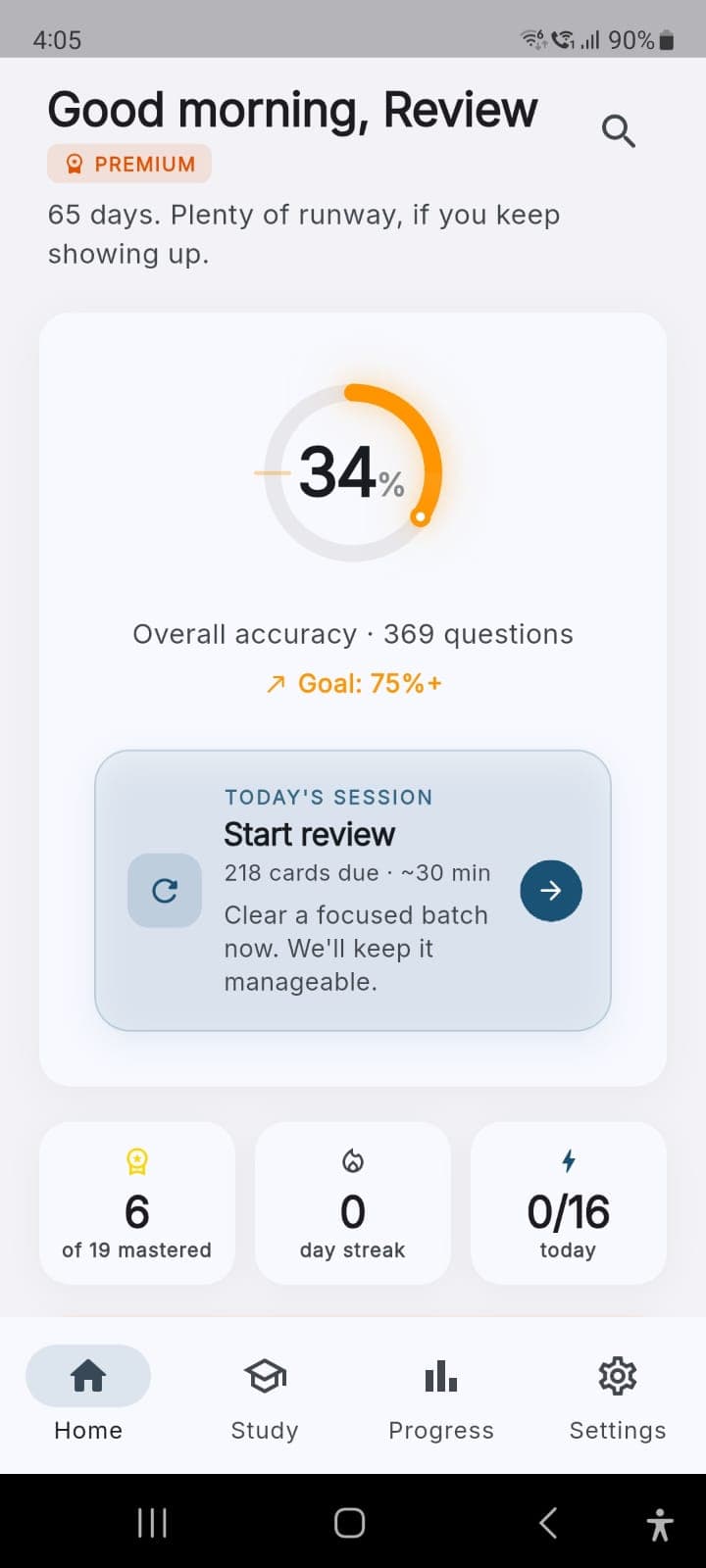
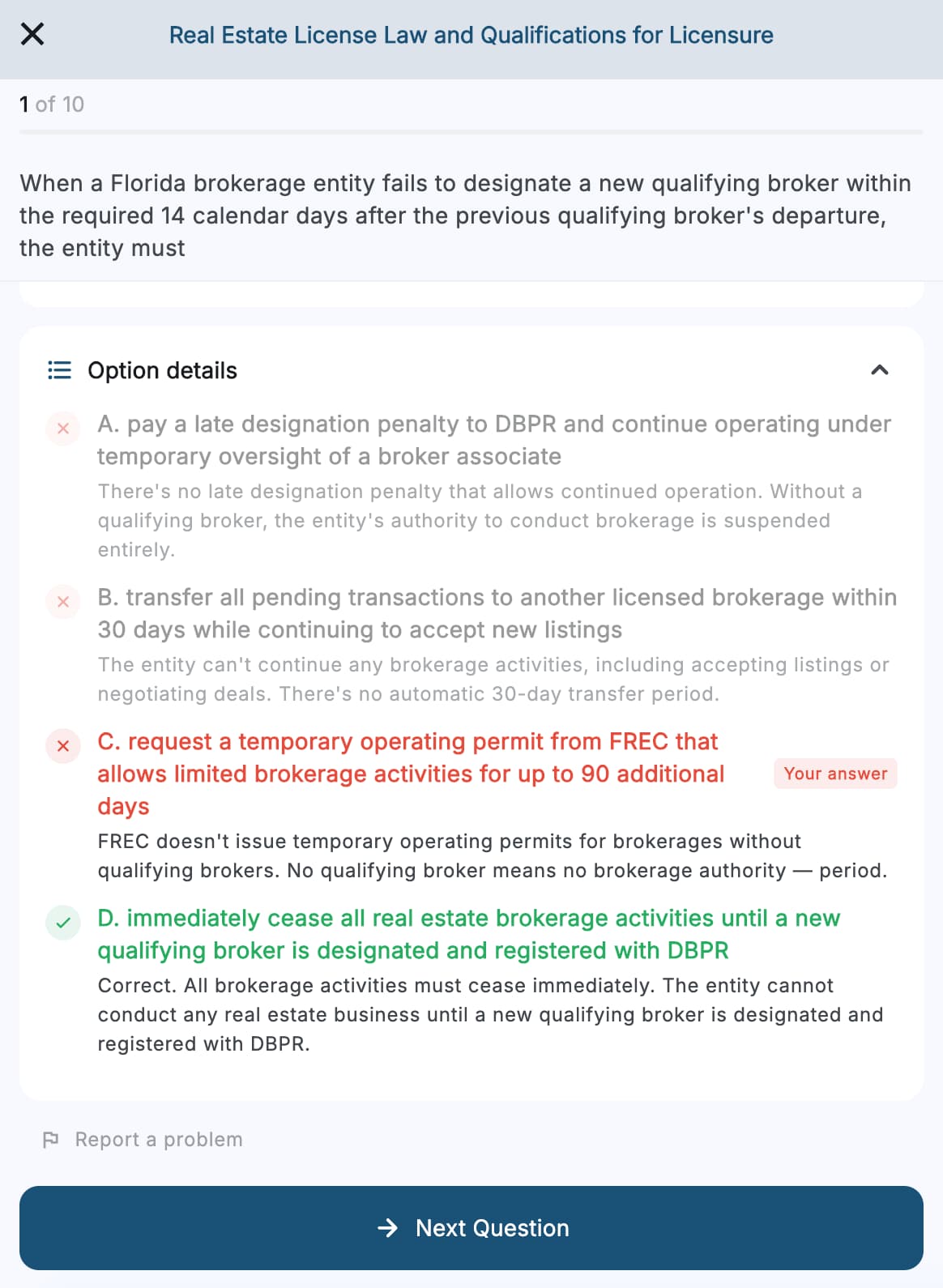
Start with one small block: try 5 Florida questions when the house gives you 10 minutes, drill one calculation in Math Drill during nap-time, check your readiness before scheduling the exam, or download Pass Florida when you are ready for the full question bank.
Methodology
The official exam facts and licensing anchors in this guide come from the primary sources listed below. The parent-situation schedule picker (baby or toddler / school-age / teens with activities / single parent / working parent), the six-mode Parent Study System (nap-time drill / school-day block / bedtime review / weekend protected block / car-line review / interrupted-session recovery), the four-week study plan (with the explicit six-week stretch option), parent readiness gate, minimum viable day rule, the 5-minute / 10-minute / 20-minute fallback drills, audio review framing, the four-prompt missed-question review template, and the seven-day parent-friendly weekly rhythm with a planned off-day are independent Pass Florida coaching pedagogy, not DBPR rules or Pearson VUE process documents. The Florida Real Estate Commission (FREC), which sits under DBPR, controls the broader licensing framework that the study plan sits inside. The plan should flex based on actual readiness data; the calendar is not the boss.
Product Note
Pass Florida publishes this guide and offers the exam-prep app linked on this page. Pass Florida is independent exam preparation, not a DBPR-approved pre-licensing course, a tutoring service, a childcare service, a Pearson VUE scheduling tool, a licensing-activation service, a legal service, or a guarantee of passage.
Sources
- DBPR Real Estate Sales Associate Candidate Information Booklet, effective January 2025
- Pearson VUE Florida Real Estate and Appraisers licensing exams
- DBPR Real Estate Education Requirements
- F.S. Chapter 475, real estate brokers, sales associates, schools, and appraisers
- F.A.C. Division 61J2, Florida Real Estate Commission
- DBPR Candidate Information Booklets
This post is study-methodology content for Florida Real Estate Sales Associate candidates who are also parents. It is not legal, licensing, tax, childcare, family, medical, or professional advice. DBPR topic weights, the 19-content-area outline, the 75-points passing grade, the 100-question / 3.5-hour exam format, the 63-hour pre-licensure requirement, closed-book exam rules, and Pearson VUE scheduling logistics can change between exam windows. For your specific licensing path, verify against the current DBPR Candidate Information Booklet, the current Pearson VUE Florida Real Estate page, and your pre-license course provider. Studying with Pass Florida or any other exam-prep tool does not guarantee passage of the state exam.