VERIFY BEFORE RELYING
This guide explains how the Florida sales associate exam tests F.S. 475.011 exemptions from the real estate license requirement, and it also corrects a common search-intent mix-up: being exempt from needing a license for a specific activity is not the same thing as being exempt from the 63-hour pre-license course or being exempt from the state exam. It is exam-prep coaching only, not legal, brokerage, employment, property-management, attorney-services, accounting, tax, appraisal, securities, timeshare, landlord-tenant, or licensing advice and not a Department of Business and Professional Regulation (DBPR), Florida Real Estate Commission (FREC), or Pearson VUE determination. Florida real estate licensure is governed by F.S. Chapter 475 and F.A.C. Chapter 61J2. F.S. Section 475.01(1)(a) defines "broker," which is the activity trigger that makes a license required. F.S. Section 475.011 lists the statutory categories where Part I of Chapter 475 does not apply, including attorney-in-fact execution-only activity, attorneys-at-law and CPAs acting within the scope of their duties, court-appointed or trust fiduciaries, owners or entities selling, exchanging, or leasing their own real property subject to the transactional-compensation limitation, certain salaried public-utility / rural-electric-cooperative / railroad / government employees, onsite salaried apartment-community leasing employees, salaried condominium or cooperative apartment managers renting individual units for periods no greater than 1 year, FCC-regulated radio / television / cable enterprise transactions with a real-property carve-back, qualifying appraisal students, licensed or certified appraisers and trainee appraisers, certain railroad unit-rule appraisal activity, public-lodging transient-occupancy rental / advertising activity, certain business-enterprise transactions involving securities dealers or federally insured depository institutions, timeshare-specific carve-outs, and the apartment-tenant referral-fee rule capped at $50 per transaction. F.S. Section 475.41 states that a person who acts as a broker without a license cannot recover compensation in a Florida court. F.S. Section 475.42(1)(a) makes operating as a broker or sales associate without a valid current active license a third-degree felony; other F.S. 475.42 violations can be second-degree misdemeanors unless a different punishment is prescribed. The exact statutory text, DBPR application requirements, mutual-recognition paths, and exam-outline placement can change between exam windows and rulemaking cycles. Verify current requirements against F.S. 475.011, F.S. 475.17, F.S. 475.42, the DBPR Sales Associate Candidate Information Booklet, the DBPR Sales Associate Application, F.S. Chapter 475, F.A.C. Chapter 61J2, and current FREC guidance. The Exemption Categories Decoder, License-vs-Course-vs-Exam decoder, Acting-As vs Being-Compensated-As decoder, Salary-vs-Transactional decoder, Property Manager Carve-Out decoder, 8-row Florida-specific traps table, and embedded exam-style question are Pass Florida observational coaching pedagogy, not DBPR, FREC, or Pearson VUE process documents.
QUICK ANSWER
If you mean "who does not need a Florida real estate license for this activity," the answer lives mostly in F.S. 475.011. The Florida license requirement is triggered by the F.S. 475.01(1)(a) broker definition: performing broker activity for another person for compensation. F.S. 475.011 then removes specific actors and activities from that requirement. The most exam-relevant categories are owners or entities dealing in their own real property, attorneys-at-law and CPAs acting within the scope of their professional duties, attorney-in-fact execution-only activity, court-appointed or trust fiduciaries, certain salaried utility / railroad / government employees, onsite salaried apartment-community leasing employees, salaried condominium or cooperative apartment managers handling rentals no longer than 1 year, public-lodging transient-occupancy rental / advertising, timeshare carve-outs, licensed appraisers and trainee appraisers performing appraisal duties, and the apartment-tenant referral-fee rule capped at $50 per transaction. If you mean "who is exempt from the 63-hour pre-license course," Florida Bar members and applicants with a qualifying four-year real estate degree are different education-exemption issues. If you mean "who is exempt from the state sales associate exam," do not treat F.S. 475.011 as an exam waiver; most applicants still must satisfy DBPR exam rules, and mutual-recognition candidates follow a separate Florida-law exam path.
WHO THIS GUIDE IS FOR
Florida sales associate exam candidates studying the License Law and Qualifications for Licensure content area, particularly the F.S. 475.011 exemption categories, the "which of the following requires a license" EXCEPT/NOT question pattern, and the salary-vs-transactional compensation edge case. Useful whether you are first-time studying licensure exemptions, drilling EXCEPT/NOT questions about which actor in a fact pattern needs a license, recovering from a License Law miss on a practice exam (typically the salaried-employee compensation flip or the attorney-incident-to-legal-services scope), or a retake candidate whose score report flagged License Law. Pair with the unlicensed assistants guide for the sister Tier 3 brokerage post on what an unlicensed person can do under a broker (the other side of the same coin), the voluntary-inactive vs involuntary-inactive guide for what happens when a licensee becomes null and void (and falls into "no license = problem" territory), the FREC rules and violations guide for the F.S. 475.42 enforcement teeth that activate when someone falsely claims exemption, the F.S. Chapter 475 guide for the broader statutory backbone, the broker associate guide for the broker definition framework, the sales associate compensation guide for the compensation framework that controls the salary-vs-transactional line, the licensing roadmap for the path exemptions avoid, the laws to memorize guide for the broader memorization strategy, and the 19 official exam topics guide for the broader exam map. Not legal, brokerage, employment, property-management, attorney-services, accounting, or licensing advice.
EXAM PREP ONLY
The Florida sales associate exam is a closed-book, computer-based licensing exam. DBPR's current Sales Associate Candidate Information Booklet (CIB) states 100 multiple-choice questions, three and a half hours, 19 content areas, and a passing grade of at least 75. The exam covers Florida real estate principles and practices, real estate law, real estate mathematics, F.S. Chapter 475 Part I, and F.A.C. Chapter 61J2. The exemptions-from-licensure topic fits inside License Law and Qualifications for Licensure. This article explains how the concept is tested. It does not replace the required 63-hour FREC-approved course, DBPR application steps, Pearson VUE scheduling rules, fingerprinting, post-licensing, continuing education, legal advice, or official sources. Real-world decisions about whether a specific actor or activity falls within an F.S. 475.011 exemption involve specific Florida statutory and rule analysis that licensees, employers, and would-be exempt parties should verify directly with current DBPR rules, FREC guidance, and qualified Florida counsel. This guide does not substitute for that.
Selling, buying, leasing, exchanging, auctioning, appraising, or negotiating real property for another person, for compensation, with no statutory exemption.
Owner or entity dealing in its own property, attorney or CPA within professional duties, execution-only attorney-in-fact, court-appointed or trust fiduciary, narrow salaried employee category, qualifying appraiser, public lodging transient rental, timeshare carve-out, or other current listed category.
F.S. 475.41 bars recovery of compensation. F.S. 475.42(1)(a) makes operating as a broker or sales associate without a valid current active license a third-degree felony.
Exemptions-from-licensure questions are one of the most directly testable License Law distinctions on the Florida sales associate exam. The statutory anchor is clear (F.S. 475.011), the categories are concrete, and the enforcement teeth (F.S. 475.41 plus F.S. 475.42) create the "why this matters" payoff that the exam often tests in EXCEPT/NOT format.
DBPR's Sales Associate Candidate Information Booklet places this topic inside License Law and Qualifications for Licensure. The exam-tested distinctions usually turn on whether a specific actor in a fact pattern falls within an F.S. 475.011 carve-out, whether the activity is really for another, and whether the compensation has flipped from salary to transaction-based pay.
This post also answers the exact phrase many candidates search: "who is exempt from the Florida real estate license exam?" The short answer is that F.S. 475.011 is not an applicant exam-waiver statute. It is a licensure-inapplicability statute for specific actors and activities. Florida Bar and four-year real-estate-degree exemptions are pre-license course issues. Mutual recognition is a separate application path. Keep those boxes separate or this topic becomes much harder than it needs to be.
This post is exam prep. It is not legal, employment, brokerage, property-management, attorney-services, accounting, or licensing advice.
What this guide covers
- Official source map
- License exemption vs course exemption vs exam exemption
- Exam concept vs real licensing analysis
- The license trigger: F.S. 475.01(1)(a) broker definition
- The F.S. 475.011 exemption categories
- Acting-As vs Being-Compensated-As decoder
- The salary-vs-transactional compensation test
- Property manager carve-out decoder
- Enforcement: F.S. 475.41 and F.S. 475.42
- Answer-Choice Decoder: pick the trigger first
- Common Florida-specific traps
- Exam-style question
- Related exam concepts
- Frequently Asked Questions
Official Source Map
Use F.S. Chapter 475 (broker and sales associate licensing) and F.A.C. Chapter 61J2 (FREC rules) for the statutory framework. Use the decision tables in this guide as exam-prep coaching only.
| Claim in this guide | Primary source | Why it matters |
|---|---|---|
| F.S. Section 475.01(1)(a) defines "broker," and the license requirement is triggered by performing broker activity for another for compensation | F.S. Section 475.01, Definitions | The activity trigger that makes the F.S. 475.011 exemption analysis matter |
| F.S. Section 475.011 lists the statutory exemptions from the real estate license requirement | F.S. Section 475.011, Exemptions; this part inapplicable | The single statute that controls all exemption-category questions |
| Florida Bar members and qualifying four-year real-estate-degree applicants may be exempt from the 63-hour sales associate pre-license course, not automatically exempt from every licensing or exam requirement | DBPR RE 1 Sales Associate Application and F.S. Section 475.17 | Prevents the common search-intent mistake of treating a course exemption as a license or state-exam exemption |
| F.S. Section 475.41 states that a person who acts as a broker without a license cannot recover compensation in a Florida court | F.S. Section 475.41, Contracts of unlicensed person for commissions invalid | The civil-recovery teeth that make exemption analysis economically meaningful |
| F.S. Section 475.42(1)(a) makes operating as a broker or sales associate without a valid current active license a third-degree felony | F.S. Section 475.42, Violations and penalties | The criminal-enforcement teeth that make the exam-testing of exemption boundaries serious |
| F.A.C. Chapter 61J2 contains the broader FREC rules governing licensee conduct, supervision, advertising, and discipline | F.A.C. Chapter 61J2, Florida Real Estate Commission | The administrative-rule backbone for FREC operations |
| DBPR's Sales Associate CIB places this topic inside License Law and Qualifications for Licensure | DBPR Sales Associate Candidate Information Booklet | Anchors the topic placement to the DBPR exam outline |
| DBPR Division of Real Estate is the operational channel for licensure questions and enforcement | DBPR Division of Real Estate | The agency-side answer for real-world exemption questions |
| The Exemption Categories Decoder, License-vs-Course-vs-Exam decoder, Acting-As vs Being-Compensated-As decoder, Salary-vs-Transactional decoder, Property Manager Carve-Out decoder, 8-row Florida-specific traps table, and embedded exam-style question are study heuristics | Pass Florida coaching methodology | These are not DBPR, FREC, or Pearson VUE rules |
License Exemption vs Course Exemption vs Exam Exemption
This keyword is messy because candidates use the word "exempt" for three different things. The exam expects you to keep them separate.
| Candidate question | Actual legal bucket | Best exam-prep answer |
|---|---|---|
| "Who is exempt from needing a Florida real estate license?" | F.S. 475.011 licensure exemption / Part I inapplicability | Specific actors and activities can be outside the license requirement, such as owners dealing in their own property, attorneys and CPAs acting within their professional duties, court fiduciaries, narrow salaried employee categories, appraisers, certain public-lodging rental activity, and timeshare carve-outs |
| "Who is exempt from the 63-hour pre-license course?" | Education requirement under F.S. 475.17 and DBPR RE 1 application instructions | Active Florida Bar members in good standing and applicants with a qualifying four-year real estate degree can claim pre-license course exemptions; that does not automatically erase every other licensing requirement |
| "Who is exempt from the state sales associate exam?" | DBPR application / testing path question | Do not use F.S. 475.011 as an exam-waiver rule. Initial sales associate applicants generally must pass the state exam unless they qualify under a separate DBPR pathway; mutual recognition is a separate Florida-law examination path, not a simple "no exam" shortcut |
| "Can I do real estate work without ever applying?" | Activity-specific exemption question | Only if the activity and actor actually fit a current exemption or the broker definition never triggers. Otherwise the person risks F.S. 475.41 no-recovery consequences and F.S. 475.42 penalties |
For SEO, this post answers the broad phrase "license exam exemption." For exam accuracy, it teaches the narrower rule: F.S. 475.011 is about whether a license is required for a specific activity, not whether an applicant gets to skip the sales associate exam.
Exam Concept vs Real Licensing Analysis
Before studying this topic, separate exam vocabulary from real-world legal analysis.
| Situation | What to rely on | Why it matters |
|---|---|---|
| Florida exam-style exemption question | F.S. 475.011 category list + salary-vs-transactional compensation test + EXCEPT/NOT question logic | The exam tests whether the candidate can name the category and apply the compensation test |
| "Can I skip the 63-hour course or state exam?" question | F.S. 475.17, DBPR RE 1, current DBPR application instructions, and the current candidate information booklet | Course exemptions and applicant exam paths are different from F.S. 475.011 licensure exemptions |
| Real "does this person need a Florida real estate license?" question | Current text of F.S. 475.011, current F.A.C. Chapter 61J2 rules, DBPR enforcement history, and qualified Florida counsel | Real exemption analysis is fact-specific, the boundaries shift with rulemaking and case law, and the penalty for getting it wrong is criminal exposure under F.S. 475.42 |
| Real employer-side question (can our salaried employee do X without a license?) | Current F.S. 475.011 plus qualified employment / brokerage counsel | Employer exposure is real if a salaried employee crosses into broker activity |
| Real out-of-state owner / out-of-state broker question | Current DBPR guidance, F.S. Chapter 475 reciprocity rules, and qualified counsel | Out-of-state activity in Florida has its own analysis separate from F.S. 475.011 categories |
| Real disciplinary case for unlicensed activity | F.S. 475.42 penalty framework, F.A.C. Chapter 61J2 procedural rules, DBPR Unlicensed Activity Unit, and qualified legal counsel | Disciplinary and criminal exposure is genuine; do not rely on exam-prep coaching for real-world defense |
On the exam, the stem controls the universe. If the stem describes an owner selling their own home, the answer is exempt. If the stem describes an attorney closing a transaction as part of representing an estate client, the answer is usually exempt as attorney-incident-to-legal-services. If the stem describes an onsite salaried apartment-community employee working in a leasing capacity, the answer is usually exempt. If the stem flips the salaried employee to transaction-based compensation, the exemption usually evaporates. Do not import out-of-state nuance, specific DBPR-investigation procedures, or criminal-defense theories unless the stem invites them.
For exam prep, identify the category and apply the compensation test. For real-world questions about whether a specific activity falls within F.S. 475.011, consult qualified Florida counsel and the current statute.
The License Trigger: F.S. 475.01(1)(a) Broker Definition
The F.S. 475.011 exemption analysis only matters when the activity would otherwise require a license. The trigger is F.S. 475.01(1)(a), which defines "broker."
The broker definition in F.S. 475.01(1)(a) describes a person who, for another and for compensation (or with the expectation of compensation), performs real estate broker activity. The exam-tested broker activity verbs include selling, buying, exchanging, leasing, auctioning, appraising, advertising, negotiating, or otherwise dealing in real property or any interest in real property, or who holds themselves out as doing so.
Three elements must usually be present for the license requirement to attach:
| Element | What it means | Why it matters |
|---|---|---|
| "For another" | The actor is performing the activity for someone else, not for themselves | Owners selling their own property fail this element, which is why the owner exemption exists |
| Broker activity | Selling, buying, exchanging, leasing, auctioning, appraising, advertising, negotiating, or otherwise dealing in real property | If the activity does not match a broker verb, the license requirement does not attach in the first place |
| For compensation | The actor expects payment, commission, fee, or other valuable consideration | Pure volunteer or pure-gratuitous activity may not trigger the license requirement |
The F.S. 475.011 exemption categories below assume the three elements are present. If any element is missing, the license requirement may not attach at all, and the exemption analysis is unnecessary.
The F.S. 475.011 Exemption Categories
F.S. 475.011 contains multiple categories where Part I of Chapter 475 does not apply. For the exam, learn the categories in plain English, but also notice what the current statute does not include: there is no broad free-standing "auctioneer exemption," no generic cemetery-company exemption, no generic airport / airline employee exemption, and no blanket "owner-developer" label in the current text. Some older outlines and flashcards still use those shortcuts. The current exam-safe habit is to tie the actor back to the actual statutory category.
| Exempt category | What the exemption covers | Common exam stem pattern |
|---|---|---|
| Attorney-in-fact, execution only | A person acting as attorney-in-fact only for the execution of contracts or conveyances. This is not a license to advertise, negotiate, solicit, or broker property for a fee | "Adult child signs the closing deed under a valid power of attorney" |
| Attorneys-at-law within professional duties | Attorneys acting within the scope of legal duties. The exam-safe phrase is "incident to legal services," not "separate brokerage business" | "Attorney closes a property sale while representing an estate client" |
| CPAs within professional duties | Certified public accountants acting within the scope of accounting duties | "CPA analyzes tax consequences of selling an investment property" |
| Court-appointed and trust fiduciaries | Personal representatives, receivers, trustees, general or special magistrates, and certain trustees acting under will, court order, deed of trust, or qualifying trust agreement | "Court-appointed personal representative sells estate property" |
| Owner or entity dealing in its own real property | An individual, corporation, partnership, trust, joint venture, or other entity selling, exchanging, or leasing its own real property | "Owner sells her own duplex" |
| Owner/entity transactional-compensation limitation | The own-property exemption is not available to the extent an agent, employee, or independent contractor is paid commission or other compensation strictly on a transactional basis to make sales, exchanges, or leases to customers in the ordinary course of the owner's real estate business | "Developer's employee is paid per lot sold to the public" |
| Public utility, rural electric cooperative, railroad, or state/local government employee | Employee acts within employment, receives no compensation beyond salary, and handles real property for the employer's use | "Railroad employee acquires right-of-way for the railroad on salary only" |
| Onsite apartment-community leasing employee | Salaried employee of an owner, or of a registered broker for an owner, of an apartment community who works in an onsite rental office in a leasing capacity | "Onsite leasing employee shows apartments for the owner and is paid salary only" |
| Condominium or cooperative apartment manager | Salaried manager of a condominium or cooperative apartment complex renting individual units, when rentals are for periods no greater than 1 year | "Condo manager arranges six-month rentals of individual units" |
| FCC-regulated radio / TV / cable enterprise transactions | Sale or purchase of licensed radio, television, or cable enterprises, with a broker or sales associate required for the land/building/improvement portion if real property is included | "Brokerage of a cable enterprise, with real estate portion handled by a licensee" |
| Full-time appraisal graduate student | Student enrolled in a commission-approved Florida appraisal degree program, under direct supervision, doing appraisal activities related to the degree program | "Graduate appraisal student issues report in supervisor's name" |
| Timeshare owner and exchange-company carve-outs | Timeshare owner reselling the owner's own period, and qualifying exchange-company activity under Chapter 721 | "Owner resells her own timeshare week" |
| Licensed/certified appraiser or trainee appraiser | Appraiser or trainee registered, licensed, or certified by DBPR under Part II performing appraisals under that part | "Certified appraiser performs an appraisal assignment" |
| Railroad unit-rule appraisal | Person appraising a railroad or railroad terminal company under the unit-rule method for ad valorem tax purposes | "Unit-rule appraisal of railroad property for tax assessment" |
| Public lodging transient-occupancy rental / advertising | Person or entity renting or advertising for rent, for transient occupancy, a public lodging establishment licensed under Chapter 509 | "Hotel operator advertises transient rooms for rent" |
| Business-enterprise transactions for accredited investors | SEC-registered dealer, federally insured depository institution, and related entities in business-enterprise transactions with accredited investors, excluding real property not connected with the business-enterprise transaction | "Sale of a business enterprise to an accredited investor includes non-real-estate assets" |
| Apartment-tenant referral fee | Property management firm or apartment-complex owner pays an unlicensed tenant a finder/referral fee of no more than $50 per transaction; tenant may not advertise or promote services | "Tenant receives $50 rent credit for introducing a new tenant" |
The exam-day shortcut: memorize the category names and the salary-vs-transactional compensation test. Most exam questions reduce to recognizing the category, asking whether the actor is really acting for another, and checking whether the stem quietly switched from salary to transaction-based compensation.
Acting-As vs Being-Compensated-As Decoder
A common source of confusion is the difference between performing an activity and being compensated for it as a broker.
| If the stem describes... | Apply this test | Usually correct answer |
|---|---|---|
| Owner selling their own property | The activity is not "for another" | Exempt; owner is acting for themselves |
| Owner's employee or contractor making public sales for transaction-based pay | Is the person paid commission or other compensation strictly on a transactional basis in the ordinary course of the owner's business of selling, exchanging, or leasing real property to the public? | Not protected by the own-property exemption to that extent |
| Attorney performing real estate work for a client as part of legal services | Is the attorney charging legal fees for legal services, or is the attorney charging a separate brokerage commission? | If legal fees incident to legal services: exempt. If separate brokerage commission: not exempt under attorney exemption |
| Attorney-in-fact signing documents under power of attorney | Is the person executing contracts or conveyances only, or are they soliciting, negotiating, advertising, or arranging deals for compensation? | Execution-only authority can be exempt. Brokerage activity for compensation is not saved by merely holding a power of attorney |
| Salaried employee performing narrow statutory rental or employer-use tasks | Is compensation a fixed salary with no transaction-based compensation, and does the task fit the listed category? | If fixed salary and tasks fall within the statutory scope: exempt. If transaction-based compensation or sales brokerage appears: not exempt |
| CPA giving tax advice that touches real estate | Is the CPA charging accounting fees for accounting services or a separate real estate fee? | If accounting fees incident to accounting services: exempt. If separate real estate brokerage compensation: not exempt under CPA exemption |
| Court-appointed personal representative selling estate property | Is the person acting under court authority for the property under their appointment? | If acting under court appointment: exempt. If branching into separate brokerage for other parties: not exempt |
| Government employee acting outside official capacity (moonlighting as a private broker) | Is the activity within official government duties? | If within official capacity: exempt. If moonlighting for private compensation: not exempt under government exemption |
| Appraiser performing appraisal duties | Is the person registered, licensed, or certified under Part II, or a qualifying supervised graduate appraisal student? | Appraisal duties can be exempt under the appraiser/student categories. Brokerage sales or leasing work is a different analysis |
| Tenant receiving a referral fee | Is the tenant receiving no more than $50 per transaction, and not advertising or promoting referral services? | The capped referral-fee carve-out can apply. Advertising, promotion, or larger compensation breaks the safe exam answer |
The cleanest framing: the exemption attaches to a specific category of person performing a specific activity in a specific compensation structure. When the stem flips any of those three (category, activity, or compensation), the exemption usually evaporates.
The Salary-vs-Transactional Compensation Test
This is the single most-tested edge case in the F.S. 475.011 universe.
| Scenario | Compensation | Exemption status |
|---|---|---|
| Salaried onsite employee of an apartment-community owner works in the onsite rental office in a leasing capacity | Fixed salary | Exempt under the onsite apartment-community leasing employee category |
| Same employee receives a per-unit bonus or commission for each new lease signed | Transaction-based compensation | Likely NOT exempt; the compensation detail is the exam trap |
| Salaried manager of a condominium or cooperative apartment complex rents individual units for six-month terms | Fixed salary, rentals no greater than 1 year | Exempt under the condo/co-op manager category |
| Same manager arranges two-year leases or starts brokering sales of individual units | Outside the statutory rental scope | NOT protected by the condo/co-op rental category |
| Employee of a public utility, rural electric cooperative, railroad, or government agency acquires property for employer use | Salary only, within employment, no extra compensation | Exempt under the employer-use employee category |
| Same employee moonlights by finding private buyers for a separate fee | Private transaction-based compensation | NOT exempt under the employer-use category |
| Owner's employee leases the owner's own property to the public in the ordinary course of the owner's real estate business and is paid per transaction | Transaction-based compensation | Own-property exemption is not available to that extent |
| Apartment tenant receives a $50 rent credit for introducing a prospective tenant | Referral fee no more than $50 per transaction, no advertising or promotion | Exempt within the tenant referral-fee carve-out |
The exam-day shortcut: if the stem mentions "salary" and a narrow statutory scope, the answer is often exempt. If the stem mentions commission per transaction, per-lease compensation, referral money above $50, or a finder fee per closing, the answer often flips to license-required. The issue is not just W-2 vs 1099. The exam is usually testing whether the compensation is fixed salary inside a listed statutory carve-out or transaction-based pay for broker activity.
Property Manager Carve-Out Decoder
Property management is one of the most heavily-tested edge cases because the line between exempt leasing activity and licensed brokerage activity is fact-specific.
| Property management activity | Usually requires license? | Reason |
|---|---|---|
| Salaried onsite employee of an apartment-community owner works in the onsite rental office in a leasing capacity | Usually no | Express F.S. 475.011 apartment-community employee category |
| Salaried employee of a registered broker for the apartment-community owner works in the onsite rental office in a leasing capacity | Usually no | Express category covers a salaried employee of a registered broker for the owner |
| Salaried condo or cooperative apartment manager rents individual units for periods no greater than 1 year | Usually no | Express condo/co-op manager rental category |
| Public lodging establishment rents or advertises transient occupancy | Usually no | Express public-lodging transient-occupancy category |
| Apartment-complex owner or property management firm pays a tenant a referral fee of $50 or less per transaction | Usually no | Express tenant referral-fee carve-out, as long as the tenant does not advertise or promote referral services |
| Property manager (or employee) sells the managed property to a third party | Usually yes (license required) | Sales brokerage exceeds the property-management leasing carve-out |
| Property manager (or employee) earns per-lease commission for each new tenant signed | Usually yes (license required) | Transaction-based compensation crosses the statutory line |
| Tenant advertises or promotes tenant-finding services for pay | Usually yes (license required) | The $50 referral-fee carve-out does not authorize advertising or promotion by an unlicensed person |
| Owner of investment property hires a CPA to do tax planning that includes lease-vs-sale analysis | Usually no | CPA exemption incident to accounting services |
The exam-day shortcut: do not say "property managers are exempt" as a blanket rule. The exam-safe answer is narrower: onsite salaried apartment-community leasing, salaried condo/co-op rental management for rentals no greater than 1 year, public-lodging transient occupancy, and the $50 tenant-referral rule are the clean carve-outs. Sales activity, transaction-based compensation, and public promotion by an unlicensed tenant usually flip the answer.
Enforcement: F.S. 475.41 and F.S. 475.42
The reason exemption analysis matters is the enforcement teeth on the other side.
| Statute | What it does | Why it matters |
|---|---|---|
| F.S. 475.41, Contracts of unlicensed person for commissions invalid | A person who acts as a broker without a license cannot recover compensation in a Florida court | Civil-recovery teeth: even if the customer is willing to pay, the unlicensed broker cannot enforce the contract |
| F.S. 475.42(1)(a), operating without a valid current active license | A person may not operate as a broker or sales associate without a valid current active license; violation is a third-degree felony | Criminal-enforcement teeth: this is the penalty line for the classic unlicensed-broker fact pattern |
| F.S. 475.42(2), penalties for other subsection (1) violations | Violations of F.S. 475.42(1) are second-degree misdemeanors unless Chapter 475 prescribes a different punishment | Prevents the sloppy shortcut that every F.S. 475.42 issue has the same penalty |
| F.A.C. Chapter 61J2 | FREC disciplinary jurisdiction over licensees, including licensees who aid and abet unlicensed activity | Licensee-side exposure: a licensee who allows an unlicensed person to perform broker activity faces disciplinary exposure |
This is why exam stems often include a sentence like "if the activity requires a license, what penalty applies?" For the classic unlicensed broker or sales associate fact pattern, the criminal answer is F.S. 475.42(1)(a): third-degree felony. The civil answer is F.S. 475.41: no court recovery of the commission or compensation. Memorize those two consequences alongside F.S. 475.011 itself.
CATEGORY FIRST, COMPENSATION SECOND
Most exemption-question misses come from skipping the compensation test.
Turn the rule in this guide into Florida-specific scenario practice, then explain why each plausible distractor is wrong.
Answer-Choice Decoder: Pick the Trigger First
Most wrong answers on this topic are not wildly false. They belong to the wrong category or miss the compensation flip.
| If the stem says... | Start with this analysis | Usually wrong answer pattern |
|---|---|---|
| Owner selling their own home | Owner exemption (not "for another") | Calling the owner an unlicensed broker because they are negotiating with a buyer |
| Owner's employee is paid per sale or per lease in the owner's public real estate business | Own-property exemption limitation | Applying the owner exemption even after the stem adds transaction-based compensation |
| Florida-licensed attorney closing a transaction as part of representing an estate client | Attorney-incident-to-legal-services exemption | Saying the attorney needs a separate real estate license to close estate property |
| Attorney-in-fact signs the deed under a power of attorney | Execution-only attorney-in-fact exemption | Treating power of attorney as permission to solicit buyers, negotiate terms, and charge brokerage fees |
| Salaried onsite apartment-community employee working in leasing capacity | Onsite salaried apartment-community leasing employee exemption | Turning every leasing office employee into an unlicensed broker even when the salary and onsite facts are clean |
| Court-appointed personal representative selling decedent's home | Court-appointed exemption | Saying the personal representative needs a real estate license to handle estate property |
| CPA giving tax advice that touches a client's real estate decision | CPA-incident-to-accounting-services exemption | Saying the CPA needs a real estate license to discuss real estate tax implications |
| City real estate department employee buying property for the city | Government-official-capacity exemption | Saying the city employee needs a real estate license to act for the city |
| Salaried employee starts receiving per-transaction compensation | Compensation flip; exemption likely evaporates | Continuing to apply the salaried-employee exemption after the compensation flipped |
| Condo manager rents individual units for two-year terms | Condo/co-op manager category only covers rentals no greater than 1 year | Applying the condo/co-op rental category after the term exceeds the statutory limit |
| Tenant receives $150 for bringing in a renter or advertises tenant-finding services | Tenant referral-fee carve-out is capped at $50 and does not authorize advertising or promotion | Treating any apartment referral payment as automatically exempt |
When two answer choices sound plausible, ask which category the stem invited and whether the compensation structure has flipped from salary to transaction-based pay.
Common Florida-Specific Traps
| Trap | What it looks like | Repair |
|---|---|---|
| Compensation-flip oversight | Stem describes a salaried employee in the first half but switches to per-transaction compensation in the second half, and the candidate keeps the salaried-employee exemption answer | Re-read the stem for the compensation structure. A flip from salary to transaction-based pay usually flips the answer from exempt to license-required. |
| Attorney-exemption scope-creep | Stem describes an attorney who is operating a separate brokerage business under the same firm name, and the candidate applies the attorney-incident-to-legal-services exemption | The attorney exemption covers real estate work incident to legal services. Operating a separate brokerage under the same firm does not qualify. |
| CPA-exemption scope-creep | Stem describes a CPA marketing themselves as a real estate consultant for a separate fee, and the candidate applies the CPA-incident-to-accounting-services exemption | Same logic as attorneys. Separate brokerage fee usually evaporates the CPA exemption. |
| Owner/entity compensation limitation | Stem describes an owner selling its own property, then says an employee or contractor is paid commission per sale in the owner's ordinary business of selling to the public | The own-property exemption has a transaction-based compensation limitation. Track who gets paid and how. |
| Property-management leasing-vs-sales confusion | Stem describes a property manager who has been leasing units (exempt) and is now selling the managed property (license required), and the candidate keeps the property-management exemption answer | Leasing and sales are different activities. The property-management leasing carve-out does not extend to sales brokerage. |
| Government-employee moonlighting trap | Stem describes a city real estate department employee who, after hours, brokers private property sales for a private commission, and the candidate applies the government exemption | Government exemption covers official-capacity activity. Private after-hours brokerage is not within official capacity. |
| Power-of-attorney scope trap | Stem mentions a "power of attorney" but the person is doing more than executing contracts or conveyances | The attorney-in-fact category is execution-only. It does not turn brokerage negotiation into exempt activity. |
| Treating "no license" as automatically illegal | Stem describes an exempt actor (owner, attorney, CPA, government employee) and the candidate picks "unlicensed activity / third-degree felony" | Exempt actors are not "unlicensed" in the F.S. 475.42 sense for that activity; they are statutorily outside the license requirement. |
Exam-Style Question
Stem: Which of the following persons is NOT exempt from the Florida real estate licensure requirement under F.S. 475.011?
A. A Florida-licensed attorney who closes a property sale as part of representing the estate of a deceased client and charges a legal fee for legal services.
B. A salaried employee of the owner of Sunset Apartments who shows vacant units in the building, quotes rental rates, and collects security deposits from prospective tenants, paid a fixed monthly salary with no per-unit commission.
C. A court-appointed personal representative who sells the decedent's home as part of administering the estate under court authority.
D. A real estate consultant who, for a flat per-transaction fee, helps multiple unrelated property owners find buyers, negotiate sale terms, and complete the transactions, and who holds no Florida real estate license.
Show answer
Correct answer: D. The consultant is performing broker activity (helping owners find buyers and negotiating sale terms) for others (multiple unrelated property owners) for compensation (a per-transaction fee), with no statutory exemption category that applies. Under the F.S. 475.01(1)(a) broker definition, this is broker activity. Under F.S. 475.011, there is no consultant-fee exemption that covers this fact pattern. Under F.S. 475.42(1)(a), operating as a broker or sales associate without a valid current active license is a third-degree felony. Under F.S. 475.41, the consultant cannot recover the per-transaction fees in a Florida court.
Option A is wrong (i.e., this person IS exempt) because the attorney is performing real estate work incident to legal services (representing the estate) and is charging a legal fee for legal services, not a separate brokerage commission. This is the classic attorney-incident-to-legal-services exemption under F.S. 475.011.
Option B is wrong (i.e., this person IS exempt) because the salaried employee falls within the narrow salaried-employee-of-owner exemption for showing vacant units, quoting rental rates, and collecting deposits in the owner's own building. The "fixed monthly salary with no per-unit commission" detail is the key compensation-test fact that keeps the exemption intact. If the stem had said "per-unit commission," the exemption would likely evaporate.
Option C is wrong (i.e., this person IS exempt) because the personal representative is acting under court authority to administer estate property, which falls within the court-appointed-personal-representative exemption under F.S. 475.011.
The exam-day shortcut for this stem: A, B, and C all match a named F.S. 475.011 exemption category and a clean compensation structure. D matches no exemption category and includes the "for another, for compensation" elements that trigger the broker definition. Option D is the answer to a "NOT exempt" stem.
Related Exam Concepts
| If this is your weak spot | Read this next | Why |
|---|---|---|
| What can an unlicensed person do under a broker | Unlicensed assistants guide | The Tier 3 brokerage sister covering the other side of the same statutory question |
| What happens when a license becomes null and void | Voluntary inactive vs involuntary inactive guide | A null-and-void licensee becomes unlicensed and is no longer protected by their prior license |
| FREC disciplinary process and unlicensed-activity enforcement | FREC rules and violations guide | F.S. 475.42 enforcement is administered through FREC and the DBPR Unlicensed Activity Unit |
| Broader F.S. Chapter 475 statutory framework | F.S. Chapter 475 guide | The statutory backbone for the broker definition, exemption categories, and enforcement |
| Sales associate compensation framework | Sales associate compensation guide | The compensation framework that controls the salary-vs-transactional line |
| Broker definition framework | Broker associate guide | The broker-license definition that activates when an exemption does not apply |
| Broker vs sales associate comparison | Florida broker vs sales associate guide | The license types that an exempt person avoids needing |
| The licensure path that exemptions avoid | How to get a Florida real estate license guide | The path required when no exemption applies |
| Memorization strategy | Laws to memorize guide | The broader memorization strategy for Florida exam-tested laws including F.S. 475.011 |
| Broader exam map | Florida real estate exam 19 topics guide | DBPR topic-weight overview including License Law |
Frequently Asked Questions
What is F.S. 475.011?
F.S. 475.011 is the Florida statute that lists the exemptions from the real estate license requirement. It sits next to F.S. 475.01 (broker definition) and F.S. 475.42 (penalty for unlicensed activity). Together, these three statutes form the framework the exam tests when asking whether a specific actor in a fact pattern needs a Florida real estate license.
Who is exempt from the Florida real estate exam?
Be careful with the wording. F.S. 475.011 does not create a blanket state-exam waiver. It says Part I of Chapter 475 does not apply to specific actors and activities, which means those actors may not need a license for that activity. Florida Bar members in good standing and applicants with a qualifying four-year real estate degree may be exempt from the 63-hour sales associate pre-license course, but that is a course exemption, not the same thing as a license exemption or a universal state-exam exemption. Mutual recognition is also separate; it is not the same as F.S. 475.011.
Do I need a Florida real estate license to sell my own home?
No. Owners selling their own real property are exempt under F.S. 475.011. The exemption rests on the "for another" element of the broker definition: when you are selling your own property, you are not acting for another, and the broker definition does not attach. But if an owner uses an agent, employee, or independent contractor who is paid commission or other compensation strictly on a transactional basis to make sales, exchanges, or leases to customers in the ordinary course of the owner's real estate business, the own-property exemption is not available to that extent.
Do attorneys need a Florida real estate license?
Florida-licensed attorneys are exempt under F.S. 475.011 when performing real estate work incident to their legal services for a client (representing an estate, closing a transaction as part of legal representation, drafting documents). The attorney exemption does not cover operating a separate brokerage business under the law firm's name.
Do CPAs need a Florida real estate license?
CPAs are exempt under F.S. 475.011 when performing real estate-related work incident to their accounting or tax services for a client. The CPA exemption does not cover charging a separate real estate brokerage fee or marketing the CPA as a real estate consultant for compensation.
Does a property manager need a Florida real estate license?
It depends on the exact statutory category, activity, and compensation. The clean F.S. 475.011 carve-outs include a salaried onsite apartment-community leasing employee of the owner or registered broker for the owner, a salaried condominium or cooperative apartment manager renting individual units for periods no greater than 1 year, transient-occupancy rental or advertising of a licensed public lodging establishment, and the apartment-tenant referral-fee rule capped at $50 per transaction. Property managers who broker sales, earn transaction-based compensation, or step outside those narrow categories generally need a Florida real estate license.
What is the difference between an unlicensed assistant and an exempt person?
An unlicensed assistant is a person performing narrow non-broker functions under a licensed broker's supervision (administrative, clerical, marketing-prep). An exempt person under F.S. 475.011 is a person who falls within a named statutory carve-out and does not need a license for the specific activity. See the unlicensed assistants guide for the sister-post analysis.
What happens if I act as a broker without a license and without an exemption?
Under F.S. 475.41, you cannot recover compensation in a Florida court for the brokerage activity, even if the customer is willing to pay. Under F.S. 475.42(1)(a), operating as a broker or sales associate without a valid current active license is a third-degree felony. Other F.S. 475.42 violations can be second-degree misdemeanors unless Chapter 475 prescribes a different punishment.
Is the salaried-employee exemption a complete safe harbor?
No. The salaried-employee exemptions under F.S. 475.011 are narrow. They apply to specific employee categories, such as certain public-utility / rural-electric-cooperative / railroad / government employees acting for their employer with no compensation beyond salary, onsite apartment-community leasing employees, and salaried condominium or cooperative apartment managers renting individual units for periods no greater than 1 year. The exemption usually evaporates when the compensation flips from fixed salary to transaction-based compensation or when the activity exceeds the narrow exempt scope.
Where is the exemptions-from-licensure topic placed on the DBPR exam outline?
The exemptions topic falls inside License Law and Qualifications for Licensure on the DBPR Sales Associate Candidate Information Booklet. Verify current weight allocations against the current CIB.
Does Pass Florida replace my 63-hour course?
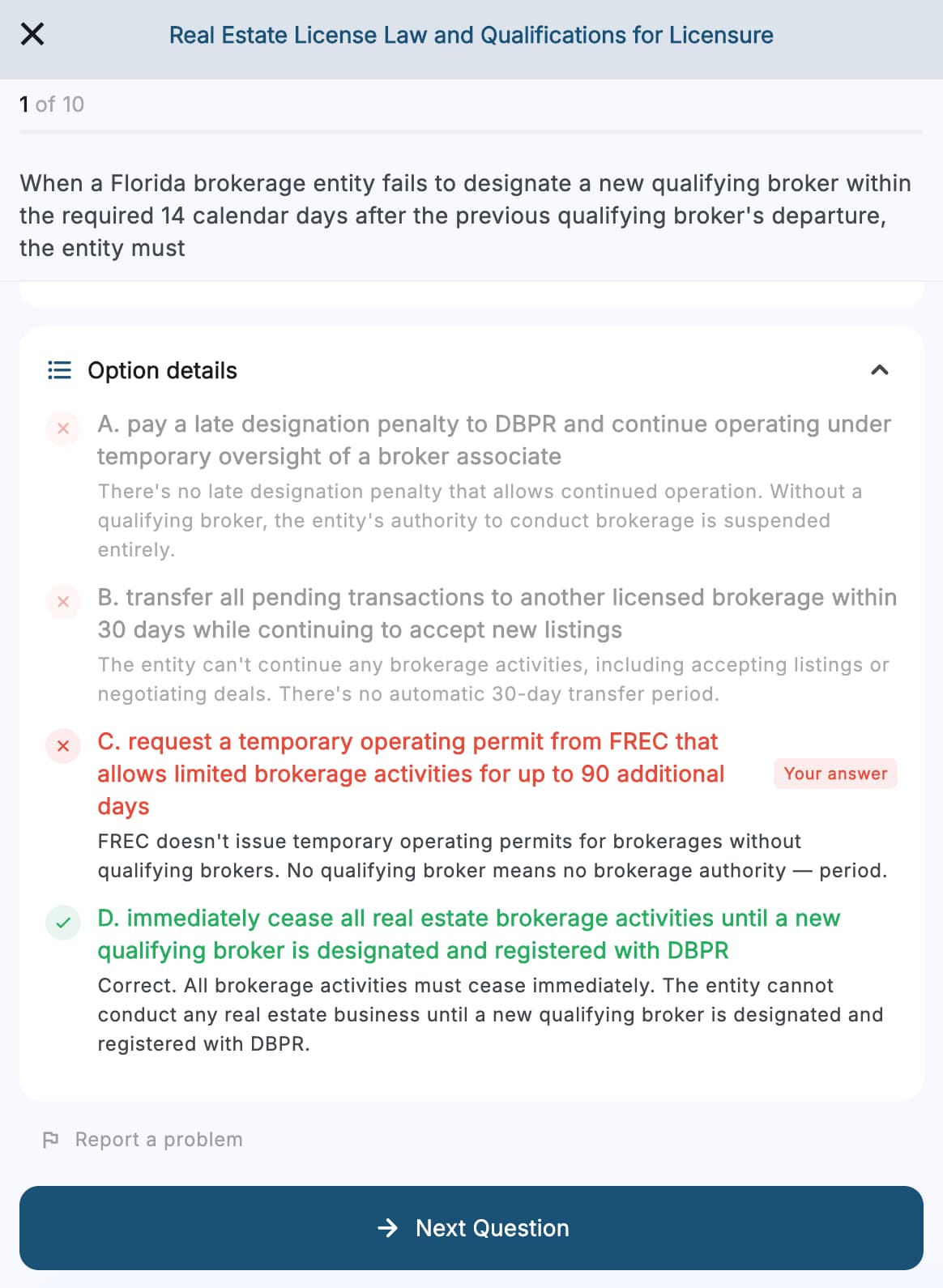
No. Pass Florida is exam preparation content, not a substitute for the FREC-approved 63-hour pre-license course, DBPR processes, Pearson VUE scheduling, or licensed professional advice. The app gives you 1,142 Florida-specific practice questions to help you prepare after and alongside your required coursework.
Ready to drill F.S. 475.011 exemption questions?
The single discipline that prevents most exemption-question misses is naming the category before applying the compensation test. The next score jump usually comes from drilling sister License Law topics that share the same statutory backbone and enforcement framework.
- Pair with the unlicensed-assistant sister: Unlicensed assistants guide
- Pair with the broader F.S. Chapter 475 pillar: F.S. Chapter 475 guide
- Pair with the FREC disciplinary process sibling: FREC rules and violations guide
- Try Florida-specific practice questions: Try 5 questions
Methodology
This guide was written for Florida sales associate exam candidates studying the License Law and Qualifications for Licensure content area, particularly the F.S. 475.011 exemption categories, the salary-vs-transactional compensation test, and the common search-intent confusion between license exemptions, pre-license course exemptions, and state-exam exemptions. It anchors the exemption-category decoder and the enforcement framework to: F.S. Section 475.01(1)(a) (broker definition that triggers the license requirement), F.S. Section 475.011 (exemption categories), F.S. Section 475.17 (education requirement context), F.S. Section 475.41 (no recovery without a license), F.S. Section 475.42(1)(a) (third-degree felony for operating as a broker or sales associate without a valid current active license), F.A.C. Chapter 61J2 (FREC rules), the DBPR Division of Real Estate operational channel, the DBPR RE 1 Sales Associate Application, and the DBPR Sales Associate Candidate Information Booklet.
The Exemption Categories Decoder, License-vs-Course-vs-Exam decoder, Acting-As vs Being-Compensated-As decoder, Salary-vs-Transactional decoder, Property Manager Carve-Out decoder, Answer-Choice Decoder, 8-row Florida-specific traps table, and embedded exam-style question are Pass Florida observational coaching pedagogy and are not DBPR, FREC, or Pearson VUE process documents.
Pass Florida is not affiliated with DBPR, FREC, Pearson VUE, or any pre-license course provider, and Pass Florida does not guarantee passage of any state exam. Pass Florida does not replace the FREC-approved 63-hour pre-license course, DBPR application steps, Pearson VUE scheduling rules, fingerprinting, post-licensing, continuing education, or consultation with a qualified licensed professional. Its role is targeted practice with Florida-specific exam-style questions, not legal, employment, brokerage, property-management, attorney-services, accounting, or licensing advice.
Real-world questions about whether a specific actor or activity falls within an F.S. 475.011 exemption involve specific Florida statutory and rule analysis that can be fact-sensitive. Specific situations (whether a salaried employee's specific tasks fall within the narrow exempt scope, whether an attorney's specific real estate activity is within legal duties, whether a property manager's specific activity exceeds the leasing or transient-occupancy carve-out, whether an owner's employee is paid on a strictly transactional basis, whether a tenant referral fee exceeds $50 or involves advertising, whether an attorney-in-fact is doing execution-only work) require qualified Florida legal counsel and direct verification against current F.S. 475.011 and current DBPR rules. This guide does not substitute for any of that.
Official sources are listed below. Requirements, policies, exam outlines, statutes, regulations, exemption scope, and FREC enforcement priorities can change, so verify current details with the official source before making a real-world decision.
Product Note
Pass Florida publishes this guide and offers the exam-prep app linked on this page. Pass Florida is not affiliated with DBPR, FREC, Pearson VUE, or any pre-license course provider, and Pass Florida does not guarantee passage of any state exam.
Sources
- F.S. Section 475.01, Definitions
- F.S. Section 475.011, Exemptions; this part inapplicable
- F.S. Section 475.17, Qualifications for practice
- F.S. Section 475.41, Contracts of unlicensed person for commissions invalid
- F.S. Section 475.42, Violations and penalties
- F.S. Chapter 475, Real Estate Brokers, Sales Associates, Schools, and Appraisers, Florida Senate
- F.A.C. Chapter 61J2, Florida Real Estate Commission
- DBPR Division of Real Estate
- DBPR RE 1 Sales Associate Application PDF
- DBPR Sales Associate Candidate Information Booklet PDF
- Pearson VUE Florida Real Estate and Appraisers Licensing Exams
This post is exam preparation content for the Florida Real Estate Sales Associate exam. It is not legal, employment, brokerage, property-management, attorney-services, accounting, tax, appraisal, securities, timeshare, landlord-tenant, or professional advice. Pass Florida is not affiliated with the Department of Business and Professional Regulation (DBPR), the Florida Real Estate Commission (FREC), Pearson VUE, or any pre-license course provider, and Pass Florida does not guarantee passage of any state exam. The Florida real estate licensure framework, broker definition, F.S. 475.011 exemption categories, F.S. 475.17 education requirements, F.S. 475.41 civil-recovery bar, F.S. 475.42 criminal-penalty structure, DBPR application pathways, and FREC enforcement priorities are governed by F.S. Chapter 475 and F.A.C. Chapter 61J2 and update over time. Specific situations (whether a specific salaried employee's tasks fall within an exempt scope, whether an attorney's specific real estate activity is within professional duties, whether a property manager's specific activity exceeds the leasing or transient-occupancy carve-out, whether an owner/entity employee is paid transactionally, whether a tenant referral fee exceeds $50 or involves advertising, whether an attorney-in-fact is doing execution-only work, whether unlicensed activity exposure is criminal or civil in a specific case) require qualified Florida legal counsel and direct verification against current F.S. 475.011, F.A.C. Chapter 61J2, and DBPR enforcement guidance. For real-world decisions, verify current requirements with the official source or consult a qualified licensed Florida professional working within the scope of their licensure.