VERIFY BEFORE RELYING
This guide explains how the Florida sales associate exam tests the three license statuses (Active, Voluntary Inactive, Involuntary Inactive) and the reactivation timeline. It is exam-prep coaching only, not legal, brokerage-supervision, continuing-education, license-renewal, or licensing advice and not a Department of Business and Professional Regulation (DBPR), Florida Real Estate Commission (FREC), or Pearson VUE determination. Florida license statuses, renewal cycles, continuing-education hours, and reactivation pathways are governed by F.S. Chapter 475 and F.A.C. Chapter 61J2. F.S. Section 475.182 sets out the renewal and continuing-education framework. F.S. Section 475.183 governs inactive status. F.A.C. Rule 61J2-1.014 addresses inactive renewal. F.A.C. Rule 61J2-3.009 contains the continuing-education rules for active and inactive brokers and sales associates. F.A.C. Rule 61J2-3.010 addresses license reactivation education. F.A.C. Rule 61J2-3.015 addresses notices of satisfactory course completion. The general framework referenced in this guide (Florida sales associate licenses renew every two years; active and inactive licensees both must satisfy applicable education and renewal requirements; failure to renew by the deadline causes the license to become involuntarily inactive; 12 months or less involuntarily inactive generally points to the 14-hour continuing-education reactivation path; more than 12 months but fewer than 24 months points to the 28-hour reactivation education path; more than 2 years involuntarily inactive automatically expires and becomes null and void, subject only to narrow statutory hardship reinstatement language) reflects the current Florida licensee-status framework. Specific continuing-education hours, late-fee amounts, renewal-fee amounts, the precise day each window starts and ends, hardship documentation rules, and DBPR processing rules can change between rulemaking cycles and should be verified against current DBPR rules and FREC guidance for any real-world licensee decision. Specific exam-tested vocabulary (active, voluntary inactive, involuntary inactive, current inactive, null and void, renewal cycle, continuing education, late fee, reactivation), the DBPR placement of this concept inside the License Law and Qualifications for Licensure content area, and the Florida statutory and rule language can change between exam windows; verify current allocations against the DBPR Sales Associate Candidate Information Booklet, F.S. Chapter 475, F.A.C. Chapter 61J2, and current FREC guidance. The Three-Status Disambiguation (Active vs Voluntary Inactive vs Involuntary Inactive), Reactivation Timeline Decoder, Answer-Choice Decoder, 8-row Florida-specific traps table, and embedded exam-style question are Pass Florida observational coaching pedagogy, not DBPR, FREC, or Pearson VUE process documents.
QUICK ANSWER
Florida real estate licenses have three statuses for exam purposes: Active (licensee is affiliated with a broker or operating as a broker and may perform licensed real estate services), Voluntary Inactive (licensee voluntarily chose inactive status, license is current but the licensee may not perform real estate services until reactivation), and Involuntary Inactive (licensee failed to renew by the deadline, license is not active and cannot be used until reactivated). Active and inactive licensees both must satisfy applicable education and renewal requirements on the 2-year cycle. The load-bearing exam rule is the involuntary-inactive timeline: 12 months or less generally means 14-hour CE plus renewal and late fees; more than 12 months but fewer than 24 months means a 28-hour reactivation education course plus renewal and late fees; more than 2 years involuntarily inactive means the license automatically expires and becomes null and void. If the stem explicitly mentions illness or economic hardship, watch for the narrow statutory hardship reinstatement window; otherwise, treat more than 2 years involuntarily inactive as null and void.
WHO THIS GUIDE IS FOR
Florida sales associate exam candidates studying the License Law and Qualifications for Licensure content area, particularly the three license-status distinctions (Active vs Voluntary Inactive vs Involuntary Inactive), the renewal and continuing-education cycle, and the 12-month / 24-month involuntary-inactive reactivation timeline. Useful whether you are first-time studying licensee status, drilling EXCEPT/NOT questions about which status a specific licensee is in, recovering from a License Law miss on a practice exam (typically the voluntary-vs-involuntary inactive mix-up, the 14-hour-vs-28-hour reactivation confusion, or the null-and-void threshold mistake), or a retake candidate whose score report flagged License Law. Pair with the F.S. Chapter 475 guide for the broader statutory backbone, the FREC rules and violations guide for the disciplinary-process sibling, the unlicensed assistants guide for the sister Tier 3 brokerage post on what an unlicensed person can and cannot do (which becomes relevant when a license is involuntarily inactive or null and void), the sales associate compensation guide for the Tier 3 brokerage compensation pillar, the retake rules guide for the requalification context, the course certificate expired guide for the related certificate-validity timeline, the laws to memorize guide for the broader memorization strategy, and the 19 official exam topics guide for the broader exam map. Not legal, brokerage-supervision, continuing-education, license-renewal, or licensing advice.
EXAM PREP ONLY
The Florida sales associate exam is a closed-book, computer-based licensing exam. DBPR's current Sales Associate Candidate Information Booklet (CIB) states 100 multiple-choice questions, three and a half hours, 19 content areas, and a passing grade of at least 75. The exam covers Florida real estate principles and practices, real estate law, real estate mathematics, F.S. Chapter 475 Part I, and F.A.C. Chapter 61J2. The license-status topic fits inside License Law and Qualifications for Licensure. This article explains how the concept is tested. It does not replace the required 63-hour FREC-approved course, DBPR application steps, Pearson VUE scheduling rules, fingerprinting, post-licensing, continuing education, legal advice, or official sources. Real-world license renewal, continuing-education compliance, and reactivation procedures involve specific Florida licensee deadlines, fees, and DBPR processing rules that change over time and that licensees should verify directly with the current DBPR rules and FREC guidance; this guide does not substitute for that.
Licensee is affiliated with a broker (sales associate) or operating as a broker, and may perform licensed real estate services.
Licensee chose inactive status. License is current but the licensee may not perform real estate services until reactivation.
License becomes involuntarily inactive when the licensee fails to renew by the deadline. 12 months or less: 14-hour CE path. More than 12 but fewer than 24 months: 28-hour reactivation path. More than 2 years: null and void.
License-status questions are one of the most directly testable License Law distinctions on the Florida sales associate exam. The vocabulary is concrete (Active, Voluntary Inactive, Involuntary Inactive), the statutory hooks are clear (F.S. Sections 475.182 and 475.183 plus F.A.C. Chapter 61J2), and the reactivation timeline (12 months / 24 months) is a load-bearing rule the exam often tests with date-driven scenarios.
DBPR's Sales Associate Candidate Information Booklet places this topic inside License Law and Qualifications for Licensure. The exam-tested distinctions usually turn on which status applies, what the licensee can and cannot do in that status, and what reactivation pathway applies for a given length of inactivity.
This post is exam prep. It is not license-renewal advice, continuing-education compliance guidance, or a substitute for licensed legal counsel.
What this guide covers
- Official source map
- Exam Concept vs Real License Maintenance
- The Three-Status Disambiguation: Active vs Voluntary Inactive vs Involuntary Inactive
- Active License
- Voluntary Inactive License
- Involuntary Inactive License
- Renewal Cycle and Continuing Education
- Reactivation Timeline Decoder
- Answer-Choice Decoder: Pick the Status First
- Common Florida-Specific Traps
- Exam-Style Question
- Related Exam Concepts
- Frequently Asked Questions
Official Source Map
Use F.S. Chapter 475 (broker / sales associate licensing) and F.A.C. Chapter 61J2 (FREC rules) for the statutory framework. Use the decision tables in this guide as exam-prep coaching only.
| Claim in this guide | Primary source | Why it matters |
|---|---|---|
| F.S. Section 475.182 sets out the renewal cycle and continuing-education requirements for Florida real estate licensees | F.S. Section 475.182, Renewal of license; continuing education | The statutory backbone for the renewal cycle, CE requirements, and the involuntary-inactive trigger |
| F.S. Section 475.183 governs inactive status | F.S. Section 475.183, Inactive status | The statute that creates the 12-month, 24-month, null-and-void, and hardship-reinstatement framework for involuntarily inactive licenses |
| F.S. Section 475.25 sets out the FREC disciplinary process, which can interact with license-status decisions | F.S. Section 475.25, Discipline | The discipline statute that can affect a licensee's status separately from the renewal cycle |
| F.A.C. Rule 61J2-1.014 addresses inactive renewal | F.A.C. Rule 61J2-1.014, Inactive Renewal | The rule that connects inactive renewal to F.S. Section 475.183 |
| F.A.C. Rule 61J2-3.009 contains the continuing-education rules for active and inactive licensees | F.A.C. Rule 61J2-3.009, Continuing Education for Active and Inactive Broker and Sales Associate Licensees | The rule that defines the recurring 14-hour continuing-education requirement, excluding the first renewal period |
| F.A.C. Rule 61J2-3.010 contains the reactivation education rule | F.A.C. Rule 61J2-3.010, License Reactivation Education for Brokers and Sales Associates | The rule that supports the 28-hour reactivation education path after more than 12 months but fewer than 24 months involuntarily inactive |
| F.A.C. Rule 61J2-3.015 addresses notices of satisfactory course completion | F.A.C. Rule 61J2-3.015, Notices of Satisfactory Course Completion | The rule that matters when proving completion of required education |
| F.A.C. Rule 61J2-3.020 contains the post-licensing rule | F.A.C. Rule 61J2-3.020, Post-licensing Education for Active and Inactive Broker and Sales Associate Licensees | The first-renewal caveat: post-licensing is different from later-cycle CE |
| DBPR's knowledge base confirms the 28-hour path after more than 12 months but fewer than 24 months involuntarily inactive | DBPR Knowledge Base, Involuntary Inactive more than 12 months | Operational DBPR guidance for the 28-hour course, renewal fees, late fee, 24th-month endpoint, and hardship-extension language |
| F.A.C. Chapter 61J2 contains the broader FREC rules governing licensee conduct, advertising, escrow, and supervision | F.A.C. Chapter 61J2, Florida Real Estate Commission | The administrative-rule backbone for licensee operations |
| DBPR's Sales Associate CIB places this topic inside License Law and Qualifications for Licensure | DBPR Sales Associate Candidate Information Booklet | Anchors the topic placement to the DBPR exam outline |
| DBPR Division of Real Estate processes licensee renewals, status changes, and reactivation applications | DBPR Division of Real Estate | The operational channel for real-world license-status decisions |
| The Three-Status Disambiguation (Active vs Voluntary Inactive vs Involuntary Inactive), Reactivation Timeline Decoder, Answer-Choice Decoder, 8-row Florida-specific traps table, and embedded exam-style question are study heuristics | Pass Florida coaching methodology | These are not DBPR, FREC, or Pearson VUE rules |
Exam Concept vs Real License Maintenance
Before studying this topic, separate exam vocabulary from real-world license-maintenance procedure.
| Situation | What to rely on | Why it matters |
|---|---|---|
| Florida exam-style license-status question | DBPR outline vocabulary: Active / Voluntary Inactive / Involuntary Inactive / null and void / reactivation timeline | The exam tests status recognition and timeline arithmetic, not real-world renewal procedure |
| Real renewal or status-change decision | DBPR renewal portal, current F.A.C. Chapter 61J2 rules, current CE-hour requirements, current fee schedule, and qualified counsel for any complex scenario | Real renewals have specific deadlines, fee amounts, and processing rules that update between exam windows |
| Real involuntarily-inactive reactivation at 12 months or less | DBPR reactivation procedure, 14-hour CE, renewal fee, late fee, and qualified counsel for any DBPR-side dispute | Reactivation requires specific documentation and DBPR processing |
| Real involuntarily-inactive reactivation after more than 12 months but fewer than 24 months | DBPR reactivation procedure, 28-hour reactivation education, renewal fee, late fee, and qualified counsel for any DBPR-side dispute | This is the higher-friction path most candidates miss because it is not just ordinary CE |
| Real null-and-void license (more than 2 years involuntarily inactive) | Full requalification unless a narrow statutory hardship reinstatement path applies | The null-and-void path usually means starting over from the pre-license course |
| Real disciplinary case that affects status | F.S. Section 475.25 disciplinary process, F.A.C. Chapter 61J2 procedural rules, and qualified legal counsel | Disciplinary status changes are separate from the renewal-cycle status changes covered in this guide |
On the exam, the stem controls the universe. If the stem describes a sales associate who failed to renew last month, the answer is Involuntary Inactive plus the 14-hour CE / renewal-fee / late-fee path. If the stem describes a licensee who failed to renew 18 months ago, the answer is Involuntary Inactive plus the 28-hour reactivation education path. If the stem describes a licensee who voluntarily chose inactive status 18 months ago, the answer is Voluntary Inactive plus return to active by satisfying applicable education and registering with a broker. If the stem describes a license that has been involuntarily inactive for more than 2 years, the answer is null and void unless the stem expressly adds the statutory hardship reinstatement fact pattern. Do not import disciplinary nuance, specific fee dollar amounts that may change, or DBPR processing-timeline details unless the stem invites them.
For exam prep, identify the status and the timeline. For real-world renewal or reactivation decisions, verify against current DBPR rules and consult counsel for any complex situation.
The Three-Status Disambiguation: Active vs Voluntary Inactive vs Involuntary Inactive
The single most-tested point in this topic is the three-status distinction.
| Status | What it means | Can perform real estate services? | Continuing education required? |
|---|---|---|---|
| Active | Licensee is affiliated with a broker (sales associate) or operating as a broker | Yes | Yes (per 2-year renewal cycle) |
| Voluntary Inactive | Licensee voluntarily chose inactive status; license is current | No, until reactivation | Yes (per 2-year renewal cycle) |
| Involuntary Inactive | Licensee failed to renew by the deadline; license cannot be used until reactivated | No, until reactivation | Yes, but the required education depends on the 12-month / 24-month timeline |
The exam-day shortcut: Active means affiliated and performing; Voluntary Inactive means current but not performing because the licensee chose it; Involuntary Inactive means not performing because the licensee failed to renew. Active and inactive licensees still have education and renewal duties, but involuntary inactive status has a stricter clock: 12 months or less, more than 12 but fewer than 24 months, and more than 2 years. The Voluntary Inactive licensee chose the status; the Involuntary Inactive licensee did not.
Active License
An Active license means the licensee is affiliated with a Florida real estate broker (for a sales associate) or is operating as a broker (for a broker), and may perform licensed real estate services for compensation. Sales associates must be affiliated with one and only one broker at a time; broker associates and brokers have their own affiliation structures.
Active licensees:
- Can perform licensed real estate activity (negotiate, show property, quote prices, prepare contracts, collect commission)
- Must complete continuing education on the 2-year renewal cycle
- Must renew by the renewal deadline
- Are subject to FREC disciplinary jurisdiction under F.S. Section 475.25
If a licensee wants to stop performing real estate services without losing the license, they can request Voluntary Inactive status. If a licensee simply stops renewing, the license becomes Involuntarily Inactive when the renewal deadline passes.
Voluntary Inactive License
Voluntary Inactive status is licensee-elected. A licensee can request Voluntary Inactive status when they want to maintain a current license but not perform real estate services for a period (sabbatical, career break, move out of state temporarily, etc.).
Voluntary Inactive licensees:
- Have a current license that has not lapsed
- Cannot perform real estate services until they reactivate
- Must complete continuing education on the 2-year renewal cycle
- Must continue to renew on the standard renewal cycle
- Can return to Active status by completing required CE and registering with a broker (sales associate) or by completing the broker requirements (broker)
The exam-day shortcut: Voluntary Inactive licensees chose the status, kept the license current, and can return to Active relatively easily as long as they have stayed current on renewal and CE.
Involuntary Inactive License
A license becomes Involuntarily Inactive when the licensee fails to renew by the renewal deadline. The licensee did not choose this status; it resulted from inaction.
Involuntarily Inactive licensees:
- Have a license that is not active because they missed the renewal deadline
- Cannot perform real estate services until they reactivate
- Must complete required continuing education to reactivate
- Must pay renewal fees and any applicable late fees
The reactivation pathway depends on how long the license has been Involuntarily Inactive (see the Reactivation Timeline Decoder below).
The exam-day distinction from Voluntary Inactive is the cause: Voluntary is licensee-elected; Involuntary results from missed renewal. Voluntary inactive focuses on staying current and registering with a broker before performing services again. Involuntary inactive adds late fees and the stricter 12-month / 24-month clock.
Renewal Cycle and Continuing Education
Florida real estate sales associate and broker licenses renew on a standard 2-year cycle. Active and inactive licensees must satisfy the applicable education and renewal requirements. For later-cycle continuing education, F.A.C. Rule 61J2-3.009 sets the 14-hour CE framework for active and inactive brokers and sales associates, excluding the first renewal period of the current license.
First-renewal post-licensing is a separate trap. A newly licensed sales associate who misses the required post-license education at the first renewal is not in the same ordinary CE bucket. This guide focuses on the voluntary inactive vs involuntary inactive status distinction and the later-cycle involuntary-inactive reactivation timeline.
Key points the exam tests:
| Item | Standard exam-tested rule |
|---|---|
| Renewal cycle length | 2 years |
| Later-cycle continuing education hours | 14 hours under F.A.C. Rule 61J2-3.009, excluding the first renewal period of the current license |
| Renewal deadline | Last day of the licensee's renewal month every 2 years |
| Failure to renew by deadline | License becomes Involuntary Inactive |
| Voluntary Inactive election | Filed with DBPR; licensee remains subject to CE and renewal |
| Involuntary inactive 12 months or less | 14-hour CE path plus renewal fee and late fee |
| Involuntary inactive more than 12 months but fewer than 24 months | 28-hour reactivation education path plus renewal fee and late fee |
| Involuntary inactive more than 2 years | License automatically expires and becomes null and void, subject only to narrow hardship reinstatement language |
The exam-day shortcut: do not say inactive means "no education required." Voluntary inactive still carries renewal and education duties. Involuntary inactive can still be repaired, but the repair changes after month 12 and closes after more than 2 years.
Reactivation Timeline Decoder
The reactivation timeline is the load-bearing fact the exam tests with date-driven scenarios. The pathway depends on how long the license has been inactive.
| Time inactive | Status | Reactivation pathway |
|---|---|---|
| Currently active or Voluntary Inactive (current) | License is current | Complete required CE and (for sales associate) register with a broker; renew on the standard cycle |
| Involuntarily Inactive 12 months or less | Reactivatable | Complete at least 14 hours of commission-prescribed CE, pay renewal fee and late fee, and return to Active or Voluntary Inactive status |
| Involuntarily Inactive more than 12 months but fewer than 24 months | Reactivatable, but harder | Complete 28 hours of commission-prescribed reactivation education, pay renewal fee and late fee, and return to Current status |
| Involuntarily Inactive more than 2 years | License automatically expires and becomes null and void | Full requalification is the normal exam answer unless the stem expressly gives the statutory illness/economic-hardship reinstatement fact pattern |
| Void license with statutory hardship facts | Narrow exception | F.S. Section 475.183 allows a reinstatement request within 6 months after void status if the failure resulted from illness or economic hardship and the licensee otherwise satisfies the law |
The exam-day shortcut: 12 months or less = 14-hour CE path; more than 12 but fewer than 24 months = 28-hour reactivation education path; more than 2 years = null and void. Date arithmetic on the stem usually determines the answer.
Important precision: first-renewal post-licensing is different from later-cycle CE. Also, the exact late-fee dollar amount, the precise day the reactivation window opens or closes, hardship documentation requirements, and the pre-license re-education requirements at the null-and-void path are governed by current F.A.C. Chapter 61J2 rules and DBPR procedures. Verify current specifics directly with DBPR for any real-world decision; this guide explains the exam-tested framework, not individualized licensing advice.
STATUS DISCIPLINE BEFORE TIMELINE
Most license-status misses come from naming the status before doing the date arithmetic.
Turn the rule in this guide into Florida-specific scenario practice, then explain why each plausible distractor is wrong.
Answer-Choice Decoder: Pick the Status First
Most wrong answers on this topic are not wildly false. They belong to the wrong status or the wrong timeline window.
| If the stem says... | Start with this status | Usually wrong answer pattern |
|---|---|---|
| Sales associate currently working with a broker, no renewal issue | Active | Calling an active licensee inactive because the stem mentions a CE requirement |
| Sales associate voluntarily requested inactive status 18 months ago | Voluntary Inactive (current) | Calling voluntary inactive "null and void" or "needs to retake the exam" |
| Sales associate failed to renew last month | Involuntary Inactive, 12 months or less | Calling involuntary inactive "null and void" prematurely |
| Sales associate failed to renew 18 months ago | Involuntary Inactive, more than 12 but fewer than 24 months | Picking ordinary 14-hour CE instead of 28-hour reactivation education |
| License has been involuntarily inactive for 26 months | Null and void; full requalification is the normal exam answer | Calling it reactivatable with just CE and late fee |
| Stem expressly says illness or economic hardship caused failure to complete 28-hour reactivation before expiration | Possible hardship reinstatement fact pattern | Ignoring the statutory hardship language or treating every void license as automatically reinstatable |
| Licensee asks whether CE is required while voluntary inactive | Yes, CE is required for all three statuses while the license is current | Saying CE is only required for active licensees |
| Licensee asks whether they can perform real estate services while inactive | No, only active licensees can perform services | Saying voluntary or involuntary inactive licensees can still do "some" real estate work |
When two answer choices sound plausible, ask which status the stem invited and whether the date arithmetic lands at 12 months or less, more than 12 but fewer than 24 months, or more than 2 years.
Common Florida-Specific Traps
| Trap | What it looks like | Repair |
|---|---|---|
| Voluntary-vs-involuntary confusion | Stem describes a licensee who stopped working and the candidate cannot tell whether the licensee chose inactive status or just failed to renew | Voluntary Inactive is licensee-elected; Involuntary Inactive results from missed renewal. Look for the cause in the stem. |
| 12-month arithmetic error | Stem gives a date 13 or 18 months after missed renewal and the candidate picks ordinary 14-hour CE | More than 12 but fewer than 24 months involuntarily inactive points to the 28-hour reactivation education path. |
| 24-month null-and-void error | Stem gives a date 25 or 26 months after missed renewal and the candidate picks "still reactivatable" | More than 2 years involuntarily inactive automatically expires and becomes null and void. |
| Hardship overuse | Candidate treats every void license as reinstatable because hardship language exists | Hardship is narrow. On the exam, use it only when the stem expressly says illness or economic hardship prevented timely completion. |
| CE-only-for-active oversight | Stem asks whether a Voluntary Inactive licensee must complete CE and the candidate says no | Active and inactive licensees have education and renewal duties. Do not treat inactive status as an education vacation. |
| Can-perform-services-while-inactive error | Stem describes an inactive licensee performing real estate services and the candidate picks "permissible because the license is still current" | Only Active licensees can perform real estate services. Voluntary and Involuntary Inactive licensees cannot until they reactivate. |
| Confusing inactive with revoked | Stem describes a disciplinary suspension or revocation and the candidate calls it inactive | Disciplinary status changes (suspension, revocation) are separate from the renewal-cycle inactive statuses covered in this guide. F.S. Section 475.25 governs discipline. |
| Treating null-and-void as "expired" | Stem says license is null and void and the candidate picks "still reactivatable with paperwork" | Null and void requires full requalification including a new pre-license course and exam, not just paperwork. |
Exam-Style Question
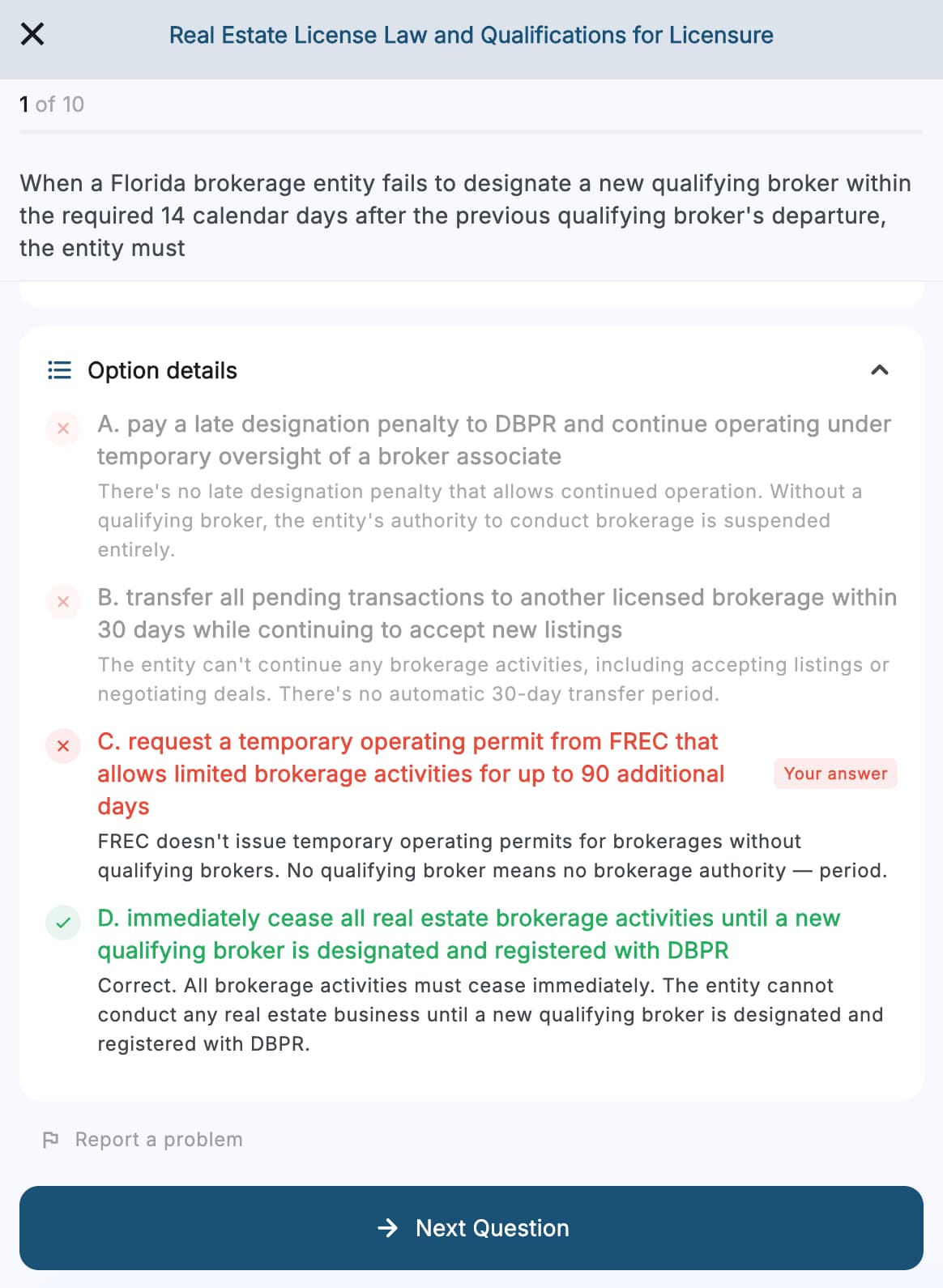
Stem: A Florida sales associate's license became involuntarily inactive 18 months ago because the licensee failed to renew by the renewal deadline. The licensee now wants to return to performing real estate services in Florida. Which of the following statements is MOST correct?
A. The licensee must complete the 28-hour reactivation education course and pay the required renewal fee plus late fee before returning to Current status.
B. The licensee can reactivate by completing only the ordinary 14-hour continuing-education requirement and paying the renewal fee, because the license has not been inactive for 2 years.
C. The license is null and void because all involuntarily inactive licenses expire immediately when the renewal deadline is missed.
D. The licensee is still in active status because Florida licenses do not become involuntarily inactive without a formal FREC disciplinary action.
Show answer
Correct answer: A. Eighteen months is more than 12 months but fewer than 24 months involuntarily inactive. Under F.S. Section 475.183 and the DBPR guidance for delinquent / involuntary inactive licensees, that points to the 28-hour reactivation education path plus renewal fees and late fee before the license can return to Current status.
Option B is wrong because the ordinary 14-hour CE path is for involuntary inactive status of 12 months or less. Once the stem crosses the 12-month line but stays before 24 months, the 28-hour reactivation course is the exam-tested answer.
Option C is wrong because missing the renewal deadline creates involuntary inactive status; it does not make the license automatically null and void on day one. Null and void is the normal answer after the license has been involuntarily inactive for more than 2 years.
Option D is wrong because Florida licenses do become involuntarily inactive when the licensee fails to renew by the deadline. The transition does not require a formal FREC disciplinary action; missing the renewal deadline is the trigger under F.S. Section 475.182 and F.A.C. Chapter 61J2.
The exam-day shortcut for this stem: 18 months involuntary inactive = more than 12 but fewer than 24 months = 28-hour reactivation education plus fees. Option A is the most complete answer.
Related Exam Concepts
| If this is your weak spot | Read this next | Why |
|---|---|---|
| Broader F.S. Chapter 475 statutory framework | F.S. Chapter 475 guide | The statutory backbone for licensee status, discipline, and renewal |
| FREC disciplinary process | FREC rules and violations guide | How FREC actually pursues licensee discipline, which can interact with status decisions |
| Unlicensed-assistant rules (relevant when a license becomes null and void) | Unlicensed assistants guide | What a person whose license has been null and void can and cannot do (typically nothing requiring a license) |
| Sales associate compensation rules | Sales associate compensation guide | The Tier 3 brokerage compensation pillar (compensation rules require active licensure) |
| Retake context for null-and-void path | How many times can you retake the exam guide | The retake rules that apply when full requalification requires a new exam |
| Course certificate validity timeline | Course certificate expired guide | The related certificate-validity timeline for the pre-license course |
| Long-gap re-licensure scenario | Retake after a long break guide | The candidate-side guide for the long-gap scenario that often follows null-and-void |
| Dual-track exposure pattern in another content area | Steering, blockbusting, and redlining guide | The sister Tier 3 dual-track exposure pattern (civil plus professional discipline) |
| Memorization strategy | Florida laws to memorize guide | The broader memorization strategy for Florida exam-tested laws including the 12-month / 24-month timeline |
| Broader exam map | Florida real estate exam 19 topics guide | DBPR topic-weight overview including License Law |
Frequently Asked Questions
What is the difference between voluntary inactive and involuntary inactive?
Voluntary Inactive is licensee-elected: the licensee chose inactive status while keeping the license current. Involuntary Inactive results from failure to renew by the renewal deadline: the licensee did not choose this status, it resulted from inaction. Both statuses prohibit the licensee from performing real estate services until reactivation, and both still carry education and renewal obligations.
How long do I have to reactivate an involuntarily inactive license?
F.S. Section 475.183 uses a 12-month / 24-month structure. At 12 months or less involuntarily inactive, the licensee may reactivate by completing at least 14 hours of commission-prescribed CE and paying the required renewal and late fees. After more than 12 months but fewer than 24 months, the licensee must complete 28 hours of commission-prescribed reactivation education and pay the required renewal and late fees. After more than 2 years involuntarily inactive, the license automatically expires and becomes null and void, subject only to narrow statutory illness/economic-hardship reinstatement language.
Do I have to complete continuing education while my license is inactive?
Yes. Active and inactive licensees have education and renewal obligations. For later-cycle CE, F.A.C. Rule 61J2-3.009 uses the 14-hour continuing-education framework for active and inactive brokers and sales associates, excluding the first renewal period of the current license. Involuntary inactive status can add the 28-hour reactivation education requirement after more than 12 months but before 24 months.
Can a voluntarily inactive licensee perform real estate services?
No. Only Active licensees can perform licensed real estate services for compensation. A Voluntarily Inactive licensee has a current license but cannot perform services until they reactivate.
Does failure to complete continuing education make my license null and void?
It can lead to involuntary inactive status if you cannot renew without the required education, and then to null and void if the license remains involuntarily inactive for more than 2 years. Failing later-cycle CE does not usually make the license null and void instantly; it creates the missed-renewal problem that starts the involuntary-inactive clock. First-renewal post-licensing is different and can be much harsher, so do not merge those two concepts.
What happens after more than 2 years involuntarily inactive?
After more than 2 years involuntarily inactive, F.S. Section 475.183 says the license automatically expires and becomes null and void. For exam purposes, the normal answer is full requalification unless the stem expressly gives the narrow statutory hardship fact pattern involving illness or economic hardship and a timely reinstatement request.
Is voluntary inactive the same as suspended?
No. Voluntary Inactive is a renewal-cycle status the licensee chose. Suspension is a disciplinary status imposed by FREC under F.S. Section 475.25. The two are governed by different statutes and have different consequences.
Where is the license-status topic placed on the DBPR exam outline?
The license-status topic falls inside License Law and Qualifications for Licensure on the DBPR Sales Associate Candidate Information Booklet. Verify current weight allocations against the current CIB.
Does Pass Florida replace my 63-hour course?
No. Pass Florida is exam preparation content, not a substitute for the FREC-approved 63-hour pre-license course, DBPR processes, Pearson VUE scheduling, or licensed professional advice. The app gives you 1,142 Florida-specific practice questions to help you prepare after and alongside your required coursework.
Ready to drill license-status distinctions?
The single discipline that prevents most license-status misses is identifying the status before doing the date arithmetic. The next score jump usually comes from drilling sister Tier 3 brokerage and License Law topics that share the same statutory backbone and disciplinary framework.
- Pair with the broader F.S. Chapter 475 pillar: F.S. Chapter 475 guide
- Pair with the FREC disciplinary process sibling: FREC rules and violations guide
- Pair with the unlicensed-assistant sister: Unlicensed assistants guide
- Try Florida-specific practice questions: Try 5 questions
Methodology
This guide was written for Florida sales associate exam candidates studying the License Law and Qualifications for Licensure content area, particularly the voluntary-inactive vs involuntary-inactive distinction and the 12-month / 24-month involuntary-inactive reactivation timeline. It anchors the three-status disambiguation and the reactivation timeline to: F.S. Section 475.182 (renewal and continuing education), F.S. Section 475.183 (inactive status), F.S. Section 475.25 (FREC discipline, which can interact with status decisions), F.A.C. Chapter 61J2 (FREC rules), F.A.C. Rule 61J2-1.014 (inactive renewal), F.A.C. Rule 61J2-3.009 (continuing education for active and inactive brokers and sales associates), F.A.C. Rule 61J2-3.010 (license reactivation education), F.A.C. Rule 61J2-3.015 (notices of satisfactory course completion), F.A.C. Rule 61J2-3.020 (post-licensing education for active and inactive brokers and sales associates), DBPR guidance on delinquent / involuntary inactive licenses after 12 months, the DBPR Division of Real Estate operational channel, and the DBPR Sales Associate Candidate Information Booklet.
The Three-Status Disambiguation, Reactivation Timeline Decoder, Answer-Choice Decoder, 8-row Florida-specific traps table, and embedded exam-style question are Pass Florida observational coaching pedagogy and are not DBPR, FREC, or Pearson VUE process documents.
Pass Florida is not affiliated with DBPR, FREC, Pearson VUE, or any pre-license course provider, and Pass Florida does not guarantee passage of any state exam. Pass Florida does not replace the FREC-approved 63-hour pre-license course, DBPR application steps, Pearson VUE scheduling rules, fingerprinting, post-licensing, continuing education, or consultation with a qualified licensed professional. Its role is targeted practice with Florida-specific exam-style questions, not legal, license-renewal, continuing-education compliance, brokerage-supervision, or licensing advice.
Real-world license renewal, continuing-education compliance, reactivation procedures, and null-and-void recovery involve specific Florida licensee deadlines, fees, and DBPR processing rules that change over time. Specific situations (whether a particular reactivation pathway applies in a specific fact pattern, exactly what CE hours and fees are required at a specific reactivation date, whether fingerprinting or background re-check is required at relicensure, how a disciplinary status interacts with a renewal status) require qualified legal counsel and direct verification against current DBPR rules. This guide does not substitute for any of that.
Official sources are listed below. Requirements, policies, exam outlines, statutes, regulations, CE hours, fees, and FREC processing rules can change, so verify current details with the official source before making a real-world decision.
Product Note
Pass Florida publishes this guide and offers the exam-prep app linked on this page. Pass Florida is not affiliated with DBPR, FREC, Pearson VUE, or any pre-license course provider, and Pass Florida does not guarantee passage of any state exam.
Sources
- F.S. Section 475.182, Renewal of license; continuing education
- F.S. Section 475.183, Inactive status
- F.S. Section 475.25, Discipline
- F.S. Chapter 475, Real Estate Brokers, Sales Associates, Schools, and Appraisers, Florida Senate
- F.A.C. Rule 61J2-1.014, Inactive Renewal
- F.A.C. Rule 61J2-3.009, Continuing Education for Active and Inactive Broker and Sales Associate Licensees
- F.A.C. Rule 61J2-3.010, License Reactivation Education for Brokers and Sales Associates
- F.A.C. Rule 61J2-3.015, Notices of Satisfactory Course Completion
- F.A.C. Rule 61J2-3.020, Post-licensing Education for Active and Inactive Broker and Sales Associate Licensees
- F.A.C. Chapter 61J2, Florida Real Estate Commission
- DBPR Knowledge Base, What happens if a real estate licensee is delinquent/Involuntary Inactive more than 12 months?
- DBPR Division of Real Estate
- DBPR Sales Associate Candidate Information Booklet PDF
- Pearson VUE Florida Real Estate and Appraisers Licensing Exams
This post is exam preparation content for the Florida Real Estate Sales Associate exam. It is not legal, license-renewal, continuing-education compliance, brokerage-supervision, employment, payroll, tax, insurance, title, closing, or professional advice. Pass Florida is not affiliated with the Department of Business and Professional Regulation (DBPR), the Florida Real Estate Commission (FREC), Pearson VUE, or any pre-license course provider, and Pass Florida does not guarantee passage of any state exam. The Florida license-status framework, continuing-education hours, late-fee and renewal-fee amounts, 12-month / 24-month reactivation deadlines, hardship reinstatement language, and null-and-void recovery rules are governed by F.S. Chapter 475 and F.A.C. Chapter 61J2 and update over time. Specific situations (exact CE hours at a specific reactivation date, exact late-fee amount, whether hardship reinstatement applies, whether fingerprinting or background re-check is required at relicensure, whether a particular disciplinary status interacts with the renewal cycle) require qualified legal counsel and direct verification against current DBPR rules. For real-world decisions, verify current requirements with the official source or consult a qualified licensed Florida professional working within the scope of their licensure.