QUICK ANSWER
The Florida real estate exam laws to memorize first are Chapter 475 and F.A.C. 61J2 for license law, brokerage relationships, escrow, advertising, violations, and Florida Real Estate Commission (FREC) discipline. Then memorize Chapter 83 landlord-tenant deadlines, Chapter 201 documentary stamp tax rates, Chapter 196 homestead structure, Chapter 760 and federal fair housing classes, and federal trigger laws such as RESPA, TILA, ECOA, and lead-based paint. Do not memorize every section number. Learn the rule, the trigger fact, and the exam consequence.
The winning move is to triage each law before flashcards: what does the law control, which tier does it belong to, does the question give a trigger word, then what is the exam consequence.
What this guide covers
- Florida real estate exam laws to memorize: the practical map
- The official source map
- The 4-step law triage
- The fast decision: memorize, recognize, or skim?
- The 48-hour priority list
- Chapter 475: the license-law backbone
- Rule 61J2: the details that turn into exam answers
- Chapter 83: residential landlord-tenant law
- Chapter 201: documentary stamp tax
- Chapter 196: homestead exemption
- Chapter 760 and federal fair housing law
- Federal laws: what to recognize
- Other Florida chapters in the DBPR reference list
- The law memorization ladder
- Mistakes students make with Florida law questions
- Read the Wrong Assumptions
- Related exam concepts
- FAQ
Deadlines, duties, protected classes, exemptions, tax rates, and FREC authority belong here.
Know what RESPA, TILA, ECOA, ADA, Chapter 689, and Chapter 95 are used for.
Corporate chapters, organizational statutes, and broad procedural laws are lower-yield.
LAW OVERLOAD IS REAL
Turn statute names into exam triggers.
Turn the rule in this guide into Florida-specific scenario practice, then explain why each plausible distractor is wrong.
Florida Real Estate Exam Laws to Memorize: The Practical Map
Memorize the laws that create exam decisions: license authority, brokerage duties, escrow deadlines, landlord-tenant deadlines, tax rates, homestead structure, protected classes, and federal disclosure triggers.
If you are asking what laws to memorize for the Florida real estate exam, you are probably feeling the exact problem DBPR creates by being thorough.
The Candidate Information Booklet lists Chapter 475, Chapter 61J2, and a long set of Florida statutes and federal laws that may be useful for preparation. That list is real. It is also not a command to memorize every chapter line by line.
The exam is not trying to turn you into a lawyer.
What the exam tests is whether a new Florida sales associate can recognize the law that controls a real estate scenario: who needs a license, what a transaction broker owes, when escrow money must move, what a landlord must do with a deposit, which protected class is involved, what tax rate applies, or which disclosure rule fits the transaction.
That means you need three levels of study:
| Level | What to do | Examples |
|---|---|---|
| Memorize cold | Know the number, duty, deadline, or protected class | Next-business-day and third-business-day escrow deposit rules, 15/30 escrow dispute rule, fair housing classes |
| Recognize | Know what the law controls and what exam topic it belongs to | RESPA, TILA, ECOA, Chapter 689, Chapter 95 |
| Skim only | Know the chapter exists but do not turn it into a week-long project | Corporate entity chapters, broad administrative procedure |
The goal is not to win a statute-number contest. The goal is to answer Florida sales associate questions correctly.
The Official Source Map
Use the DBPR Candidate Information Booklet for exam references, the DBPR Law Book for Chapter 475 and F.A.C. 61J2 access, Florida Statutes for current law, and agency sources for tax, fair housing, credit, settlement, and lead disclosures.
Use each source for the job it actually does. This keeps you from over-reading low-yield law and under-studying high-yield exam triggers.
| Source | Use it for | Do not use it for |
|---|---|---|
| DBPR Candidate Information Booklet | Exam outline, topic weights, reference list, scoring, exam logistics | A section-by-section study plan |
| DBPR printable Law Book | Direct access to Chapter 475 and F.A.C. 61J2 | Replacing your approved course or practice questions |
| Florida Statutes | Current statutory text for Chapter 475, 83, 196, 201, 760, 689, 725, and related chapters | Guessing exam weight from chapter length |
| Florida Administrative Code | FREC operational rules, especially escrow, advertising, education, and discipline | Memorizing every rule number equally |
| HUD, CFPB, EPA | Federal fair housing, mortgage disclosure/credit, and lead-based paint recognition | Deep federal compliance research for the sales associate exam |
The CIB is the map. The law book is a reference. Your study plan should be built from exam weight plus the rules that turn into clear answer choices.
The 4-step law triage
Triage every law question by control area, study tier, trigger word, and exam consequence before you pick an answer.
When a law question feels heavy, do not start by trying to recall the section number. Force the question through this order.
| Step | Ask this | Common clue words |
|---|---|---|
| 1. What does the law control? | License, escrow, brokerage relationships, landlord-tenant, taxes, fair housing, settlement disclosures, credit, contracts | who needs a license, deposit, deadline, deed, stamp, homestead, race, RESPA, TILA |
| 2. Which tier does it belong to? | Tier 1 (Chapter 475 + 61J2), Tier 2 (Chapter 83 + 201 + 196 + 760), Tier 3 (RESPA/TILA/ECOA/lead-based paint), Tier 4 (organizational and procedural chapters) | weight, scenario-tested, recognize-only, context-only |
| 3. Does the question give a trigger word? | Specific number, protected class, deadline, dollar amount, or prohibited act | 3 business days, 15 days, $25,000, race, kickback, panic sell |
| 4. What is the exam consequence? | License denial, FREC discipline, dollar amount, refund deadline, prohibited act, voidable contract, exemption granted | revocation, fine, treble damages, return deposit, eviction notice |
This is the same habit you want on test day: control function first, tier second, trigger word third, answer letter last.
The exam version
Read the last sentence of the question first. If it asks, "Who needs a license?" think Tier 1 / Chapter 475. If it asks, "What is the deadline?" think Tier 2 deadlines (escrow 1/3/15/30, Chapter 83 15/30/15 and 3/7/7, homestead Jan 1 / March 1). If it asks, "Which federal law controls?" think Tier 3 recognition (RESPA for settlement, TILA for credit cost, ECOA for credit discrimination, lead-based paint for pre-1978 housing). If it asks about Chapter 542 or Chapter 120, you are probably in Tier 4 context territory and the answer is usually the general concept, not the section number.
The Fast Decision: Memorize, Recognize, or Skim?
Memorize laws that create a direct answer, recognize laws that identify the legal context, and skim reference-list chapters that rarely need section-by-section recall.
Use this table before you start making flashcards.
| Law source | Study level | Why it matters |
|---|---|---|
| Chapter 475, Part I | Memorize core sections | License law, FREC, brokerage relationships, escrow, discipline, compensation |
| F.A.C. Chapter 61J2 | Memorize high-yield rules | FREC rules, escrow timing, advertising, education, discipline guidelines |
| Chapter 83 | Memorize patterns | Residential deposits, notices, self-help eviction, landlord and tenant duties |
| Chapter 201 | Memorize rates | Documentary stamps on deeds and notes |
| Chapter 196 | Memorize homestead structure | Exemption layers, filing timing, school vs non-school split |
| Chapter 760 and federal fair housing | Memorize classes and practices | Protected classes, steering, blockbusting, redlining, accommodations |
| RESPA and TILA | Recognize | Settlement and credit-cost disclosure context |
| ECOA | Recognize | Credit discrimination context |
| Lead-based paint law | Recognize key trigger | Pre-1978 residential housing disclosure |
| Chapter 689 and Chapter 725 | Recognize | Deeds, conveyances, statute of frauds and contracts |
| Chapter 95 | Recognize | Statute of limitations and adverse possession context |
| Corporate and business entity chapters | Skim | Entity registration context, usually not deep statute recall |
If you are 2 weeks out from the exam, start at the top of this table. If you are 48 hours out, memorize only the cold rules and use the rest for recognition.
The 48-Hour Priority List
In the last 48 hours, memorize Chapter 475, F.A.C. 61J2 escrow and advertising, Chapter 83 deadlines, Chapter 201 tax rates, Chapter 196 homestead, fair housing, and federal trigger laws.
If the exam is close, use this order. It is designed for score movement, not legal completeness.
| Priority | Memorize this | Why it moves points |
|---|---|---|
| 1 | Chapter 475 license triggers, FREC powers, brokerage relationships, discipline, compensation | These questions appear across multiple content areas, not just one law bucket |
| 2 | 61J2 escrow and advertising: 1 / 3 / 15 / 30 timing, personal-fund caps, misleading ad logic | The answer choices are often pure deadline or rule-recognition traps |
| 3 | Chapter 83 residential deadlines: 15 / 30 / 15 deposits, 3 / 7 / 7 notices, 30-day month-to-month termination | Close numbers are easy points if you keep them grouped |
| 4 | Chapter 201 deed stamps, note stamps, Miami-Dade exception, and intangible tax | Law turns directly into math |
| 5 | Chapter 196 homestead: January 1, March 1, school vs non-school, 2026 $26,411 additional layer, Save Our Homes | Homestead appears as both law and property-tax math |
| 6 | Fair housing: seven classes, 1866 race rule, exemptions, steering/blockbusting/redlining, accommodation/modification | Scenario wording changes the legal label |
| 7 | RESPA, TILA/Reg Z, ECOA, lead-based paint | Federal recognition questions reward trigger words, not code-section recall |
Then stop reading new law and do mixed questions. The final stretch is for retrieval practice, not a fresh tour through the statute book.
Chapter 475: The License-Law Backbone
Chapter 475 is the backbone of the Florida sales associate exam because it controls licensing, FREC authority, compensation, discipline, brokerage relationships, escrow, violations, and the Recovery Fund.
Chapter 475 is the most important Florida statute for the sales associate exam. It is the source behind license requirements, FREC authority, brokerage relationships, escrow duties, discipline, unlicensed practice, compensation, and Recovery Fund basics.
Do not read it like a legal code. Read it like an exam scenario map.
| Section or topic | What to memorize | Exam trigger |
|---|---|---|
| F.S. 475.01 | Broker, sales associate, broker associate, compensation, customer, single agent, transaction broker | Who needs a license? |
| F.S. 475.011 | Main exemptions | Owner, attorney, trustee, salaried employee, onsite apartment employee |
| F.S. 475.02 | FREC membership | 7 members: 4 brokers, 1 broker or sales associate, 2 consumers, at least one age 60+ |
| F.S. 475.17 | Sales associate qualifications | Age 18, high school or equivalent, character, pre-license course, exam |
| F.S. 475.25 | Discipline | Denial, probation, suspension, revocation, reprimand, fine up to $5,000 per count |
| F.S. 475.278 | Brokerage relationships | Transaction broker, single agent, no brokerage relationship |
| F.S. 475.42 | Violations and penalties | Unlicensed practice, false information, illegal compensation, trade-name problems |
| F.S. 475.482 to 475.486 | Recovery Fund | Consumer recovery after qualifying licensee misconduct |
The most important Chapter 475 skill is recognizing the fact pattern.
If a question asks whether a person needs a license, look for "for another" and "for compensation." If a question asks who may be paid, remember that a sales associate is paid through the employing broker. If a question asks what FREC can do after misconduct, think discipline under F.S. 475.25.
For the full map, use the Florida Statute 475 real estate exam guide.
Rule 61J2: The Details That Turn Into Exam Answers
F.A.C. 61J2 turns Chapter 475 into operational exam answers, especially escrow timing, broker records, advertising, education, and disciplinary guidelines.
Chapter 475 gives the law. F.A.C. Chapter 61J2 gives many of the operational rules.
Do not memorize every rule number. Memorize the rule families that create clean exam answers.
| Rule family | What to know cold | Related guide |
|---|---|---|
| 61J2-10 | Offices, advertising, trade names, kickbacks, escrow notice requirements | FREC rules and violations |
| 61J2-14 | Funds entrusted to brokers, deposits, escrow, records | Escrow and trust account rules |
| 61J2-24 | Disciplinary guidelines, citations, noncompliance | FREC rules and violations |
| 61J2-3 | Education requirements | How long the Florida license takes |
The highest-yield 61J2 facts are escrow and advertising.
Escrow facts to memorize
| Situation | Rule |
|---|---|
| Sales associate receives deposit | Deliver to broker or employer by end of next business day |
| Broker receives deposit | Place into escrow no later than end of third business day after receipt |
| Broker-held conflicting demands | Notify FREC within 15 business days of last demand |
| Broker-held good-faith doubt | Notify FREC within 15 business days after the doubt |
| Settlement procedure | Institute within 30 business days |
| Sales escrow personal funds cap | $1,000 |
| Property management escrow personal funds cap | $5,000 |
Practice those with the Florida real estate escrow practice questions.
Advertising facts to memorize
Know that advertising cannot be false, fraudulent, deceptive, or misleading. Know that brokerage name visibility matters. Know that team advertising rules can matter if the question gives a team or group name that hides the brokerage relationship.
Do not spend a week memorizing every advertising subsection. Learn the exam logic: the public must know who the broker is, and the ad cannot mislead.
Chapter 83: Residential Landlord-Tenant Law
For Chapter 83, memorize the residential deposit and notice deadlines: 15 days, 30 days, 15 days for deposits, and 3 days, 7 days, 7 days for common notices.
Chapter 83 can feel like a small topic because it lives inside the Federal and State Laws content area. Do not ignore it. It has clean deadlines that make easy exam points if you know the pattern.
Memorize the residential pattern from Chapter 83, Part II.
| Topic | What to memorize | Exam trap |
|---|---|---|
| Security deposit, no claim | Return deposit within 15 days after termination | Using 30 days when there is no claim |
| Security deposit claim | Written claim notice within 30 days after termination | Starting from inspection date instead of termination |
| Tenant objection | 15 days after receiving claim notice | Starting from move-out date |
| Nonpayment of rent | 3-day notice, excluding Saturday, Sunday, and court holidays | Counting weekend days |
| Curable noncompliance | 7-day notice to cure | Treating every violation as noncurable |
| Noncurable noncompliance | 7-day notice to vacate | Giving a cure period when the violation cannot be cured |
| Month-to-month termination | At least 30 days before end of monthly period | Using the old 15-day rule |
| Self-help eviction | Illegal | Choosing lockout or utility shutoff |
The exam does not need many landlord-tenant questions to hurt you. The numbers are close together, and answer choices are built to blur them.
For the full current-law version, read Florida landlord-tenant law for the real estate exam.
Chapter 201: Documentary Stamp Tax
For Chapter 201, memorize deed stamps at $0.70 per $100 in most counties, Miami-Dade exceptions, and note or mortgage stamps at $0.35 per $100.
Chapter 201 is where Florida documentary stamp tax lives.
For exam purposes, memorize the rates and what document they apply to.
| Tax | What to memorize | Common trap |
|---|---|---|
| Deed stamps, most counties | $0.70 per $100 of consideration | Using the mortgage-note rate |
| Deed stamps, Miami-Dade single-family | $0.60 per $100 | Forgetting the county exception |
| Deed stamps, Miami-Dade non-single-family | $1.05 per $100 | Missing the surtax |
| Notes and written obligations | $0.35 per $100 of loan amount | Using the deed rate |
| Nonrecurring intangible tax | 0.002 on new mortgage amount | Applying to sale price instead of loan amount |
Chapter 201 directly controls deed and note stamps. Nonrecurring intangible tax is a related Florida closing-cost rule that students should study with the documentary stamp family even though it is not the same chapter.
For examples and calculator practice, use Documentary stamps and closing costs and the documentary stamp tax calculator.
Chapter 196: Homestead Exemption
For Chapter 196, memorize January 1 qualification, March 1 filing, the first $25,000 layer, the 2026 additional $26,411 non-school layer, and Save Our Homes.
Chapter 196 matters because homestead shows up as both law and math.
Memorize the structure, not just the slogan.
| Homestead fact | What to know |
|---|---|
| Qualification date | Owner must qualify as of January 1 |
| Usual filing deadline | March 1 with county property appraiser |
| First exemption layer | First $25,000 applies to school and non-school ad valorem taxes |
| Additional exemption layer | $26,411 for 2026; applies above $50,000 and to non-school taxes only |
| School vs non-school | School taxes do not get the additional layer |
| Save Our Homes | Limits assessed-value increases on homesteads to 3% or CPI, whichever is lower; DOR's 2026 CPI adjustment document lists 2.7% |
| Portability | Can transfer up to $500,000 of accumulated Save Our Homes benefit if the owner had a Florida homestead exemption in any of the 3 immediately preceding years |
For 2026 study, use the current homestead guide because the additional exemption and Save Our Homes cap are now year-sensitive. Read Florida homestead exemption on the real estate exam.
Chapter 760 and Federal Fair Housing Law
Memorize the seven statewide and federal housing classes: race, color, national origin, religion, sex, familial status, and disability.
Fair housing is one of the clearest "memorize cold" areas.
Know the seven federal Fair Housing Act protected classes:
- Race
- Color
- National origin
- Religion
- Sex
- Familial status
- Disability
Florida's statewide housing discrimination statute, F.S. 760.23, tracks the same main housing classes. Some local Florida ordinances may add classes, but do not automatically add local classes to a statewide exam question unless the question tells you to.
Also memorize the exam pairings:
| Law or concept | What it does | Exam trigger |
|---|---|---|
| Fair Housing Act | Prohibits housing discrimination in protected classes | Refusal to rent, steering, discriminatory ads |
| Civil Rights Act of 1866 | Race discrimination in property rights, no race exemption | Owner-occupied exemption with race fact |
| HOPA | Senior housing exception to familial-status rules | 55+ or 62+ community |
| Reasonable accommodation | Rule or policy change for disability | No-pets exception for assistance animal |
| Reasonable modification | Physical change for disability | Ramp, grab bars |
| Steering | Directing buyers or renters by protected class | "You would be happier in this area" |
| Blockbusting | Panic-selling pressure aimed at owners | "Sell before values drop" |
| Redlining | Lending or insurance discrimination by area | Lender refuses a neighborhood |
For the deeper table, use the fair housing exam guide.
DEADLINES, RATES, AND CLASSES
Memorizing the law is step one. Recognizing it in a scenario is the exam.
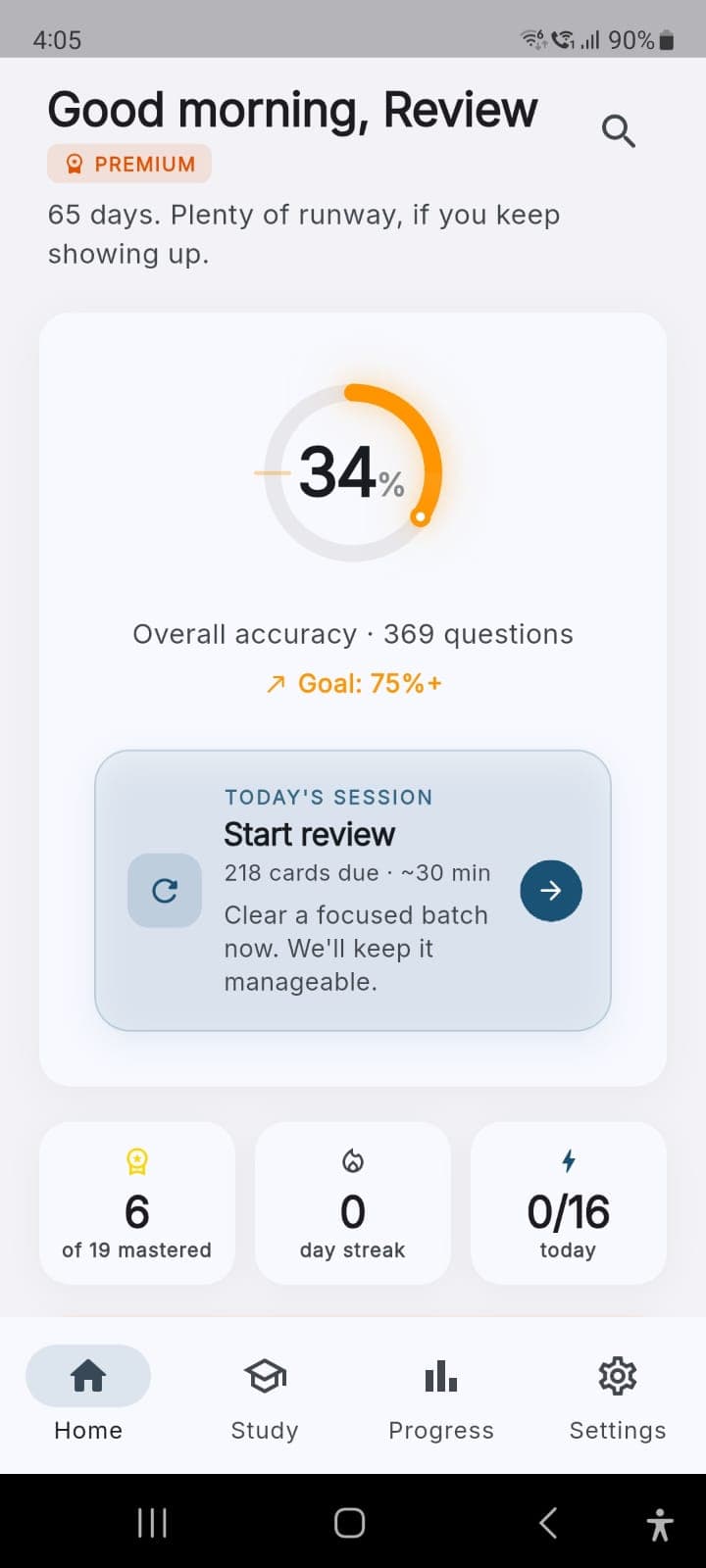
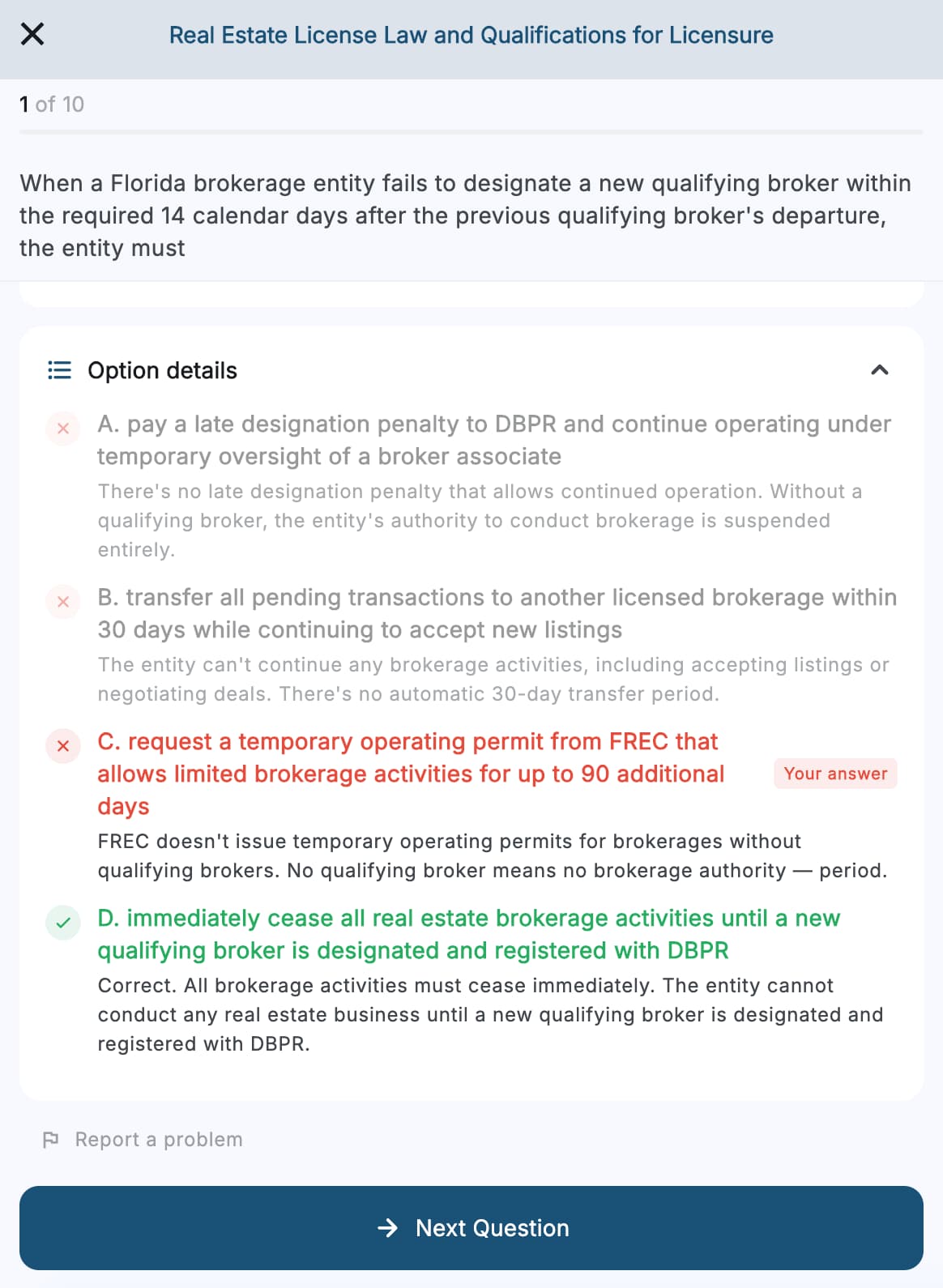
Pass Florida turns these statutes into the fact patterns the exam actually uses: 1,142 Florida-specific questions, a 19-topic diagnostic, a Trap Library, and weak-area drilling, for one $39.99 purchase. No subscription. No copied exam questions.
Federal Laws: What to Recognize
Recognize federal laws by trigger: RESPA for settlement and kickbacks, TILA for credit-cost disclosures, ECOA for credit discrimination, and lead-based paint for pre-1978 housing. The antitrust and kickbacks guide drills the Sherman Act and RESPA referral traps in detail.
The DBPR reference list includes several federal laws. You do not need to memorize every U.S. Code section, but you should know what each law controls.
| Federal law | What to recognize | Exam use |
|---|---|---|
| RESPA | Settlement procedures, referral fee and kickback restrictions, settlement disclosures | Closing and mortgage transaction questions |
| TILA | Credit-cost disclosure, APR, loan terms | Mortgage lending and disclosure questions |
| ECOA | Credit discrimination | Lender cannot discriminate based on protected credit factors |
| Fair Housing Act | Housing discrimination | Protected classes and prohibited practices |
| Civil Rights Act of 1866 | Race discrimination in property rights | No race exemption |
| Lead-Based Paint Hazard Reduction Act | Pre-1978 residential lead disclosure | Seller or landlord disclosure before buyer or tenant is bound |
| ADA | Disability access and public accommodations context | Usually recognize, not deep real estate sales recall |
If you are short on time, prioritize Fair Housing Act, Civil Rights Act of 1866, RESPA, TILA, ECOA, and lead-based paint. Those are more likely to appear as recognizable transaction facts.
Other Florida Chapters in the DBPR Reference List
Skim the lower-yield Florida chapters for legal context, but do not give them the same study time as Chapter 475, F.A.C. 61J2, Chapter 83, Chapter 201, Chapter 196, and fair housing.
The CIB reference list is broad. Some chapters matter because they explain the legal background behind exam topics, but they usually do not require detailed section-number memorization.
| Chapter | Study level | What to know |
|---|---|---|
| Chapter 95 | Recognize | Statute of limitations and adverse possession |
| Chapter 120 | Skim | Administrative procedure context |
| Chapter 163 | Recognize | Local planning and growth management |
| Chapter 193 | Recognize | Assessments and Green Belt law |
| Chapter 197 | Recognize | Tax collections, tax liens, tax certificates |
| Chapter 542 | Recognize | Antitrust and restraint of trade |
| Chapter 689 | Recognize | Conveyances, deeds, land trusts |
| Chapter 695 | Recognize | Recording real estate conveyances |
| Chapter 701 | Recognize | Mortgage assignment and cancellation |
| Chapter 712 | Recognize | Marketable Record Title Act |
| Chapter 718, 719, 720 | Recognize | Condominiums, cooperatives, homeowners' associations |
| Chapter 725 | Recognize | Statute of frauds and unenforceable contracts |
This is where students over-study. If the exam asks about a deed clause, you need the deed concept. You usually do not need to quote Chapter 689. If the exam asks about antitrust, you need price fixing, market allocation, group boycotts, and tie-in arrangements. You usually do not need to recite Chapter 542.
The Law Memorization Ladder
Spend most study time in Tier 1 and Tier 2, use Tier 3 for trigger-word recognition, and treat Tier 4 as context only.
Use this ladder to study without drowning.
| Tier | What belongs here | How to study |
|---|---|---|
| Tier 1 | Chapter 475, F.A.C. 61J2, brokerage relationships, escrow, discipline | Scenario questions and flashcards |
| Tier 2 | Fair housing, Chapter 83, Chapter 201, Chapter 196 | Tables, deadlines, protected classes, rates |
| Tier 3 | RESPA, TILA, ECOA, lead-based paint, Chapter 689, Chapter 725 | Trigger-word recognition |
| Tier 4 | Corporate, partnership, administrative, and organizational laws | Skim as context only |
Spend most of your time in Tier 1 and Tier 2.
Tier 3 is for recognition. Tier 4 is for context. If you are using Tier 4 to avoid escrow or fair housing, you are probably studying the wrong thing.
Mistakes Students Make With Florida Law Questions
The most common law-study mistakes are memorizing section numbers, treating every reference equally, mixing protected-class lists, skipping deadlines, and avoiding tax formulas.
Mistake 1: Memorizing section numbers instead of rule triggers
Knowing "475.278" is less useful than knowing transaction broker is the presumed relationship and is not fiduciary representation.
Mistake 2: Treating every reference in the CIB as equally testable
DBPR lists many references. The exam weights tell you where to spend energy. Brokerage activities and contracts carry much more weight than planning and zoning.
Mistake 3: Mixing federal and Florida protected classes
For statewide Florida housing law, use the seven housing classes unless the question gives a local ordinance or another legal context.
Mistake 4: Studying landlord-tenant law without deadlines
Chapter 83 questions often turn on the number: 15, 30, 15 for deposits, and 3, 7, 7 for notices.
Mistake 5: Studying tax chapters without formulas
Chapter 201 and Chapter 196 are not just law vocabulary. They become math questions through deed stamps, mortgage stamps, homestead, school taxes, non-school taxes, and millage.
Read the Wrong Assumptions
Wrong assumptions usually come from treating the law book like the exam blueprint instead of using trigger facts, consequences, and DBPR topic weights.
Wrong assumptions about Florida law are the real risk in this topic. Use this decoder when a question feels too dense or you cannot decide where to start.
| Wrong assumption | Better exam-day assumption |
|---|---|
| "I need to memorize every chapter the CIB lists" | The CIB references many laws; only Tier 1 and Tier 2 deserve full memorization |
| "Section numbers are the answer" | Trigger facts and consequences are the answer; section numbers are mostly recognition |
| "If it is in the DBPR law book, it is equally tested" | Law-book length is reference depth, not exam weight |
| "Florida adds age and marital status to statewide housing classes" | F.S. 760.23 lists the seven housing classes; local ordinances are separate |
| "RESPA, TILA, and ECOA are the same federal law" | RESPA covers settlement, TILA covers credit cost, ECOA covers credit discrimination |
| "Chapter 542 antitrust needs deep section recall" | Recognize price fixing, market allocation, group boycotts, and tying; do not recite the chapter |
| "Reading the DBPR Law Book cover to cover is the study plan" | The CIB itself says the law book is reference, not a study guide |
If you can name why the wrong assumption fails in one sentence, you are close to test-ready.
Related Exam Concepts
Pair this law map with Chapter 475, FREC rules, escrow, fair housing, landlord-tenant, homestead, documentary-stamp, and 19-topic study resources.
| Concept | Why it matters | Read next |
|---|---|---|
| Chapter 475 | Core Florida license law | Florida Statute 475 guide |
| Fair housing | Protected classes and prohibited practices | Fair housing on the Florida exam |
| Escrow | Deadlines, disputes, commingling, conversion | Escrow and trust account rules |
| Landlord-tenant | Chapter 83 notices and deposits | Florida landlord-tenant law |
| Homestead | Chapter 196 and property tax math | Florida homestead exemption |
| Documentary stamps | Chapter 201 and closing-cost math | Documentary stamps and closing costs |
| Topic weights | Shows where law appears on the outline | Florida real estate exam 19 topics |
Frequently Asked Questions
What laws should I memorize for the Florida real estate exam?
Memorize the core exam patterns from Chapter 475, F.A.C. 61J2, Chapter 83, Chapter 201, Chapter 196, Chapter 760, and federal fair housing law. Recognize RESPA, TILA, ECOA, lead-based paint, Chapter 689, Chapter 725, and antitrust law by their exam use.
Do I need to memorize statute numbers?
Only a few section numbers are worth recognizing, such as Chapter 475 for license law, F.S. 475.278 for brokerage relationships, Chapter 83 for landlord-tenant, Chapter 201 for documentary stamps, and Chapter 196 for homestead. The exam usually tests what the law does, not whether you can cite a section number.
Is Chapter 475 the most important Florida real estate law?
Yes, for the sales associate exam. Chapter 475 is the backbone for licensing, FREC, broker and sales associate duties, compensation, escrow, brokerage relationships, discipline, and violations.
What federal laws are most important for the exam?
Know the Fair Housing Act, Civil Rights Act of 1866, RESPA, TILA, ECOA, and lead-based paint disclosure rules. You usually need to recognize the scenario and prohibited conduct rather than recite the U.S. Code section.
Should I read the whole DBPR law book?
Use the DBPR law book as a reference, not as your main study plan. The CIB itself says the law booklet is not a study guide and does not replace approved course material. For exam prep, focus on the laws that create scenarios, deadlines, disclosures, dollar amounts, and prohibited acts.
What is the fastest way to study Florida real estate law?
Use one table per law family. For Chapter 475, learn who may do what. For 61J2, learn escrow and advertising details. For Chapter 83, learn the notices. For Chapter 201 and Chapter 196, learn the math triggers. For fair housing, learn protected classes and prohibited practices. Then practice mixed Florida-specific questions.
Ready to triage the laws by exam yield?
The best next step is to test law triggers under pressure, then download Pass Florida when you need full Florida-specific repetition across the 19-topic outline.
You do not pass the Florida real estate exam by memorizing every law in the reference list.
You pass by knowing which laws control the most common exam facts.
Chapter 475 and Rule 61J2 are your backbone. Chapter 83, Chapter 201, Chapter 196, Chapter 760, and federal fair housing law are your next layer. RESPA, TILA, ECOA, lead-based paint, deeds, contracts, recording, and antitrust are recognition topics.
Learn the trigger. Learn the consequence. Then practice the scenario.
Print the Chapter 475 key sections cheat sheet to keep the backbone statutes in front of you, or browse the free study PDF library for the brokerage relationships matrix and fair housing protected classes sheets.
Start with practice violations and penalties, then test mixed wording on the free timed practice exam. When you need the full law-and-scenario question bank, see what the one-time purchase includes or download Pass Florida.
Methodology
The article prioritizes laws based on exam weight, frequency of scenario testing, and whether the law creates a deadline, disclosure, duty, rate, protected class, or prohibited act. The 4-step law triage, official source map, 48-hour priority list, and Memorize/Recognize/Skim framework are independent Pass Florida pedagogy derived from common candidate mistakes, not DBPR or Florida Real Estate Commission (FREC) test frameworks.
This is exam-prep education for Florida sales associate candidates. It is not legal advice and is not a substitute for the FREC-approved 63-hour pre-license course, continuing education, broker guidance, or qualified Florida real estate counsel.
Product Note
Pass Florida publishes this guide and offers the exam-prep app linked on this page. Pass Florida is independent exam preparation, not a DBPR-approved pre-licensing course, continuing education course, legal service, brokerage compliance tool, or guarantee of passage.
Sources
- DBPR Florida Real Estate Sales Associate Candidate Information Booklet
- DBPR Florida Real Estate Law Book
- F.A.C. 61J2-2.029, Examination Areas of Competency
- F.S. Chapter 475
- F.A.C. Chapter 61J2-10
- F.A.C. Chapter 61J2-14
- F.A.C. Chapter 61J2-24
- F.S. Chapter 83
- F.S. 83.49, Deposit money or advance rent; duty of landlord and tenant
- F.S. 83.56, Termination of rental agreement
- F.S. 83.57, Termination of tenancy without specific term
- F.S. Chapter 201
- F.S. Chapter 196
- Florida Department of Revenue, 2026 Additional Homestead Exemption Adjustment
- F.S. 760.23, Discrimination in sale or rental of housing and other prohibited practices
- HUD Fair Housing Act overview
- CFPB RESPA and Regulation X resources
- CFPB Regulation Z / Truth in Lending
- CFPB Equal Credit Opportunity Act resources
- EPA Lead-Based Paint Disclosure Rule
This post is exam preparation content for the Florida Real Estate Sales Associate exam. It is not legal, tax, financial, lending, appraisal, brokerage, insurance, title, closing, or professional advice. F.S. Chapter 475 amendments, F.A.C. 61J2 rule revisions, the inflation-adjusted Chapter 196 additional homestead exemption amount, CFPB rule updates affecting RESPA / TILA / ECOA, HUD final rules, and Florida documentary-stamp rate changes can revise between exam windows. For real-world decisions, verify against the current primary source and consult a qualified licensed Florida professional. Studying with Pass Florida or any other exam-prep tool does not guarantee passage of the state exam.