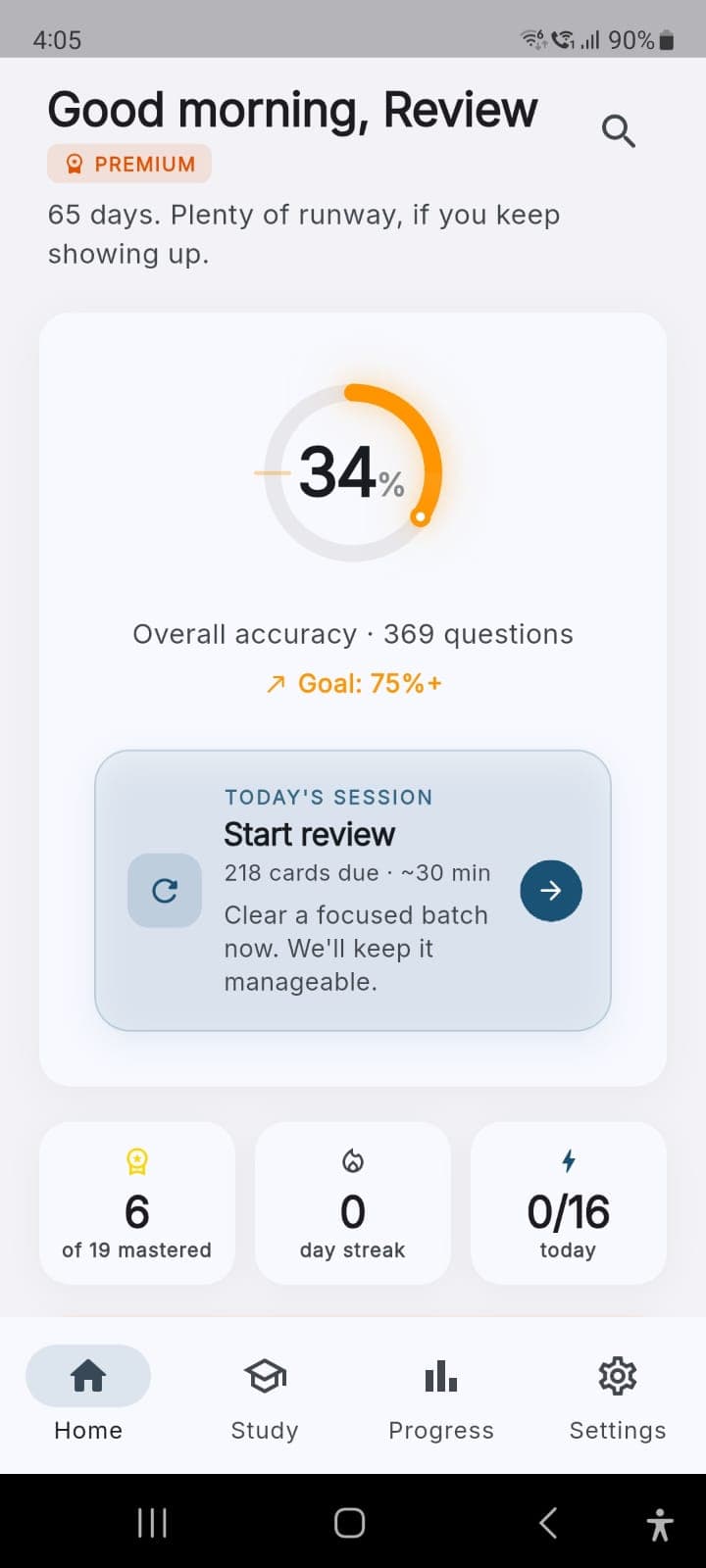
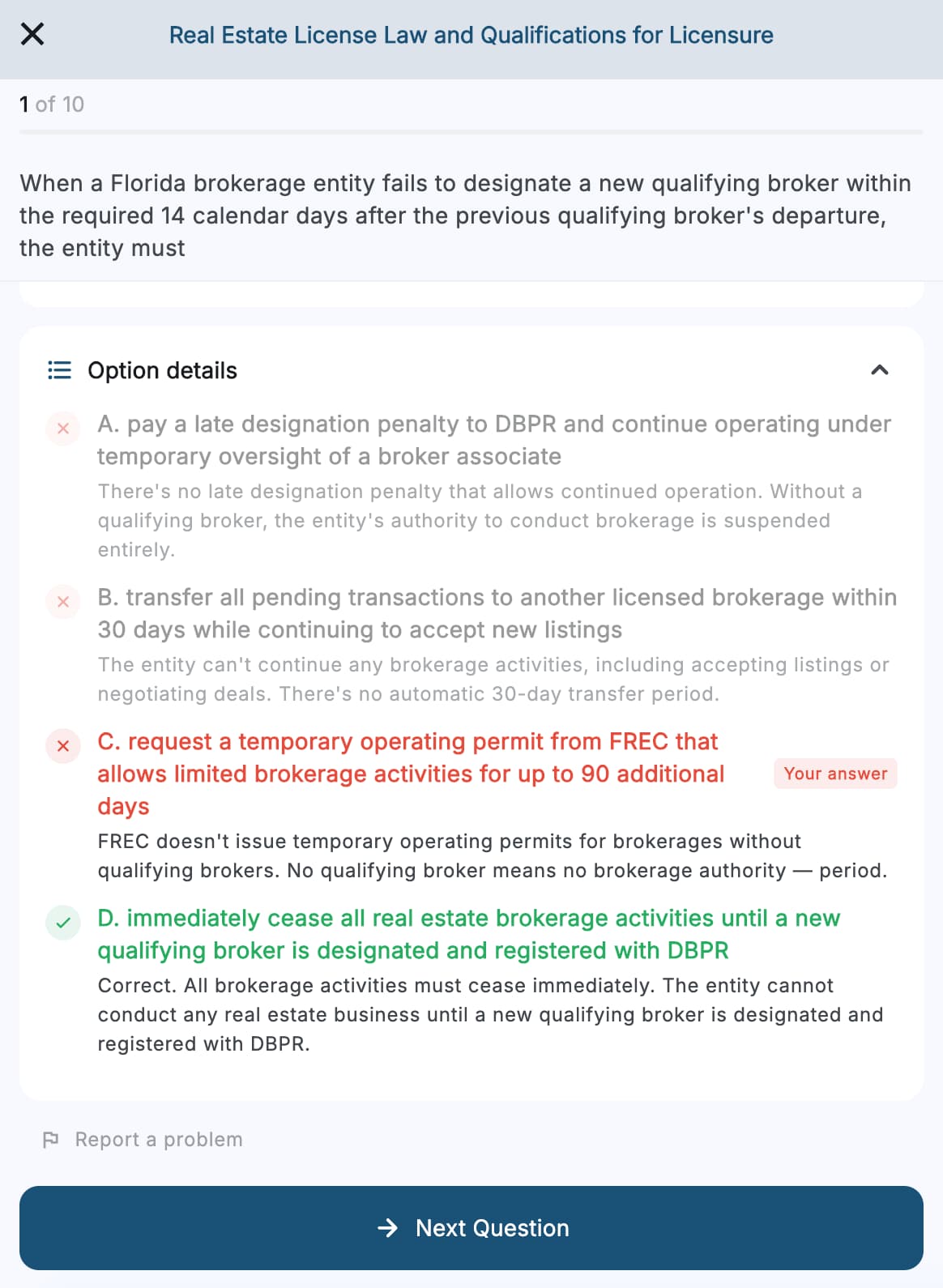
VERIFY BEFORE RELYING
These are original teaching questions for the 12% Real Estate Contracts slice. The underlying rules sit at the intersection of Florida common law (Johnson v. Davis), the Florida Statute of Frauds (F.S. 725.01), Florida brokerage relationship law (F.S. 475.278), disclosure statutes (F.S. 404.056 radon, F.S. 689.261 property tax, F.S. 689.302 flood, F.S. 553.996 energy efficiency, F.S. 720.401 HOA, F.S. 718.503 condo), the federal lead-based paint rule, and post-August-17-2024 NAR (National Association of Realtors) buyer-agreement policy changes. Florida Realtors forms can also revise between exam windows. For exam purposes, study the framework these questions train. For a real transaction or compliance question, verify against the current Florida Statutes Chapter 475, the applicable disclosure statute, the current F.A.C. 61J2-2.029 competency rule, the current DBPR Sales Associate Candidate Information Booklet, and qualified Florida real estate counsel.
QUICK ANSWER
Florida real estate exam contracts practice questions should train scenarios, not definitions. The contracts section is 12% of the Florida sales associate exam, so expect roughly 12 questions on contract essentials, offer and acceptance, Statute of Frauds, void versus voidable contracts, assignment, novation, option contracts, listing agreements, buyer-broker agreements, sale contracts, breach remedies, and mandatory disclosures. Use the 13 original questions below to find your weak spots before you take a full practice exam.
Do not just check whether you got the letter right. For every miss, name the trigger fact and the legal consequence.
WHO THIS GUIDE IS FOR
Florida sales associate candidates who have already reviewed the contract rules and want to test whether the distinctions are automatic under pressure. Useful as a diagnostic before a full timed practice exam, or as a focused drill after a missed contracts score on a topic-mix set. Pair with the Florida real estate contracts guide for the rule explanations behind each question, the Florida real estate vocabulary guide for close-term distinctions, and the question wording guide for EXCEPT / BEST / legal-consequence stems. Not a substitute for the Florida Real Estate Commission (FREC) approved 63-hour pre-license course.
What this guide covers
- How to use this page
- What the exam tests in contracts
- Fast decision: are you ready on contracts?
- The 4-step question triage
- The contract rule table to know first
- 13 original Florida real estate exam contracts practice questions
- Answer key and rule map
- What your misses mean
- Common mistakes students make on contract questions
- Related exam concepts
- A 2-day contracts fix plan
- FAQ
CONTRACTS ARE A HIGH-VALUE TOPIC
Practice the rule behind the wording, not just the vocabulary.
Practice Florida contract scenarios that force you to distinguish valid, void, voidable, and unenforceable agreements from the facts in the stem.
Florida Real Estate Exam Contracts Practice Questions: How to Use This Page
Use these contracts practice questions after one rule review. Answer first, read the explanation, identify the trigger fact, and write the legal consequence you missed.
Use these Florida real estate exam contracts practice questions after you have reviewed the rules once. If you have not studied the topic yet, start with the Florida real estate contracts guide, then come back here and test yourself.
Do not rush the answer choices. Contract questions often turn on one word:
- Void versus voidable
- Assignment versus novation
- Inquiry versus counteroffer
- Executory versus executed
- Option versus right of first refusal
- Legal title versus equitable title
The student who loses contracts points usually does not miss because the story is confusing. They miss because two answer choices sound legally possible, and only one matches the exact consequence.
What the Exam Tests in Contracts
Florida contracts practice should cover formation, classification, disclosure, remedies, and transaction judgment, not just contract vocabulary.
The DBPR sales associate outline places Real Estate Contracts at 12% of the exam. The official subtopics are not just "contracts" in general. They include preparation of contracts, essentials of a contract, Statute of Frauds, Statute of Limitations, transfer of real property, contract categories, negotiation, termination, listing contracts, buyer-broker agreements, option contracts, sale and purchase contracts, and mandatory disclosures.
That means a smart contracts practice session should cover three layers:
| Layer | What you are training |
|---|---|
| Formation | Capacity, offer, acceptance, counteroffer, writing, consideration |
| Classification | Valid, void, voidable, unenforceable, executed, executory, bilateral, unilateral |
| Florida transaction judgment | Disclosure duties, listing types, options, sale contracts, remedies, and title transfer concepts |
The questions below are arranged to touch each layer instead of drilling one definition repeatedly.
Fast Decision: Are You Ready on Contracts?
Score yourself after all 13 questions.
| Score | Readiness signal | What to do next |
|---|---|---|
| 11 to 13 correct | Strong | Move into mixed timed practice so contracts stay sharp under pressure. |
| 9 to 10 correct | Close | Review the missed rule categories and do another 20 contract questions. |
| 7 to 8 correct | Risky | Rebuild the rule table before taking a full practice exam. |
| 0 to 6 correct | Not ready | Read the contracts guide, then practice one contract category at a time. |
If you miss a question, write down the rule you missed, not just the answer letter. "Question 3 was C" does not help on the real exam. "A counteroffer terminates the original offer" does.
The 4-step question triage
Before you open the answer explanation, force every question through this quick filter.
| Step | Ask this first | Examples in this drill |
|---|---|---|
| 1. What changed? | Identify the fact that changes the legal result | age 17, oral agreement, changed closing date, as-is language |
| 2. What category is it? | Formation, enforceability, classification, transfer, disclosure, or remedy | counteroffer, unenforceable, executory, assignment, disclosure |
| 3. What is the legal consequence? | Choose the precise label, not the familiar story | voidable, equitable title, liquidated damages |
| 4. What trap is being offered? | Find the answer choice that sounds close but overstates the rule | void instead of voidable, testing instead of disclosure |
This is the same habit you want on test day: trigger fact first, legal label second, answer letter last.
The Contract Rule Table to Know First
| If the question says | Think | Common trap |
|---|---|---|
| Minor signs a contract | Voidable by the minor | Calling it void |
| Court-adjudicated incompetent person signs | Void | Calling it voidable |
| Oral real estate sale agreement | Usually unenforceable | Calling it illegal or void |
| Offeree changes a material term | Counteroffer | Treating it as acceptance |
| Party transfers rights but remains liable | Assignment | Calling it novation |
| New agreement releases original party | Novation | Calling it assignment |
| Seller must keep offer open, buyer may choose | Option contract | Treating both parties as equally bound |
| Signed contract before closing | Executory contract | Calling it executed |
| Buyer has contract interest before deed | Equitable title | Saying buyer has legal title |
| Known latent material defect | Seller disclosure issue | Assuming "as is" eliminates disclosure |
Keep this table next to you while you review the explanations. The real gain is learning which fact triggers which rule.
13 Original Florida Real Estate Exam Contracts Practice Questions
These are original study questions written for Florida exam preparation. They are not copied from the DBPR exam, Pearson VUE, or any live exam form.
Question 1: Contract Essentials
A buyer and seller sign a written purchase contract for a Florida residential property. The buyer is 17 years old. The seller is an adult and later wants to cancel only because the seller received a better offer. Which statement is most accurate?
A. The contract is void, so either party may ignore it
B. The contract is voidable by the minor buyer
C. The contract is unenforceable because all real estate buyers must be at least 18
D. The seller may void the contract because the buyer lacked capacity
Answer and explanation
Correct answer: B
A minor's contract is generally voidable by the minor, not void automatically. The protected party is the minor. The adult seller does not get to use the buyer's age as an escape hatch after receiving a better offer.
The trap is answer A. Students often hear "minor" and jump to void. On the exam, voidable means the contract can be avoided by the protected party.
Question 2: Statute of Frauds
A seller orally agrees to sell a vacant lot to a buyer for $180,000. They shake hands, but nothing is signed. The buyer later tries to force the sale in court. What is the best contract label?
A. Void because oral real estate contracts are illegal
B. Voidable by either party
C. Unenforceable because the required writing is missing
D. Executed because the parties agreed orally
Answer and explanation
Correct answer: C
Florida real estate sale contracts generally need to satisfy the Statute of Frauds to be enforceable. When the problem is missing written evidence for a real estate sale, the best exam label is usually unenforceable, not void.
Void means the law treats the contract as if it never existed, often because of illegal purpose or a party adjudicated incompetent. A missing writing is a different issue.
Question 3: Offer, Acceptance, and Counteroffer
A seller offers to sell a property for $410,000 with closing in 45 days. The buyer responds, "I accept if closing is in 60 days." The next morning, the buyer says, "Never mind. I accept the original 45-day closing." What is the legal effect?
A. A contract was formed when the buyer accepted the original offer the next morning
B. The buyer's first response was a counteroffer that terminated the original offer
C. The buyer's first response was only an inquiry, so the original offer stayed open
D. The seller must accept because price did not change
Answer and explanation
Correct answer: B
Changing a material term, such as the closing date, is a counteroffer. A counteroffer rejects and terminates the original offer. The buyer cannot revive the old offer alone the next morning.
The trap is thinking only price changes matter. Contract questions test all material terms, including closing date, financing, inspection deadlines, seller credits, and included property.
Question 4: Inquiry vs Counteroffer
A buyer receives a written offer from a seller. Before accepting, the buyer asks, "Would the seller consider leaving the patio furniture?" The seller does not respond. Before the offer deadline, the buyer accepts the original offer exactly as written. What is the likely result?
A. The buyer's question was an inquiry, so the original offer was not terminated
B. The buyer's question was a counteroffer, so the original offer ended
C. The buyer rejected the offer because any question changes the offer
D. The seller is required to include the patio furniture
Answer and explanation
Correct answer: A
An inquiry asks whether a different term might be acceptable. It does not automatically reject the offer. A counteroffer proposes a changed deal.
The wording matters. "Would you consider" is softer than "I offer only if." On the exam, read the verb.
Question 5: Executory vs Executed
A buyer and seller sign a purchase contract on May 1. The inspection period and financing approval are still pending, and closing is scheduled for June 15. Which term best describes the contract on May 2?
A. Executed, because both parties signed
B. Executory, because performance remains before closing
C. Voidable, because the buyer has not received the deed
D. Unilateral, because the seller must convey title
Answer and explanation
Correct answer: B
The contract is executory because important performance remains. Signing alone does not make the contract fully executed. A real estate purchase contract is usually executory between signing and closing.
Executed means fully performed. After closing, when the deed has been delivered and the purchase price paid, the contract has been executed.
Question 6: Assignment vs Novation
A buyer under contract assigns the buyer's rights to another purchaser. The seller agrees to the assignment but does not release the original buyer from liability. Which statement is most accurate?
A. This is a novation because a new purchaser is involved
B. This is an assignment, and the original buyer may remain liable
C. This is void because Florida purchase contracts can never be assigned
D. This automatically cancels the original contract
Answer and explanation
Correct answer: B
Assignment transfers rights. It does not automatically release the original party from responsibility. Novation requires a new agreement that substitutes a party and releases the original party.
The exam likes this exact distinction because both answers involve someone new entering the deal.
Question 7: Option Contract
A property owner signs an option agreement giving a buyer the right to purchase the property for $300,000 within 60 days. The buyer pays option consideration. During the 60 days, which statement is best?
A. The seller may revoke the option at any time before the buyer exercises it
B. The buyer is obligated to purchase the property
C. The seller is bound to sell if the buyer properly exercises the option
D. The option is invalid because only the buyer made a promise
Answer and explanation
Correct answer: C
An option contract binds the seller to keep the offer open for the option period. The buyer has the right, but not the obligation, to purchase.
The trap is thinking both parties must be equally bound. Option contracts are intentionally one-sided after consideration is paid.
Question 8: Equitable Title
A buyer and seller sign a valid purchase contract for a home. Closing is scheduled for next month. Before closing, which statement best describes the buyer's interest?
A. The buyer has legal title because the contract is signed
B. The buyer has equitable title, while the seller still holds legal title
C. The buyer has no interest until the deed is recorded
D. The seller has no remaining interest after signing
Answer and explanation
Correct answer: B
After a valid purchase contract is signed, the buyer generally has equitable title. The seller keeps legal title until deed delivery at closing.
If the question asks about ownership rights before closing, separate equitable title from legal title. The deed transfers legal title.
Question 9: Listing Agreement Type
A seller signs a listing agreement with Broker A. The agreement says the seller may sell the property personally without owing Broker A a commission, but the seller may not list with another broker during the listing period. What type of listing is this?
A. Open listing
B. Exclusive agency listing
C. Exclusive right of sale listing
D. Net listing
Answer and explanation
Correct answer: B
In an exclusive agency listing, one broker has the exclusive agency, but the seller can still sell the property personally without owing that broker a commission. In an exclusive right of sale listing, the broker generally earns a commission if the property sells during the listing period, even if the seller finds the buyer.
The trap is answer C. Exclusive agency and exclusive right of sale sound close, but the seller's personal-sale exception separates them.
Question 10: Mandatory Disclosure
A seller knows that a roof leak was repaired cosmetically but not structurally. The problem is not readily observable during a normal showing. The seller lists the property "as is." What is the safest exam answer?
A. The seller has no duty because the property is listed as is
B. The seller should disclose the known latent material defect
C. The seller only has to disclose if the buyer asks directly
D. The seller can wait until after closing because inspection is the buyer's responsibility
Answer and explanation
Correct answer: B
Florida contract and disclosure questions often test known latent material defects. "As is" does not give a seller permission to hide a known condition that materially affects value and is not readily observable.
The exam point is not whether the buyer should inspect. The point is the seller's disclosure duty when the seller knows the defect.
Question 11: Radon Disclosure
A Florida contract for the sale of a building does not include the required radon warning language. Which answer best describes the tested concept?
A. The seller must perform a radon test before closing
B. Florida requires specific warning language, but the disclosure itself is not a testing requirement
C. Radon disclosure applies only to vacant land
D. Radon disclosure is only required if radon has already been discovered
Answer and explanation
Correct answer: B
Florida's radon rule is a disclosure-language issue. The exam can trap students into choosing testing or remediation, but the rule centers on notice language in covered sale contracts and certain rental agreements.
Disclosure does not automatically mean inspection, testing, repair, or guarantee.
Question 12: Buyer-Broker Agreement
An MLS participant is working with a buyer who wants to tour a listed Florida home. The buyer has not signed a written buyer agreement yet. Which answer best reflects the post-settlement contract principle candidates should know?
A. A written buyer agreement is required before touring, and compensation must be objectively ascertainable
B. A buyer agreement is optional if the buyer has not made an offer yet
C. The agreement can say the broker will receive whatever compensation the seller offers
D. NAR policy replaces Florida brokerage relationship duties under Chapter 475
Answer and explanation
Correct answer: A
The tested principle is written agreement first and specific compensation. Under the NAR settlement framework, an MLS participant working with a buyer must enter into a written agreement before touring a home, including in-person and live virtual tours, and compensation cannot be open-ended.
The Florida layer still matters. Buyer-broker compensation documentation does not erase the need to understand Florida relationship types such as single agent, transaction broker, and no brokerage relationship.
Question 13: Breach Remedy
A buyer defaults under a purchase contract. The contract states that the seller may keep the escrow deposit as the agreed amount of damages if the buyer defaults. What is this remedy called?
A. Specific performance
B. Liquidated damages
C. Rescission
D. Novation
Answer and explanation
Correct answer: B
Liquidated damages are damages agreed to in advance by the parties. In real estate contracts, the escrow deposit is often tied to this concept when a buyer defaults.
Specific performance asks a court to require performance. Rescission cancels the contract. Novation replaces an old contract with a new one and releases the original party.
Answer Key and Rule Map
| Question | Correct answer | Rule tested |
|---|---|---|
| 1 | B | Minor's contract is voidable by the minor |
| 2 | C | Oral real estate sale contract is usually unenforceable |
| 3 | B | Counteroffer terminates original offer |
| 4 | A | Inquiry does not terminate the offer |
| 5 | B | Signed but not closed contract is executory |
| 6 | B | Assignment does not automatically release original party |
| 7 | C | Option binds seller, buyer may choose |
| 8 | B | Buyer has equitable title before closing |
| 9 | B | Exclusive agency keeps seller personal-sale exception |
| 10 | B | Known latent material defects should be disclosed |
| 11 | B | Radon is disclosure language, not a testing rule |
| 12 | A | Written buyer agreement before touring, compensation specific |
| 13 | B | Pre-agreed damages are liquidated damages |
If you missed three or more, do not take a full timed exam yet. Spend one more session on contract labels and one session on contract scenarios.
What Your Misses Mean
| Miss pattern | Likely issue | Fix |
|---|---|---|
| Questions 1, 2, or 5 | Contract status labels are shaky | Drill valid, void, voidable, unenforceable, executed, and executory. |
| Questions 3 or 4 | Offer language is too rushed | Underline the changed term and decide if it is a question or a new offer. |
| Questions 6 or 7 | Transfer concepts are mixed | Separate assignment, novation, and option contracts on one card. |
| Questions 8 or 9 | Ownership and listing vocabulary need work | Review Florida real estate vocabulary. |
| Questions 10 or 11 | Disclosure rules are being overgeneralized | Read the mandatory disclosure section in the contracts guide. |
| Question 12 | Buyer-agreement rules are being treated as form trivia | Separate written agreement timing, compensation specificity, and Florida relationship duties. |
| Question 13 | Remedy words are too close | Make a four-row chart: damages, liquidated damages, rescission, specific performance. |
One bad contract set does not mean you are bad at contracts. It usually means you are reading for the story instead of the legal consequence.
Common Mistakes Students Make on Contract Questions
Mistake 1: Treating every oral agreement as void
The Florida exam may give you void, voidable, and unenforceable in the same answer set. If the only problem is the missing writing for a real estate sale, think unenforceable.
Mistake 2: Forgetting that counteroffers kill the original offer
Students often try to preserve the original offer because it feels fair. Contract law is stricter. A counteroffer is a rejection plus a new offer.
Mistake 3: Picking the broad disclosure answer
"Disclose everything" can sound safe, but exam questions usually ask about a specific required disclosure or a specific known material fact. Match the disclosure to the fact pattern.
Mistake 4: Confusing buyer obligation with buyer right
An option gives the buyer a right to buy. It does not force the buyer to buy. That is why the seller is bound and the buyer has a choice.
Mistake 5: Studying contracts only as vocabulary
Definitions help, but contracts are a consequence topic. For every term, ask: what happens next?
Mistake 6: Treating buyer-broker agreements as a form-name question
The exam is more likely to test the principle than the form number: written agreement before touring, compensation stated clearly, and Florida brokerage relationship duties still controlled by Florida law.
Related Exam Concepts
| Concept | Why it matters | Read next |
|---|---|---|
| Contract rules | Full rule explanations behind these questions | Florida real estate contracts guide |
| Full exam practice | See contracts inside a mixed 20-question set | Florida real estate practice exam |
| Contract vocabulary | Clarifies close terms like assignment and novation | Florida real estate vocabulary |
| Question wording | Helps with EXCEPT, BEST, and legal-consequence stems | Florida real estate exam question wording |
| Topic weighting | Shows why contracts deserve serious study time | Florida real estate exam 19 topics |
A 2-Day Contracts Fix Plan
Use this if you scored below 9 out of 13.
| Time block | Task |
|---|---|
| Day 1, 25 minutes | Rewrite the rule table by hand without looking. |
| Day 1, 35 minutes | Review every missed question and name the exact rule. |
| Day 1, 20 minutes | Read the contract status section in the contracts guide. |
| Day 2, 30 minutes | Do 20 fresh contract practice questions. |
| Day 2, 20 minutes | Make a miss log: term, trigger fact, correct consequence. |
| Day 2, 30 minutes | Take a mixed set so contracts do not become isolated memory. |
Contracts improve quickly when you stop rereading and start sorting facts into legal consequences.
How to Review These Questions
Do one clean pass before opening any answer explanations. Then review in this order.
| Review move | Why it matters |
|---|---|
| Mark the trigger fact | This trains you to find the word that changes the outcome |
| Name the rule before reading the explanation | This prevents answer-letter memorization |
| Rewrite each miss as a one-line rule | This turns a missed question into a reusable flashcard |
| Retake only the missed categories next day | This shows whether you learned the rule or remembered the question |
The real score is not 13 out of 13 after rereading this page. The real score is whether you can see the same rule when it appears in a different story.
FAQ
How many contract questions are on the Florida real estate exam?
DBPR's current sales associate candidate information booklet lists Real Estate Contracts as 12% of the exam. Since the exam has 100 scored questions, that means contracts are roughly 12 questions, though individual exam forms can vary.
What contract topics should I study first?
Start with valid, void, voidable, and unenforceable contracts. Then study offer and acceptance, counteroffers, Statute of Frauds, assignment, novation, option contracts, listing agreements, sale contracts, breach remedies, and mandatory disclosures.
Are these copied from the Florida real estate exam?
No. These are original teaching examples written for study. They are not copied from DBPR, Pearson VUE, or any live exam.
Are contracts mostly vocabulary or scenarios?
Both, but scenarios matter more. You need the vocabulary to name the rule, but the exam usually asks what happens after a fact changes.
What score should I get on contracts practice before test day?
Aim for at least 80% on fresh contract questions. If you can only score well after seeing the same questions repeatedly, you may be memorizing answers instead of learning the rules.
Should I study contracts before math?
Study both, but contracts deserves early attention because it is a 12% topic and uses scenario reading. Math also matters because a few formula misses can decide a close score.
Do I need a pre-license course to use these questions?
These questions are exam prep, not a substitute for the required 63-hour pre-license course. Use them after or alongside your course review to prepare for the state exam.
Ready to drill the contract distinctions?
If you missed more than three of the 13 questions, rebuild the contract rule table before moving to a full mixed practice exam.
Contracts is one of the highest-value Florida real estate exam topics because it rewards precision. If you can separate void from voidable, inquiry from counteroffer, assignment from novation, and disclosure from inspection, you can pick up points that many students give away.
Use this page as a diagnostic. Then move into mixed practice so you can recognize contract rules when they appear beside brokerage, property rights, escrow, titles, disclosures, and math.
Practice more contract questions | Run the readiness calculator | Take the free practice exam | Download Pass Florida
Methodology
The questions are original teaching scenarios designed to practice rules, categories, and answer-choice traps without copying official exam content.
This article is exam-prep education, not legal advice. For legal questions about an actual transaction, candidates should rely on current statutes, contract language, broker guidance, and attorney advice where appropriate.
Product Note
Pass Florida publishes this guide and offers the exam-prep app linked on this page. Pass Florida is independent exam preparation, not a DBPR-approved pre-licensing course, legal service, brokerage compliance tool, or guarantee of passage.
Sources
- DBPR Florida Real Estate Sales Associate Candidate Information Booklet
- F.A.C. 61J2-2.029, Examination Areas of Competency
- Pearson VUE Florida Real Estate licensing exams
- F.S. 475.278, Authorized brokerage relationships
- F.S. 725.01, Statute of Frauds
- F.S. 404.056, radon disclosure
- F.S. 689.261, Property tax disclosure
- F.S. 689.302, Residential flood disclosure
- F.S. 553.996, Energy efficiency information
- F.S. 720.401, Homeowners' association disclosure
- F.S. 718.503, Condominium disclosure
- EPA, Lead-Based Paint Disclosure Rule
- Florida Realtors, Florida real estate disclosure laws
- National Association of Realtors, Written Buyer Agreements 101
This post is exam preparation content for the Florida Real Estate Sales Associate exam. It is not legal, tax, financial, lending, appraisal, brokerage, insurance, title, closing, or professional advice. Contract rules, disclosure statutes, NAR settlement implementation, and Florida Realtors form revisions can change between exam windows. For real-world decisions, verify against the current primary source and consult a qualified licensed Florida professional. Studying with Pass Florida or any other exam-prep tool does not guarantee passage of the state exam.