QUICK ANSWER
If you need to retake the Florida real estate exam after a long break, do not restart by rereading every chapter. First check whether your DBPR application window and 63-hour course completion are still valid. Then treat any old score report as a clue, take a fresh Florida-specific diagnostic, rebuild the highest-weight topics first, refresh math and current-law updates, and schedule Pearson VUE only after eligibility and timed practice both support it.
EXAM PREP ONLY
This is Florida sales associate exam-prep guidance, not DBPR, FREC, Pearson VUE, legal, licensing, testing-accommodations, or brokerage advice. The 21-day rebuild plan and 80%-with-no-major-topic-below-65% readiness target are Pass Florida study benchmarks, not DBPR rules or guarantees.
Check your score report, take a diagnostic, then repair the highest-weight weak areas.
Rebuild the core 19-topic map, math setup, and current Florida law updates before rebooking.
Your course date, application window, and DBPR status matter as much as your study plan.
What this guide covers
- Official source map
- Coming back after a long break
- First: check whether you are still eligible
- The long-break status audit
- If your old score report is stale
- Fast decision table
- What a long break does to exam knowledge
- The Long-Break Rebuild Plan
- Step 1: rebuild from a fresh diagnostic
- Step 2: repair the heavy topics first
- Step 3: update 2026 law before final practice
- Step 4: rebuild math with short daily reps
- Step 5: rebuild test stamina
- A 21-day plan for long-break retakers
- When to schedule the retake
- Pearson VUE scheduling traps after a break
- Mistakes long-break retakers make
- Related exam concepts
- Frequently Asked Questions
Official Source Map
The official facts for a long-break retake come from DBPR eligibility documents, the DBPR Sales Associate CIB, Pearson VUE scheduling rules, Florida law, and FREC monthly pass-rate reports.
Use DBPR application and course-validity materials for eligibility. Use the DBPR Sales Associate CIB for exam structure and content weights. Use the current FREC monthly Division Report for pass-rate context. Use the rebuild plans in this guide as study coaching.
| Claim in this guide | Primary source | Why it matters |
|---|---|---|
| An approved applicant must appear for examination within two years from the date DBPR received the application | DBPR RE 1 Sales Associate Application PDF | The application-clock that can disqualify a long-break retaker before any study question is answered |
| The FREC-approved 63-hour pre-license course is valid for licensure purposes for two years after the course completion date | DBPR Real Estate Sales Associate Requirements PDF | The course-clock that can require new education proof if the gap is long enough |
| The Florida sales associate exam is closed book, 100 multiple-choice questions, three and a half hours, 19 content areas, with a passing grade of 75 points or higher | DBPR Sales Associate Candidate Information Booklet PDF | The structural framing within which the long-break rebuild plan operates |
| DBPR CIB topic weights drive the priority order: Brokerage Activities and Procedures at 12%, Real Estate Contracts at 12%, Residential Mortgages at 9%, Property Rights at 8%, Real Estate Appraisal at 8%, Authorized Relationships at 7%, Titles at 7%, License Law at 6%, Computations at 6% | DBPR Sales Associate CIB | High-weight topics are where the largest score gains are mathematically available during a rebuild |
| DBPR's CIB says failed candidates may review only their most recent exam, only the questions answered incorrectly, and must request review within 21 days from the exam date | DBPR Sales Associate CIB | Explains why an old score report is usually only a clue after a long break, not a full retake plan |
| The March 2026 FREC monthly Division Report shows approximately 51% first-time pass rate and approximately 31% repeater pass rate for the Florida sales associate exam | March 2026 FREC Division Report PDF and Florida Real Estate Commission monthly Division Reports | The repeater pass-rate frames why a long-break retake without a structured rebuild plan compounds the repeater-band risk |
| Pearson VUE administers scheduling, physical test-center delivery, cancellation/rescheduling, and exam fee collection; Florida DBPR candidates are required to take the exam in a physical test center | Pearson VUE Florida Real Estate and Appraisers licensing exams | Scheduling is governed by Pearson VUE, not by DBPR coursework |
| Pearson VUE states appointments may be made up to one calendar day before the desired test date subject to availability, cancellation/rescheduling without penalty requires two full calendar days, and retakes within 21 days of an exam review require customer service override | Pearson VUE Florida Real Estate and Appraisers licensing exams | Long-break retakers often create avoidable scheduling problems by booking before eligibility and practice data are ready |
| Real estate brokerage law that frames the exam content is in F.S. Chapter 475, Part I, and F.A.C. Chapter 61J2 | F.S. Chapter 475, Florida Senate and F.A.C. Chapter 61J2 | The statutory and rule backbone for the Florida-law content this rebuild plan prioritizes |
| The Long-Break Status Audit, Long-Break Rebuild Plan, 5-Step framework (Status check, Diagnostic reset, Heavy-topic repair, Math reset, Stamina rebuild), 21-Day Plan, Pearson VUE Scheduling Trap table, Fast Decision triage table, and 7-mistake honest-failure diagnostic are study heuristics | Pass Florida coaching methodology | These are not DBPR, FREC, or Pearson VUE rules |
Retake Florida Real Estate Exam After Long Break
After a long break, start by checking eligibility and stale study data, then rebuild with a fresh diagnostic instead of treating the old attempt as today's readiness signal.
Coming back after a long break feels different from failing last week.
If you failed recently, the exam is still fresh. You remember the testing center. You remember which questions hurt. You probably still have momentum.
After a few months, the problem changes.
You may still remember broad ideas, but the details have gone fuzzy. Transaction broker duties blur into single agent duties. Escrow deadlines feel familiar but not automatic. Math formulas look readable until you have to choose one under time. New Florida law updates may have happened since your course. Worst of all, you may feel like the break says something about you.
It does not.
A long break usually means life happened. Work changed. Family needed you. Money got tight. Confidence dropped. The first attempt felt embarrassing. Or the exam simply became easier to avoid than to face.
The fix is not shame.
The fix is a clean restart system.
This page is for Florida sales associate candidates who failed months ago, paused studying, or let the exam drift. It is exam prep only. It does not replace the 63-hour pre-license course, post-license education, or continuing education.
First: Check Whether You Are Still Eligible
Before you schedule Pearson VUE again, verify your DBPR application status and 63-hour course completion date because both can matter after a long pause.
Before you buy another practice tool, schedule Pearson VUE, or build a study calendar, check your official status.
There are two clocks students confuse.
| Clock | Official anchor | Why it matters |
|---|---|---|
| Application and exam timing | DBPR RE 1 says an approved applicant must appear for examination within two years from the date the application was received by DBPR | If too much time has passed, your application status may no longer support another exam attempt |
| 63-hour course completion | DBPR sales associate requirements say the FREC-approved 63-hour pre-license course is valid for licensure purposes for two years after completion | If your course is too old, you may need new valid proof before testing |
Do not guess from memory.
Log in to your DBPR account. Check your application status. Find your course completion date. Look for any DBPR correspondence, deficiency notices, or expired authorization details.
If you are close to a two-year date, slow down and verify before scheduling.
Use the Florida real estate course certificate expired guide if your course date is the question. Use DBPR application pending if your file never reached exam-ready status.
The Long-Break Status Audit
A long-break retaker should audit DBPR status, course date, name and ID details, old score data, review-window timing, accommodations, and cancellation risk before studying hard again.
Before you study, create a one-page status audit. This is the difference between a clean comeback and a frantic scheduling week.
| Status item | What to verify | Why it matters after a long break |
|---|---|---|
| DBPR application received date | The date DBPR received the application that made you eligible for the exam | The RE 1 application says approved applicants must appear for the exam within two years from the application received date |
| Current DBPR account status | Whether your application, authorization, background, name, address, or deficiency status is still clean | A candidate can feel study-ready and still have a DBPR status issue that blocks scheduling or licensure |
| Course completion date | Whether your 63-hour pre-license course is still within the two-year licensure-validity window | If the course is too old, your study plan may not matter until education proof is fixed |
| Admissions / authorization information | Whether Pearson VUE has the current authorization and your legal name matches your ID | Pearson warns candidates to verify the legal name and personal information used for exam records |
| Old score report | Whether it identifies a weak topic that still matters | Useful as a clue, but stale after months unless confirmed by a fresh diagnostic |
| Exam-review window | Whether you are still within the CIB review-request window for your most recent failed exam | If the window is gone, rebuild from diagnostics instead of waiting for a review you cannot use |
| Accommodation needs | Whether you need extra time, a reader, separate room, or another approved testing support | Testing accommodations must be handled before the appointment, not improvised on exam day |
| Calendar and cancellation risk | Whether your target date gives enough time to cancel or reschedule without penalty | Pearson VUE's penalty-free cancellation/rescheduling policy uses a two-full-calendar-day rule |
The audit should take less than an hour. It prevents the most expensive long-break mistake: studying hard for three weeks and discovering the official file was the real blocker.
FRESH START
Check status first. Then rebuild with fresh questions.
Use the 19-topic diagnostic to identify the weak areas behind the score, then confirm the repair in fresh timed questions before retesting.
If Your Old Score Report Is Stale
An old score report is useful as a starting clue, but after months away, a fresh diagnostic is a better map of what you need to repair now.
Old score reports are useful, but they have limits.
DBPR's CIB says candidates who fail are entitled to review the questions they answered incorrectly under DBPR-prescribed terms. It also says the review request must be made within 21 days from the exam date, the candidate may review only the most recent exam, and only the questions answered incorrectly are available for review.
That matters after a long break.
| What you still have | How to use it |
|---|---|
| Topic labels from the old score report | Treat them as a starting hypothesis, not proof of today's weakness |
| Memory of specific question types | Translate the memory into miss categories: rule, wording, math setup, timing, or fatigue |
| No score report | Take a 100-question diagnostic and rebuild from current data |
| Recent failed exam still inside review window | Consider the official review process before scheduling again, then confirm Pearson VUE retake timing rules |
| Old exam outside review window | Move on. Your best replacement is fresh mixed practice with topic reporting |
The clean rule: after a long break, your old score report tells you where the story started; a fresh diagnostic tells you where the story is now.
Fast Decision Table
The longer the break, the more you should prioritize eligibility, course age, and current-law updates before scheduling another attempt.
| Your situation | What to do first |
|---|---|
| You failed 1 to 3 months ago | Use your old score report, take a fresh diagnostic, and build a 14-day repair plan |
| You failed 4 to 12 months ago | Treat the old score report as a clue, not the whole map. Rediagnose everything |
| You failed more than a year ago | Check DBPR status, course age, and current law updates before scheduling |
| You finished the course nearly two years ago | Confirm the certificate is still valid for the exam date |
| Your application is near the two-year mark | Contact DBPR or verify status before paying Pearson VUE |
| You cannot find your score report | Use a fresh diagnostic and full timed practice exam to rebuild the study map |
| You missed by only a few points | Use the narrow-fail plan, but still refresh stale law and math |
| You scored in the 50s or low 60s | Plan a 30-day rebuild, not a quick cram |
The goal is not to scare you. It is to prevent an avoidable testing-day problem.
Long-break retakers often focus only on confidence. Confidence matters, but paperwork can block you before confidence even gets tested.
What a Long Break Does to Exam Knowledge
A long break usually weakens recall, math setup, deadline memory, and mixed-topic stamina before it erases broad familiarity.
Stale knowledge is sneaky.
You may feel like you remember a topic because the words look familiar. That is recognition. The exam needs recall and application.
Here is what usually fades first.
| What gets stale | Why it fades | How to rebuild it |
|---|---|---|
| Florida law numbers | Deadlines and dollar amounts do not stay active without repetition | Use short daily drills and a one-page number sheet |
| Brokerage relationships | Similar duties blend together over time | Rebuild transaction broker, single agent, and no brokerage relationship separately |
| Escrow rules | Business-day timing is easy to miscount | Drill deadline scenarios in a row |
| Contracts | Validity, enforceability, remedies, and disclosures sound similar | Use scenario questions, not just definitions |
| Math setup | Formula names look familiar but selection slows down | Drill formula recognition before calculations |
| Exam pacing | Test stamina disappears when you stop timed practice | Reintroduce timed 25, 50, and 100 question sets |
| Current-law updates | Older course notes may miss 2026 status changes | Read a current-law update before final practice |
If you have been away for months, do not assume the old score report still tells the whole truth.
It tells you what was weak then.
Your fresh diagnostic tells you what is weak now.
The Long-Break Rebuild Plan
The safest rebuild sequence is status check, diagnostic reset, core topic repair, timed practice, final update check, and then the rebook decision.
This is the clean restart plan.
Use it if you failed months ago, stopped studying, and want to retake without pretending you are starting from zero.
| Phase | Time | Goal |
|---|---|---|
| Status check | 1 day | Confirm DBPR status, course date, certificate, and Pearson VUE readiness |
| Diagnostic reset | 1 to 2 days | Find your current weak areas, not just old weak areas |
| Core rebuild | 7 to 14 days | Repair high-weight topics, math, wording, and Florida law |
| Timed practice | 3 to 5 days | Rebuild stamina and test-day decision making |
| Final update check | 1 day | Review 2026 law changes and test-day logistics |
| Rebook decision | After data | Schedule only when practice and eligibility both support it |
That sequence matters.
If you schedule first, the date creates pressure. Pressure makes students cram randomly. Random cramming creates false confidence.
If you diagnose first, the schedule has a job.
Step 1: Rebuild From a Fresh Diagnostic
Take a fresh mixed diagnostic before rereading because it shows what survived the break and what actually needs repair.
Take a fresh diagnostic before rereading anything.
You need to know what survived the break.
Use this setup:
- 50 to 100 Florida-specific questions.
- Mixed topics.
- Timed, but not brutal.
- No notes.
- Save topic results.
- Mark math and wording misses separately.
After the diagnostic, sort every miss into one of five buckets.
| Miss type | What it means | Repair |
|---|---|---|
| Forgotten rule | You once knew it, but it is gone | Short rule review, then 20 topic questions |
| Never learned well | It was weak even before the break | Full topic rebuild |
| Wording trap | You answered the wrong job | Drill EXCEPT, NOT, first, next, and best questions |
| Math setup | You chose the wrong formula or number | Formula-recognition drills |
| Timing or fatigue | You knew it but rushed or faded | Timed sets and two-pass practice |
Do not overreact to the first score.
The first diagnostic after a long break is supposed to be humbling. Its job is to tell the truth early.
Step 2: Repair the Heavy Topics First
Long-break retakers should repair the highest-weight DBPR content areas first because they offer the largest score recovery.
DBPR's Candidate Information Booklet lists 19 content areas for the sales associate exam. They are not equal.
Two topics are especially heavy: Real Estate Brokerage Activities and Procedures and Real Estate Contracts are each listed at 12%. Residential Mortgages is 9%. Property Rights and Real Estate Appraisal are each 8%. Authorized Relationships and Titles are each 7%. License Law and Computations are each 6%.
That is where a long-break retaker should start.
| Priority | Topic | Why long-break students miss it |
|---|---|---|
| 1 | Brokerage Activities and Procedures | Escrow, advertising, commission, business entities, and associate duties blur together |
| 2 | Contracts | Students remember definitions but miss scenario questions |
| 3 | Residential Mortgages | Note, mortgage, clauses, assumptions, and qualifying rules go stale |
| 4 | Property Rights | Estates, ownership forms, condos, HOAs, and homestead need fresh sorting |
| 5 | Appraisal | Approaches to value, depreciation, GRM, and cap rate need pattern recognition |
| 6 | Authorized Relationships | Transaction broker, single agent, and no brokerage relationship must stay separate |
| 7 | Computations | Math requires repetition, not memory alone |
Use the 19-topic breakdown as your map.
If you need a recent-fail schedule, use the failed Florida real estate exam retake plan. If you have been away for months, stay with this page because the first phase is different.
Step 3: Update 2026 Law Before Final Practice
Check current Florida-law updates after rebuilding core topics so old notes do not survive into final practice.
Long-break retakers are more exposed to old notes.
That does not mean the entire exam changed. It did not.
The Florida sales associate exam still tests the same core structure: 100 questions, 3.5 hours, 75 points or higher to pass, and the 19-topic outline.
But current-law details can matter. If your notes are from an older course or an old study group, check the update layer before you do final practice.
Start with these categories:
| Update area | Why it matters |
|---|---|
| Brokerage compensation and buyer agreement practice | Important practice context, but do not confuse it with Chapter 475 brokerage relationship law |
| Flood disclosure | Seller and landlord disclosure updates are exam-relevant |
| Landlord-tenant electronic notice | Email notice has specific conditions |
| Condominium updates | Disclosure, inspection, and association rules are active Florida topics |
| Business rent tax | Older commercial leasing notes may be outdated |
| FREC and post-license status | Do not study dead bills as current law |
Use Florida real estate exam changes in 2026 for the current-law pass.
The safest rule is this:
Core concepts first. Updates second. Headlines last.
Step 4: Rebuild Math With Short Daily Reps
Math comes back fastest through short daily setup drills, not one long final-week cram session.
Math fades quickly because it is procedural.
You might recognize "doc stamps" and still forget whether to use the sale price, mortgage amount, or rounded $100 increment. You might remember cap rate but mix up NOI and value. You might know LTV but divide the wrong direction.
Use a 10-day math refresh.
| Day | Math focus |
|---|---|
| 1 | Percentages, decimals, and calculator rhythm |
| 2 | Commission and commission splits |
| 3 | Documentary stamps and intangible tax |
| 4 | Proration |
| 5 | LTV, down payment, and mortgage qualifying |
| 6 | Cap rate, NOI, and GRM |
| 7 | Millage and property taxes |
| 8 | Area, acreage, and legal description math |
| 9 | Mixed setup drill |
| 10 | Timed mixed math set |
Use the Florida real estate exam math formulas guide, the math formulas reference, and the math drill.
Do not wait until the final weekend to restart math. Math rewards small daily exposure.
Step 5: Rebuild Test Stamina
Rebuild stamina with 10, 25, 50, and then 100-question timed sets before treating yourself as Pearson VUE-ready.
After a long break, content is not the only issue.
Stamina is also gone.
Do not jump from zero practice to a full 100-question exam if that makes you avoid studying. Build up.
| Set size | When to use it | What it tests |
|---|---|---|
| 10 questions | First three days back | Starting friction and basic recall |
| 25 questions | Early rebuild | Topic transfer and attention |
| 50 questions | Middle rebuild | Mixed-topic stamina |
| 100 questions | Final confirmation | Pearson VUE simulation |
The official exam gives you 210 minutes for 100 questions. A full practice test should eventually copy that structure: 100 questions, 210 minutes, no notes, no phone, no pausing the clock.
Use the full length practice exam strategy before you book.
A 21-Day Plan for Long-Break Retakers
A 21-day long-break plan works when your eligibility is clean and your first diagnostic shows you need repair, not a full course restart.
This plan assumes you can study 60 to 90 minutes most days.
| Days | Focus | What to do |
|---|---|---|
| 1 to 2 | Status and diagnostic | Check DBPR, course date, old score report, then take a fresh diagnostic |
| 3 to 5 | Heavy topic 1 | Repair your weakest high-weight topic |
| 6 to 8 | Heavy topic 2 | Repair the second high-weight weakness |
| 9 to 10 | Math restart | Formula recognition and short calculation sets |
| 11 to 12 | Florida law refresh | FREC, escrow, relationships, license law, disclosures |
| 13 | Wording traps | EXCEPT, NOT, first, next, best, may, must |
| 14 | Timed 50-question mixed set | Measure transfer and pacing |
| 15 to 16 | Repair remaining gaps | Narrow blocks based on the timed set |
| 17 | 2026 update check | Read current-law updates and remove stale notes |
| 18 | Full timed practice exam | 100 questions, 210 minutes |
| 19 | Review misses | Sort by rule, wording, math, timing, and confidence |
| 20 | Final repair | Drill the two patterns still costing points |
| 21 | Rebook decision | Schedule only if eligibility and practice data are ready |
If your diagnostic score is already above 80% with stable topic scores, compress the plan.
If your diagnostic score is below 60%, stretch the plan to 30 days. A long break plus a low score usually needs a rebuild, not a cram.
When to Schedule the Retake
Schedule the retake only when official status is clean, fresh mixed practice is stable, and timing, math, and topic floors all support the appointment.
Do not schedule just because you finally feel motivated.
Motivation is good, but it fades. Readiness data is better.
Use this checklist before rebooking:
| Check | Ready signal |
|---|---|
| DBPR status | You are still eligible to sit for the exam |
| Course certificate | Completion proof is valid for your exam date |
| Current-law review | You checked 2026 updates and removed stale notes |
| Practice score | Fresh mixed practice is 80% or higher |
| Topic floors | No major topic is below 65% |
| Math | Formula setup is no longer panic-based |
| Timing | You can finish with review time remaining |
| Exam-day logistics | ID, certificate, route, and appointment details are confirmed |
If any official status item is unclear, resolve that before paying.
If only a study item is weak, keep studying and schedule after the next fresh timed set.
For retake logistics, use how many times can you retake the Florida real estate exam.
Pearson VUE Scheduling Traps After a Break
The biggest Pearson VUE traps after a break are booking before eligibility is clear, missing the two-full-calendar-day reschedule rule, and misunderstanding exam-review retake timing.
Long-break retakers are more likely to make scheduling mistakes because they are re-learning the system while rebuilding content. Keep the logistics separate from the study plan.
| Trap | What the official source says | Safer move |
|---|---|---|
| Assuming online testing is available | Pearson VUE states Florida DBPR candidates are required to test in a physical test center | Plan route, parking, ID, and arrival around a physical test-center appointment |
| Booking before checking legal-name match | Pearson warns candidates to verify the web account legal name and personal information against government-issued ID | Fix name or profile issues before scheduling, not at check-in |
| Waiting until the last second to find a seat | Pearson says appointments may be made up to one calendar day before the desired date, subject to availability | Use that as a last-resort scheduling window, not a study plan |
| Missing the cancellation/reschedule cutoff | Pearson says penalty-free cancellation/rescheduling requires two full calendar days | If your final practice score is weak, reschedule before the penalty window |
| Trying to retake immediately after an exam review | Pearson says retakes within 21 days of an exam review require customer-service override | Decide whether the review is worth the scheduling delay before you request it |
| Paying before eligibility is clear | DBPR eligibility and course validity are separate from Pearson seat availability | Resolve DBPR and course-clock questions before paying Pearson VUE |
Scheduling should be the last step, not the first burst of motivation. For a long-break retaker, the clean order is DBPR status, course validity, diagnostic, repair, full timed practice, then Pearson VUE.
Mistakes Long-Break Retakers Make
Long-break retakers usually fail again when they reuse stale data, reread instead of practicing, ignore official status, or book before a full timed practice exam.
Mistake 1: Using the old score report as the whole plan
The old score report is useful, but it may be incomplete after months away. Pair it with a fresh diagnostic.
Mistake 2: Restarting with the full textbook
Full rereading feels responsible, but it often delays practice. Read only the rule you need, then answer questions.
Mistake 3: Ignoring eligibility until exam week
Course age and DBPR application timing can matter. Check them before scheduling, not after.
Mistake 4: Trusting old notes without a 2026 update check
Some notes age badly. Review current-law updates before final practice.
Mistake 5: Taking one good quiz as proof you are ready
A 20-question quiz is not a Pearson VUE simulation. Use a full timed exam before rebooking.
Mistake 6: Avoiding the emotional part
Long breaks often come with embarrassment. Name it, but do not let it choose your schedule. Your next attempt needs a system, not self-punishment.
Mistake 7: Scheduling before the full timed practice exam
A long-break retaker can look strong in 25-question sets and still fade across 100 questions. Take at least one full timed practice exam before paying for another Pearson VUE appointment.
Related Exam Concepts
Use the recent-fail retake plan, score-report guide, course-expiration guide, math formulas, and full-length practice strategy when your long-break issue overlaps those specific problems.
| Need | Read this next | Why |
|---|---|---|
| Recent failed attempt | Failed Florida real estate exam retake plan | Good if your fail was recent and the score report is fresh |
| Retake rules and fees | How many times can you retake the exam? | Explains attempt limits, fees, and timing |
| Current-law refresh | Florida real estate exam changes in 2026 | Helps remove stale update notes |
| Course timing problem | Course certificate expired | Covers the two-year course validity issue |
| Score report interpretation | Florida real estate exam score report | Shows how to use old and new results |
| Full 100-question stamina | Full-length practice exam strategy | Confirms whether your comeback survives 100 questions and 210 minutes |
| Math rust | Florida real estate exam math formulas | Rebuilds formula selection and setup before the retake |
| Last few points | Last 10 points plan | Useful if you are already near passing |
Frequently Asked Questions
Can I retake the Florida real estate exam after a long break?
Yes, if you are still eligible under DBPR requirements and your course proof remains valid for the exam date. Check your DBPR account, application timing, and 63-hour course completion date before scheduling Pearson VUE again.
Do I need to retake the 63-hour course after a long break?
Only if your course completion is no longer valid for licensure purposes or DBPR tells you new education proof is required. DBPR's sales associate requirements say the FREC-approved 63-hour pre-license course is valid for licensure purposes for two years after the course completion date.
Is my old score report still useful?
Yes, but it is not enough by itself. Use it as a clue, then take a fresh diagnostic because some strengths may have gone stale and some old weaknesses may have changed.
Can I review my old failed exam questions after a long break?
Usually not if the break is long. DBPR's current CIB says the request to review must be made within 21 days from the exam date, and candidates may review only the most recent exam and only the questions answered incorrectly. If that window is gone, use the old score report as a clue and rebuild from a fresh diagnostic.
How long should I study before retaking after months away?
Many long-break retakers should plan 14 to 30 days, depending on the diagnostic score. If you are already scoring above 80% on fresh mixed practice, you may need less. If you are below 60%, give yourself a longer rebuild.
What if my application expired?
Do not schedule the exam based on old paperwork. Check DBPR status and follow DBPR instructions for your situation. You may need to reapply or supply updated documents.
Can I schedule a retake right after an exam review?
Pearson VUE's Florida Real Estate page says candidates who want to schedule a retake within 21 days of an exam review must contact customer service for an override. Outside that 21-day exclusion period, candidates can schedule the retake online themselves. Always verify current Pearson VUE rules before planning around a review.
Should I study 2026 law changes before retaking?
Yes, but after you rebuild the core exam topics. The core exam format and 19-topic outline still matter most. Use the 2026 changes page to catch stale notes before final practice.
Should I use the regular retake plan or this long-break plan?
Use the regular retake plan if you failed recently and your score report is fresh. Use this long-break plan if months have passed, your confidence is stale, or you need to check eligibility before rebooking.
Does Pass Florida replace the 63-hour course?
No. Pass Florida is exam prep only. It does not replace the 63-hour pre-license course, post-license education, or continuing education.
Ready to retake after a long break?
The next step is a clean eligibility check, a fresh diagnostic, and a timed practice result that supports rebooking.
If your DBPR eligibility is still good and your diagnostic supports it, the next score jump usually comes from focused heavy-topic repair, a math reset, a current-law update pass, and at least one full timed practice exam under Pearson-VUE-style conditions before you pay to rebook. The 21-Day Plan above is the structured way to do it; the resources below are the in-cluster siblings that handle adjacent failure modes.
- Pair with the recent-fail variant: Failed Florida real estate exam retake plan
- Use your old/new results correctly: Florida real estate exam score report
- Confirm 100-question stamina: Full-length practice exam strategy
- Repair the last 10 points: Raise your Florida real estate exam score 10 points
- Diagnose the practice-vs-real-exam gap: Why the real exam feels harder than practice
- Try Florida-specific fresh practice: Try 5 questions
RETAKE READY?
Use fresh data before you rebook.
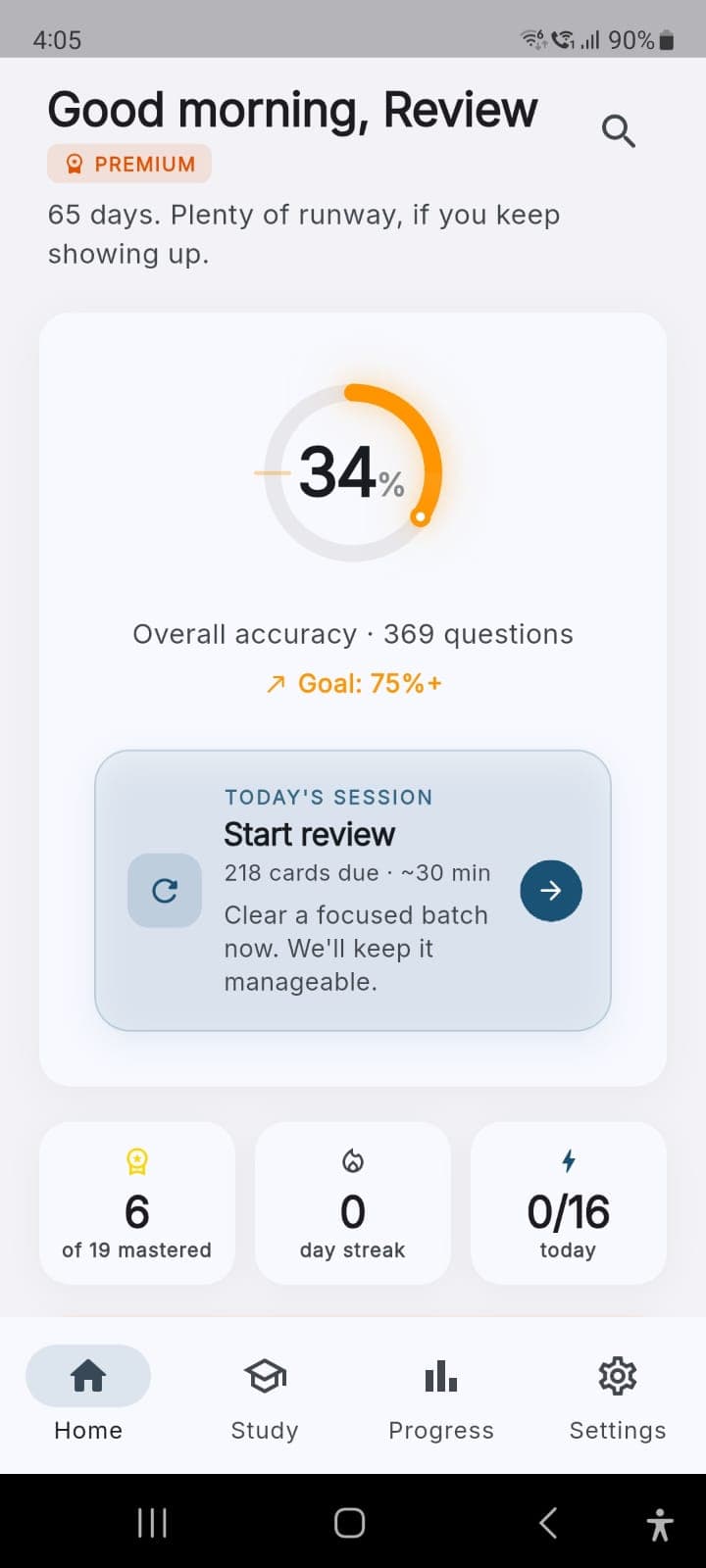
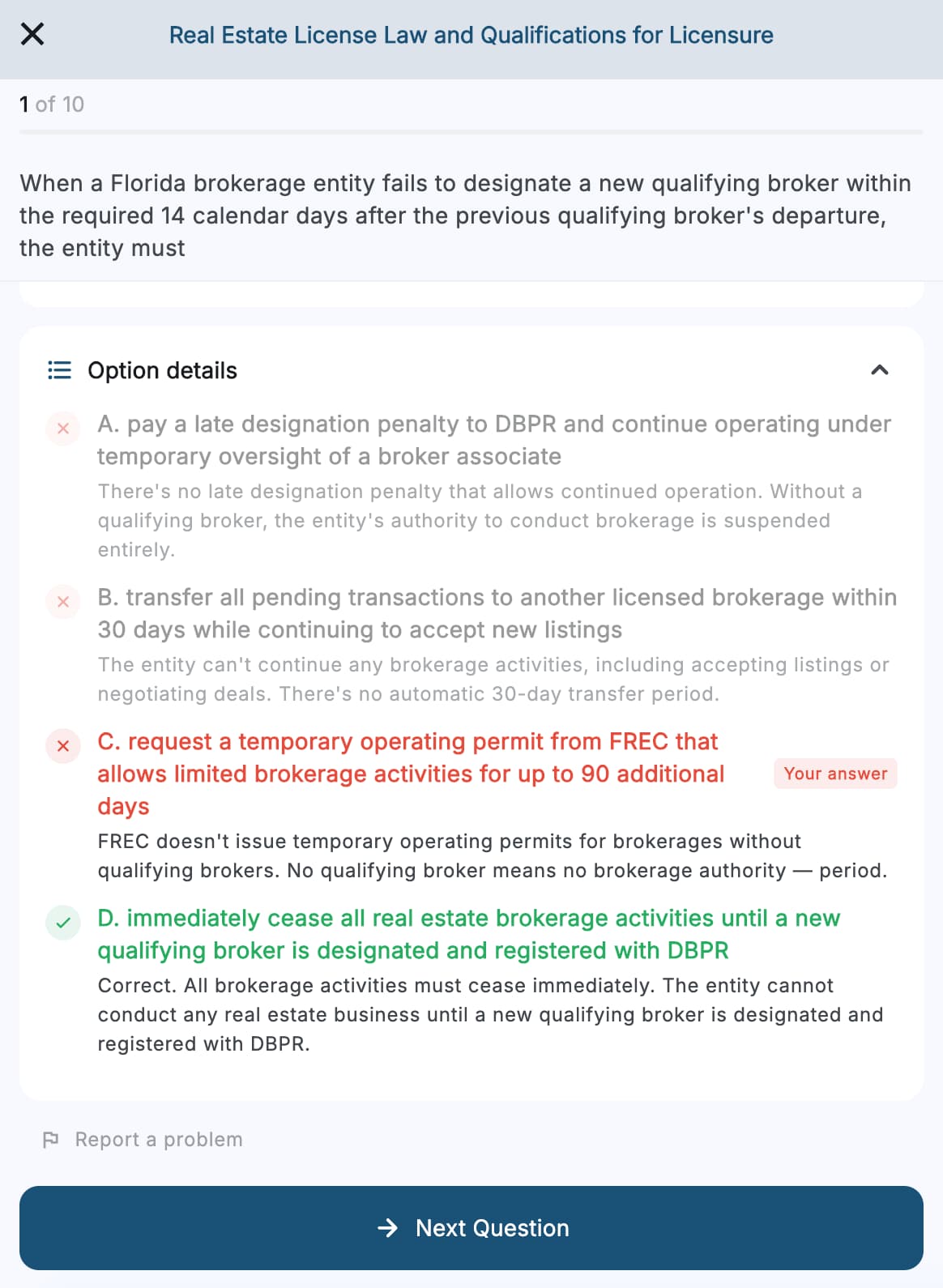
Try a quick Florida question set, check whether your readiness is stable, then use Pass Florida for the full 1,142-question bank, 19-topic diagnostic, Weak Area Blitz, Math Coach, and timed exam-style practice for one $39.99 purchase. No subscription. No copied exam questions.
Methodology
This guide was built for Florida sales associate exam candidates retaking the exam after a long break from studying or testing. It anchors the eligibility framework to the DBPR RE 1 Sales Associate Application's two-year exam-appearance window and the DBPR Real Estate Sales Associate Requirements' two-year validity for FREC-approved 63-hour pre-license course completion. It anchors stale-score-report guidance to the DBPR Sales Associate Candidate Information Booklet's exam-review rules (request within 21 days from the exam date; review only the most recent exam; review only incorrectly answered questions). It anchors Pearson VUE scheduling cautions to the current Florida Real Estate and Appraisers licensing page (physical test-center delivery, one-calendar-day appointment availability subject to seats, two-full-calendar-day cancellation/rescheduling rule, and customer-service override for retakes within 21 days of an exam review). It anchors the score-repair priority order to the current DBPR Sales Associate Candidate Information Booklet (CIB) topic weights (Brokerage Activities and Procedures 12%, Real Estate Contracts 12%, Residential Mortgages 9%, Property Rights 8%, Real Estate Appraisal 8%, Authorized Relationships 7%, Titles 7%, License Law 6%, Computations 6%) and the pass-rate context from the March 2026 Florida Real Estate Commission (FREC) monthly Division Report (approximately 51% first-time pass rate, approximately 31% repeater pass rate).
The Long-Break Status Audit, Long-Break Rebuild Plan, 5-Step framework (Status check, Diagnostic reset, Heavy-topic repair, Math reset, Stamina rebuild), 21-Day Plan, Pearson VUE Scheduling Trap table, Fast Decision triage table, and 7-mistake honest-failure diagnostic are Pass Florida observational coaching pedagogy and are not DBPR, FREC, or Pearson VUE process documents.
Pass Florida is not affiliated with the Department of Business and Professional Regulation (DBPR), the Florida Real Estate Commission (FREC), Pearson VUE, or any pre-license course provider, and Pass Florida does not guarantee passage of any state exam. Pass Florida does not replace the FREC-approved 63-hour pre-license course, DBPR application steps, Pearson VUE scheduling rules, fingerprinting, post-licensing, continuing education, or consultation with a qualified licensed professional. Its role is targeted practice with Florida-specific exam-style questions, not legal, tax, brokerage, lending, licensing, or DBPR-application guidance.
Long-break eligibility status (the DBPR application two-year clock and the 63-hour course two-year validity), old score-report usefulness, exam-review availability, and Pearson VUE appointment timing should be verified against the candidate's own DBPR account and current Pearson VUE page before any scheduling decision. The 80%-with-no-major-topic-below-65% readiness threshold referenced in this guide is a practical planning benchmark, not a DBPR-published readiness rule and not a guarantee of any specific Pearson VUE outcome.
Official sources are listed below. Requirements, policies, exam outlines, content weights, application timing rules, course-validity rules, and pass-rate distributions can change, so verify current details with the official source before making a real-world decision.
Product note
Pass Florida publishes this guide and offers the exam-prep app linked on this page. Pass Florida is not affiliated with DBPR, FREC, Pearson VUE, or any pre-license course provider, and Pass Florida does not guarantee passage of any state exam.
Sources
- DBPR Sales Associate Candidate Information Booklet PDF
- DBPR RE 1 Sales Associate Application PDF
- DBPR Real Estate Sales Associate Requirements PDF
- DBPR Candidate Information Booklets index
- March 2026 FREC Division Report PDF
- Florida Real Estate Commission monthly Division Reports
- F.A.C. Chapter 61J2, Florida Real Estate Commission
- F.S. Chapter 475, Real Estate Brokers, Sales Associates, Schools, and Appraisers, Florida Senate
- Pearson VUE Florida Real Estate and Appraisers Licensing Exams
- Pearson VUE Florida real estate candidate fact sheet PDF
This post is exam preparation content for the Florida Real Estate Sales Associate exam. It is not legal, tax, financial, lending, appraisal, brokerage, insurance, title, closing, career, DBPR-application, testing-accommodations, or professional advice. Pass Florida is not affiliated with the Department of Business and Professional Regulation (DBPR), the Florida Real Estate Commission (FREC), Pearson VUE, or any pre-license course provider, and Pass Florida does not guarantee passage of any state exam. Long-break eligibility status (the DBPR application two-year clock and the 63-hour course two-year validity), old score-report usefulness, exam-review availability, and Pearson VUE appointment timing should be verified against the candidate's own DBPR account and current Pearson VUE page before any scheduling decision. The 80%-with-no-major-topic-below-65% readiness threshold is a planning benchmark, not a DBPR rule and not a guarantee of any specific Pearson VUE outcome. For real-world decisions, verify current requirements with the official source or consult a qualified licensed Florida professional.