QUICK ANSWER
Passing the Florida real estate exam on your first try is a routine, not luck. About half of first-time takers do not pass, and the ones who do tend to follow the same sequence: diagnose your weak areas early, study by exam weight instead of front to back, practice a little every day with spaced repetition, drill the math from week one, simulate full timed exams weekly, and only book the real exam once your timed practice scores clear the line with no weak topic left behind. This page lays out that routine step by step and a week-by-week cadence you can follow.
EXAM PREP ONLY
This is Florida sales associate exam-prep guidance. The routine and readiness checkpoints are Pass Florida study frameworks based on common first-time-pass patterns, not official requirements, and they do not guarantee any result.
Most people who fail the Florida real estate exam on the first try did not fail because the material was too hard. They failed because their preparation was unstructured: rereading the textbook, drilling questions they already knew, skipping the math, and booking the exam before they were ready.
Recent FREC monthly reports put the first-time pass rate in the high 40s to low 50s, so roughly half of first-timers do not pass. The pass-rate breakdown covers the data. The good news is that the gap between passing and failing on the first attempt is mostly process, and process is something you control.
This is the routine first-time passers tend to follow. It is not a secret method. It is a disciplined sequence: diagnose, study by weight, drill daily, simulate, fix weak areas, then book. Follow it and a clean first attempt becomes the likely outcome, not a coin flip.
For the full instructional breakdown of every phase, pair this with how to pass the Florida real estate exam. This page is the first-try routine that sits on top of it.
What this guide covers
- Why first-timers fail, and how the routine avoids it
- The first-try routine, step by step
- A week-by-week cadence
- The readiness gate: when to book
- Exam-day execution
- Frequently Asked Questions
Why first-timers fail, and how the routine avoids it
Most first-time failures trace to four fixable habits: studying by recognition instead of recall, leaving math for the end, using generic national prep, and booking before timed scores are ready.
Before the routine, understand what it is designed to prevent. First-time failures cluster around four patterns:
- Recognition instead of recall. Rereading notes and re-taking the same questions feels productive, but it trains you to recognize answers, not retrieve them cold. The exam hides the answer until you commit. The routine fixes this with retrieval practice and fresh questions.
- Leaving math for the end. Math is one of the most improvable parts of the exam, but only if you start early. Cramming formulas the night before fails. The routine drills math from week one.
- Generic national prep. Much of the exam is Florida law: Chapter 475, FREC rules, escrow timelines, doc stamps, homestead. National prep that does not mention Florida leaves you exposed. The routine uses Florida-specific practice.
- Booking too early. Scheduling the exam before your timed scores are ready turns a first attempt into a coin flip. The routine sets a readiness gate and holds to it.
The pass-rate analysis and why the real exam feels harder than practice tests go deeper on these failure modes. The routine below is built to design them out.
The first-try routine, step by step
Diagnose weak areas, study by exam weight, practice daily with spaced repetition, drill math early, simulate timed exams weekly, fix weak areas, then book once you clear the readiness gate.
This is the core sequence. Each step feeds the next.
1. Diagnose before you study
Start with a diagnostic so you study from data, not guesswork. A short free diagnostic question or the free timed practice exam shows which of the 19 content areas cost you the most points. You cannot fix what you have not measured.
2. Study by exam weight, not front to back
The 19 content areas are not equal. Brokerage activities and contracts alone are nearly a quarter of the exam, while planning and zoning is 1%. Spend your time in proportion. The question bank by topic maps the blueprint weights so you can see where the points actually live, and the 19-topic guide shows the full breakdown.
3. Practice a little every day
Consistency beats cramming. Short daily sessions that reuse your misses move your score further than occasional long sittings, because spaced repetition moves facts into durable memory. The daily practice routine covers how many questions to do a day and how to run the spaced-repetition loop. This is the engine of the whole routine.
4. Drill the math from week one
Do not save math for the end. Work a few math problems every week from the start, so the formulas are automatic by exam day. The math practice questions and answers give you a worked set across all the tested calculation types, and the closing-math cluster (buyer funds at closing, seller net, doc stamps) handles the debit-credit questions candidates miss most.
5. Simulate a full timed exam weekly
Once a week, take a timed set under exam conditions: clock running, answers hidden, mixed topics. This rehearses pacing and stamina, which are separate skills from knowing the content. The free practice questions and the timed practice exam are built for this checkpoint.
6. Fix weak areas, then re-test
After each timed simulation, read the topic breakdown and drill only your weakest areas. Then re-test those areas to confirm the gap is closed, not just reviewed once. This targeting is what makes the routine efficient.
7. Book once you clear the readiness gate
Do not schedule the real exam by the calendar. Schedule it by your scores. The readiness gate below is the rule.
RUN THE ROUTINE
Diagnose, drill, and simulate in one place.
Start with the diagnostic, practice the weakest Florida topics, and use timed mixed sets to prove the improvement before test day.
A week-by-week cadence
A four-week version runs diagnose and base in week one, heavy topics in week two, weak-area repair in week three, and timed simulation and the readiness gate in week four.
The routine fits any runway. Here is a four-week version. Stretch it to six or eight weeks if you have time, or compress it using the 30-day study plan if your date is set.
| Week | Focus | Daily habit |
|---|---|---|
| 1 | Diagnose, then build a base across all 19 areas | 20 to 30 questions, all areas, review every miss |
| 2 | Heavy topics first: brokerage, contracts, mortgages, property, appraisal | 30 to 40 questions weighted to heavy areas, plus math |
| 3 | Repair: drill your weakest areas, re-test until they hold | 30 to 50 questions on weak areas, one timed set |
| 4 | Simulate full timed exams, fix the last gaps, clear the gate | 40 to 60 questions, two full timed simulations |
The constant across every week is the daily session. The weekly timed simulation is what tells you whether the daily work is transferring.
The readiness gate: when to book
Book the real exam only after you score about 80% or higher on full timed practice exams with no single content area below 65%.
This is the single rule that protects a first attempt. Do not book until you can clear it on fresh, timed, full-length practice:
- About 80% or higher overall. The passing line is 75 out of 100, and you want a cushion for exam-day nerves and a few unfamiliar questions. Aiming for exactly 75 leaves no room for error.
- No content area below about 65%. A strong average can hide one weak cluster that the real exam will find. Confirm every area is at least solid before you book.
- On fresh questions, under time. A high score on a question set you have seen before measures memory of those questions, not readiness. The gate only counts on new, timed practice.
When you clear that bar consistently, book the exam. Confidence at that point is earned, not hoped for. The retake fee is $36.75 if it comes to that, but the routine is designed so it does not.
Exam-day execution
Use a two-pass strategy, flag and move past hard questions, watch for EXCEPT and NOT wording, and trust the preparation instead of second-guessing.
The routine gets you ready. Exam day is about executing, not learning. A few rules:
- Two passes. Answer everything you know on the first pass, flagging anything that takes more than a minute. Return to the flagged questions on the second pass with the clock pressure off the rest of the test.
- Flag and move. One hard question is worth the same as one easy question. Do not let a single stem burn five minutes.
- Read the wording. Watch for EXCEPT, NOT, LEAST, and BEST. These reverse what the question is asking and are a top source of avoidable misses.
- Trust the preparation. If you cleared the readiness gate, your first instinct is usually right. Change an answer only when you have a concrete reason, not a feeling.
For the full exam-day walkthrough, see how to pass the Florida real estate exam.
Ready to run the first-try routine?
Start with a free diagnostic question, build the daily habit, simulate timed exams, and book once you clear the readiness gate.
A clean first attempt is the payoff of a boring, consistent routine. Start it today, not the week before your exam.
FIRST-TRY ROUTINE
Build the routine on a real Florida question bank.
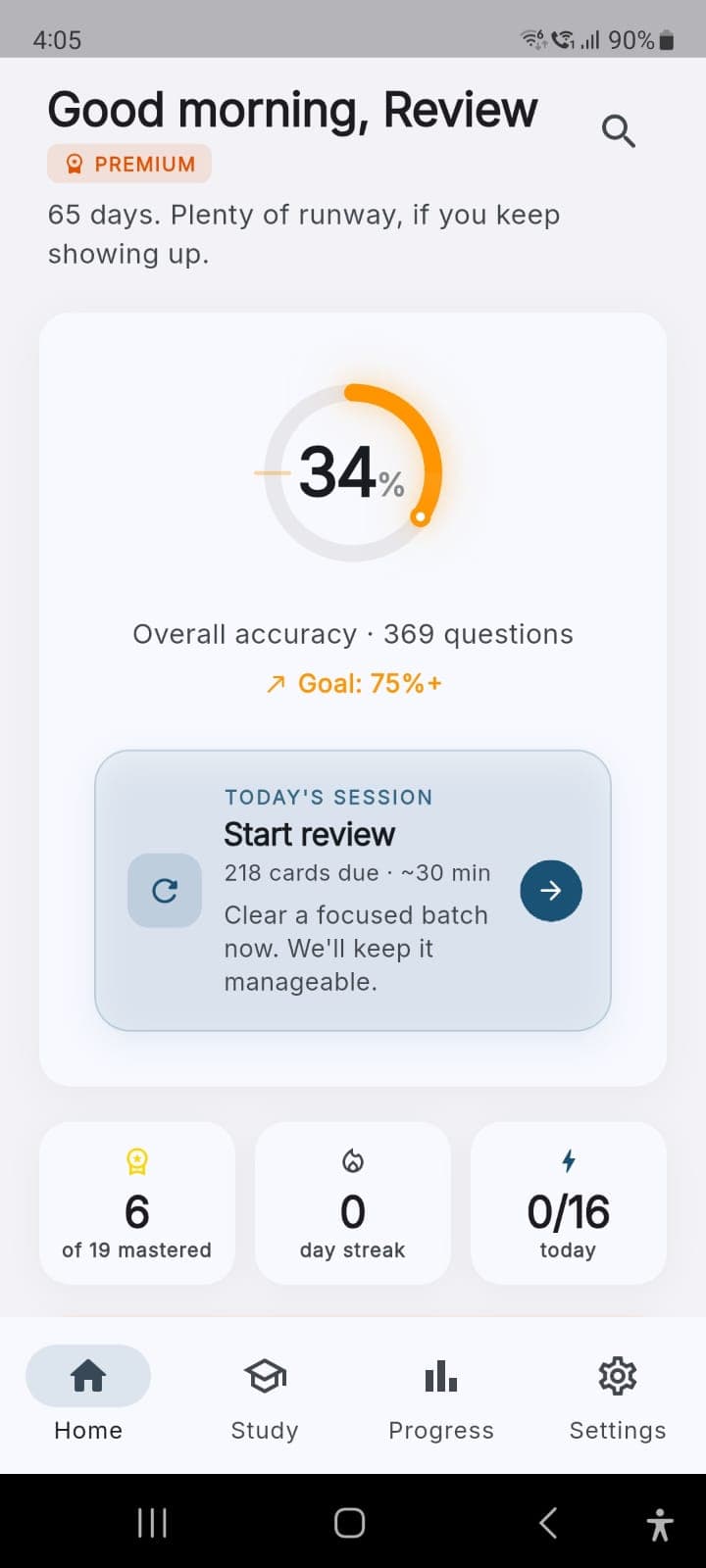
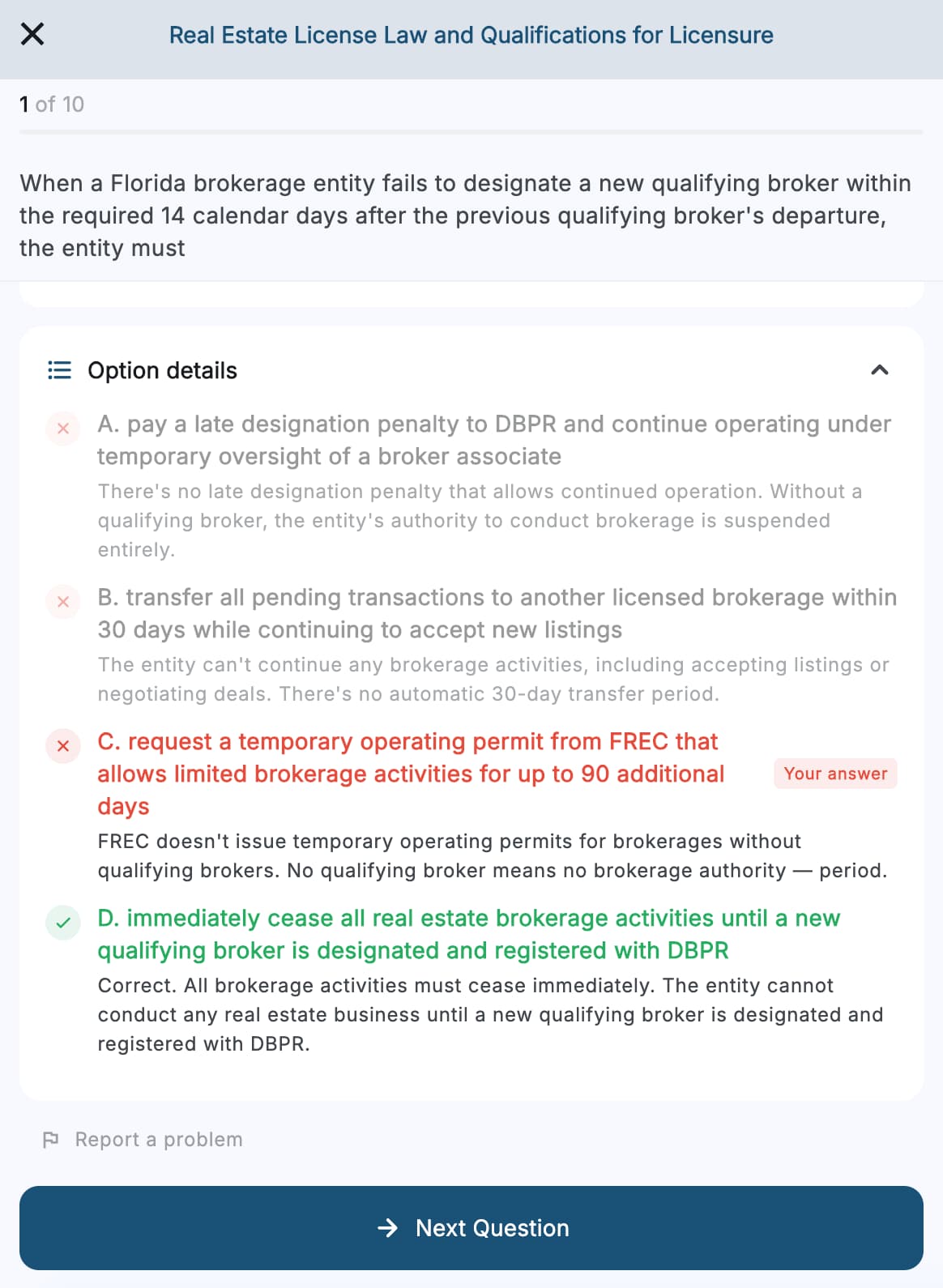
Start with a free question, take the free timed practice exam to see where you stand, then download Pass Florida for the full 1,142-question bank, the 19-topic diagnostic, Weak Area Blitz, Quick Review spaced repetition, Math Coach, and a 100-question Exam Style mode for one $39.99 purchase. No subscription. No copied exam questions.
Try a free question Take the timed practice exam Download Pass Florida
Frequently Asked Questions
What percentage of people pass the Florida real estate exam on the first try?
Recent FREC monthly Division Reports put the first-time pass rate in the high 40s to low 50s, so roughly half of first-time takers pass. Retaker pass rates are lower. The pass-rate guide tracks the monthly figures and what they mean for your preparation.
How long does it take to prepare to pass on the first try?
Most candidates need several weeks of consistent daily practice, not a few crammed days. A four-week routine works if you practice daily and simulate timed exams; a longer runway is more forgiving. The right length depends on your starting knowledge and how much time you can give it each day.
What is the most common reason people fail the first time?
Booking before they are ready, and preparing by recognition instead of recall. Rereading notes and re-taking familiar questions feels productive but does not build the cold retrieval the exam demands. The routine fixes both with retrieval practice and a readiness gate.
Should I take the exam if I am scoring around 75% on practice?
Not yet. Aim for about 80% or higher on fresh, full-length timed practice with no content area below about 65% before you book. A practice score right at 75 leaves no cushion for nerves or a few unfamiliar questions on test day.
Do I really need to study the math to pass on the first try?
Yes. Math is one of the most improvable areas, but only if you start early. Work a few problems every week from the start so the formulas are automatic. The math practice questions cover every tested calculation type.
Is passing on the first try realistic if I am bad at tests?
Yes, because the routine is built on consistency, not test-taking talent. Daily practice, timed simulation, and a readiness gate compensate for nerves. The candidates who pass first are usually the ones who prepared in the exam's format, not the ones who are naturally good at tests.
Methodology
The first-time pass-rate context (high 40s to low 50s) reflects recent FREC Division of Real Estate monthly Division Reports as compiled in the Pass Florida pass-rate guide; monthly figures change, so verify the current report before relying on a specific number. The first-try routine, the week-by-week cadence, and the readiness gate (about 80% on timed practice, no area below about 65%) are Pass Florida study frameworks based on common first-time-pass patterns and retrieval-practice principles. They are study guidance, not official DBPR requirements, and they do not guarantee passage.
Product note
Pass Florida publishes this guide and offers the exam-prep app linked on this page. Pass Florida is independent exam preparation, not a DBPR-approved 63-hour pre-license course, post-license course, or Pearson VUE scheduling service. It does not provide licensing credit and does not guarantee passage.
Sources
- DBPR Florida Real Estate Sales Associate Candidate Information Booklet
- Pearson VUE Florida Real Estate testing page
- Florida real estate exam pass rate (FREC Division Report figures)
This post is exam preparation content for the Florida Real Estate Sales Associate exam. It is not legal, tax, financial, lending, appraisal, brokerage, insurance, title, closing, or professional advice. For real-world decisions, verify current requirements with the official source or consult a qualified licensed Florida professional.