VERIFY BEFORE RELYING
This guide compares self-paced and livestream delivery formats for the Florida 63-hour sales associate pre-licensure course. It is course-selection methodology only, not legal advice and not a Department of Business and Professional Regulation (DBPR) determination. F.A.C. 61J2-3.008 controls the 63-hour Course I requirement (consisting of 63 hours of 50 minutes each, inclusive of examination), classroom delivery, live streaming and video conferencing delivery while students are in attendance, distance education requirements, and the end-of-course examination rules (70%-or-higher passing grade, 30-day minimum retake wait after failure, one retake per year maximum). F.A.C. 61J2-3.015 controls notices of satisfactory course completion and the certificate handling rules. F.S. 475.17 controls qualifications for licensure and the 2-year validity of the course completion certificate. The 5-question Self-Discipline Audit, provider-question checklist, format-fit scorecard, provider red-flag table, decide-before-paying rule, and after-course handoff steps are Pass Florida coaching pedagogy, not DBPR or FREC process documents. Verify your specific course requirements against the current DBPR Real Estate Associate Requirements for Licensure, the current F.A.C. 61J2-3.008, and your chosen provider's enrollment terms before paying.
QUICK ANSWER
Self-paced works best for candidates who already finish unsupervised work, protect calendar time, and add separate exam practice after the course. Livestream works best for candidates who need fixed class times, live questions, and external accountability to finish the 63-hour requirement before state exam prep.
WHO THIS GUIDE IS FOR
Florida sales associate candidates choosing between self-paced (asynchronous online) and livestream (synchronous online) delivery formats for the 63-hour pre-licensure course. Useful whether you are 30+ days before enrollment and comparing formats, mid-shop and triaging providers, or post-course-final-fail and deciding whether to switch formats for a repeat. Pair with the 63-hour course online vs in-person guide for the broader format comparison, the best Florida pre-license course guide for provider-level comparison, the course final vs state exam guide for the post-course handoff, the working full-time study guide if your schedule constrains the format choice, and the standard licensing path guide for the full process. Not legal advice and not a DBPR determination.
What this guide covers
- Official source map
- The Discipline Before Delivery Rule
- Self-paced vs livestream in one table
- Format fit scorecard
- What Florida allows under F.A.C. 61J2-3.008
- The Florida mechanics most students miss
- Provider red flags before you enroll
- The Self-Discipline Audit
- Can you finish self-paced in two weeks?
- When self-paced is the better fit
- When livestream is the better fit
- Course final retakes are not a small detail
- How to decide before paying
- What to do after either course format
- Exam-style question
- What NOT to do
- Related course and exam concepts
- Frequently asked questions
Official Source Map
Use F.A.C. 61J2 rules and DBPR sources for the actual course requirements. Use the format-fit pedagogy in this guide as planning methodology.
| Claim in this guide | Primary source | Why it matters |
|---|---|---|
| Sales associate Course I is 63 hours of 50 minutes each, inclusive of examination | F.A.C. 61J2-3.008 | The structural baseline for both self-paced and livestream formats |
| Distance education must be interactive and provide registration, evaluation, monitoring, verification of pre-license education, and identity verification | F.A.C. 61J2-3.008 | Florida distance education is not a loose pile of videos; this rule frames what self-paced providers must do |
| Live streaming and video conferencing while students are in attendance count within classroom delivery language | F.A.C. 61J2-3.008 | Livestream is a regulatory delivery method, not a marketing label |
| Course final passing grade is 70% or higher | F.A.C. 61J2-3.008 | The hinge between "I took the class" and "I completed the education requirement" |
| Students who fail the end-of-course exam must wait at least 30 days from the original exam date to retest | F.A.C. 61J2-3.008 | The single most consequential rule for a rushed self-paced timeline |
| Within one year of the original exam, a student may retest a maximum of one time; otherwise, the student must repeat the course | F.A.C. 61J2-3.008 | A failed second attempt restarts the 63-hour requirement entirely |
| End-of-course examinations require objective timing controls and cannot use hint, back, or retry functions | F.A.C. 61J2-3.008 | Frames what a "proctored final" actually means under Florida rule |
| Applicants for initial licensure must provide the course completion certificate at the scheduled examination as proof of satisfactory completion | F.A.C. 61J2-3.015 | Certificate handling rules; the original goes to the student, the school keeps a copy |
| The FREC-approved pre-license course is valid for licensure purposes for two years after the course completion date | F.S. 475.17 | Defines the maximum gap between course completion and state exam |
| DBPR controls licensure requirements; Pearson VUE controls state exam scheduling | DBPR Real Estate Associate Requirements for Licensure, DBPR Real Estate FREC Educational Requirements, and Pearson VUE Florida Real Estate | The course is upstream of the state exam, not the state exam itself |
The Discipline Before Delivery Rule
Choose a Florida self-paced or livestream real estate course based on your completion habits, not convenience. Self-paced rewards internal discipline; livestream rewards candidates who need fixed class times and live accountability.
If every school sounds flexible, pause before choosing by convenience. The real choice is not which format looks easiest. It is which format you will finish without losing momentum before the Florida sales associate state exam.
The Discipline Before Delivery Rule is simple: choose the format based on how you actually finish hard things, not how you wish you studied.
Self-paced and livestream can both be legitimate delivery formats when the course is properly approved. The format is only the delivery system. The outcome depends on whether you finish the 63-hour course, pass the course final, keep the certificate fresh, and then shift into Florida sales associate exam practice.
This topic overlaps with the broader Florida 63-hour course online vs in-person decision, but the choice here is narrower. You are comparing two online-adjacent formats: asynchronous self-paced study and synchronous livestream instruction.
On the Florida sales associate exam path, the hidden skill is not "which format is easier." It is matching your completion behavior to the amount of structure you need.
The best format is the one that reduces the failure point most likely to stop you. For one candidate, that failure point is attendance. For another, it is procrastination. For another, it is finishing the course but never converting the material into state-exam performance.
Self-Paced vs Livestream In One Table
Self-paced gives schedule control but creates procrastination risk. Livestream gives structure and live questions but creates attendance risk. Both still need separate Florida state-exam practice after the 63-hour course.
| Decision factor | Self-paced course | Livestream course |
|---|---|---|
| Schedule | You choose when to study | You attend at fixed live times |
| Accountability | Mostly internal | Built into the class calendar |
| Instructor access | Usually delayed or limited by provider support | Usually live during class sessions |
| Best fit | Disciplined candidates with irregular schedules | Candidates who finish better with appointments |
| Main risk | Procrastination and unfinished modules | Missing sessions or attending passively |
| Exam-prep gap | Still needs mixed state-exam practice | Still needs mixed state-exam practice |
The state exam does not care which course format you chose. It cares whether you can apply Florida rules, recognize traps, set up math, and answer exam-style questions under time.
The course gets you through the education requirement. Exam prep turns the material into test-day points.
Format Fit Scorecard
Self-paced usually fits irregular schedules and strong independent learners. Livestream usually fits candidates who need class appointments, real-time questions, and external pressure to keep moving.
Use this table as the fast answer before you compare provider brands.
| Your situation | Better first choice | Why |
|---|---|---|
| You work rotating shifts or have unpredictable childcare windows | Self-paced | Fixed livestream attendance becomes the weak point |
| You procrastinate until another person expects you to show up | Livestream | The class calendar creates external accountability |
| You learn well from reading, video, and practice without live explanation | Self-paced | You can convert flexibility into progress |
| You need to ask questions while the topic is being taught | Livestream | Real-time clarification reduces stuck points |
| You are trying to finish quickly and have 4-5 protected hours daily | Self-paced | The calendar can compress if the provider permits it and you retain the material |
| You failed or nearly failed the course final before | Livestream or highly supported self-paced | The risk is not access; the risk is understanding and retention |
| You need the lowest upfront price | Self-paced, but only after approval and retake terms are clear | Cheap only helps if you finish, pass the final, and understand what is excluded |
| You want the smoothest handoff to state exam practice | Either format plus a separate exam-practice plan | Course format and state-exam readiness are different problems |
If the table gives you two possible answers, choose the one that reduces your biggest known failure pattern. Do not optimize for the version of yourself who has a perfect week. Optimize for your normal week.
What Florida Allows
Florida allows approved 63-hour sales associate pre-license education through qualifying classroom, livestream or video conferencing, and distance education formats. Approval and course-final rules matter more than the marketing label.
DBPR's education materials say sales associate pre-licensure courses may be conducted in classroom and distance education environments. Rule 61J2-3.008 says Course I consists of 63 hours of 50 minutes each, inclusive of examination, and it describes classroom delivery, live streaming or video conferencing while students are in attendance, and distance education requirements.
For the candidate, the practical rule is this:
Verify approval before paying.
A course being online, self-paced, livestream, popular, cheap, or convenient does not automatically make it the right Florida sales associate pre-license course. Your first filter is whether it satisfies the Florida requirement for your situation. Your second filter is whether you will actually finish it.
The Florida Mechanics Most Students Miss
The biggest Florida course-format traps are approval status, attendance or participation tracking, identity verification, controlled course-final rules, certificate handling, and the 30-day retake wait after a failed course final.
This is where self-paced and livestream stop being generic internet-course labels.
Under Rule 61J2-3.008, live streaming or video conferencing counts inside the classroom-delivery language when the instructor is delivering hours live and students are in attendance. That means the live calendar is part of the product. If you miss sessions, ask the provider how make-up time works before you enroll.
Distance learning is not supposed to be a loose pile of videos. The rule says distance learning must be interactive, provide registration, evaluation, monitoring, and verification of pre-license education, and verify student identity for enrollment, course participation, and course completion. The school also has to make a course timeline available before enrollment.
For self-paced candidates, that can show up as time-on-task tracking, idle-time controls, module locks, knowledge checks, identity verification, or other provider systems. The point is not that every school uses the same software. The point is that Florida distance education is supposed to verify participation and completion, not just sell access to videos.
The course final is the part to ask about before paying. Rule 61J2-3.008 requires objective timing controls for end-of-course examinations and says the final cannot use aids such as hint, back, or retry functions. A provider may use ID checks, remote proctoring, a locked browser, webcam monitoring, or another approved process, but the exact method is provider-specific.
Ask these questions before enrolling:
| Florida-specific question | Why it matters |
|---|---|
| How does the course verify my identity and participation? | Distance education must document more than a login |
| Is the final exam remote-proctored, locked-browser, or otherwise controlled? | Provider rules can affect your setup, device, and test-day friction |
| What happens if I fail the course final? | The rule creates a 30-day wait and retake limits, and the provider may have its own retake fee or scheduling process |
| How is attendance tracked for livestream sessions? | Live hours matter when the course depends on attendance |
| When and how do I receive the completion certificate? | Provider handoff can affect how quickly you have valid proof for the state exam |
Provider Red Flags Before You Enroll
The provider page should make the course easier to understand, not more confusing. Treat these as reasons to slow down before paying.
| Red flag | Why it matters | What to ask |
|---|---|---|
| The page says "Florida approved" but does not clearly identify the 63-hour sales associate pre-license course | You may be looking at exam prep, CE, post-license, or a generic real estate course | "Is this the FREC-approved 63-hour Course I for Florida sales associate applicants?" |
| The final-exam retake policy is vague | Rule 61J2-3.008 creates a 30-day wait and one-retake limit; provider fees and scheduling can add friction | "What happens after a failed course final, and what fees apply?" |
| Livestream make-up rules are unclear | Missing live hours can affect completion | "How are attendance, make-up sessions, and missed class time handled?" |
| Self-paced access length is short | Candidates often underestimate how long the course plus final plus review takes | "How long do I have access, and what happens if access expires before completion?" |
| The package mixes course, exam prep, and tutoring without separating them | You need to know what satisfies DBPR education versus what is optional exam practice | "Which part is the approved course, and which part is supplemental practice?" |
| Refund terms are hard to find | Course access, started modules, books, proctoring, and bundles can affect refunds | "What is refundable after enrollment, login, shipped materials, or scheduled final exam?" |
Provider polish is not the same as provider fit. A strong enrollment page should tell you exactly what course you are buying, how attendance or participation is tracked, how the course final works, how retakes work, when you receive proof of completion, and what is not included.
The Self-Discipline Audit
Self-paced looks attractive because it feels flexible. That flexibility is real, and for the right candidate, it can be the best choice.
The problem is that flexibility can hide delay. No one is waiting for you at 6:00 p.m. No instructor is moving the room forward. No classmate notices when you disappear for three weeks.
Before choosing self-paced, answer these honestly:
| Audit question | Green signal | Red flag |
|---|---|---|
| Do you finish online work without reminders? | You have done it before | You usually need outside pressure |
| Can you block study time before the week starts? | You schedule sessions like appointments | You plan to "fit it in" later |
| Can you recover after missing a day? | You restart the next day | One missed day becomes a missed week |
| Do you understand without live explanation? | You can learn from reading, video, and examples | You need questions answered in real time |
| Will you add exam prep after the course? | You know the course final is not the state exam | You expect the course alone to carry you |
If you hit two or more red flags, self-paced may still work, but you need an external structure. That means a fixed weekly calendar, a study partner, a provider with strong instructor support, or choosing livestream instead.
As a planning range, provider pricing observed in May 2026 puts basic online self-paced 63-hour courses around $70 to $150, mid-tier online courses around $249 to $459, and classroom or live-school packages around $399 to $799 depending on bundle and provider. Use those as planning numbers only, then verify current pricing, access length, refund terms, retake fees, proctoring requirements, and whether exam prep is included before enrolling.
For the broader budget picture, use the Florida real estate license cost article before you compare course packages only by sticker price.
Can You Finish Self-Paced In Two Weeks?
Yes, but only if the math is honest.
The course itself is 63 hours. A two-week finish means roughly 4.5 hours of course time every day before review, provider friction, ID verification, final-exam scheduling, and life interruptions. That can work for a disciplined candidate with open evenings and a clean calendar. It usually fails for someone hoping to "catch up on weekends."
The course final retake rule is the bigger issue. If you fail the end-of-course exam, Rule 61J2-3.008 creates a 30-day minimum wait before retesting. That means a rushed two-week course plan can become a six-week licensing delay if you are moving fast without retaining the material.
Livestream has the opposite timeline problem. You may learn better with live teaching, but the calendar controls the pace. If the next livestream cohort takes four weeks, you cannot compress it into two just because your application is already moving.
When Self-Paced Is The Better Fit
Self-paced is usually the better fit when your schedule is the real obstacle. Shift work, parenting, school, travel, caregiving, or unpredictable work hours can make fixed livestream attendance unrealistic.
It also fits candidates who already have strong self-management habits. If you complete online training at work, keep your own deadlines, and can study without a room full of people, self-paced can protect your calendar and reduce friction.
The trap is thinking "flexible" means "easy." For exam purposes, self-paced creates a second job: you are both the student and the scheduler. If you do not schedule the work, the work does not happen.
A self-paced candidate should create three dates before enrolling: the course start date, the target course final date, and the first state-exam practice date. That third date matters because the course final and the Florida sales associate state exam are separate tests.
Use Florida real estate course final vs state exam if you need that distinction clear before you pick a course.
When Livestream Is The Better Fit
Livestream is usually the better fit when accountability is the real obstacle. A fixed class time can protect you from the vague promise that you will "study this weekend."
The strongest reason to choose livestream is not that it is automatically better instruction. It is that the calendar forces progress. You show up, the instructor teaches, questions happen in real time, and the group moves forward together.
The trap is passive attendance. A livestream course can feel productive because you were present for three hours, but presence is not the same as retention. If you do not review, answer practice questions, and repair misses, the state exam can still feel unfamiliar.
A livestream candidate should do a short review after every class day. Ten mixed Florida questions after class can reveal whether you learned the rule or only recognized the lecture.
Course Final Retakes Are Not A Small Detail
A failed Florida 63-hour course final can trigger a 30-day retake wait and one-retake-per-year limit under Rule 61J2-3.008. That makes rushed course completion risky.
The course final is the hinge between "I took the class" and "I completed the education requirement."
Rule 61J2-3.008 says a 70% or higher grade on the end-of-course examination constitutes satisfactory course completion. It also says students who fail the end-of-course exam must wait at least 30 days from the original exam date to retest. Within one year of the original exam, a student may retest a maximum of one time. Otherwise, the student must repeat the course before being eligible to take the end-of-course exam again.
This matters more for self-paced candidates than many realize. A fast module pace can create a false sense that the final is just another quiz. It is not. If you fail it, the retake rule can disrupt your DBPR timeline and delay the state exam.
Livestream candidates have a different version of the same risk. Attendance and make-up policies matter because Rule 61J2-3.008 ties the course final to completion of instruction and limits missed classroom instruction. If your work schedule makes live attendance shaky, choose carefully.
Rule 61J2-3.015 also matters after you pass the course final. It says applicants for initial licensure as a broker or sales associate must provide the course completion certificate at the scheduled examination as proof of satisfactory completion. The original certificate goes to the student, and the school keeps a copy for a minimum period.
Do not assume the state exam vendor already has everything just because your provider says you passed. Ask when the certificate is released, whether it is downloadable, whether there is any provider review period, and what name must match your exam record.
How To Decide Before Paying
Use this decision rule before paying.
Choose self-paced when schedule control is the biggest problem and you already finish independent work. Choose livestream when follow-through is the biggest problem and a live calendar will keep you moving.
Do not choose self-paced only because it is cheaper. A cheaper course that you do not finish is not cheaper. Do not choose livestream only because it feels safer. A live class that you attend passively still leaves you with exam-prep work.
For a wider provider comparison, use the best Florida pre-license real estate course article after you decide which format fits your behavior.
What To Do After Either Course Format
After either course format, save your completion proof, take a mixed Florida diagnostic, sort misses by topic and trap type, drill weak areas, and use timed practice before scheduling Pearson VUE.
After the 63-hour course, your question changes.
During the course, the question is: "Can I finish the requirement?"
After the course, the question is: "Can I answer mixed Florida exam-style questions without a chapter label?"
Self-paced students often need to add structure after the course because they are used to moving module by module. Livestream students often need to add application practice because class discussion can create familiarity without test-day transfer.
Your next steps after either format:
- Save your course completion proof and completion date.
- Take a mixed Florida-specific diagnostic.
- Sort misses by topic, wording, math setup, and careless reading.
- Drill weak topics before booking Pearson VUE.
- Use timed practice before trusting your readiness.
The official state exam passing score is 75 points or higher. A practice target around 80% is a planning cushion, not a DBPR rule.
AFTER THE 63-HOUR COURSE
The course gets you eligible. Practice makes the state exam feel familiar.
Verify the official licensing requirement first, then use Florida-specific practice only for the sales associate knowledge exam.
Exam-Style Question
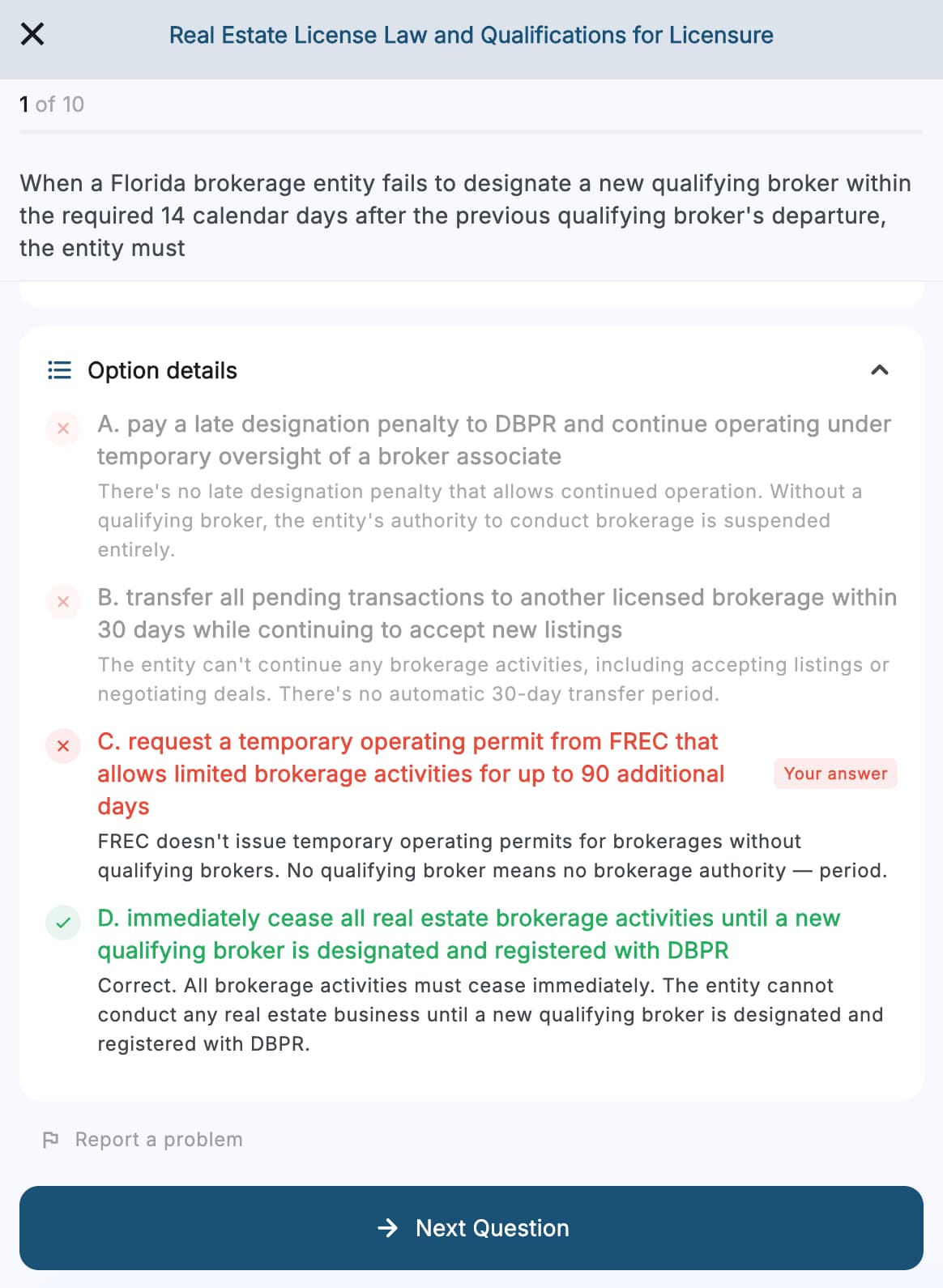
A Florida sales associate candidate takes a self-paced Course I and fails the end-of-course exam. The candidate wants to retest the next morning because the DBPR application is already moving. Which statement is most accurate for exam purposes?
- A. The candidate may retest immediately because self-paced courses move at the student's speed
- B. The candidate must wait at least 30 days before retesting the course final
- C. The candidate may skip the course final if the DBPR application is already submitted
- D. The candidate's livestream attendance history controls the retake rule for a self-paced final
Answer
Correct answer: B. Rule 61J2-3.008 says a student who fails the end-of-course examination must wait at least 30 days from the original exam date to retest. A is the self-paced myth. C confuses DBPR application progress with course completion. D mixes format facts that do not control this situation.
What Not To Do
Do not choose self-paced because you are imagining your most disciplined week. Choose it only if your normal week has room for protected study blocks.
Do not choose livestream because you want the course to make you pass the state exam. It may help you finish the course, but you still need Florida sales associate exam practice.
Do not compare only the sticker price. Compare provider approval, schedule fit, support access, course access length, course final rules, and whether exam prep is included.
Do not wait until after the course goes cold to start state-exam practice. The best handoff is course completion, then mixed Florida questions.
Related Course And Exam Concepts
Use the next guide based on the decision you are trying to make.
| Your question | Read next | Why it matters |
|---|---|---|
| You are still comparing online, livestream, and classroom formats | Florida 63-hour course online vs in-person | Gives the broader format map beyond the two online-adjacent options |
| You want provider-level buying criteria | Best Florida real estate pre-license course | Helps compare approval, access length, support, final rules, and exam-prep add-ons |
| You are confusing the course final with the state exam | Florida real estate course final vs state exam | Separates the provider exam from the Pearson VUE state exam |
| You work full-time or have limited weekly hours | Study for the Florida real estate exam while working full-time | Helps turn your format choice into a weekly study plan |
| You need the full license path | How to get a Florida real estate license | Places the 63-hour course inside application, fingerprints, exam, and broker activation |
| You are budgeting the whole path | Florida real estate license cost | Keeps course price from hiding application, fingerprint, exam, post-license, and startup costs |
FAQ
Is self-paced or livestream better for a Florida real estate course?
Neither is automatically better. Self-paced is better for disciplined candidates who need schedule control. Livestream is better for candidates who need fixed class times, live questions, and accountability.
Does a self-paced Florida real estate course count?
It can count if it is the correct FREC-approved Florida sales associate pre-license course and satisfies the applicable delivery requirements. Verify approval before enrolling.
Does a livestream Florida real estate course count?
It can count when offered properly by an approved provider. Rule 61J2-3.008 describes live streaming or video conferencing delivery while students are in attendance as part of classroom delivery language.
Is self-paced harder to finish?
It can be harder to finish for candidates who need outside structure. The issue is not intelligence. The issue is whether you can create deadlines, recover from missed study days, and keep moving without a live class calendar.
Does Florida require proctoring for self-paced course finals?
Florida's rule requires controls around distance education, identity verification, course participation, course completion, and timed end-of-course exams. The exact method can vary by provider, so ask whether the final uses remote proctoring, a locked browser, webcam monitoring, ID verification, or another approved process.
What happens if I fail the Florida 63-hour course final?
Rule 61J2-3.008 says students who fail the end-of-course exam must wait at least 30 days from the original exam date to retest. Within one year of the original exam, the student may retest a maximum of one time; otherwise, the course must be repeated before another final exam attempt.
How long do I have to take the state exam after finishing the course?
DBPR's sales associate requirements say the FREC-approved pre-license course is valid for licensure purposes for two years after the course completion date. Do not finish the course and let the certificate sit while your exam readiness fades.
Which format is better if I work full-time?
Self-paced often fits full-time workers with unpredictable schedules. Livestream can be better if your work schedule is stable and you need external accountability. For a broader study plan, use the working full-time exam study guide.
Should I pick the cheapest self-paced course?
Only if it is approved, you can finish it, and you understand what is included. A cheap course that stalls your timeline or leaves you without exam practice can cost more in retakes and delay.
Does Pass Florida replace the 63-hour course?
No. Pass Florida is exam preparation for the Florida sales associate exam. It does not replace the 63-hour pre-license course, DBPR processes, Pearson VUE scheduling, provider support, post-license education, or continuing education.
Ready to Pick the Format You Will Actually Finish?
The Florida 63-hour course is a single gate before the state exam path. Picking the right format is not about which one looks better. It is about which one you will finish.
Trace your honest completion habit first. Match the format to that habit. Then plan the handoff to state exam practice from day one of the course.
Start small today: try 5 Florida questions to see what state-exam practice looks like before you commit to the 63-hour course, check your readiness once you finish the course final, or download Pass Florida when you are ready to start state-exam practice in parallel with the course's final review.
Methodology
The Discipline Before Delivery Rule, the 5-question Self-Discipline Audit with the green-signal / red-flag matrix, the provider-question checklist, the format-fit scorecard, the provider red-flag table, the can-you-finish-self-paced-in-two-weeks math walk, the when-self-paced-fits and when-livestream-fits decision framing, the after-course handoff steps (save certificate / mixed Florida diagnostic / sort misses / drill weak topics / use timed practice), the embedded Exam-Style Question, the related-course-and-exam-concepts map, and the 4-pattern "What NOT to Do" list are independent Pass Florida coaching pedagogy derived from observed patterns in Florida candidate course-format decisions, not DBPR rules or FREC process documents. The Florida Real Estate Commission (FREC), which sits under DBPR, controls the broader licensing framework that the 63-hour course requirement sits inside. Pre-license provider pricing ($70-$799 range observed in May 2026) is observational and varies by provider, format, and bundle; verify current pricing directly with each provider before enrolling.
This article is course-selection methodology, not legal advice and not a DBPR determination. For your specific course-format decision, verify provider terms directly and check your DBPR application status against MyFloridaLicense.com before paying. Studying with Pass Florida or any other exam-prep tool does not guarantee passage of the state exam and does not replace the 63-hour pre-license course.
Product Note
Pass Florida publishes this guide and offers the exam-prep app linked on this page. Pass Florida is independent state-exam preparation, not a DBPR-approved 63-hour pre-license course, a tutoring service, a Pearson VUE scheduling tool, a licensing-activation service, a course-final proctoring service, a 14-hour CE provider, a 45-hour post-license course, a legal service, or a guarantee of passage.
Sources
- DBPR Real Estate Associate Requirements for Licensure
- DBPR Real Estate FREC Educational Requirements
- F.A.C. 61J2-3.008, Pre-licensing Education for Broker and Sales Associate Applicants
- F.A.C. 61J2-3.015, Notices of Satisfactory Course Completion
- F.A.C. Division 61J2, Florida Real Estate Commission
- F.S. 475.17, Qualifications for Practice
- F.S. Chapter 475, real estate brokers, sales associates, schools, and appraisers
- Pearson VUE Florida Real Estate and Appraisers licensing exams
This post is course-selection methodology content for Florida Real Estate Sales Associate candidates choosing between self-paced and livestream 63-hour pre-licensure course formats. It is not legal, tax, lending, appraisal, brokerage, title, insurance, closing, or professional advice and is not a DBPR determination. The Discipline Before Delivery Rule, Self-Discipline Audit, provider-question checklist, format-fit scorecard, provider red-flag table, decide-before-paying rule, after-course handoff steps, embedded Exam-Style Question, related-course-and-exam-concepts map, and "What NOT to Do" list are observational Pass Florida coaching pedagogy, not DBPR or FREC process documents. Pass Florida is an exam-prep app for the state exam; it does not replace the 63-hour pre-license course, DBPR processes, Pearson VUE scheduling, provider support, post-license education, or continuing education. For your specific course-format decision, verify your specific course requirements against the current DBPR Real Estate Associate Requirements for Licensure, the current F.A.C. 61J2-3.008, your chosen provider's enrollment terms, and your MyFloridaLicense.com application record before paying. Studying with Pass Florida or any other exam-prep tool does not guarantee passage of the state exam.