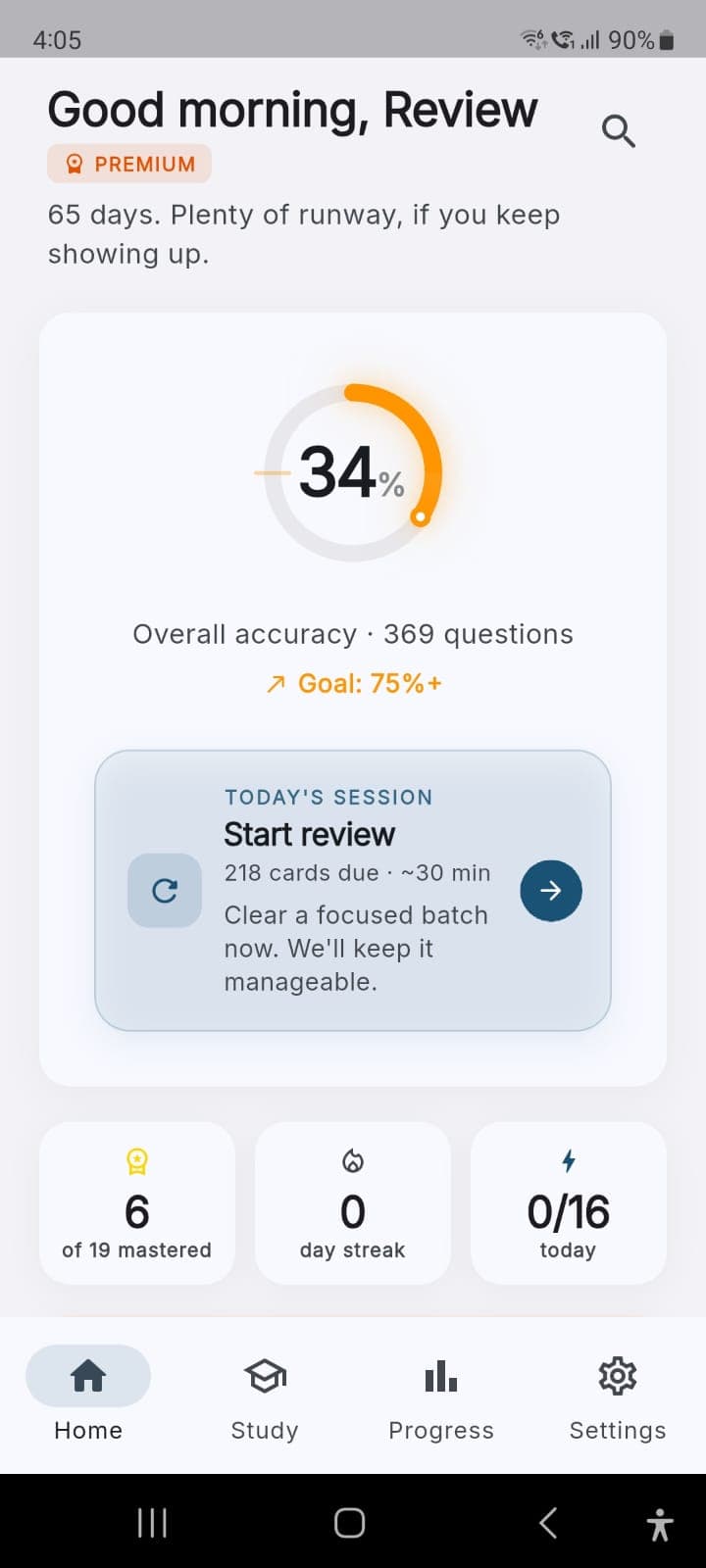
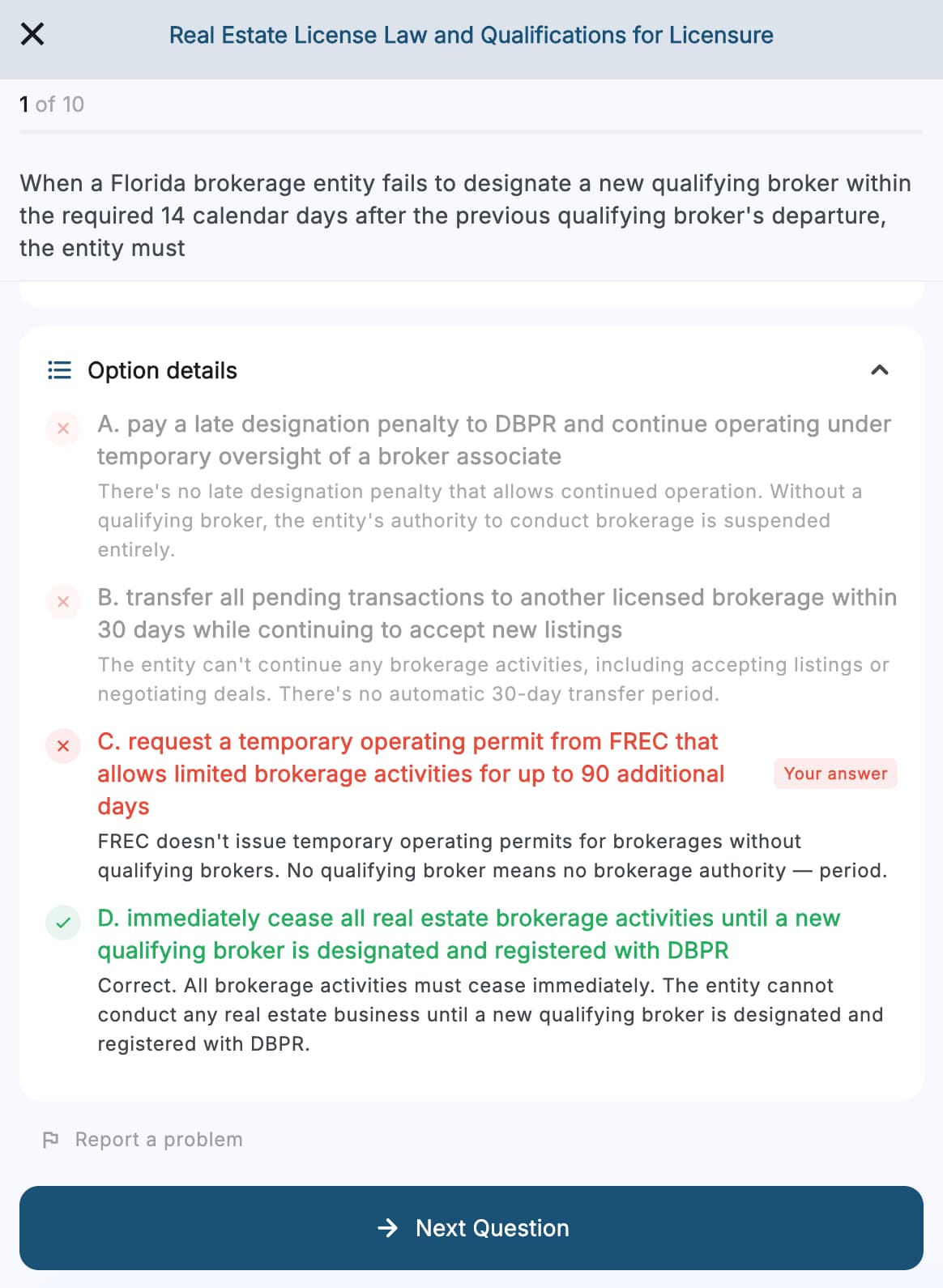
VERIFY BEFORE RELYING
This article is exam-prep content distinguishing the provider's 63-hour course final from the DBPR (Department of Business and Professional Regulation) state exam. F.A.C. (Florida Administrative Code) Rule 61J2-3.008 (course final 70% threshold + end-of-course examination requirements), the DBPR Candidate Information Booklet (CIB) 75-point state-exam passing score, the 100-question / 3.5-hour state exam format, Pearson VUE policies, and course-provider exam policies can change. Always verify the current rule against F.A.C. 61J2-3.008, the DBPR Candidate Information Booklet, and your course provider's current end-of-course policy before relying on any specific number in this article.
QUICK ANSWER
The Florida real estate course final and the DBPR state exam are two separate tests. The course final helps complete your 63-hour pre-license course. The state exam is the licensing exam you take through Pearson VUE after eligibility. Passing the course final does not mean you are ready for the state exam. The main trap is treating a course-completion score as a Pearson VUE readiness score.
What this guide covers
- The Two-Test Separation Rule
- Course final vs state exam
- Why the state exam feels different
- What passing the course final actually means
- The 70/75/80 handoff
- The bridge plan after the course final
- Common traps students fall for
- Exam-style question
- What to pair with this topic
- What not to do
- FAQ
The Two-Test Separation Rule
The course final is a course-completion gate. The Florida state real estate exam is a licensing-readiness gate. Passing one does not automatically answer the other.
Use The Two-Test Separation Rule:
Treat the course final as a completion gate. Treat the state exam as a readiness gate.
Do not let one score answer both questions.
The course final asks, "Did you satisfactorily complete the required course?"
The DBPR state exam asks, "Can you apply Florida real estate law, principles, practices, and math well enough to qualify for licensure?"
Those overlap, but they are not the same test.
For exam purposes, the hidden skill is separation. A strong candidate knows which gate they are facing, what that gate proves, and what it does not prove.
Course final vs state exam
The Florida course final is tied to your 63-hour provider course; the state exam is the DBPR/Pearson VUE licensing test with a 75-point passing score.
| Question | Course final | DBPR state exam |
|---|---|---|
| What is it? | The provider's end-of-course exam for the 63-hour pre-license course | The Florida Real Estate Sales Associate Examination |
| Who is connected to it? | Your approved school or course provider | DBPR and Pearson VUE |
| Main purpose | Satisfactory course completion | Licensure examination |
| Passing score | Rule 61J2-3.008 says 70% or higher constitutes satisfactory course completion | DBPR says 75 points or higher passes |
| What it proves | You completed the course requirement, assuming all provider and rule requirements are met | You passed the state licensing exam |
| What it does not prove | That you are ready for Pearson VUE | That you can skip course requirements unless an accepted exemption applies |
| Main study trap | Mistaking course familiarity for state exam readiness | Mistaking state exam anxiety for lack of knowledge |
That last row matters.
A candidate can pass the course final and still fail the state exam.
A candidate can feel nervous before the state exam and still be ready.
The difference is data.
Why the state exam feels different
The state exam feels different because it mixes topics without chapter labels, uses fresh fact patterns, and tests whether you can transfer course knowledge under timed pressure.
The course final may be difficult. Do not dismiss it.
Florida's course rules require an end-of-course exam, and the rule language includes application-oriented testing. So the right takeaway is not "course final easy, state exam hard."
The better takeaway is:
They are hard in different ways.
On the Florida sales associate exam, questions are mixed across content areas. A contract question can sit next to a mortgage question, then a brokerage relationship question, then a math question. You do not get a chapter label. You do not get a hint that says, "This is from yesterday's lesson."
That changes the reading skill.
| Skill | Course final version | State exam version |
|---|---|---|
| Recall | Recognize material from the course | Recognize the rule without chapter order |
| Application | Apply course concepts after instruction | Apply Florida rules in a fresh fact pattern |
| Timing | Provider-specific | 100 questions in 3.5 hours |
| Pressure | Passing the course | Moving toward licensure |
| Review habit | Check what you missed in the course | Diagnose weak topics, wording traps, and pacing |
The state exam often feels harder because the setup is less familiar, the answer choices are closer, and the stakes are higher.
What passing the course final actually means
Passing the course final is a real milestone.
It usually means you did the work required by the course provider, completed the course sequence, and earned the completion proof you need for the next part of the licensing path.
It does not mean you should automatically book Pearson VUE for tomorrow.
After the course final, ask three questions:
- Can I answer mixed Florida questions without knowing the chapter?
- Can I explain why the wrong answers are wrong?
- Can I score in a safe range under time?
If the answer is no, you are not starting over. You are moving from course mode into exam mode.
That is a different phase.
The 70/75/80 handoff
Use this handoff after the course final.
| Number | What it means | How to use it |
|---|---|---|
| 70% | Course final completion threshold under the course rule | This helps complete the course requirement |
| 75 | Official state exam passing score | This is the minimum score needed on the Florida sales associate exam |
| 80% | Pass Florida practice readiness target | This gives a cushion before Pearson VUE |
The 80% target is not a DBPR rule. It is an exam-prep planning rule.
Why use a higher practice target than the official passing score?
Because practice at home is usually calmer than Pearson VUE. You may read faster at home. You may recognize your practice bank. You may pause between questions. You may not feel the same pressure.
A thin 75% practice score can turn into a 72 on test day. An 80% practice score gives you more room for nerves, odd wording, and fatigue.
The bridge plan after the course final
After you pass the course final, do not reread the whole course from page one.
Build a bridge.
| Step | What to do | Why it works |
|---|---|---|
| 1 | Take a short mixed diagnostic | Finds weak areas after the course |
| 2 | Sort misses by topic | Prevents vague studying |
| 3 | Drill the weakest 3 topics | Raises score faster than reviewing everything equally |
| 4 | Add daily math setup practice | Protects points that depend on process |
| 5 | Practice EXCEPT and NOT wording | Fixes avoidable reading errors |
| 6 | Take a timed mixed set | Tests state-exam readiness, not course memory |
| 7 | Schedule only when scores are stable | Keeps emotion from driving the date |
A good bridge does not need to be dramatic.
It needs to be honest.
If your course final was 88%, but your mixed Florida practice is 63%, the course score is not lying. It is just answering a different question.
Common traps students fall for
Trap 1: "I passed the course final, so I am ready"
Maybe. Maybe not.
The course final is a completion signal. The state exam is a mixed, timed, licensing signal.
Repair step: take a fresh mixed practice set before scheduling Pearson VUE.
Trap 2: Studying only the way the course was taught
Courses usually teach in order. The state exam does not test in order.
If you only study chapter by chapter, a mixed exam can feel chaotic even when you know the material.
Repair step: after each focused topic session, do a small mixed set so your brain learns to switch topics.
Trap 3: Retaking familiar course questions
A rising score on familiar questions can feel good and still fail to measure readiness.
If you remember the wording, you may be testing memory of the question, not understanding of the rule.
Repair step: use fresh Florida-specific questions and review every answer choice.
Trap 4: Ignoring the certificate and ID side
Readiness is not only knowledge.
DBPR's candidate materials explain that the pre-license education completion certificate is an admission document at the test center. The state exam also has ID and test-center rules.
Repair step: separate paperwork readiness from score readiness. You need both.
Use the Florida real estate exam day guide before your appointment.
Trap 5: Thinking the state exam uses copied course questions
Do not study as if you are trying to memorize an item bank.
For exam purposes, your goal is transfer: see a new fact pattern, find the tested rule, eliminate the tempting wrong answers, and choose the best answer.
Repair step: explain the rule after each missed question in your own words.
AFTER THE COURSE FINAL
Turn course completion into state exam readiness.
Start with the diagnostic, practice the weakest Florida topics, and use timed mixed sets to prove the improvement before test day.
Exam-style question
A candidate passes the Florida 63-hour course final with a strong score. The next day, she asks whether she should schedule the DBPR state exam immediately. She has not taken a timed mixed practice exam yet. What is the best advice?
- A. Schedule immediately because the course final and state exam measure the same readiness
- B. Schedule immediately because the course final score replaces state exam preparation
- C. Take a fresh timed mixed practice set first, because the course final and state exam are separate gates
- D. Wait six months because passing the course final means the material will stay fresh
Answer
Correct answer: C. The controlling fact is that she passed the course final but has not measured state exam readiness. A and B confuse course completion with licensure exam readiness. D creates unnecessary delay and ignores knowledge decay.
What to pair with this topic
If you just passed the course final, pair this article with:
| Need | Better next resource |
|---|---|
| Understand the full exam structure | Florida real estate exam guide |
| Build a passing plan | How to pass the Florida real estate exam |
| Compare course format decisions | Florida 63-hour course online vs in-person |
| Check course certificate timing | Florida real estate course certificate expired |
| Understand why practice can mislead | Why the real exam feels harder than practice tests |
What not to do
Do not ask your course final score to predict everything.
Do not assume a hard course final means the state exam will be easy.
Do not assume an easy course final means the state exam will be easy.
Do not schedule Pearson VUE only because you are tired of studying.
Do not keep rereading the course if your real problem is application, timing, or trap wording.
Do not ignore paperwork. A valid course certificate, proper ID, and Pearson VUE logistics still matter.
FAQ
Is the Florida real estate course final the same as the state exam?
No. The course final is the end-of-course exam connected to your 63-hour pre-license course. The state exam is the Florida Real Estate Sales Associate Examination used for licensure.
If I pass the course final, can I take the state exam?
Passing the course final is part of completing the course requirement, but you also need DBPR eligibility, proper admission documents, and a Pearson VUE appointment. Verify your specific status with DBPR, Pearson VUE, and your provider.
Is the state exam harder than the course final?
It can feel harder because it is mixed, timed, closed book, and tied to licensure. The course final can also be challenging, but the state exam usually demands stronger transfer: applying rules to new exam-style questions without chapter labels.
What score do I need on the course final?
Rule 61J2-3.008 says a grade of 70% or higher on the Commission-prescribed end-of-course examination constitutes satisfactory course completion.
What score do I need on the Florida real estate state exam?
DBPR's candidate booklet says the sales associate examination is graded on 100 points, and a candidate who receives 75 points or higher has passed.
How soon should I take the state exam after the course final?
Soon enough that the material stays fresh, but not so soon that you skip readiness data. Take fresh mixed practice first. If your timed scores are stable around 80% and documents are in order, you have a stronger reason to schedule.
Should I study differently after passing the course final?
Yes. Move from course review to mixed exam practice. Focus on Florida-specific scenarios, trap wording, math setup, and timed sets.
Does Pass Florida replace the 63-hour course?
No. Pass Florida is exam prep only. It does not replace the 63-hour pre-license course, the course final, post-license education, continuing education, DBPR approval, or Pearson VUE scheduling.
Ready to bridge from course completion to state-exam readiness?
After the course final, use mixed Florida-specific practice, a readiness check, and timed review before you schedule Pearson VUE.
The candidates who pass the state exam after the course final consistently do one thing: they treat the course final as the end of one cycle, not the end of their preparation. A passing course-final score earns the certificate. Florida-specific mixed practice earns Pearson VUE.
Use the next practice set to prove what improved, not to repeat questions you already remember.
Take the free timed practice exam | Run the readiness calculator | Download Pass Florida
Methodology
This guide was written for Florida sales associate exam candidates distinguishing the provider's 63-hour course final from the DBPR state exam. The factual anchors come from primary sources: F.A.C. Rule 61J2-3.008 (70% pass threshold for the Commission-prescribed end-of-course examination + multiple-choice 4-answer-choice format + at least 70% application-oriented questions + at least 100 items / 2 items per instruction hour), the DBPR Real Estate Sales Associate Candidate Information Booklet (100-point scoring, 75-point passing score, 100-question state exam, and three-and-a-half-hour exam time), the DBPR Real Estate Associate Requirements for Licensure, and the Pearson VUE Florida DBPR Licensing Exams page.
The Two-Test Separation Rule, the course-final-vs-state-exam comparison framework, the skill-by-skill comparison table, the 70/75/80 handoff three-number framework, the 7-step bridge plan, the 5 traps with repair steps, the exam-style question with the four-choice trap pattern, and the what-not-to-do anti-pattern list are practical study patterns derived from common candidate mistakes, not DBPR, FREC, Pearson VUE, or course-provider rules. The 80% practice readiness target is a Pass Florida benchmark, not a DBPR rule.
This article does not promise a passing result on the Florida sales associate examination, does not promise course-final passage, and does not replace DBPR, FREC, Pearson VUE, your course provider, or qualified licensed Florida professional guidance. Outcomes depend on candidate preparation, current statutory and rule updates, and provider-specific exam policies.
Product note. Pass Florida publishes this guide and offers the exam-prep app linked on this page. We do not claim to use copied exam questions, promise passage, replace the 63-hour FREC-approved pre-license course, replace the provider's course final, or replace DBPR processes, FREC rule interpretation, Pearson VUE scheduling, course-provider records, or qualified licensed Florida professional guidance.
For the deeper course-final study loop (5-step practice plan, 7-day sprint, provider-questions matrix, 30-day rescue plan after a failed final), see the companion how to pass the Florida real estate course final exam guide.
Sources
- DBPR Real Estate Associate Requirements for Licensure
- DBPR Real Estate Sales Associate Candidate Information Booklet
- F.A.C. 61J2-3.008, Pre-licensing Education for Broker and Sales Associate Applicants
- Pearson VUE Florida DBPR Licensing Exams
This post is exam-prep content for Florida real estate sales associate candidates distinguishing the provider's 63-hour course final from the DBPR state exam. It summarizes the Two-Test Separation Rule, the 70/75/80 handoff framework, the 7-step bridge plan, and the five most common course-final-to-state-exam traps, and is not a guarantee of passing the exam, not legal advice, not licensing advice, and not a substitute for DBPR, FREC, Pearson VUE, the course provider, or a qualified licensed Florida professional. Verify any rule, score threshold, or provider exam policy against the primary source before relying on this article for a real licensing decision. Pass Florida is an educational study tool sold for one $39.99 purchase with no subscription.